
Pioneer VSX-519V-K: Connecting other video components
Connecting other video components: Pioneer VSX-519V-K
Table of contents
- IMPORTANT
- Information for users on collection and disposal of old equipment and used batteries
- Contents
- Chapter 1: Before you start
- Chapter 2: 5 minute guide
- Chapter 3: Connecting up
- Connecting up03 Analog audio cables Component video cables Digital audio cables About video outputs connection Video cables
- Connecting a TV and Blu-ray Disc player or DVD player
- Connecting the multichannel analog outputs
- Connecting a satellite receiver or other digital set-top box
- Connecting other audio components Connecting to the front panel audio mini jack
- Connecting other video components
- Using the component video jacks
- Connecting antennas
- Connecting the speakers
- Connecting up 03 Hints on speaker placement Speaker placement diagrams
- Connecting an IR receiver Plugging in the receiver
- Chapter 4: Controls and displays Front panel
- Operating range of remote control unit
- Display
- Controls and displays04
- Remote control
- Controls and displays04
- Controls and displays 04
- Chapter 5: Listening to your system Listening in surround sound Auto playback
- Listening in stereo
- Using Front Stage Surround Advance Using the Sound Retriever Using Stream Direct
- Using Phase Control
- Setting the Audio options Setting What it does Option(s)
- Setting What it does Option(s)
- Playing other sources Selecting the multichannel analog inputs Choosing the input signal Using the headphone
- Chapter 6: The System Setup menu Using the System Setup menu Manual speaker setup
- The System Setup menu06 Channel level Crossover network
- Speaker Distance The Input Assign menu
- Chapter 7: Using the MULTI-ZONE feature MULTI-ZONE listening
- Using the MULTI-ZONE feature 07 Using the MULTI-ZONE controls MULTI-ZONE remote controls
- Chapter 8 Using the tuner Listening to the radio Saving station presets
- Using the tuner 08 Naming preset stations
- An introduction to RDS Searching for RDS programs
- Displaying RDS information
- Chapter 9: Making recordings Making an audio or a video recording
- Chapter 10: Additional information Troubleshooting Problem Remedy
- Problem Remedy
- HDMI Symptom Remedy Important information regarding the HDMI connection
- Resetting the main unit Specifications
- Cleaning the unit
Connecting up 03
English
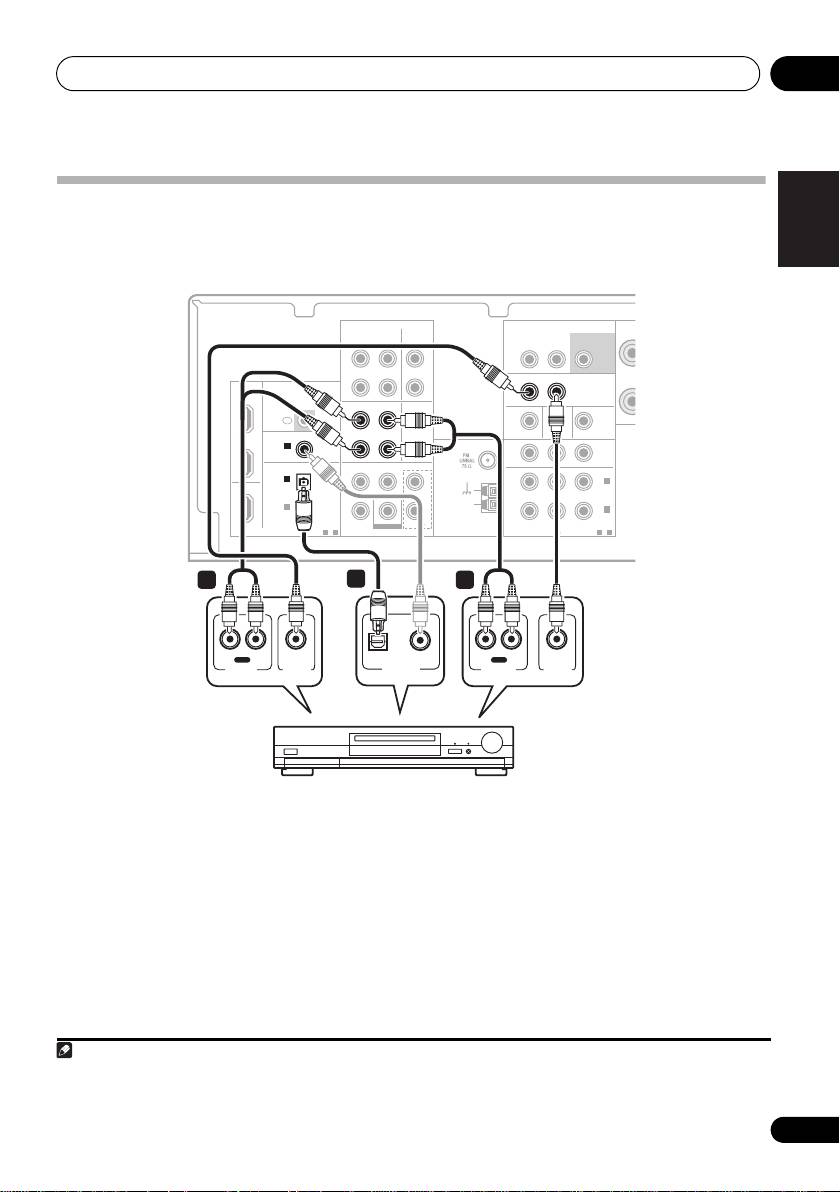
Connecting other video components
This receiver has audio/video inputs and outputs suitable for connecting analog or digital video
recorders, including VCRs and HDD/DVD recorders.
This receiver
Français
AUDIO
AUDIO
ZONE2 OUT
SUBWOOFER
R
OUT
CD-R/TAPE CD
IN IN
L R
PRE OUT
L
OUT
OUT
DVR/VCR VIDEO
DVR/VCR VIDEO
IN
IN
HDMI
R
BD/DVD
IN
IR
OUT
OUT
DVR/VCR TV/SAT
DVR/VCR
IN
IN
IN
IN
L
L
TV/SAT
COAXIAL
COAXIAL
ASSIGNABLE
MONITOR OUT BD/DVD IN TV/SAT IN
IN
IN 1
IN 1
ANTENNA
P
R
B
YP
R
R
(CD)
(CD)
OUT
OPTICAL
OPTICAL
CENTERSURROUND
FRONT
IN 2
IN 2
L
IN 2
OUT
(DVR/VCR)
(DVR/VCR)
(TV/SAT)
AM
IN 1
R
LOOP
IN 1
(CD-R/TAPE)
(BD/DVD)
Italiano
ASSIGNABLE
SUBWOOFER
BD/DVD IN
ASSIGNABLE
DIGITAL
DIGITAL
1
-
2
BD/DVD MULTI CH IN
COMPONENT VIDEO
1
-
2
2 1
3
Nederlands
RL
IN
REC
OPTICAL COAXIAL
RL
OUT
PLAY
AUDIO IN
VIDEO IN
DIGITAL OUT
AUDIO OUT
VIDEO OUT
Español
DVR, VCR, LD player, etc.
1 Connect a set of audio/video outputs on
2 Connect a set of audio/video inputs on
the recorder to the DVR/VCR AUDIO and
the recorder to the DVR/VCR AUDIO and
Deutsch
VIDEO inputs on this receiver.
VIDEO outputs on this receiver.
Use a stereo RCA phono cable for the audio
Use a stereo RCA phono cable for the audio
connection and a standard RCA video cable for
connection and a standard RCA video cable
the video connection.
for the video connection.
3 If your video component has a digital
audio output, connect it to a digital input on
this receiver.
The example shows a recorder connected to the
1
DIGITAL OPTICAL IN 2 (DVR/VCR)
input.
13
En
Note
VSX_519V_MY.book 13 ページ 2009年1月16日 金曜日 午後7時32分
1If your video component only has an coaxial digital output, you can connect it to the coaxial input on this receiver using an
coaxial cable. When you set up the receiver you’ll need to tell the receiver which input you connected the component to (see
Choosing the input signal on page 32).
