
Pioneer A-20-S: instruction
Class: Hi-Fi equipment
Type: Hi-Fi Component
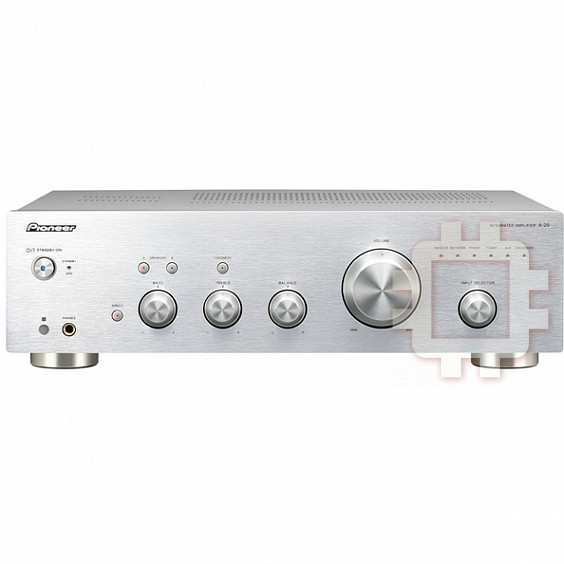
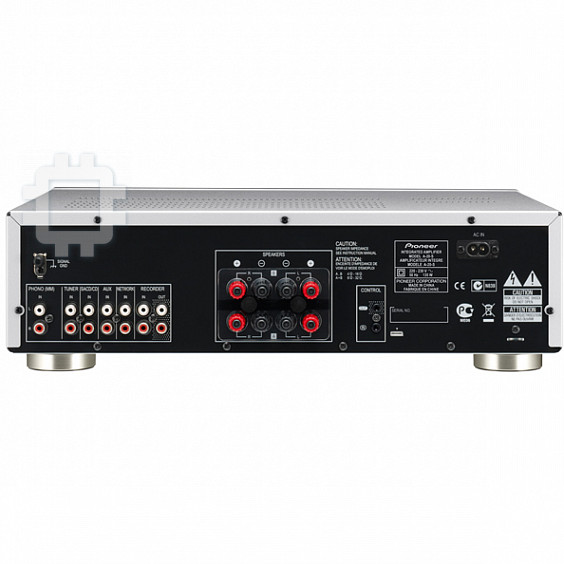
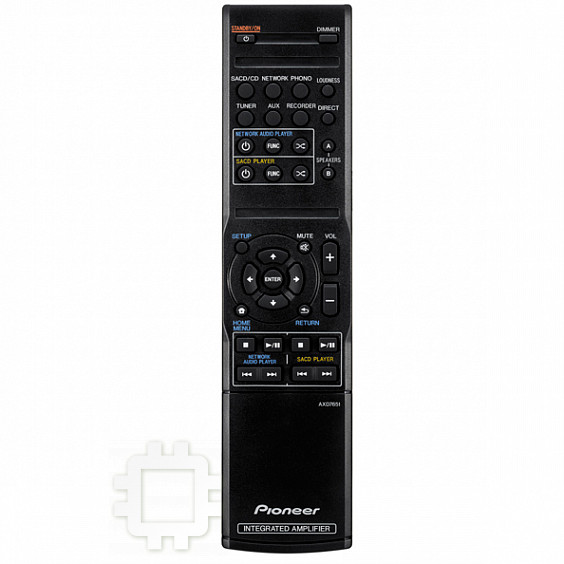
Manual for Pioneer A-20-S
Table of contents
A-
20
-K/-S
A-
30
-K/-S
A-
10
-K/-S
Integrated Amplifier | Amplificateur Intégré |
Eingebauter Verstärker | Amplificatore Integrato |
Geïntegreerde versterker | Amplificador integrado |
Operating Instructions | Mode d’emploi | Bedienungsanleitung |
Istruzioni per I’uso | Handleiding | Manual de instrucciones |
Инструкции по эксплуатации
ME06
A30_SYXE8_cover_anki.fm 1 ページ 2012年2月21日 火曜日 午後1時42分
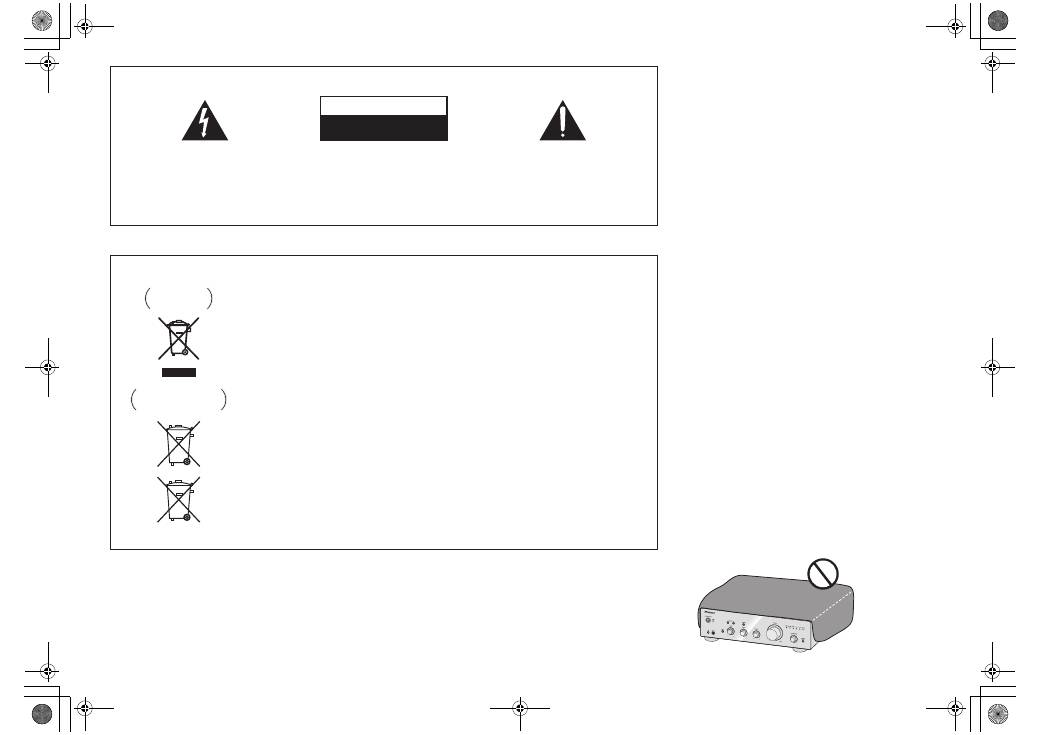
The exclamation point within an equilateral
triangle is intended to alert the user to the
presence of important operating and
maintenance (servicing) instructions in the
literature accompanying the appliance.
The lightning flash with arrowhead symbol,
within an equilateral triangle, is intended to
alert the user to the presence of uninsulated
“dangerous voltage” within the product’s
enclosure that may be of sufficient
magnitude to constitute a risk of electric
shock to persons.
CAUTION:
TO PREVENT THE RISK OF ELECTRIC
SHOCK, DO NOT REMOVE COVER (OR
BACK). NO USER-SERVICEABLE PARTS
INSIDE. REFER SERVICING TO QUALIFIED
SERVICE PERSONNEL.
CAUTION
RISK OF ELECTRIC SHOCK
DO NOT OPEN
IMPORTANT
D3-4-2-1-1_A1_En
WARNING
This equipment is not waterproof. To prevent a fire or
shock hazard, do not place any container filled with
liquid near this equipment (such as a vase or flower
pot) or expose it to dripping, splashing, rain or
moisture.
D3-4-2-1-3_A1_En
WARNING
Before plugging in for the first time, read the following
section carefully.
The voltage of the available power supply differs
according to country or region. Be sure that the
power supply voltage of the area where this unit
will be used meets the required voltage (e.g., 230 V
or 120 V) written on the rear panel.
D3-4-2-1-4*_A1_En
WARNING
To prevent a fire hazard, do not place any naked flame
sources (such as a lighted candle) on the equipment.
D3-4-2-1-7a_A1_En
VENTILATION CAUTION
When installing this unit, make sure to leave space
around the unit for ventilation to improve heat radiation
(at least 30 cm at top, 10 cm at rear, and 10 cm at each
side).
WARNING
Slots and openings in the cabinet are provided for
ventilation to ensure reliable operation of the product,
and to protect it from overheating. To prevent fire
hazard, the openings should never be blocked or
covered with items (such as newspapers, table-cloths,
curtains) or by operating the equipment on thick carpet
or a bed.
D3-4-2-1-7b*_A1_En
Information for users on collection and disposal of old equipment and used batteries
These symbols on the products, packaging, and/or accompanying documents mean
that used electrical and electronic products and batteries should not be mixed with
general household waste.
For proper treatment, recovery and recycling of old products and used batteries,
please take them to applicable collection points in accordance with your national
legislation.
By disposing of these products and batteries correctly, you will help to save valuable
resources and prevent any potential negative effects on human health and the
environment which could otherwise arise from inappropriate waste handling.
For more information about collection and recycling of old products and batteries,
please contact your local municipality, your waste disposal service or the point of sale
where you purchased the items.
These symbols are only valid in the European Union.
For countries outside the European Union:
If you wish to discard these items, please contact your local authorities or dealer and
ask for the correct method of disposal.
K058a_A1_En
Symbol examples
for batteries
Symbol for
equipment
Pb
European model only
A30_SYXE8.book 2 ページ 2012年2月16日 木曜日 午前8時58分
3
If the AC plug of this unit does not match the AC
outlet you want to use, the plug must be removed
and appropriate one fitted. Replacement and
mounting of an AC plug on the power supply cord of
this unit should be performed only by qualified
service personnel. If connected to an AC outlet, the
cut-off plug can cause severe electrical shock. Make
sure it is properly disposed of after removal.
The equipment should be disconnected by removing
the mains plug from the wall socket when left unused
for a long period of time (for example, when on
vacation).
D3-4-2-2-1a_A1_En
CAUTION
The
/I STANDBY/ON
switch on this unit will not
completely shut off all power from the AC outlet.
Since the power cord serves as the main disconnect
device for the unit, you will need to unplug it from the
AC outlet to shut down all power. Therefore, make
sure the unit has been installed so that the power
cord can be easily unplugged from the AC outlet in
case of an accident. To avoid fire hazard, the power
cord should also be unplugged from the AC outlet
when left unused for a long period of time (for
example, when on vacation).
D3-4-2-2-2a*_A1_En
Operating Environment
Operating environment temperature and humidity:
+5 °C to +35 °C (+41 °F to +95 °F); less than 85 %RH
(cooling vents not blocked)
Do not install this unit in a poorly ventilated area, or in
locations exposed to high humidity or direct sunlight (or
strong artificial light)
D3-4-2-1-7c*_A1_En
This product is for general household purposes. Any
failure due to use for other than household purposes
(such as long-term use for business purposes in a
restaurant or use in a car or ship) and which requires
repair will be charged for even during the warranty
period.
K041_A1_En
POWER-CORD CAUTION
Handle the power cord by the plug. Do not pull out the
plug by tugging the cord and never touch the power
cord when your hands are wet as this could cause a
short circuit or electric shock. Do not place the unit, a
piece of furniture, etc., on the power cord, or pinch the
cord. Never make a knot in the cord or tie it with other
cords. The power cords should be routed such that they
are not likely to be stepped on. A damaged power cord
can cause a fire or give you an electrical shock. Check
the power cord once in a while. When you find it
damaged, ask your nearest PIONEER authorized
service center or your dealer for a replacement.
S002*_A1_En
CAUTION:
HOT SURFACE. DO NOT TOUCH.
The top surface over the internal
heatsink may become hot when
operating this product continuously.
(A-30 only)
Thank you for buying this Pioneer
product.
Please read through these operating instructions so that
you will know how to operate your model properly. After
you have finished reading the instructions, put them in a
safe place for future reference
.
Contents
01 Before you start
What’s in the box
. . . . . . . . . . . . . . . . . . . . . . . . . . 4
Loading the batteries in the remote control
(Except A-10)
. . . . . . . . . . . . . . . . . . . . . . . . . . . . . 4
Using the remote control
. . . . . . . . . . . . . . . . . . . . .4
Installing the amplifier
. . . . . . . . . . . . . . . . . . . . . . 4
02 Connecting up
Making cable connections
. . . . . . . . . . . . . . . . . . . 5
About “Bi-wiring”
. . . . . . . . . . . . . . . . . . . . . . . . . . 5
Connecting speaker cables
. . . . . . . . . . . . . . . . . . 6
Connecting audio cables
. . . . . . . . . . . . . . . . . . . . 6
Using centralized control with other Pioneer
components (Except A-10)
. . . . . . . . . . . . . . . . . . . 6
Plugging in
. . . . . . . . . . . . . . . . . . . . . . . . . . . . . . 6
03 Controls and displays
Front panel
. . . . . . . . . . . . . . . . . . . . . . . . . . . . . . 7
Rear panel
. . . . . . . . . . . . . . . . . . . . . . . . . . . . . . . 8
Remote control (Except A-10)
. . . . . . . . . . . . . . . . 9
04 Operation
Playback
. . . . . . . . . . . . . . . . . . . . . . . . . . . . . . . 10
Set the power to Standby
. . . . . . . . . . . . . . . . . . . .10
When using the unit as a power amplifier
(A-30 only)
. . . . . . . . . . . . . . . . . . . . . . . . . . . . . . .10
Making an audio recording
. . . . . . . . . . . . . . . . . 11
To set for automatic standby status
(Auto Power Down)
. . . . . . . . . . . . . . . . . . . . . . . 11
Restoring all the settings to the factory default
settings
. . . . . . . . . . . . . . . . . . . . . . . . . . . . . . . . 11
05 Additional information
Troubleshooting
. . . . . . . . . . . . . . . . . . . . . . . . . . 12
Cleaning the unit
. . . . . . . . . . . . . . . . . . . . . . . . . 12
Specifications
. . . . . . . . . . . . . . . . . . . . . . . . . . . 13
A30_SYXE8.book 3 ページ 2012年2月16日 木曜日 午前8時58分

01
Before you start
4
En
Chapter 1:
Before you start
What’s in the box
Please confirm that the following accessories are in the
box when you open it.
• Remote control (Except A-10)
• AAA/IEC R03 dry cell batteries x2 (Except A-10)
• Power cord
• Warranty card
• Operating instructions (This document)
Note
• Illustrations featured in the Operating Instructions
may have been modified or simplified for ease of
explanation, and may therefore differ from the
actual product appearance.
• The illustrations used here are mainly of the A-30.
Loading the batteries in the remote
control (Except A-10)
1
Open the rear lid.
2
Insert the new batteries, matching the
polarities as indicated inside the case.
3
Close the rear lid.
The batteries included with the unit have been provided
to allow you check product operation and may not last
long. We recommend using alkaline batteries that have
a longer life.
WARNING
• Do not use or store batteries in direct sunlight or
other excessively hot place, such as inside a car or
near a heater. This can cause batteries to leak,
overheat, explode or catch fire. It can also reduce
the life or performance of batteries.
Caution
Incorrect use of batteries may result in such hazards as
leakage and bursting. Observe the following
precautions:
• When inserting the batteries, make sure not to
damage the springs on the battery’s
terminals.
A-30
A-20
A-30
A-20
A-30
A-20
• Do not use any batteries other than the ones
specified. Also, do not use a new battery together
with an old one.
• When loading the batteries into the remote control,
set them in the proper direction, as indicated by the
polarity marks (
and
).
• Do not heat batteries, disassemble them, or throw
them into flames or water.
• Batteries may have different voltages, even if they
are the same size and shape. Do not use different
types of batteries together.
• To prevent leakage of battery fluid, remove the
batteries if you do not plan to use the remote
control for a long period of time (1 month or more).
If the fluid should leak, wipe it carefully off the
inside of the case, then insert new batteries. If a
battery should leak and the fluid should get on your
skin, flush it off with large quantities of water.
• When disposing of used batteries, please comply
with governmental regulations or environmental
public institution’s rules that apply in your country/
area.
Using the remote control
The remote has a range of about 7 m at an angle of about
30º from the remote sensor.
Keep in mind the following when using the remote
control:
• Make sure that there are no obstacles between the
remote and the remote sensor on the unit.
• Remote operation may become unreliable if strong
sunlight or fluorescent light is shining on the unit’s
remote sensor.
• Remote controllers for different devices can
interfere with each other. Avoid using remotes for
other equipment located close to this unit.
• Replace the batteries when you notice a fall off in
the operating range of the remote.
Installing the amplifier
When installing this unit, make sure to put it on a level
and stable surface.
• Don’t install it on the following places:
– on a color TV (the screen may distort)
– near a cassette deck (or close to a device that
gives off a magnetic field). This may interfere with
the sound.
– in direct sunlight
– in damp or wet areas
– in extremely hot or cold areas
– in places where there is vibration or other
movement
– in places that are very dusty
– in places that have hot fumes or oils (such as a
kitchen)
• Do not mount the unit on a sofa or other object or
material with absorbent qualities, since sound
quality may be adversely affected.
7 m
30 °
30 °
A30_SYXE8.book 4 ページ 2012年2月16日 木曜日 午前8時58分
Connecting up
02
5
En
English
Deutsch
Français
Nederlands
Italiano
Español
Ру
сский
Chapter 2:
Connecting up
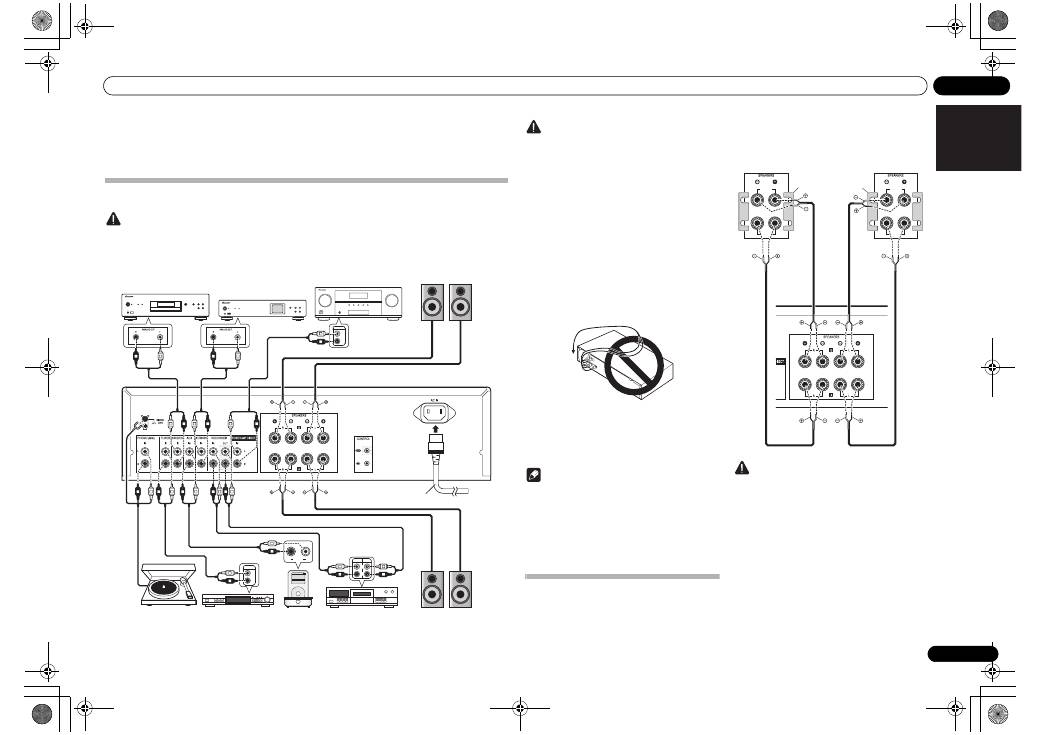
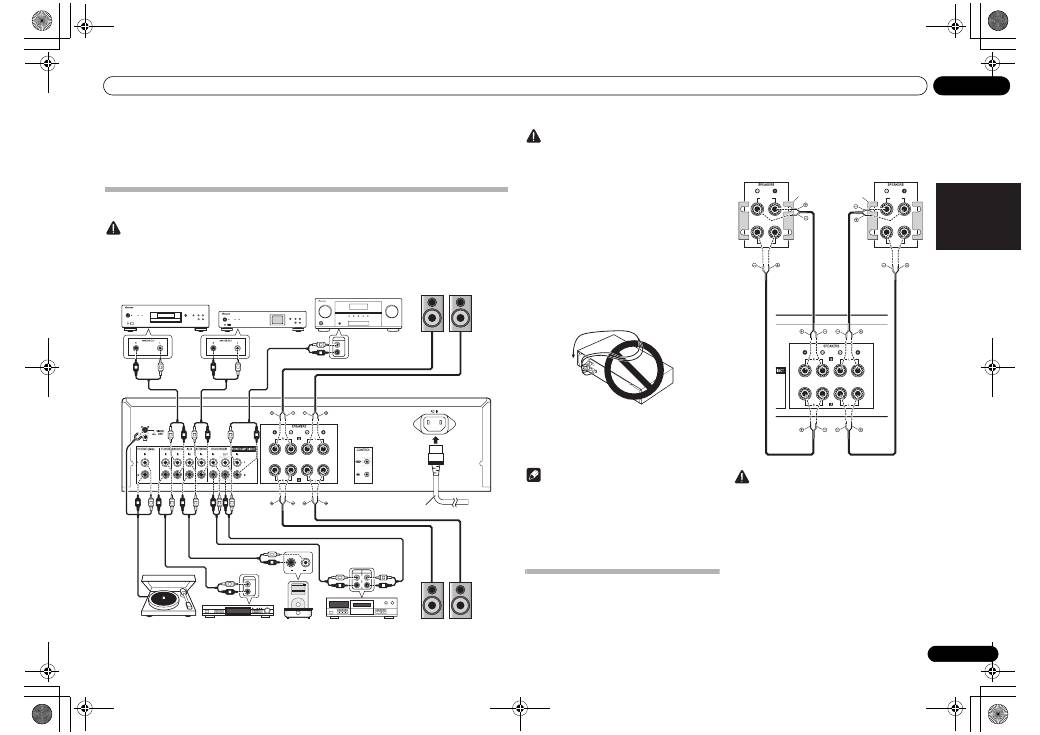
Making cable connections
Caution
• Before making or changing the connections, switch off the power and disconnect the power cord from the AC
outlet.
• Connect the power cord after all the connections between devices have been completed.
REC
R
L
OUTPUT
R
L
PLAY
R
L
AUDIO
OUTPUT
PRE OUT
R
L
L
R
L
R
L
R
L
R
L
R
L
R
L
R
L
R
L
R
L
R
L
R
L
R
L
R
L
R
L
R
MENU
iPod
Music>
Extras>
Settings>
Shuffle Songs
Backlight
SACD/CD player
Network audio player
PRE OUT jacks on pre-
amplifier or AV amplifier
Speaker system B
Speaker system A
Turntable
Tuner
iPod dock, etc
CD recorder or
tape deck
Right
Left
Right
Left
Power cord
(included)
A-30’s rear panel
A-30 only
Caution
• The
SIGNAL GND
terminal is provided to reduce
noise when connecting the unit to components
such as an analog turntable.
• Do not connect the
PHONO (MM)
terminals to any
component other than a turntable; also, do not
connect to a turntable equipped with built-in
equalizer. An excessively high sound output may be
produced, resulting in damage to your speakers or
other devices.
• The unit’s
PHONO (MM)
terminals are designed to
be used with turntables equipped with MM
(moving-magnet) type cartridges. Turntables
equipped with MC (moving-coil) cartridges cannot
be used.
• Make sure not to bend the cables over the top of
this unit (as shown in the illustration). If this
happens, the magnetic field produced by the
transformers in this unit may cause a humming
noise from the speakers.
• The unit’s
POWER AMP DIRECT
terminals should
never be connected to any other component’s
connectors except PRE-AMP OUT.
• If your turntable has a grounding wire, secure it to
the ground terminal on this amplifier.
Note
• When connecting a tape cassette deck, playback
noise may be heard, depending on the installation
location. This noise is caused by leakage flux from
the amplifier’s transformer. In this event, change
the installation location, or move the deck farther
from the amplifier.
• iPod is a trademark of Apple Inc., registered in the
U.S. and other countries.
About “Bi-wiring”
This unit can be used with speakers that support bi-
wiring. Be sure to connect the high-frequency and
low-frequency connections correctly.
• During playback, be sure that both the
SPEAKERS
A
button and
SPEAKERS B
button are set to ON
(page 7).
Caution
• When using bi-wiring to connect speakers, avoid
adverse affects on the amplifier by being sure to
remove the HIGH and LOW short bars provided
with the speakers. For detailed information, consult
the instructions provided with the speakers.
• When using speakers with removable network
circuits, note that if the network is removed, no
effect will be produced and damage may be caused
to the speaker.
• Another method of connection is to connect the
SPEAKERS A
terminals to HIGH and the
SPEAKERS B
terminals to LOW (reverse that shown
in the illustration).
HIGH
LOW
HIGH
LOW
Speaker system
Left
Speaker system
Right
A-30’s rear
panel
Remove the shorting
bar between the +
and – terminals.
A30_SYXE8.book 5 ページ 2012年2月16日 木曜日 午前8時58分
02
Connecting up
6
En
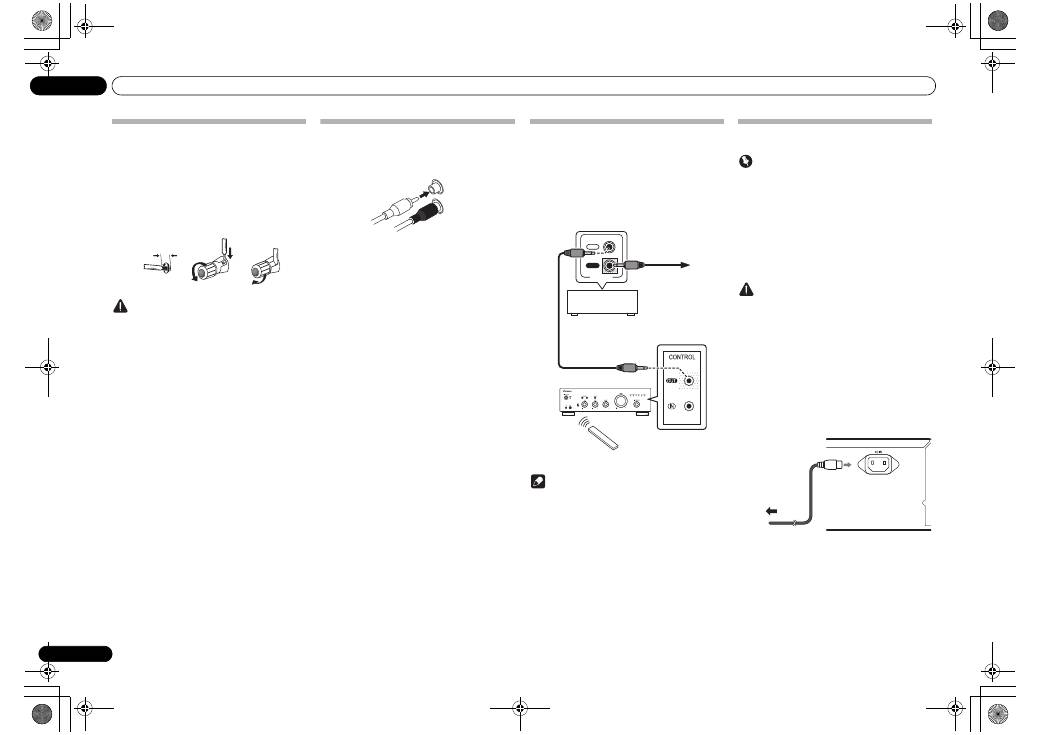
Connecting speaker cables
1
Twist the cable cores.
2
Loosen the nut on the SPEAKERS
terminal, and insert the speaker cable into
the exposed hole in the terminal shaft.
3
Retighten the terminal nut.
Caution
• When using only one set of speaker terminals
(SPEAKERS A or SPEAKERS B), or when utilizing
bi-wiring connections, the speaker used should
have a nominal impedance between 4
Ω
and
16
Ω
. When using both sets of terminals, the
connected speakers should have nominal
impedance between 8
Ω
and 32
Ω
. Consult the
instructions accompanying your speakers for
details regarding the impedance value.
• Make sure the positive and negative (+/–) terminals
on the amplifier match those on the speakers.
• These speaker terminals carry
HAZARDOUS live
voltage
. To prevent the risk of electric shock when
connecting or disconnecting the speaker cables,
disconnect the power cord before touching any
uninsulated parts.
• Make sure that all the bare speaker wire is twisted
together and inserted fully into the speaker
terminal. If any of the bare speaker wire touches the
back panel it may cause the power to cut off as a
safety measure.
Connecting audio cables
Connect the white plug to the left (L) jack, and the red
plug to the right (R) jack. Be sure to insert the plugs fully
into the jacks.
1
2
3
10 mm
Left (white)
Right (red)
Using centralized control with other
Pioneer components (Except A-10)
Multiple Pioneer components equipped with
CONTROL
IN/OUT
jacks can be connected to the A-30/A-20 unit,
allowing centralized control of the components via the
remote sensor on the A-30/A-20. This also allows remote
control of components not equipped with a remote
sensor, or installed in places where the component’s
remote sensor cannot be accessed.
Note
• For connections use a commercially available
monaural miniplug cord (without resistor).
• When connecting the
CONTROL IN/OUT
jacks,
commercially available audio cords must also be
used to make analog connections. Merely
connecting the
CONTROL IN/OUT
jacks alone will
not allow proper system control.
• When a control cord is connected to the A-30/A-
20’s
CONTROL IN
jack, the unit cannot be
controlled by pointing the remote control at the A-
30/A-20 (the remote sensor is automatically
disabled).
Plugging in
Important
• When going on a trip or otherwise not using the
unit for an extended period, always disconnect the
power cord from its outlet. Note that various
internal settings will not be lost even if the power
cord is disconnected from its outlet for an extended
time.
• If it is necessary to detach the power cord, first be
sure to press the
/I STANDBY/ON
button on the
front panel of the unit so the A-30/A-20 is turned
OFF or the A-10 is in standby mode before
detaching the cord.
Caution
• The use of a power cord other than the one provided
will invalidate the warranty, since Pioneer will not
be responsible for any damage incurred. (The
power cord provided with the model A-30 has a
rated current capacity of 10 A, while the cord
provided with the A-20/A-10 has a rated current
capacity of 2.5 A.)
• Do not use any power cord other than the one
supplied with this unit.
• Do not use the supplied power cord for any purpose
other than that described below.
After you’ve finished making all connections, plug the
unit into an AC outlet.
1
Plug the supplied power cord into the
AC IN socket on the rear panel of the unit.
2
Plug the other end into an AC outlet.
IN
OUT
CONTROL
Other Pioneer
component equipped
with CONTROL IN/
OUT jacks
To other Pioneer
component
equipped with
CONTROL IN jack
A-30/A-20
Aim remote control
at the sensor on the
A-30/A-20.
A-30/A-20
remote
control
To AC outlet
Power cord
A-30’s rear panel
02_connecting_up.fm 6 ページ 2012年6月21日 木曜日 午後2時1分
Controls and displays
03
7
En
English
Deutsch
Français
Nederlands
Italiano
Español
Ру
сский
Chapter 3:
Controls and displays
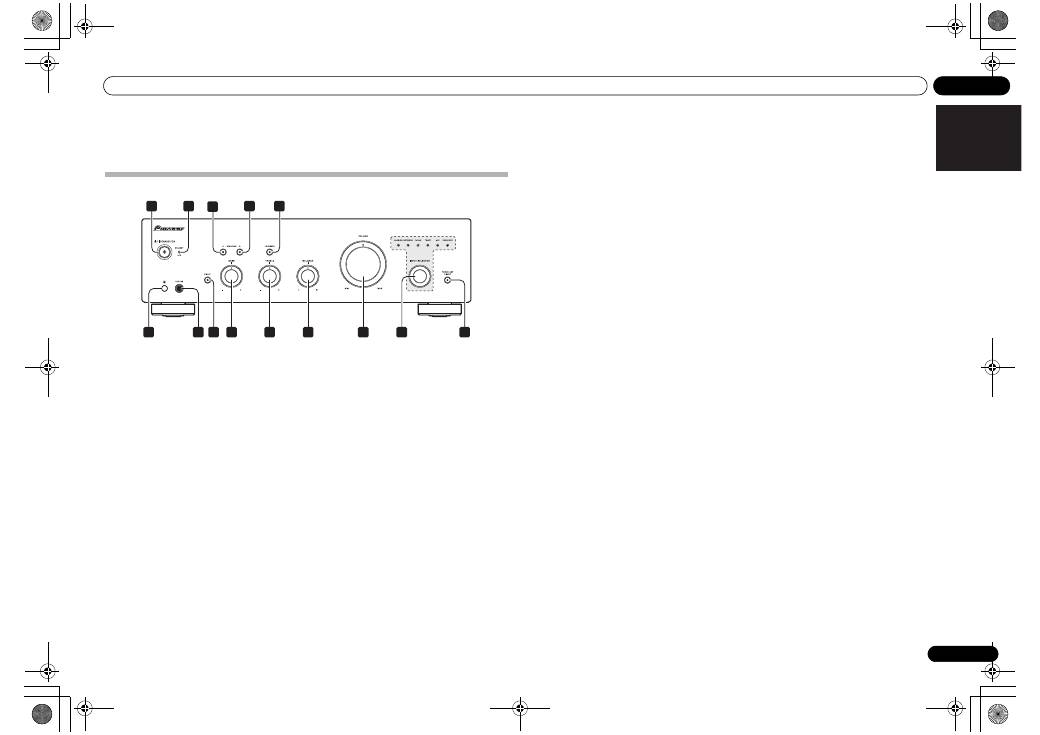
Front panel
1
/I STANDBY/ON
Switches the amplifier between off and on.
When power is turned on, the power indicator in the
center of the button will light.
• On the A-10 model, this switches the amplifier
between standby and on.
2
STANDBY/APD indicator
When power is set to standby, the indicator lights red.
When the Auto Power Down (APD) function is on, the
indicator lights green (page 11).
3
SPEAKERS A button/indicator
Use this button to listen to the speaker system
connected to
SPEAKERS A
terminals.
On
: The indicator lights. Sound is heard from the
speaker system. (Sound will also be produced from the
PHONES
jack.)
Off
: The indicator goes off. No sound is heard from the
speaker system. Set to this position when listening with
headphones.
4
SPEAKERS B button/indicator
Use this button to listen to the speaker system
connected to
SPEAKERS B
terminals.
On
: The indicator lights. Sound is heard from the
speaker system. (Sound will also be produced from the
PHONES
jack.)
Off
: The indicator goes off. No sound is heard from the
speaker system. Set to this position when listening with
headphones.
5
LOUDNESS button/indicator
Use when listening at low volume levels.
On
: The indicator lights: Boosts low and high
frequencies to give added punch to playback even at a
low volume level.
Off
: The indicator goes off: Should normally be left in
this position.
• This button does not operate when the
DIRECT
button is in the on position.
• When sound volume is raised, the amount of
change produced by the
LOUDNESS
circuit is
reduced.
3
1
6
2
5
4
7
13
14
9
10
11
12
8
A-30
6
Remote sensor (Except A-10)
Receives the signals from the remote control (page 4).
7
PHONES jack
Use to connect headphones. No sound is produced
when the
POWER AMP DIRECT
button is ON.
8
DIRECT button/indicator
On
: The indicator lights: When this button is set to ON,
sound signals are output directly, without being passed
through the various adjustment circuits (
BASS
,
TREBLE
,
BALANCE
,
LOUDNESS
). This allows reproduction of the
signals with greater fidelity, but it disables any settings
made with the
BASS
,
TREBLE
,
BALANCE
or
LOUDNESS
controls.
Off
: The indicator goes off: The signal passes through
the various frequency adjusting circuits. When the
indicator is OFF, adjustments can be made with the
BASS
,
TREBLE
,
BALANCE
, and
LOUDNESS
controls.
9
BASS tone control
Use to adjust the low-frequency tone. The center position
is the flat (normal) position. When turned to the right,
low-frequency tones are emphasized; when turned to the
left, low-frequency tones are de-emphasized.
• This button does not operate when the
DIRECT
button is in the on position.
10 TREBLE tone control
Use to adjust the high-frequency tone. The center
position is the flat (normal) position. When turned to the
right, high-frequency tones are emphasized; when
turned to the left, high-frequency tones are de-
emphasized.
• This button does not operate when the
DIRECT
button is in the on position.
11 BALANCE control
Should normally be left in the center position. Adjust
balance if the sound is louder from one of the speakers.
If the right side is louder, turn toward the L (left) position
and if the left side is louder, turn toward the R (right)
position.
• This button does not operate when the
DIRECT
button is in the on position.
12 VOLUME control
Use to adjust the volume level. (Also allows adjustment
of the headphone sound volume.)
13 INPUT SELECTOR knob/indicators
Turn the knob clockwise or counterclockwise so that the
indicator lights for your desired input source. Turning
the knob clockwise causes the lit indicator to right.
Turning counterclockwise causes it to left. When the
remote control’s
MUTE
button is pressed to mute the
sound, the indicator for the input source selected with
the
INPUT SELECTOR
knob flashes.
14 POWER AMP DIRECT button/indicator
(A-30 only)
Press this button when the A-30 is to be used as a power
amplifier (page 10).
A30_SYXE8.book 7 ページ 2012年2月16日 木曜日 午前8時58分
03
Controls and displays
8
En
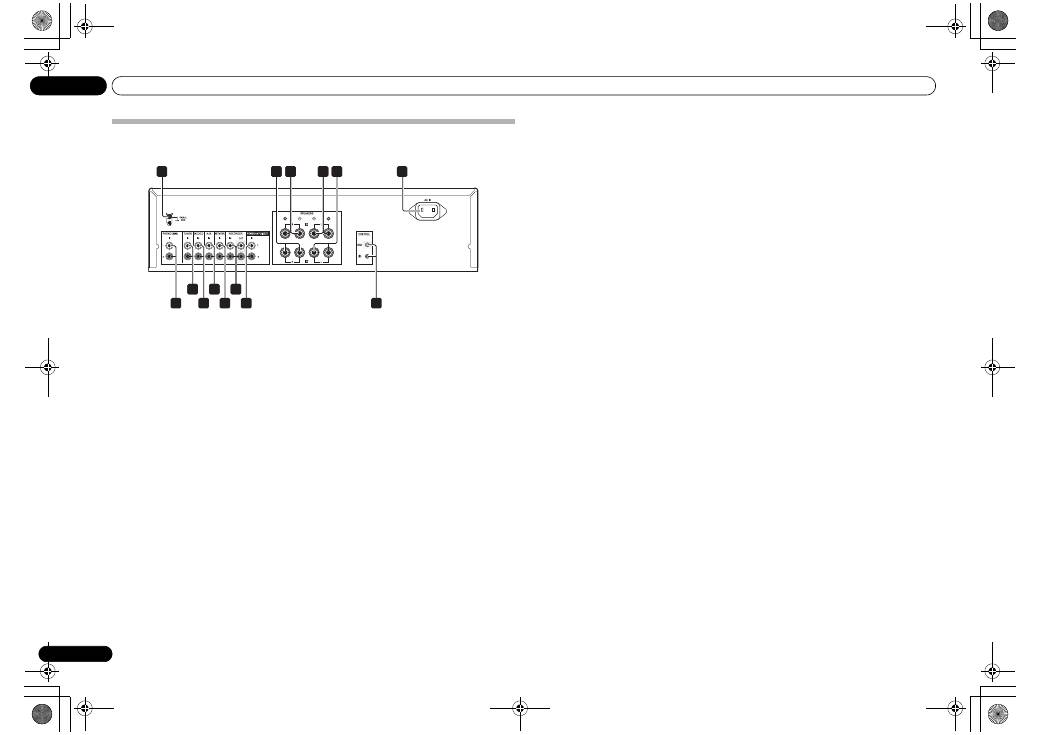
Rear panel
See pages 5-6 for details regarding connections.
1
GND (Turntable ground) terminal
This ground terminal is designed to help reduce noise
when a turntable is connected. It is not a safety ground.
2
SPEAKERS A terminals (Right channel)
3
SPEAKERS B terminals (Right channel)
4
SPEAKERS B terminals (Left channel)
5
SPEAKERS A terminals (Left channel)
6
AC IN jack
Connect power cord to here and an AC wall socket.
7
PHONO (MM) IN terminals
8
TUNER IN terminals
9
SACD/CD IN terminals
10 AUX IN terminals
11 NETWORK IN terminals
12 RECORDER IN/OUT terminals
13 POWER AMP DIRECT IN terminals (A-30
only)
When using the A-30 as a power amplifier, connect the
pre-amplifier here (page 10).
14 CONTROL IN/OUT jack (Except A-10)
A-30
1
6
7
2
8
2
10
9
13
11
2
12
2
14
2
2
3
2
4
2
5
A30_SYXE8.book 8 ページ 2012年2月16日 木曜日 午前8時58分

Controls and displays
03
9
En
English
Deutsch
Français
Nederlands
Italiano
Español
Ру
сский
Remote control (Except A-10)
STANDBY/ON
DIMMER
SACD/CD NETWORK
PHONO
TUNER
OPTION
AUX
RECORDER
VOLUME
MUTE
LOUDNESS
SPEARKERS
A
B
NETWORK AUDIO PLAYER
ENTER
SOUND
SETUP
APD
DIRECT
RETURN
HOME MENU
FUNC
INPUT
SACD PLAYER
FUNC
NETWORK AUDIO PLAYER
1
8
9
10
12
11
13
2
3
4
6
4
7
5
A-30
8
5
7
3
10
11
1
2
3
4
3
4
3
4
3
12
A-20
6
1
STANDBY/ON
Switches the amplifier between standby and on.
2
Input selector buttons
Press to select an input source. These select the
component connected to the corresponding input on the
rear panel.
• When the A-30 is connected, the
OPTION
button is
disabled.
3
SACD PLAYER control buttons
Use to control Pioneer SACD player.
(Cannot be used to perform playback/pause on the
PD-D6/PD-D6MK2/PD-D9/PD-D9MK2 models.)
4
NETWORK AUDIO PLAYER control
buttons
Use to control Pioneer network audio player.
5
LOUDNESS
Use to set the loudness circuit ON/OFF (page 7).
6
MUTE
Mutes/unmutes the sound.
7
DIRECT
Press to access Direct listening (page 7).
8
DIMMER
This button allows the illumination of the unit's front
panel indicators to be set in three levels (does not affect
the
STANDBY
indicator).
9
INPUT +/–
Use to change the input source. The source changes as
below.
SACD/CD
NETWORK
PHONO
TUNER
AUX
RECORDER
Return to the beginning.
10 SPEAKERS A button/indicator
Use this button to listen to the speaker system
connected to
SPEAKERS A
terminals.
11 SPEAKERS B button/indicator
Use this button to listen to the speaker system
connected to
SPEAKERS B
terminals.
12 VOLUME +/–
Use to set the listening volume.
13 APD
Use to set the Auto Power Down function to ON/OFF
(page 11).
A30_SYXE8.book 9 ページ 2012年3月6日 火曜日 午前11時13分
04
Operation
10
En
Chapter 4:
Operation
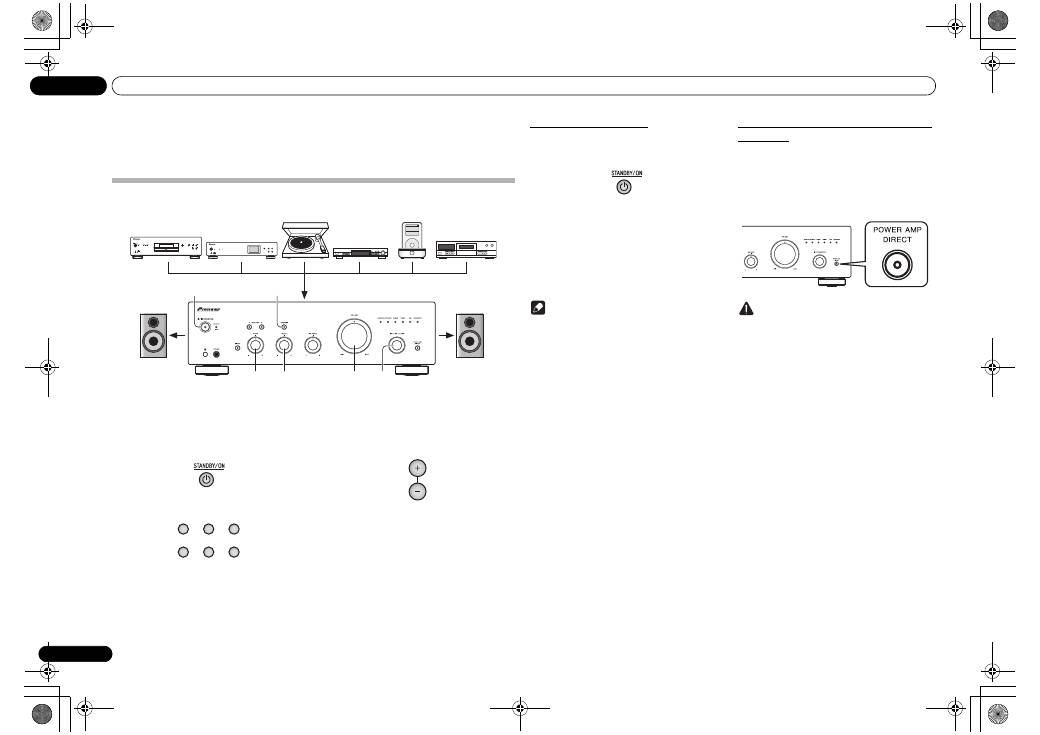
Playback
1
Turn on the power of the playback
component.
2
Turn power ON to the unit.
• If the unit is in the standby mode, press the remote
control’s
STANDBY/ON
button.
3
Select the source you want to playback.
Select the playback component.
• When using the A-30’s remote control, the
INPUT
+/–
button can be used to select the component.
• When using the front panel controls, rotate the
INPUT SELECTOR
knob.
4
Start playback of the component you
selected in step 1.
5
Adjust playback volume with VOLUME
control.
6
Adjust the tone to your preference using
the BASS and TREBLE controls, and
LOUDNESS button.
If the
DIRECT
button has been set to ON, these controls
are disabled.
3
5
6
6
6
2
MENU
iPod
Music>
Extras>
Settings>
Shuffle Songs
Backlight
/I STANDBY/ON
STANDBY
iPod/USB
5V
2.1A
PURE AUDIO
Hi-Bit 32
FUNCTION
NETWORK AUDIO PLAYER
N-50
SACD/CD player
Network audio player
Turntable
Tuner
iPod dock, etc
CD recorder or
tape deck
Playback
Playback
SACD/CD NETWORK
PHONO
TUNER
AUX
RECORDER
VOLUME
Set the power to Standby
1
Press the remote control’s
STANDBY/
ON button.
The next time you wish to turn on the power, press the
remote control’s
STANDBY/ON
button.
• In the case of the A-30/A-20, If the front panel’s
STANDBY/ON
button is pressed, the power will
be turned off. In this case, if the power is off,
pressing the remote control’s
STANDBY/ON
button will not turn on the power. To turn on the
power again, press the front panel’s
STANDBY/
ON
button.
Note
• If the power cord is disconnected when the unit is
in the standby mode the unit will turn off, but when
the cord is then reconnected, the unit will not
automatically turn on. After reconnecting the
power cord, press the remote control’s
STANDBY/ON
button to turn the power on.
When using the unit as a power amplifier
(A-30 only)
When a pre-amplifier is connected to the unit’s
POWER
AMP DIRECT
terminals, the unit can be used as a power
amplifier.
1
Press the POWER AMP DIRECT button
on the front panel of the unit.
The
POWER AMP DIRECT
indicator will light.
Caution
• When the
POWER AMP DIRECT
indicator is
lighted, operations change as follows:
– The unit’s front-panel
VOLUME
,
BASS
,
TREBLE
,
and
BALANCE
controls are disabled. These
adjustments are controlled by the component
connected to the unit’s
POWER AMP DIRECT
terminals.
– When the
POWER AMP DIRECT
indicator is
lighted, sound volume from the A-30 will
automatically be fixed at its maximum output.
When using this unit as a power amplifier,
check the output level of the component
connected to the
POWER AMP DIRECT
terminals and set it to a low level as appropriate
before turning on the
POWER AMP DIRECT
indicator. If the sound volume of the component
connected to the
POWER AMP DIRECT
terminals is initially set to a high output level,
loud sound may suddenly be output when the
POWER AMP DIRECT
indicator lights.
– Sound is not produced from the
PHONES
jack
and
RECORDER OUT
terminals.
• For more information, consult the operating
instructions for the component connected to the A-
30’s
POWER AMP DIRECT
terminals.
A30_SYXE8.book 10 ページ 2012年2月16日 木曜日 午前8時58分
Operation
04
11
En
English
Deutsch
Français
Nederlands
Italiano
Español
Ру
сский
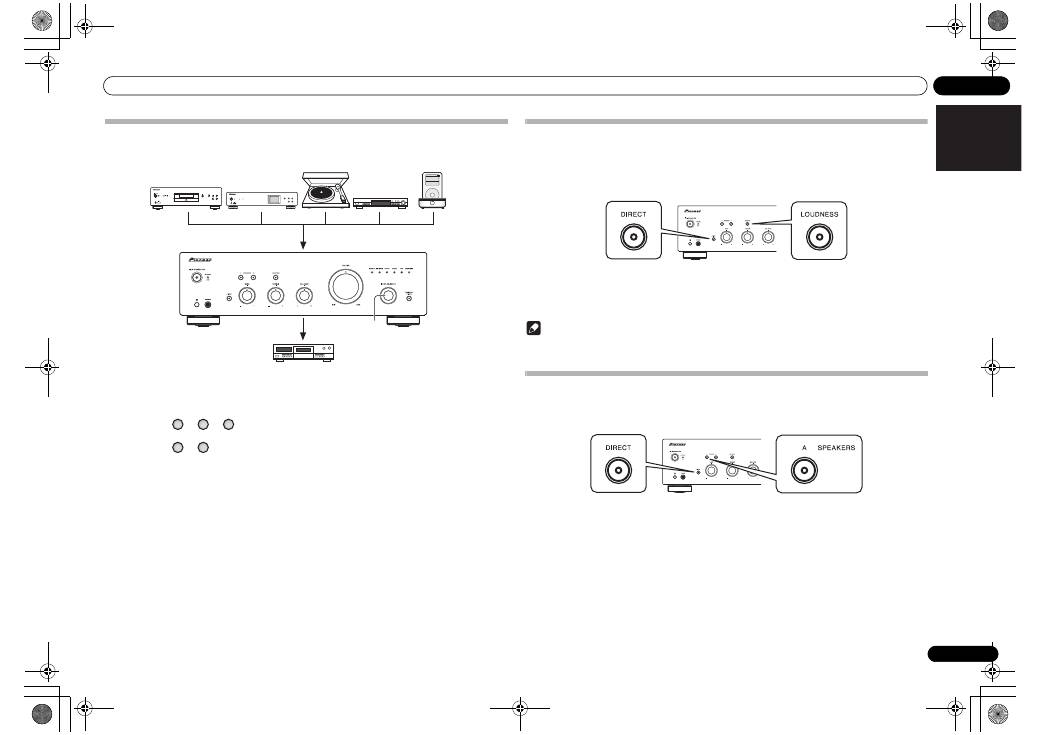
Making an audio recording
You can make an audio recording from any audio source connected to the amplifier.
1
Select the source you want to record.
2
Start recording, then start playback of
the source component.
1
MENU
iPod
Music>
Extras>
Settings>
Shuffle Songs
Backlight
/I STANDBY/ON
STANDBY
iPod/USB
5V
2.1A
PURE AUDIO
Hi-Bit 32
FUNCTION
NETWORK AUDIO PLAYER
N-50
SACD/CD player
Network audio player
Turntable
Tuner
iPod dock, etc
Audio recording component
(CD recorder, tape deck, etc.)
Playback
Recording
SACD/CD NETWORK
PHONO
TUNER
AUX
To set for automatic standby status (Auto Power Down)
When this condition is set, if no input signal is detected for 30 minutes, the unit will automatically enter standby
status.
1
If the unit’s power is ON, hold the unit’s front-panel DIRECT button and LOUDNESS
button depressed simultaneously for three seconds.
When this condition is set to ON, the
STANDBY/APD
indicator on the unit’s front panel will light green. Press the
buttons again to disable the setting.
• This condition can also be set by means of the
APD
button on the A-30’s remote control.
• The factory default setting is ON.
Note
• Depending on the device connected, excessive noise produced by the device may be interpreted as an audio
signal, thus preventing the Automatic Power-Down function from operating.
Restoring all the settings to the factory default settings
1
When power is in standby mode, hold the front-panel’s DIRECT button and
SPEAKERS A button depressed simultaneously for five seconds.
2
Turn power ON to the unit.
A30_SYXE8.book 11 ページ 2012年3月6日 火曜日 午前11時13分
05
Additional information
12
En
Chapter 5:
Additional information
Troubleshooting
Incorrect operations are often mistaken for trouble and malfunctions. If you think that there is something wrong with
this component, check the points below. Sometimes the trouble may lie in another component. Investigate the other
components and electrical appliances being used. If the trouble cannot be rectified even after exercising the checks
listed below, ask your nearest Pioneer authorized service center or your dealer to carry out repair work.
• If the unit does not operate normally due to external effects such as static electricity disconnect the power plug
from the outlet and insert again to return to normal operating conditions.
Problem
Remedy
The power does not turn on.
• Is the power plug disconnected from the power outlet? Connect the power plug
correctly to its outlet (page 6).
•Is the power cord disconnected from the AC IN connector? Connect the power cord
correctly (page 6).
Power turns off.
•Is the Auto Power Down function turned ON? If you do not want the power to turn off
automatically, disable the Auto Power Down function (page 11).
During playback, sound stops, and
the
STANDBY/APD
indicator flashes
red at about 1 second intervals.
•The unit’s internal temperature has risen and the safety circuit has operated.
- Turn power OFF, and allow the unit to cool before turning the power ON again.
- Install the unit in a location with better ventilation.
- Confirm that the unit is installed correctly; if the unit is turned on again without
being allowed to cool, the same symptoms may appear (page 4).
During playback, sound stops, and
the
STANDBY/APD
indicator flashes
red at about 2 second intervals.
•Are you using speakers with impedance values not supported by this unit? Confirm
the speaker’s nominal impedance value (page 6).
•Are any speaker cables loose from the
SPEAKERS
terminals and touching other
wires or the surface of the rear panel? Disconnect the power cord and reconnect the
speaker cables correctly (page 6).
When power is turned on, the
STANDBY/APD
indicator flashes at
irregular intervals.
•The unit’s circuitry is damaged. Disconnect the power cord and consult your dealer
or nearest
Pioneer authorized service center
.
No sound is output when a function is
selected.
•A connection cable is disconnected or connected improperly. Check your
connections (page 5).
•Connectors or pin plugs on a cable are dirty. Wipe off any dirt from connectors and
pin plugs.
•Confirm that the unit’s input selector is set to the desired playback component. Set
selector correctly (page 10).
•In the case of the A-30/A-20, press
MUTE
on the remote control to turn muting off
(page 9).
No sound from one speaker.
•Are the connection cables or speaker cables disconnected on one side? Reconnect
securely (page 5).
Cleaning the unit
• Use a polishing cloth or dry cloth to wipe off dust
and dirt.
• When the surface is dirty, wipe with a soft cloth
dipped in some neutral cleanser diluted five or six
times with water, and wrung out well, and then
wipe again with a dry cloth. Do not use furniture
wax or cleansers.
• Never use thinners, benzine, insecticide sprays or
other chemicals on or near this unit, since these
will corrode the surface.
Can’t operate the remote
control.
•Replace the battery (page 4).
•Operate within 7 m, 30° of the remote sensor on the front panel (page 4).
•Remove the obstacle or operate from another position.
•Avoid exposing the remote sensor on the front panel to direct light.
•Is the control cord for one component connected improperly? Confirm correct
connections (page 6).
Can’t change input source on A-30.
•Check whether
POWER AMP DIRECT
function is ON. If so, press the front panel’s
POWER AMP DIRECT
button to turn the function OFF (page 10).
Problem
Remedy
A30_SYXE8.book 12 ページ 2012年2月16日 木曜日 午前8時58分
Additional information
05
13
En
English
Deutsch
Français
Nederlands
Italiano
Español
Ру
сский
Specifications
Amplifier section
Power output specification is for when power supply is 230 V.
•
Continuous power output (both
channels driven at 20 Hz to 20 kHz)
A-30 . . . . . . . . . . . . . . . . . . . . . . . . . . . . . . . . 70 W + 70 W
A-20, A-10 . . . . . . . . . . . . . . . . . . . . . . . . . . . 50 W + 50 W
(THD 0.1 %, 4
Ω
)
A-30 . . . . . . . . . . . . . . . . . . . . . . . . . . . . . . . . . 40 W+40 W
A-20, A-10 . . . . . . . . . . . . . . . . . . . . . . . . . . . . 30 W+30 W
(THD 0.05 %, 8
Ω
)
Audio section
•
Input (Sensitivity/Impedance)
SACD/CD, NETWORK, TUNER, AUX, RECORDER
. . . . . . . . . . . . . . . . . . . . . . . . . . . . . . . . . . . 200 mV/50 k
Ω
POWER AMP DIRECT (A-30 only). . . . . . . . . . . 1 V/10 k
Ω
PHONO (MM) . . . . . . . . . . . . . . . . . . . . . . . . 2.8 mV/50 k
Ω
•
Output (Level/Impedance)
RECORDER OUT . . . . . . . . . . . . . . . . . . . . 200 mV/2.2 k
Ω
PHONES . . . . . . . . . . . . . . . . . . . . . . . . . . . . 250 mV/32
Ω
•
Frequency response
SACD/CD, NETWORK, TUNER, AUX, RECORDER
. . . . . . . . . . . . . . . . . . . . . . . . . . . .5 Hz to 100 kHz dB*
PHONO (MM) . . . . . . . . . . . . . .20 Hz to 20 kHz ±0.5 dB*
* Measured with DIRECT button switched on.
•
Tone control
(When VOLUME is set to -30 dB)
Bass. . . . . . . . . . . . . . . . . . . . . . . . . . . . .± 10 dB (100 Hz)
Treble. . . . . . . . . . . . . . . . . . . . . . . . . . . .± 10 dB (10 kHz)
•
Signal-to-Noise Ratio (IHF SHORTED,
A-NETWORK)
SACD/CD, NETWORK, TUNER, AUX, RECORDER
. . . . . . . . . . . . . . . . . . . . . . . . . . . . . . . . . . . . . . . . 105 dB*
PHONO (MM, 2.8 mV input) . . . . . . . . . . . . . . . . . 77 dB*
* Measured with DIRECT button switched on.
•
Speaker load impedance
A, B . . . . . . . . . . . . . . . . . . . . . . . . . . . . . . . . . 4
Ω
to 16
Ω
A+B. . . . . . . . . . . . . . . . . . . . . . . . . . . . . . . . . 8
Ω
to 32
Ω
Bi-wiring . . . . . . . . . . . . . . . . . . . . . . . . . . . . . 4
Ω
to 16
Ω
Miscellaneous
Power requirements
. . . . . . . . . . . . . . . . . . . . . . . . . . AC 220 V to 230 V, 50 Hz
Power consumption
A-30 . . . . . . . . . . . . . . . . . . . . . . . . . . . . . . . . . . . . . .175 W
A-20/A-10. . . . . . . . . . . . . . . . . . . . . . . . . . . . . . . . . .135 W
In standby . . . . . . . . . . . . . . . . . . . . . . . . . . . . . . . . . 0.3 W
Dimensions
. . . . . . . . . . . . . 435 mm (W) x 128 mm (H) x 360 mm (D)
Weight (without package)
A-30 . . . . . . . . . . . . . . . . . . . . . . . . . . . . . . . . . . . . . . 7.9 kg
A-20 . . . . . . . . . . . . . . . . . . . . . . . . . . . . . . . . . . . . . . 7.2 kg
A-10 . . . . . . . . . . . . . . . . . . . . . . . . . . . . . . . . . . . . . . 6.7 kg
Accessories
Remote control (Except A-10) . . . . . . . . . . . . . . . . . . . . . 1
AAA/IEC R03 dry cell batteries (Except A-10) . . . . . . . . 2
Power cord
Warranty card
Operating instructions (This document)
Note
• Specifications and the design are subject to
possible modifications without notice, due to
improvements.
• Corporation and product names mentioned herein
are trademarks or registered trademarks of the
respective corporations.
© 2012 PIONEER CORPORATION.
All rights reserved.
A30_SYXE8.book 13 ページ 2012年2月16日 木曜日 午前8時58分
Ce point d’exclamation, placé dans un
triangle équilatéral, a pour but d’attirer
l’attention de l’utilisateur sur la présence,
dans les documents qui accompagnent
l’appareil, d’explications importantes du
point de vue de l’exploitation ou de
l’entretien.
Ce symbole de l’éclair, placé dans un
triangle équilatéral, a pour but d’attirer
l’attention de l’utilisateur sur la présence, à
l’intérieur du coffret de l’appareil, de
“tensions dangereuses” non isolées d’une
grandeur suffisante pour représenter un
risque d’électrocution pour les êtres
humains.
ATTENTION :
POUR ÉVITER TOUT RISQUE
D’ÉLECTROCUTION, NE PAS ENLEVER LE
COUVERCLE (NI LE PANNEAU ARRIÈRE).
AUCUNE PIÈCE RÉPARABLE PAR
L’UTILISATEUR NE SE TROUVE À
L’INTÉRIEUR. CONFIER TOUT ENTRETIEN À
UN PERSONNEL QUALIFIÉ UNIQUEMENT.
ATTENTION
DANGER D´ELECTROCUTION
NE PAS OUVRIR
IMPORTANT
D3-4-2-1-1_A1_Fr
AVERTISSEMENT
Cet appareil n’est pas étanche. Pour éviter les risques
d’incendie et de décharge électrique, ne placez près de
lui un récipient rempli d’eau, tel qu’un vase ou un pot
de fleurs, et ne l’exposez pas à des gouttes d’eau, des
éclaboussures, de la pluie ou de l’humidité.
D3-4-2-1-3_A1_Fr
AVERTISSEMENT
Avant de brancher l’appareil pour la première, lisez
attentivement la section suivante.
La tension de l’alimentation électrique disponible
varie selon le pays ou la région. Assurez-vous que
la tension du secteur de la région où l’appareil sera
utilisé correspond à la tension requise (par ex. 230
V ou 120 V), indiquée sur le panneau arrière.
D3-4-2-1-4*_A1_Fr
AVERTISSEMENT
Pour éviter les risques d’incendie, ne placez aucune
flamme nue (telle qu’une bougie allumée) sur
l’appareil.
D3-4-2-1-7a_A1_Fr
PRÉCAUTION DE VENTILATION
Lors de l’installation de l’appareil, veillez à laisser un
espace suffisant autour de ses parois de manière à
améliorer la dissipation de chaleur (au moins 30 cm sur
le dessus, 10 cm à l’arrière et 10 cm de chaque côté).
AVERTISSEMENT
Les fentes et ouvertures du coffret sont prévues pour la
ventilation, pour assurer un fonctionnement stable de
l’appareil et pour éviter sa surchauffe. Pour éviter les
risques d’incendie, ne bouchez jamais les ouvertures et
ne les recouvrez pas d’objets, tels que journaux, nappes
ou rideaux, et n’utilisez pas l’appareil posé sur un tapis
épais ou un lit.
D3-4-2-1-7b*_A1_Fr
K058a_A1_Fr
Pb
Information à destination des utilisateurs sur la collecte et l’élimination des
équipements et batteries usagés
Ces symboles qui figurent sur les produits, les emballages et/ou les documents
d’accompagnement signifient que les équipements électriques et électroniques et
batteries usagés ne doivent pas être jetés avec les déchets ménagers et font l’objet
d’une collecte sélective.
Pour assurer l’enlèvement et le traitement appropriés des produits et batteries
usagés, merci de les retourner dans les points de collecte sélective habilités
conformément à la législation locale en vigueur.
En respectant les circuits de collecte sélective mis en place pour ces produits, vous
contribuerez à économiser des ressources précieuses et à prévenir les impacts
négatifs éventuels sur la santé humaine et l’environnement qui pourraient résulter
d’une mauvaise gestion des déchets.
Pour plus d’information sur la collecte et le traitement des produits et batteries
usagés, veuillez contacter votre municipalité, votre service de gestion des déchets
ou le point de vente chez qui vous avez acheté ces produits.
Ces symboles ne sont valables que dans les pays de l’Union Européenne.
Pour les pays n’appartenant pas à l’Union Européenne :
Si vous souhaitez jeter ces articles, veuillez contacter les autorités ou revendeurs
locaux pour connaître les méthodes d’élimination appropriées.
Exemples de marquage
pour les batteries
Marquage pour les
équipements
A30_SYXE8-Fr.book Page 2 Thursday, February 16, 2012 11:51 AM

3
NOTE IMPORTANTE SUR LE CABLE D’ALIMENTATION
Tenir le câble d’alimentation par la fiche. Ne pas
débrancher la prise en tirant sur le câble et ne pas
toucher le câble avec les mains mouillées. Cela risque de
provoquer un court-circuit ou un choc électrique. Ne pas
poser l’appareil ou un meuble sur le câble. Ne pas pincer
le câble. Ne pas faire de noeud avec le câble ou l’attacher
à d’autres câbles. Les câbles d’alimentation doivent être
posés de façon à ne pas être écrasés. Un câble abîmé
peut provoquer un risque d’incendie ou un choc
électrique. Vérifier le câble d’alimentation de temps en
temps. Contacter le service après-vente PIONEER le plus
proche ou le revendeur pour un remplacement.
S002*_A1_Fr
Si la fiche d’alimentation secteur de cet appareil ne
convient pas à la prise secteur à utiliser, la fiche doit
être remplacée par une appropriée. Ce
remplacement et la fixation d’une fiche secteur sur le
cordon d’alimentation de cet appareil doivent être
effectués par un personnel de service qualifié. En cas
de branchement sur une prise secteur, la fiche de
coupure peut provoquer une sérieuse décharge
électrique. Assurez-vous qu’elle est éliminée
correctement après sa dépose.
L’appareil doit être déconnecté en débranchant sa
fiche secteur au niveau de la prise murale si vous
prévoyez une période prolongée de non utilisation
(par exemple avant un départ en vacances).
D3-4-2-2-1a_A1_Fr
ATTENTION
L’interrupteur
/I STANDBY/ON
de cet appareil ne
coupe pas complètement celui-ci de sa prise secteur.
Comme le cordon d’alimentation fait office de
dispositif de déconnexion du secteur, il devra être
débranché au niveau de la prise secteur pour que
l’appareil soit complètement hors tension. Par
conséquent, veillez à installer l’appareil de telle
manière que son cordon d’alimentation puisse être
facilement débranché de la prise secteur en cas
d’accident. Pour éviter tout risque d’incendie, le
cordon d’alimentation sera débranché au niveau de
la prise secteur si vous prévoyez une période
prolongée de non utilisation (par exemple avant un
départ en vacances).
D3-4-2-2-2a*_A1_Fr
Milieu de fonctionnement
Température et humidité du milieu de fonctionnement :
De +5 °C à +35 °C (de +41 °F à +95 °F) ; Humidité
relative inférieure à 85 % (orifices de ventilation non
obstrués)
N’installez pas l’appareil dans un endroit mal ventilé ou
un lieu soumis à une forte humidité ou en plein soleil
(ou à une forte lumière artificielle).
D3-4-2-1-7c*_A1_Fr
Ce produit est destiné à une utilisation domestique
générale. Toute panne due à une utilisation autre qu'à
des fins privées (comme une utilisation à des fins
commerciales dans un restaurant, dans un autocar
ou sur un bateau) et qui nécessite une réparation
sera aux frais du client, même pendant la période de
garantie.
K041_A1_Fr
ATTENTION:
SURFACE CHAUDE. NE PAS TOUCHER.
La surface supérieure du dissipateur de
chaleur interne peut devenir très chaude
lorsque ce produit fonctionne en
permanence.
(A-30 uniquement)
Merci d’avoir acheté ce produit
Pioneer.
Veuillez lire entièrement ce mode d’emploi afin de
pouvoir faire fonctionner correctement le modèle que
vous avez choisi. Après avoir fini la lecture du mode
d’emploi, placez-le dans un endroit sûr afin de pouvoir
vous y référer plus tard
.
Table des matières
01 Préparatifs
Contenu de la boîte
. . . . . . . . . . . . . . . . . . . . . . . .4
Chargement des piles de la télécommande
(à l’exception de l’A-10)
. . . . . . . . . . . . . . . . . . . . .4
Utilisation de la télécommande
. . . . . . . . . . . . . . . .4
Installation de l’amplificateur
. . . . . . . . . . . . . . . .4
02 Raccordement
Raccordements des câbles
. . . . . . . . . . . . . . . . . .5
A propos de “bi-câblage (bi-wiring)”
. . . . . . . . . . . .5
Connexion des câbles d’enceinte
. . . . . . . . . . . . . .6
Raccordement des câbles audio
. . . . . . . . . . . . . .6
Commande centralisée avec d’autres composants
Pionner (à l’exception de l’A-10)
. . . . . . . . . . . . . .6
Branchement
. . . . . . . . . . . . . . . . . . . . . . . . . . . . .6
03 Commandes et afficheur
Panneau avant
. . . . . . . . . . . . . . . . . . . . . . . . . . . .7
Panneau arrière
. . . . . . . . . . . . . . . . . . . . . . . . . . .8
Télécommande (à l’exception de l’A-10)
. . . . . . . . .9
04 Fonctionnement
Lecture
. . . . . . . . . . . . . . . . . . . . . . . . . . . . . . . .10
Réglage de la puissance sur la mise en veille
. . . .10
Lorsque vous utilisez l’unité comme amplificateur
(A-30 uniquement)
. . . . . . . . . . . . . . . . . . . . . . . . .10
Réalisation d’un enregistrement audio
. . . . . . . .11
Pour régler un statut de veille automatique
(fonction de mise hors tension automatique)
. . . .11
Pour restaurer tous les réglages sur
les valeurs par défaut
. . . . . . . . . . . . . . . . . . . . . .11
05 Informations supplémentaires
Guide de dépannage
. . . . . . . . . . . . . . . . . . . . . .12
Nettoyage de l’unité
. . . . . . . . . . . . . . . . . . . . . . .12
Spécifications
. . . . . . . . . . . . . . . . . . . . . . . . . . .13
A30_SYXE8-Fr.book Page 3 Thursday, February 16, 2012 11:51 AM

01
Préparatifs
4
Fr
Chapitre 1 :
Préparatifs
Contenu de la boîte
Veuillez confirmer que les accessoires suivants sont
présents dans la boîte quand vous l’ouvrez.
• Télécommande (à l’exception de l’A-10)
• Piles sèches AAA/IEC R03 x2 (à l’exception de
l’A-10)
• Cordon d’alimentation
• Carte de garantie
• Mode d’emploi (ce document)
Remarque
• Les illustrations des instructions opérationnelles
peuvent avoir été modifiées ou simplifiées dans le
but de clarification et en conséquence peuvent
différer de l’apparence actuelle du produit.
• Les illustrations utilisées ici représentent
principalement l’A-30.
Chargement des piles de la
télécommande
(à l’exception de l’A-10)
1
Ouvrez le couvercle arrière.
2
Placez les piles neuves, en faisant
correspondre la polarité à celle du boîtier.
3
Fermez le couvercle arrière.
Les piles incluses avec l’unité ont été fournies pour
permettre de contrôler le fonctionnement du produit et
ne dureront pas longtemps. Nous recommandons
d’utiliser des piles alcalines qui ont une durée de vie
utile plus longue.
AVERTISSEMENT
• N’utilisez ni ne conservez les piles sous la lumière
directe du soleil ou dans un endroit excessivement
chaud, comme une voiture ou à proximité d’un
appareil de chauffage. Les piles risqueraient de
fuir, de surchauffer, d’exploser ou de s’enflammer.
Leur durée de vie ou leur performance pourrait
également être réduite.
A-30
A-20
A-30
A-20
A-30
A-20
Attention
Toute utilisation incorrecte des piles peut entraîner des
accidents, par exemple une fuite ou une explosion.
Respectez les précautions suivantes :
• Lorsque vous placez les piles, prenez soin de ne pas
endommager les ressorts des bornes des piles
.
• Ne pas utiliser de piles autres que celles qui sont
indiquées. Ne pas utiliser non plus une pile neuve
avec une pile usée.
• Lorsque vous installez les piles dans la
télécommande, orientez-les batteries dans la
bonne direction en respectant la polarité (
et
).
• Ne pas chauffer, ni démonter, ni ne jeter les piles
dans le feu ou l’eau.
• La tension des piles peut différer l’une de l’autre et
cela même si leur type et forme sont identiques.
Utiliser ensemble uniquement des piles du même
type.
• Pour éviter que les piles ne fuient, enlever les piles
lorsque le produit n’est pas censé être utilisé
pendant une période prolongée (à savoir 1 mois ou
plus). Si les piles ont fuit, nettoyer soigneusement
l’intérieur du compartiment et placer ensuite les
piles. Si une pile fuit et que du liquide entre en
contact avec votre peau, nettoyer à grande quantité
d’eau.
• Lorsque vous jetez des piles usées, veuillez vous
conformer aux normes gouvernementales ou à la
réglementation des institutions publiques
environnementales en vigueur dans votre pays ou
région.
Utilisation de la télécommande
La télécommande a une portée d’environ 7 m avec un
angle de 30° par rapport au capteur de télécommande.
Gardez à l’esprit ce qui suit lorsque vous utilisez la
télécommande :
• Assurez-vous de l’absence d’obstacles entre la
télécommande et le capteur de l’appareil.
• La télécommande risque de ne pas fonctionner
correctement si la lumière du soleil ou une lampe
fluorescente puissante éclaire le capteur de
l’appareil.
• Les télécommandes de différents appareils
peuvent interférer entre elles. Evitez d’utiliser des
télécommandes commandant d’autres
équipements situés à proximité de cet appareil.
• Remplacez les piles lorsque vous constatez une
diminution de la portée de fonctionnement de la
télécommande.
Installation de l’amplificateur
Lors de l’installation de l’appareil, assurez-vous que ce
dernier est posé sur une surface plane et stable.
• N’installez pas l’appareil dans les endroits suivants :
– sur un téléviseur couleur (les images à l’écran
pourraient être déformées)
– à proximité d’une platine à cassettes (ou d’un
appareil qui produit un champ magnétique). Le son
pourrait s’en trouver affecté.
– à la lumière directe du soleil
– à l’humidité
– à des températures extrêmes
– en présence de vibrations ou autres mouvements
– à la poussière
– à la fumée ou aux émanations graisseuses
(cuisine par ex.)
• Ne pas installer l’unité sur un divan ou tout autre
objet/matériau ayant des caractéristiques
absorbantes sous risque d’affecter la qualité du
son.
7 m
30 °
30 °
A30_SYXE8-Fr.book Page 4 Thursday, February 16, 2012 11:51 AM
Raccordement
02
5
Fr
English
Deutsch
Français
Nederlands
Italiano
Español
Ру
сский
Chapitre 2 :
Raccordement
Raccordements des câbles
Attention
• Avant d’effectuer ou de modifier les raccordements, mettez l’appareil hors tension et débranchez le cordon
d’alimentation de la prise secteur.
• Connectez le cordon d’alimentation après avoir effectué toutes les connexions entre les appareils.
REC
R
L
OUTPUT
R
L
PLAY
R
L
AUDIO
OUTPUT
PRE OUT
R
L
L
R
L
R
L
R
L
R
L
R
L
R
L
R
L
R
L
R
L
R
L
R
L
R
L
R
L
R
L
R
MENU
iPod
Music>
Extras>
Settings>
Shuffle Songs
Backlight
Lecteur SACD/CD
Lecteur audio réseau
Prises PRE OUT sur le
pré-amplificateur ou
amplificateur AV
Système d’enceinte B
Système d’enceinte A
Platine
Syntoniseur Station d’accueil
iPod, etc.
Enregistreur CD
ou à bande
Droite Gauch
Droite Gauch
Cordon
d’alimentation
Panneau arrière A-30
A-30
uniquement
Attention
• La borne
SIGNAL GND
est fournie pour réduire le
bruit lors de la connexion de l’unité aux
composants, tels que la platine.
• Ne pas connecter les bornes
PHONO (MM)
à un
autre composant qu’une platine; ne pas connecter
non plus une platine dotée d’un égalisateur intégré.
Un son émis trop fort peut se produire, ce qui
endommagerait les enceintes ou les autres
appareils.
• Les bornes de l’unité
PHONO (MM)
ont été conçues
pour être utilisées avec des des platines dotées de
cartouches de type MM (à aimant mobile). Ne pas
utiliser les les platines dotées de cartouches MC (à
bobine mobile).
• Assurez-vous de ne pas plier les câbles par dessus
cette unité (comme indiqué dans l’illustration). Si
cela se produit, le champ magnétique produit par
les transformateurs dans cette unité peut
provoquer un ronflement des enceintes.
• Les bornes de l’unité
POWER AMP DIRECT
ne
doivent jamais être branchées à des connecteurs
autres que PRE-AMP OUT.
• Si votre platine dispose d’un fil de mise à la terre,
fixez-le à la borne de terre de cet amplificateur.
Remarque
• Lors de la connexion d’un enregistreur à bande, le
bruit de fond peut être perçu, selon l’emplacement
de l’installation. Ce bruit provient d’une fuite du
transformateur de l’amplificateur. Dans ce cas,
changez l’emplacement de l’installation ou
distancez davantage la platine de l’amplificateur.
• iPod est une marque commerciale d’Apple Inc.,
enregistrées aux États-Unis et dans d’autres pays.
A propos de “bi-câblage (bi-wiring)”
Cette unité peut être utilisée avec des enceintes
prenant en charge le bi-câblage. Toujours raccorder
correctement la haute fréquence et la basse
fréquence.
• Au cours de la lecture, assurez-vous que les
boutons
SPEAKERS A
et
SPEAKERS B
sont sur
Marche (ON) (page 7).
Attention
• Lorsque vous utilisez un bi-câblage pour connecter
les enceintes, assurez-vous d’enlever les tiges de
court-circuit HIGH et LOW fournies avec les
haut-parleurs pour ne pas créer d’effets adverses
sur l’amplificateur. Pour de plus amples
informations, consultez les instructions fournies
avec les enceintes.
• Lorsque vous utilisez des enceintes avec des
circuits de réseau amovibles, si le réseau est
enlevé, aucun effet ne se produira et les enceintes
peuvent subir des dommages.
• Vous pouvez alternativement connecter les bornes
SPEAKERS A
sur HIGH et celles sur LOW
SPEAKERS B
(à l’inverse de ce qui est illustré).
HIGH
LOW
HIGH
LOW
Système des
Gauch
Système des
Droite
Panneau
arrière A-30
Enlevez la tige de
court-circuit entre
les bornes + et –.
A30_SYXE8-Fr.book Page 5 Thursday, February 16, 2012 11:51 AM
02
Raccordement
6
Fr
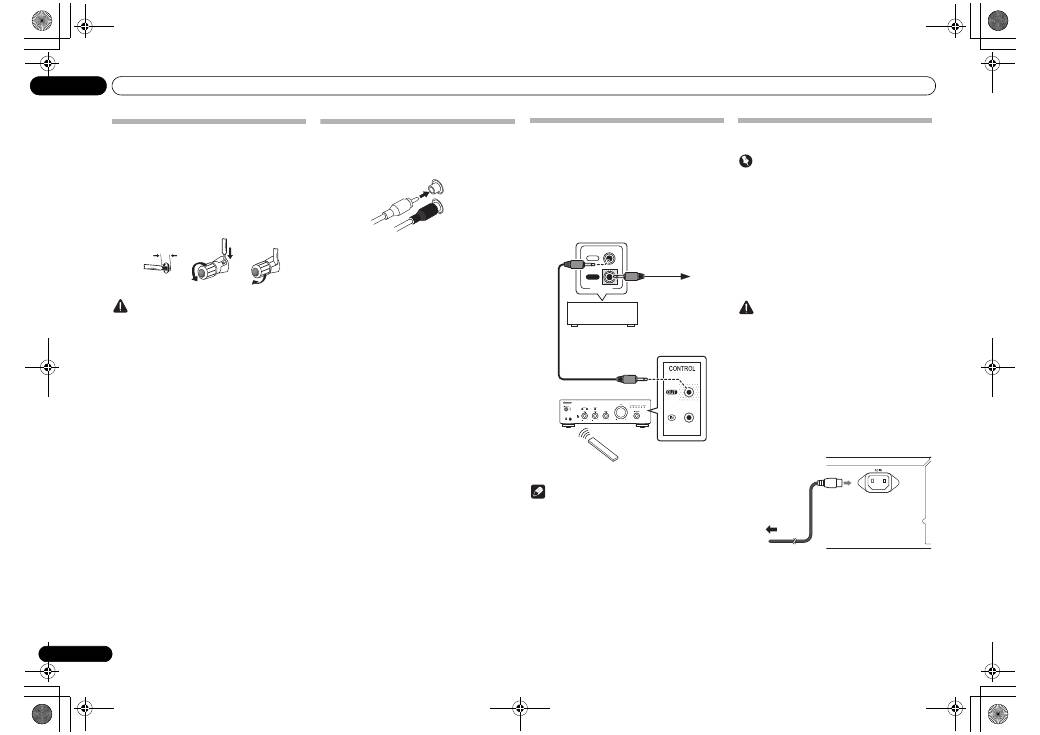
Connexion des câbles d’enceinte
1
Entortillez l’âme des câbles.
2
Desserrez l’écrou sur la borne SPEAKERS
et introduisez le câble de l’enceinte dans le
trou exposé dans la borne.
3
Resserrez l’écrou de la borne.
Attention
• Lorsque vous utilisez uniquement un jeu de
bornes de l’enceinte (SPEAKERS A ou SPEAKERS
B), ou lorsque vous utilisez des connexions
bi-câblage, l’enceinte utilisée doit disposer
d’une impédance nominale entre 4
Ω
et 16
Ω
.
Lorsque vous utilisez des jeux de bornes, les
enceintes connectées doivent disposer d’une
impédance nominale entre 8
Ω
et 32
Ω
. Pour de
plus amples informations sur la valeur de
l’impédance, consultez les instructions jointes
aux enceintes.
• Vérifiez que les bornes positive et négative (+/–) sur
l’amplificateur correspondent à celles des
enceintes.
• Les bornes des haut-parleurs sont sous une
tension ACTIVE DANGEREUSE
. Pour éviter tout
risque de décharge électrique lors du branchement
et du débranchement des câbles d’enceinte,
débranchez le cordon d’alimentation avant de
toucher des parties non isolées.
• Assurez-vous que tous les fils dénudés d’enceinte
sont entortillés ensemble et totalement introduits
dans la borne de l’enceinte. Si l’un des fils dénudés
entre en contact avec le panneau arrière,
l’alimentation sera automatiquement coupée par
mesure de sécurité.
Raccordement des câbles audio
Connectez la fiche blanche à la prise gauche (L) et la
fiche rouge à la prise droite (R). Assurez-vous de bien
brancher les fiches dans les prises.
1
2
3
10 mm
Gauche
(blanche)
Droite (rouge)
Commande centralisée avec d’autres
composants Pionner (à l’exception de
l’A-10)
De nombreux composants Pionneer dotés de prises
CONTROL IN/OUT
peuvent être connectés aux unités
A-30/A-20 centralisant la commande des composants
via le télécapteur sur l’A-30/A-20. Cette centralisation
permet d’utiliser une télécommande dont les
composants ne sont pas munis d’un télécapteur ou sont
installés à des emplacements inaccessibles par le
télécapteur.
Remarque
• Pour établir la connexion, utilisez un cordon mini-
fiche mono en vente dans le commerce (sans
résistance).
• Lors de la connexion des prises
CONTROL IN/OUT
,
des cordons audio en vente dans le commerce
doivent être utilisés pour établir les connexions
analogiques. La connexion des prises
CONTROL
IN/OUT
ne suffit pas à à assurer un contrôle
adéquat du système.
• Lorsqu’un cordon de commande est connecté à la
prise de l’A-30/A-20
CONTROL IN
, il est impossible
de contrôler l’unité en pointant la télécommande à
l’A-30/A-20 (le télécapteur est automatiquement
désactivé).
Branchement
Important
• Lorsque vous devez vous absenter ou quelle que
soit la situation où l’unité ne sera pas utilisée
pendant une longue durée, toujours déconnecter le
cordon d’alimentation de ses prises. Les réglages
internes sont toujours conservés et cela même si le
cordon d’alimentation est déconnecté de sa prise
pendant une longue période.
• Si le cordon d’alimentation doit être déconnecté,
assurez-vous d’appuyer sur le bouton
/I STANDBY/ON
sur le panneau avant de l’unité
de manière à ce que l’A-30/A-20 soit sur Arrêt (OFF)
ou l’A-10 en mode d’attente avant de retirer le
cordon.
Attention
•
L’utilisation d’un cordon d'alimentation autre que
celui fourni, annule la garantie. En conséquence,
Pionner n’endosse aucune responsabilité pour les
dommages qui pourraient survenir. (Le courant
nominal du cordon d'alimentation fourni avec le
modèle A-30 est de 10 A alors que le cordon fourni
avec A-20/A-10 est de 2,5 A).
• Ne pas utiliser de cordon d’alimentation autre que
celui fourni avec cette unit.
• Ne pas utiliser le cordon d’alimentation fourni pour
un usage que celui qui est décrit ci-dessous.
Après avoir effectué toutes les connexions, branchez
l’unité dans une prise CA.
1
Branchez le cordon d’alimentation dans
la prise AC IN située sur le panneau arrière
de l’unité.
2
Branchez l’autre extrémité dans la prise
CA.
IN
OUT
CONTROL
Vers d’autres
composants Pioneer
munis de prises
CONTROL IN/OUT
Vers d’autres
composants
Pioneer munis
d’une prise
CONTROL IN
A-30/A-20
Visez la télécommande
en direction du capteur
sur l’A-30/A-20.
Télécommande
A-30/A-20
Vers la prise CA
Cordon d’alimentation
Panneau arrière A-30
02_connecting_up.fm 6 ページ 2012年6月21日 木曜日 午後2時8分

Commandes et afficheur
03
7
Fr
English
Deutsch
Français
Nederlands
Italiano
Español
Ру
сский
Chapitre 3 :
Commandes et afficheur
Panneau avant
1
/I STANDBY/ON
Ce bouton permet de mettre l’amplificateur sous/hors
tension.
Lors de la mise sous tension, l’indicateur au centre du
bouton s’allume.
• Sur un modèle A-10, ce bouton permet de mettre
l’amplificateur sous tension et en veille.
2
Indicateur STANDBY/APD
Lorsque l’alimentation est en mode veille, l’indicateur
s’allume en rouge. Lorsque la fonction de mise hors
tension automatique (APD) est activée, l’indicateur
s’allume en vert (page 11).
3
Bouton/indicateur SPEAKERS A
Ce bouton permet d’écouter le système d’enceinte
connecté aux bornes
SPEAKERS A
.
On
: L’indicateur s’allume. Le son est entendu du
système d’enceinte. (Le son sera également émis de la
prise
PHONES
).
Off
: L’indicateur s’éteint. Aucun son n’est entendu du
système d’enceinte. Réglez à cette position lorsque vous
utilisez des écouteurs.
4
Bouton/indicateur SPEAKERS B
Ce bouton permet d’écouter le système d’enceinte
connecté aux bornes
SPEAKERS B
.
On
: L’indicateur s’allume. Le son est entendu du
système d’enceinte. (Le son sera également émis de la
prise
PHONES
).
Off
: L’indicateur s’éteint. Aucun son n’est entendu du
système d’enceinte. Réglez à cette position lorsque vous
utilisez des écouteurs.
5
Bouton/indicateur LOUDNESS
Utilisez lorsque vous utilisez à des niveaux faibles.
On
: L’indicateur s’allume : Augmente les fréquences
hautes et basses pour donner du punch aux lectures
même à niveau sonore faible.
Off
: L’indicateur s’éteint: Doit en principe rester dans
cette position.
• Ce bouton ne fonctionne pas lorsque le bouton
DIRECT
est en position de marche.
• Lorsque vous augmentez le son, la quantité de
changement produit par le circuit
LOUDNESS
est
réduite.
3
1
6
2
5
4
7
13
14
9
10
11
12
8
A-30
6
Capteur de télécommande
(à l’exception de l’A-10)
Reçoit les signaux émis par la télécommande (page 4).
7
Prise PHONES
Utilisez pour connecter des écouteurs. Pas de son
produit lorsque le bouton
POWER AMP DIRECT
est sur
ON.
8
Bouton/indicateur DIRECT
On
: L’indicateur s’allume : Lorsque ce bouton est sur
ON, les signaux sonores sont émis directement sans
passer par les divers circuits de réglage (
BASS
,
TREBLE
,
BALANCE
,
LOUDNESS
). Les signaux sont ainsi
reproduits très fidèlement mais les réglages effectués
avec les commandes
BASS
,
TREBLE
,
BALANCE
ou
LOUDNESS
sont ignorés.
Off
: L’indicateur s’éteint: Le signal passe par divers
circuits d’ajustement de fréquence. Lorsque l’indicateur
est sur OFF, les réglages peuvent être effectués avec les
commandes
BASS
,
TREBLE
,
BALANCE
et
LOUDNESS
.
9
Commande de la tonalité BASS
Utilisez pour régler la tonalité basse fréquence. La
position centrale correspond à une position plate
(normale). Lorsque vous tournez sur la droite, les
tonalités basse fréquence sont accentuées; lorsque
vous tournez sur la gauche, les tonalités basse
fréquence sont atténuées.
• Ce bouton ne fonctionne pas lorsque le bouton
DIRECT
est en position de marche.
10 Commande de la tonalité TREBLE
Utilisez pour régler la tonalité haute fréquence. La
position centrale correspond à une position plate
(normale). Lorsque vous tournez sur la droite, les
tonalités haute fréquence sont accentuées; lorsque vous
tournez sur la gauche, les tonalités haute fréquence sont
atténuées.
• Ce bouton ne fonctionne pas lorsque le bouton
DIRECT
est en position de marche.
11
Commande
BALANCE
Doit en principe rester au centre. Réglez l’équilibre si le
son est plus fort d’une enceinte que de l’autre. Si le côté
droit est plus fort, tournez vers la gauche (L) et si le côté
gauche est plus fort, tournez vers la droite (R).
• Ce bouton ne fonctionne pas lorsque le bouton
DIRECT
est en position de marche.
12 Commandes du VOLUME
Utilisez pour régler le niveau du volume. (Permet
également d’effectuer des réglages du volume sonore
des écouteurs.)
13 Touche/indicateur INPUT SELECTOR
Tournez le bouton dans le sens horaire ou anti-horaire
de manière à ce que l’indicateur s’allume pour la source
d’entrée souhaitée. Tournez le bouton dans le sens
horaire pour que l’indicateur s’allume sur la droite.
Tournez dans le sens anti-horaire pour que l’indicateur
s’allume sur la gauche. Lorsque vous appuyez sur le
bouton de la télécommande
MUTE
pour mettre le son
en sourdine, l’indicateur de la source d’entrée
sélectionné avec le bouton
INPUT SELECTOR
se met à
clignoter.
14 Bouton/indicateur POWER AMP DIRECT
(A-30 uniquement)
Appuyez sur ce bouton lorsque l’A-30 sera utilisé
comme amplificateur de la puissance (page 10).
A30_SYXE8-Fr.book Page 7 Thursday, February 16, 2012 11:51 AM
03
Commandes et afficheur
8
Fr
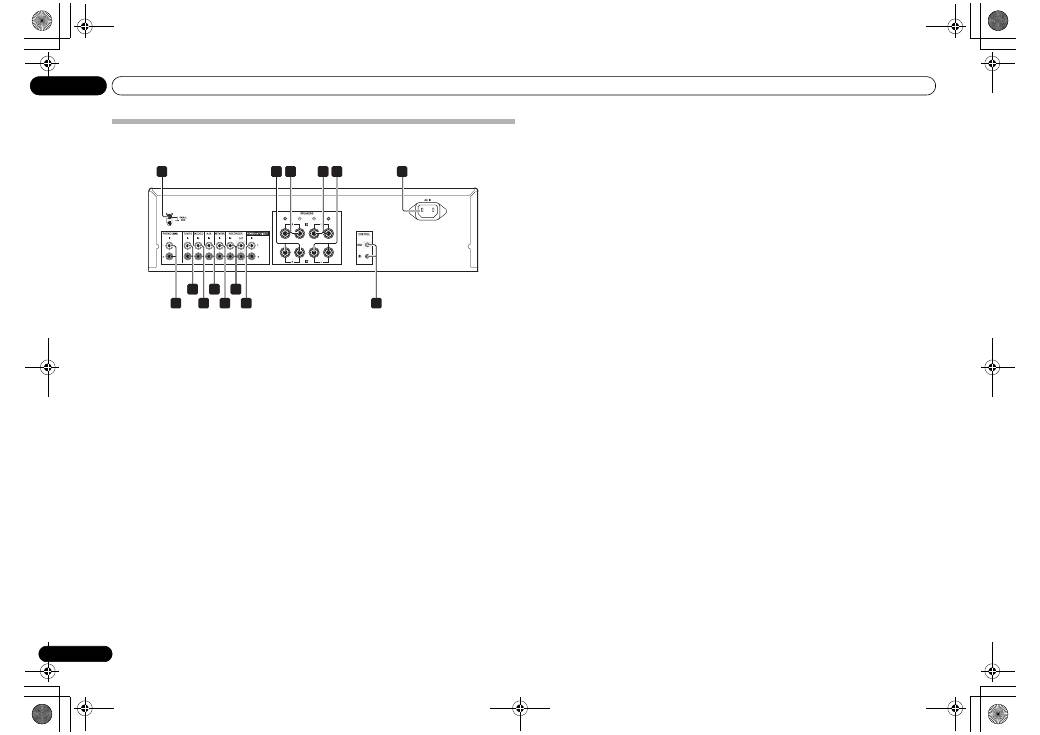
Panneau arrière
Pour de plus amples informations sur les connexions, voir les pages 5-6.
1
Borne GND (mise à la terre de la platine)
Cette borne de terre a été conçue pour réduire le bruit
lorsqu’une platine est branchée. Il ne s’agit pas d’une
mise à la terre de sécurité.
2
SPEAKERS A bornes (canal droit)
3
SPEAKERS B bornes (canal droit)
4
SPEAKERS B bornes (canal gauche)
5
SPEAKERS A bornes (canal gauche)
6
Prise AC IN
Connectez le cordon d’alimentation ici et à une prise
murale CA.
7
PHONO (MM) IN bornes
8
TUNER IN bornes
9
SACD/CD IN bornes
10 AUX IN bornes
11 NETWORK IN bornes
12 RECORDER IN/OUT bornes
13 POWER AMP DIRECT IN bornes
(A-30 uniquement)
Lorsque vous utilisez l’A-30 comme amplificateur de la
puissance, connectez le pré-amplificateur ici (page 10).
14 CONTROL IN/OUT prise
(à l’exception de l’A-10)
A-30
1
6
7
2
8
2
10
9
13
11
2
12
2
14
2
2
3
2
4
2
5
A30_SYXE8-Fr.book Page 8 Thursday, February 16, 2012 11:51 AM


