
Dell Precision 380: инструкция
Раздел: Компьютерная техника, комплектующие, аксессуары
Тип: Монитор
Инструкция к Монитору Dell Precision 380
Оглавление
- Примечания, уведомления и предупреждения Сокращения и аббревиатуры
- Содержание
- Источники информации Что требуется найти? Информация находится здесь
- Что требуется найти? Информация находится здесь
- Что требуется найти? Информация находится здесь
- Что требуется найти? Информация находится здесь
- Установка компьютера (ориентация компьютера с корпусом Tower) 1 2
- 3
- Видеоплата для подключения одного и двух мониторов, с одним разъемом Адаптер для двух кабелей VGA: Адаптер для подключения двух кабелей DVI:
- Видеоплата для подключения двух мониторов с одним разъемом DVI и одним разъемом VGA Видеоплата с двумя разъемами DVI для подключения двух мониторов
- 4 5
- 6 Установка компьютера (ориентация настольного компьютера) 1
- 2 3
- Видеоплата для подключения одного и двух мониторов, с одним разъемом Адаптер для двух кабелей VGA: Адаптер для подключения двух кабелей DVI:
- Видеоплата для подключения двух мониторов с одним разъемом DVI и одним разъемом VGA Видеоплата с двумя разъемами DVI для подключения двух мониторов
- 4 5 6
- Информация о компьютере Вид спереди (ориентация компьютера с корпусом Tower) 5 индикатор обращения к жесткому диску
- 14 индикатор сетевого соединения
- Вид сзади (ориентация компьютера с корпусом Tower)
- Вид спереди (ориентация настольного компьютера)
- 12 индикатор сетевого соединения
- Вид сзади (ориентация настольного компьютера) Разъемы на задней панели
- 5 индикатр обращения к сети
- 12 разъем клавиатуры Подключайте стандартную клавиатуру к фиолетовому разъему клавиатуры. USB-клавиатуру следует подключать к разъему USB.
- Вид изнутри
- Цвет кабелей Компоненты системной платы
- Поиск руководства пользователя
- Снятие крышки корпуса компьютера
- Уход за компьютером
- Устранение неисправностей Советы по поиску и устранению неисправностей Разрешение вопросов несовместимости программного и аппаратного обеспечения Использование функции восстановления системы Microsoft Windows XP
- Создание точки восстановления Восстановление более раннего рабочего состояния компьютера Отмена последнего восстановления системы
- Включение восстановления системы Использование последней удачной конфигурации Другие возможности решения конфликтов программного обеспечения и оборудования Dell Diagnostics Когда использовать программу Dell Diagnostics
- Запуск программы Dell Diagnostics с жесткого диска Запуск программы Dell Diagnostics с компактдиска Drivers and Utilities (Драйверы и Утилиты)
- Перед началом тестирования Звуковые сигналы Код Причина
- Код Причина
- Сообщения об ошибках Индикаторы диагностики Индикаторы Описание проблемы Варианты решения
- Индикаторы Описание проблемы Варианты решения
- Индикаторы Описание проблемы Варианты решения
- Индикаторы Описание проблемы Варианты решения
- Индикаторы Описание проблемы Варианты решения
- Индикаторы Описание проблемы Варианты решения
- Часто задаваемые вопросы Как сделать... Решение Источник информации
- Как сделать... Решение Источник информации
- Указатель

Dell Precision™ Workstation 380
Quick Reference Guide
Model DCTA
www.dell.com | support.dell.com

Notes, Notices, and Cautions
NOTE: A NOTE indicates important information that helps you make better use of your computer.
NOTICE: A NOTICE indicates either potential damage to hardware or loss of data and tells you how to avoid the
problem.
CAUTION: A CAUTION indicates a potential for property damage, personal injury, or death.
Abbreviations and Acronyms
For a complete list of abbreviations and acronyms, see the Glossary in your
User’s Guide
.
®
®
If you purchased a Dell™ n Series computer, any references in this document to Microsoft
Windows
operating systems are not applicable.
____________________
Information in this document is subject to change without notice.
© 2005 Dell Inc. All rights reserved.
Reproduction in any manner whatsoever without the written permission of Dell Inc. is strictly forbidden.
Trademarks used in this text: Dell, the DELL logo, and Dell Precision are trademarks of Dell Inc.; Intel and Pentium are registered trademarks
of Intel Corporation; Microsoft and Windows are registered trademarks of Microsoft Corporation.
Other trademarks and trade names may be used in this document to refer to either the entities claiming the marks and names or their products.
Dell Inc. disclaims any proprietary interest in trademarks and trade names other than its own.
Model DCTA
May 2005 P/N M8559 Rev. A01

Contents
Finding Information . . . . . . . . . . . . . . . . . . . . . . . . . . . . . . . . 5
Setting Up Your Computer (Tower Orientation)
. . . . . . . . . . . . . . . . . . 9
Setting Up Your Computer (Desktop Orientation)
. . . . . . . . . . . . . . . . 14
About Your Computer
. . . . . . . . . . . . . . . . . . . . . . . . . . . . . . . 19
Front View (Tower Orientation)
. . . . . . . . . . . . . . . . . . . . . . . 19
Back View (Tower Orientation)
. . . . . . . . . . . . . . . . . . . . . . . 21
Front View (Desktop Orientation)
. . . . . . . . . . . . . . . . . . . . . . 22
Back View (Desktop Orientation)
. . . . . . . . . . . . . . . . . . . . . . 24
Back-Panel Connectors
. . . . . . . . . . . . . . . . . . . . . . . . . . 24
Inside View
. . . . . . . . . . . . . . . . . . . . . . . . . . . . . . . . . 27
System Board Components
. . . . . . . . . . . . . . . . . . . . . . . . . . . . 28
Locating Your User’s Guide
. . . . . . . . . . . . . . . . . . . . . . . . . . . 29
Removing the Computer Cover
. . . . . . . . . . . . . . . . . . . . . . . . . . 30
Caring for Your Computer
. . . . . . . . . . . . . . . . . . . . . . . . . . . . 31
Solving Problems
. . . . . . . . . . . . . . . . . . . . . . . . . . . . . . . . 32
Troubleshooting Tips
. . . . . . . . . . . . . . . . . . . . . . . . . . . . 32
Resolving Software and Hardware Incompatibilities
. . . . . . . . . . . 32
®
®
Using Microsoft
Windows
XP System Restore . . . . . . . . . . . . . 32
Using the Last Known Good Configuration
. . . . . . . . . . . . . . . . . 34
Dell Diagnostics
. . . . . . . . . . . . . . . . . . . . . . . . . . . . . . . 34
Before You Start Testing
. . . . . . . . . . . . . . . . . . . . . . . . . . 36
Beep Codes
. . . . . . . . . . . . . . . . . . . . . . . . . . . . . . . . . . . . 36
Error Messages
. . . . . . . . . . . . . . . . . . . . . . . . . . . . . . . 37
Diagnostic Lights
. . . . . . . . . . . . . . . . . . . . . . . . . . . . . . . . . 37
Frequently Asked Questions
. . . . . . . . . . . . . . . . . . . . . . . . . . . 42
Index . . . . . . . . . . . . . . . . . . . . . . . . . . . . . . . . . . . . . . . . . 45
Contents 3

4 Contents
Finding Information
NOTE: Some features may not be available for your computer or in certain countries.
NOTE: Additional information may ship with your computer.
What Are You Looking For? Find It Here
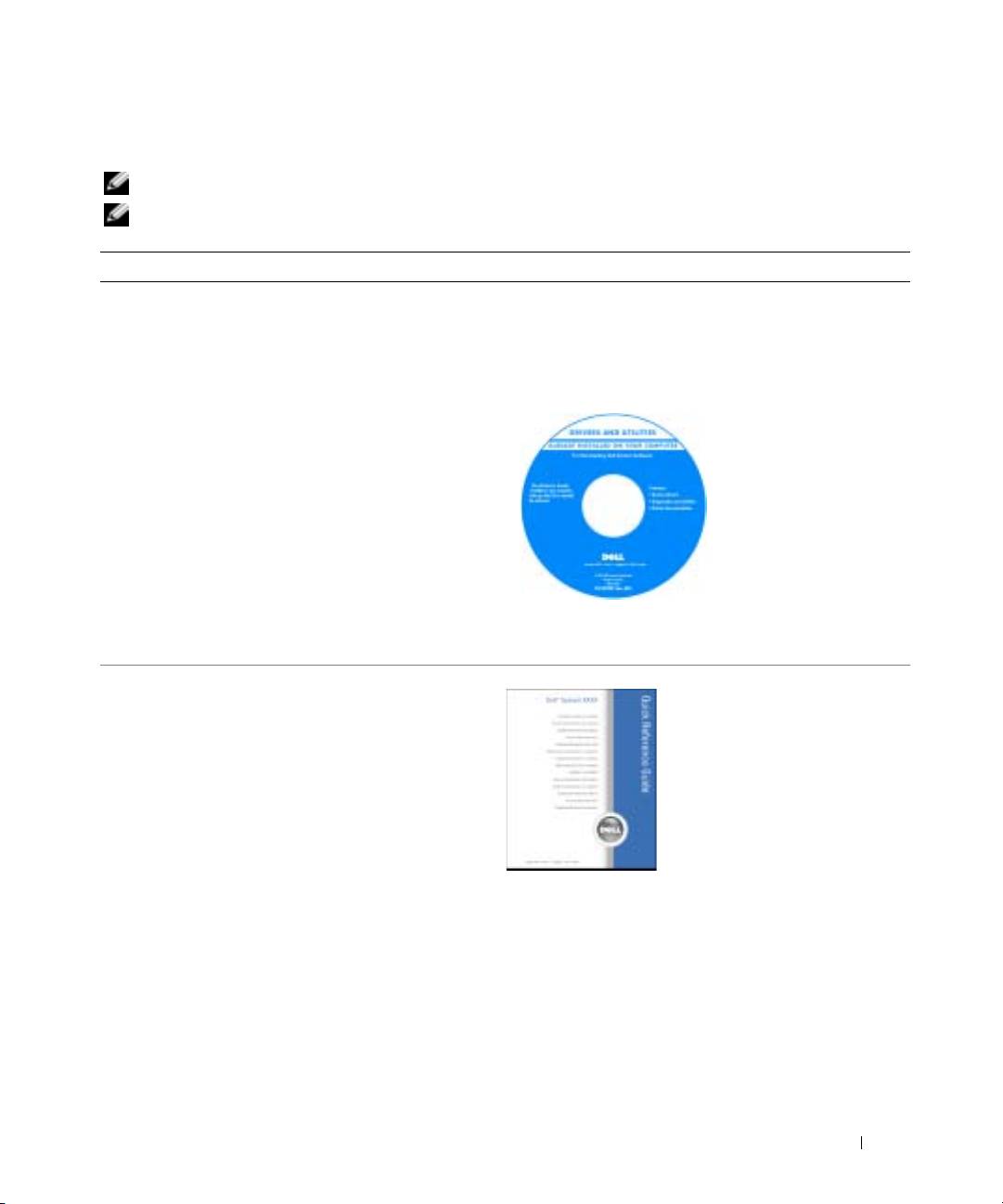
• A diagnostic program for my computer
Drivers and Utilities CD (also known as ResourceCD)
• Drivers for my computer
Documentation and drivers are already installed on your
• My computer documentation
computer. You can use the CD to reinstall drivers, run the
• My device documentation
"Dell Diagnostics" on page 34, or access your
documentation.
• Desktop System Software (DSS)
Readme files may be
included on your CD to
provide last-minute
updates about technical
changes to your
computer or advanced
technical-reference
material for technicians
or experienced users.
NOTE: Drivers and documentation updates can be found at
support.dell.com.
• How to set up my computer
Quick Reference Guide
• How to care for my computer
• Basic troubleshooting information
• How to run the Dell Diagnostics
• Error codes and diagnostic lights
• How to remove and install parts
• How to open my computer cover
NOTE: This document is available as a PDF at
support.dell.com.
Quick Reference Guide 5
What Are You Looking For? Find It Here
• Warranty information
Dell™ Product Information Guide
• Terms and Conditions (U.S. only)
• Safety instructions
• Regulatory information
• Ergonomics information
• End User License Agreement
www.dell.com | support.dell.com
• How to remove and replace parts
User’s Guide
• Specifications
®
®
Microsoft
Windows
XP Help and Support Center
• How to configure system settings
1
Click the
Start
button and click
Help and Support
.
• How to troubleshoot and solve problems
2
Click
User’s and system guides
and click
User’s guides
.
The User’s Guide is also available on the
Drivers and
Utilities
CD
.
®
®
• Service Tag and Express Service Code
Service Tag and Microsoft
Windows
License
• Microsoft Windows License Label
These labels are located on your computer.
• Use the Service Tag to
identify your
computer when you
use
support.dell.com
or contact technical
support.
• Enter the Express
Service Code to direct
your call when
contacting technical
support.
6 Quick Reference Guide

What Are You Looking For? Find It Here
• Solutions — Troubleshooting hints and tips, articles
Dell Support Website — support.dell.com
from technicians, online courses, frequently asked
NOTE: Select your region to view the appropriate support
questions
site.
• Community — Online discussion with other Dell
NOTE: Corporate, government, and education customers
customers
can also use the customized Dell Premier Support website
• Upgrades — Upgrade information for components, such
at premier.support.dell.com. The website may not be
as memory, the hard drive, and the operating system
available in all regions.
• Customer Care — Contact information, service call and
order status, warranty, and repair information
• Service and support — Service call status and support
history, service contract, online discussions with
technical support
• Reference — Computer documentation, details on my
computer configuration, product specifications, and
white papers
• Downloads — Certified drivers, patches, and software
updates
• Desktop System Software (DSS) — If you reinstall the
operating system for your computer, you should also
reinstall the DSS utility. DSS provides critical updates
for your operating system and support for Dell™
®
®
3.5-inch USB floppy drives, Intel
Pentium
M
processors, optical drives, and USB devices. DSS is
necessary for correct operation of your Dell computer.
The software automatically detects your computer and
operating system and installs the updates appropriate
for your configuration.
To download Desktop System Software:
1
Go to
support.dell.com
and click
Downloads
.
2
Enter your Service Tag or product model.
3
In the
Download Category
drop-down menu, click
All
.
4
Select the operating system and operating system
language for your computer, and click
Submit.
Under
Select a Device
, scroll to
System and
Configuration Utilities
, and click
Dell Desktop System
Software
.
• How to use Windows XP
Windows Help and Support Center
• Documentation for my computer
1
Click the
Start
button and click
Help and Support
.
• Documentation for devices (such as a modem)
2
Type a word or phrase that describes your problem and
click the arrow icon.
3
Click the topic that describes your problem.
4
Follow the instructions on the screen.
Quick Reference Guide 7

What Are You Looking For? Find It Here
• How to reinstall my operating system
Operating System CD
The operating system is already installed on your
computer. To reinstall your operating system, use the
Operating System CD. See your User’s Guide for
instructions.
After you reinstall your
operating system, use the
optional Drivers and
Utilities CD to reinstall
drivers for the devices
that came with your
www.dell.com | support.dell.com
computer.
Your operating system
product key label is
located on your
computer.
NOTE: The color of your CD varies based on the operating
system you ordered.
NOTE: The Operating System CD is optional and may not
ship with your computer.
• How to use Linux
Dell Supported Linux Sites
• E-mail discussions with users of Dell Precision™
• Linux.dell.com
products and the Linux operating system
• Lists.us.dell.com/mailman/listinfo/linux-precision
• Additional information regarding Linux and my Dell
Precision computer
8 Quick Reference Guide
Setting Up Your Computer (Tower Orientation)
CAUTION: Before you begin any of the procedures in this section, follow the safety instructions in the
Product Information Guide.
You must complete all steps to properly set up your computer.
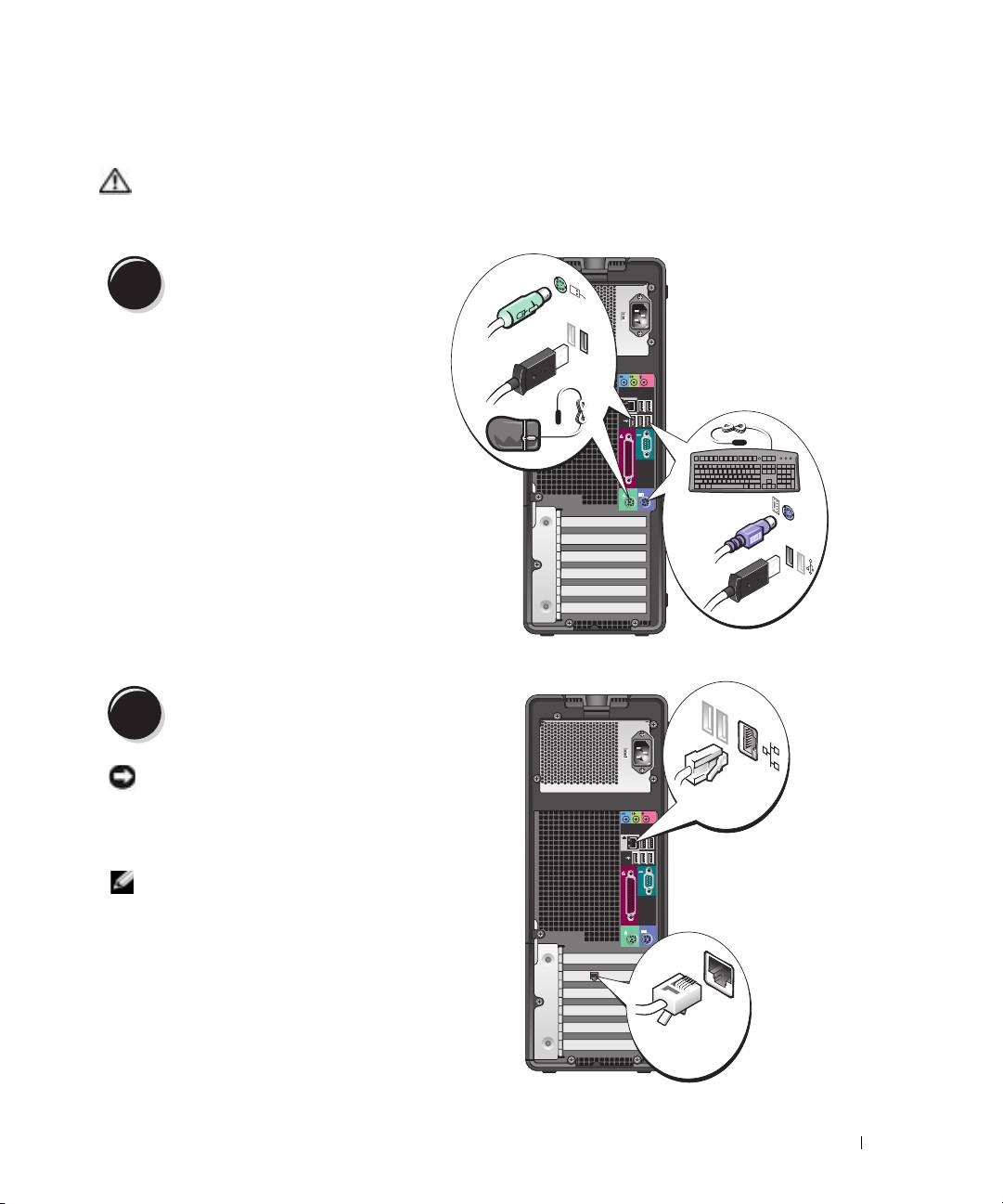
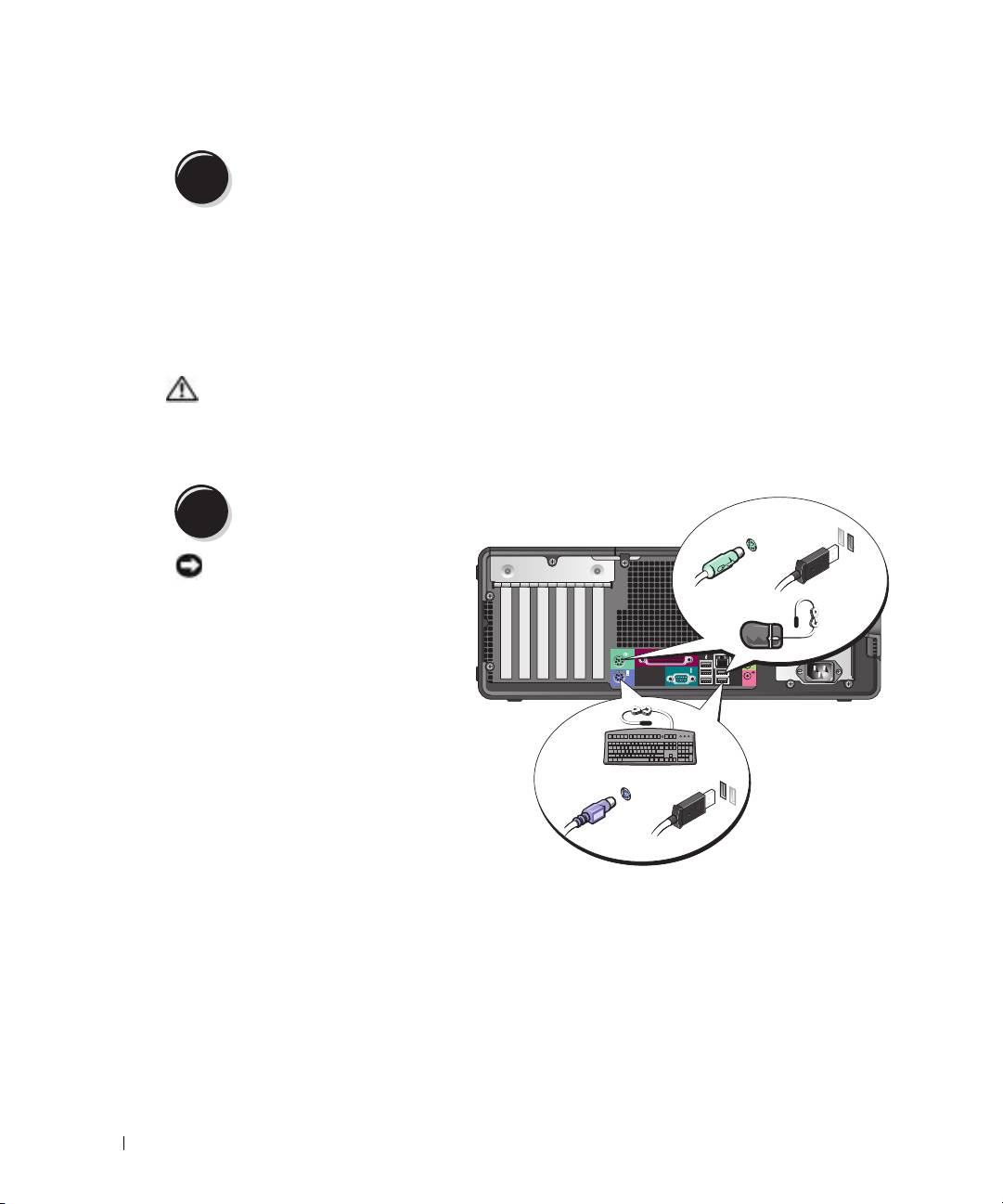
Connect the keyboard and the mouse.
1
PS/2
or
USB
PS/2
or
USB
Connect the modem or the network cable.
2
NOTICE: Do not connect a modem cable to the
network adapter. Voltage from telephone
Network
communications can damage the network adapter.
NOTE: If your computer has a network card installed,
connect the network cable to the card.
Modem
Quick Reference Guide 9
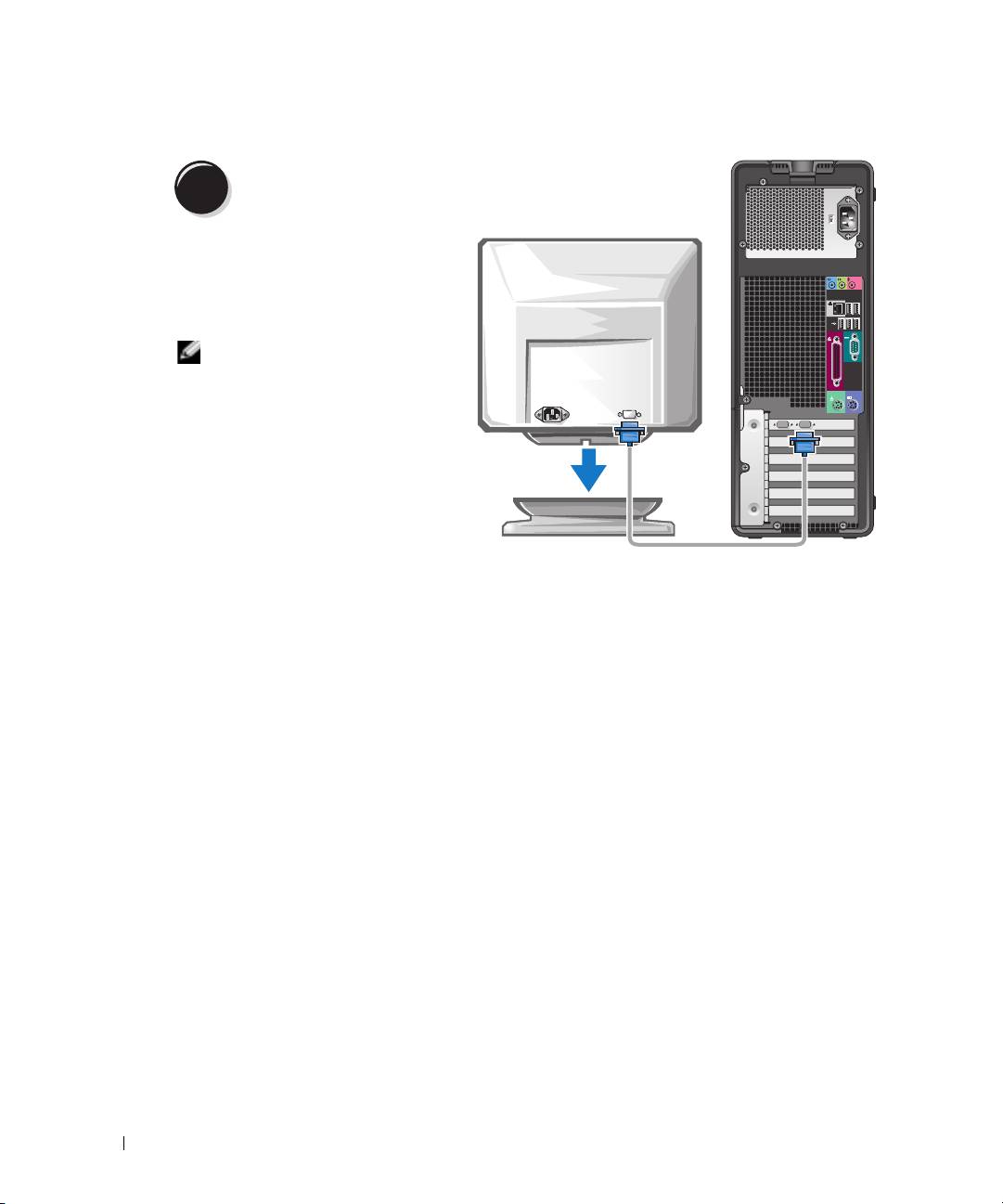
Connect the monitor.
3
Depending on your graphics
card, you can connect your
monitor in various ways.
NOTE: You may need to use
the provided adapter or
cable to connect your
www.dell.com | support.dell.com
monitor to the computer.
10 Quick Reference Guide
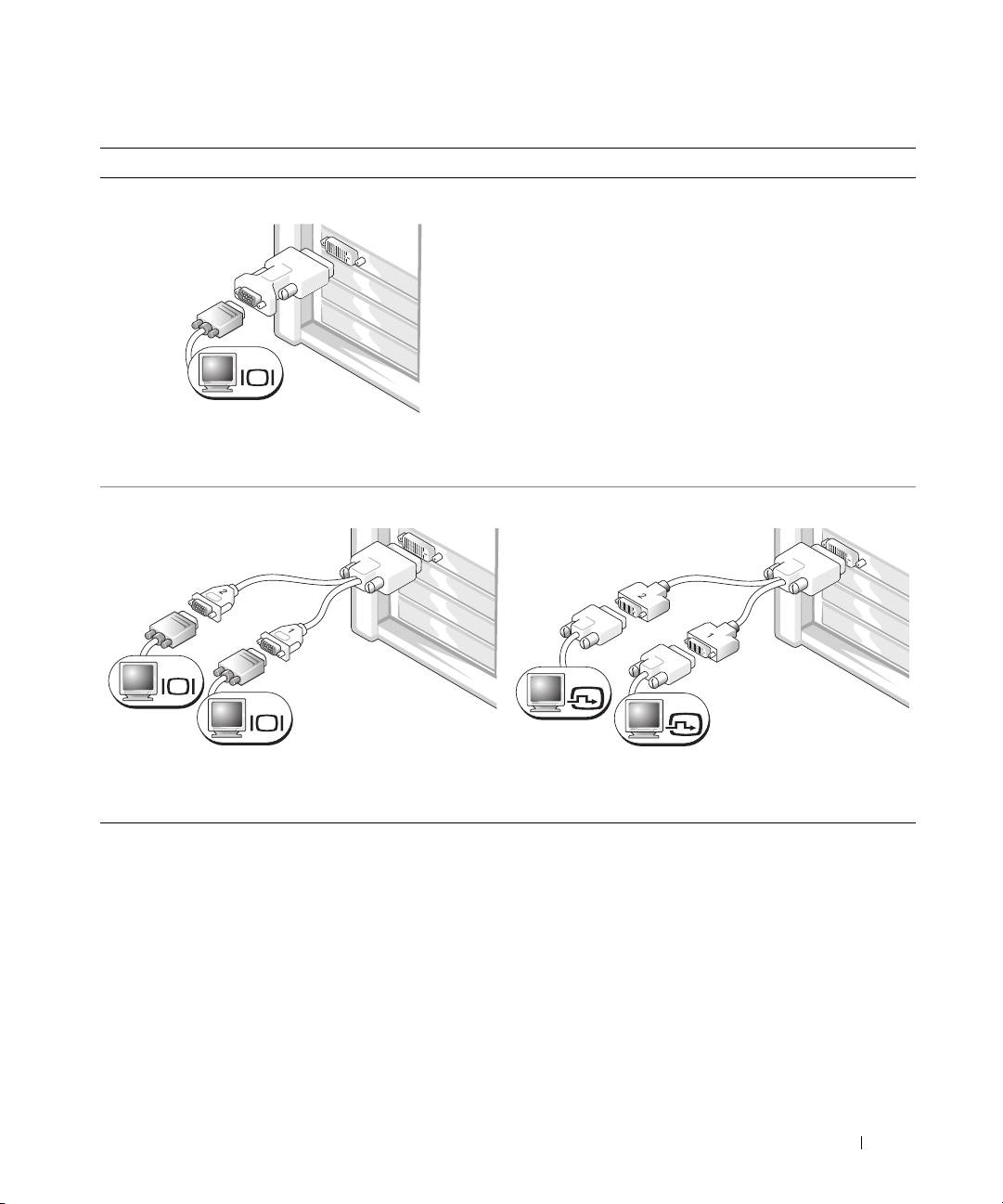
For single- and dual-monitor capable cards with a single connector
One VGA adapter:
VGA
Use the VGA adapter when you have a single-monitor
graphics card and you want to connect your computer to a
VGA monitor.
Dual VGA Y cable adapter:
Dual DVI Y cable adapter:
VGA
DVI
VGA
DVI
Use the appropriate Y cable when your graphics card has a
Use the appropriate Y cable when your graphics card has a
single connector and you want to connect your computer
single connector and you want to connect your computer
to one or two VGA monitors.
to one or two DVI monitors.
The dual-monitor cable is color-coded; the blue connector is for the primary monitor, and the black
connector is for the second monitor. To enable dual-monitor support, both monitors must be
attached to the computer when you start the computer.
Quick Reference Guide 11
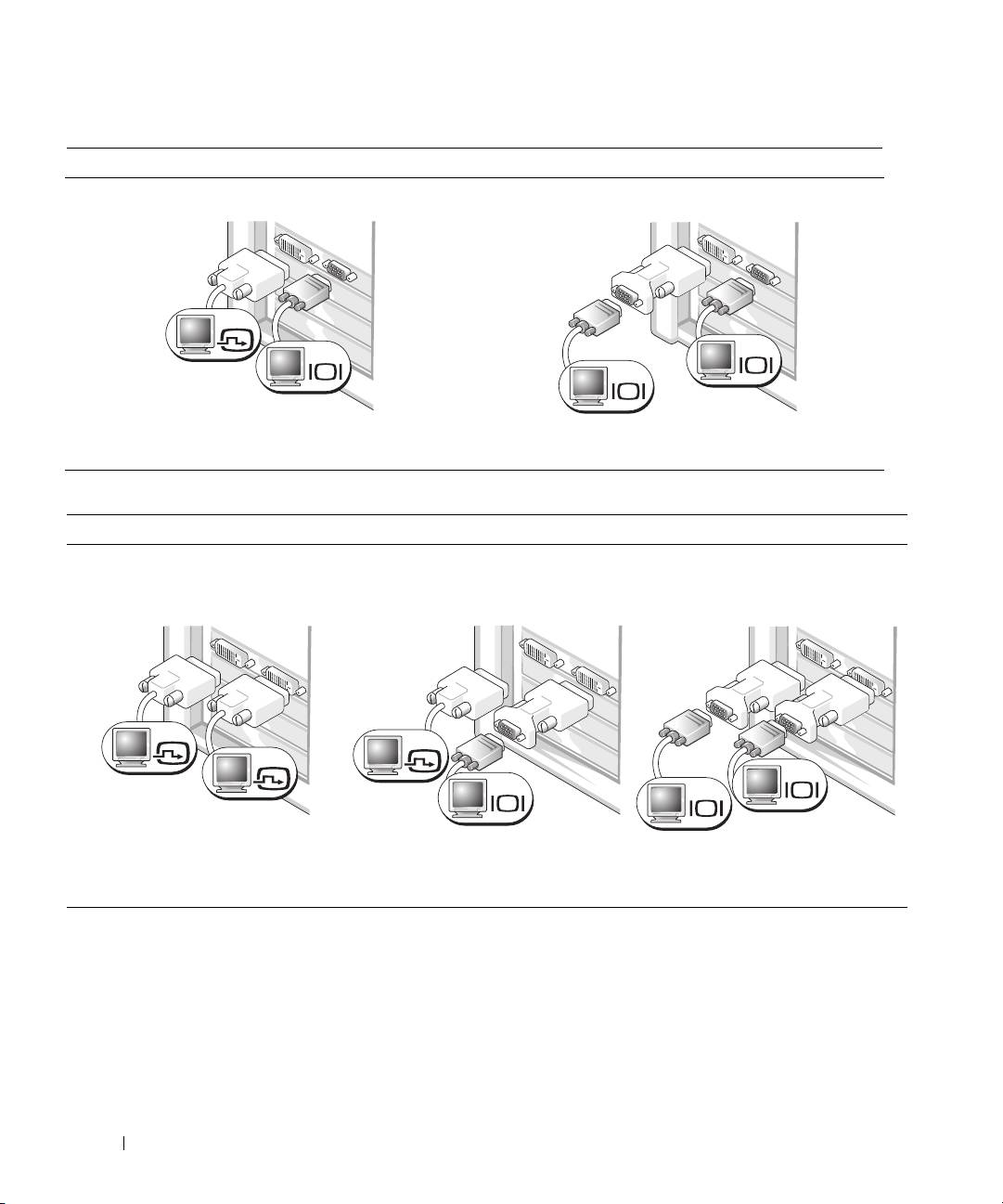
For dual-monitor capable cards with one DVI connector and one VGA connector
One DVI connector and one VGA connector:
Two VGA connectors with one VGA adapter:
DVI
VGA
VGA
VGA
www.dell.com | support.dell.com
Use the appropriate connector(s) when you want to
Use the VGA adapter when you want to connect your
connect your computer to one or two monitors.
computer to two VGA monitors.
For dual-monitor capable cards with two DVI connectors
Two DVI connectors:
Two DVI connectors with one VGA
Two DVI connectors with two VGA
adapter:
adapters:
DVI
DVI
DVI
VGA
VGA
VGA
Use the DVI connectors to connect
Use the VGA adapter to connect a
Use two VGA adapters to connect two
your computer to one or two DVI
VGA monitor to one of the DVI
VGA monitors to the DVI connectors
monitors.
connectors on your computer
on your computer.
12 Quick Reference Guide
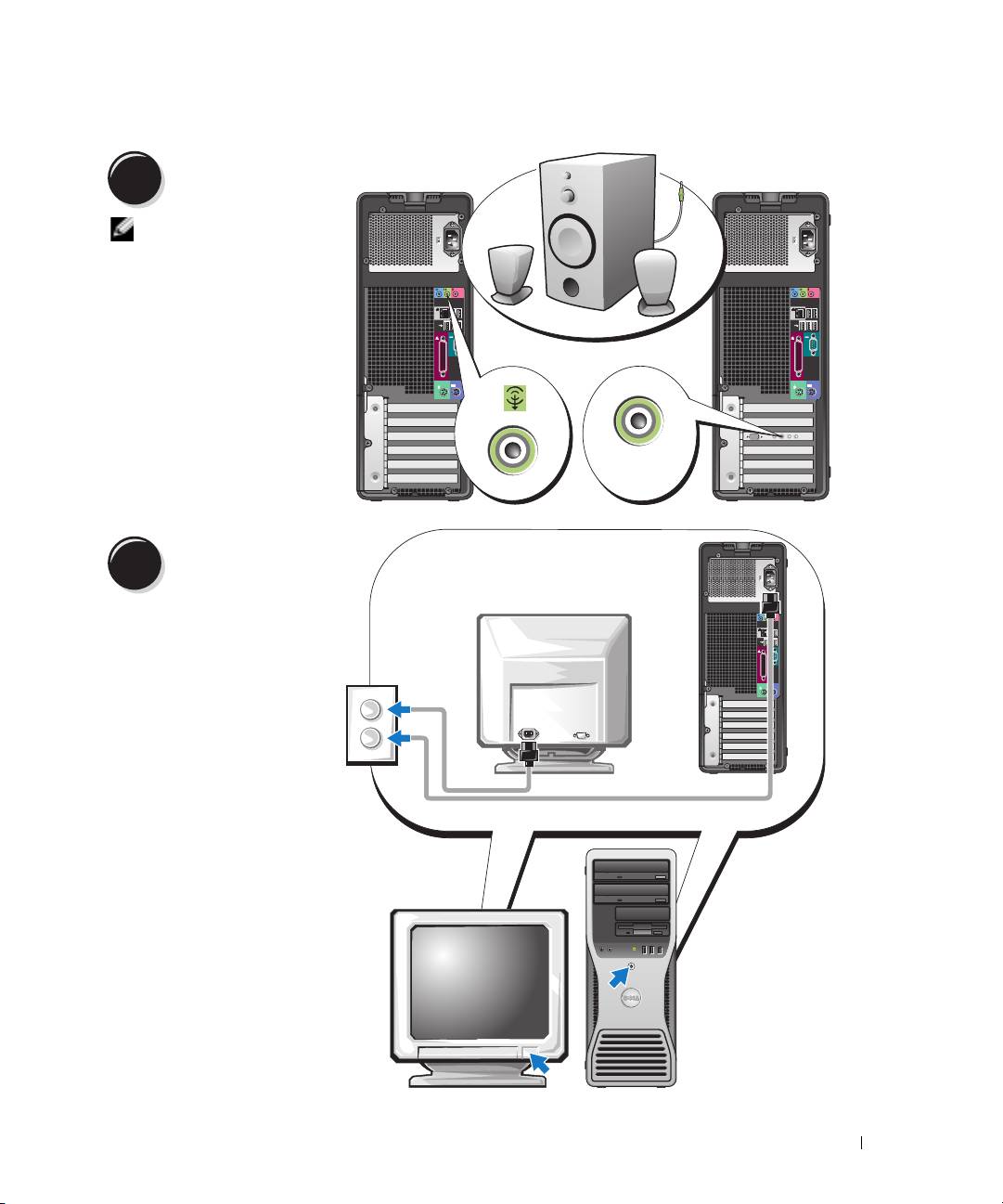
Connect the speakers.
4
NOTE: If your
computer has a sound
card installed, connect
the speakers to the
card.
LINE OUT
Connect the power
cables and turn on the
5
computer and monitor.
1234
Quick Reference Guide 13
Install additional software or devices.
6
Before you install any devices or software that did not come with your computer, read the
documentation that came with the software or device or contact the vendor to verify that the
software or device is compatible with your computer and operating system.
You have now completed the setup for your tower computer.
Setting Up Your Computer (Desktop Orientation)
CAUTION: Before you begin any of the procedures in this section, follow the safety instructions in the
www.dell.com | support.dell.com
Product Information Guide.
You must complete all steps to properly set up your computer.
Connect the keyboard and the
1
mouse.
PS/2
or
USB
NOTICE: Do not connect a
modem cable to the network
adapter. Voltage from
telephone communications
can damage the network
adapter.
PS/2
USB
or
14 Quick Reference Guide
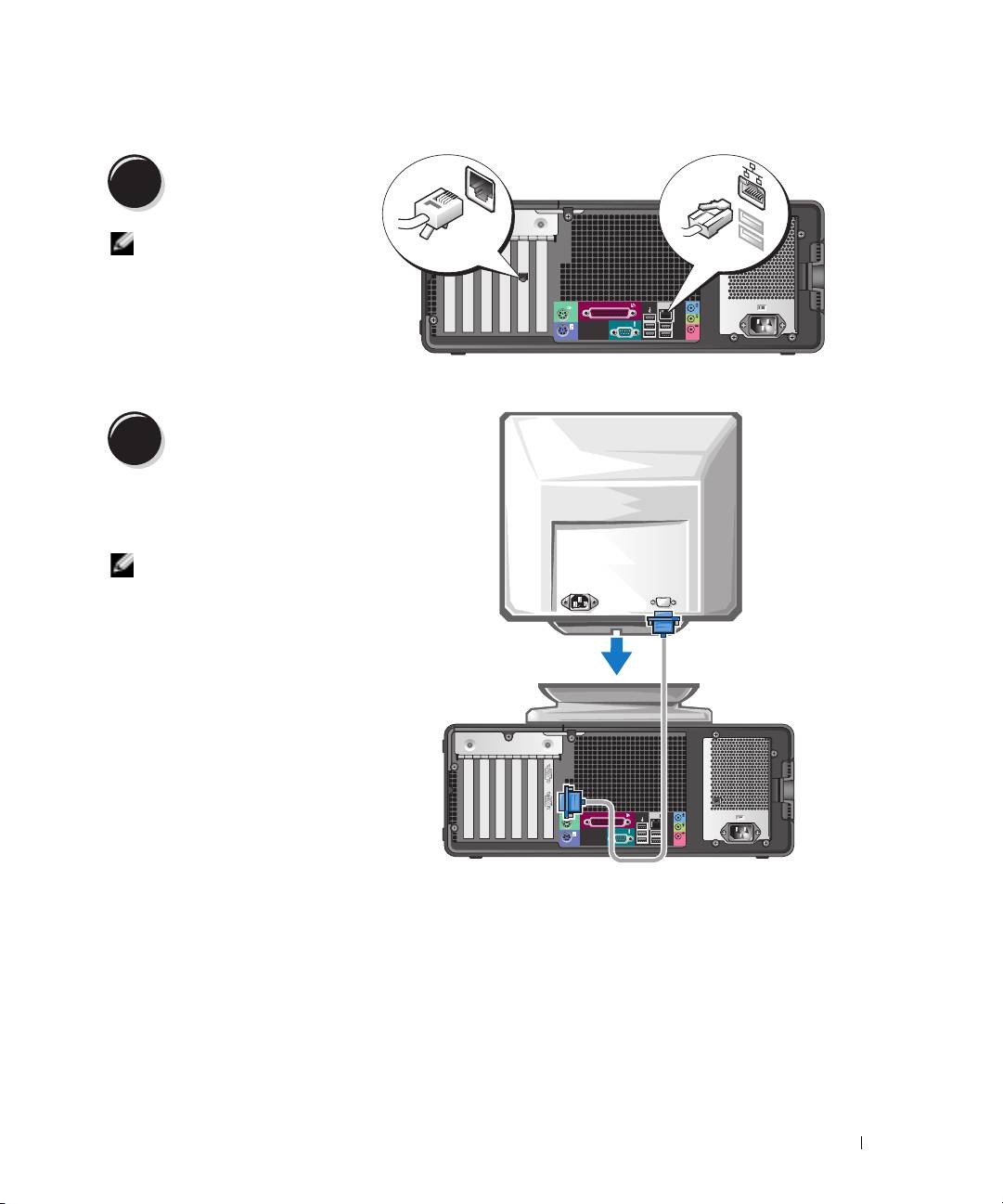
Connect the modem or the
2
network cable.
NOTE: If your computer
Modem
Network
has a network card
installed, connect the
network cable to the card.
Connect the monitor.
3
Depending on your graphics card, you
can connect your monitor in various
ways.
NOTE: You may need to use the
provided adapter or cable to connect
your monitor to the computer.
Quick Reference Guide 15
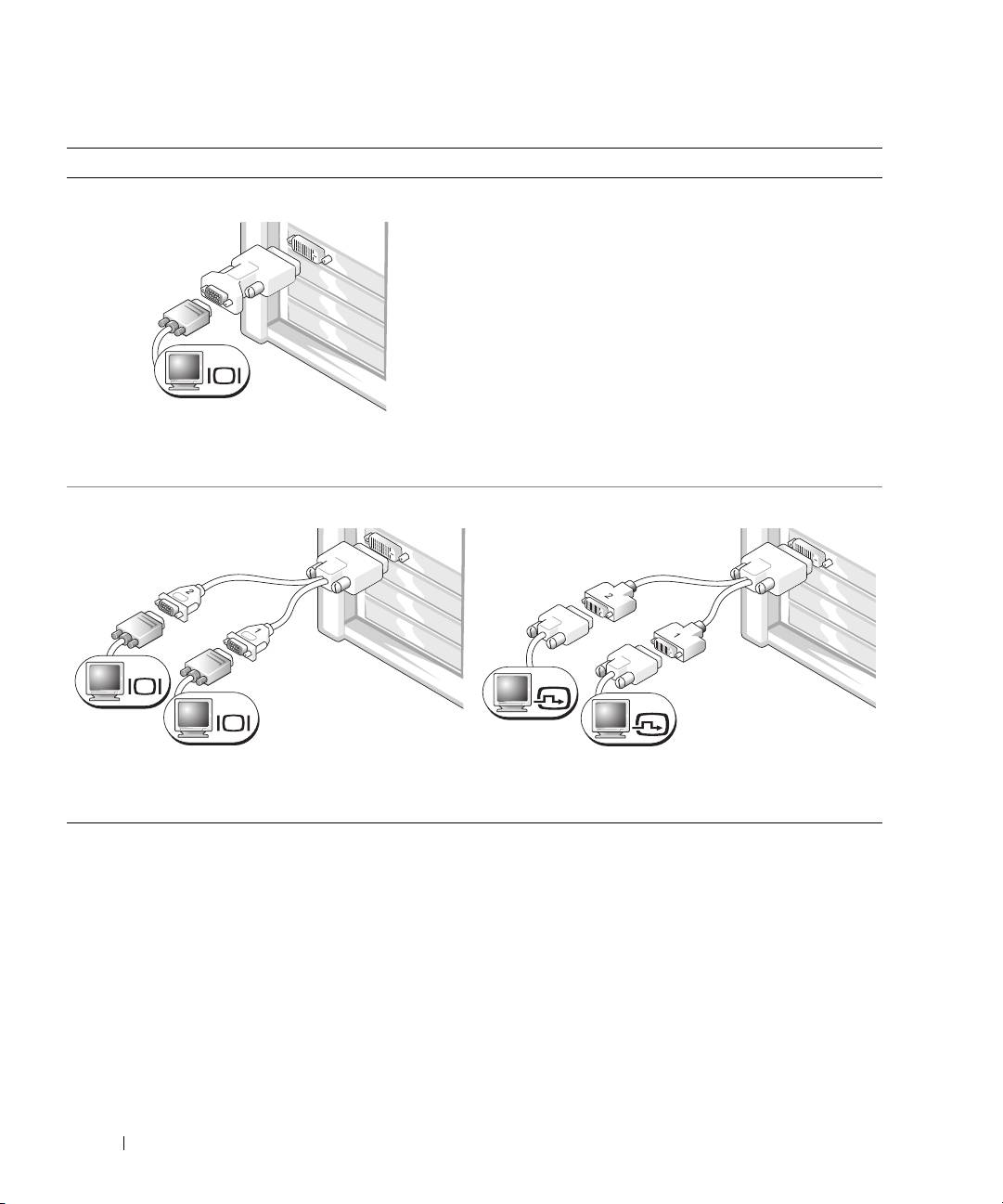
For single- and dual-monitor capable cards with a single connector
VGA adapter:
VGA
www.dell.com | support.dell.com
Use the VGA adapter when you have a single monitor
graphics card and you want to connect your computer to a
VGA monitor.
Dual VGA Y cable adapter:
Dual DVI Y cable adapter:
VGA
DVI
VGA
DVI
Use the appropriate Y cable when your graphics card has a
Use the appropriate Y cable when your graphics card has a
single connector and you want to connect your computer
single connector and you want to connect your computer
to one or two VGA monitors.
to one or two DVI monitors.
The dual-monitor cable is color-coded; the blue connector is for the primary monitor, and the black
connector is for the second monitor. To enable dual-monitor support, both monitors must be
attached to the computer when you start your computer.
16 Quick Reference Guide
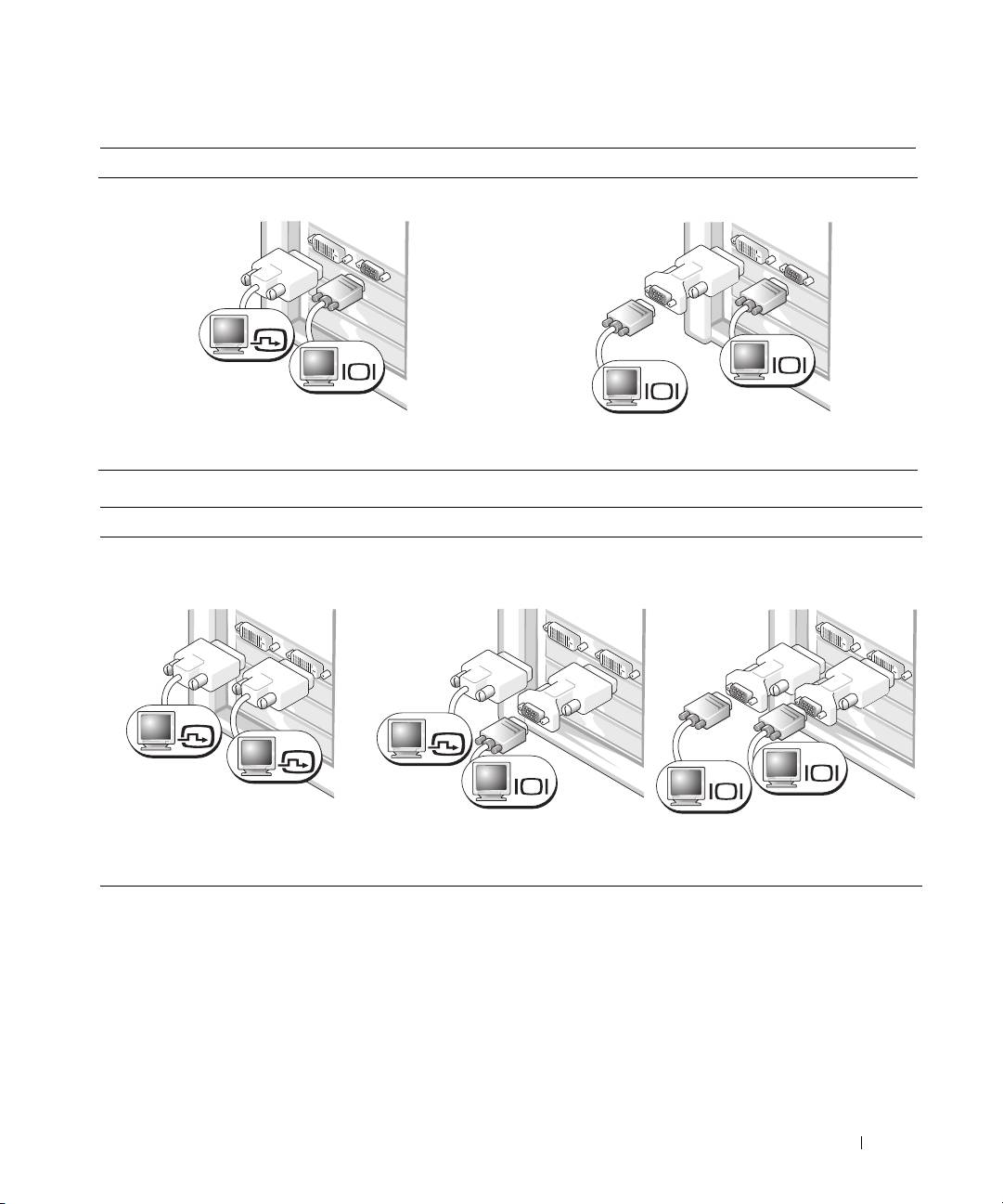
For dual-monitor capable cards with one DVI connector and one VGA connector
One DVI connector and one VGA connector:
Two VGA connectors with one VGA adapter:
DVI
VGA
VGA
VGA
Use the appropriate connector(s) when you want to
Use the VGA adapter when you want to connect your
connect your computer to one or two monitors.
computer to two VGA monitors.
For dual-monitor capable cards with two DVI connectors
Two DVI connectors:
Two DVI connectors with one VGA
Two DVI connectors with two VGA
adapter:
adapters:
DVI
DVI
DVI
VGA
VGA
VGA
Use the DVI connector(s) to connect
Use the VGA adapter to connect a
Use two VGA adapters to connect two
your computer to one or two DVI
VGA monitor to one of the DVI
VGA monitors to the DVI connectors
monitors.
connectors on your computer.
on your computer.
Quick Reference Guide 17
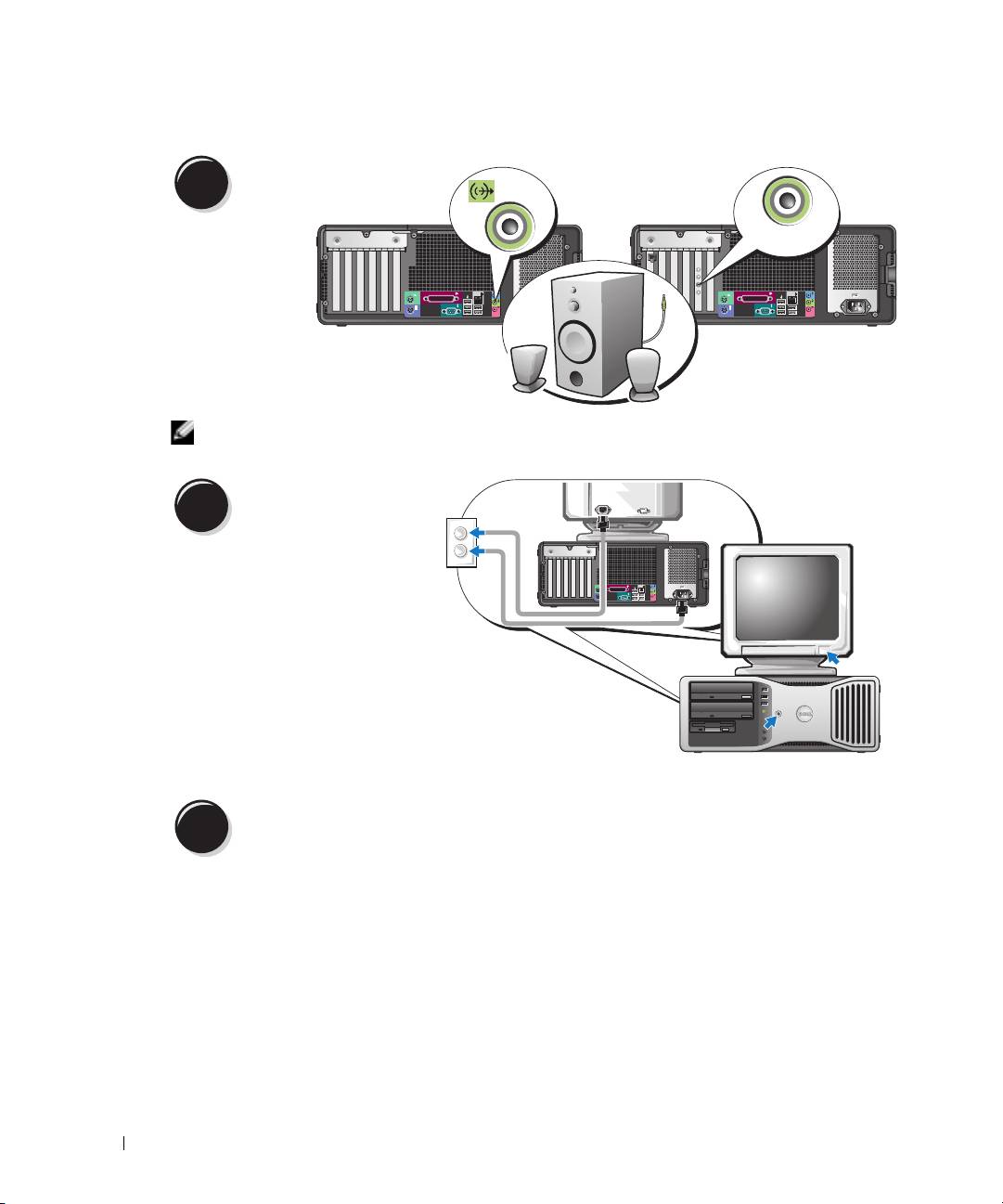
Connect the speakers.
4
LINE OUT
www.dell.com | support.dell.com
NOTE: If your computer has a sound card installed, connect the speakers to the card.
Connect the power cables
and turn on the computer
5
and monitor.
Your desktop computer has an
optional front IEEE 1394
connector. This connector is only
available if you purchased an
IEEE 1394 card. To purchase a
card, contact Dell. For
instructions on contacting Dell
4
3
and for more information on the
2
1
IEEE 1394 card, see your
User’s
Guide
.
Install additional software or devices.
6
Before you install any devices or software that did not come with your computer, read the
documentation that came with the software or device or contact the vendor to verify that the
software or device is compatible with your computer and operating system.
You have now completed the setup for your desktop computer.
18 Quick Reference Guide
About Your Computer
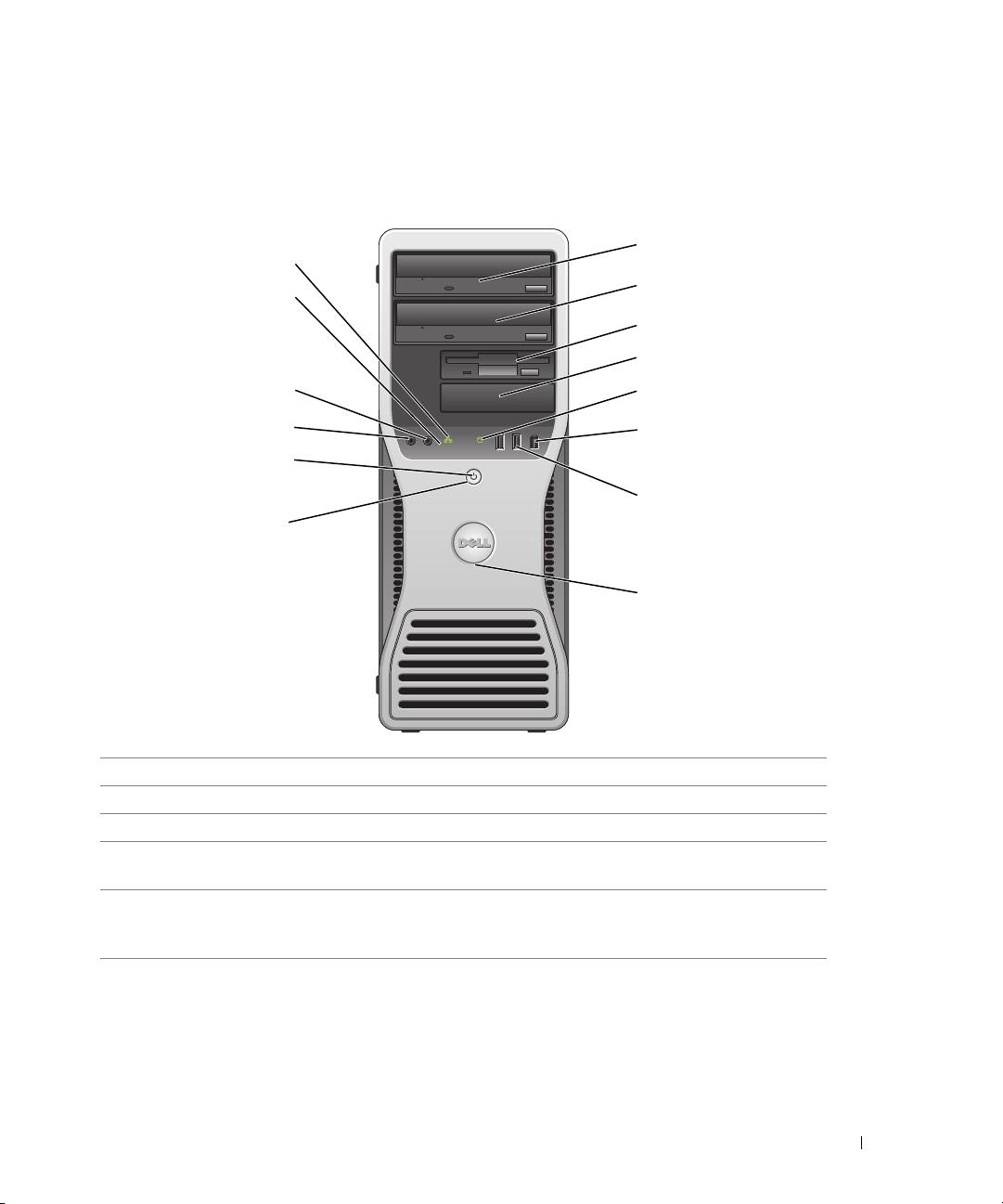
Front View (Tower Orientation)
1
14
2
13
3
4
12
5
11
6
1234
10
7
9
8
1 upper 5.25-inch drive bay Holds a CD/DVD drive.
2 lower 5.25-inch drive bay Holds a CD/DVD drive or an optional third hard drive.
3 upper 3.5-inch drive bay Holds an optional fourth hard drive (serial ATA).
4 lower 3.5-inch drive bay You can use the bay for an optional floppy drive or an optional
Media Card Reader.
5 hard-drive activity light The hard drive light is on when the computer reads data from or
writes data to the hard drive. The light might also be on when a
device such as your CD player is operating.
Quick Reference Guide 19
6 IEEE 1394 connector
Use the optional IEEE 1394 connectors for high-speed data devices such as digital
(optional)
video cameras and external storage devices.
7 USB 2.0 connectors (2) Use the front USB connectors for devices that you connect occasionally, such as
flash memory keys or cameras, or for bootable USB devices (see
system setup
for
more information on booting to a USB device).
It is recommended that you use the back USB connectors for devices that typically
remain connected, such as printers and keyboards.
8 Dell™ badge rotation
To rotate, place fingers around the outside of the badge, press in, and turn the
notch
badge. You can also rotate the badge using the slot provided near the bottom of
the badge.
9 power button Press to turn on the computer.
www.dell.com | support.dell.com
NOTICE: To avoid losing data, do not use the power button to turn off the
computer. Instead, perform an operating system shutdown.
NOTE: The power button can also be used to wake the computer or to place it into a
power-saving state. See "Power Management" in your User’s Guide for more
information.
10 power light The power light illuminates and blinks or remains solid to indicate different states:
• No light — The computer is turned off.
• Steady green — The computer is in a normal operating state.
• Blinking green — The computer is in a power-saving state.
• Blinking or solid amber — See "Power Problems" in your
User’s Guide
.
To exit from a power-saving state, press the power button or use the keyboard or
the mouse if it is configured as a wake device in the Windows Device Manager. For
more information about sleep states and exiting from a power-saving state, see
"Power Management" in your User’s Guide.
See "Diagnostic Lights" on page 37 for a description of light codes that can help
you troubleshoot problems with your computer.
11 microphone connector Use the microphone connector to attach a personal computer microphone for
voice or musical input into a sound or telephony program.
12 headphone connector Use the headphone connector to attach headphones.
13 diagnostic lights (4) Use the lights to help you troubleshoot a computer problem based on the
diagnostic code. For more information, see "Diagnostic Lights" on page 37.
14 network link light The network link light is on when a good connection exists between a 10-Mbps,
100-Mbps, or 1000-Mbps (or 1-Gbps) network and the computer.
20 Quick Reference Guide
