
Dell PowerEdge 1950: инструкция
Раздел: Бытовая, кухонная техника, электроника и оборудование
Тип: Компьютер
Инструкция к Компьютеру Dell PowerEdge 1950
Оглавление
Dell™ PowerEdge™ 1950 Systems
Hardware Owner’s Manual
www.dell.com | support.dell.com

Notes, Notices, and Cautions
NOTE: A NOTE indicates important information that helps you make better use of your computer.
NOTICE: A NOTICE indicates either potential damage to hardware or loss of data and tells you how to avoid the
problem.
CAUTION: A CAUTION indicates a potential for property damage, personal injury, or death.
____________________
Information in this document is subject to change without notice.
© 2009 Dell Inc. All rights reserved.
Reproduction in any manner whatsoever without the written permission of Dell Inc. is strictly forbidden.
Trademarks used in this text: Dell, the DELL logo, Inspiron, Dell Precision, Dimension, OptiPlex, Latitude, PowerEdge, PowerVault, PowerApp,
Dell OpenManage, and Dell XPS are trademarks of Dell Inc.; Intel, Pentium, Xeon, and Celeron are registered trademarks of Intel Corporation;
Microsoft and Windows are registered trademarks of Microsoft Corporation.
Other trademarks and trade names may be used in this document to refer to either the entities claiming the marks and names or their products.
Dell Inc. disclaims any proprietary interest in trademarks and trade names other than its own.
Model EMU01
September 2009 P/N HH176 Rev. A02

Contents
1 About Your System
Other Information You May Need. . . . . . . . . . . . . . . . . . . . . . . 9
Accessing System Features During Startup
. . . . . . . . . . . . . . . . . . 10
Front-Panel Features and Indicators
. . . . . . . . . . . . . . . . . . . . . . 11
Hard-Drive Indicator Codes
. . . . . . . . . . . . . . . . . . . . . . . 12
Back-Panel Features and Indicators
. . . . . . . . . . . . . . . . . . . . . . 14
Connecting External Devices
. . . . . . . . . . . . . . . . . . . . . . 15
Power Indicator Codes
. . . . . . . . . . . . . . . . . . . . . . . . . . . . 15
NIC Indicator Codes
. . . . . . . . . . . . . . . . . . . . . . . . . . . . . 16
LCD Status Messages
. . . . . . . . . . . . . . . . . . . . . . . . . . . . . 17
Solving Problems Described by LCD Status Messages. . . . . . . . . . 24
Removing LCD Status Messages . . . . . . . . . . . . . . . . . . . . 24
System Messages
. . . . . . . . . . . . . . . . . . . . . . . . . . . . . . . 25
Warning Messages
. . . . . . . . . . . . . . . . . . . . . . . . . . . . . . 30
Diagnostics Messages
. . . . . . . . . . . . . . . . . . . . . . . . . . . . . 30
Alert Messages
. . . . . . . . . . . . . . . . . . . . . . . . . . . . . . . . 30
2 Using the System Setup Program
Entering the System Setup Program. . . . . . . . . . . . . . . . . . . . . . 31
Responding to Error Messages
. . . . . . . . . . . . . . . . . . . . . . 31
Using the System Setup Program
. . . . . . . . . . . . . . . . . . . . 31
System Setup Options
. . . . . . . . . . . . . . . . . . . . . . . . . . . . . 32
Main Screen . . . . . . . . . . . . . . . . . . . . . . . . . . . . . . . . . . . . . . . . . . . . . . . . 32
CPU Information Screen. . . . . . . . . . . . . . . . . . . . . . . . . 35
Integrated Devices Screen
. . . . . . . . . . . . . . . . . . . . . . . . 36
System Security Screen
. . . . . . . . . . . . . . . . . . . . . . . . . 37
Exit Screen. . . . . . . . . . . . . . . . . . . . . . . . . . . . . . . . 38
Contents 3

System and Setup Password Features . . . . . . . . . . . . . . . . . . . . . 38
Using the System Password
. . . . . . . . . . . . . . . . . . . . . . . 38
Using the Setup Password
. . . . . . . . . . . . . . . . . . . . . . . . 40
Disabling a Forgotten Password
. . . . . . . . . . . . . . . . . . . . . . . . 41
Baseboard Management Controller Configuration
. . . . . . . . . . . . . . 41
Entering the BMC Setup Module . . . . . . . . . . . . . . . . . . . . 42
BMC Setup Module Options. . . . . . . . . . . . . . . . . . . . . . . 42
3 Installing System Components
Recommended Tools . . . . . . . . . . . . . . . . . . . . . . . . . . . . . 44
Inside the System
. . . . . . . . . . . . . . . . . . . . . . . . . . . . . . . 44
Removing and Replacing the Front Bezel
. . . . . . . . . . . . . . . . . . . 45
Opening and Closing the System
. . . . . . . . . . . . . . . . . . . . . . . 46
Opening the System
. . . . . . . . . . . . . . . . . . . . . . . . . . . 46
Closing the System
. . . . . . . . . . . . . . . . . . . . . . . . . . . 47
Cooling Fan Modules
. . . . . . . . . . . . . . . . . . . . . . . . . . . . . 48
Removing a Cooling Fan Module
. . . . . . . . . . . . . . . . . . . . 48
Replacing a Cooling Fan Module
. . . . . . . . . . . . . . . . . . . . 49
Removing the Plastic Fan Guide . . . . . . . . . . . . . . . . . . . . . 50
Replacing the Plastic Fan Guide
. . . . . . . . . . . . . . . . . . . . . 50
Cooling Shrouds
. . . . . . . . . . . . . . . . . . . . . . . . . . . . . . . 50
System Board Cooling Shroud
. . . . . . . . . . . . . . . . . . . . . . 50
Memory Cooling Shroud
. . . . . . . . . . . . . . . . . . . . . . . . . 52
Power Supplies
. . . . . . . . . . . . . . . . . . . . . . . . . . . . . . . . 53
Removing a Power Supply
. . . . . . . . . . . . . . . . . . . . . . . . 54
Replacing a Power Supply
. . . . . . . . . . . . . . . . . . . . . . . . 55
Removing the Power Supply Blank
. . . . . . . . . . . . . . . . . . . 56
Installing the Power Supply Blank
. . . . . . . . . . . . . . . . . . . . 56
SAS Controller Daughter Card
. . . . . . . . . . . . . . . . . . . . . . . . 56
Removing a SAS Controller Daughter Card . . . . . . . . . . . . . . . 56
Installing a SAS Controller Daughter Card or SAS RAID
Controller Daughter Card
. . . . . . . . . . . . . . . . . . . . . . . . 56
RAID Battery
. . . . . . . . . . . . . . . . . . . . . . . . . . . . . . 60
4 Contents

Expansion Cards . . . . . . . . . . . . . . . . . . . . . . . . . . . . . . . 61
Installing an Expansion Card
. . . . . . . . . . . . . . . . . . . . . . . 61
Removing an Expansion Card
. . . . . . . . . . . . . . . . . . . . . . 62
Configuring the Boot Device
. . . . . . . . . . . . . . . . . . . . . . . . . 63
Configuring the Boot Drive
. . . . . . . . . . . . . . . . . . . . . . . . . . 63
System Memory
. . . . . . . . . . . . . . . . . . . . . . . . . . . . . . . . 63
General Memory Module Installation Guidelines
. . . . . . . . . . . . 64
Non-Optimal Memory Configurations
. . . . . . . . . . . . . . . . . . 64
Memory Sparing Support
. . . . . . . . . . . . . . . . . . . . . . . . 64
Memory Mirroring Support . . . . . . . . . . . . . . . . . . . . . . . 65
Installing Memory Modules
. . . . . . . . . . . . . . . . . . . . . . . 65
Removing Memory Modules
. . . . . . . . . . . . . . . . . . . . . . . 67
Activating the Integrated NIC TOE
. . . . . . . . . . . . . . . . . . . . . . 67
Processors
. . . . . . . . . . . . . . . . . . . . . . . . . . . . . . . . . . . 67
Removing the Processor
. . . . . . . . . . . . . . . . . . . . . . . . . 67
Installing a Processor
. . . . . . . . . . . . . . . . . . . . . . . . . . 70
RAC Card
. . . . . . . . . . . . . . . . . . . . . . . . . . . . . . . . . . . 71
Installing a RAC Card
. . . . . . . . . . . . . . . . . . . . . . . . . . 71
Removing the RAC Card and Cables
. . . . . . . . . . . . . . . . . . 72
Optical Drive
. . . . . . . . . . . . . . . . . . . . . . . . . . . . . . . . . 73
Removing the Optical Drive Tray . . . . . . . . . . . . . . . . . . . . 73
Installing the Optical Drive Tray. . . . . . . . . . . . . . . . . . . . . 74
Hard Drives
. . . . . . . . . . . . . . . . . . . . . . . . . . . . . . . . . . 75
Before You Begin
. . . . . . . . . . . . . . . . . . . . . . . . . . . . 75
Removing a Drive Blank
. . . . . . . . . . . . . . . . . . . . . . . . . 75
Installing a Drive Blank
. . . . . . . . . . . . . . . . . . . . . . . . . 76
Installing a Hot-Plug Hard Drive
. . . . . . . . . . . . . . . . . . . . . 76
Replacing a Hard-Drive Carrier
. . . . . . . . . . . . . . . . . . . . . . . . 78
Removing a Hard Drive From a Hard-Drive Carrier
. . . . . . . . . . . 78
Installing a SAS Hard Drive Into a SATAu Drive Carrier
. . . . . . . . 78
Installing a SATA Hard Drive Into a SATA Drive Carrier
. . . . . . . . 79
Installing a SATA Hard Drive and Interposer Card Into a
SATAu Hard-Drive Carrier
. . . . . . . . . . . . . . . . . . . . . . . . 80
Contents 5

Expansion-Card Riser. . . . . . . . . . . . . . . . . . . . . . . . . . . . . 82
Removing an Expansion-Card Riser
. . . . . . . . . . . . . . . . . . . 82
Installing an Expansion-Card Riser
. . . . . . . . . . . . . . . . . . . 83
Backplane Board
. . . . . . . . . . . . . . . . . . . . . . . . . . . . . . . 83
Removing the Backplane Board
. . . . . . . . . . . . . . . . . . . . . 83
Installing the Backplane Board
. . . . . . . . . . . . . . . . . . . . . . 85
Sideplane Board
. . . . . . . . . . . . . . . . . . . . . . . . . . . . . . . . 85
Removing the Sideplane Board . . . . . . . . . . . . . . . . . . . . . 85
Installing the Sideplane Board . . . . . . . . . . . . . . . . . . . . . . 86
System Battery
. . . . . . . . . . . . . . . . . . . . . . . . . . . . . . . . 86
Replacing the System Battery
. . . . . . . . . . . . . . . . . . . . . . 86
Control Panel Assembly
. . . . . . . . . . . . . . . . . . . . . . . . . . . 88
Removing the Control Panel
. . . . . . . . . . . . . . . . . . . . . . . 88
Installing the Control Panel
. . . . . . . . . . . . . . . . . . . . . . . 89
System Board
. . . . . . . . . . . . . . . . . . . . . . . . . . . . . . . . . 90
Removing the System Board
. . . . . . . . . . . . . . . . . . . . . . . 90
Installing the System Board
. . . . . . . . . . . . . . . . . . . . . . . 91
4 Troubleshooting Your System
Safety First—For You and Your System. . . . . . . . . . . . . . . . . . . . 93
Start-Up Routine
. . . . . . . . . . . . . . . . . . . . . . . . . . . . . . . 93
Checking the Equipment
. . . . . . . . . . . . . . . . . . . . . . . . . . . 94
Troubleshooting IRQ Assignment Conflicts
. . . . . . . . . . . . . . . 94
Troubleshooting External Connections
. . . . . . . . . . . . . . . . . . 94
Troubleshooting the Video Subsystem
. . . . . . . . . . . . . . . . . . 95
Troubleshooting the Keyboard
. . . . . . . . . . . . . . . . . . . . . . 95
Troubleshooting the Mouse
. . . . . . . . . . . . . . . . . . . . . . . 96
Troubleshooting Basic I/O Functions
. . . . . . . . . . . . . . . . . . . . . 96
Troubleshooting a Serial I/O Device . . . . . . . . . . . . . . . . . . . 97
Troubleshooting a USB Device . . . . . . . . . . . . . . . . . . . . . 97
Troubleshooting a NIC
. . . . . . . . . . . . . . . . . . . . . . . . . . . . 98
Troubleshooting a Wet System
. . . . . . . . . . . . . . . . . . . . . . . . 98
Troubleshooting a Damaged System
. . . . . . . . . . . . . . . . . . . . . 99
6 Contents

Troubleshooting the System Battery. . . . . . . . . . . . . . . . . . . . . 100
Troubleshooting Power Supplies
. . . . . . . . . . . . . . . . . . . . . . 100
Troubleshooting System Cooling Problems
. . . . . . . . . . . . . . . . . 101
Troubleshooting a Fan . . . . . . . . . . . . . . . . . . . . . . . . . 101
Troubleshooting System Memory
. . . . . . . . . . . . . . . . . . . . . . 102
Troubleshooting an Optical Drive
. . . . . . . . . . . . . . . . . . . . . . 103
Troubleshooting a Hard Drive
. . . . . . . . . . . . . . . . . . . . . . . . 104
Troubleshooting a SAS or SAS RAID Controller Daughter Card
. . . . . . 105
Troubleshooting Expansion Cards
. . . . . . . . . . . . . . . . . . . . . . 107
Troubleshooting the Microprocessors
. . . . . . . . . . . . . . . . . . . . 108
5 Running the System Diagnostics
Using Server Administrator Diagnostics . . . . . . . . . . . . . . . . . . 111
System Diagnostics Features
. . . . . . . . . . . . . . . . . . . . . . . . 111
When to Use the System Diagnostics
. . . . . . . . . . . . . . . . . . . . 111
Running the System Diagnostics
. . . . . . . . . . . . . . . . . . . . . . 112
System Diagnostics Testing Options
. . . . . . . . . . . . . . . . . . . . 112
Using the Custom Test Options
. . . . . . . . . . . . . . . . . . . . . . . 112
Selecting Devices for Testing
. . . . . . . . . . . . . . . . . . . . . 112
Selecting Diagnostics Options
. . . . . . . . . . . . . . . . . . . . . 113
Viewing Information and Results
. . . . . . . . . . . . . . . . . . . 113
6 Jumpers and Connectors
System Board Jumpers . . . . . . . . . . . . . . . . . . . . . . . . . . . 115
Disabling a Forgotten Password
. . . . . . . . . . . . . . . . . . . . . . . 117
System Board Connectors
. . . . . . . . . . . . . . . . . . . . . . . . . . 118
SAS/SATA Backplane Board Connectors
. . . . . . . . . . . . . . . . . . 120
Expansion-Card Riser-Board Components and PCI Buses
. . . . . . . . . 122
SAS Sideplane Board Connectors
. . . . . . . . . . . . . . . . . . . . . . 123
Contents 7

7 Getting Help
Technical Assistance . . . . . . . . . . . . . . . . . . . . . . . . . . . . 125
Online Services
. . . . . . . . . . . . . . . . . . . . . . . . . . . . 125
AutoTech Service
. . . . . . . . . . . . . . . . . . . . . . . . . . . 126
Automated Order-Status Service . . . . . . . . . . . . . . . . . . . . 126
Technical Support Service
. . . . . . . . . . . . . . . . . . . . . . . 126
Dell Enterprise Training and Certification
. . . . . . . . . . . . . . . . . . 127
Problems With Your Order
. . . . . . . . . . . . . . . . . . . . . . . . . 127
Product Information
. . . . . . . . . . . . . . . . . . . . . . . . . . . . . 127
Returning Items for Warranty Repair or Credit
. . . . . . . . . . . . . . . 127
Before You Call
. . . . . . . . . . . . . . . . . . . . . . . . . . . . . . . 128
Contacting Dell
. . . . . . . . . . . . . . . . . . . . . . . . . . . . . . . 130
Glossary . . . . . . . . . . . . . . . . . . . . . . . . . . . . . . . . . . . 147
Index . . . . . . . . . . . . . . . . . . . . . . . . . . . . . . . . . . . . . 155
8 Contents

1
About Your System
This section describes the physical, firmware, and software interface features that provide and ensure
the essential functioning of your system. The physical connectors on your system’s front and back
panels provide convenient connectivity and system expansion capability. The system firmware,
applications, and operating systems monitor the system and component status and alert you when a
problem arises. System conditions can be reported by any of the following:
• Front or back panel indicators
• LCD status messages
• System messages
• Warning messages
• Diagnostics messages
• Alert messages
This section describes each type of message, lists the possible causes, and provides steps to resolve any
problems indicated by a message. The system indicators and features are illustrated in this section.
Other Information You May Need
CAUTION: The Product Information Guide provides important safety and regulatory information.
Warranty information may be included within this document or as a separate document.
•The
Rack Installation Guide
or
Rack Installation Instructions
included with your rack solution
describes how to install your system into a rack.
•The
Getting Started Guide
provides an overview of system features, setting up your system, and
technical specifications.
• CDs included with your system provide documentation and tools for configuring and managing your
system.
• Systems management software documentation describes the features, requirements, installation, and
basic operation of the software.
• Operating system documentation describes how to install (if necessary), configure, and use the
operating system software.
• Documentation for any components you purchased separately provides information to configure and
install these options.
• Updates are sometimes included with the system to describe changes to the system, software, and/or
documentation.
About Your System 9

NOTE: Always check for updates on support.dell.com and read the updates first because they often
supersede information in other documents.
• Release notes or readme files may be included to provide last-minute updates to the system or
documentation or advanced technical reference material intended for experienced users or technicians.
Accessing System Features During Startup
Table 1-1 describes keystrokes that may be entered during startup to access system features. If your
operating system begins to load before you enter the keystroke, allow the system to finish booting, and then
restart your system and try again.
Table 1-1. Keystrokes for Accessing System Features
Keystroke Description
<F2> Enters the System Setup program. See "Using the System Setup Program" on page 31.
<F10> Enters the System Diagnostics program. See "Running the System Diagnostics" on page 112.
<Ctrl+E> Enters the Baseboard Management Controller (BMC) Management Utility, which allows access to the
system event log (SEL). See the BMC User’s Guide for more information on setup and use of BMC.
<Ctrl+C> Enters the SAS Configuration Utility. See your SAS adapter User’s Guide for more information.
<Ctrl+R> Enters the RAID configuration utility, which allows you to configure an optional RAID card. For more
information, see the documentation for your RAID card.
<Ctrl+S> Option is displayed only if you have PXE support enabled through the System Setup Program (see
"Integrated Devices Screen" on page 36). This keystroke allows you to configure NIC settings for PXE
boot. For more information, see the documentation for your integrated NIC.
<Ctrl+D> If you have the optional Dell Remote Access Controller (DRAC) installed, this keystroke allows
access to selected DRAC configuration settings. See the DRAC User’s Guide for more information on
setup and use of DRAC.
10 About Your System
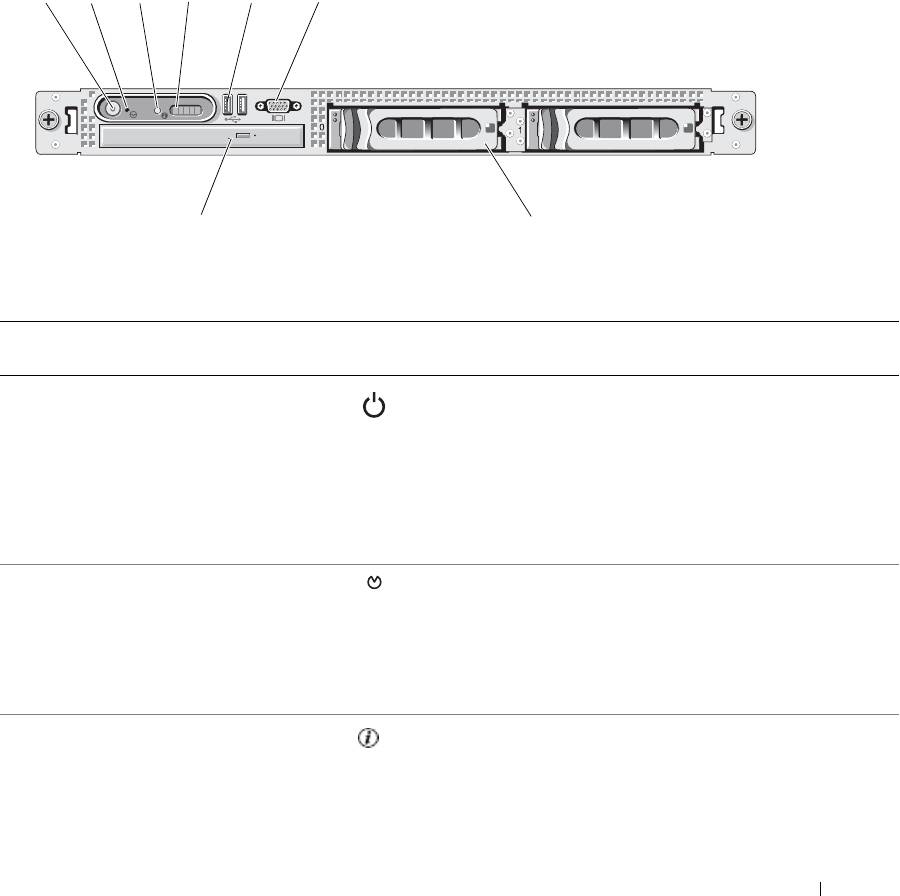
Front-Panel Features and Indicators
Figure 1-1 shows the controls, indicators, and connectors located behind the optional rack bezel on the
system's front panel.
Figure 1-1. Front-Panel Features and Indicators
21
6543
8
7
Table 1-2. Front-Panel LED Indicators, Buttons, and Connectors
Ite
Indicator, Button, or Connector Icon Description
m
1 Power-on indicator, power button The power button controls the DC power supply output to
the system.
NOTE: If you turn off the system using the power button
and the system is running an ACPI-compliant operating
system, the system performs a graceful shutdown before
the power is turned off. If the system is not running an
ACPI-compliant operating system, the power is turned off
immediately after the power button is pressed.
2 NMI button Used to troubleshoot software and device driver errors
when using certain operating systems. This button can be
pressed using the end of a paper clip.
Use this button only if directed to do so by qualified
support personnel or by the operating system's
documentation.
3 System identification button The identification buttons on the front and back panels can
be used to locate a particular system within a rack. When
one of these buttons is pushed, the blue system status
indicator on the front and back blinks until one of the
buttons is pushed again.
About Your System 11
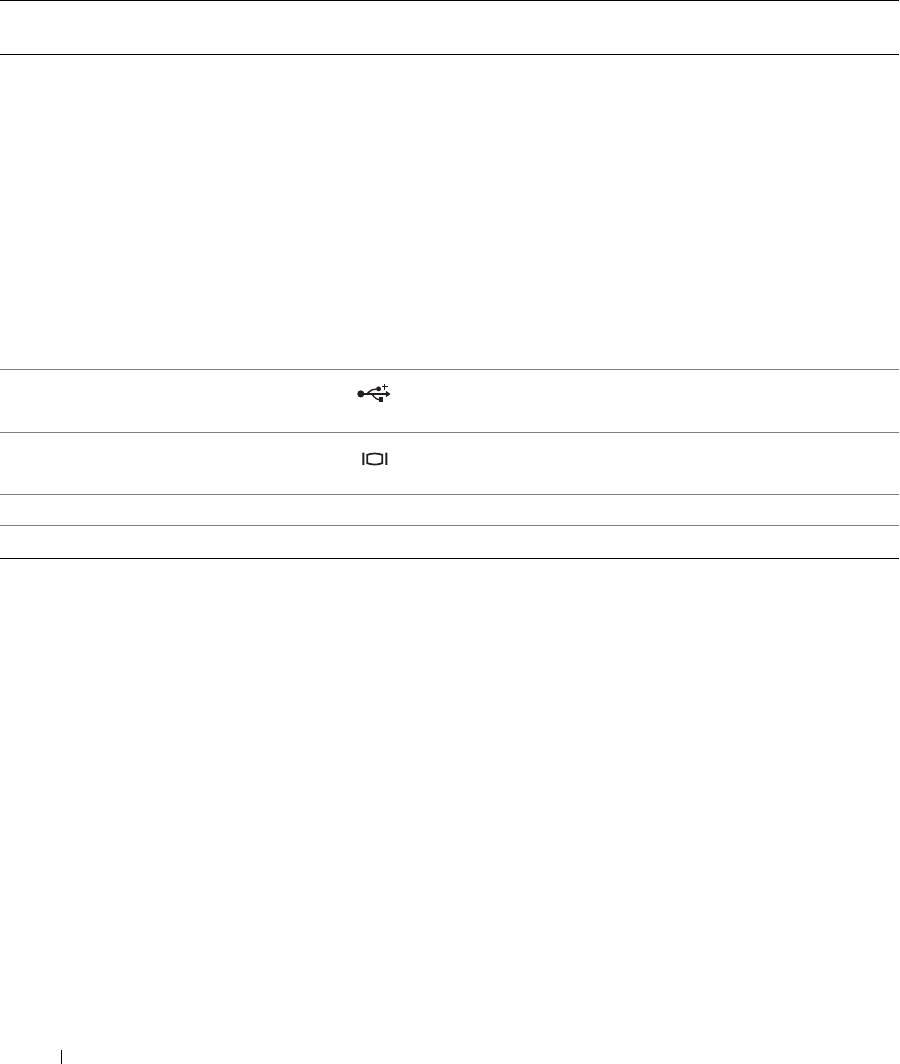
Table 1-2. Front-Panel LED Indicators, Buttons, and Connectors (continued)
Ite
Indicator, Button, or Connector Icon Description
m
4 LCD display Provides system ID, status information, and system error
messages.
The LCD display lights during normal system operation.
Both the systems management software and the
identification buttons located on the front and back of the
system can cause the LCD to flash blue to identify a
particular system.
The LCD display lights amber when the system needs
attention due to a problem with power supplies, fans,
system temperature, or hard drives.
NOTE: If the system is connected to AC power and an
error has been detected, the LCD display lights amber
regardless of whether the system has been powered on.
5 USB connectors (2) Connects USB 2.0-compliant devices to the system.
6 Video connector Connects a monitor to the system.
7 Hard drives (optional) Four 2.5" drives or two 3.5" drives (shown in figure).
8 Optical drive (optional) One optional slimline optical drive
NOTE: DVD devices are data only.
Hard-Drive Indicator Codes
If your hard drives are configured with the optional SAS RAID daughter card, two indicators on each of the
hard-drive carriers provide information on the status of the hard drives. See Figure 1-2 and Table 1-3. The
SAS backplane firmware controls the drive power-on/fault indicator.
12 About Your System
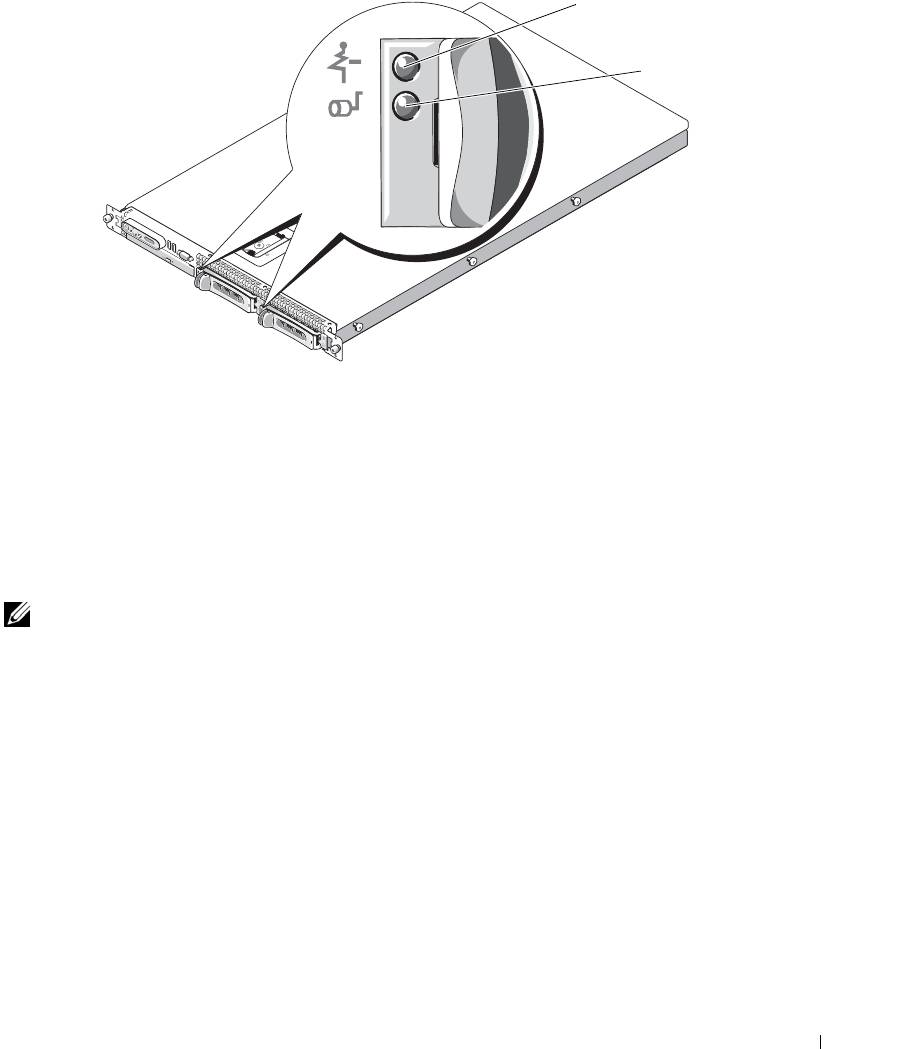
Figure 1-2. Hard-Drive Indicators
1
2
1 drive-status indicator (green
2 green drive-activity indicator
and amber)
Table 1-3 lists the drive indicator patterns. Different patterns are displayed as drive events occur in the
system. For example, if a hard-drive fails, the "drive failed" pattern appears. After the drive is selected for
removal, the "drive being prepared for removal" pattern appears, followed by the "drive ready for insertion
or removal" pattern. After the replacement drive is installed, the "drive being prepared for operation" pattern
appears, followed by the "drive online" pattern.
NOTE: For non-RAID configurations, only the drive-activity indicator is active. The drive-status indicator is off.
About Your System 13
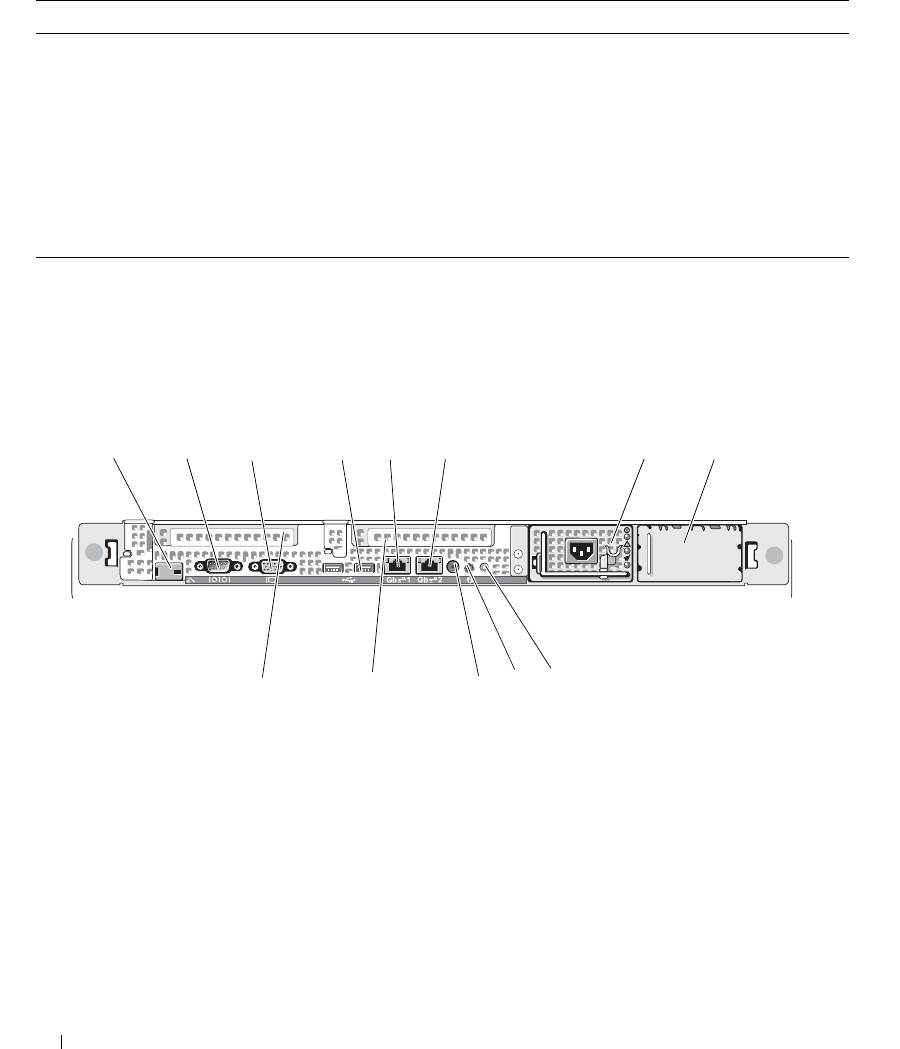
Table 1-3. Hard-Drive Indicator Patterns for RAID
Condition Drive-Status Indicator Pattern
Identify drive/preparing for removal Blinks green two times per second.
Drive ready for insertion or removal Off
Drive predicted failure Blinks green, amber, and off.
Drive failed Blinks amber four times per second.
Drive rebuilding Blinks green slowly.
Drive online Steady green.
Rebuild aborted Blinks green three seconds, amber three seconds, and off six seconds.
Back-Panel Features and Indicators
Figure 1-3 shows the controls, indicators, and connectors located on the system's back panel.
Figure 1-3. Back-Panel Features and Indicators
1 3
2
4
5
6
7
8
12
10
9
13
11
1 remote access controller
2 serial connector 3 video connector
(optional)
4 USB connectors (2) 5 NIC1 connector 6 NIC2 connector
7 power supply 1 8 power supply 2 (optional) 9 system status indicator
1
system identification button 11 system status indicator
12 left PCI expansion slot (slot 2)
0
connector
1
center PCI expansion slot
3
(slot 1)
14 About Your System
Connecting External Devices
When connecting external devices to your system, follow these guidelines:
• Most devices must be connected to a specific connector and device drivers must be installed before the
device operates properly. (Device drivers are normally included with your operating system software or
with the device itself.) See the documentation that accompanied the device for specific installation and
configuration instructions.
• Always attach external devices while your system is turned off. Next, turn on any external devices before
turning on the system (unless the documentation for the device specifies otherwise).
For information about individual connectors, see "Jumpers and Connectors" on page 115. For information about
enabling, disabling, and configuring I/O ports and connectors, see "Using the System Setup Program" on
page 31.
Power Indicator Codes
The power button on the front panel controls the power input to the system's power supplies. The power
indicator can provide information on power status (see
Figure 1-1
). Table 1-4 lists the power button indicator
codes.
Table 1-4. Power Button Indicators
Indicator Function
On Indicates that power is supplied to the system and the system is operational.
Off Indicates that no power is supplied to the system.
The indicators on the power supplies show whether power is present or whether a power fault has occurred
(see Figure 1-4).
Table 1-5. Power Supply Indicators
Indicator Function
Power supply status Green indicates that the power supply is operational.
Power supply fault Amber indicates a problem with the power supply.
AC line status Green indicates that a valid AC source is connected to the power supply.
About Your System 15
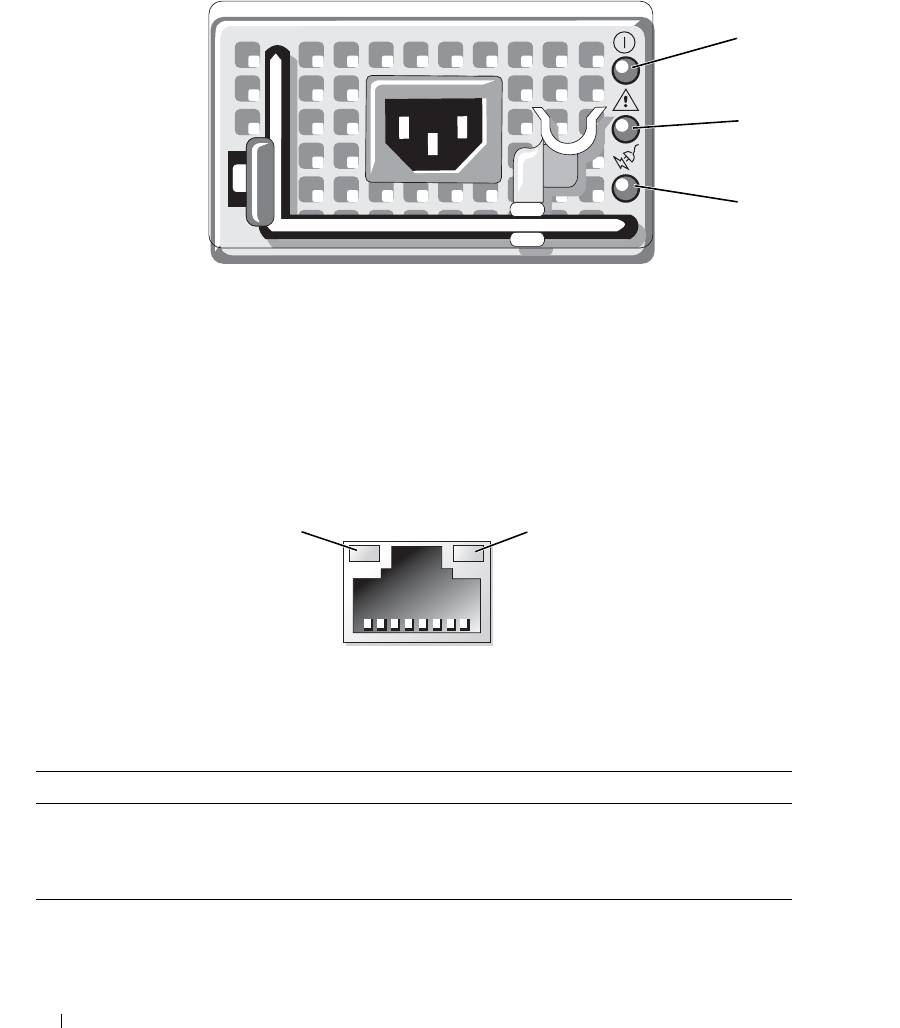
Figure 1-4. Power Supply Indicators
1
2
3
1 power supply status indicator 2 power supply fault indicator 3 AC line status indicator
NIC Indicator Codes
Each NIC on the back panel has an indicator that provides information on network activity and link status.
See Figure 1-5. Table 1-6 lists the NIC indicator codes.
Figure 1-5. NIC Indicators
1
2
1 link indicator 2 activity indicator
Table 1-6. NIC Indicator Codes
Indicator Indicator Code
Link and activity indicators are off The NIC is not connected to the network.
Link indicator is green The NIC is connected to a valid link partner on the network.
Activity indicator is amber blinking Network data is being sent or received.
16 About Your System
LCD Status Messages
The system's control panel LCD provides status messages to signify when the system is operating correctly
or when the system needs attention.
The LCD lights blue to indicate a normal operating condition, and lights amber to indicate an error
condition. The LCD scrolls a message that includes a status code followed by descriptive text. Table 1-7 lists
the LCD status messages that can occur and the probable cause for each message. The LCD messages refer
to events recorded in the System Event Log (SEL). For information on the SEL and configuring system
management settings, see the systems management software documentation.
CAUTION: Many repairs may only be done by a certified service technician. You should only perform
troubleshooting and simple repairs as authorized in your product documentation, or as directed by the online or
telephone service and support team. Damage due to servicing that is not authorized by Dell is not covered by your
warranty. Read and follow the safety instructions that came with the product.
NOTE: If your system fails to boot, press the System ID button for at least five seconds until an error code
appears on the LCD. Record the code, then see "Getting Help" on page 125.
Table 1-7. LCD Status Messages
Code Text Causes Corrective Actions
N/A SYSTEM NAME A 62-character string that can be
This message is for information
defined by the user in the System
only.
Setup program.
You can change the system string
The SYSTEM NAME displays
in the System Setup program. See
under the following conditions:
"Using the System Setup Program"
• The system is powered on.
on page 31.
• The power is off and active
POST errors are displayed.
E1000 FAILSAFE, Call
See "Getting Help" on page 125.
Support
E1114 Temp Ambient Ambient system temperature is out
See "Troubleshooting System
of acceptable range.
Cooling Problems" on page 101.
E1116 Temp Memory Memory has exceeded acceptable
See "Troubleshooting System
temperature and has been disabled
Cooling Problems" on page 101.
to prevent damage to the
components.
E12nn xx PwrGd Specified voltage regulator has
See "Getting Help" on page 125.
failed.
E1210 CMOS Batt CMOS battery is missing, or the
See "Troubleshooting the System
voltage is out of acceptable range.
Battery" on page 100.
About Your System 17
Table 1-7. LCD Status Messages (continued)
Code Text Causes Corrective Actions
E1211 ROMB Batt RAID battery is either missing,
Reseat the RAID battery
bad, or unable to recharge due to
connector. See "RAID Battery" on
thermal issues.
page 60, and "Troubleshooting
System Cooling Problems" on
page 101.
E1229 CPU # VCORE Processor # VCORE voltage
See "Getting Help" on page 125.
regulator has failed.
E1310 RPM Fan ## RPM of specified cooling fan is
See "Troubleshooting System
out of acceptable operating range.
Cooling Problems" on page 101.
E1311 RPM Fan Mod #x RPM of fan x in the # module is
See "Troubleshooting System
out of acceptable operating range.
Cooling Problems" on page 101.
E1313 Fan Redundancy The system is no longer fan-
Check control panel LCD for
redundant. Another fan failure will
additional scrolling messages. See
put the system at risk of over-
"Troubleshooting System Cooling
heating.
Problems" on page 101.
E1410 CPU # IERR Specified microprocessor is
See your system’s "Information
reporting an internal error.
Update Tech Sheet" located on
support.dell.com for the most
current system information. If the
problem persists, see "Getting
Help" on page 125.
E1414 CPU # Thermtrip Specified microprocessor is out of
See "Troubleshooting System
acceptable temperature range and
Cooling Problems" on page 101. If
has halted operation.
the problem persists, ensure that
the microprocessor heat sinks are
properly installed. See
"Troubleshooting the
Microprocessors" on page 108.
NOTE: The LCD continues to
display this message until the
system’s power cord is
disconnected and reconnected to
the AC power source, or the SEL
is cleared using either Server
Assistant or the BMC
Management Utility. See the Dell
OpenManage Baseboard
Management Controller User’s
Guide for information about these
utilities.
18 About Your System
Table 1-7. LCD Status Messages (continued)
Code Text Causes Corrective Actions
E1418 CPU # Presence Specified processor is missing or
See "Troubleshooting the
bad, and the system is in an
Microprocessors" on page 108.
unsupported configuration.
E141C CPU Mismatch Processors are in a configuration
See "System Memory" on page 63.
unsupported by Dell.
Ensure that your processors match
and conform to the type described
in the Microprocessor Technical
Specifications outlined in your
system’s Getting Started Guide.
E141F CPU Protocol The system BIOS has reported a
See "Getting Help" on page 125.
processor protocol error.
E1420 CPU Bus PERR The system BIOS has reported a
See "Getting Help" on page 125.
processor bus parity error.
E1421 CPU Init The system BIOS has reported a
See "Getting Help" on page 125.
processor initialization error.
E1422 CPU Machine Chk The system BIOS has reported a
See "Getting Help" on page 125.
machine check error.
E1610 PS # Missing No power is available from the
See "Troubleshooting Power
specified power supply; specified
Supplies" on page 100.
power supply is improperly
installed or faulty.
E1614 PS # Status No power is available from the
See "Troubleshooting Power
specified power supply; specified
Supplies" on page 100.
power supply is improperly
installed or faulty.
E1618 PS # Predictive Power supply voltage is out of
See "Troubleshooting Power
acceptable range; specified power
Supplies" on page 100.
supply is improperly installed or
faulty.
E161C PS # Input Lost Power source for specified power
Check the AC power source for the
supply is unavailable, or out of
specified power supply. If the
acceptable range.
problem persists, see
"Troubleshooting Power Supplies"
on page 100.
E1620 PS # Input Range Power source for specified power
Check the AC power source for the
supply is unavailable, or out of
specified power supply. If the
acceptable range.
problem persists, see
"Troubleshooting Power Supplies"
on page 100.
About Your System 19

Table 1-7. LCD Status Messages (continued)
Code Text Causes Corrective Actions
E1624 PS Redundancy The power supply subsystem is no
See "Troubleshooting Power
longer redundant. If the last supply
Supplies" on page 100.
fails, the system will go down.
E1710 I/O Channel Chk The system BIOS has reported an
See "Getting Help" on page 125.
I/O channel check.
E1711 PCI PERR B## D##
The system BIOS has reported a
Remove and reseat the PCI
F##
PCI parity error on a component
expansion cards. If the problem
that resides in PCI configuration
persists, see "Troubleshooting
space at bus ##, device ##,
Expansion Cards" on page 107.
function ##.
If the problem persists, the riser
PCI PERR Slot #
The system BIOS has reported a
card or system board is faulty. See
PCI parity error on a component
"Getting Help" on page 125.
that resides in the specified PCI
slot.
E1712 PCI SERR B## D##
The system BIOS has reported a
Remove and reseat the PCI
F##
PCI system error on a component
expansion cards. If the problem
that resides in PCI configuration
persists, see "Getting Help" on
space at bus ##, device ##,
page 125.
function ##.
If the problem persists, the riser
PCI SERR Slot #
The system BIOS has reported a
card or system board is faulty. See
PCI system error on a component
"Getting Help" on page 125.
that resides in the specified slot.
E1714 Unknown Err The system BIOS has determined
See "Getting Help" on page 125.
that there has been an error in the
system, but is unable to determine
its origin.
E171F PCIE Fatal Err
The system BIOS has reported a
Remove and reseat the PCI
B## D## F##
PCIe fatal error on a component
expansion cards. If the problem
that resides in PCI configuration
persists, see "Troubleshooting
space at bus ##, device ##,
Expansion Cards" on page 107.
function ##.
If the problem persists, the riser
PCIE Fatal Err
The system BIOS has reported a
card or system board is faulty. See
Slot #
PCIe fatal error on a component
"Getting Help" on page 125.
that resides in the specified slot.
E1810 HDD ## Fault The SAS subsystem has
See "Troubleshooting a Hard
determined that hard drive ## has
Drive" on page 104.
experienced a fault.
20 About Your System
