Pioneer VSX-520-S: HDMI cables About HDMI Analog audio cables
HDMI cables About HDMI Analog audio cables: Pioneer VSX-520-S
Table of contents
- IMPORTANT VENTILATION CAUTION
- Operating Environment
- Contents
- Flow of settings on the receiver
- Chapter 1: Before you start
- Before you start01 Ventilation
- Chapter 2: Controls and displays
- Controls and displays02 Operating range of remote control
- Controls and displays 02 Display
- Controls and displays02
- Remote control
- Controls and displays02
- Controls and displays 02
- Chapter 3: Connecting your equipment Placing the speakers
- Hints on the speaker placement
- Connecting the speakers
- Making cable connections
- HDMI cables About HDMI Analog audio cables
- Digital audio cables About video outputs connection
- Connecting a TV and playback components Connecting using HDMI Connecting your component with no HDMI terminal
- Connecting a satellite receiver Connecting an HDD/DVD or other digital set-top box recorder, VCR and other video sources
- Using the component video jacks Connecting other audio components
- Connecting antennas
- Plugging in the receiver
- Chapter 4: Basic Setup Automatically setting up for surround sound (MCACC)
- Basic Setup04
- Chapter 5: Listening to your system Basic playback
- Auto playback Listening in surround sound
- Listening to your system 05
- Using Front Stage Surround Advance Listening in stereo
- Using Stream Direct Better sound using Phase Control Using the Sound Retriever
- Using surround back channel processing Listening with Acoustic Calibration EQ
- Setting the Audio options Setting the Up Mix function
- Setting What it does Option(s)
- Setting What it does Option(s)
- Choosing the input signal Using the headphone
- Chapter 6: The System Setup menu Using the System Setup menu Manual speaker setup
- Speaker setting
- Crossover network Channel level Speaker distance
- The Input Assign menu The Pre Out Setting
- Chapter 7 Using the tuner Listening to the radio Saving station presets
- Using the tuner07
- An introduction to RDS
- Using the tuner07 Displaying RDS information
- Chapter 8: Making recordings Making an audio or a video recording
- Chapter 9: Other connections
- Connecting Optional Bluetooth ADAPTER
- Other connections09
- Chapter 10: Additional information Troubleshooting Problem Remedy
- Problem Remedy
- Additional information 10
- HDMI Symptom Remedy
- Resetting the main unit
- Specifications Cleaning the unit
Connecting your equipment03
HDMI cables
• Input of multi-channel linear PCM digital
audio signals (192 kHz or less) for up to 8
Both video and sound signals can be transmitted
channels
simultaneously with one cable. If connecting the
player and the TV via this receiver, for both
4
•
Input of the following digital audio formats:
1
connections, use HDMI cables.
– Dolby Digital, Dolby Digital Plus, DTS,
High bitrate audio (Dolby TrueHD, DTS-HD
Master Audio), DVD-Audio, CD, SACD
(DSD signal), Video CD, Super VCD
HDMI, the HDMI Logo and High-Definition
Multimedia Interface are trademarks or
registered trademarks of HDMI Licensing, LLC in
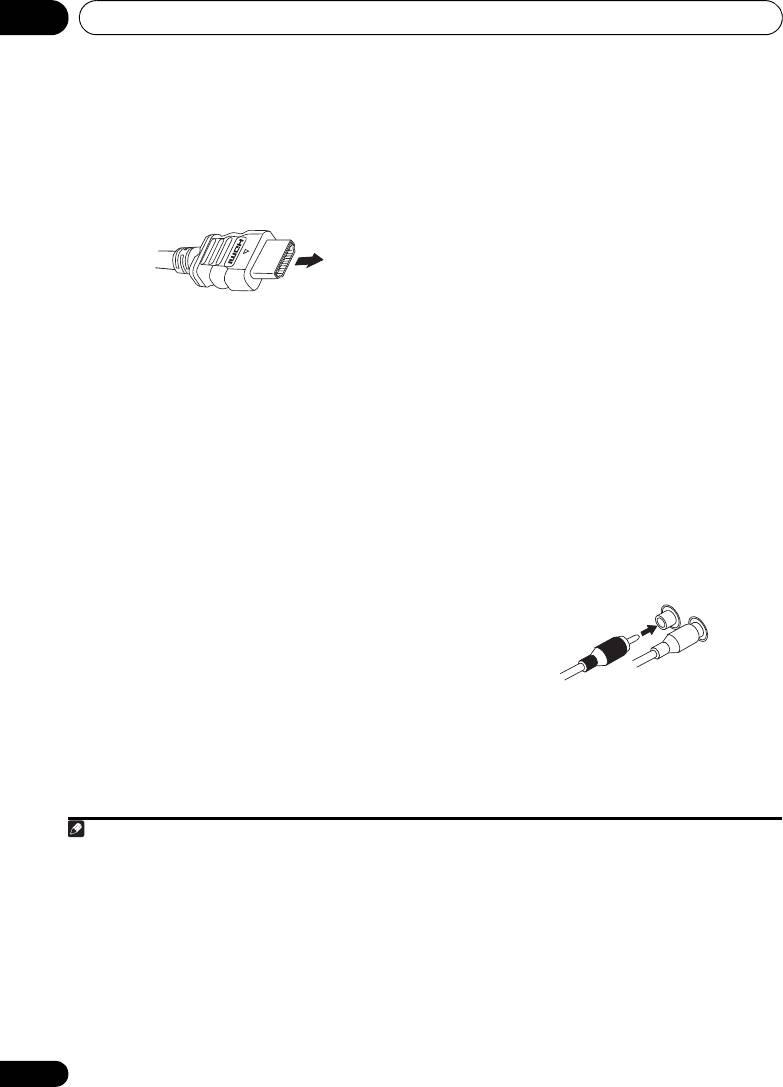
Be careful to connect the terminal in the
the United States and other countries.
proper direction.
“x.v.Color” and x.v.Color logo are trademarks of
About HDMI
Sony Corporation.
The HDMI connection transfers
uncompressed digital video, as well as almost
Analog audio cables
every kind of digital audio that the connected
Use stereo RCA phono cables to connect
component is compatible with, including DVD-
analog audio components. These cables are
Video, DVD-Audio, SACD, Dolby Digital Plus,
typically red and white, and you should
Dolby TrueHD, DTS-HD Master Audio (see
connect the red plugs to R (right) terminals
below for limitations), Video CD/Super VCD
and white plugs to L (left) terminals.
and CD.
This receiver incorporates High-Definition
®
Multimedia Interface (HDMI
) technology.
This receiver supports the functions described
2
below through HDMI connections.
• Digital transfer of uncompressed video
(contents protected by HDCP (1080p/24,
1080p/60, etc.))
3
• 3D signal transfer
3
• Deep Color signal transfer
3
• x.v.Color signal transfer
20
En
Note
1 • Set the HDMI parameter in Setting the Audio options on page 35 to THRU (THROUGH) and set the input signal in Choosing
the input signal on page 38 to HDMI, if you want to hear HDMI audio output from your TV (no sound will be heard from this
receiver).
• If the video signal does not appear on your TV, try adjusting the resolution settings on your component or display. Note that
some components (such as video game units) have resolutions that may not be displayed. In this case, use a (analog)
composite connection.
• When the video signal from the HDMI is 480i, 480p, 576i or 576p, Multi Ch PCM sound and HD sound cannot be received.
®
®
2 • Use a High Speed HDMI
cable. If HDMI cable other than a High Speed HDMI
cable is used, it may not work properly.
• When an HDMI cable with a built-in equalizer is connected, it may not operate properly.
3 Signal transfer is only possible when connected to a compatible component.
HDMI cable
VSX-520_SYXCN_En.book 20 ページ 2010年4月12日 月曜日 午後7時13分
Analog audio cables
Right (red)
Left (white)
4 • HDMI format digital audio transmissions require a longer time to be recognized. Due to this, interruption in the audio may
occur when switching between audio formats or beginning playback.
• Turning on/off the device connected to this unit's HDMI OUT terminal during playback, or disconnecting/connecting the
HDMI cable during playback, may cause noise or interrupted audio.