
Pioneer VSX-420-K: Connecting a TV and DVD player
Connecting a TV and DVD player: Pioneer VSX-420-K
Table of contents
- IMPORTANT
- Operating Environment
- Contents
- Flow of settings on the receiver
- Chapter 1: Before you start Checking what’s in the box Installing the receiver Loading the batteries
- Chapter 2: Controls and displays Front panel
- Operating range of remote control unit Display
- Controls and displays 02
- Remote control
- Controls and displays 02
- Controls and displays02
- Chapter 3: Connecting your equipment Placing the speakers
- Connecting the speakers
- Making cable connections
- About video outputs connection
- Connecting a TV and Blu-ray Disc player
- Connecting a TV and DVD player
- Connecting your component with no HDMI terminal
- Connecting an HDD/DVD recorder, VCR and other video components
- Connecting a satellite receiver Connecting the multichannel or other digital set-top box analog outputs
- Connecting other audio components Connecting to the front panel audio mini jack
- Connecting antennas
- Connecting an IR receiver Plugging in the receiver
- Chapter 4: Listening to your system Basic playback
- Choosing the input signal Auto playback Listening in surround sound
- Listening in stereo
- Using Front Stage Surround Using Stream Direct Advance Using the Sound Retriever
- Using Phase Control
- Setting the Audio options Setting What it does Option(s)
- Setting What it does Option(s)
- analog inputs Using the headphone
- Chapter 5: The System Setup menu Using the System Setup menu Manual speaker setup
- Channel level Crossover network
- Speaker Distance The Input Assign menu
- Chapter 6: Using the MULTI-ZONE feature MULTI-ZONE listening
- Using the MULTI-ZONE controls Button What it does
- Chapter Using the tuner Listening to the radio Saving station presets
- An introduction to RDS
- Displaying RDS information
- Chapter 8: Making recordings Making an audio or a video recording
- Chapter 9: Additional information Troubleshooting Problem Remedy
- Problem Remedy
- HDMI Symptom Remedy Resetting the main unit
- Specifications Cleaning the unit
Connecting your equipment03
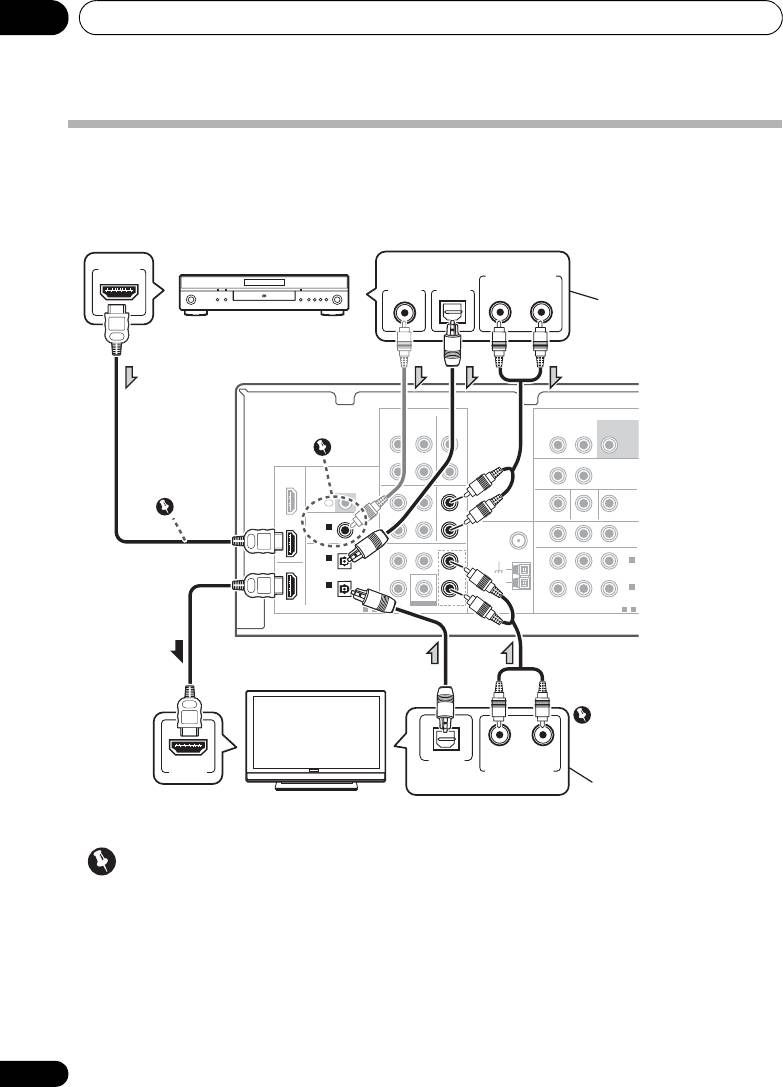
Connecting a TV and DVD player
Connecting using HDMI
If you have an HDMI or DVI (with HDCP) equipped DVD player, you can connect it to this receiver
using a commercially available HDMI cable.
AUDIO
AUDIO
HDMI
L
COAXIAL
IN 1
ANTENNA
R
(CD)
FM
UNBAL
CENTERSURROUND
FRONT
75
Ω
IN 2
L
(DVD/SA
AM
IN 1
R
LOOP
IN 1
(BD/TV)
DIGITAL
1
-
2
BD/TV MULTI CH IN
COMPONENT VIDEO
Important
1 Even if you connect the playback
2
If the connection was made using a coaxial
components with an HDMI cable, no sound
cable, press
SIGNAL SEL
repeatedly to select
C1
will come out of the speaker connected to this
(see page 26).
receiver. An audio cable connection is also
3 If you connected the TV (as shown above)
needed for this.
and there is still no sound, press BD then press
SIGNAL SEL
repeatedly to select O1 or A (see
page 26).
18
En
T
IR
OUT
ASSIGNABLE
MONIT
OUT
OPTICAL
IN 2
ASSIGNABLE
ASSIGNABLE
1
-
2
O
ZONE2 OUT
SUBWOOFER
OUT
CD-R/TAPE CD
IN IN
L R
PRE OUT
L
OUT
DVR/VCR VIDEO
IN
R
BD/TV
IN
DVR/VCR
IN
IN
DVD/SAT
MONITOR OUT DVD/SAT IN
IN
P
R
B
YP
OUT
SUBWOOFER
HDMI OUT
DIGITAL AUDIO OUT
ANALOG AUDIO OUT
COAXIAL
OPTICAL
RL
2
HDMI
DVD/SAT
IN
L
1
MONITOR OUT BD/TV IN
R
IN 2
L
OUT
(DVD/SAT)
IN 1
(BD/TV)
R
BD/TV IN
3
RL
OPTICAL
HDMI IN
DIGITAL AUDIO OUT
ANALOG AUDIO OUT
Select one
Without this connection,
you will NOT be able to
listen to the player with this
HDMI/DVI-compatible
receiver.
DVD player
This connection is
required in order to listen
Select one
to the sound of the TV over
the receiver.
HDMI/DVI-compatible TV
VSX-420_SY_En.book 18 ページ 2010年3月19日 金曜日 午前9時37分
