
Pioneer S-4EX-QL: About the EX series Technology behind the S-4EX
About the EX series Technology behind the S-4EX: Pioneer S-4EX-QL
Table of contents
- Contents
- Before you start What’s in the box
- About the EX series Technology behind the S-4EX
- Installation and Placement How to install
- Choosing Where To Place The Speaker Systems
- Connections Connecting to an amplifier Connecting the cables
- Single-Wire Connections Bi-Wire Connections
- Bi-Amplification Connections Vertical Bi-Amping Horizontal Bi-Amping
- Other Information Attaching/Removing the Grille Cover Specifications Cleaning the speaker cabinet
S-4EX_EN.book 4 ページ 2008年7月16日 水曜日 午後2時2分
About the EX series
The EX series, incorporating the abundant technological know-how behind Pioneer’s flagship TAD speaker series, was developed
with the goal of creating the ultimate speaker possible in its price range.
The design and production of the EX series result from an international effort that represents the finest in Pioneer’s speaker technology.
Bass Drivers
The bass driver pictured below serves as the foundation of the
Technology behind the S-4EX
S-4EX speaker system. The driver’s strength is the result of the
Aramid/Carbon composite material, originally created during the
CST
development of the S-1EX, that is used in its diaphragm. Pioneer’s
The core driver of the system is the Coherent Source Transducer
exclusive LDMC magnetic circuit technology has been
(CST), which draws on the technology used in TAD. The tweeter
incorporated in order to preserve linearity from low to high output
diaphragm is mounted concentrically within the apex of the
levels and minimize distortion.
midrange cone and provides a point source of sound from 400 Hz
to 100 kHz. The CST ensures a perfect spectral balance between
the direct and reflected sounds that arrive at the listener’s ears,
providing a more consistent sound throughout the listening room
and improved imaging capability.
Bass Enclosure Construction
The unique form of the S-4EX is based upon logical necessity. In
order to synchronize the arrival time of sound from the CST and
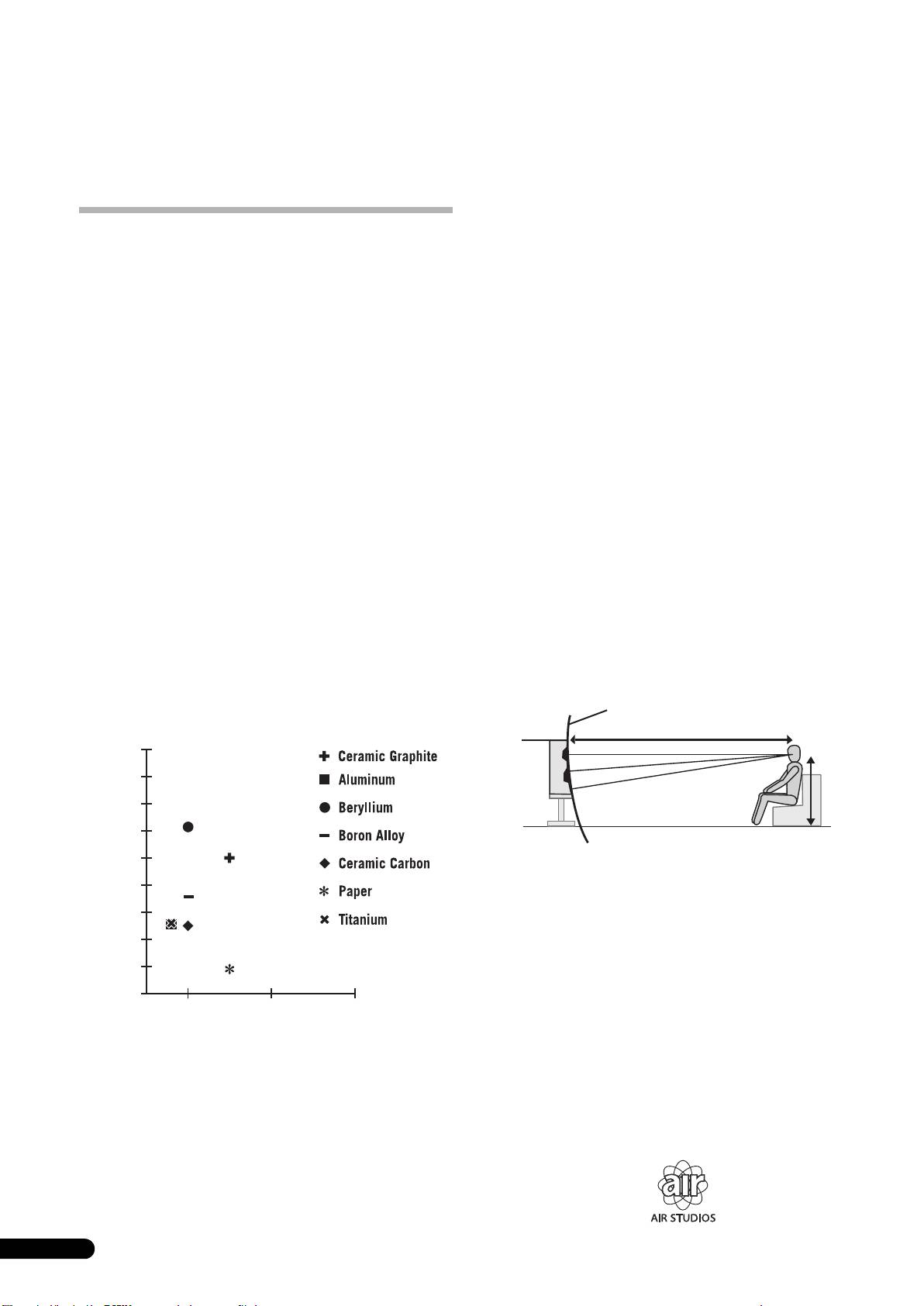
Ceramic Graphite Diaphragm
the bass driver, each driver is mounted upon a baffle that serves
to create a highly delicate curve known as the “precision curve”
The CST’s tweeter features a ceramic graphite diaphragm that
(see illustration below). Made of up to 65 mm thick MDF (Medium
provides top-level strength and dampening characteristics that
Density Fiberboard), this baffle is, moreover, strong enough to
are practically unrivaled by any other available materials currently
contain the force of the drivers. Additionally, the bass port has
used in high-end audio speaker systems. Ceramic graphite’s
been carved out of an extremely thick block of MDF, resulting in
lightness and exceptional strength combine to create speakers
the reduction of wind noise for clear, deep bass.
whose diaphragm resonance can be pushed far beyond their
audible range.
Precision curve
Velocity (m/s)
3 m
18 000
16 000
1 m
14 000
12 000
10 000
Crossover Networks
8 000
The crossover networks use only the finest components. Air cored
6 000
coils, noninductive resistors, and film capacitors in the signal path
are all carefully chosen and optimized for the CST driver to provide
4 000
the greatest transparency to the signal. The bass drivers use
silicon steel plate core inductors that minimize distortion and loss
2 000
during energy transfer. All components are connected directly to
their respective wiring materials, instead of a printed circuit-
0
board, allowing for minimal loss and maximum performance.
0.005 0.015 0.025
Inner Loss
Collaboration with Air Studios
Since its establishment by George Martin in 1969, London,
Magnesium Alloy Diaphragm
England’s Air Studios has earned unequivocal respect from
The CST’s midrange features a magnesium alloy diaphragm
scores of artists who recognize it as the world’s premier recording
whose characteristic lightness and high inner loss provide
studio. The Air Studios seal that was awarded to the S-4EX
excellent transience and minimal coloration of midrange sounds.
indicates that these speakers are capable of producing the high-
quality sound demanded by the world’s top-class sound creators.
4
En
