
Pioneer S-3EX-W: Bi-Amplification Connections Vertical Bi-Amping Horizontal Bi-Amping
Bi-Amplification Connections Vertical Bi-Amping Horizontal Bi-Amping: Pioneer S-3EX-W
Table of contents
- Contents
- Before you start What’s in the box
- About the EX series Technology behind the S-3EX
- Bass Drivers Crossover Networks Collaboration with Air Studios Bass Enclosure Construction
- Installation and Placement How to install
- Choosing Where To Place The Speaker Systems
- Connections Connecting to an amplifier Connecting the cables
- Single-Wire Connections Bi-Wire Connections
- Bi-Amplification Connections Vertical Bi-Amping Horizontal Bi-Amping
- Other Information Attaching/Removing the Grille Cover Specifications Cleaning the speaker cabinet
Bi-Amplification Connections
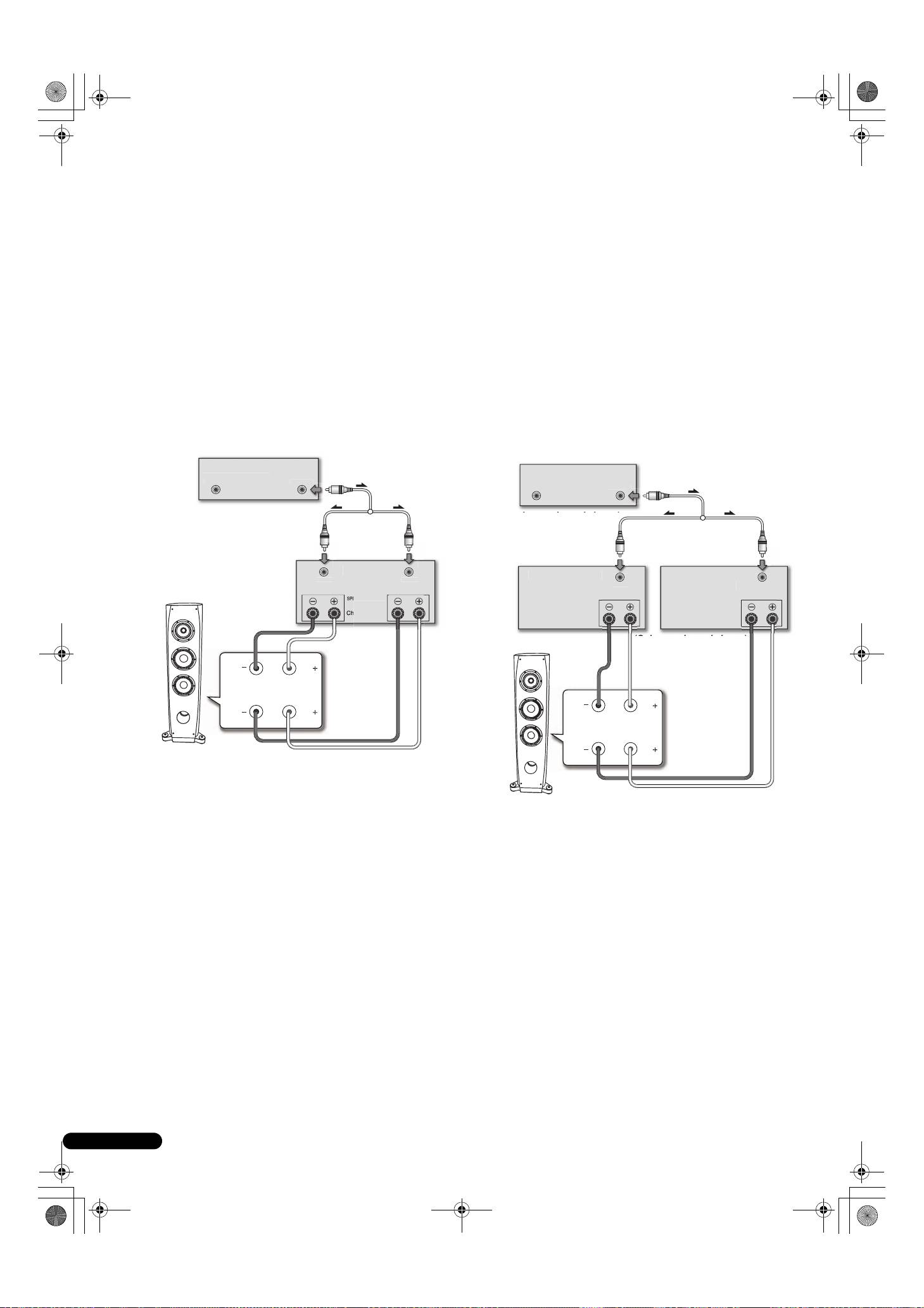
Bi-Amplification allows the best performance when using dedicated amplifiers for low- and mid-to-high-frequency sections. There are two
possible configurations, commonly referred to as horizontal and vertical bi-amping.
Caution
Remove the shorting links before connecting speaker cables in bi-amplifications connections. Failure to do so may result in damage to your
amplifiers.
Vertical Bi-Amping
Horizontal Bi-Amping
With this configuration, identical stereo amplifiers are used for
With this configuration, you may use different stereo amplifiers for
each speaker system. One channel of each amplifier drives the
the low- and mid-to-high-frequency sections of the speaker system
low frequency section and the other channel drives the high
(e.g., tube amplifiers for high frequency and solid state for low
frequency section, as shown below.
frequency). Each channel of one amplifier drives the low-
Connect one set of wires and amplifier channel to the bottom set
frequency section of each speaker system and each channel of
of binding posts (bass driver-specific network).
the other amplifier drives the mid-to-high-frequency section, as
shown below.
Then connect a second set of wires and the other amplifier
channel to the top binding posts (CST-specific network).
This method requires that both amplifiers have the same gain;
otherwise an imbalance will be heard between the low- and mid-
Take care to connect both (+) wires to the (+) amplifier terminals
to-high-frequency reproduction from the speaker system. If in
and both (–) wires to the (–) amplifier terminals.
doubt, please consult your local dealer.
10
En
E
AKER
S
OUTPU
T
INP
UT
OUTPUT
UT
INP
UT
h.1
Ch.
2
OU
TP
UT
(Onl
Speaker (rear) Input panel
y
one channel shown
)
Power am
Speaker
p
(
rear
)
Pre-am
(Commercially-
available Y-adaptor)
p
(rear
)
HF
HF
LF
LF
INP
SPEAKERS OUTPUT
UT
SPEAKERS OUTPU
T
INP
UT
OUTPUT
UT
OU
TP
UT
Power am
p
(rear
)
(Low fre
q
uenc
y)
Power am
p
(rear
)
(Hi
g
h fre
q
uenc
y)
(Only one channel shown)
hlh)
(O l
(Only one channel shown)
hlh)
(Only one channel shown)
Ol h l h )
Pre-am
(Commercially-available
Y-adaptor)
Speaker (rear) Input panel
Speaker
p
(rear
)
HF
HF
LF
LF
S-3EX_EN.book 10 ページ 2007年4月23日 月曜日 午後5時12分
