
Dell Precision M70: About Your Computer
About Your Computer: Dell Precision M70
Оглавление
- About Your Computer
Back to Contents Page
About Your Computer
DellPrecision™MobileWorkstationM70User'sGuide
Front View
Left Side View
Right Side View
Back View
Bottom View
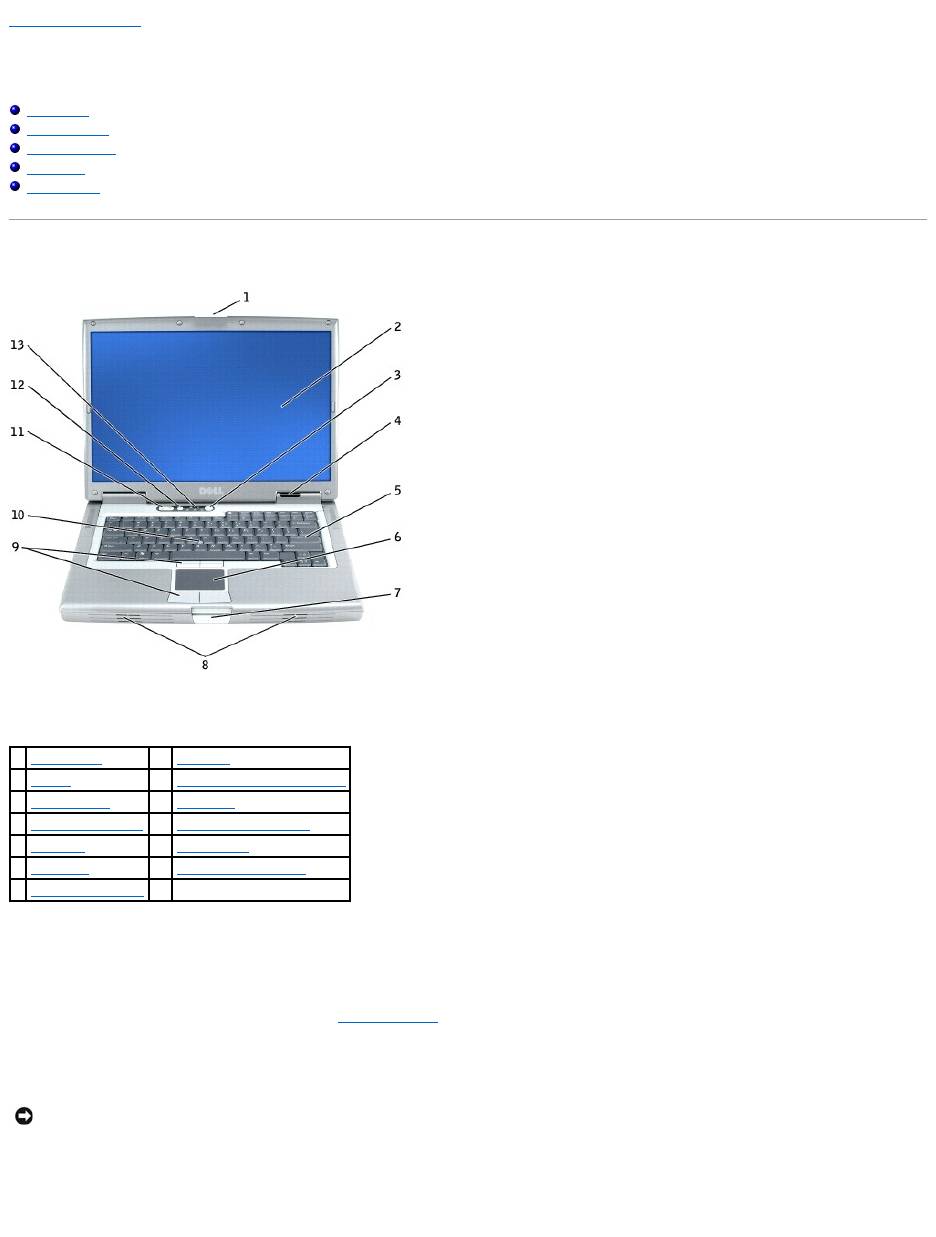
Front View
display latch — Keeps the display closed.
display — For more information about your display, see "Using the Display."
power button — Press the power button to turn on the computer or to enter or exit a power management mode.
If the computer stops responding, press and hold the power button until the computer turns off completely (which may take several seconds).
device status lights
1
display latch
8
speakers
2
display
9
track stick/touch pad buttons
3
power button
10
track stick
4
device status lights
11
volume control buttons
5
keyboard
12
mute button
6
touch pad
13
keyboard status lights
7
display latch button
NOTICE: To avoid losing data, shut down your computer instead of pressing the power button.
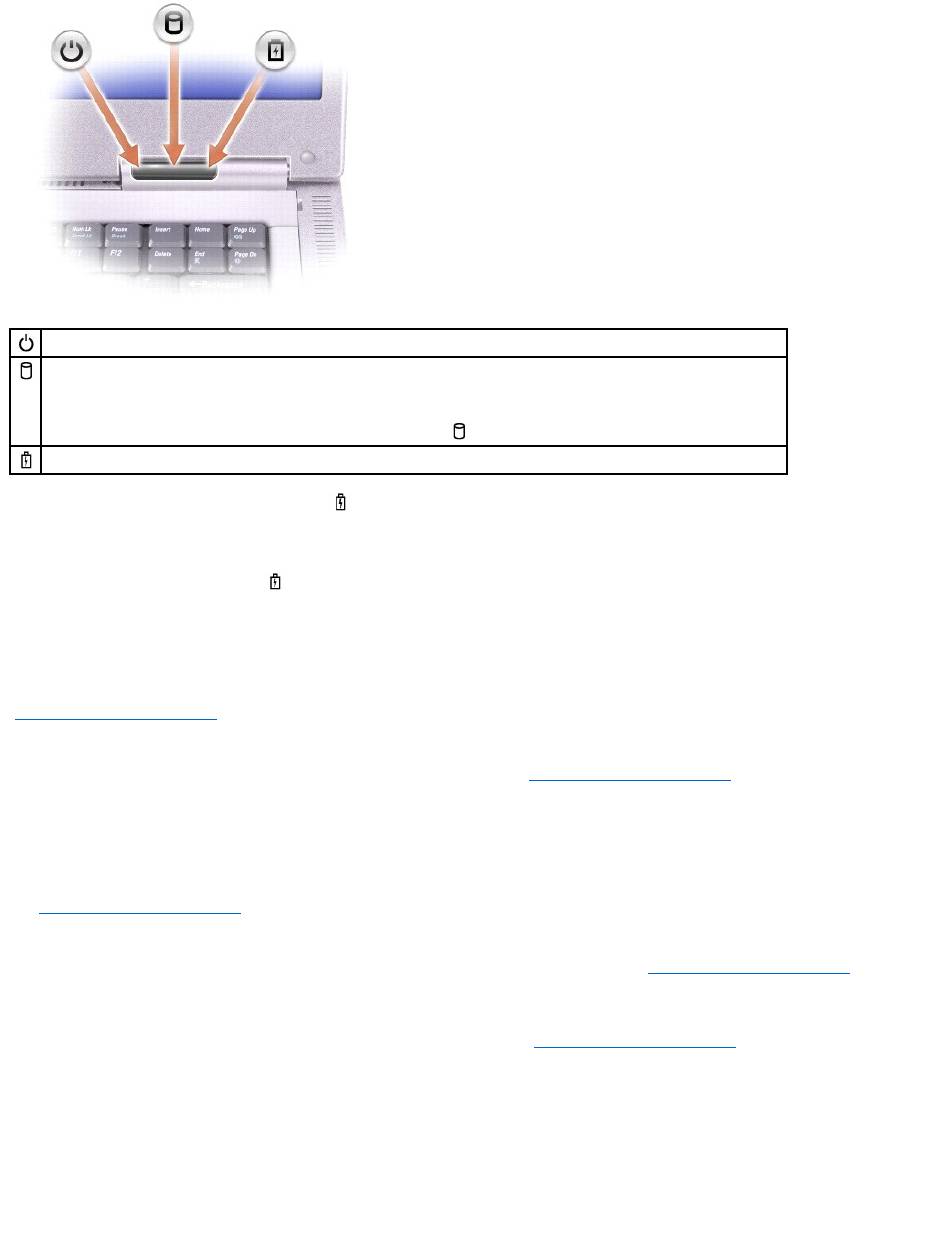
If the computer is connected to an electrical outlet, the light operates as follows:
¡ Solid green: The battery is charging.
¡ Flashing green: The battery is completely charged.
If the computer is running on a battery, the light operates as follows:
¡ Off: The battery is adequately charged (or the computer is turned off).
¡ Flashing orange: The battery charge is low.
¡ Solid orange: The battery charge is critically low.
keyboard — The keyboard includes a numeric keypad as well as the Microsoft® Windows® logo key. For information on supported keyboard shortcuts, see
"Using the Keyboard and Touch Pad."
touch pad — Touch pad and touch pad buttons provide the functionality of a mouse. See "Using the Keyboard and Touch Pad" for more information.
display latch button — Press this button to release the display latch and open the display.
speakers — To adjust the volume of the integrated speakers, press the volume control buttons or volume control keyboard shortcuts. For more information,
see "Using the Keyboard and Touch Pad."
track stick/touch pad buttons — Track stick and touch pad buttons provide the functionality of a mouse. See "Using the Keyboard and Touch Pad" for more
information.
track stick — Track stick and track stick buttons provide the functionality of a mouse. See "Using the Keyboard and Touch Pad" for more information.
volume control buttons — Press these buttons to adjust the volume.
mute button — Press this button to turn off the volume.
keyboard status lights
Turns on when you turn on the computer.
Turns on when the computer reads or writes data.
NOTICE: To avoid loss of data, never turn off the computer while the light is flashing.
Turns on steadily or blinks when the computer is in a power management mode. It also blinks to indicate battery charge status.
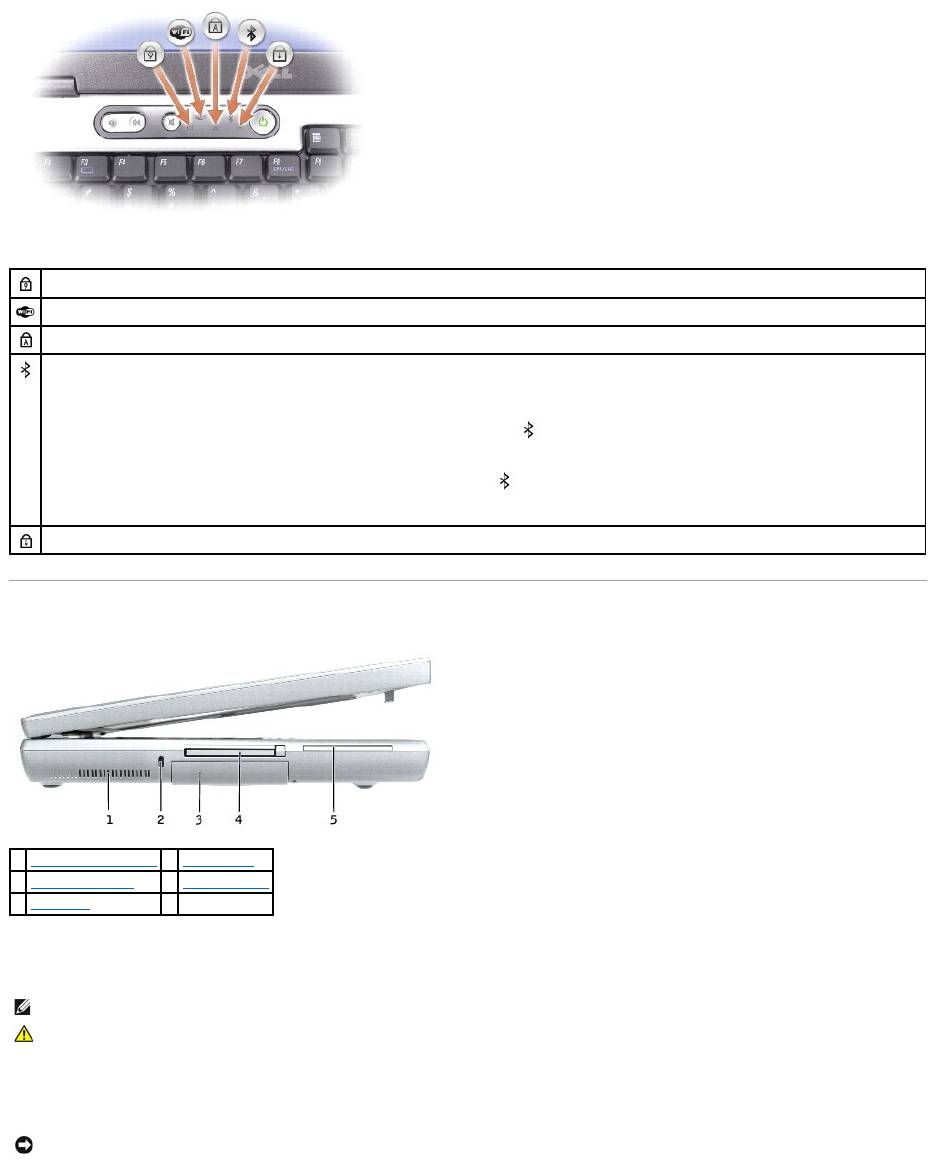
The green lights located above the keyboard indicate the following:
Left Side View
processor fan air vent — The computer uses internal fans to create airflow through the vents, which prevents the computer from overheating.
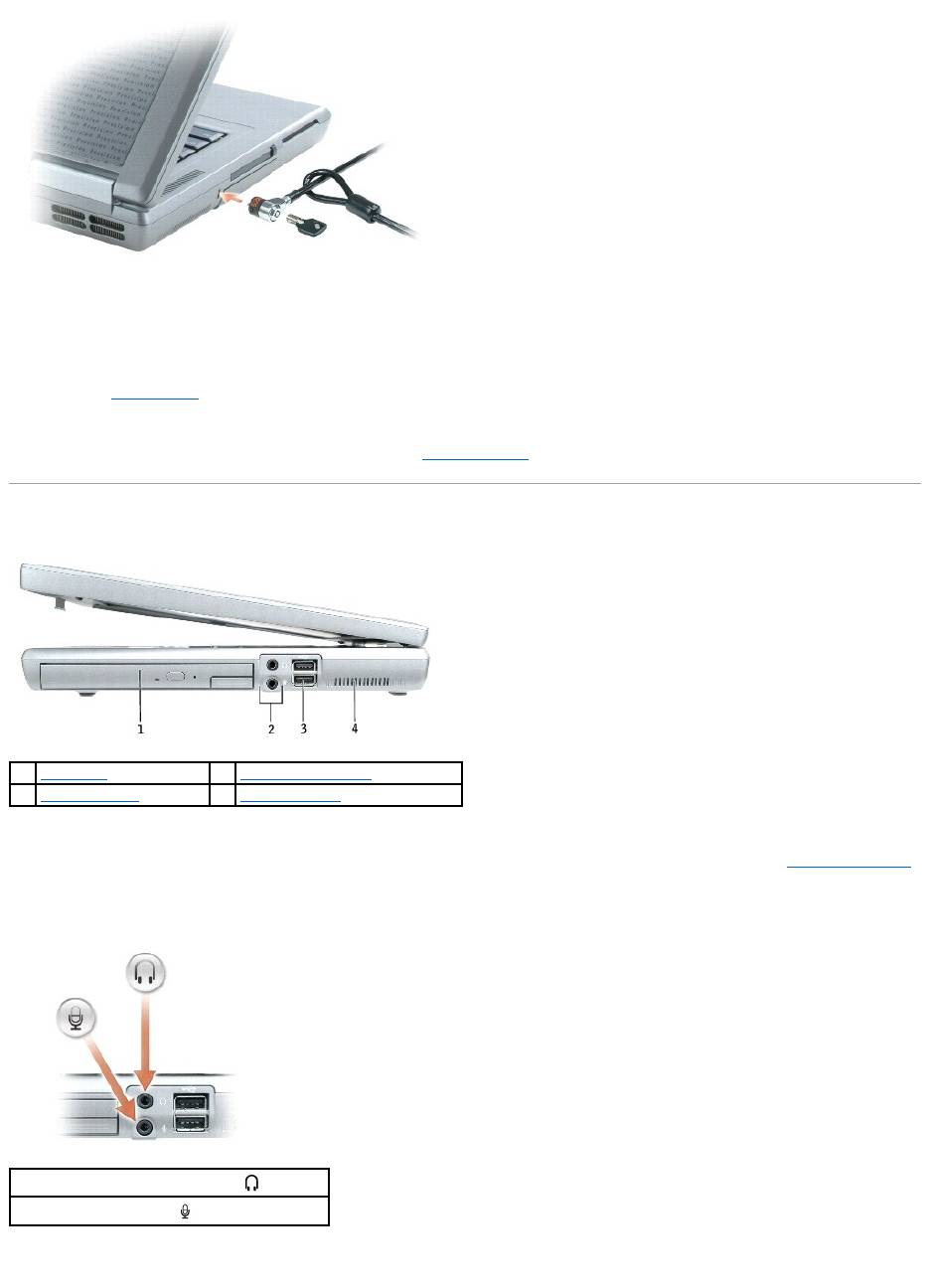
security cable slot — Lets you attach a commercially available antitheft device to the computer. For more information, see the instructions included with the
device.
Turns on when the numeric keypad is enabled.
Turns on when wireless networking is enabled. To enable or disable wireless networking, press <Fn><F2>.
Turns on when the uppercase letter function is enabled.
Turns on when a card with Bluetooth®wireless technology is enabled.
NOTE: The card with Bluetooth wireless technology is an optional feature, so the light turns on only if you ordered the card with your computer.
For more information, see the documentation that came with your card.
To turn off only the Bluetooth wireless technology functionality, right-click the icon in the system tray and select Disable Bluetooth Radio.
To quickly enable or disable all wireless devices, press <Fn><F2>.
Turns on when the scroll lock function is enabled.
1
processor fan air vent
4
PC Card slot
2
security cable slot
5
smart card slot
3
hard drive
NOTE: The computer turns on the fans when the computer gets hot. Fan noise is normal and does not indicate a problem with the fan or the computer.
CAUTION: Do not block, push objects into, or allow dust to accumulate in the air vents. Do not store your computer in a low-airflow environment,
such as a closed briefcase, while it is running. Restricting the airflow can damage the computer or cause a fire.
NOTICE: Before you buy an antitheft device, ensure that it will work with the security cable slot.
hard drive — Stores software and data.
PC Card slot — Supports one PC Card, such as a modem or network adapter. The computer ships with a plastic blank installed in the slot. For more
information, see "Using PC Cards."
smart card slot — Supports one smart card. For more information, see "Using Smart Cards."
Right Side View
module bay — YoucaninstalldevicessuchasanopticaldriveorDellTravelLite™moduleinthemodulebay.Formoreinformation,see"Using the Module Bay."
audio connectors
USB 2.0 connectors (2)
1
module bay
3
USB 2.0 connectors (2)
2
audio connectors
4
video fan air vent
Attach headphones or speakers to the connector.
Attach a microphone to the connector.
video fan air vent — The computer uses internal fans to create airflow through the vents, which prevents the computer from overheating.
Back View
video fan air vent — The computer uses internal fans to create airflow through the vents, which prevents the computer from overheating.
infrared sensor — Lets you transfer files from your computer to another infrared-compatible device without using cable connections.
When you receive your computer, the sensor is disabled. You can use system setup to enable the sensor. For information on transferring data, see Windows
Help, the Windows Help and Support Center, or the documentation that came with your infrared-compatible device.
network connector (RJ-45)
modem connector (RJ-11)
USB 2.0 connectors (2)
Connects USB 2.0 compliant devices, such as a mouse, keyboard, or printer.
NOTE: The computer turns on the fans when the computer gets hot. Fan noise is normal and does not indicate a problem with the fan or the computer.
CAUTION: Do not block, push objects into, or allow dust to accumulate in the air vents. Do not store your computer in a low-airflow environment,
such as a closed briefcase, while it is running. Restricting the airflow can damage the computer or cause a fire.
1
video fan air vent
6
S-video TV-out connector
2
infrared sensor
7
serial connector
3
network connector (RJ-45)
8
video connector
4
modem connector (RJ-11)
9
AC adapter connector
5
USB 2.0 connectors (2)
10
processor fan air vent
NOTE: The computer turns on the fans when the computer gets hot. Fan noise is normal and does not indicate a problem with the fans or the computer.
CAUTION: Do not block, push objects into, or allow dust to accumulate in the air vents. Do not store your computer in a low-airflow environment,
such as a closed briefcase, while it is running. Restricting the airflow can damage the computer or cause a fire.
NOTICE: The network connector is slightly larger than the modem connector. To avoid damaging the computer, do not plug a telephone line in to the
network connector.
Connects the computer to a network. The two lights next to the connector indicate the status of the link and the transfer of information
on a wired network connection.
For information on using the network adapter, see the online network-adapter documentation supplied with your computer. See
"Finding Information."
If you ordered the optional internal modem, connect the telephone line to the modem connector.
For information on using the modem, see the online modem documentation supplied with your computer. See "Finding Information."
S-video TV-out connector
serial connector
video connector
AC adapter connector — Connects the AC adapter so that you can run the computer on AC power instead of battery power.
The AC adapter converts AC power to the DC power required by the computer. You can connect the AC adapter with your computer turned either on or off.
processor fan air vent — The computer uses internal fans to create airflow through the vents, which prevents the computer from overheating.
Bottom View
Connect USB devices, such as a mouse, keyboard, or printer. You can also connect the optional floppy drive directly to a USB connector
using the optional floppy-drive cable.
Connects your computer to a TV. Also connects digital-audio capable devices using the TV/digital-audio adapter cable. For more
information, see "Connecting Your Computer to a TV or Audio Device."
Connects serial devices, such as a mouse or handheld device.
Connects an external monitor. For more information, see "Using the Display."
CAUTION: The AC adapter works with electrical outlets worldwide. However, power connectors and power strips vary among countries. Using an
incompatible cable or improperly connecting the cable to the power strip or electrical outlet may cause fire or equipment damage.
NOTICE: When you disconnect the AC adapter cable from the computer, grasp the connector, not the cable itself, and pull firmly but gently to avoid
damaging the cable.
NOTE: The computer turns on the fans when the computer gets hot. Fan noise is normal and does not indicate a problem with the fans or the computer.
CAUTION: Do not block, push objects into, or allow dust to accumulate in the air vents. Do not store your computer in a low-airflow environment,
such as a closed briefcase, while it is running. Restricting the airflow can damage the computer or cause a fire.
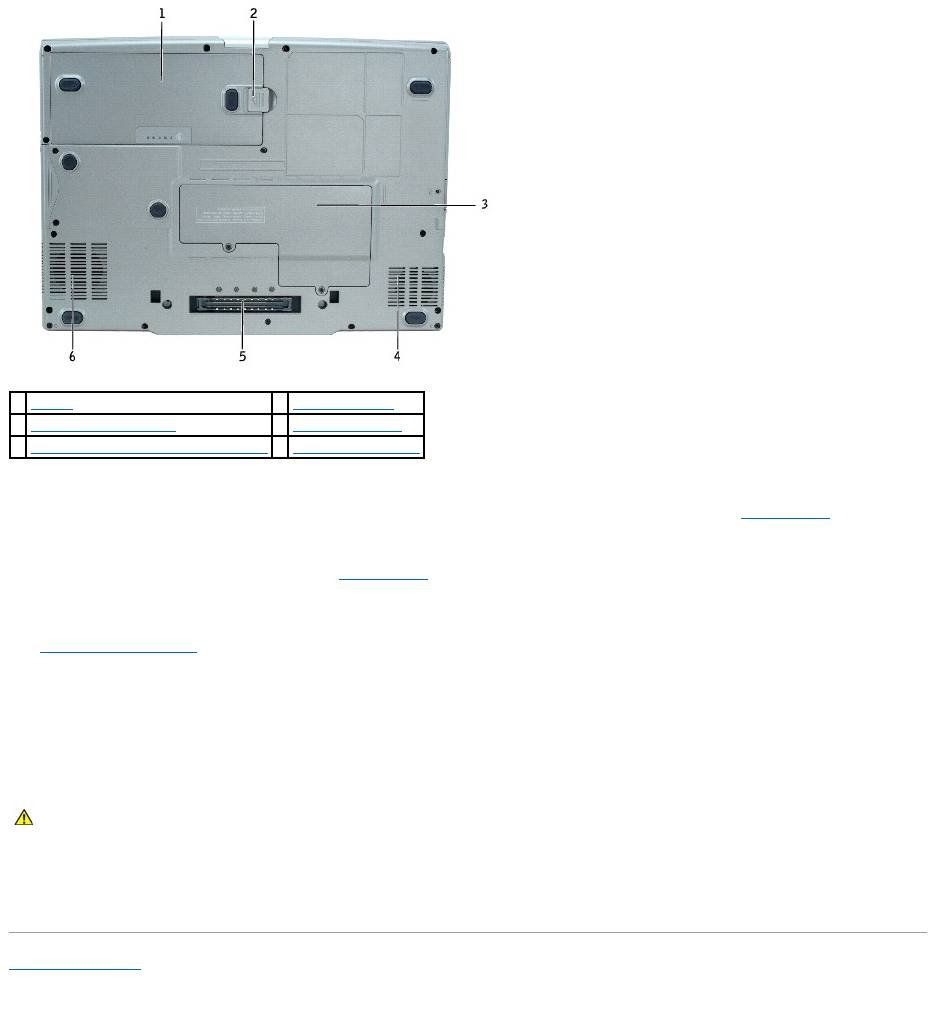
battery — When a battery is installed, you can use the computer without connecting the computer to an electrical outlet. See "Using a Battery."
battery-bay latch release — Releases the battery. See "Using a Battery."
Mini PCI card/modem/DIMM module cover — Covers the compartment that contains the optional modem, the optional Mini PCI card, and the DIMM module.
See "Adding and Replacing Parts."
video fan air vent — The computer uses an internal fan to create airflow through the vents, which prevents the computer from overheating.
docking device slot — Lets you attach your computer to a docking device. See the documentation that came with your docking device for additional
information.
processor fan air vent — The computer uses an internal fan to create airflow through the vents, which prevents the computer from overheating.
Back to Contents Page
1
battery
4
video fan air vent
2
battery-bay latch release
5
docking device slot
3
Mini PCI card/modem/DIMM module cover
6
processor fan air vent
CAUTION: YourcomputerfeaturesUndock&Go™technologythatallowsyoutoundockyourcomputerwithoutgoingintoStandbymode.
Because the computer may not automatically go into Standby mode when it is undocked, ensure that the settings in the Power Options control
panel do not prohibit the computer from going into Standby mode. If you change the Power Options control panel to prohibit the computer from
going into Standby mode, you greatly increase the chances of causing your battery to deteriorate quickly or causing your computer to overheat.

Back to Contents Page
Appendix
DellPrecision™MobileWorkstationM70User'sGuide
Macrovision Product Notice
FCC Notices (U.S. Only)
Macrovision Product Notice
This product incorporates copyright protection technology that is protected by method claims of certain U.S. patents and other intellectual property rights
owned by Macrovision Corporation and other rights owners. Use of this copyright protection technology must be authorized by Macrovision Corporation, and is
intended for home and other limited viewing uses only unless otherwise authorized by Macrovision Corporation. Reverse engineering or disassembly is
prohibited.
FCC Notices (U.S. Only)
Most Dell computers are classified by the Federal Communications Commission (FCC) as Class B digital devices. To determine which classification applies to
your computer, examine all FCC registration labels located on the bottom, side, or back panel of your computer, on card-mounting brackets, and on the cards
themselves. If any one of the labels carries a Class A rating, your entire computer is considered to be a Class A digital device. If all labels carry an FCC Class B
rating as distinguished by either an FCC ID number or the FCC logo, ( ), your computer is considered to be a Class B digital device.
Once you have determined your computer's FCC classification, read the appropriate FCC notice. Note that FCC regulations provide that changes or
modifications not expressly approved by Dell could void your authority to operate this equipment.
This device complies with Part 15 of the FCC Rules. Operation is subject to the following two conditions:
l This device may not cause harmful interference.
l This device must accept any interference received, including interference that may cause undesired operation.
Class A
This equipment has been tested and found to comply with the limits for a Class A digital device pursuant to Part 15 of the FCC Rules. These limits are designed
to provide reasonable protection against harmful interference when the equipment is operated in a commercial environment. This equipment generates, uses,
and can radiate radio frequency energy and, if not installed and used in accordance with the manufacturer's instruction manual, may cause harmful
interference with radio communications. Operation of this equipment in a residential area is likely to cause harmful interference, in which case you will be
required to correct the interference at your own expense.
Class B
This equipment has been tested and found to comply with the limits for a Class B digital device pursuant to Part 15 of the FCC Rules. These limits are designed
to provide reasonable protection against harmful interference in a residential installation. This equipment generates, uses, and can radiate radio frequency
energy and, if not installed and used in accordance with the manufacturer's instruction manual, may cause interference with radio communications. However,
there is no guarantee that interference will not occur in a particular installation. If this equipment does cause harmful interference to radio or television
reception, which can be determined by turning the equipment off and on, you are encouraged to try to correct the interference by one or more of the following
measures:
l Reorient or relocate the receiving antenna.
l Increase the separation between the equipment and the receiver.
l Connect the equipment into an outlet on a circuit different from that to which the receiver is connected.
l Consult the dealer or an experienced radio/television technician for help.
FCC Identification Information
The following information is provided on the device or devices covered in this document in compliance with FCC regulations:
l Model number: PP15L
l Company name:
Dell Inc.
One Dell Way
Round Rock, Texas 78682 USA
512-338-4400
Back to Contents Page

Back to Contents Page
Alert Standard Format (ASF)
DellPrecision™MobileWorkstationM70User'sGuide
Alert Standard Format (ASF) is a Distributed Management Task Force (DMTF) management standard that specifies "pre-operating system" or "operating system
absent" alerting techniques. The standard is designed to generate an alert on potential security and fault conditions when the operating system is in a sleep
state or the system is turned off. ASF is designed to supersede previous operating system-absent alerting technologies.
Your computer supports the following ASF alerts and remote capabilities:
For more information about Dell's ASF implementation, see ASF for Dell Portable Computers and the ASF Administrator's Guide for Dell Portable Computers, which
are available on the Dell Support website at support.dell.com.
Back to Contents Page
Alert
Description
Chassis Intrusion – Physical Security Violation/Chassis Intrusion – Physical
Security Violation Event Cleared
The docking device has been opened and the PCI slot has
been compromised.
Failure to Boot to BIOS
The BIOS did not complete loading upon initiation.
System Password Violation
The system password is invalid (alert occurs after three failed
attempts).
Entity Presence
Periodic heartbeats have been transmitted to verify system
presence.
Back to Contents Page
Using a Battery
DellPrecision™MobileWorkstationM70User'sGuide
Battery Performance
Checking the Battery Charge
Charging the Battery
Removing a Battery
Installing a Battery
Storing a Battery
Battery Performance
ForoptimalcomputerperformanceandtohelppreserveBIOSsettings,operateyourDell™portablecomputerwiththemainbatteryinstalledatalltimes.Use
a battery to run the computer when it is not connected to an electrical outlet. One battery is supplied as standard equipment in the battery bay.
Battery operating time varies depending on operating conditions. You can install an optional second battery in the module bay to significantly increase
operating time.
Operating time is significantly reduced when you perform operations including, but not limited to, the following:
l Using optical drives, such as DVD or CD drives
l Using wireless communications devices, PC Cards, or USB devices
l Using high-brightness display settings, 3D screen savers, or other power-intensive programs such as 3D games
l Running the computer in maximum performance mode
You can check the battery charge before you insert the battery into the computer. You can also set power management options to alert you when the battery
charge is low.
Checking the Battery Charge
The Dell QuickSet Battery Meter, the Microsoft® Windows® Power Meter window and icon, the battery charge gauge and health gauge, and the low-
battery warning provide information on the battery charge.
Dell QuickSet Battery Meter
If Dell QuickSet is installed, press <Fn><F3> to display the QuickSet Battery Meter.
The Battery Meter window displays status, charge level, and charge completion time for the battery in your computer.
In addition, when your computer is connected to a docking device (docked), the Battery Meter window includes a Dock Battery tab, which displays the charge
level and current status of the docking device battery.
The following icons appear in the Battery Meter window:
CAUTION: Before you begin any of the procedures in this section, follow the safety instructions located in the Product Information Guide.
NOTE: Batteries for portable computers are covered only during the initial 1-year period of the limited warranty for your computer. For more information
about the Dell warranty for your computer, see the Product Information Guide or separate paper warranty document that shipped with your computer.
NOTE: Battery capacity (the time it can hold a charge) decreases over time. Depending on how often the battery is used and the conditions under which
it is used, you may need to purchase a new battery during the life of your computer.
NOTE: It is recommended that you connect your computer to an electrical outlet when writing to a CD or DVD.
CAUTION: Using an incompatible battery may increase the risk of fire or explosion. Replace the battery only with a compatible battery purchased
from Dell. The lithium-ion battery is designed to work with your Dell computer. Do not use a battery from other computers with your computer.
CAUTION: Do not dispose of batteries with household waste. When your battery no longer holds a charge, call your local waste disposal or
environmental agency for advice on disposing of a lithium-ion battery. See "Battery Disposal" in the Product Information Guide.
CAUTION: Misuse of the battery may increase the risk of fire or chemical burn. Do not puncture, incinerate, disassemble, or expose the battery to
temperaturesabove65°C(149°F).Keepthebatteryawayfromchildren.Handledamagedorleakingbatterieswithextremecare.Damaged
batteries may leak and cause personal injury or equipment damage.
NOTE: You can use your docking device to charge a computer battery. However, a battery in a docking device does not power the docking device or
computer.
The computer or docking device is running on battery power.
For more information about QuickSet, right-click the icon in the taskbar, and click Help.
Microsoft Windows Power Meter
The Windows Power Meter indicates the remaining battery charge. To check the Power Meter, double-click the icon on the taskbar. For more information
about the Power Meter tab, see "Power Management."
If the computer is connected to an electrical outlet, a icon appears.
Charge Gauge
Before you insert a battery, press the status button on the battery charge gauge to illuminate the charge-level lights. Each light represents approximately 20
percent of the total battery charge. For example, if the battery has 80 percent of its charge remaining, four of the lights are on. If no lights appear, the battery
has no charge.
Health Gauge
The battery operating time is largely determined by the number of times it is charged. After hundreds of charge and discharge cycles, batteries lose some
charge capacity, or battery health. To check the battery health, press and hold the status button on the battery charge gauge for at least 3 seconds. If no
lights appear, the battery is in good condition, and more than 80 percent of its original charge capacity remains. Each light represents incremental
degradation. If five lights appear, less than 60 percent of the charge capacity remains, and you should consider replacing the battery. See "Specifications" for
more information about the battery operating time.
Low-Battery Warning
A low-batterywarningoccurswhenthebatterychargeisapproximately90percentdepleted.Thecomputerbeepsonce,indicatingthatminimalbattery
operating time remains. During that time, the speaker beeps periodically. If two batteries are installed, the low-battery warning means that the combined
charge of both batteries is approximately 90 percent depleted. The computer enters hibernate mode when the battery charge is at a critically low level. For
more information about low-battery alarms, see "Power Management."
Charging the Battery
When you connect the computer to an electrical outlet or install a battery while the computer is connected to an electrical outlet, the computer checks the
battery charge and temperature. If necessary, the AC adapter then charges the battery and maintains the battery charge.
If the battery is hot from being used in your computer or being in a hot environment, the battery may not charge when you connect the computer to an
electrical outlet.
The battery is too hot to start charging if the light flashes alternately green and orange. Disconnect the computer from the electrical outlet and allow the
computer and the battery to cool to room temperature. Then connect the computer to an electrical outlet to continue charging the battery.
For more information about resolving problems with a battery, see "Power Problems."
Removing a Battery
The computer is connected to AC power and the battery is charging.
The computer is connected to AC power and the battery is fully charged.
NOTE: When you press and hold the status button on the battery charge gauge for at least 3 seconds, the charge-level lights will first light to display
the current charge status. Then they switch to Health status where they represent incremental degradation when lit.
NOTICE: To avoid losing or corrupting data, save your work immediately after a low-battery warning. Then connect the computer to an electrical outlet.
You can also turn the computer off and install a second battery in the module bay. If the battery runs completely out of power, hibernate mode begins
automatically.
NOTE: WithDell™ExpressCharge™,whenthecomputeristurnedofftheACadapterchargesacompletelydischargedbatteryto80percentinabout1
hour and to 100 percent in approximately 2 hours. Charge time is longer with the computer turned on. You can leave the battery in the computer as long
as you like. The battery’s internal circuitry prevents the battery from overcharging.
CAUTION: Before performing these procedures, disconnect the modem from the telephone wall jack.
1. Ensure that the computer is turned off and disconnected from the electrical outlet.
2. If the computer is connected to a docking device (docked), undock it. See the documentation that came with your docking device for instructions.
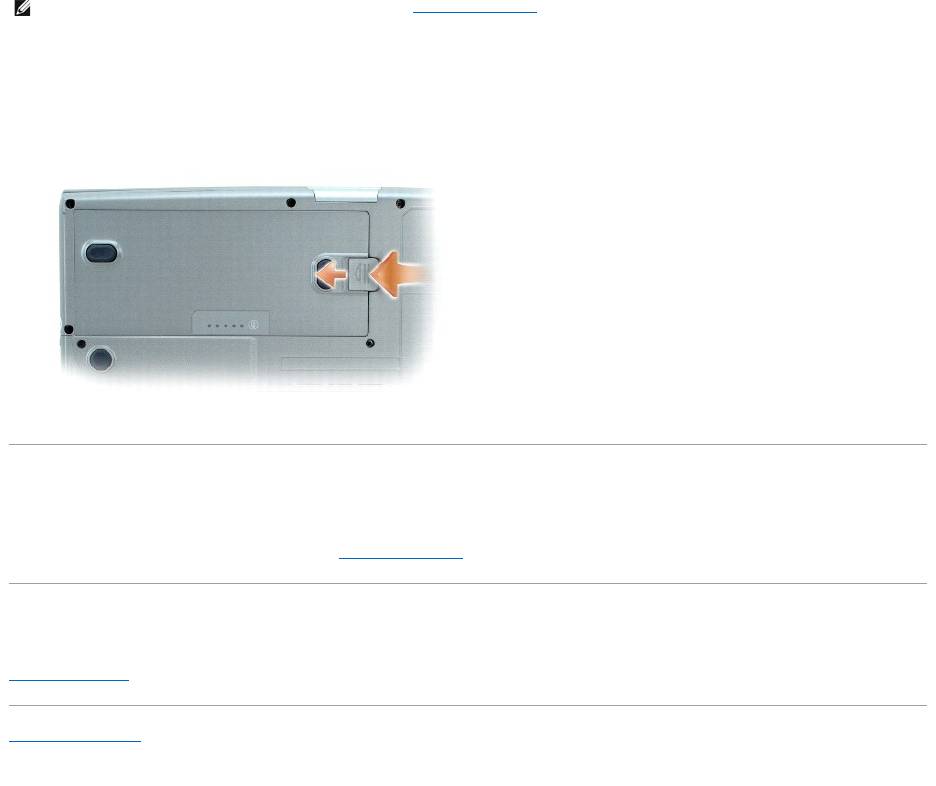
3. Slide and hold the battery-bay latch release on the bottom of the computer, and then remove the battery from the bay.
Installing a Battery
Ensure that the computer is turned off. Slide the battery into the bay until the latch release clicks.
For information about installing the second battery, see "Using the Module Bay."
Storing a Battery
Remove the battery when you store your computer for an extended period of time. A battery discharges during prolonged storage. After a long storage period,
recharge the battery fully before you use it.
Back to Contents Page
NOTE: For information about removing the second battery, see "Using the Module Bay."
Back to Contents Page
Using the Module Bay
DellPrecision™MobileWorkstationM70User'sGuide
About the Module Bay
About the Device Security Screw
Removing and Installing Devices While the Computer Is Turned Off
Removing and Installing Devices While the Computer Is Running
About the Module Bay
You can install devices such as a floppy drive, optical drive, second battery, or second hard drive in the module bay.
About the Device Security Screw
YourDell™computershipswithaCD/DVDdriveinstalledinthemodulebayandadevicesecurityscrew,whichisnotinstalledintheCD/DVDdrivebut
packaged separately. When you install a module in the bay, you can install the device security screw to prevent the module from being easily removed.
Removing the Device Security Screw
If the device security screw is installed, you must remove the screw to remove the module from the bay:
1. Save and close any open files, exit any open programs, and shut down the computer.
2. If the computer is connected to a docking device (docked), undock it. See the documentation that came with your docking device for instructions.
3. Close the display and turn the computer over.
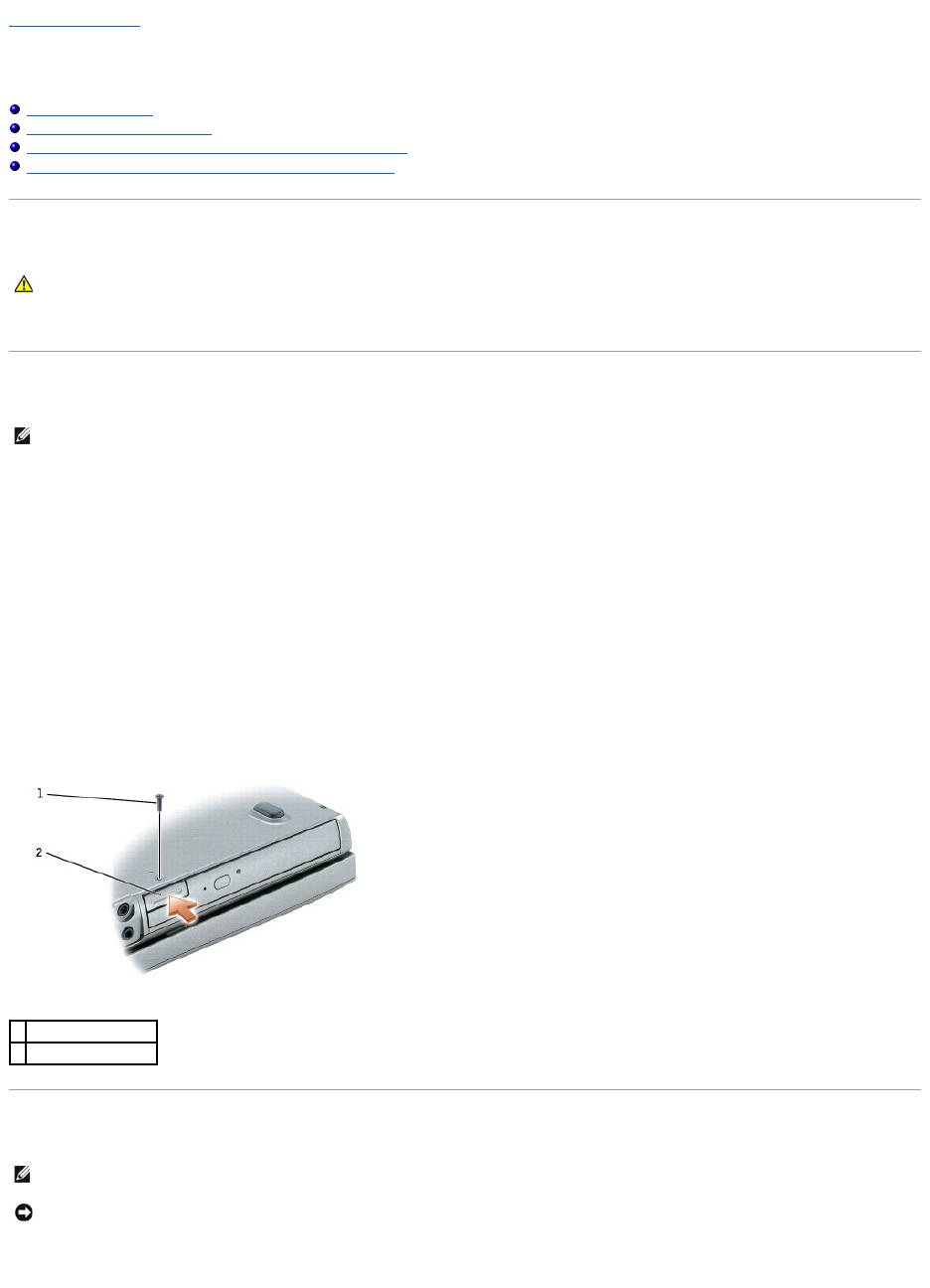
4. Use a #1 Phillips screwdriver to remove the device security screw from the bottom of the computer.
Removing and Installing Devices While the Computer Is Turned Off
1. If the device security screw is installed, remove it.
CAUTION: Before you begin any of the procedures in this section, follow the safety instructions located in the Product Information Guide.
NOTE: You do not need to install the device security screw unless you want to prevent the module from being easily removed.
1
device security screw
2
device latch release
NOTE: If the device security screw is not installed, you can remove and install devices while the computer is running and connected to a docking device
(docked).
NOTICE: To prevent damage to devices, store them in a safe, dry place when they are not installed in the computer. Avoid pressing down on them or
placing heavy objects on top of them.
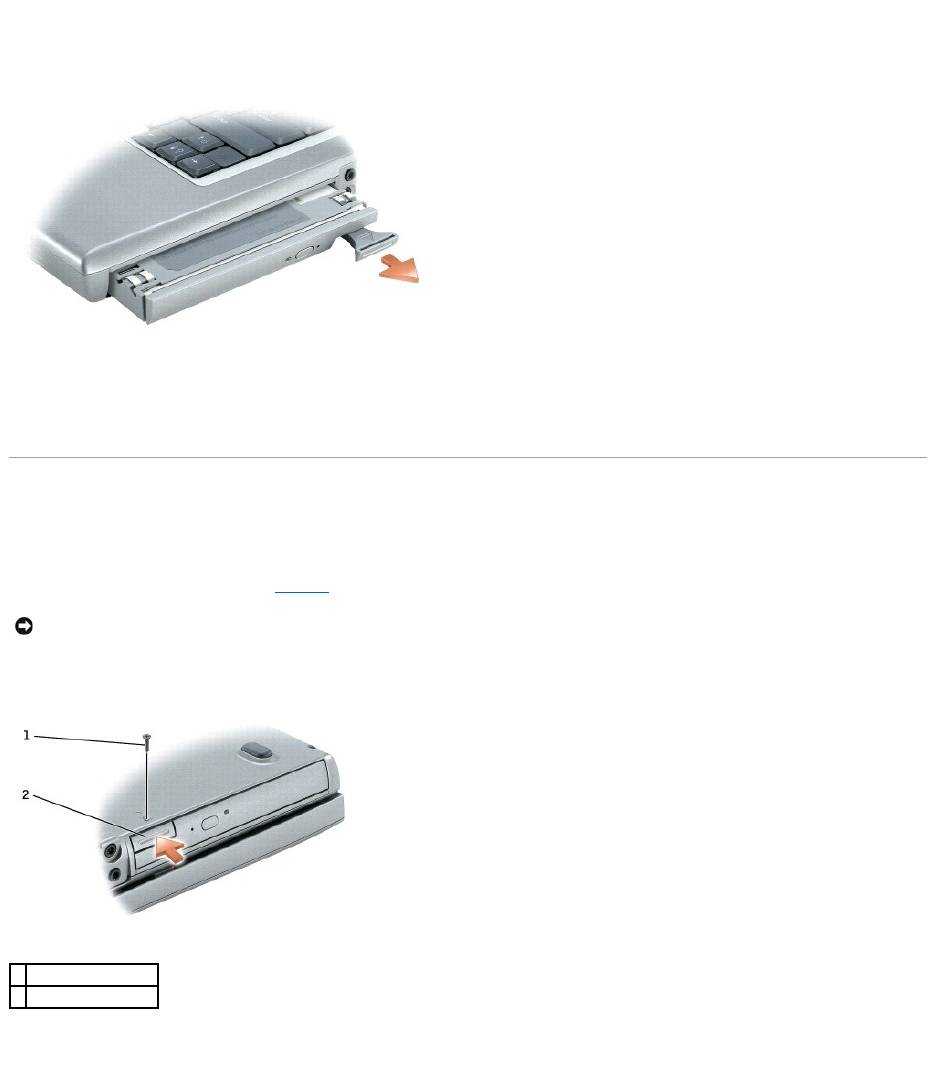
2. Press the device latch release.
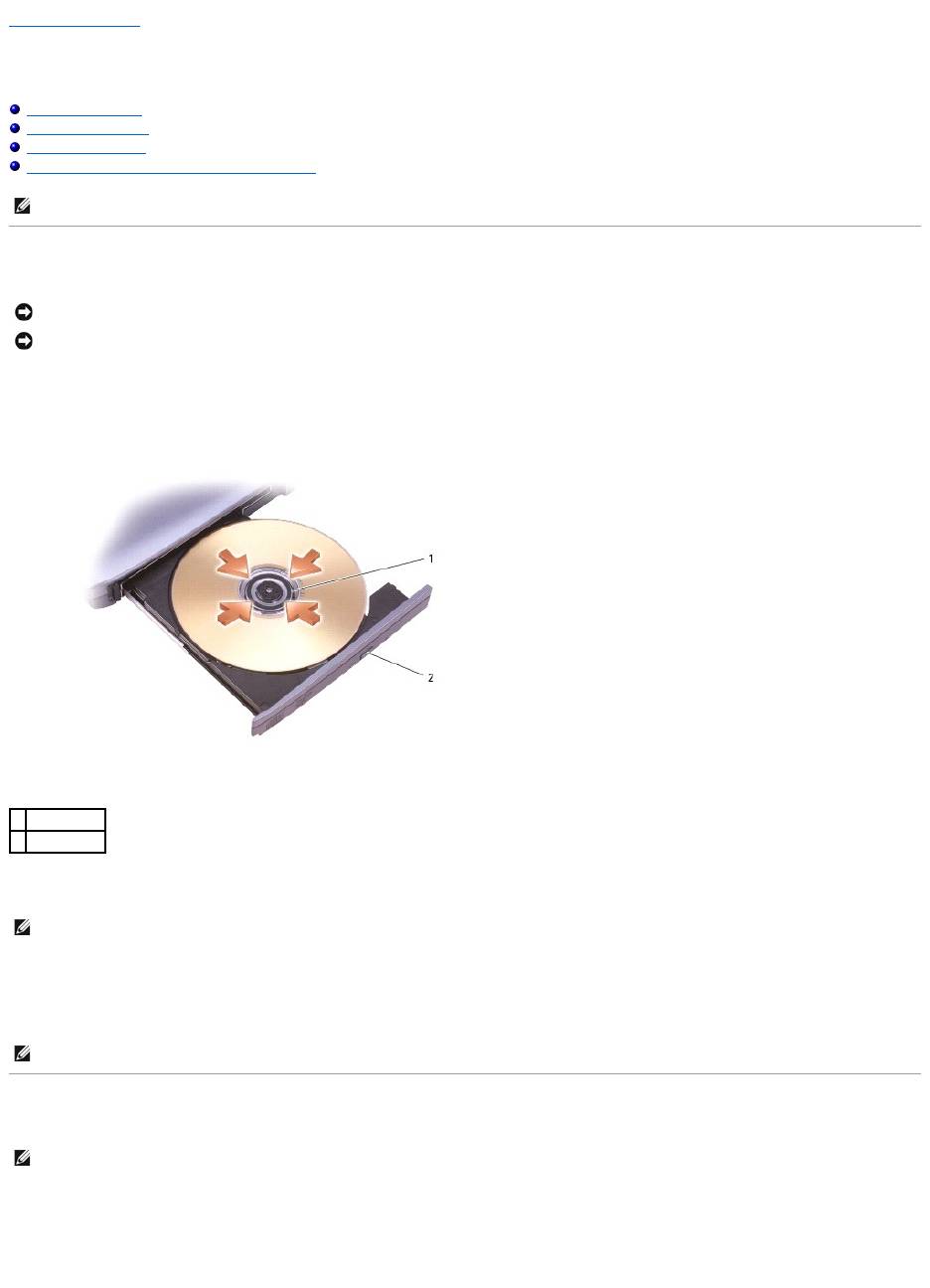
3. Pull the device out of the module bay.
4. Push the new device into the bay until it clicks.
5. Press the device latch release.
Removing and Installing Devices While the Computer Is Running
1. Before ejecting the device, double-click the Safely Remove Hardware icon on the taskbar, click the device you want to eject, and click Stop.
2. If the device security screw is installed, remove it.
3. Press the device latch release.
4. Pull the device out of the module bay.
NOTICE: To prevent damage to devices, store them in a safe, dry place when they are not installed in the computer. Avoid pressing down on them or
placing heavy objects on top of them.
1
device security screw
2
device latch release
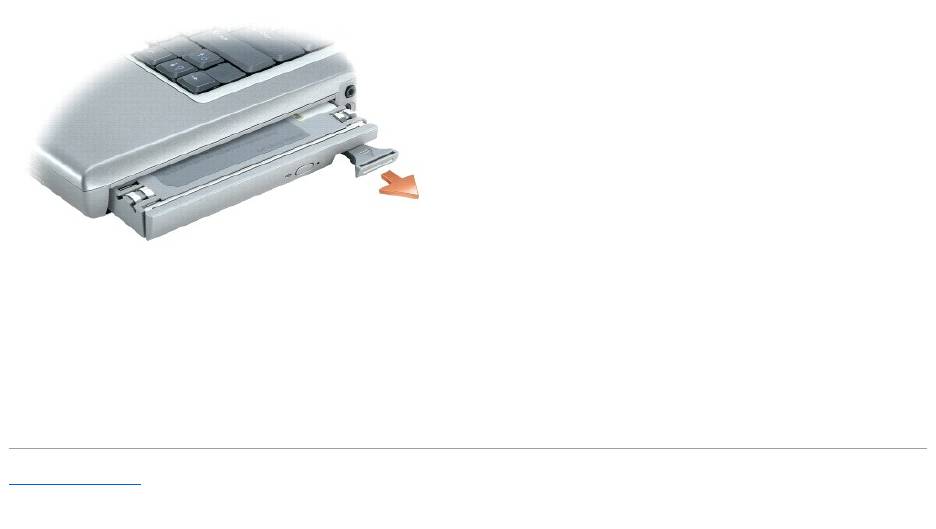
5. Push the new device into the bay until it clicks.
The operating system automatically recognizes the device.
6. Press the device latch release.
7. If necessary, enter your password to unlock your computer.
Back to Contents Page
Back to Contents Page
Using CDs, DVDs, and Other Module Bay Devices
DellPrecision™MobileWorkstationM70User'sGuide
Playing a CD or DVD
Adjusting the Volume
Adjusting the Picture
Connecting Your Computer to a TV or Audio Device
Playing a CD or DVD
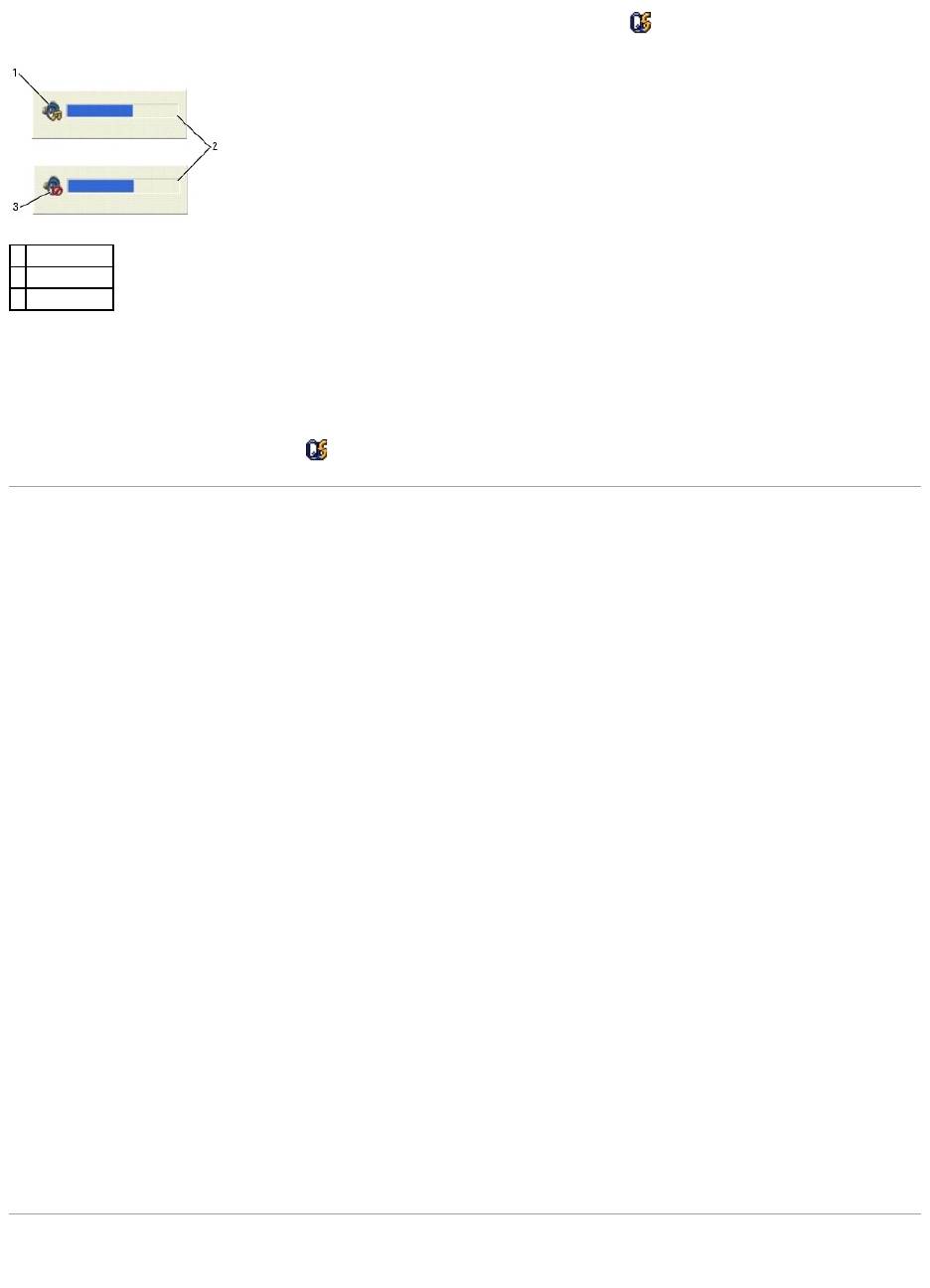
1. Press the eject button on the front of the drive.
2. Pull the tray out.
3. Place the disc, label side up, in the center of the tray and snap the disc onto the spindle.
4. Push the tray back into the drive.
To format CDs for storing data, to create music CDs, or to copy CDs, see the CD software that came with your computer.
Adjusting the Volume
1. Click the Start button, point to All Programs (or Programs)® Accessories® Entertainment (or Multimedia), and then click Volume Control.
2. In the Volume Control window, click and drag the bar in the Volume Control column and slide it up or down to increase or decrease the volume.
For more information on volume control options, click Help in the Volume Control window.
NOTE: The Drivers and Utilities CD is optional and may not ship with all computers.
NOTICE: Do not press down on the CD or DVD tray when you open or close it. Keep the tray closed when you are not using the drive.
NOTICE: Do not move the computer when you are playing CDs or DVDs.
1
spindle
2
eject button
NOTE: If you use a module that shipped with another computer, you need to install the drivers and software necessary to play DVDs or write data. For
more information, see the Drivers and Utilities CD.
NOTE: Ensure that you follow all copyright laws when you create CDs.
NOTE: When the speakers are muted, you do not hear the CD or DVD playing.
The Volume Meter displays the current volume level, including mute, on your computer. Either right-click the icon in the taskbar or press the volume
control buttons to enable or disable the Volume Meter on the screen.
When the meter is enabled, adjust the volume with the volume control buttons or by pressing the following keys:
l Press <Fn> <PageUp> to increase volume.
l Press <Fn> <PageDn> to decrease volume.
l Press <Fn> <End> to mute volume.
For more information about QuickSet, right-click the icon in the taskbar and click Help.
Adjusting the Picture
If an error message notifies you that the current resolution and color depth are using too much memory and preventing DVD playback, adjust the display
properties.
Microsoft®Windows®XP
1. Click the Start button and click Control Panel.
2. Under Pick a category, click Appearance and Themes.
3. Under Pick a task..., click Change the screen resolution.
4. In the Display Properties window, click and drag the bar in Screen resolution to change the setting to 1024 by 768 pixels.
5. Click the drop-down menu under Color quality, and then click Medium (16 bit).
6. Click OK.
Microsoft Windows 2000
1. Click the Start button, point to Settings, and then click Control Panel.
2. Double-click the Display icon and click the Settings tab.
3. Click and drag the bar in Screen area to change the setting to 1024 by 768 pixels.
4. Under Color quality, click the drop-down menu and click High Color (16 bit).
5. Click Apply.
6. Click OK to save the settings and close the window.
Connecting Your Computer to a TV or Audio Device
1
volume icon
2
Volume Meter
3
mute icon
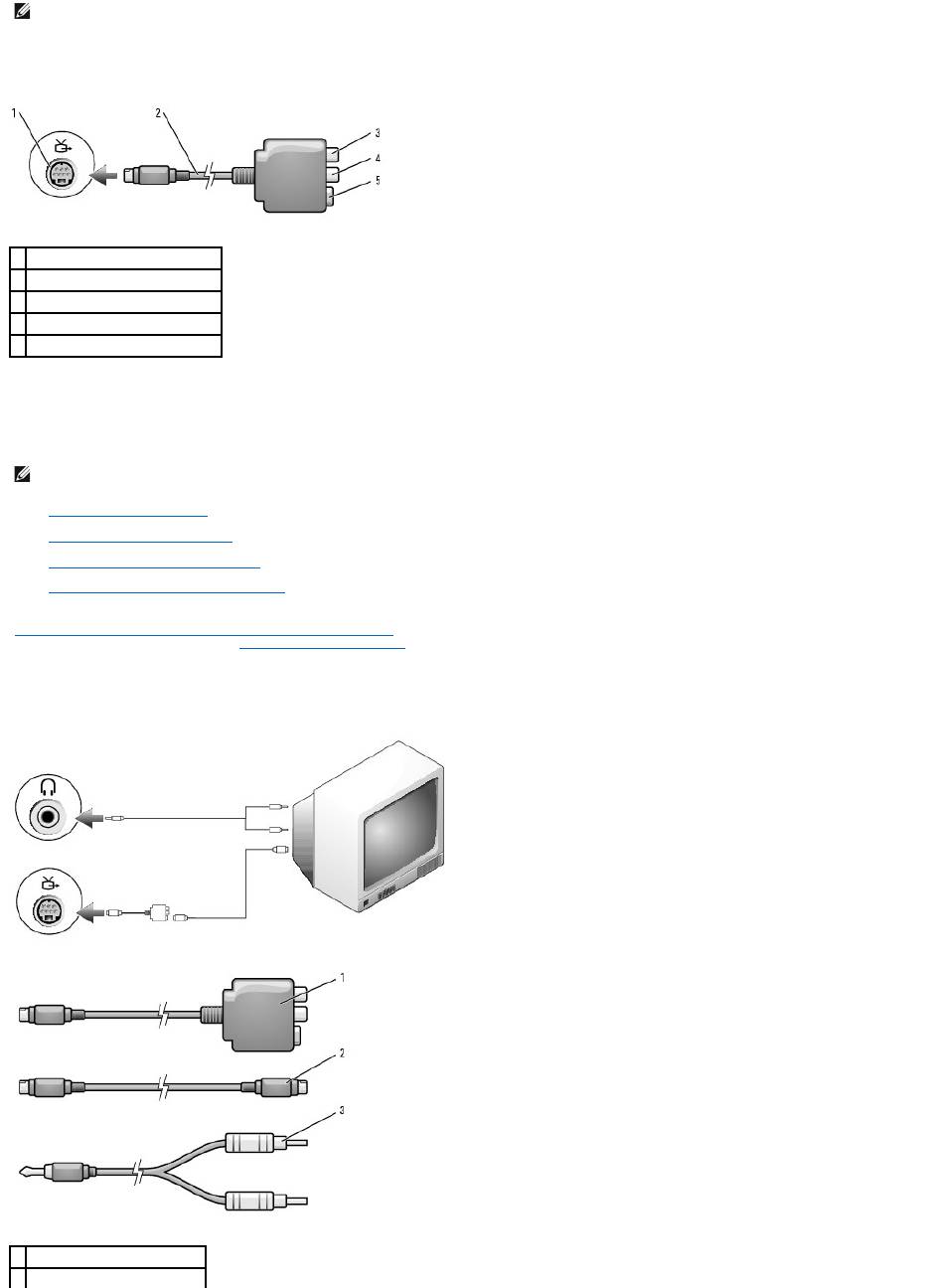
Your computer has an S-video TV-out connector that, together with the TV/digital audio adapter cable (available from Dell), enables you to connect the
computer to a TV and/or stereo audio device. The TV/digital audio adapter cable provides connectors for an S-video cable, a composite video cable, and an
S/PDIF digital audio cable.
Your TV has either an S-video input connector or a composite video-input connector. Depending on what type of connector is available on your TV, you can use
a commercially available S-video cable or composite video cable to connect your computer to your TV. For audio devices without support for S/PDIF digital
audio, you can use the audio connector on the side of the computer to connect the computer to your audio device.
It is recommended that you connect video and audio cables to your computer in one of the following combinations.
l S-video and standard audio
l S-video and S/PDIF digital audio
l Composite video and standard audio
l Composite video and S/PDIF digital audio
When you finish connecting the video and audio cables between your computer and your TV, you must enable your computer to work with the TV. See
"Enabling the Display Settings for a TV in Microsoft® Windows® XP" to ensure that the computer recognizes and works properly with the TV. Additionally, if
you are using S/PDIF digital audio, see "Enabling S/PDIF Digital Audio."
S-Video and Standard Audio
NOTE: Video and audio cables for connecting your computer to a TV or other audio device are not included with your computer. Cables may be
purchased at most consumer electronics stores. The TV/digital audio adapter cable is available for purchase from Dell.
1
S-video TV-out connector
2
TV/digital audio adapter cable
3
S/PDIF digital audio connector
4
composite video-input connector
5
S-video input connector
NOTE: See the diagrams at the beginning of each subsection to help you determine which method of connection you should use.
1
TV/digital audio adapter cable
2
S-video cable
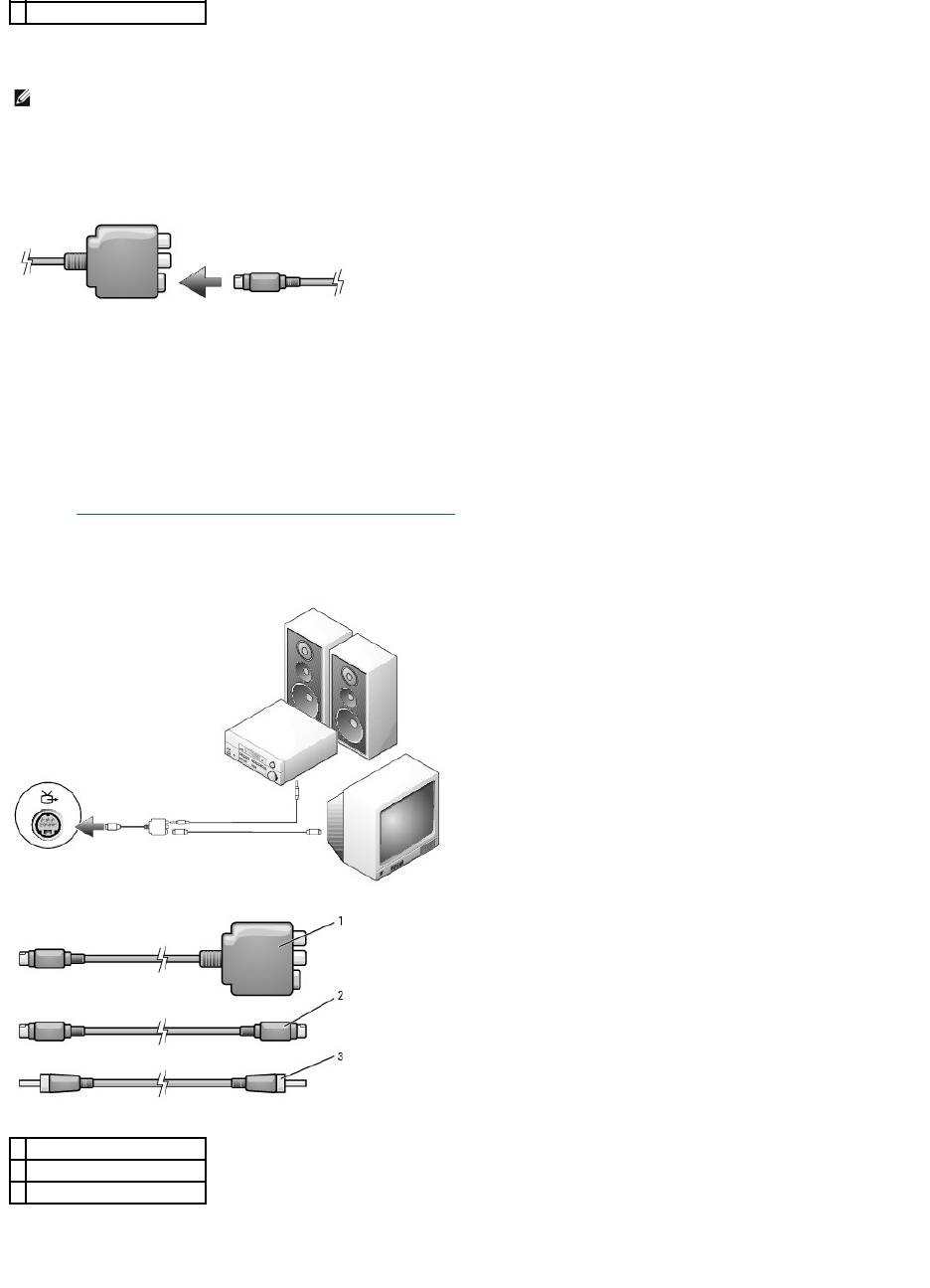
1. Turn off the computer and the TV and/or audio device that you want to connect.
2. Connect the TV/digital audio adapter cable to the S-video TV-out connector on your computer.
3. Plug one end of the S-video cable in to the S-video input connector on the TV/digital audio adapter cable.
4. Plug the other end of the S-video cable in to the S-video input connector on your TV.
5. Plug the single-connector end of the audio cable in to the headphone connector on your computer.
6. Plug the two RCA connectors on the other end of the audio cable in to the audio input connectors on your TV or other audio device.
7. Turn on the TV and any audio device that you connected (if applicable), and then turn on the computer.
8. See "Enabling the Display Settings for a TV in Microsoft® Windows® XP" to ensure that the computer recognizes and works properly with the TV.
S-Video and S/PDIF Digital Audio
1. Turn off the computer and the TV and/or audio device that you want to connect.
2. Connect the TV/digital audio adapter cable to the S-video TV-out connector on your computer.
3
standard audio cable
NOTE: You can connect an S-video cable directly to the S-video TV-out connector on the computer (without the TV/digital audio adapter cable) if your TV
or audio device supports S-video but not S/PDIF digital audio.
1
TV/digital audio adapter cable
2
S-video cable
3
S/PDIF digital audio cable
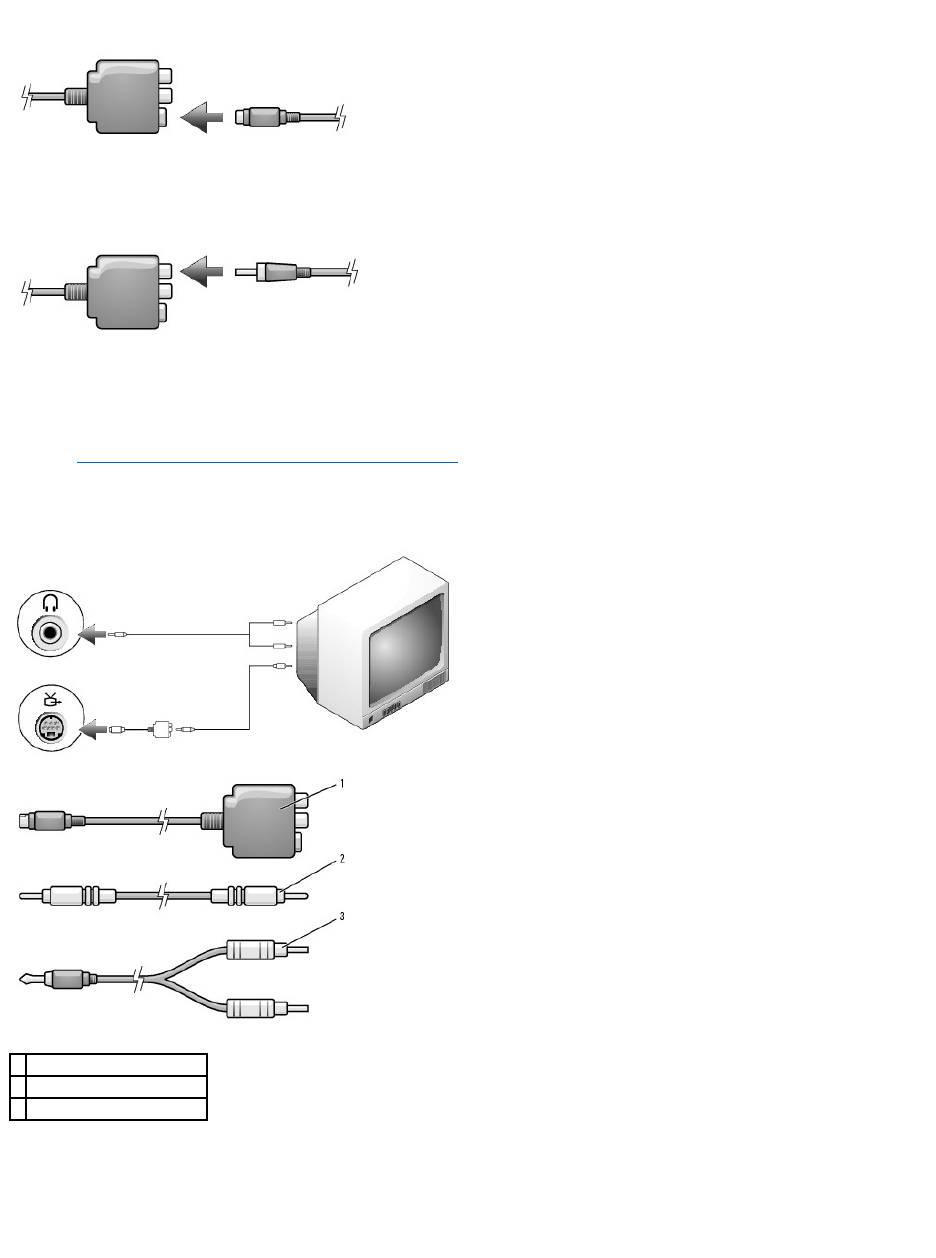
3. Plug one end of the S-video cable in to the S-video input connector on the TV/digital audio adapter cable.
4. Plug the other end of the S-video cable in to the S-video input connector on the TV.
5. Plug one end of the S/PDIF digital audio cable in to the digital audio connector on the TV/digital audio adapter cable.
6. Plug the other end of the S/PDIF digital audio cable in to the audio input connector on your TV or other audio device.
7. Turn on the TV, turn on any audio device that you connected (if applicable), and then turn on the computer.
8. See "Enabling the Display Settings for a TV in Microsoft® Windows® XP" to ensure that the computer recognizes and works properly with the TV.
Composite Video and Standard Audio
1. Turn off the computer and the TV and/or audio device that you want to connect.
2. Connect the TV/digital audio adapter cable to the S-video TV-out connector on the computer.
3. Plug one end of the composite video cable in to the composite video-input connector on the TV/digital audio adapter cable.
1
TV/digital audio adapter cable
2
composite video cable
3
standard audio cable
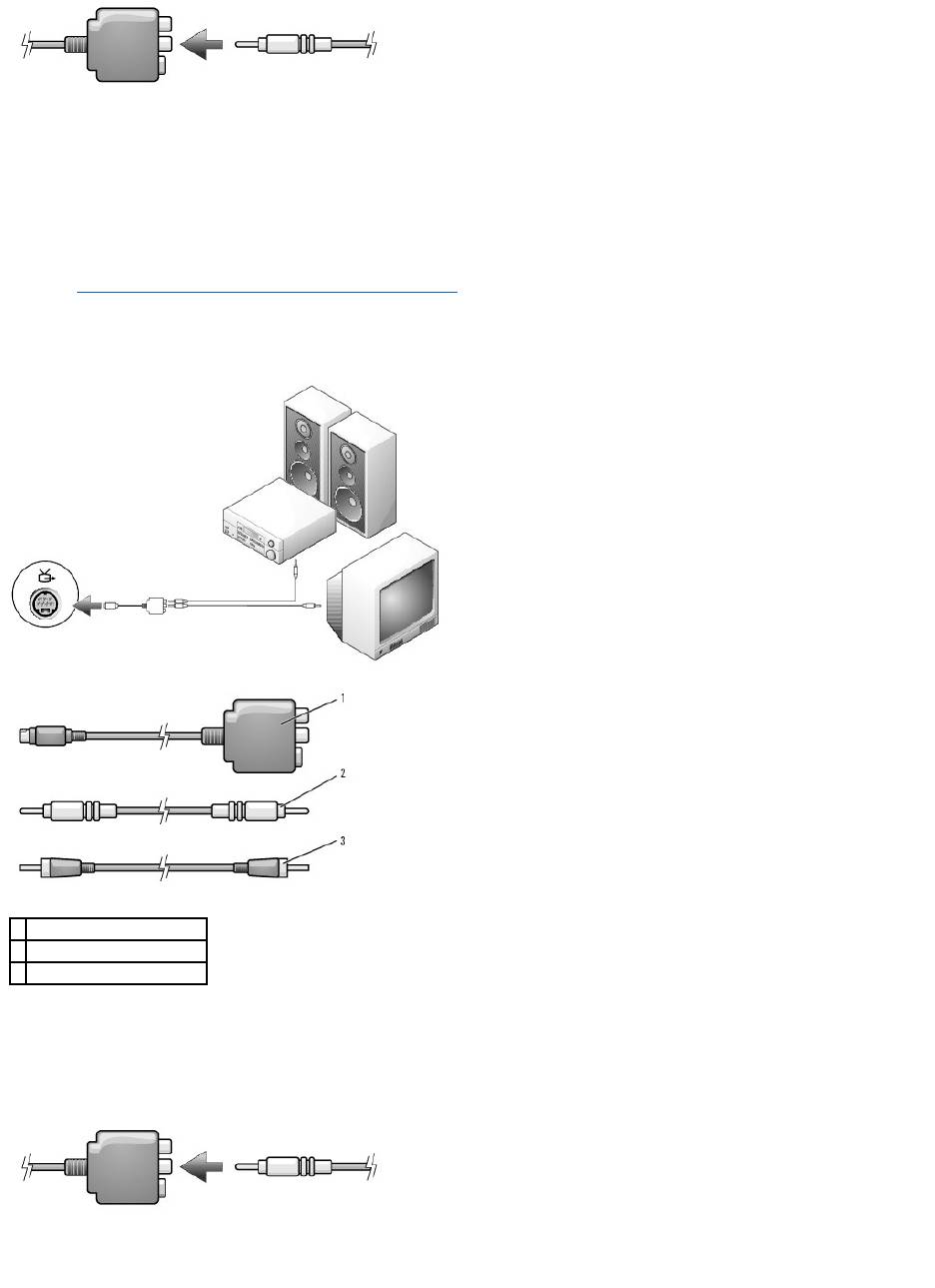
4. Plug the other end of the composite video cable in to the composite video-input connector on the TV.
5. Plug the single-connector end of the audio cable in to the headphone connector on the computer.
6. Plug the two RCA connectors on the other end of the audio cable in to the audio input connectors on your TV or other audio device.
7. Turn on the TV, turn on any audio device that you connected (if applicable), and then turn on the computer.
8. See "Enabling the Display Settings for a TV in Microsoft® Windows® XP" to ensure that the computer recognizes and works properly with the TV.
Composite Video and S/PDIF Digital Audio
1. Turn off the computer and the TV and/or audio device that you want to connect.
2. Connect the TV/digital audio adapter cable to the S-video TV-out connector on the computer.
3. Plug one end of the composite video cable in to the composite video-input connector on the TV/digital audio adapter cable.
4. Plug the other end of the composite video cable in to the composite video-input connector on the TV.
1
TV/digital audio adapter cable
2
composite video cable
3
S/PDIF digital audio cable
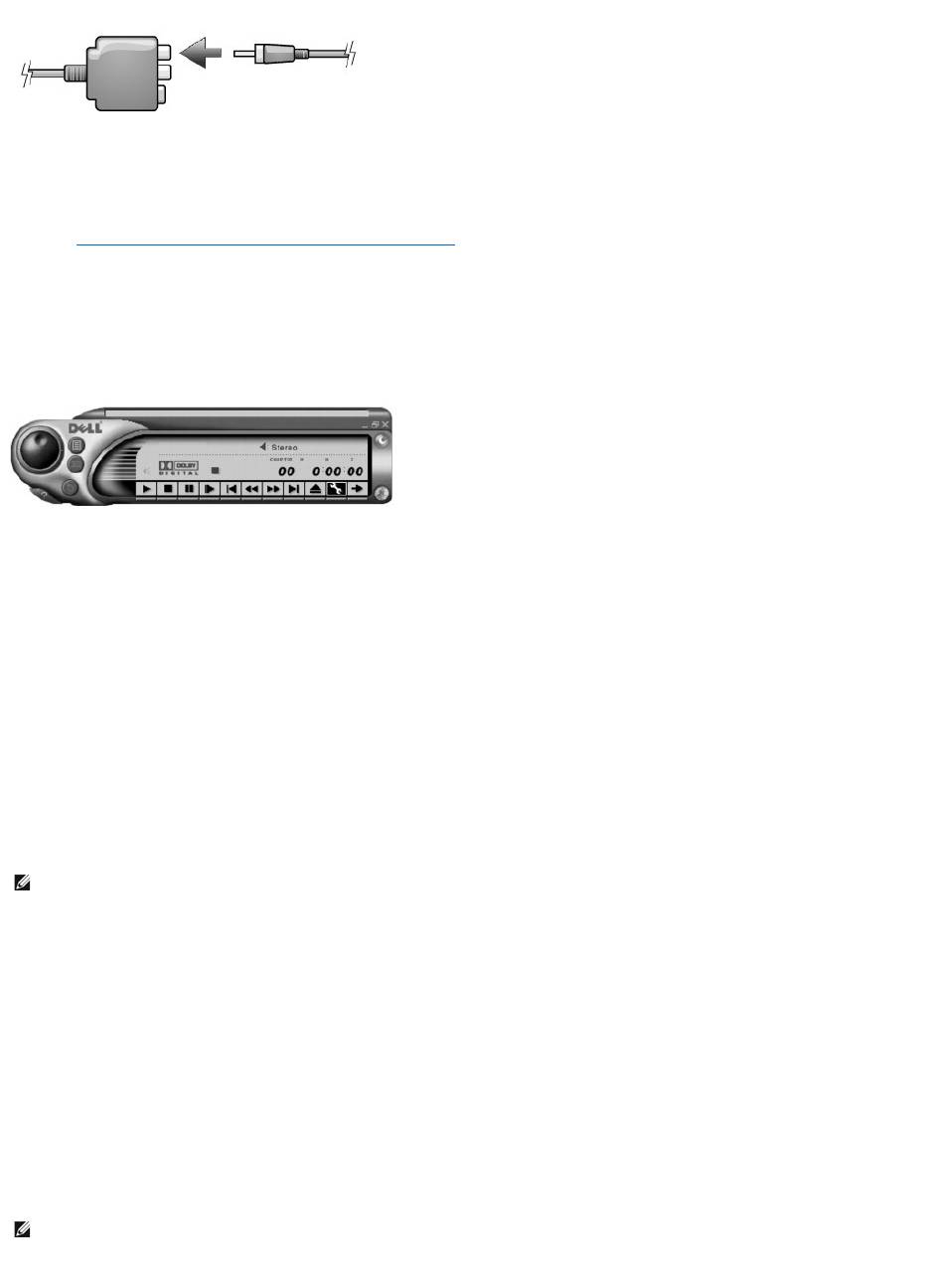
5. Plug one end of the S/PDIF digital audio cable in to the S/PDIF audio connector on the TV/digital audio adapter cable.
6. Plug the other end of the digital audio cable in to the S/PDIF input connector on your TV or other audio device.
7. Turn on the TV, turn on any audio device that you connected (if applicable), and then turn on the computer.
8. See "Enabling the Display Settings for a TV in Microsoft® Windows® XP" to ensure that the computer recognizes and works properly with the TV.
Enabling S/PDIF Digital Audio
If your computer has a DVD drive, you can enable Dolby Digital 5.1 audio for DVD playback.
1. Double-click the Cyberlink PowerDVD icon on the Microsoft®Windows®desktop.
2. Insert a DVD into the DVD drive.
If the DVD begins playing, click the stop button.
3. Click the Properties (wrench) icon.
4. Click the Audio tab.
5. Click Enable S/PDIF output.
6. Click Apply.
7. Click OK.
Enabling S/PDIF in the Windows Audio Driver
1. Double-click the speaker icon in the Windows notification area.
2. Click the Options menu and then click Advanced Controls.
3. Click Advanced.
4. Click Enable S/PDIF.
5. Click Close.
6. Click OK.
Setting Up the Dolby Headphone
1. Double-click the Intervideo Win DVD icon on the Windows desktop.
NOTE: Enabling S/PDIF in Windows disables the sound from the headphone connector.
NOTE: The Dolby headphone feature is available only if your computer has a DVD drive.

2. Click the Properties icon.
3. Click the Dolby Headphone tab.
4. Click Enable Dolby Headphone.
5. Select one of the four options to set the level of surround sound effects. Option 1 is a baseline stereo option and Options 2, 3, and 4 are surround
sound levels.
6. Click Apply, and then click OK to close the WinDVD Properties window.
7. Click Exit.
Enabling the Display Settings for a TV in Microsoft®Windows®XP
Your computer may have either an ATI video-controller card or an NVIDIA video-controller card. See the following subsection that corresponds to the video
controller installed in your computer.
ATI Video-Controller Card
1. Click the Start button and click Control Panel.
2. Click Appearances and Themes.
3. Under or pick a Control Panel icon, click Display.
4. Click the Settings tab and click Advanced.
5. Click the Displays tab.
6. Click the upper-left corner of the TV button to enable the TV.
7. Click OK.
NVIDIA Video-Controller Card
1. Click the Start button and click Control Panel.
2. Click Appearances and Themes.
3. Under or pick a Control Panel icon, click Display.
4. Click the Settings tab and click Advanced.
5. Click the Nvidia GeForce tab.
6. On the left side of the menu, click nView Display Mode.
7. Click Clone to enable the television.
8. Click Apply.
9. Click OK to confirm the settings change.
10. Click Yes to keep the new settings.
NOTE: Icon labels may be visible only when you place the cursor over the icon.
NOTE: Ensure that you properly connect the TV before you enable the display settings.
NOTE: Ensure that you properly connect the TV before you enable the display settings.

11. Click OK.
Back to Contents Page

Back to Contents Page
Cleaning Your Computer
DellPrecision™MobileWorkstationM70User'sGuide
Computer, Keyboard, and Display
l Use a can of compressed air to gently remove dust from the slots and holes on your computer and from between the keys on the keyboard.
l Moisten a soft, lint-free cloth with either water or an LCD cleaner, and wipe the display until it is clean.
l Moisten a soft, lint-free cloth with water and wipe the computer and keyboard. Do not allow water from the cloth to seep between the touch pad and
the surrounding palm rest.
Touch Pad
1. Shut down and turn off your computer, disconnect any attached devices, and disconnect them from their electrical outlets.
2. Remove any installed batteries.
3. Moisten a soft, lint-free cloth with water, and wipe it gently across the surface of the touch pad. Do not allow water from the cloth to seep between the
touch pad and the surrounding palm rest.
Floppy Drive
Clean your floppy drive using a commercially available cleaning kit. These kits contain pretreated floppy disks to remove contaminants that accumulate during
normal operation.
CDs and DVDs
If you notice problems, such as skipping, with the playback quality of your CDs or DVDs, try cleaning the discs.
1. Hold the disc by its outer edge. You can also touch the inside edge of the center hole.
2. With a soft, lint-free cloth, gently wipe the bottom of the disc (the unlabeled side) in a straight line from the center to the outer edge of the disc.
For stubborn dirt, try using water or a diluted solution of water and mild soap. You can also purchase commercial products that clean discs and provide
some protection from dust, fingerprints, and scratches. Cleaning products for CDs are safe to use on DVDs.
Back to Contents Page
CAUTION: Before you begin any of the procedures in this section, follow the safety instructions located in the Product Information Guide.
CAUTION: Before you clean your computer, disconnect the computer from the electrical outlet and remove any installed batteries. Clean your
computer with a soft cloth dampened with water. Do not use liquid or aerosol cleaners, which may contain flammable substances.
NOTICE: To avoid damaging the computer or display, do not spray cleaning solution directly onto the display. Only use products specifically designed for
cleaning LCDs, and follow the instructions that are included with the product.
NOTICE: Do not attempt to clean drive heads with a swab. You might accidentally misalign the heads, which prevents the drive from operating.
NOTICE: Always use compressed air to clean the lens in the CD/DVD drive, and follow the instructions that come with the compressed air. Never touch
the lens in the drive.
NOTICE: To prevent damaging the surface, do not wipe in a circular motion around the disc.

Back to Contents Page
Using the Dell Diagnostics
DellPrecision™MobileWorkstationM70User'sGuide
Dell Diagnostics
When to Use the Dell Diagnostics
If you experience a problem with your computer, perform the checks in "Lockups and Software Problems" and run the Dell Diagnostics before you contact Dell
for technical assistance.
It is recommended that you print these procedures before you begin.
Start the Dell Diagnostics from either your hard drive or from the Drivers and Utilities CD (also known as the ResourceCD).
Starting the Dell Diagnostics From Your Hard Drive
The Dell Diagnostics is located on a hidden diagnostic utility partition on your hard drive.
1. Shut down the computer.
2. If the computer is connected to a docking device (docked), undock it. See the documentation that came with your docking device for instructions.
3. Connect the computer to an electrical outlet.
4. Diagnostics can be invoked one of two ways:
a. Turnonthecomputer.WhentheDELL™logoappears,press<F12>immediately.SelectDiagnosticsfromthebootmenuandpress<Enter>.
b. Press and hold the <Fn> key while powering the system on.
The computer runs the Pre-boot System Assessment, a series of initial tests of your system board, keyboard, hard drive, and display.
l During the assessment, answer any questions that appear.
l If a failure is detected, the computer stops and beeps. To stop the assessment and restart the computer, press <n>; to continue to the next
test, press <y>; to retest the component that failed, press <r>.
l If failures are detected during the Pre-boot System Assessment, write down the error code(s) and contact Dell.
If the Pre-boot System Assessment completes successfully, you receive the message Booting Dell Diagnostic Utility Partition. Press any key to
continue.
5. PressanykeytostarttheDellDiagnosticsfromthediagnosticsutilitypartitiononyourharddrive.
Starting the Dell Diagnostics From the Drivers and Utilities CD
1. Insert the Drivers and Utilities CD.
2. Shut down and restart the computer.
When the DELL logo appears, press <F12> immediately.
If you wait too long and the Windows logo appears, continue to wait until you see the Windows desktop. Then shut down your computer and try again.
CAUTION: Before you begin any of the procedures in this section, follow the safety instructions in the Product Information Guide.
NOTICE: The Dell Diagnostics works only on Dell computers.
NOTE: The Drivers and Utilities CD is optional and may not ship with your computer.
NOTE: If your computer cannot display a screen image, contact Dell.
NOTE: If you wait too long and the operating system logo appears, continue to wait until you see the Microsoft®Windows®desktop. Then shut down
your computer and try again.
NOTE: If you see a message stating that no diagnostics utility partition has been found, run the Dell Diagnostics from the Drivers and Utilities CD.
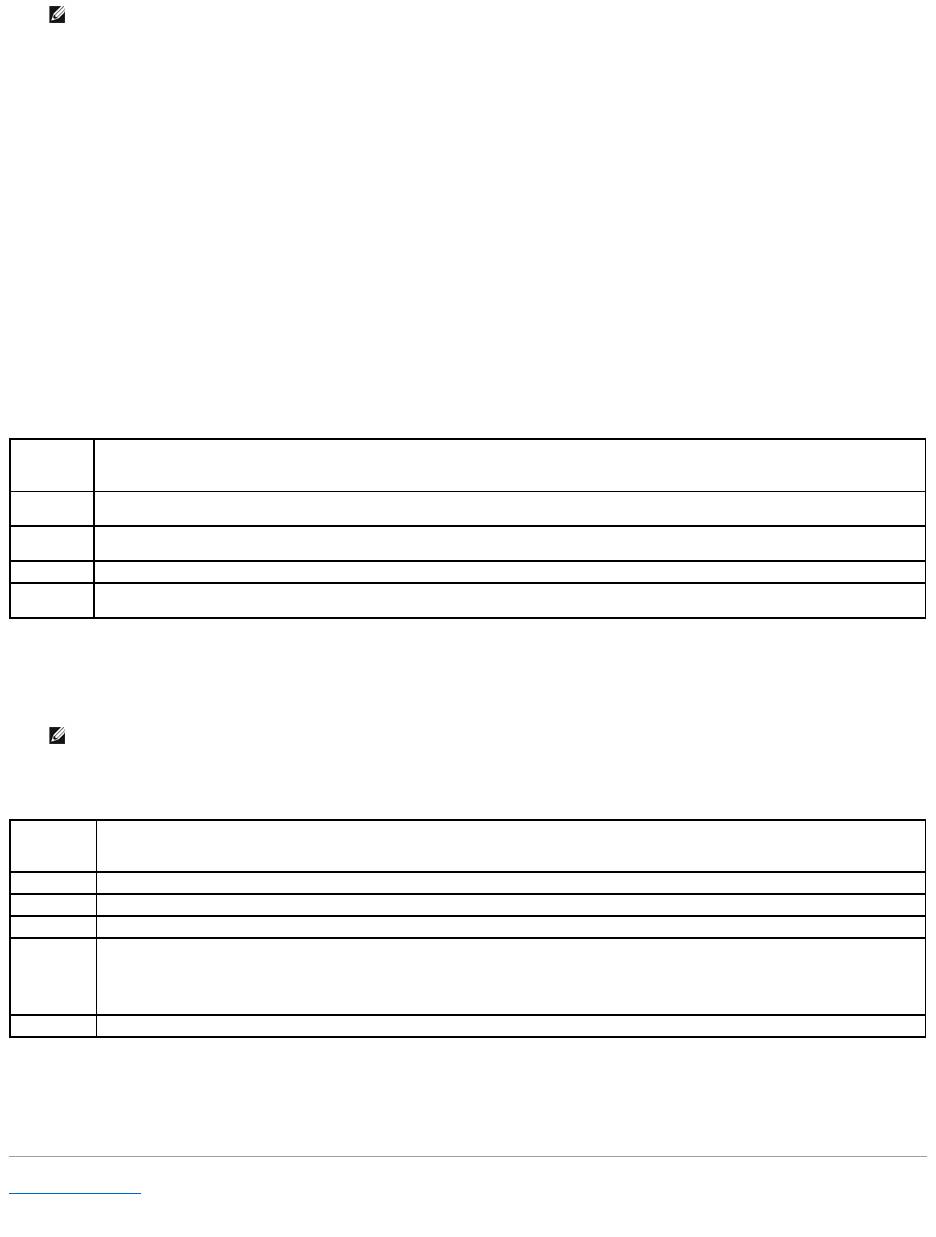
3. When the boot device list appears, highlight CD/DVD/CD-RW Drive and press <Enter>.
4. Select the CD/DVD/CD-RW Drive option from the CD boot menu.
5. Select the Boot from CD-ROM option from the menu that appears.
6. Type 1 to start the ResourceCD menu.
7. Type 2 to start the Dell Diagnostics.
8. Select Run the 32 Bit Dell Diagnostics from the numbered list. If multiple versions are listed, select the version appropriate for your computer.
9. When the Dell Diagnostics Main Menu appears, select the test you want to run.
Dell Diagnostics Main Menu
1. After the Dell Diagnostics loads and the Main Menu screen appears, click the button for the option you want.
2. If a problem is encountered during a test, a message appears with an error code and a description of the problem. Write down the error code and
problem description and follow the instructions on the screen.
If you cannot resolve the error condition, contact Dell.
3. If you run a test from the Custom Test or Symptom Tree option, click the applicable tab described in the following table for more information.
4. When the tests are completed, if you are running the Dell Diagnostics from the Drivers and Utilities CD, remove the CD.
5. When the tests are complete, close the test screen to return to the Main Menu screen. To exit the Dell Diagnostics and restart the computer, close the
Main Menu screen.
Back to Contents Page
NOTE: The next steps change the boot sequence for one time only. On the next start-up, the computer boots according to the devices specified in
system setup.
Option
Function
Express Test
Performs a quick test of devices. This test typically takes 10 to 20 minutes and requires no interaction on your part. Run Express Test first to
increase the possibility of tracing the problem quickly.
Extended
Test
Performs a thorough check of devices. This test typically takes 1 hour or more and requires you to answer questions periodically.
Custom Test
Tests a specific device. You can customize the tests you want to run.
Symptom
Tree
Lists the most common symptoms encountered and allows you to select a test based on the symptom of the problem you are having.
NOTE: The Service Tag for your computer is located at the top of each test screen. If you contact Dell, technical support will ask for your Service
Tag.
Tab
Function
Results
Displays the results of the test and any error conditions encountered.
Errors
Displays error conditions encountered, error codes, and the problem description.
Help
Describes the test and may indicate requirements for running the test.
Configuration
Displays your hardware configuration for the selected device.
The Dell Diagnostics obtains configuration information for all devices from system setup, memory, and various internal tests, and it displays
the information in the device list in the left pane of the screen. The device list may not display the names of all the components installed on
your computer or all devices attached to your computer.
Parameters
Allows you to customize the test by changing the test settings.
Back to Contents Page
Using the Display
DellPrecision™MobileWorkstationM70User'sGuide
Adjusting Brightness
Switching the Video Image
Setting Display Resolution
Dual Independent Display Mode
Large Desktop Display Mode
Swapping Primary and Secondary Displays
Adjusting Brightness
WhentheDell™computerisrunningonbatterypower,youcanconservepowerbysettingthebrightnesstothelowestcomfortablesettingbypressing<Fn>
and the up- or down-arrow on the keyboard.
The Dell QuickSet Brightness Meter shows the current brightness setting for the display. Right-click the icon in the taskbar to enable or disable the
Brightness Meter on the screen.
You can enable or disable the Brightness Meter from the QuickSet taskbar menu. When the meter is enabled, press the following keys to adjust brightness:
l Press <Fn> and the up-arrow key to increase brightness on the integrated display only (not on an external monitor).
l Press <Fn> and the down-arrow key to decrease brightness on the integrated display only (not on an external monitor).
For more information about QuickSet, right-click the icon in the taskbar and click Help.
Switching the Video Image
When you start the computer with an external device (such as an external monitor or projector) attached and turned on, the image may appear on either the
computer display or the external device.
Press <Fn><F8> to switch the video image to the display only, the external device only, or the display and the external device simultaneously.
Setting Display Resolution
To display a program at a specific resolution, both the graphics card and the display must support the program, and the necessary video drivers must be
installed.
Before you change any of the default display settings, make a note of the default settings for future reference.
If you choose a resolution or color palette that is higher than the display supports, the settings adjust automatically to the closest possible setting.
Microsoft®Windows®XP
1. Click the Start button and click Control Panel.
2. Under Pick a category, click Appearance and Themes.
3. Under Pick a task..., click the area you want to change, or under or pick a Control Panel icon, click Display.
NOTE: By default, the Brightness Meter appears in the lower-right corner of the display. You can click and drag the meter to a new location, and the
meter subsequently always appears at the new location.
NOTE: Brightness key combinations only affect the display on your portable computer, not monitors that you attach to your portable computer or
docking device. If your computer is connected to an external monitor and you try to change the brightness level, the Brightness Meter appears, but the
brightness level on the monitor does not change.
NOTE: Use only the Dell-installed video drivers, which are designed to offer the best performance with your Dell-installed operating system.

4. Try different settings for Color quality and Screen resolution.
Microsoft Windows 2000
1. Click the Start button, point to Settings, and then click Control Panel.
2. Double-click the Display icon and click the Settings tab.
3. Try different settings for Colors and Screen area.
If the video resolution setting is higher than that supported by the display, the computer enters pan mode. In pan mode, the screen cannot be completely
displayed. For example, the taskbar that usually appears at the bottom of the desktop may no longer be visible. To view the rest of the screen, use the touch
pad or track stick to pan up, down, left, and right.
Dual Independent Display Mode
You can attach an external monitor or projector to your computer and use it as an extension of your display (known as "dual independent display" or
"extended desktop" mode). This mode allows you to use both screens independently and drag objects from one screen to the other, effectively doubling the
amount of viewable work space.
Microsoft Windows XP
1. Connect the external monitor, TV, or projector to the computer.
2. Open the Control Panel and double-click the Display icon.
3. In the Display Properties window, click the Settings tab.
4. Click the monitor 2 icon, click the Extend my Windows desktop... check box, then and click Apply.
5. Change Screen Area to the appropriate sizes for both displays and click Apply.
6. If prompted to restart the computer, click Apply the new color setting without restarting and click OK.
7. If prompted, click OK to resize your desktop.
8. If prompted, click Yes to keep the settings.
9. Click OK to close the Display Properties window.
To disable dual independent display mode:
1. Click the Settings tab in the Display Properties window.
2. Click the monitor 2 icon, uncheck the Extend my Windows desktop... option, and then click Apply.
If necessary, press <Fn><F8> to bring the screen image back to the computer display.
Microsoft Windows 2000
The Windows 2000 operating system does not natively support dual independent display (extended desktop) mode on your computer.
NOTE: As the resolution increases, icons and text appear smaller on the screen.
NOTICE: You can damage an external monitor by using an unsupported refresh rate. Before adjusting the refresh rate on an external monitor, see the
monitor user's guide.
NOTE: If you choose a resolution or color palette that is higher than the display supports, the settings adjust automatically to the closest possible
values. For more information, see your operating system documentation.
NOTE: This software may not be available in certain countries.

Large Desktop Display Mode
With some operating systems, you can connect an external monitor or projector to your computer to enlarge your work space (large desktop display mode). This
mode allows you to view a large document over two displays as if they were one large display. The taskbar runs uninterrupted across the two displays. You
can set up your two monitors either vertically or horizontally.
Windows 2000
To activate large desktop mode on two external displays that are attached to the VGA or DVI connectors on the docking device, your computer must be
connected to the docking device and the portable computer display closed. To activate large desktop mode on the portable computer display and a single
external display, connect the external display either to your portable computer or the docking device, and keep the portable computer display open.
1. Connect the external monitor, TV, or projector to the computer or docking device.
2. Open the Control Panel and double-click the Display icon.
3. In the Display Properties window, click the Settings tab.
4. Press <Fn><F8> until the display that you want to use as primary (left-most or top-most) display is set as the primary display.
5. Click the Advanced tab.
6. On the next screen, click the ATI Displays tab which shows several different display options.
7. Click the red (off) and green (on) indicators in the upper left corners until the two displays that you want to use show green. Both displays should now
be active in clone (or simulscan) mode.
8. Press the right-arrow or the down-arrow button on your keyboard to specify a horizontal or vertical display setup, and click Apply.
Swapping Primary and Secondary Displays
Microsoft Windows XP
To swap your primary and secondary display designations (for example, to use your external monitor as your primary display after docking):
1. Click the Start button and click Settings.
2. Select Control Panel and click Display.
3. Under Pick a category, click Appearance and Themes.
4. Under Pick a task..., click the area you want to change, or under or pick a Control Panel icon, click Display.
5. Click Settings tab® Advanced® Displays tab.
See the documentation that came with your video card for additional information.
Microsoft Windows 2000
To swap your primary and secondary display designations (for example, to use your external monitor as your primary display after docking), open the Control
Panel, click the Display icon® Settings tab® Advanced® Displays tab. See the documentation that came with your video card for additional information.
Back to Contents Page
NOTE: The Windows XP operating system and some Windows 2000 operating systems do not support large desktop display mode. See the
documentation that came with your video card for more information.
NOTE: You may need to try different settings depending on your display setup.

Back to Contents Page
Reinstalling Software
DellPrecision™MobileWorkstationM70User'sGuide
Drivers
Resolving Software and Hardware Incompatibilities
Using Microsoft®Windows®XP System Restore
Reinstalling Microsoft®Windows®XP
Drivers
What Is a Driver?
A driver is a program that controls a device such as a printer, mouse, or keyboard. All devices require a driver program.
A driver acts like a translator between the device and any other programs that use the device. Each device has its own set of specialized commands that only
its driver recognizes.
Dell ships your computer to you with required drivers already installed—no further installation or configuration is needed.
Many drivers, such as the keyboard driver, come with your Microsoft®Windows®operating system. You may need to install drivers if you:
l Upgrade your operating system.
l Reinstall your operating system.
l Connect or install a new device.
Identifying Drivers
If you experience a problem with any device, identify whether the driver is the source of your problem and, if necessary, update the driver.
Windows XP
1. Click the Start button and click Control Panel.
2. Under Pick a Category, click Performance and Maintenance.
3. Click System.
4. In the System Properties window, click the Hardware tab.
5. Click Device Manager.
6. Scroll down the list to see if any device has an exclamation point (a yellow circle with a [!]) on the device icon.
If an exclamation point is next to the device name, you may need to reinstall the driver or install a new driver.
Reinstalling Drivers and Utilities
Using the Windows XP Device Driver Rollback
If you install a new device driver that causes system instability, you can use the Windows XP Device Driver Rollback to replace the new device driver with the
previously installed version of the device driver. If you cannot reinstall your previous driver by using the Device Driver Rollback process, then use System
Restore to return your operating system to its previous operating state before you installed the new device driver. To use Device Driver Rollback:
1. Click the Start button and right-click My Computer.
NOTICE: TheDellSupportwebsiteatsupport.dell.comandyourDriversandUtilitiesCDprovideapproveddriversforDell™computers.Ifyouinstall
drivers obtained from other sources, your computer might not work correctly.
NOTE: The Drivers and Utilities CD is optional and may not ship with all computers.

2. Click Properties.
3. Click the Hardware tab and click Device Manager.
4. In the Device Manager window, right-click the device for which the new driver was installed and then click Properties.
5. Click the Drivers tab.
6. Click Roll Back Driver.
Using the Drivers and Utilities CD
If using Device Driver Rollback or System Restore does not resolve the problem, then reinstall the driver from the Drivers and Utilities CD (also known as the
ResourceCD).
1. Save and close any open files, and exit any open programs.
2. Insert the Drivers and Utilities CD.
In most cases, the CD starts running automatically. If it does not, start Windows Explorer, click your CD drive directory to display the CD contents, and
then double-click the autorcd.exe file. The first time that you run the CD, it might prompt you to install setup files. Click OK, and follow the instructions
on the screen to continue.
3. From the Language drop-down menu in the toolbar, select your preferred language for the driver or utility (if available). A welcome screen appears.
4. Click Next.
The CD automatically scans your hardware to detect drivers and utilities used by your computer.
5. After the CD completes the hardware scan, you can also detect other drivers and utilities. Under Search Criteria, select the appropriate categories from
the System Model, Operating System, and Topic drop-down menus.
A link or links appear(s) for the specific drivers and utilities used by your computer.
6. Click the link of a specific driver or utility to display information about the driver or utility that you want to install.
7. Click the Install button (if present) to begin installing the driver or utility. At the welcome screen, follow the screen prompts to complete the installation.
If no Install button is present, automatic installation is not an option. For installation instructions, either see the appropriate instructions in the following
subsections, or click Extract, follow the extracting instructions, and then read the readme file.
If instructed to navigate to the driver files, click the CD directory on the driver information window to display the files associated with that driver.
Manually Reinstalling Drivers for Windows XP
1. After copying the driver files to your hard drive, click the Start button and right-click My Computer.
2. Click Properties.
3. Click the Hardware tab and click Device Manager.
4. Double-click the type of device for which you are installing the driver (for example, Modems or Infrared devices).
5. Double-click the name of the device for which you are installing the driver.
6. Click the Driver tab and click Update Driver.
7. Click Install from a list or specific location (Advanced) and click Next.
8. Click Browse and browse to the location to which you previously copied the driver files.
NOTE: The Drivers and Utilities CD may contain drivers for operating systems that are not on your computer. Ensure that you are installing software
appropriate for your operating system.
NOTE: The Drivers and Utilities CD is optional and may not ship with all computers.
NOTE: If you are reinstalling an infrared sensor driver, you must first enable the infrared sensor in system setup before continuing with the driver
installation.

9. When the name of the appropriate driver appears, click Next.
10. Click Finish and restart your computer.
Manually Reinstalling Drivers for Windows 2000
1. After copying the driver files to your hard drive, click the Start button, point to Settings, and then click Control Panel.
2. Double-click the System icon.
3. Click the Hardware tab.
4. Click Device Manager.
5. Double-click the type of device for which you are installing the driver (for example, Modems or Infrared devices).
6. Double-click the name of the device.
7. Click the Driver tab and click Update Driver.
8. Click Next.
9. Ensure that Search for a suitable driver for my device (recommended) is selected, and then click Next.
10. Ensure that the Specify a location check box is checked and that all other check boxes are unchecked, and click Next.
11. Click Browse to browse to the location to which you previously copied the driver files.
12. When the name of the appropriate driver appears, click Next.
13. Click Finish and restart your computer.
Resolving Software and Hardware Incompatibilities
If a device is either not detected during the operating system setup or is detected but incorrectly configured, you can use the Hardware Troubleshooter to
resolve the incompatibility.
Windows XP
To resolve incompatibilities using the Hardware Troubleshooter:
1. Click the Start button and click Help and Support.
2. Type hardware troubleshooter in the Search field and click the arrow to start the search.
3. Click Hardware Troubleshooter in the Search Results list.
4. In the Hardware Troubleshooter list, click I need to resolve a hardware conflict on my computer, and click Next.
Using Microsoft®Windows®XP System Restore
The Microsoft®Windows®XP operating system provides System Restore to allow you to return your computer to an earlier operating state (without affecting
data files) if changes to the hardware, software, or other system settings have left the computer in an undesirable operating state. See the Windows Help
and Support Center for information on using System Restore.
NOTE: If you are reinstalling an infrared driver, you must first enable the infrared sensor in the system setup program before continuing with the driver
installation.
NOTICE: Make regular backups of your data files. System Restore does not monitor your data files or recover them.
NOTE: TheproceduresinthisdocumentwerewrittenfortheWindowsdefaultview,sotheymaynotworkifyousetyourDell™computertothe
Windows Classic view.

Creating a Restore Point
1. Click the Start button and click Help and Support.
2. Click System Restore.
3. Follow the instructions on the screen.
Restoring the Computer to an Earlier Operating State
1. Click the Start button, point to All Programs® Accessories® System Tools, and then click System Restore.
2. Ensure that Restore my computer to an earlier time is selected and click Next.
3. Click a calendar date to which you want to restore your computer.
The Select a Restore Point screen provides a calendar that allows you to see and select restore points. All calendar dates with available restore points
appear in boldface type.
4. Select a restore point and click Next.
If a calendar date has only one restore point, then that restore point is automatically selected. If two or more restore points are available, click the
restore point that you prefer.
5. Click Next.
The Restoration Complete screen appears after System Restore finishes collecting data and then the computer restarts.
6. After the computer restarts, click OK.
To change the restore point, you can either repeat the steps using a different restore point, or you can undo the restoration.
Undoing the Last System Restore
1. Click the Start button, point to All Programs® Accessories® System Tools, and then click System Restore.
2. Click Undo my last restoration and click Next.
3. Click Next.
The System Restore screen appears and the computer restarts.
4. After the computer restarts, click OK.
Enabling System Restore
If you reinstall Windows XP with less than 200 MB of free hard-disk space available, System Restore is automatically disabled. To see if System Restore is
enabled:
1. Click the Start button and click Control Panel.
2. Click Performance and Maintenance.
3. Click System.
4. Click the System Restore tab.
NOTICE: Before you restore the computer to an earlier operating state, save and close any open files and exit any open programs. Do not alter, open,
or delete any files or programs until the system restoration is complete.
NOTICE: Before you undo the last system restore, save and close all open files and exit any open programs. Do not alter, open, or delete any files or
programs until the system restoration is complete.

5. Ensure that Turn off System Restore is unchecked.
Reinstalling Microsoft®Windows®XP
Before You Begin
If you are considering reinstalling the Windows XP operating system to correct a problem with a newly installed driver, first try using Windows XP Device Driver
Rollback. If Device Driver Rollback does not resolve the problem, then use System Restore to return your operating system to the operating state it was in
before you installed the new device driver.
To reinstall Windows XP, you need the following items:
l Dell™Operating System CD
l Dell™Drivers and Utilities CD
Reinstalling Windows XP
To reinstall Windows XP, perform all the steps in the following sections in the order in which they are listed.
The reinstallation process can take 1 to 2 hours to complete. After you reinstall the operating system, you must also reinstall the device drivers, virus
protection program, and other software.
Booting From the Operating System CD
1. Save and close any open files and exit any open programs.
2. Insert the Operating System CD. Click Exit if the Install Windows XP message appears.
3. Restart the computer.
4. Press<F12>immediatelyaftertheDELL™logoappears.
If the operating system logo appears, wait until you see the Windows desktop, and then shut down the computer and try again.
5. Press the arrow keys to select CD-ROM, and press <Enter>.
6. When the Press any key to boot from CD message appears, press any key.
Windows XP Setup
1. When the Windows XP Setup screen appears, press <Enter>.
2. Read the information on the Microsoft Windows Licensing Agreement screen, and press <F8> to accept the license agreement.
3. If your computer already has Windows XP installed and you want to recover your current Windows XP data, type r to select the repair option, and
remove the CD.
4. If you want to install a new copy of Windows XP, press <Esc> to select that option.
5. Press <Enter> to select the highlighted partition (recommended), and follow the instructions on the screen.
NOTICE: You must use Windows XP Service Pack 1 (SP1) or later when you reinstall Windows XP.
NOTICE: Before performing the installation, back up all data files on your primary hard drive. For conventional hard drive configurations, the primary
hard drive is the first drive detected by the computer.
NOTE: The Operating System CD and the Drivers and Utilities CD are optional and may not ship with all computers.
NOTE: The Drivers and Utilities CD contains drivers that were installed during assembly of the computer. Use the Drivers and Utilities CD to load any
required drivers, including the drivers required if your computer has a RAID controller.
NOTICE: The Operating System CD provides options for reinstalling Windows XP. The options can overwrite files and possibly affect programs installed
on your hard drive. Therefore, do not reinstall Windows XP unless a Dell technical support representative instructs you to do so.
NOTICE: To prevent conflicts with Windows XP, disable any virus protection software installed on your computer before you reinstall Windows XP. See
the documentation that came with the software for instructions.

The Windows XP Setup screen appears, and the operating system begins to copy files and install the devices. The computer automatically restarts
multiple times.
6. When the Regional and Language Options screen appears, select the settings for your location and click Next.
7. Enter your name and organization (optional) in the Personalize Your Software screen, and click Next.
8. At the Computer Name and Administrator Password window, enter a name for your computer (or accept the one provided) and a password, and click
Next.
9. If the Modem Dialing Information screen appears, enter the requested information and click Next.
10. Enter the date, time, and time zone in the Date and Time Settings window, and click Next.
11. If the Networking Settings screen appears, click Typical and click Next.
12. If you are reinstalling Windows XP Professional and you are prompted to provide further information regarding your network configuration, enter your
selections. If you are unsure of your settings, accept the default selections.
Windows XP installs the operating system components and configures the computer. The computer automatically restarts.
13. When the Welcome to Microsoft screen appears, click Next.
14. When the How will this computer connect to the Internet? message appears, click Skip.
15. When the Ready to register with Microsoft? screen appears, select No, not at this time and click Next.
16. When the Who will use this computer? screen appears, you can enter up to five users.
17. Click Next.
18. Click Finish to complete the setup, and remove the CD.
19. Reinstall the appropriate drivers with the Drivers and Utilities CD.
20. Reinstall the Notebook System Software (NSS) utility.
If you reinstall the operating system for your computer, you should also reinstall the Notebook System Software (NSS) utility. NSS provides critical
updates for your operating system and support for Dell™ 3.5-inch USB floppy drives, Intel® Pentium® M processors, optical drives, and USB devices.
NSS is necessary for correct operation of your Dell notebook computer. NSS automatically detects your computer and operating system and installs the
updates appropriate for your configuration.
If you do not have the Dell Drivers and Utilities CD, access the Dell product support website. Click Downloads and select System and Configuration Utilities
and Windows XP. Select Dell Notebook System Software and follow the instructions for downloading and installing the Dell Notebook System Software.
21. Reinstall your virus protection software.
22. Reinstall your programs.
Back to Contents Page
NOTICE: Do not press any key when the following message appears: Press any key to boot from the CD.
NOTE: The time required to complete the setup depends on the size of the hard drive and the speed of your computer.
NOTICE: Do not press any key when the following message appears: Press any key to boot from the CD.
NOTE: The Dell Drivers and Utilities CD is required for installation of the NSS utility. However, this CD is optional and may not ship with all computers.
NOTE: To reinstall and activate your Microsoft Office or Microsoft Works Suite programs, you need the Product Key number located on the back of the
Microsoft Office or Microsoft Works Suite CD sleeve.
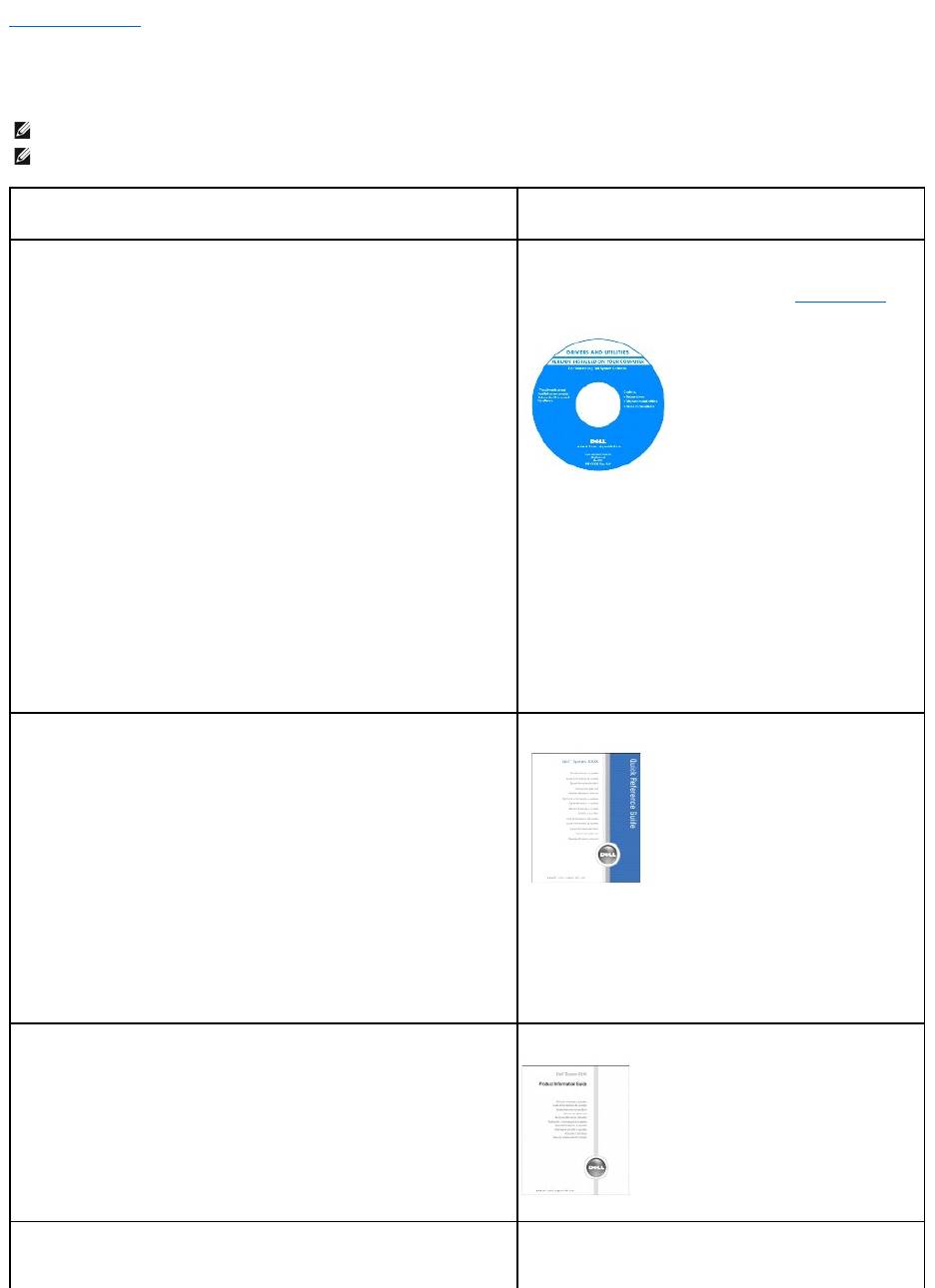
Back to Contents Page
Finding Information
DellPrecision™MobileWorkstationM70User'sGuide
NOTE: Some features may not be available for your computer or in certain countries.
NOTE: Additional information may ship with your computer.
What Are You Looking For?
Find It Here
l A diagnostic program for my computer
l Drivers for my computer
l My computer documentation
l My device documentation
l Notebook System Software (NSS)
Drivers and Utilities CD (also known as ResourceCD)
Documentation and drivers are already installed on your computer.
You can use the CD to reinstall drivers, run the Dell Diagnostics, or
access your documentation.
Readme files may be included on your CD to provide last-minute
updates about technical changes to your computer or advanced
technical-reference material for technicians or experienced users.
NOTE: The Drivers and Utilities CD is optional and may not ship with
all computers.
NOTE: The latest drivers and documentation updates can be found
at support.dell.com.
l How to set up my computer
l How to care for my computer
l Basic troubleshooting information
l How to run the Dell Diagnostics
l Error codes and diagnostic lights
l How to remove and install parts
l How to open my computer cover
Quick Reference Guide
NOTE: The Quick Reference Guide is optional and may not ship with
all computers.
NOTE: This document is available as a PDF at support.dell.com.
l Warranty information
l Terms and Conditions (U.S. only)
l Safety instructions
l Regulatory information
l Ergonomics information
l End User License Agreement
Dell™ProductInformationGuide
l Service Tag and Express Service Code
l Microsoft Windows License Label
Service Tag and Microsoft Windows License
These labels are located on your computer.
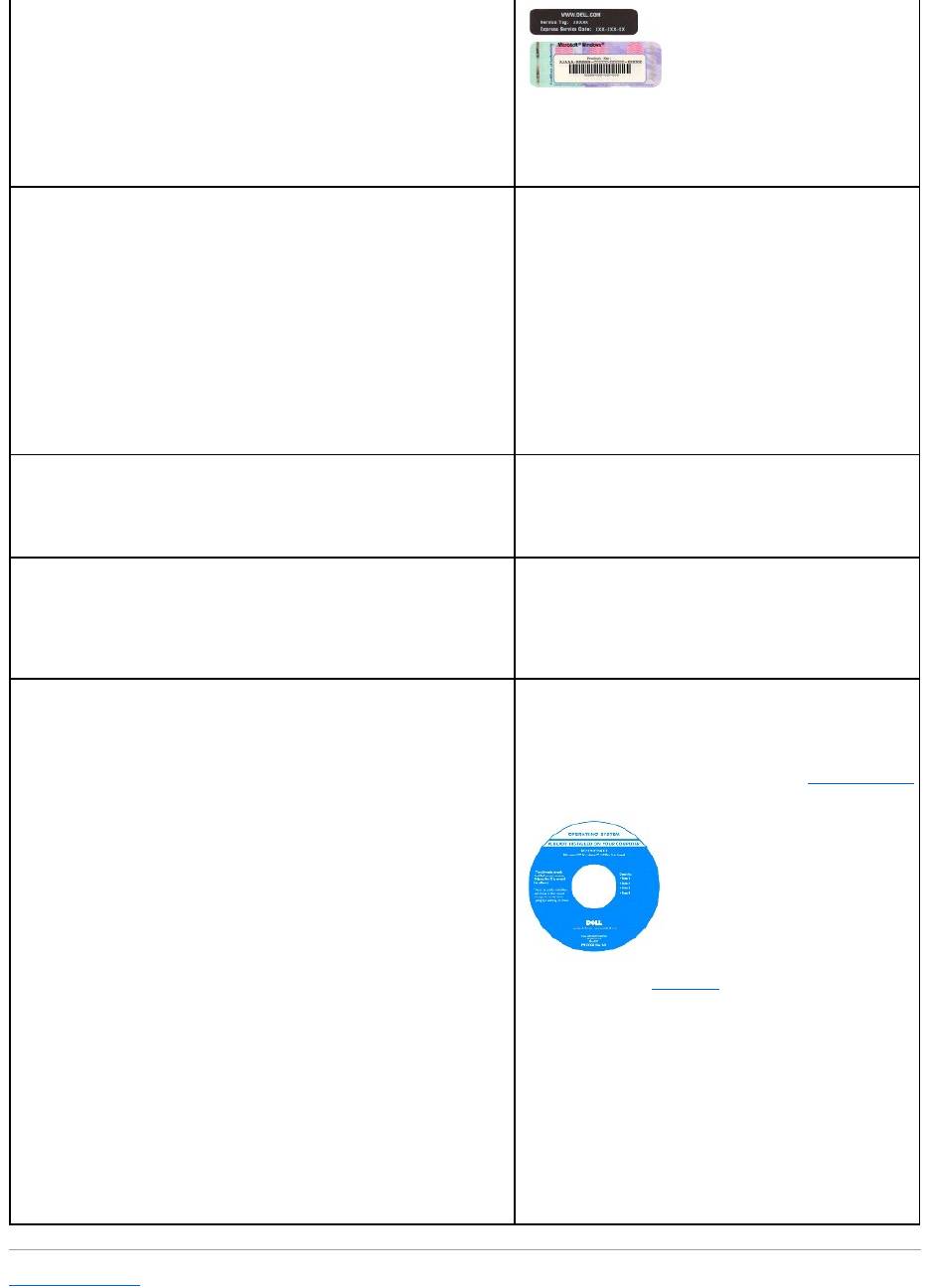
Back to Contents Page
l Use the Service Tag to identify your computer when you use
support.dell.com or contact technical support.
l Enter the Express Service Code to direct your call when
contacting technical support.
l Solutions — Troubleshooting hints and tips, articles from technicians, online
courses, frequently asked questions
l Community — Online discussion with other Dell customers
l Upgrades — Upgrade information for components, such as memory, the hard
drive, and the operating system
l Customer Care — Contact information, service call and order status, warranty,
and repair information
l Service and support — Service call status and support history, service contract,
online discussions with technical support
l Reference — Computer documentation, details on my computer configuration,
product specifications, and white papers
l Downloads — Certified drivers, patches, and software updates
l Notebook System Software (NSS) — If you reinstall the operating system for
your computer, you should also reinstall the NSS utility. NSS provides critical
updatesforyouroperatingsystemandsupportforDell™3.5-inch USB floppy
drives, Intel® Pentium®M processors, optical drives, and USB devices. NSS is
necessary for correct operation of your Dell computer. The software
automatically detects your computer and operating system and installs the
updates appropriate for your configuration.
Dell Support Website — support.dell.com
NOTE: Select your region to view the appropriate support site.
NOTE: Corporate, government, and education customers can also
use the customized Dell Premier Support website at
premier.support.dell.com. The website may not be available in all
regions.
l Service call status and support history
l Top technical issues for my computer
l Frequently asked questions
l File downloads
l Details on my computer configuration
l Service contract for my computer
Dell Premier Support Website — premiersupport.dell.com
The Dell Premier Support website is customized for corporate,
government, and education customers. This website may not be
available in all regions.
l How to use Windows XP
l Documentation for my computer
l Documentation for devices (such as a modem)
Windows Help and Support Center
1. Click the Start button and click Help and Support.
2. Type a word or phrase that describes your problem and click
the arrow icon.
3. Click the topic that describes your problem.
4. Follow the instructions on the screen.
l How to reinstall my operating system
Operating System CD
The operating system is already installed on your computer. To
reinstall your operating system, use the Operating System CD. See
your Precision User's Guide for instructions.
After you reinstall your operating system, use the Drivers and Utilities
CD to reinstall drivers for the devices that came with your computer.
Your operating system product key label is located on your
computer.
NOTE: The Operating System CD is optional and may not ship with
all computers.
NOTE: The Drivers and Utilities CD is optional and may not ship with
all computers.
NOTE: The color of your CD varies based on the operating system
you ordered.


Back to Contents Page
Getting Help
DellPrecision™MobileWorkstationM20User'sGuide
Technical Assistance
Problems With Your Order
Product Information
Returning Items for Warranty Repair or Credit
Before You Call
Contacting Dell
Technical Assistance
If you need help with a technical problem, Dell is ready to assist you.
1. Complete the procedures in "Solving Problems."
2. Run the "Dell Diagnostics."
3. Make a copy of the Diagnostics Checklist and fill it out.
4. Use Dell's extensive suite of online services available at Dell Support (support.dell.com) for help with installation and troubleshooting procedures.
5. If the preceding steps have not resolved the problem, contact Dell.
NOTE: Call technical support from a telephone near or at the computer so that technical support can assist you with any necessary procedures.
NOTE: Dell's Express Service Code system may not be available in all countries.
When prompted by Dell's automated telephone system, enter your Express Service Code to route the call directly to the proper support personnel. If you do
not have an Express Service Code, open the Dell Accessories folder, double-click the Express Service Code icon, and follow the directions.
For instructions on using the technical support service, see "Technical Support Service."
NOTE: Some of the following services are not always available in all locations outside the continental U.S. Call your local Dell representative for information on
availability.
Online Services
You can access Dell Support at support.dell.com. Select your region on the WELCOME TO DELL SUPPORT page, and fill in the requested details to access
help tools and information.
You can contact Dell electronically using the following addresses:
l World Wide Web
www.dell.com/
www.dell.com/ap/ (Asian/Pacific countries only)
www.dell.com/jp (Japan only)
www.euro.dell.com (Europe only)
www.dell.com/la/ (Latin American countries)
www.dell.ca (Canada only)
l Anonymous file transfer protocol (FTP)
ftp.dell.com/
Log in as user: anonymous, and use your e-mail address as your password.
l Electronic Support Service
mobile_support@us.dell.com
support@us.dell.com
CAUTION: If you need to remove the computer covers, first disconnect the computer power and modem cables from all electrical outlets.

apsupport@dell.com (Asian/Pacific countries only)
support.jp.dell.com (Japan only)
support.euro.dell.com (Europe only)
l Electronic Quote Service
sales@dell.com
apmarketing@dell.com (Asian/Pacific countries only)
sales_canada@dell.com (Canada only)
l Electronic Information Service
info@dell.com
AutoTech Service
Dell's automated technical support service—AutoTech—provides recorded answers to the questions most frequently asked by Dell customers about their
portable and desktop computers.
When you call AutoTech, use your touch-tone telephone to select the subjects that correspond to your questions.
TheAutoTechserviceisavailable24hoursaday,7daysaweek.Youcanalsoaccessthisservicethroughthetechnicalsupportservice.Forthetelephone
number to call, see the contact numbers for your region.
Automated Order-Status Service
TocheckonthestatusofanyDell™productsthatyouhaveordered,youcangotosupport.dell.com, or you can call the automated order-status service. A
recording prompts you for the information needed to locate and report on your order. For the telephone number to call, see the contact numbers for your
region.
Technical Support Service
Dell'stechnicalsupportserviceisavailable24hoursaday,7daysaweek,toansweryourquestionsaboutDellhardware.Ourtechnicalsupportstaffuses
computer-based diagnostics to provide fast, accurate answers.
To contact Dell's technical support service, see "Technical Assistance" and then call the number for your country as listed in "Contacting Dell."
Problems With Your Order
If you have a problem with your order, such as missing parts, wrong parts, or incorrect billing, contact Dell for customer assistance. Have your invoice or
packing slip handy when you call. For the telephone number to call, see the contact numbers for your region.
Product Information
If you need information about additional products available from Dell, or if you would like to place an order, visit the Dell website at www.dell.com. For the
telephone number to call to speak to a sales specialist, see the contact numbers for your region.
Returning Items for Warranty Repair or Credit
Prepare all items being returned, whether for repair or credit, as follows:
1. Call Dell to obtain a Return Material Authorization Number, and write it clearly and prominently on the outside of the box.
For the telephone number to call, see the contact numbers for your region.
2. Include a copy of the invoice and a letter describing the reason for the return.
3. Include a copy of the Diagnostics Checklist indicating the tests you have run and any error messages reported by the Dell Diagnostics.
4. Include any accessories that belong with the item(s) being returned (power cables, software floppy disks, guides, and so on) if the return is for credit.
5. Pack the equipment to be returned in the original (or equivalent) packing materials.
You are responsible for paying shipping expenses. You are also responsible for insuring any product returned, and you assume the risk of loss during shipment
to Dell. Collect On Delivery (C.O.D.) packages are not accepted.
Returns that are missing any of the preceding requirements will be refused at Dell's receiving dock and returned to you.
Before You Call
NOTE: Have your Express Service Code ready when you call. The code helps Dell's automated-support telephone system direct your call more efficiently.
Remember to fill out the Diagnostics Checklist. If possible, turn on your computer before you call Dell for technical assistance and call from a telephone at or
near the computer. You may be asked to type some commands at the keyboard, relay detailed information during operations, or try other troubleshooting
steps possible only at the computer itself. Ensure that the computer documentation is available.
Contacting Dell
To contact Dell electronically, you can access the following websites:
l www.dell.com
l support.dell.com (technical support)
l premiersupport.dell.com (technical support for educational, government, healthcare, and medium/large business customers, including Premier,
Platinum, and Gold customers)
For specific web addresses for your country, find the appropriate country section in the table below.
NOTE: In certain countries, technical support specific to Dell Inspiron™ XPS computers is available at a separate telephone number listed for participating
countries. If you do not see a telephone number listed that is specific for Inspiron XPS computers, you may contact Dell through the technical support number
listed and your call will be routed appropriately.
When you need to contact Dell, use the electronic addresses, telephone numbers, and codes provided in the following table. If you need assistance in
determining which codes to use, contact a local or an international operator.
CAUTION: Before working inside your computer, read the safety instructions in your Product Information Guide.
Diagnostics Checklist
Name:
Date:
Address:
Phone number:
Service Tag (bar code on the back of the computer):
Express Service Code:
Return Material Authorization Number (if provided by Dell support technician):
Operating system and version:
Devices:
Expansion cards:
Are you connected to a network? Yes No
Network, version, and network adapter:
Programs and versions:
See your operating system documentation to determine the contents of the system's start-up files. If the computer is connected to a printer, print each file.
Otherwise, record the contents of each file before calling Dell.
Error message, beep code, or diagnostic code:
Description of problem and troubleshooting procedures you performed:
NOTE: Toll-free numbers are for use within the country for which they are listed.
Country (City)
International Access Code
Country Code
City Code
Department Name or Service Area,
Website and E-Mail Address
Area Codes,
Local Numbers, and
Toll-Free Numbers
Anguilla
General Support
toll-free:800-335-0031
Antigua and Barbuda
General Support
1-800-805-5924
Website: www.dell.com.ar

Argentina (Buenos Aires)
International Access Code: 00
Country Code: 54
City Code: 11
E-mail: us_latin_services@dell.com
E-mail for desktop and portable computers:
la-techsupport@dell.com
E-mail for servers and EMC®storage products:
la_enterprise@dell.com
Customer Care
toll-free:0-800-444-0730
Tech Support
toll-free:0-800-444-0733
Tech Support Services
toll-free:0-800-444-0724
Sales
0-810-444-3355
Aruba
General Support
toll-free:800-1578
Australia (Sydney)
International Access Code:
0011
Country Code: 61
City Code: 2
E-mail (Australia): au_tech_support@dell.com
E-mail (New Zealand): nz_tech_support@dell.com
Home and Small Business
1-300-655-533
Government and Business
toll-free:1-800-633-559
Preferred Accounts Division (PAD)
toll-free:1-800-060-889
Customer Care
toll-free:1-800-819-339
Technical Support (portables and desktops)
toll-free:1-300-655-533
Technical Support (servers and workstations)
toll-free:1-800-733-314
Corporate Sales
toll-free:1-800-808-385
Transaction Sales
toll-free:1-800-808-312
Fax
toll-free:1-800-818-341
Austria (Vienna)
International Access Code: 900
Country Code: 43
City Code: 1
Website: support.euro.dell.com
E-mail: tech_support_central_europe@dell.com
Home/Small Business Sales
082024053000
Home/Small Business Fax
082024053049
Home/Small Business Customer Care
082024053014
Preferred Accounts/Corporate Customer Care
082024053016
Home/Small Business Technical Support
082024053014
Preferred Accounts/Corporate Technical Support
06608779
Switchboard
082024053000
Bahamas
General Support
toll-free:1-866-278-6818
Barbados
General Support
1-800-534-3066
Belgium (Brussels)
International Access Code: 00
Country Code: 32
City Code: 2
Website: support.euro.dell.com
E-mail for French-speaking Customers:
support.euro.dell.com/be/fr/emaildell/
Technical Support for Inspiron XPS computers only
024819296
Technical Support for all other Dell computers
024819288
Technical Support Fax
024819295
Customer Care
0271315.65
Corporate Sales
024819100
Fax
024819299
Switchboard
024819100
Bermuda
General Support
1-800-342-0671
Bolivia
General Support
toll-free:800-10-0238
Brazil
International Access Code: 00
Country Code: 55
City Code: 51
Website: www.dell.com/br
Customer Support, Technical Support
0800903355
Technical Support Fax
514815470
Customer Care Fax
514815480
Sales
0800903390
British Virgin Islands
General Support
toll-free:1-866-278-6820
Brunei
Country Code: 673
Customer Technical Support (Penang, Malaysia)
6046334966
Customer Service (Penang, Malaysia)
6046334949
Transaction Sales (Penang, Malaysia)
6046334955
Canada (North York, Ontario)
International Access Code: 011
Online Order Status: www.dell.ca/ostatus
AutoTech (automated technical support)
toll-free:1-800-247-9362
Customer Care (Home Sales/Small Business)
toll-free:1-800-847-4096
Customer Care (med./large business, government)
toll-free:1-800-326-9463
Technical Support (Home Sales/Small Business)
toll-free:1-800-847-4096
Technical Support (med./large bus., government)
toll-free:1-800-387-5757
Technical Support (printers, projectors, televisions, handhelds, digital
jukebox, and wireless)
1-877-335-5767
Sales (Home Sales/Small Business)
toll-free:1-800-387-5752
Sales (med./large bus., government)
toll-free:1-800-387-5755
Spare Parts Sales & Extended Service Sales
18664403355
Cayman Islands
General Support
1-800-805-7541
Chile (Santiago)
Country Code: 56
City Code: 2
Sales, Customer Support, and Technical Support
toll-free:1230-020-4823
China (Xiamen)
Country Code: 86
City Code: 592
Technical Support website: support.dell.com.cn
Technical Support E-mail: cn_support@dell.com
Customer Care E-mail: customer_cn@dell.com
Technical Support Fax
5928181350
TechnicalSupport(Dell™Dimension™andInspiron)
toll-free:8008582969
TechnicalSupport(OptiPlex™,Latitude™,andDellPrecision™)
toll-free:8008580950
Technical Support (servers and storage)
toll-free:8008580960
Technical Support (projectors, PDAs, switches, routers, and so on)
toll-free:8008582920
Technical Support (printers)
toll-free:8008582311
Customer Care
toll-free:8008582060
Customer Care Fax
5928181308
Home and Small Business
toll-free:8008582222
Preferred Accounts Division
toll-free:8008582557
Large Corporate Accounts GCP
toll-free:8008582055
Large Corporate Accounts Key Accounts
toll-free:8008582628
Large Corporate Accounts North
toll-free:8008582999
Large Corporate Accounts North Government and Education
toll-free:8008582955
Large Corporate Accounts East
toll-free:8008582020
Large Corporate Accounts East Government and Education
toll-free:8008582669
Large Corporate Accounts Queue Team
toll-free:8008582572
Large Corporate Accounts South
toll-free:8008582355
Large Corporate Accounts West
toll-free:8008582811
Large Corporate Accounts Spare Parts
toll-free:8008582621
Colombia
General Support
980-9-15-3978
Costa Rica
General Support
0800-012-0435
Czech Republic (Prague)
International Access Code: 00
Country Code: 420
Website: support.euro.dell.com
E-mail: czech_dell@dell.com
Technical Support
225372727
Customer Care
225372707
Fax
225372714
Tech Fax
225372728
Switchboard
225372711
Denmark (Copenhagen)
International Access Code: 00
Country Code: 45
Website: support.euro.dell.com
E-mail: support.euro.dell.com/dk/da/emaildell/
Technical Support for Inspiron XPS computers only
7010 0074
Technical Support for all other Dell computers
70230182
Customer Care (Relational)
70230184
Home/Small Business Customer Care
32875505
Switchboard (Relational)
32871200
Switchboard Fax (Relational)
32871201
Switchboard (Home/Small Business)
32875000
Switchboard Fax (Home/Small Business)
32875001
Dominica
General Support
toll-free:1-866-278-6821
Dominican Republic
General Support
1-800-148-0530
Ecuador
General Support
toll-free:999-119
El Salvador
General Support
01-899-753-0777
Finland (Helsinki)
International Access Code: 990
Website: support.euro.dell.com
E-mail: support.euro.dell.com/fi/fi/emaildell/
Technical Support
0925331360

Country Code: 358
City Code: 9
Customer Care
0925331338
Fax
0925331399
Switchboard
0925331300
France (Paris) (Montpellier)
International Access Code: 00
Country Code: 33
City Codes: (1) (4)
Website: support.euro.dell.com
E-mail: support.euro.dell.com/fr/fr/emaildell/
Home and Small Business
Technical Support for Inspiron XPS computers only
0825 387 129
Technical Support for all other Dell computers
0825387270
Customer Care
0825823833
Switchboard
0825004700
Switchboard (calls from outside of France)
0499754000
Sales
0825004700
Fax
0825004701
Fax (calls from outside of France)
0499754001
Corporate
Technical Support
0825004719
Customer Care
0825338339
Switchboard
0155947100
Sales
0155947100
Fax
0155947101
Germany (Langen)
International Access Code: 00
Country Code: 49
City Code: 6103
Website: support.euro.dell.com
E-mail: tech_support_central_europe@dell.com
Technical Support for Inspiron XPS computers only
06103 766-7222
Technical Support for all other Dell computers
06103766-7200
Home/Small Business Customer Care
0180-5-224400
Global Segment Customer Care
06103766-9570
Preferred Accounts Customer Care
06103766-9420
Large Accounts Customer Care
06103766-9560
Public Accounts Customer Care
06103766-9555
Switchboard
06103766-7000
Greece
International Access Code: 00
Country Code: 30
Website: support.euro.dell.com
E-mail: support.euro.dell.com/gr/en/emaildell/
Technical Support
00800-44 14 95 18
Gold Service Technical Support
00800-44 14 00 83
Switchboard
2108129810
Gold Service Switchboard
2108129811
Sales
2108129800
Fax
2108129812
Grenada
General Support
toll-free:1-866-540-3355
Guatemala
General Support
1-800-999-0136
Guyana
General Support
toll-free:1-877-270-4609
Hong Kong
International Access Code: 001
Country Code: 852
Website: support.ap.dell.com
Technical Support E-mail: apsupport@dell.com
Technical Support (Dimension and Inspiron)
29693188
Technical Support (OptiPlex, Latitude, and Dell Precision)
29693191
TechnicalSupport(PowerApp™,PowerEdge™,PowerConnect™,and
PowerVault™)
29693196
Customer Care
34160910
Large Corporate Accounts
34160907
Global Customer Programs
34160908
Medium Business Division
34160912
Home and Small Business Division
29693105
India
Technical Support
1600338045
Sales (Large Corporate Accounts)
1600338044
Sales (Home and Small Business)
1600338046
Website: support.euro.dell.com
E-mail: dell_direct_support@dell.com
Technical Support for Inspiron XPS computers only
1850 200 722
Technical Support for all other Dell computers
1850543543
Ireland (Cherrywood)
International Access Code: 16
Country Code: 353
City Code: 1
U.K. Technical Support (dial within U.K. only)
08709080800
Home User Customer Care
012044014
Small Business Customer Care
012044014
U.K. Customer Care (dial within U.K. only)
08709060010
Corporate Customer Care
1850200982
Corporate Customer Care (dial within U.K. only)
08709074499
Ireland Sales
012044444
U.K. Sales (dial within U.K. only)
08709074000
Fax/Sales Fax
012040103
Switchboard
012044444
Italy (Milan)
International Access Code: 00
Country Code: 39
City Code: 02
Website: support.euro.dell.com
E-mail: support.euro.dell.com/it/it/emaildell/
Home and Small Business
Technical Support
0257782690
Customer Care
0269682114
Fax
0269682113
Switchboard
0269682112
Corporate
Technical Support
0257782690
Customer Care
0257782555
Fax
0257503530
Switchboard
02577821
Jamaica
General Support (dial from within Jamaica only)
1-800-682-3639
Japan (Kawasaki)
International Access Code: 001
Country Code: 81
City Code: 44
Website: support.jp.dell.com
Technical Support (servers)
toll-free: 0120-198-498
Technical Support outside of Japan (servers)
81-44-556-4162
Technical Support (Dimension and Inspiron)
toll-free: 0120-198-226
Technical Support outside of Japan (Dimension and Inspiron)
81-44-520-1435
Technical Support (Dell Precision, OptiPlex, and Latitude)
toll-free:0120-198-433
Technical Support outside of Japan (Dell Precision, OptiPlex, and Latitude)
81-44-556-3894
Technical Support (PDAs, projectors, printers, routers)
toll-free: 0120-981-690
Technical Support outside of Japan (PDAs, projectors, printers, routers)
81-44-556-3468
Faxbox Service
044-556-3490
24-Hour Automated Order Service
044-556-3801
Customer Care
044-556-4240
Business Sales Division (up to 400 employees)
044-556-1465
Preferred Accounts Division Sales (over 400 employees)
044-556-3433
Large Corporate Accounts Sales (over 3500 employees)
044-556-3430
Public Sales (government agencies, educational institutions, and medical
institutions)
044-556-1469
Global Segment Japan
044-556-3469
Individual User
044-556-1760
Switchboard
044-556-4300
Korea (Seoul)
International Access Code: 001
Country Code: 82
City Code: 2
Technical Support
toll-free:080-200-3800
Sales
toll-free:080-200-3600
Customer Service (Penang, Malaysia)
6046334949
Fax
2194-6202
Switchboard
2194-6000
Technical Support (Electronics and Accessories)
toll-free: 080-200-3801
Latin America
Customer Technical Support (Austin, Texas, U.S.A.)
512728-4093
Customer Service (Austin, Texas, U.S.A.)
512728-3619
Fax (Technical Support and Customer Service) (Austin, Texas, U.S.A.)
512728-3883
Sales (Austin, Texas, U.S.A.)
512728-4397
SalesFax (Austin, Texas, U.S.A.)
512728-4600
or512728-3772
Luxembourg
Website: support.euro.dell.com
E-mail: tech_be@dell.com
Technical Support (Brussels, Belgium)
3420808075

International Access Code: 00
Country Code: 352
Home/Small Business Sales (Brussels, Belgium)
toll-free:080016884
Corporate Sales (Brussels, Belgium)
024819100
Customer Care (Brussels, Belgium)
024819119
Fax (Brussels, Belgium)
024819299
Switchboard (Brussels, Belgium)
024819100
Macao
Country Code: 853
Technical Support
toll-free:0800105
Customer Service (Xiamen, China)
34 160 910
Transaction Sales (Xiamen, China)
29 693 115
Malaysia (Penang)
International Access Code: 00
Country Code: 60
City Code: 4
Website: support.ap.dell.com
Technical Support (Dell Precision, OptiPlex, and Latitude)
toll-free:1800880193
Technical Support (Dimension, Inspiron, and Electronics and Accessories)
toll-free:1800881306
Technical Support (PowerApp, PowerEdge, PowerConnect, and PowerVault)
toll-free:1800881386
Customer Service (Penang, Malaysia)
046334949
Transaction Sales
toll-free:1800888202
Corporate Sales
toll-free:1800888213
Mexico
International Access Code: 00
Country Code: 52
Customer Technical Support
001-877-384-8979
or 001-877-269-3383
Sales
50-81-8800
or 01-800-888-3355
Customer Service
001-877-384-8979
or 001-877-269-3383
Main
50-81-8800
or 01-800-888-3355
Montserrat
General Support
toll-free:1-866-278-6822
Netherlands Antilles
General Support
001-800-882-1519
Netherlands (Amsterdam)
International Access Code: 00
Country Code: 31
City Code: 20
Website: support.euro.dell.com
Technical Support for Inspiron XPS computers only
0206744594
Technical Support for all other Dell computers
0206744500
Technical Support Fax
0206744766
Home/Small Business Customer Care
0206744200
Relational Customer Care
0206744325
Home/Small Business Sales
0206745500
Relational Sales
0206745000
Home/Small Business Sales Fax
0206744775
Relational Sales Fax
0206744750
Switchboard
0206745000
Switchboard Fax
0206744750
New Zealand
International Access Code: 00
Country Code: 64
E-mail (New Zealand): nz_tech_support@dell.com
E-mail (Australia): au_tech_support@dell.com
Technical Support (for desktop and portable computers)
toll-free:0800446255
Technical Support (for servers and workstations)
toll-free:0800443563
Home and Small Business
0800446255
Government and Business
0800444617
Sales
0800441567
Fax
0800441566
Nicaragua
General Support
001-800-220-1006
Norway (Lysaker)
International Access Code: 00
Country Code: 47
Website: support.euro.dell.com
E-mail: support.euro.dell.com/no/no/emaildell/
Technical Support
67116882
Relational Customer Care
67117575
Home/Small Business Customer Care
23162298
Switchboard
67116800
Fax Switchboard
67116865
Panama
General Support
001-800-507-0962
Peru
General Support
0800-50-669
Poland (Warsaw)
Website: support.euro.dell.com
E-mail: pl_support_tech@dell.com
Customer Service Phone
5795700

International Access Code: 011
Country Code: 48
City Code: 22
Customer Care
5795999
Sales
5795999
Customer Service Fax
5795806
Reception Desk Fax
5795998
Switchboard
5795999
Portugal
International Access Code: 00
Country Code: 351
Website: support.euro.dell.com
E-mail: support.euro.dell.com/pt/en/emaildell/
Technical Support
707200149
Customer Care
800300413
Sales
800300410or800300411or
800300412or214220710
Fax
214240112
Puerto Rico
General Support
1-800-805-7545
St. Kitts and Nevis
General Support
toll-free:1-877-441-4731
St. Lucia
General Support
1-800-882-1521
St. Vincent and the
Grenadines
General Support
toll-free:1-877-270-4609
Singapore (Singapore)
International Access Code: 005
Country Code: 65
Website: support.ap.dell.com
Technical Support (Dimension, Inspiron, and Electronics and Accessories)
toll-free:18003947430
Technical Support (OptiPlex, Latitude, and Dell Precision)
toll-free:18003947488
Technical Support (PowerApp, PowerEdge, PowerConnect, and PowerVault)
toll-free:18003947478
Customer Service (Penang, Malaysia)
6046334949
Transaction Sales
toll-free:18003947412
Corporate Sales
toll-free:18003947419
Slovakia (Prague)
International Access Code: 00
Country Code: 421
Website: support.euro.dell.com
E-mail: czech_dell@dell.com
Technical Support
0254415727
Customer Care
420225372707
Fax
0254418328
Tech Fax
0254418328
Switchboard (Sales)
0254417585
South Africa (Johannesburg)
International Access Code:
09/091
Country Code: 27
City Code: 11
Website: support.euro.dell.com
E-mail: dell_za_support@dell.com
Gold Queue
0117097713
Technical Support
0117097710
Customer Care
0117097707
Sales
0117097700
Fax
0117060495
Switchboard
0117097700
Southeast Asian and Pacific
Countries
Customer Technical Support, Customer Service, and Sales (Penang,
Malaysia)
6046334810
Spain (Madrid)
International Access Code: 00
Country Code: 34
City Code: 91
Website: support.euro.dell.com
E-mail: support.euro.dell.com/es/es/emaildell/
Home and Small Business
Technical Support
902100130
Customer Care
902118540
Sales
902118541
Switchboard
902118541
Fax
902118539
Corporate
Technical Support
902100130
Customer Care
902115236
Switchboard
917229200
Fax
917229583
Sweden (Upplands Vasby)
International Access Code: 00
Country Code: 46
Website: support.euro.dell.com
E-mail: support.euro.dell.com/se/sv/emaildell/
Technical Support
0859005199
Relational Customer Care
0859005642
Home/Small Business Customer Care
0858770527
Employee Purchase Program (EPP) Support
201401444
City Code: 8
Technical Support Fax
0859005594
Sales
0859005185
Switzerland (Geneva)
International Access Code: 00
Country Code: 41
City Code: 22
Website: support.euro.dell.com
E-mail: Tech_support_central_Europe@dell.com
E-mail for French-speaking HSB and Corporate Customers:
support.euro.dell.com/ch/fr/emaildell/
Technical Support (Home and Small Business)
0844811411
Technical Support (Corporate)
0844822844
Customer Care (Home and Small Business)
0848802202
Customer Care (Corporate)
0848821721
Fax
0227990190
Switchboard
0227990101
Taiwan
International Access Code: 002
Country Code: 886
Website: support.ap.dell.com
E-mail: ap_support@dell.com
Technical Support (OptiPlex, Latitude, Inspiron, Dimension, and Electronics
and Accessories)
toll-free:00801861011
Technical Support (PowerApp, PowerEdge, PowerConnect, and PowerVault)
toll-free:00801601256
Transaction Sales
toll-free:00801651228
Corporate Sales
toll-free:00801651227
Thailand
International Access Code: 001
Country Code: 66
Website: support.ap.dell.com
Technical Support (OptiPlex, Latitude, and Dell Precision)
toll-free:1800006007
Technical Support (PowerApp, PowerEdge, PowerConnect, and PowerVault)
toll-free:1800060009
Customer Service (Penang, Malaysia)
6046334949
Corporate Sales
toll-free:1800006009
Transaction Sales
toll-free:1800006006
Trinidad/Tobago
General Support
1-800-805-8035
Turks and Caicos Islands
General Support
toll-free:1-866-540-3355
U.K. (Bracknell)
International Access Code: 00
Country Code: 44
City Code: 1344
Website: support.euro.dell.com
Customer Care website: support.euro.dell.com/uk/en/ECare/Form/Home.asp
E-mail: dell_direct_support@dell.com
Technical Support (Corporate/Preferred Accounts/PAD [1000+ employees])
08709080500
Technical Support (direct and general)
08709080800
Global Accounts Customer Care
01344373186
Home and Small Business Customer Care
08709060010
Corporate Customer Care
01344373185
Preferred Accounts (500–5000 employees) Customer Care
08709060010
Central Government Customer Care
01344373193
Local Government & Education Customer Care
01344373199
Health Customer Care
01344373194
Home and Small Business Sales
08709074000
Corporate/Public Sector Sales
01344860456
Home and Small Business Fax
08709074006
Uruguay
General Support
toll-free:000-413-598-2521
U.S.A. (Austin, Texas)
International Access Code: 011
Automated Order-Status Service
toll-free:1-800-433-9014
AutoTech (portable and desktop computers)
toll-free:1-800-247-9362
Consumer (HomeandHomeOffice)
Technical Support
toll-free:1-800-624-9896
Customer Service
toll-free:1-800-624-9897
DellNet™ServiceandSupport
toll-free:1-877-Dellnet
(1-877-335-5638)
Employee Purchase Program (EPP) Customers
toll-free:1-800-695-8133
Financial Services website:
www.dellfinancialservices.com
Financial Services (lease/loans)
toll-free:1-877-577-3355
Financial Services (Dell Preferred Accounts [DPA])
toll-free:1-800-283-2210
Business
Customer Service and Technical Support
toll-free:1-800-822-8965
Employee Purchase Program (EPP) Customers
toll-free:1-800-695-8133
Back to Contents Page
Country Code: 1
Printers and Projectors Technical Support
toll-free:1-877-459-7298
Public(government,education,andhealthcare)
Customer Service and Technical Support
toll-free:1-800-456-3355
Employee Purchase Program (EPP) Customers
toll-free:1-800-234-1490
Dell Sales
toll-free:1-800-289-3355
or toll-free:1-800-879-3355
Dell Outlet Store (Dell refurbished computers)
toll-free:1-888-798-7561
Software and Peripherals Sales
toll-free:1-800-671-3355
Spare Parts Sales
toll-free:1-800-357-3355
Extended Service and Warranty Sales
toll-free:1-800-247-4618
Fax
toll-free:1-800-727-8320
Dell Services for the Deaf, Hard-of-Hearing, or Speech-Impaired
toll-free:1-877-DELLTTY
(1-877-335-5889)
U.S. Virgin Islands
General Support
1-877-673-3355
Venezuela
General Support
8001-3605

Back to Contents Page
Glossary
A B C D E F G H I K L M N O P R S T U V W X Z
Terms in this Glossary are provided for informational purposes only and may or may not describe features included with your particular computer.
A
AC — alternating current — The form of electricity that powers your computer when you plug the AC adapter power cable in to an electrical outlet.
ACPI — advanced configuration and power interface — A power management specification that enables Microsoft®Windows®operating systems to put a
computer in standby or hibernate mode to conserve the amount of electrical power allocated to each device attached to the computer.
AGP — accelerated graphics port — A dedicated graphics port that allows system memory to be used for video-related tasks. AGP delivers a smooth, true-color
video image because of the faster interface between the video circuitry and the computer memory.
antivirus software — A program designed to identify, quarantine, and/or delete viruses from your computer.
APR — advanced port replicator — A docking device that allows you to conveniently use a monitor, keyboard, mouse, and other devices with your portable
computer.
ASF — alert standards format — A standard to define a mechanism for reporting hardware and software alerts to a management console. ASF is designed to
be platform- and operating system-independent.
B
backup — A copy of a program or data file on a floppy, CD, DVD, or hard drive. As a precaution, back up the data files from your hard drive regularly.
battery — An internal power source used to operate portable computers when not connected to an AC adapter and an electrical outlet.
battery life span — The length of time (years) during which a portable computer battery is able to be depleted and recharged.
battery operating time — The length of time (minutes or hours) that a portable computer battery holds a charge while powering the computer.
BIOS — basic input/output system — A program (or utility) that serves as an interface between the computer hardware and the operating system. Unless you
understand what effect the settings have on the computer, do not change the settings for this program. Also referred to as system setup.
bit — The smallest unit of data interpreted by your computer.
®
Bluetooth
wireless technology — A wireless technology standard for short-range (9 m [29 feet]) networking devices that allows for enabled devices to
automatically recognize each other.
boot sequence — Specifies the order of the devices from which the computer attempts to boot.
bootable CD — A CD that you can use to start your computer. In case your hard drive is damaged or your computer has a virus, ensure that you always have
a bootable CD or floppy disk available. Your Drivers and Utilities or Resource CD is a bootable CD.
bootable disk — A disk that you can use to start your computer. In case your hard drive is damaged or your computer has a virus, ensure that you always
have a bootable CD or floppy disk available.
bps — bits per second — The standard unit for measuring data transmission speed.
BTU — British thermal unit — A measurement of heat output.
bus — A communication pathway between the components in your computer.
bus speed — The speed, given in MHz, that indicates how fast a bus can transfer information.
byte — The basic data unit used by your computer. A byte is usually equal to 8 bits.
C
C — Celsius — Atemperaturemeasurementsystemwhere0°isthefreezingpointand100°istheboilingpointofwater.
cache — A special high-speed storage mechanism which can be either a reserved section of main memory or an independent high-speed storage device. The
cache enhances the efficiency of many processor operations.
L1 cache — Primary cache stored inside the processor.
L2 cache — Secondary cache which can either be external to the processor or incorporated into the processor architecture.
carnet — An international customs document that facilitates temporary imports into foreign countries. Also known as a merchandise passport.

CD — compact disc — An optical form of storage media, typically used for audio and software programs.
CD drive — A drive that uses optical technology to read data from CDs.
CD player — The software used to play music CDs. The CD player displays a window with buttons that you use to play a CD.
CD-R — CD recordable — A recordable version of a CD. Data can be recorded only once onto a CD-R. Once recorded, the data cannot be erased or written
over.
CD-RW — CD rewritable — A rewritable version of a CD. Data can be written to a CD-RW disc, and then erased and written over (rewritten).
CD-RW drive — A drive that can read CDs and write to CD-RW (rewritable CDs) and CD-R (recordable CDs) discs. You can write to CD-RW discs multiple times,
but you can write to CD-R discs only once.
CD-RW/DVD drive — A drive, sometimes referred to as a combo drive, that can read CDs and DVDs and write to CD-RW (rewritable CDs) and CD-R
(recordable CDs) discs. You can write to CD-RW discs multiple times, but you can write to CD-R discs only once.
clock speed — The speed, given in MHz, that indicates how fast computer components that are connected to the system bus operate.
COA — Certificate of Authenticity — The Windows alpha-numeric code located on a sticker on your computer. Also referred to as the Product Key or
Product ID.
Control Panel — A Windows utility that allows you to modify operating system and hardware settings, such as display settings.
controller — A chip that controls the transfer of data between the processor and memory or between the processor and devices.
CRIMM — continuity rambus in-line memory module — A special module that has no memory chips and is used to fill unused RIMM slots.
cursor — The marker on a display or screen that shows where the next keyboard, touch pad, or mouse action will occur. It often is a blinking solid line, an
underline character, or a small arrow.
D
DDR SDRAM — double-data-rate SDRAM — A type of SDRAM that doubles the data burst cycle, improving system performance.
DDR2 SDRAM — double-data-rate 2 SDRAM — A type of DDR SDRAM that uses a 4-bit prefetch and other architectural changes to boost memory speed to over
400 MHz.
device — Hardware such as a disk drive, printer, or keyboard that is installed in or connected to your computer.
device driver — See driver.
DIN connector — A round, six-pin connector that conforms to DIN (Deutsche Industrie-Norm) standards; it is typically used to connect PS/2 keyboard or mouse
cable connectors.
disk striping — A technique for spreading data over multiple disk drives. Disk striping can speed up operations that retrieve data from disk storage.
Computers that use disk striping generally allow the user to select the data unit size or stripe width.
DMA — direct memory access — A channel that allows certain types of data transfer between RAM and a device to bypass the processor.
docking device — See APR.
DMTF — Distributed Management Task Force — A consortium of hardware and software companies who develop management standards for distributed
desktop, network, enterprise, and Internet environments.
domain — A group of computers, programs, and devices on a network that are administered as a unit with common rules and procedures for use by a specific
group of users. A user logs on to the domain to gain access to the resources.
DRAM — dynamic random-access memory — Memory that stores information in integrated circuits containing capacitors.
driver — Software that allows the operating system to control a device such as a printer. Many devices do not work properly if the correct driver is not
installed in the computer.
DSL — Digital Subscriber Line — A technology that provides a constant, high-speed Internet connection through an analog telephone line.
dual display mode — A display setting that allows you to use a second monitor as an extension of your display. Also referred to as extended display mode.
DVD — digital versatile disc — A disc usually used to store movies. DVDs are double-sided, whereas CDs are single-sided. DVD drives read most CD media as
well.
DVD drive — A drive that uses optical technology to read data from DVDs and CDs.
DVD player — The software used to watch DVD movies. The DVD player displays a window with buttons that you use to watch a movie.
DVD+RW — DVD rewritable — A rewritable version of a DVD. Data can be written to a DVD+RW disc, and then erased and written over (rewritten). (DVD+RW
technology is different from DVD-RW technology.)
DVD+RW drive — drive that can read DVDs and most CD media and write to DVD+RW (rewritable DVDs) discs.
DVI — digital video interface — A standard for digital transmission between a computer and a digital video display; the DVI adapter works through the
computer's integrated graphics.

E
ECC — error checking and correction — A type of memory that includes special circuitry for testing the accuracy of data as it passes in and out of memory.
ECP — extended capabilities port — A parallel connector design that provides improved bidirectional data transmission. Similar to EPP, ECP uses direct memory
access to transfer data and often improves performance.
EIDE — enhanced integrated device electronics — An improved version of the IDE interface for hard drives and CD drives.
EMI — electromagnetic interference — Electrical interference caused by electromagnetic radiation.
ENERGY STAR® — Environmental Protection Agency requirements that decrease the overall consumption of electricity.
EPP — enhanced parallel port — A parallel connector design that provides bidirectional data transmission.
ESD — electrostatic discharge — A rapid discharge of static electricity. ESD can damage integrated circuits found in computer and communications equipment.
expansion card — A circuit board that installs in an expansion slot on the system board in some computers, expanding the capabilities of the computer.
Examples include video, modem, and sound cards.
expansion slot — A connector on the system board (in some computers) where you insert an expansion card, connecting it to the system bus.
Express Service Code — AnumericcodelocatedonastickeronyourDell™computer.UsetheExpressServiceCodewhencontactingDellforassistance.
Express Service Code service may not be available in some countries.
extended display mode — A display setting that allows you to use a second monitor as an extension of your display. Also referred to as dual display mode.
extended PC Card — A PC Card that extends beyond the edge of the PC Card slot when installed.
F
Fahrenheit — Atemperaturemeasurementsystemwhere32°isthefreezingpointand212°istheboilingpointofwater.
FCC — Federal Communications Commission — A U.S. agency responsible for enforcing communications-related regulations that state how much radiation
computers and other electronic equipment can emit.
floppy drive — A disk drive that can read and write to floppy disks.
folder — A term used to describe space on a disk or drive where files are organized and grouped. Files in a folder can be viewed and ordered in various ways,
such as alphabetically, by date, and by size.
format — The process that prepares a drive or disk for file storage. When a drive or disk is formatted, the existing information on it is lost.
FSB — front side bus — The data path and physical interface between the processor and RAM.
FTP — file transfer protocol — A standard Internet protocol used to exchange files between computers connected to the Internet.
G
G — gravity — A measurement of weight and force.
GB — gigabyte — A measurement of data storage that equals 1024 MB (1,073,741,824 bytes). When used to refer to hard drive storage, the term is often
rounded to 1,000,000,000 bytes.
GHz — gigahertz — A measurement of frequency that equals one thousand million Hz, or one thousand MHz. The speeds for computer processors, buses, and
interfaces are often measured in GHz.
graphics mode — A video mode that can be defined as x horizontal pixels by y vertical pixels by z colors. Graphics modes can display an unlimited variety of
shapes and fonts.
GUI — graphical user interface — Software that interacts with the user by means of menus, windows, and icons. Most programs that operate on the Windows
operating systems are GUIs.
H
hard drive — A drive that reads and writes data on a hard disk. The terms hard drive and hard disk are often used interchangeably.
heat sink — A metal plate on some processors that helps dissipate heat.
help file — A file that contains descriptive or instructional information about a product. Some help files are associated with a particular program, such as Help in
Microsoft Word. Other help files function as stand-alone reference sources. Help files typically have a filename extension of .hlp or .chm.
hibernate mode — A power management mode that saves everything in memory to a reserved space on the hard drive and then turns off the computer.
When you restart the computer, the memory information that was saved to the hard drive is automatically restored.
HTML — hypertext markup language — A set of codes inserted into an Internet web page intended for display on an Internet browser.

HTTP — hypertext transfer protocol — A protocol for exchanging files between computers connected to the Internet.
Hz — hertz — A unit of frequency measurement that equals 1 cycle per second. Computers and electronic devices are often measured in kilohertz (kHz),
megahertz (MHz), gigahertz (GHz), or terahertz (THz).
I
IC — Industry Canada — The Canadian regulatory body responsible for regulating emissions from electronic equipment, much as the FCC does in the United
States.
IC — integrated circuit — A semiconductor wafer, or chip, on which thousands or millions of tiny electronic components are fabricated for use in computer,
audio, and video equipment.
IDE — integrated device electronics — An interface for mass storage devices in which the controller is integrated into the hard drive or CD drive.
IEEE 1394 — Institute of Electrical and Electronics Engineers, Inc. — A high-performance serial bus used to connect IEEE 1394-compatible devices, such as
digital cameras and DVD players, to the computer.
infrared sensor — A port that allows you to transfer data between the computer and infrared-compatible devices without using a cable connection.
integrated — Usually refers to components that are physically located on the computer's system board. Also referred to as built-in.
I/O — input/output — An operation or device that enters and extracts data from your computer. Keyboards and printers are I/O devices.
I/O address — An address in RAM that is associated with a specific device (such as a serial connector, parallel connector, or expansion slot) and allows the
processor to communicate with that device.
IrDA — Infrared Data Association — The organization that creates international standards for infrared communications.
IRQ — interrupt request — An electronic pathway assigned to a specific device so that the device can communicate with the processor. Each device connection
must be assigned an IRQ. Although two devices can share the same IRQ assignment, you cannot operate both devices simultaneously.
ISP — Internet service provider — A company that allows you to access its host server to connect directly to the Internet, send and receive e-mail, and access
websites. The ISP typically provides you with a software package, user name, and access phone numbers for a fee.
K
Kb — kilobit — A unit of data that equals 1024 bits. A measurement of the capacity of memory integrated circuits.
KB — kilobyte — A unit of data that equals 1024 bytes but is often referred to as 1000 bytes.
key combination — A command requiring you to press multiple keys at the same time.
kHz — kilohertz — A measurement of frequency that equals 1000 Hz.
L
LAN — local area network — A computer network covering a small area. A LAN usually is confined to a building or a few nearby buildings. A LAN can be
connected to another LAN over any distance through telephone lines and radio waves to form a wide area network (WAN).
LCD — liquid crystal display — The technology used by portable computer and flat-panel displays.
LED — light-emitting diode — An electronic component that emits light to indicate the status of the computer.
local bus — A data bus that provides a fast throughput for devices to the processor.
LPT — line print terminal — The designation for a parallel connection to a printer or other parallel device.
M
Mb — megabit — A measurement of memory chip capacity that equals 1024 Kb.
Mbps — megabits per second — One million bits per second. This measurement is typically used for transmission speeds for networks and modems.
MB — megabyte — Ameasurementofdatastoragethatequals1,048,576bytes.1MBequals1024KB.Whenusedtorefertoharddrivestorage,thetermis
often rounded to 1,000,000 bytes.
MB/sec — megabytes per second — One million bytes per second. This measurement is typically used for data transfer ratings.
memory — A temporary data storage area inside your computer. Because the data in memory is not permanent, it is recommended that you frequently save
your files while you are working on them, and always save your files before you shut down the computer. Your computer can contain several different forms of
memory, such as RAM, ROM, and video memory. Frequently, the word memory is used as a synonym for RAM.
memory address — A specific location where data is temporarily stored in RAM.

memory mapping — The process by which the computer assigns memory addresses to physical locations at start-up. Devices and software can then identify
information that the processor can access.
memory module — A small circuit board containing memory chips, which connects to the system board.
MHz — megahertz — A measure of frequency that equals 1 million cycles per second. The speeds for computer processors, buses, and interfaces are often
measured in MHz.
modem — A device that allows your computer to communicate with other computers over analog telephone lines. Three types of modems include: external, PC
Card, and internal. You typically use your modem to connect to the Internet and exchange e-mail.
module bay — Abaythatsupportsdevicessuchasopticaldrives,asecondbattery,oraDellTravelLite™module.
monitor — The high-resolution TV-like device that displays computer output.
mouse — A pointing device that controls the movement of the cursor on your screen. Typically you roll the mouse over a hard, flat surface to move the pointer
or cursor on your screen.
ms — millisecond — A measure of time that equals one thousandth of a second. Access times of storage devices are often measured in ms.
N
network adapter — A chip that provides network capabilities. A computer may include a network adapter on its system board, or it may contain a PC Card with
an adapter on it. A network adapter is also referred to as a NIC (network interface controller).
NIC — See network adapter.
notification area — The section of the Windows taskbar that contains icons for providing quick access to programs and computer functions, such as the clock,
volume control, and print status. Also referred to as system tray.
ns — nanosecond — A measure of time that equals one billionth of a second.
NVRAM — nonvolatile random access memory — A type of memory that stores data when the computer is turned off or loses its external power source. NVRAM
is used for maintaining computer configuration information such as date, time, and other system setup options that you can set.
O
optical drive — A drive that uses optical technology to read or write data from CDs, DVDs, or DVD+RWs. Example of optical drives include CD drives, DVD
drives, CD-RW drives, and CD-RW/DVD combo drives.
P
parallel connector — An I/O port often used to connect a parallel printer to your computer. Also referred to as an LPT port.
partition — A physical storage area on a hard drive that is assigned to one or more logical storage areas known as logical drives. Each partition can contain
multiple logical drives.
PC Card — A removable I/O card adhering to the PCMCIA standard. Modems and network adapters are common types of PC Cards.
PCI — peripheral component interconnect — PCI is a local bus that supports 32-and 64-bit data paths, providing a high-speed data path between the
processor and devices such as video, drives, and networks.
PCI Express — A modification to the PCI interface that boosts the data transfer rate between the processor and the devices attached to it. PCI Express can
transferdataatspeedsfrom250MB/secto4GB/sec.IfthePCIExpresschipsetandthedevicearecapableofdifferentspeeds,theywilloperateatthe
slower speed.
PCMCIA — Personal Computer Memory Card International Association — The organization that establishes standards for PC Cards.
PIN — personal identification number — A sequence of numerals and/or letters used to restrict unauthorized access to computer networks and other secure
systems.
PIO — programmed input/output — A method of transferring data between two devices through the processor as part of the data path.
pixel — A single point on a display screen. Pixels are arranged in rows and columns to create an image. A video resolution, such as 800 x 600, is expressed as
the number of pixels across by the number of pixels up and down.
Plug-and-Play — The ability of the computer to automatically configure devices. Plug and Play provides automatic installation, configuration, and compatibility
with existing hardware if the BIOS, operating system, and all devices are Plug and Play compliant.
POST — power-on self-test — Diagnostics programs, loaded automatically by the BIOS, that perform basic tests on the major computer components, such as
memory, hard drives, and video. If no problems are detected during POST, the computer continues the start-up.
processor — A computer chip that interprets and executes program instructions. Sometimes the processor is referred to as the CPU (central processing unit).
program — Any software that processes data for you, including spreadsheet, word processor, database, and game packages. Programs require an operating
system to run.
PS/2 — personal system/2 — A type of connector for attaching a PS/2-compatible keyboard, mouse, or keypad.

PXE — pre-boot execution environment — A WfM (Wired for Management) standard that allows networked computers that do not have an operating system to
be configured and started remotely.
R
RAID — redundant array of independent disks — Amethodofprovidingdataredundancy.SomecommonimplementationsofRAIDincludeRAID0,RAID1,
RAID5,RAID10,andRAID50.
RAM — random-access memory — The primary temporary storage area for program instructions and data. Any information stored in RAM is lost when you shut
down your computer.
readme file — A text file included with a software package or hardware product. Typically, readme files provide installation information and describe new
product enhancements or corrections that have not yet been documented.
read-only — Data and/or files you can view but cannot edit or delete. A file can have read-only status if:
¡ It resides on a physically write-protected floppy disk, CD, or DVD.
¡ It is located on a network in a directory and the system administrator has assigned rights only to specific individuals.
refresh rate — The frequency, measured in Hz, at which your screen's horizontal lines are recharged (sometimes also referred to as its vertical frequency). The
higher the refresh rate, the less video flicker can be seen by the human eye.
resolution — The sharpness and clarity of an image produced by a printer or displayed on a monitor. The higher the resolution, the sharper the image.
RFI — radio frequency interference — Interference that is generated at typical radio frequencies, in the range of 10 kHz to 100,000 MHz. Radio frequencies are
at the lower end of the electromagnetic frequency spectrum and are more likely to have interference than the higher frequency radiations, such as infrared
and light.
ROM — read-only memory — Memory that stores data and programs that cannot be deleted or written to by the computer. ROM, unlike RAM, retains its
contents after you shut down your computer. Some programs essential to the operation of your computer reside in ROM.
RPM — revolutions per minute — The number of rotations that occur per minute. Hard drive speed is often measured in rpm.
RTC — real time clock — Battery-powered clock on the system board that keeps the date and time after you shut down the computer.
RTCRST — real-time clock reset — A jumper on the system board of some computers that can often be used for troubleshooting problems.
S
ScanDisk — A Microsoft utility that checks files, folders, and the hard disk's surface for errors. ScanDisk often runs when you restart the computer after it has
stopped responding.
SDRAM — synchronous dynamic random-access memory — A type of DRAM that is synchronized with the optimal clock speed of the processor.
serial connector — An I/O port often used to connect devices such as a handheld digital device or digital camera to your computer.
Service Tag — A bar code label on your computer that identifies your computer when you access Dell Support at support.dell.com or when you call Dell for
customer service or technical support.
setup program — A program that is used to install and configure hardware and software. The setup.exe or install.exe program comes with most Windows
software packages. Setup program differs from system setup.
shortcut — An icon that provides quick access to frequently used programs, files, folders, and drives. When you place a shortcut on your Windows desktop
and double-click the icon, you can open its corresponding folder or file without having to find it first. Shortcut icons do not change the location of files. If you
delete a shortcut, the original file is not affected. Also, you can rename a shortcut icon.
shutdown — The process of closing windows and exiting programs, exiting the operating system, and turning off your computer. You can lose data if you turn
off your computer before completing a shutdown.
smart card — A card that is embedded with a processor and a memory chip. Smart cards can be used to authenticate a user on computers equipped for smart
cards.
software — Anything that can be stored electronically, such as computer files or programs.
S/PDIF — Sony/Philips Digital Interface — An audio transfer file format that allows the transfer of audio from one file to another without converting it to and
from an analog format, which could degrade the quality of the file.
standby mode — A power management mode that shuts down all unnecessary computer operations to save energy.
Strikezone™ — Reinforced area of the platform base that protects the hard disk drive by acting as a dampening device when a computer experiences
resonating shock or is dropped (whether the computer is on or off).
surge protectors — Prevent voltage spikes, such as those that may occur during an electrical storm, from entering the computer through the electrical outlet.
Surge protectors do not protect against lightning strikes or against brownouts, which occur when the voltage drops more than 20 percent below the normal
AC-line voltage level.
Network connections cannot be protected by surge protectors. Always disconnect the network cable from the network connector during electrical storms.
SVGA — super-video graphics array — A video standard for video cards and controllers. Typical SVGA resolutions are 800 x 600 and 1024 x 768.
The number of colors and resolution that a program displays depends on the capabilities of the monitor, the video controller and its drivers, and the amount of
video memory installed in the computer.

S-video TV-out — A connector used to attach a TV or digital audio device to the computer.
SXGA — super-extended graphics array — A video standard for video cards and controllers that supports resolutions up to 1280 x 1024.
SXGA+ — super-extended graphics array plus — A video standard for video cards and controllers that supports resolutions up to 1400 x 1050.
system board — The main circuit board in your computer. Also known as the motherboard.
system setup — A utility that serves as an interface between the computer hardware and the operating system. System setup allows you to configure user-
selectable options in the BIOS, such as date and time or system password. Unless you understand what effect the settings have on the computer, do not
change the settings for this program.
system tray — See notification area.
T
TAPI — telephony application programming interface — Enables Windows programs to operate with a wide variety of telephony devices, including voice, data,
fax, and video.
text editor — A program used to create and edit files that contain only text; for example, Windows Notepad uses a text editor. Text editors do not usually
provide word wrap or formatting functionality (the option to underline, change fonts, and so on).
travel module — A plastic device designed to fit inside the module bay of a portable computer to reduce the weight of the computer.
U
UMA — unified memory allocation — System memory dynamically allocated to video.
UPS — uninterruptible power supply — A backup power source used when the electrical power fails or drops to an unacceptable voltage level. A UPS keeps a
computer running for a limited amount of time when there is no electrical power. UPS systems typically provide surge suppression and may also provide
voltage regulation. Small UPS systems provide battery power for a few minutes to enable you to shut down your computer.
USB — universal serial bus — A hardware interface for a low-speed device such as a USB-compatible keyboard, mouse, joystick, scanner, set of speakers,
printer, broadband devices (DSL and cable modems), imaging devices, or storage devices. Devices are plugged directly in to a 4-pin socket on your computer
or in to a multi-port hub that plugs in to your computer. USB devices can be connected and disconnected while the computer is turned on, and they can also be
daisy-chained together.
UTP — unshielded twisted pair — Describes a type of cable used in most telephone networks and some computer networks. Pairs of unshielded wires are
twisted to protect against electromagnetic interference, rather than relying on a metal sheath around each pair of wires to protect against interference.
UXGA — ultra extended graphics array — A video standard for video cards and controllers that supports resolutions up to 1600 x 1200.
V
video controller — The circuitry on a video card or on the system board (in computers with an integrated video controller) that provides the video
capabilities—in combination with the monitor—for your computer.
video memory — Memory that consists of memory chips dedicated to video functions. Video memory is usually faster than system memory. The amount of
video memory installed primarily influences the number of colors that a program can display.
video mode — A mode that describes how text and graphics are displayed on a monitor. Graphics-based software, such as Windows operating systems,
displays in video modes that can be defined as x horizontal pixels by y vertical pixels by z colors. Character-based software, such as text editors, displays in
video modes that can be defined as x columns by y rows of characters.
video resolution — See resolution.
virus — A program that is designed to inconvenience you or to destroy data stored on your computer. A virus program moves from one computer to another
through an infected disk, software downloaded from the Internet, or e-mail attachments. When an infected program starts, its embedded virus also starts.
A common type of virus is a boot virus, which is stored in the boot sectors of a floppy disk. If the floppy disk is left in the drive when the computer is shut down
and then turned on, the computer is infected when it reads the boot sectors of the floppy disk expecting to find the operating system. If the computer is
infected, the boot virus may replicate itself onto all the floppy disks that are read or written in that computer until the virus is eradicated.
V — volt — The measurement of electric potential or electromotive force. One V appears across a resistance of 1 ohm when a current of 1 ampere flows
through that resistance.
W
W — watt — The measurement of electrical power. One W is 1 ampere of current flowing at 1 volt.
WHr — watt-hour — A unit of measure commonly used to indicate the approximate capacity of a battery. For example, a 66-WHr battery can supply 66 W of
power for 1 hour or 33 W for 2 hours.
wallpaper — The background pattern or picture on the Windows desktop. Change your wallpaper through the Windows Control Panel. You can also scan in
your favorite picture and make it wallpaper.

write-protected — Files or media that cannot be changed. Use write-protection when you want to protect data from being changed or destroyed. To write-
protect a 3.5-inch floppy disk, slide its write-protect tab to the open position.
WXGA — wide-aspect extended graphics array — A video standard for video cards and controllers that supports resolutions up to 1280 x 800."
X
XGA — extended graphics array — A video standard for video cards and controllers that supports resolutions up to 1024 x 768.
Z
ZIF — zero insertion force — A type of socket or connector that allows a computer chip to be installed or removed with no stress applied to either the chip or
its socket.
Zip — A popular data compression format. Files that have been compressed with the Zip format are called Zip files and usually have a filename extension
of .zip. A special kind of zipped file is a self-extracting file, which has a filename extension of .exe. You can unzip a self-extracting file by double-clicking it.
Zip drive — A high-capacity floppy drive developed by Iomega Corporation that uses 3.5-inch removable disks called Zip disks. Zip disks are slightly larger than
regular floppy disks, about twice as thick, and hold up to 100 MB of data.
Back to Contents Page
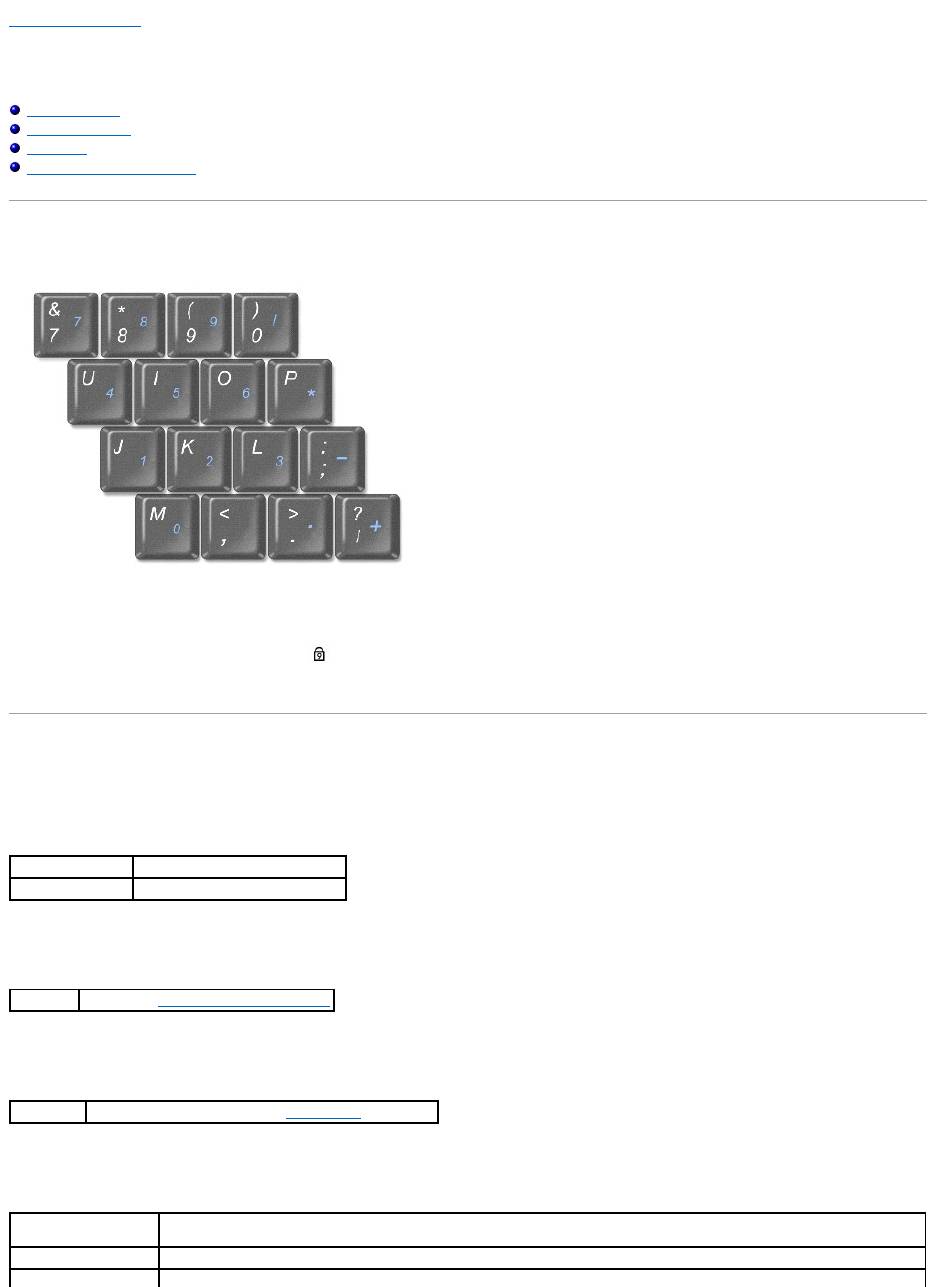
Back to Contents Page
Using the Keyboard and Touch Pad
DellPrecision™MobileWorkstationM70User'sGuide
Numeric Keypad
Key Combinations
Touch Pad
Changing the Track Stick Cap
Numeric Keypad
The numeric keypad functions like the numeric keypad on an external keyboard. Each key on the keypad has multiple functions. The keypad numbers and
symbols are marked in blue on the right of the keypad keys. To type a number or symbol, hold down <Fn> and press the desired key.
l To enable the keypad, press <Num Lk>. The light indicates that the keypad is active.
l To disable the keypad, press <Num Lk> again.
Key Combinations
System Functions
Battery
CD or DVD Tray
Display Functions
<Ctrl><Shift><Esc>
Opens the Task Manager window
<Fn><Num Lk>
Enables and disables the scroll lock
<Fn><F3>
Displays the Dell™QuickSetBatteryMeter.
<Fn><F10>
Ejects the tray out of the drive (if Dell QuickSet is installed).
<Fn><F8>
Switches the video image to the next display option. The options include the integrated display, an external monitor, and both
displays simultaneously.
<Fn> and up-arrow key
Increases brightness on the integrated display only (not on an external monitor).
<Fn> and down-arrow
Decreases brightness on the integrated display only (not on an external monitor).
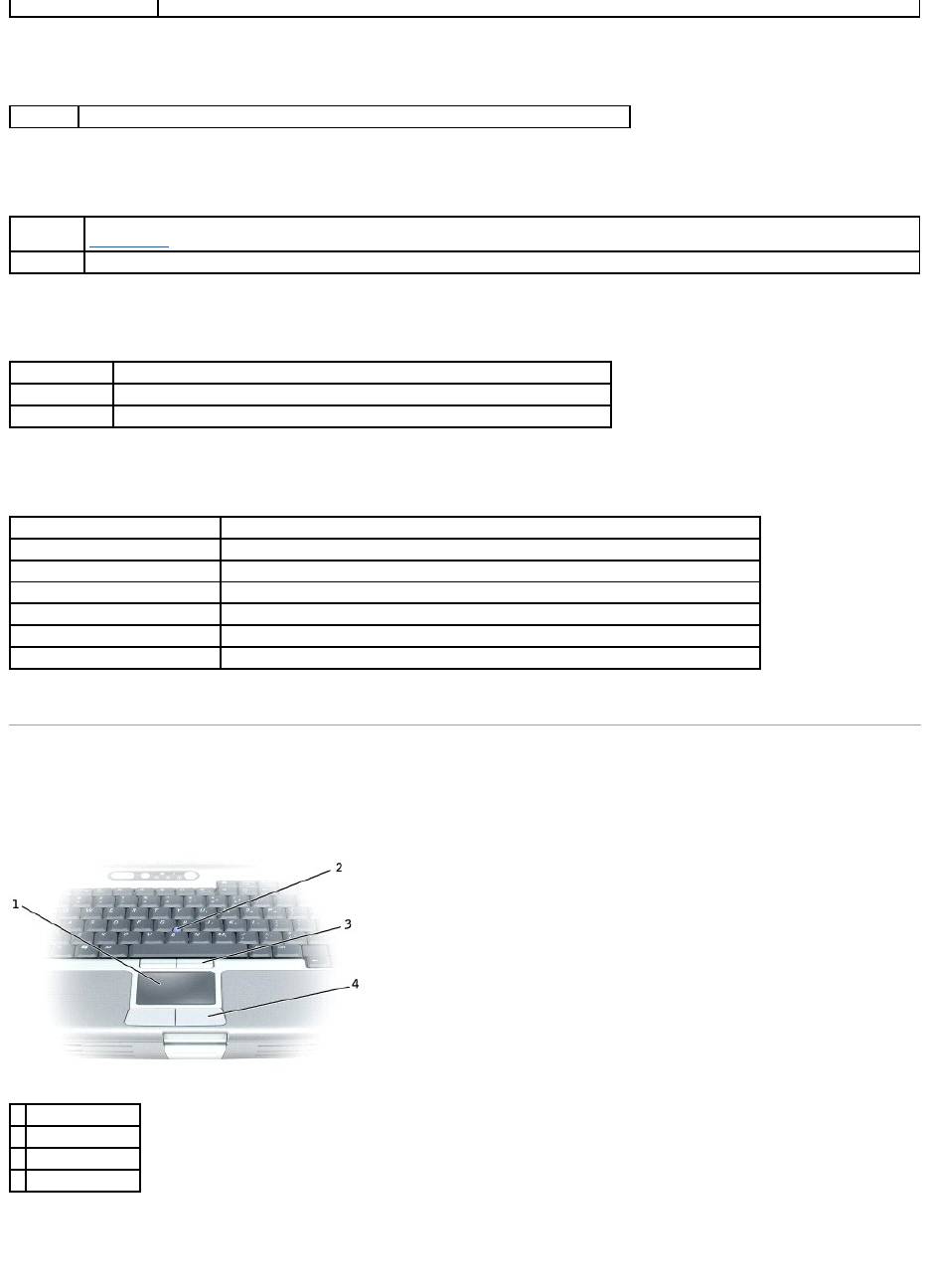
Radios (Including Wireless Networking and Bluetooth®Wireless Technology)
Power Management
Speaker Functions
Microsoft® Windows® Logo Key Functions
To adjust keyboard operation, such as the character repeat rate, open the Control Panel, click Printers and Other Hardware, and click Keyboard.
Touch Pad
The touch pad detects the pressure and movement of your finger to allow you to move the cursor on the display. Use the touch pad and touch pad buttons as
you would use a mouse.
l To move the cursor, lightly slide your finger over the touch pad.
l To select an object, lightly tap once on the surface of the touch pad or use your thumb to press the left touch-pad button.
l To select and move (or drag) an object, position the cursor on the object and tap down-up-down on the touch pad. On the second down motion, leave
your finger on the touch pad and move the selected object by sliding your finger over the surface.
key
<Fn><F2>
Enables and disables radios, including wireless networking and Bluetooth wireless technology.
<Fn><Esc>
Activates a power management mode. You can reprogram this keyboard shortcut to activate a different power management mode using the
Advanced Tab in the Power Options Properties window.
<Fn><F1>
Puts the system into Hibernate mode. Dell QuickSet is required.
<Fn><Page Up>
Increases the volume of the integrated speakers and external speakers, if attached.
<Fn><Page Dn>
Decreases the volume of the integrated speakers and external speakers, if attached.
<Fn><End>
Enables and disables the integrated speakers and external speakers, if attached.
Windows logo key and <m>
Minimizes all open windows
Windows logo key and <Shift><m>
Maximizes all windows
Windows logo key and <e>
Runs Windows Explorer
Windows logo key and <r>
Opens the Run dialog box
Windows logo key and <f>
Opens the Search Results dialog box
Windows logo key and <Ctrl><f>
Opens the Search Results-Computer dialog box (if the computer is connected to a network)
Windows logo key and <Pause>
Opens the System Properties dialog box
1
touch pad
2
track stick
3
track stick buttons
4
touch pad buttons
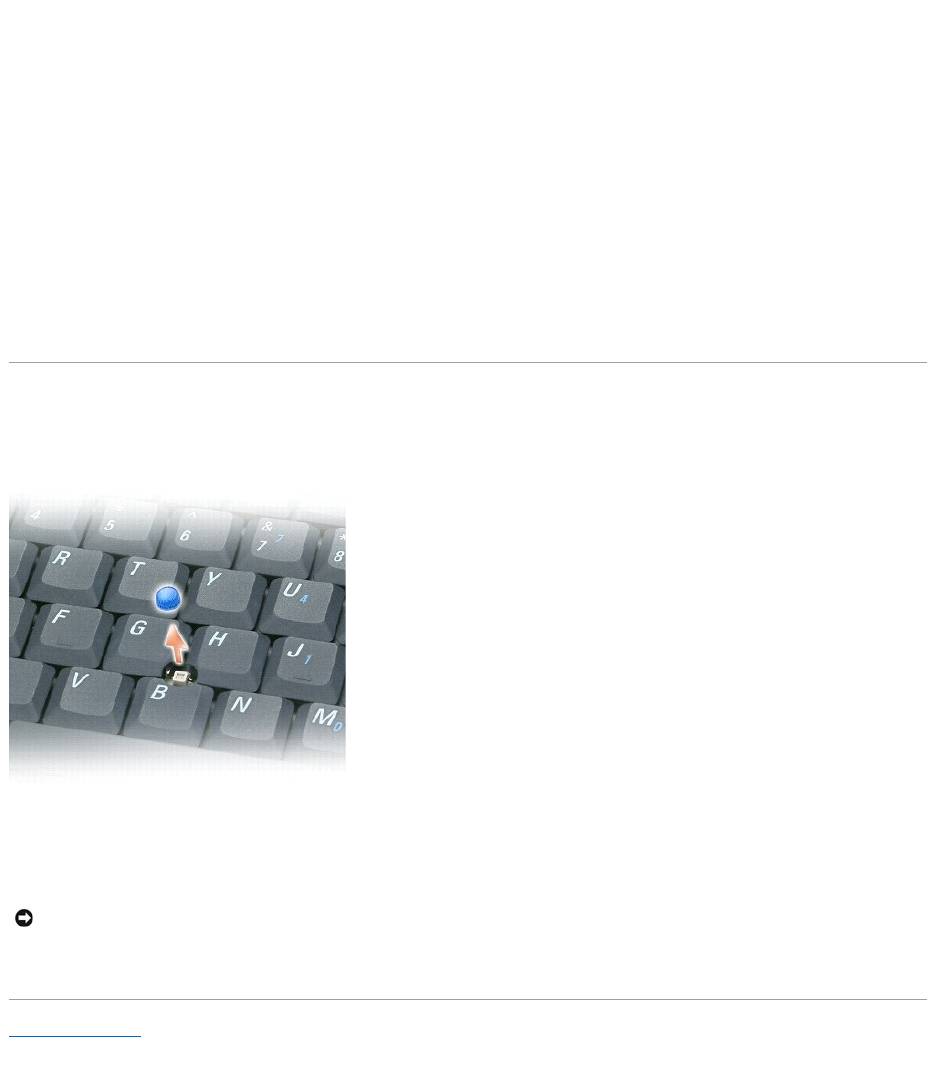
l To double-click an object, position the cursor on the object and tap twice on the touch pad or use your thumb to press the left touch-pad button twice.
You can also use the track stick to move the cursor. Press the track stick left, right, up, or down to change the direction of the cursor on the display. Use the
track stick and track stick buttons as you would use a mouse.
Customizing the Touch Pad and Track Stick
You can use the Mouse Properties window to disable the touch pad and track stick or adjust their settings.
1. Open the Control Panel, click Printers and Other Hardware, and then click Mouse.
2. In the Mouse Properties window:
l Click the Device Select tab to disable the touch pad and track stick.
l Click the Pointer tab to adjust touch pad and track stick settings.
3. Click OK to save the settings and close the window.
Changing the Track Stick Cap
You can replace your track stick cap if it wears down from prolonged use or if you prefer a different color. You can purchase additional caps by visiting the Dell
website at www.dell.com.
1. Pull the cap off the track stick.
2. Align the new cap over the square track-stick post and gently press the cap down onto the post.
3. Test the track stick to ensure that the cap is seated properly.
Back to Contents Page
NOTICE: The track stick cap can damage the display if it is not properly seated on the post.
Back to Contents Page
Passwords
DellPrecision™MobileWorkstationM70User'sGuide
About Passwords
Using a Primary/System Password
Using an Administrator Password
Using a Hard Drive Password
Assigning an Asset Tag
Enabling Trusted Platform Module (TPM)
About Passwords
A primary password, an administrator password, and a hard drive password all prevent unauthorized access to your computer in different ways. The following
table identifies types and features of passwords available on your computer.
If you forget any of your passwords, contact your system administrator or contact Dell. For your protection, Dell technical support staff will ask you for proof of
your identity to ensure that only an authorized person can use the computer.
Using a Primary/System Password
The primary/system password allows you to protect the computer from unauthorized access.
Access User Accounts from the Control Panel to create user accounts and add or change passwords. After assigning a primary/system password, you must
enter it each time you turn on your computer.
If you have assigned an administrator password, you can use it instead of the primary/system password. The computer does not specifically prompt you for
the administrator password.
Using an Administrator Password
The administrator password is designed to give system administrators or service technicians access to computers for repair or reconfiguration. The
administrators or technicians can assign identical administrator passwords to groups of computers, allowing you to assign the primary/system password.
To set or change administrator passwords, access User Accounts, which is located in the Control Panel.
1. To open User Accounts, click the Start button and point to Settings.
2. Click Control Panel.
3. Double-click User Accounts.
NOTE: Passwords are disabled when you receive your computer.
Type of Password
Features
Primary/System
l Protects the computer from unauthorized access
Administrator
l Gives system administrators or service technicians access to computers for repair or reconfiguration
l Allows you to restrict access to system setup in the same way a primary password restricts access to the computer
l Can be used instead of the primary password
Hard drive
l Helps protect the data on your hard drive or external hard drive (if one is being used) from unauthorized access
NOTE: OnlyharddrivespurchasedfromDellforusewiththeDellPrecision™D-Family computers support hard drive passwords.
NOTICE: Passwords provide a high level of security for data in your computer or hard drive. However, they are not foolproof. If you require more
security, obtain and use additional forms of protection, such as smart cards, data encryption programs, or PC Cards with encryption features.
NOTICE: If you disable the administrator password, the primary password is also disabled.

4. In the User Accounts window, click the administrator user and click the Reset Password button.
When you set an administrator password, the Configure Setup option becomes available in system setup. The Configure Setup option allows you to restrict
access to system setup in the same way that a primary or system password restricts access to the computer.
You can now use the administrator password instead of the system password. Whenever you are prompted to enter the primary/system password, you can
enter the administrator password.
If you forget the primary/system password and do not have an administrator password assigned, or if you have both a primary and an administrator
password assigned but forget them both, contact your system administrator or contact Dell.
Using a Hard Drive Password
The hard drive password helps protect the data on your hard drive from unauthorized access. You can also assign a password for an external hard drive (if
one is being used) that can be the same as or different from the password for the primary hard drive.
After assigning a hard drive password, you must enter it each time you turn on the computer and each time you restore the computer to normal operation
from standby mode.
If the hard drive password is enabled, the system asks you to type in the hard-disk drive password each time you turn on the computer.
If you enter the wrong password, a message similar to the following example appears:
Invalid password
[Press Enter to retry]
If you do not enter the correct password in three attempts, the computer tries to start from another bootable device if the Boot First Device option in system
setup is set to allow start-up from another device. If the Boot First Device option is not set to allow the computer to start from another device, the computer
returns to the operating state it was in when you turned it on.
If the hard drive password, the external hard-drive password, and the primary/system password are the same, the computer prompts you only for the
primary/system password. If the hard drive password is different from the primary/system password, the computer prompts you for both. Two different
passwords provide greater security.
Assigning an Asset Tag
The Asset Tag utility allows you to enter an asset tag that you or your company assigns to the computer. After you enter an asset tag, the tag appears in the
system setup screens.
You can also use the Asset Tag utility to enter an owner tag that appears in the system log-on screen and with the primary password prompt.
Download the Dell Portables Asset Tag utility from the support.dell.com website to create bootable media (such as a bootable CD or floppy disk), and then
use the bootable media to assign an asset tag.
1. Save and close any open files and exit any open programs.
2. Ensure that you have a drive for the bootable media (such as a floppy drive or a CD drive).
3. Access the support.dell.com website. Download the Dell Portables Asset Tag utility for your system. Unzip the files and run the Asset Tag utility to
create the bootable media.
4. Boot the computer, using the bootable media:
a. Restart the computer.
b. Press<F12>immediatelyaftertheDELL™logoappears.
If the operating system logo appears, wait until you see the Microsoft® Windows® desktop, and then shut down the computer and try again.
c. Press the arrow keys to select the drive containing the bootable media and press <Enter>.
5. Type asset and a space followed by the new asset tag, and press <Enter>.
For example, type the following command line and press <Enter>:
asset 1234$ABCD&
NOTICE: If you disable the administrator password, the primary/system password is also disabled.
NOTE: The administrator password provides access to the computer, but it does not provide access to the hard drive if a hard drive password is
assigned.
NOTE: The administrator password provides access to the computer, but it does not provide access to a hard drive that is protected by a hard drive
password.
NOTE: The Dell Portables Asset Tag utility may not be available as a download in certain countries.

6. When the computer prompts you to verify the asset tag, type y.
The computer displays the new or modified asset tag and the Service Tag.
7. Restart your computer to exit the Asset Tag utility.
Viewing Existing Asset and Service Tags
1. Boot the computer using the bootable media you created in "Assigning an Asset Tag."
2. Type asset and press <Enter>.
Deleting an Asset Tag
1. Boot the computer using the bootable media you created in "Assigning an Asset Tag."
2. Type asset /d and press <Enter>.
3. When the computer prompts you to delete the asset tag, type y.
Viewing Existing Asset and Service Tags
1. Boot the computer using the bootable media you created in "Assigning an Asset Tag."
2. Type asset and press <Enter>.
Deleting an Asset Tag
1. Boot the computer using the bootable media you created in "Assigning an Asset Tag."
2. Type asset /d and press <Enter>.
3. When the computer prompts you to delete the asset tag, type y.
Assigning an Owner Tag
An owner tag can have up to 48 characters; any combination of letters, numbers, and spaces is valid.
1. Boot the computer using the bootable media you created in "Assigning an Asset Tag."
2. Type asset /o and a space followed by the new owner tag, and press <Enter>.
For example, type the following command line and press <Enter>:
asset /o ABC Company
3. When the computer prompts you to verify the owner tag, type y.
The computer displays the new owner tag.
Deleting an Owner Tag
NOTE: An asset tag can have up to 10 characters; any combination of characters excluding spaces is valid.
NOTE: For security, you cannot set, change, or delete the owner tag if the primary or administrator passwords are set.
1. Boot the computer using the bootable media you created in "Assigning an Asset Tag."
2. Type asset /o /d and press <Enter>.
3. When the computer prompts you to delete the owner tag, type y.
Asset Tag Options
To use one of the asset tag options (see the following table):
1. Boot the computer using the bootable media you created in "Assigning an Asset Tag."
2. Type asset and a space followed by the option, and then press <Enter>.
Enabling Trusted Platform Module (TPM)
TPM is a hardware-based security feature that can be used to create and manage computer-generated encryption keys. When combined with security
software, TPM enhances existing network and computer security by enabling features such as file protection capabilities and protected e-mail. The TPM feature
isenabledthroughaTPMsystemsetupoption.
Enabling the TPM Feature
1. Turn on your computer.
2. Install the TPM Software.
The TPM software is factory-installed in the C:\Dell\TPM directory. It may also be downloaded from support.dell.com.
3. Run the setup.exe file. Follow the on-screen instructions to install the Broadcom Secure Foundation software.
If you are using TPM on your computer for the first time, proceed to step4, otherwise, continue with step5.
4. To enable the TPM software:
a. Restartthecomputerandpress<F2>duringthePowerOnSelfTesttoenterthesystemsetupprogram.
b. Open the Security menu in system setup.
c. Select the TPM Security menu option and press <Enter>.
d. Set the TPM security option to On.
e. Press <Esc> to exit the setup program.
f. If prompted, select Save/Exit.
5. Activate the TPM setup program:
a. Boot your computer to the Microsoft®Windows®operating system.
b. Click Start® Programs® Broadcom Security Platforms Tools. Then, click the icon for the Security Platform Initialization Wizard.
c. Follow the on-screen instructions to activate the TPM setup program. You only need to activate the program once.
You will be prompted to reboot your computer once the process is complete.
6. Physically activate the TPM:
Asset Tag Option
Description
/d
Deletes the asset tag
/o owner tag
Specifies a new owner tag
/o /d
Deletes the owner tag
/?
Displays the Asset Tag utility help screen
NOTE: The TPM feature supports encryption only if the operating system supports TPM. For more information, see the software documentation.
NOTICE: If you use TPM, you must follow the backup procedures in the documentation that came with the software to secure your TPM data and
encryption keys. In the event of these backups being incomplete, lost, or damaged, Dell will be unable to assist in the recovery of encrypted data.

a. Restart the computer and press <F2> during the Power On Self Test to enter the system setup program.
b. Open the Security menu in system setup and select the TPM Activation menu option.
c. Set the TPM activation state to Activate.
d. Save the changes and restart your computer.
7. Initialize the TPM owner and user passwords:
a. Boot your computer to the Microsoft®Windows®operating system.
b. Click Start® Programs® Broadcom Security Platforms Tools. Then, click the icon for the Security Platform Initialization Wizard.
c. Follow the on-screen instructions for creating the TPM owner, user passwords, and credentials.
Back to Contents Page
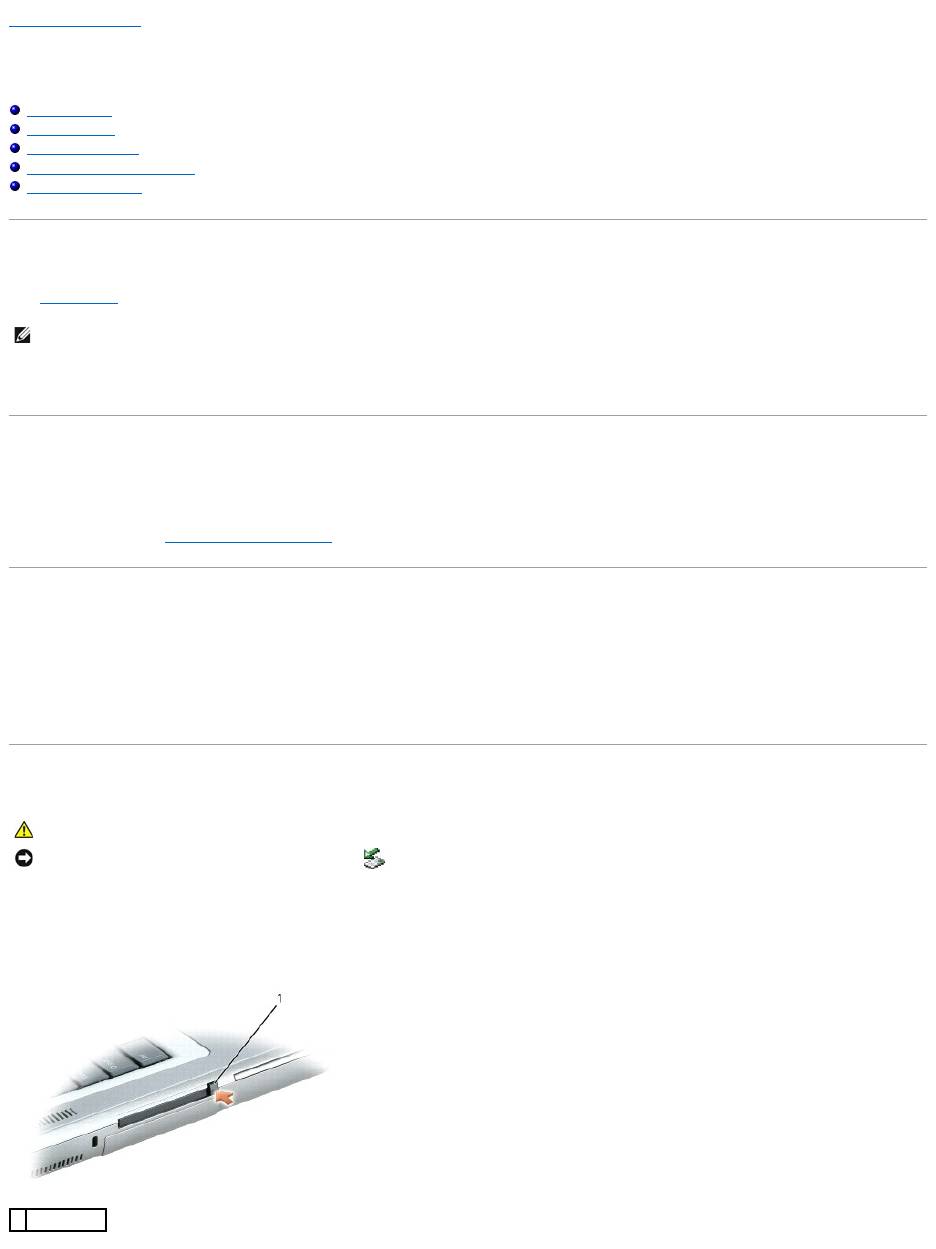
Back to Contents Page
Using PC Cards
DellPrecision™MobileWorkstationM70User'sGuide
PC Card Types
PC Card Blanks
Extended PC Cards
Removing a PC Card or Blank
Installing a PC Card
PC Card Types
See "Specifications" for information on supported PC Cards.
The PC Card slot has one connector that supports a single Type I or Type II card. The PC Card slot supports CardBus technology and extended PC Cards.
"Type" of card refers to its thickness, not its functionality.
PC Card Blanks
Your computer shipped with a plastic blank installed in the PC Card slot. Blanks protect unused slots from dust and other particles. Save the blank for use
when no PC Card is installed in the slot; blanks from other computers may not fit your computer.
To remove the blank, see "Removing a PC Card or Blank."
Extended PC Cards
An extended PC Card (for example, a wireless network adapter) is longer than a standard PC Card and extends outside the computer. Follow these
precautions when using extended PC Cards:
l Protect the exposed end of an installed card. Striking the end of the card can damage the system board.
l Always remove an extended PC Card before you pack the computer in its carrying case.
Removing a PC Card or Blank
Press the latch and remove the card or blank. For some latches, you must press the latch twice: once to pop the latch out, and then a second time to pop the
card out.
Save a blank to use when no PC Card is installed in a slot. Blanks protect unused slots from dust and other particles.
NOTE: A PC Card is not a bootable device.
CAUTION: Before you begin any of the procedures in this section, follow the safety instructions located in the Product Information Guide.
NOTICE: Use the PC Card configuration utility (click the icon in the taskbar) to select a card and stop it from functioning before you remove it from
the computer. If you do not stop the card in the configuration utility, you could lose data. Do not attempt to eject a card by pulling its cable, if one is
attached.
1
eject button
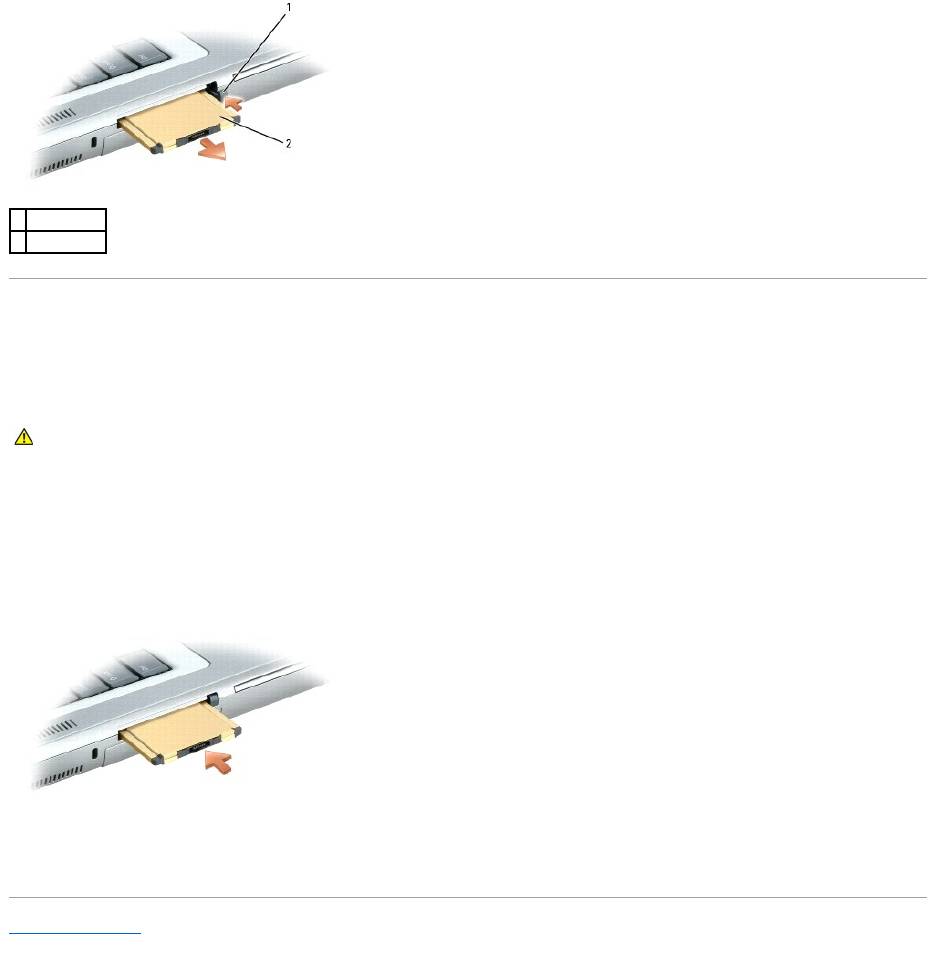
Installing a PC Card
You can install a PC Card in the computer while the computer is running. The computer automatically detects the card.
PC Cards are generally marked with a symbol (such as a triangle or an arrow) to indicate which end to insert into the slot. The cards are keyed to prevent
incorrect insertion. If card orientation is not clear, see the documentation that came with the card.
To install a PC Card:
1. Hold the card with its orientation symbol pointing into the slot and the top side of the card facing up. The latch may need to be in the "in" position
before you insert the card.
2. Slide the card into the slot until the card is completely seated in its connector.
If you encounter too much resistance, do not force the card. Check the card orientation and try again.
The computer recognizes most PC Cards and automatically loads the appropriate device driver. If the configuration program tells you to load the
manufacturer's drivers, use the floppy disk or CD that came with the PC Card.
Back to Contents Page
1
eject button
2
PC Card
CAUTION: Before you begin any of the procedures in this section, follow the safety instructions located in the Product Information Guide.
Back to Contents Page
Power Management
DellPrecision™MobileWorkstationM70User'sGuide
Power Management Tips
Power Management Wizard
Power Management Modes
Power Options Properties
Power Management Tips
l Connect the computer to an electrical outlet when possible because battery life is largely determined by the number of times the battery is charged.
l Place the computer in standby mode or hibernate mode when you leave the computer unattended for long periods of time.
l You can use the Power Management Wizard to configure the computer to enter or exit power management modes by pressing the power button,
closing the display, or pressing <Fn><Esc>.
Power Management Wizard
Click or double-click the icon to open the Power Management Wizard.
The first two screens of the wizard—Welcome and What is Power Management?—describe and define various power management options.
Use the screens that follow Welcome and What is Power Management? to set various power management options, including sleep modes, power schemes,
and low battery-charge alarms.
Setting Sleep Modes
The screen defines standby and hibernate modes. From the screen you can:
l Set standby-mode password options.
l Enable or disable hibernate mode.
l Select how the computer will respond when you close the display:
¡ Choose no action.
¡ Enter standby mode.
¡ Enter hibernate mode.
l Select how the computer will respond when you press the power button:
¡ Choose no action.
¡ Enter standby mode.
¡ Enter hibernate mode.
¡ Shut down the operating system and turn off the computer.
¡ Prompt a user for an action (Ask me what to do).
l Select how the computer will respond when you press <Fn><Esc>:
¡ Choose no action.
¡ Enter standby mode.
¡ Enter hibernate mode.
¡ Shut down Microsoft Windows and turn off the computer.
NOTE: See "Using a Battery" for more information on conserving battery power.
CAUTION: YourcomputerfeaturesUndock&Go™technologythatallowsyoutoundockyourcomputerwithoutgoingintoStandbyMode.Because
the computer may not automatically go into Standby Mode when it is undocked, be sure the settings in the Power Options control panel do not
prohibit the computer from going into Standby Mode. If you change the Power Options control panel to prohibit the computer from going into
Standby Mode, you greatly increase the chances of causing your battery to wear down quickly or causing your computer to overheat.
NOTE: The Power Management Wizard is not available if you have restricted access rights.
NOTE: On the What is Power Management? screen, you can select Do not show this page again. When you select this option, the Welcome screen
also does not appear again.

¡ Prompt a user for an action (Ask me what to do).
Selecting a Power Scheme
The screen allows you to select, create, and edit power scheme settings. In addition, you can delete power schemes that you create, but you cannot delete
Dell™QuickSetpredefinedpowerschemes(MaximumBattery,MaximumPerformance,Presentation,andNetworkDisabled).
All QuickSet power schemes are displayed in a drop-down menu near the center of the screen. The power settings for each scheme in the menu are listed
below the menu. The power settings are listed separately for when the computer is running on battery or connected to an electrical outlet.
The Power Management Wizard also allows you to associate the display brightness level with a power scheme. You must enable brightness-level power
schemes through QuickSet in order to set the brightness level.
The display brightness, internal network-card activity, and wireless activity features are not available through the Control Panel power schemes. In order to
make use of these value-added features, you must set them through QuickSet power schemes.
Setting Battery Alarms and Actions
The screen allows you to enable the low-battery and critical-battery alarms and to change settings for the alarms. For example, you can set the low-battery
alarm to 20 percent to remind you to save work and switch to AC power, and you can set the critical-battery alarm to 10 percent to enter hibernate mode.
From the screen, you can:
l Select whether the alarm will notify you by sound or text.
l Adjust the power level at which you want the alarm to notify you.
l Select how the computer will respond when the alarm notifies you:
¡ Choose no action.
¡ Enter standby mode.
¡ Enter hibernate mode.
¡ Shut down Windows and turn off the computer.
Completing the Power Management Wizard
The screen summarizes the QuickSet power scheme, sleep mode, and battery alarm settings for your computer. Review the settings you have selected and
click Finish.
For more information about QuickSet, right-click the icon in the taskbar and click Help.
Power Management Modes
Standby Mode
Standby mode conserves power by turning off the display and the hard drive after a predetermined period of inactivity (a time-out). When the computer exits
standby mode, it returns to the same operating state it was in before entering standby mode.
To enter standby mode:
l Click the Start button, click Turn off computer, and then click Stand by.
or
l Depending on how you set the power management options on the Advanced tab in the Power Options Properties window, use one of the following
methods:
¡ Press the power button.
NOTE: When your computer is running on battery power, the Network Disabled power scheme disables your internal network and wireless activity.
When your computer is connected to an electrical outlet or docking device, the Network Disabled power scheme disables only your wireless activity. You
must set the power scheme through QuickSet (not Microsoft®Windows®) for the Network Disabled power scheme to work.
NOTE: QuickSet automatically adds the word (QuickSet) after the names of power schemes created using QuickSet.
NOTE: Brightness shortcut keys only affect the display on your portable computer, not monitors that you attach to your portable computer or docking
device. If your computer is in CRT only mode and you try to change the brightness level, the Brightness Meter appears, but the brightness level on the
monitor does not change.
NOTICE: If your computer loses AC and battery power while in standby mode, it may lose data.

¡ Close the display.
¡ Press <Fn><Esc>.
To exit standby mode, press the power button or open the display depending on how you set the options on the Advanced tab. You cannot make the
computer exit standby mode by pressing a key or touching the touch pad or track stick.
Hibernate Mode
Hibernate mode conserves power by copying system data to a reserved area on the hard drive and then completely turning off the computer. When the
computer exits hibernate mode, it returns to the same operating state it was in before entering hibernate mode.
Your computer enters hibernate mode if the battery charge level becomes critically low.
To manually enter hibernate mode:
l Click the Start button, click Turn off computer, press and hold <Shift>, and then click Hibernate.
or
l Depending on how you set the power management options on the Advanced tab in the Power Options Properties window, use one of the following
methods to enter hibernate mode:
¡ Press the power button.
¡ Close the display.
¡ Press <Fn><Esc>.
To exit hibernate mode, press the power button. The computer may take a short time to exit hibernate mode. You cannot make the computer exit hibernate
mode by pressing a key or touching the touch pad or track stick. For more information on hibernate mode, see the documentation that came with your
operating system.
Power Options Properties
The Power Options Properties window helps you to manage power consumption and monitor battery charge status. To access the Windows Power Options
Properties window, click the Start button® Control Panel® Performance and Maintenance® Power Options.
Power Schemes Tab
The Power schemes drop-down menu displays the selected preset power scheme. Keep the default Portable/Laptop power scheme to maximize battery
power.
Windows XP controls the performance level of the processor depending on the power scheme you select. You do not need to make any further adjustments to
set the performance level. For information on setting processor performance for other operating systems, see "Intel SpeedStep® Technology Tab."
Each preset power scheme has different time-out settings for entering standby mode, turning off the display, and turning off the hard drive. For more
information on power management options, see the Help and Support Center.
Alarms Tab
The Low battery alarm and Critical battery alarm settings alert you with a message when the battery charge falls below a certain percentage. When you
receive your computer, the Low battery alarm and Critical battery alarm check boxes are selected. It is recommended that you continue to use these
settings. See "Using a Battery" for more information on low-battery warnings.
Power Meter Tab
The Power Meter tab displays the current power source and amount of battery charge remaining.
Advanced Tab
The Advanced tab allows you to:
NOTICE: You cannot remove devices or undock your computer while your computer is in hibernate mode.
NOTE: Some PC Cards may not operate correctly after the computer exits hibernate mode. Remove and reinsert the card, or simply restart (reboot) your
computer.
NOTE: To enable audible alarms, click each Alarm Action button and select Sound alarm.

l Set power icon and standby mode password options.
l Program the following functions (depending on your operating system):
¡ Prompt a user for an action (Ask me what to do).
¡ Enter standby mode.
¡ Enter hibernate mode.
¡ Shut down Windows and turn off the computer.
¡ Choose no action (None or Do nothing).
To program these functions, click an option from the corresponding drop-down menu and then click OK.
Hibernate Tab
The Hibernate tab lets you enable hibernate mode by clicking the Enable hibernate support check box.
Intel SpeedStep®Technology Tab
Depending on your operating system and microprocessor, the Power Options Properties window includes the Intel SpeedStep® technology tab. The Intel
SpeedStep technology allows you to set the performance level of the processor according to whether the computer is running on battery or AC power.
Depending on your operating system, typical options are:
l Automatic — The processor runs at its highest possible speed (Maximum Performance mode) when the computer is running on AC power. When the
computer is running on battery power, the processor runs in Battery Optimized mode.
l Maximum Performance — The processor runs at its highest possible speed even if the computer is running on battery power.
l Battery Optimized Performance — Processor speed is optimized for battery power even if the computer is connected to an electrical outlet.
To change additional Intel SpeedStep options:
1. Click Advanced and then click one of the following options:
l Disable Intel SpeedStep technology control
l Remove flag icon (from the notification area)
l Disable audio notification when performance changes
2. Click OK to accept any changes, and then click OK to close the Intel SpeedStep® technology window.
You can also change the Intel SpeedStep settings by right-clicking the flag icon in the notification area.
Back to Contents Page
NOTE: Windows XP controls the performance level of the processor depending on the power scheme that you select. See "Power Schemes Tab."
NOTE: To use Intel SpeedStep technology, a Windows operating system must be running.
Back to Contents Page
Solving Problems
DellPrecision™MobileWorkstationM70User'sGuide
Drive Problems
Fill out the Diagnostics Checklist as you complete these checks.
CD and DVD drive problems
Problems writing to an Optical drive
Drive Problems
CD and DVD drive problems
Hard drive problems
Email, Modem, and Internet Problems
Error Messages
Keyboard Problems
Lockups and Software Problems
Memory Problems
Network Problems
PC Card Problems
Power Problems
Printer Problems
Scanner Problems
Sound and Speaker Problems
Touch Pad or Mouse Problems
Video and Display Problems
CAUTION: Before you begin any of the procedures in this section, follow the safety instructions in the Product Information Guide.
Ensure that Microsoft®Windows®recognizesthedrive— Click the Start button and click My Computer. If the floppy, CD, or DVD drive,
is not listed, perform a full scan with your antivirus software to check for and remove viruses. Viruses can sometimes prevent Windows from
recognizing the drive.
Test the drive —
l Insert another floppy disk, CD, or DVD to eliminate the possibility that the original one is defective.
l Insert a bootable floppy disk and restart the computer.
Cleanthedriveordisk— See "Cleaning Your Computer."
Ensure that the CD is snapped onto the spindle
Check the cable connections
Checkforhardwareincompatibilities— See "Resolving Software and Hardware Incompatibilities."
RuntheDellDiagnostics— See "Dell Diagnostics."
NOTE: High-speed CD or DVD drive vibration is normal and may cause noise, which does not indicate a defect in the drive or the CD or DVD.
NOTE: Because of different regions worldwide and different disc formats, not all DVD titles work in all DVD drives.
Closeotherprograms— The optical drive must receive a steady stream of data when writing. If the stream is interrupted, an error occurs.
Try closing all programs before you write to the optical drive.
TurnoffStandbymodeinWindowsbeforewritingtoaCDorDVDdisc— See "Power Management" or search for the keyword standby in
the Windows Help and Support Center for information on power management modes.
Change the write speed to a slower rate — See the help files for your CD or DVD creation software.
If you cannot eject the Optical drive tray
If you hear an unfamiliar scraping or grinding sound
Hard drive problems
Email, Modem, and Internet Problems
1. Ensure that the computer is shut down.
2. Straighten a paper clip and insert one end into the eject hole at the front of the drive; push firmly until the tray is partially ejected.
3. Gently pull out the tray until it stops.
l Ensure that the sound is not caused by the program that is running.
l Ensure that the disk or disc is inserted properly.
Allow the computer to cool before turning it on — A hot hard drive may prevent the operating system from starting. Try allowing the
computer to return to room temperature before turning it on.
RunCheckDisk—
Windows XP
1. Click the Start button and click My Computer.
2. Right-click Local Disk C:.
3. Click Properties.
4. Click the Tools tab.
5. Under Error-checking, click Check Now.
6. Click Scan for and attempt recovery of bad sectors.
7. Click Start.
Windows 2000
1. Double-click My Computer on the Windows desktop.
2. Click the Tools tab.
3. Under Error-checking, click Check Now.
4. Click Start.
MS-DOS®
Type scandisk x: at an MS-DOS prompt, where x is the hard drive letter, and then press <Enter>. Click the Start button and click My
Computer.
CAUTION: Before you begin any of the procedures in this section, follow the safety instructions in the Product Information Guide.
NOTE: Connect the modem to an analog telephone jack only. The modem does not operate while it is connected to a digital telephone network.
Check the Microsoft Outlook®ExpressSecuritySettings— If you cannot open your e-mail attachments:
1. In Outlook Express, click Tools, click Options, and then click Security.
2. Click Do not allow attachments to remove the checkmark.
Checkthetelephonelineconnection
Checkthetelephonejack
Connectthemodemdirectlytothetelephonewalljack
Useadifferenttelephoneline
l Verify that the telephone line is connected to the jack on the modem. (The jack has either a green label or a connector-shaped icon
next to it.)
l Ensure that you hear a click when you insert the telephone line connector into the modem.
l Disconnect the telephone line from the modem and connect it to a telephone. Listen for a dial tone.
l If you have other telephone devices sharing the line, such as an answering machine, fax machine, surge protector, or line splitter,
thenbypassthemandusethetelephonetoconnectthemodemdirectlytothetelephonewalljack.Ifyouareusingalinethatis3m
(10ft)ormoreinlength,tryashorterone.
Error Messages
Fill out the Diagnostics Checklist as you complete these checks.
If the message is not listed, see the documentation for the operating system or the program that was running when the message appeared.
RuntheModemHelperdiagnostics— Click the Start button, point to All Programs (Programs in Windows 2000), and then click Modem
Helper. Follow the instructions on the screen to identify and resolve modem problems. (Modem Helper is not available on all computers.)
Verify that the modem is communicating with Windows —
Windows XP
1. Click the Start button, point to Settings, and then, click Control Panel.
2. Click Printers and Other Hardware.
3. Click Phone and Modem Options.
4. Click the Modems tab.
5. Click the COM port for your modem.
6. Click Properties, click the Diagnostics tab, and then click Query Modem to verify that the modem is communicating with Windows.
Windows 2000
1. Click the Start button, point to Settings, and then click Control Panel.
2. Double-click Phone and Modem Options.
3. Click the Modems tab.
4. Click the COM port for your modem.
5. Click Properties, click the Diagnostics tab, and then click Query Modem to verify that the modem is communicating with Windows.
If all commands receive responses, the modem is operating properly.
EnsurethatyouareconnectedtotheInternet— Ensure that you have subscribed to an Internet provider. With the Outlook Express e-
mail program open, click File. If Work Offline has a checkmark next to it, click the checkmark to remove it and connect to the Internet. For
help, contact your Internet service provider.
Scan the computer for spyware — If you are experiencing slow computer performance, you frequently receive pop-up advertisements, or
you are having problems connecting to the Internet, your computer might be infected with spyware. Use an anti-virus program that includes
anti-spyware protection (your program may require an upgrade) to scan the computer and remove spyware. For more information, go to
support.dell.com and search for the keyword spyware.
CAUTION: Before you begin any of the procedures in this section, follow the safety instructions in the Product Information Guide.
Auxiliary device failure — The touch pad, track stick, or external mouse may be faulty. For an external mouse, check the cable connection.
Enable the Pointing Device option in the system setup program. If the problem persists, contact Dell.
Bad command or file name — Ensure that you have spelled the command correctly, put spaces in the proper place, and used the correct
pathname.
Cache disabled due to failure — The primary cache internal to the microprocessor has failed. Contact Dell.
CD drive controller failure — The CD drive does not respond to commands from the computer. See "Drive Problems."
Data error — The hard drive cannot read the data. See "Drive Problems."
Decreasing available memory — One or more memory modules may be faulty or improperly seated. Reinstall the memory modules and, if
necessary, replace them.
Disk C: failed initialization — The hard drive failed initialization. Run the hard drive tests as described in "Using the Dell Diagnostics."
Drive not ready — The operation requires a hard drive in the bay before it can continue. Install a hard drive in the hard drive bay.
Error reading PCMCIA card — The computer cannot identify the PC Card. Reinsert the card or try another PC Card.
Extended memory size has changed — The amount of memory recorded in NVRAM does not match the memory installed in the computer.
Restart the computer. If the error appears again, contact Dell.
Gate A20 failure — A memory module may be loose. Reinstall the memory modules and, if necessary, replace them.
General failure — The operating system is unable to carry out the command. The message is usually followed by specific information—for
example, Printer out of paper. Take the appropriate action.
Hard-disk drive configuration error — The computer cannot identify the drive type. Shut down the computer, remove the hard drive, and
boot the computer from a CD. Then shut down the computer, reinstall the hard drive, and restart the computer. Run the Hard-Disk Drive
tests as described in "Using the Dell Diagnostics."
Hard-disk drive controller failure 0 — The hard drive does not respond to commands from the computer. Shut down the computer, remove
the hard drive, and boot the computer from a CD. Then shut down the computer, reinstall the hard drive, and restart the computer. If the
problem persists, try another drive. Run the Hard-Disk Drive tests as described in "Using the Dell Diagnostics."
Hard-disk drive failure — The hard drive does not respond to commands from the computer. Shut down the computer, remove the hard
drive, and boot the computer from a CD. Then shut down the computer, reinstall the hard drive, and restart the computer. If the problem
persists, try another drive. Run the Hard-Disk Drive tests as described in "Using the Dell Diagnostics."
Hard-disk drive read failure — The hard drive may be defective. Shut down the computer, remove the hard drive, and boot the computer
from a CD. Then shut down the computer, reinstall the hard drive, and restart the computer. If the problem persists, try another drive. Run
the Hard-Disk Drive tests as described in "Using the Dell Diagnostics."
Insert bootable media — The operating system is trying to boot to a nonbootable CD. Insert bootable media.
Invalid configuration information-please run System Setup Program — The system configuration information does not match the
hardware configuration. The message is most likely to occur after a memory module is installed. Correct the appropriate options in the
system setup program.
Keyboard clock line failure — For external keyboards, check the cable connection. Run the Keyboard Controller test as described in "Using
the Dell Diagnostics."
Keyboard controller failure — For external keyboards, check the cable connection. Restart the computer, and avoid touching the keyboard
or the mouse during the boot routine. Run the Keyboard Controller test as described in "Using the Dell Diagnostics."
Keyboard data line failure — For external keyboards, check the cable connection. Run the Keyboard Controller test as described in "Using
the Dell Diagnostics."
Keyboard stuck key failure — For external keyboards or keypads, check the cable connection. Restart the computer, and avoid touching the
keyboard or keys during the boot routine. Run the Stuck Key test as described in "Using the Dell Diagnostics."
Memory address line failure at address, read value expecting value — A memory module may be faulty or improperly seated. Reinstall the
memory modules and, if necessary, replace them.
Memory allocation error — The software you are attempting to run is conflicting with the operating system, another program, or a utility.
Shut down the computer, wait 30 seconds, and then restart it. Try to run the program again. If the error message still appears, see the
software documentation.
Memory data line failure at address, read value expecting value — A memory module may be faulty or improperly seated. Reinstall the
memory modules and, if necessary, replace them.
Memory double word logic failure at address, read value expecting value — A memory module may be faulty or improperly seated.
Reinstall the memory modules and, if necessary, replace them.
Memory odd/even logic failure at address, read value expecting value — A memory module may be faulty or improperly seated. Reinstall
the memory modules and, if necessary, replace them.
Memory write/read failure at address, read value expecting value — A memory module may be faulty or improperly seated. Reinstall the
memory modules and, if necessary, replace them.
No boot device available — The computer cannot find the hard drive. If the hard drive is your boot device, ensure that the drive is installed,
properly seated, and partitioned as a boot device.
No boot sector on hard drive — The operating system may be corrupted. Contact Dell.
No timer tick interrupt — A chip on the system board may be malfunctioning. Run the System Set tests as described in "Using the Dell
Diagnostics."
Operating system not found — Reinstall the hard drive. If the problem persists, contact Dell.
Optional ROM bad checksum — The optional ROM apparently failed. Contact Dell.
A required .DLL file was not found — The program that you are trying to open is missing an essential file. Remove and then reinstall the
program.
Microsoft® Windows® XP
1. Click the Start button and click Control Panel.
2. Click Add or Remove Programs.
3. Select the program you want to remove.
4. Click Remove or Change/Remove and follow the prompts on the screen.
5. See the program documentation for installation instructions.
Windows 2000
1. Click the Start button, point to Settings, and then click Control Panel.
2. Double-click the Add/Remove Programs icon.
3. Select the program that you want to remove.
4. Click Change or Remove Programs.
5. See the program documentation for installation instructions.
Sector not found — The operating system cannot locate a sector on the hard drive. You may have a defective sector or corrupted FAT on the
hard drive. Run the Windows error-checking utility to check the file structure on the hard drive. See the Windows Help and Support Center
for instructions. If a large number of sectors are defective, back up the data (if possible), and then reformat the hard drive.
Seek error — The operating system cannot find a specific track on the hard drive.
Shutdown failure — A chip on the system board may be malfunctioning. Run the System Set tests as described in "Using the Dell
Diagnostics."
Time-of-day clock lost power — System configuration settings are corrupted. Connect your computer to an electrical outlet to charge the
battery. If the problem persists, try to restore the data by entering the system setup program. Then immediately exit the program. See
"Using the System Setup Program." If the message reappears, contact Dell.
Time-of-day clock stopped — The coin-cell battery that supports the system configuration settings should be replaced. If the problem
persists, contact Dell.
Time-of-day not set-please run the System Setup program — The time or date stored in the system setup program does not match the
system clock. Correct the settings for the Date and Time options. See "Using the System Setup Program."
Timer chip counter 2 failed — A chip on the system board may be malfunctioning. Run the System Set tests as described in "Using the Dell
Diagnostics."
Unexpected interrupt in protected mode — The keyboard controller may be malfunctioning, or a memory module may be loose. Run the
System Memory tests and the Keyboard Controller test as described in "Using the Dell Diagnostics."
x:\ is not accessible. The device is not ready — Insert a disk into the drive and try again.
Warning: Battery is critically low — The battery is running out of charge. Connect the computer to an electrical outlet. The battery will then
recharge. If you cannot access an electrical outlet, activate hibernate mode or shut down the computer. You can also turn the computer off
and replace the battery.
Keyboard Problems
Fill out the Diagnostics Checklist as you complete these checks.
External Keyboard Problems
Unexpected Characters
Lockups and Software Problems
The computer does not start up
The computer stops responding
CAUTION: Before you begin any of the procedures in this section, follow the safety instructions in the Product Information Guide.
NOTE: Use the integrated keyboard when working in MS-DOS®mode or when running the Dell Diagnostics or the system setup program. When you
attach an external keyboard, the integrated keyboard remains fully functional.
Check the keyboard cable — Shut down the computer. Disconnect the keyboard cable and check it for damage, and firmly reconnect the
cable.
If you are using a keyboard extension cable, disconnect it and connect the keyboard directly to the computer.
Check the external keyboard —
1. Shut down the computer, wait 1 minute, and turn it on again.
2. Verify that the numbers, capitals, and scroll lock lights on the keyboard blink during the boot routine.
3. From the Windows desktop, click the Start button, point to Programs, point to Accessories, and click Notepad.
4. Type some characters on the external keyboard and verify that they appear on the display.
If you cannot verify these steps, you may have a defective external keyboard.
To verify that the problem is with the external keyboard, check the integrated keyboard —
1. Shut down the computer.
2. Disconnect the external keyboard.
3. Turn on the computer.
4. From the Windows desktop, click the Start button, point to Programs, point to Accessories, and click Notepad.
5. Type some characters on the integrated keyboard and verify that they appear on the display.
If the characters appear now but did not with the external keyboard, you may have a defective external keyboard. Contact Dell.
Run the keyboard diagnostics tests — Run the PC-AT Compatible Keyboards tests in the Dell Diagnostics. If the tests indicate a defective
external keyboard, contact Dell.
Disable the numeric keypad — Press <Num Lk> to disable the numeric keypad if numbers are displayed instead of letters. Verify that the
numbers lock light is not lit.
CAUTION: Before you begin any of the procedures in this section, follow the safety instructions in the Product Information Guide.
Ensure that the AC adapter is firmly connected to the computer and to the electrical outlet
NOTICE: You might lose data if you are unable to perform an operating system shutdown.
Turnthecomputeroff— If you are unable to get a response by pressing a key on your keyboard or moving your mouse, press and hold
the power button for at least 8 to 10 seconds until the computer turns off. Then restart your computer.
A program stops responding
A program crashes repeatedly
A program is designed for an earlier Windows operating system
A solid blue screen appears
Other software problems
End the program —
1. Press <Ctrl><Shift><Esc> simultaneously.
2. Click Applications.
3. Click the program that is no longer responding.
4. Click End Task.
NOTE: Software usually includes installation instructions in its documentation or on a floppy disk or CD.
Checkthesoftwaredocumentation— If necessary, uninstall and then reinstall the program.
IfYouAreUsingWindowsXP,RuntheProgramCompatibilityWizard— The Program Compatibility Wizard configures a program so it
runs in an environment similar to non-Windows XP operating system environments.
1. Click the Start button, point to All Programs® Accessories, and then click Program Compatibility Wizard.
2. In the welcome screen, click Next.
3. Follow the instructions on the screen.
Turnthecomputeroff— If you are unable to get a response by pressing a key on your keyboard or moving your mouse, press and hold
the power button for at least 8 to 10 seconds until the computer turns off. Then restart your computer.
Checkthesoftwaredocumentationorcontactthesoftwaremanufacturerfortroubleshootinginformation—
l Ensure that the program is compatible with the operating system installed on your computer.
l Ensure that your computer meets the minimum hardware requirements needed to run the software. See the software documentation
for information.
l Ensure that the program is installed and configured properly.
l Verify that the device drivers do not conflict with the program.
l If necessary, uninstall and then reinstall the program.
Back up your files immediately
Use a virus-scanning program to check the hard drive, floppy disks, or CDs
Save and close any open files or programs and shut down your computer through the Start menu
Scan the computer for spyware — If you are experiencing slow computer performance, you frequently receive pop-up advertisements, or
Memory Problems
Fill out the Diagnostics Checklist as you complete these checks.
Network Problems
Fill out the Diagnostics Checklist as you complete these checks.
PC Card Problems
you are having problems connecting to the Internet, your computer might be infected with spyware. Use an anti-virus program that includes
anti-spyware protection (your program may require an upgrade) to scan the computer and remove spyware. For more information, go to
support.dell.com and search for the keyword spyware.
Run the Dell Diagnostics— If all tests run successfully, the error condition is related to a software problem.
CAUTION: Before you begin any of the procedures in this section, follow the safety instructions in the Product Information Guide.
Ifyoureceiveaninsufficientmemorymessage—
l Save and close any open files and exit any open programs you are not using to see if that resolves the problem.
l See the software documentation for minimum memory requirements. If necessary, install additional memory.
l Reseat the memory modules to ensure that your computer is successfully communicating with the memory.
l Run the Dell Diagnostics.
Ifyouexperienceothermemoryproblems—
l Reseat the memory modules to ensure that your computer is successfully communicating with the memory.
l Ensure that you are following the memory installation guidelines.
l Run the Dell Diagnostics.
CAUTION: Before you begin any of the procedures in this section, follow the safety instructions in the Product Information Guide.
Checkthenetworkcableconnector— Ensure that the network cable is firmly inserted into both the network connector on the back of the
computer and the network jack.
Checkthenetworklightsonthenetworkconnector— No light indicates that no network communication exists. Replace the network
cable.
Restart the computer and log on to the network again
Checkyournetworksettings— Contact your network administrator or the person who set up your network to verify that your network
settings are correct and that the network is functioning.
CAUTION: Before you begin any of the procedures in this section, follow the safety instructions in the Product Information Guide.
CheckthePCCard— Ensure that the PC Card is properly inserted into the connector.
EnsurethatthecardisrecognizedbyWindows— Double-click the Safely Remove Hardware icon in the Windows taskbar. Ensure that
the card is listed.
If you have problems with a Dell-providedPCCard— Contact Dell.
Power Problems
Fill out the Diagnostics Checklist as you complete these checks.
Ensuring Sufficient Power for Your Computer
Your computer is designed to use the 90-W AC adapter; for optimum system performance, you should always use this adapter.
The 65-WACadaptersusedinotherDell™portablecomputerscanbeusedwithyourcomputer,buttheywilldecreasesystemperformance.Usingless-
powerful AC adapters, including the 65-W AC adapter, will cause you to receive a WARNING message.
Docking Power Considerations
Due to the extra power consumption when a computer is docked to the Dell D/Dock, normal computer operation is not possible on battery power alone.
Ensure that the 90-W AC adapter is connected to your computer when the computer is docked to the Dell D/Dock.
Docking While the Computer Is Running
IfyouhaveproblemswithaPCCardnotprovidedbyDell— Contact the PC Card manufacturer.
CAUTION: Before you begin any of the procedures in this section, follow the safety instructions in the Product Information Guide.
Check the power light — When the power light is lit or blinking, the computer has power. If the power light is blinking, the computer is in
standby mode—press the power button to exit standby mode. If the light is off, press the power button to turn on the computer.
Charge the battery — The battery charge may be depleted.
1. Reinstall the battery.
2. Use the AC adapter to connect the computer to an electrical outlet.
3. Turn on the computer.
Check the battery status light — If the battery status light flashes orange or is a steady orange the battery charge is low or depleted.
Connect the computer to an electrical outlet.
If the battery status light flashes green and orange, the battery is too hot to charge. Shut down the computer, disconnect the computer from
the electrical outlet, and then let the battery and computer cool to room temperature.
If the battery status light rapidly flashes orange, the battery may be defective. Contact Dell.
Check the battery temperature — Ifthebatterytemperatureisbelow0°C(32°F),thecomputerwillnotstartup.
Test the electrical outlet — Ensure that the electrical outlet is working by testing it with another device, such as a lamp.
Check the AC adapter — Check the AC adapter cable connections. If the AC adapter has a light, ensure that the light is on.
Connect the computer directly to an electrical outlet — Bypass power protection devices, power strips, and the extension cable to verify
that the computer turns on.
Put the computer into Standby Mode after undocking — If you leave your computer's display closed after undocking, it may continue to
function in active mode. Check the Power Options control panel to ensure that your settings allow the computer to go into Standby Mode.
Eliminate possible interference — Turn off nearby fans, fluorescent lights, halogen lamps, or other appliances.
Adjust the power properties — See "Power Management."
Reseat the memory modules — If the computer power light turns on but the display remains blank, reinstall the memory modules.
If a computer is connected to the Dell D/Dock or Dell D/Port while the computer is running, presence of the docking device is ignored until the AC adapter is
connected to the computer.
AC Power Loss While the Computer Is Docked
If a computer loses AC power while docked to the Dell D/Dock or Dell D/Port, the computer immediately goes into low-performance mode.
Printer Problems
Fill out the Diagnostics Checklist as you complete these checks.
Scanner Problems
CAUTION: Before you begin any of the procedures in this section, follow the safety instructions in the Product Information Guide.
NOTE: If you need technical assistance for your printer, contact the printer's manufacturer.
Checktheprinterdocumentation— See the printer documentation for setup and troubleshooting information.
Ensure that the printer is turned on
Checktheprintercableconnections—
l See the printer documentation for cable connection information.
l Ensure that the printer cables are securely connected to the printer and the computer.
Testtheelectricaloutlet— Ensure that the electrical outlet is working by testing it with another device, such as a lamp.
VerifythattheprinterisrecognizedbyWindows—
Windows XP
1. Click the Start button, point to Settings, click Control Panel, and then click Printers and Other Hardware.
2. Click View installed printers or fax printers.
If the printer is listed, right-click the printer icon.
3. Click Properties and click the Ports tab. For a USB printer, ensure that the Print to the following port(s): setting is USB. If your
computer is docked and the docking station has a parallel printer attached, ensure that the Print to the following port(s): setting is
LPT1 (Printer Port).
Windows 2000
1. Click the Start button, point to Settings, and then click Printers.
If the printer is listed, right-click the printer icon.
2. Click Properties and click the Ports tab.
If your computer is docked and the docking station has a parallel printer attached, ensure that the Print to the following port(s):
setting is LPT1 (Printer Port). For a USB printer, ensure that the Print to the following port(s): setting is USB.
Reinstalltheprinterdriver— See the printer documentation for instructions
CAUTION: Before you begin any of the procedures in this section, follow the safety instructions in the Product Information Guide.
NOTE: If you need technical assistance for your scanner, contact the scanner's manufacturer.
Checkthescannerdocumentation— See the scanner documentation for setup and troubleshooting information.
Sound and Speaker Problems
Fill out the Diagnostics Checklist as you complete these checks.
No sound from integrated speakers
No sound from external speakers
Unlockthescanner— Ensure that your scanner is unlocked if it has a locking tab or button.
Restart the computer and try the scanner again
Checkthecableconnections—
l See the scanner documentation for cable connection information.
l Ensure that the scanner cables are securely connected to the scanner and the computer.
VerifythatthescannerisrecognizedbyMicrosoftWindows—
1. Click the Start button, click Control Panel, and then click Printers and Other Hardware.
2. Click Scanners and Cameras.
If your scanner is listed, Windows recognizes the scanner.
Reinstallthescannerdriver— See the scanner documentation for instructions.
CAUTION: Before you begin any of the procedures in this section, follow the safety instructions in the Product Information Guide.
Adjust the Windows volume control — Double-click the speaker icon in the lower-right corner of your screen. Ensure that the volume is
turned up and that the sound is not muted. Adjust the volume, bass, or treble controls to eliminate distortion.
Adjust the volume using keyboard shortcuts — Press <Fn><End> to disable (mute) or re-enable the integrated speakers.
Reinstall the sound (audio) driver — See "Reinstalling Drivers and Utilities."
For Windows 2000 only, ensure that digital audio for the CD drive is enabled —
1. Click the Start button, point to Settings, and then click Control Panel.
2. Double-click the System icon.
3. Click the Hardware tab.
4. Click Device Manager.
5. Double-click DVD/CD-ROM drives.
6. Double-click the name of the drive.
7. On the drive Properties screen, click the Properties tab.
8. Click the box near the bottom of the screen to enable digital audio for your CD or DVD drive.
NOTE: The volume control in some MP3 players overrides the Windows volume setting. If you have been listening to MP3 songs, ensure that you did not
turn the player volume down or off.
Ensurethatthesubwooferandthespeakersareturnedon— See the setup diagram supplied with the speakers. If your speakers have
volume controls, adjust the volume, bass, or treble to eliminate distortion.
AdjusttheWindowsvolumecontrol— Click or double-click the speaker icon in the lower-right corner of your screen. Ensure that the
volume is turned up and that the sound is not muted.
No sound from headphones
Touch Pad or Mouse Problems
Video and Display Problems
Disconnectheadphonesfromtheheadphoneconnector— Sound from the speakers is automatically disabled when headphones are
connected to the computer's front-panel headphone connector.
Testtheelectricaloutlet— Ensure that the electrical outlet is working by testing it with another device, such as a lamp.
Eliminatepossibleinterference— Turn off nearby fans, fluorescent lights, or halogen lamps to check for interference.
Reinstall the audio driver
Run the Dell Diagnostics
Checktheheadphonecableconnection— Ensure that the headphone cable is securely inserted into the headphone connector.
AdjusttheWindowsvolumecontrol— Click or double-click the speaker icon in the lower-right corner of your screen. Ensure that the
volume is turned up and that the sound is not muted.
Check the touch pad settings —
Windows XP
1. Click the Start button, click Control Panel, and then click Printers and Other Hardware.
2. Click Mouse.
3. Try adjusting the settings.
Windows 2000
1. Click the Start button, point to Settings, and then click Control Panel.
2. Double-click the Mouse icon.
3. Try adjusting the settings.
Check the mouse cable — Shut down the computer. Disconnect the mouse cable, check it for damage, and firmly reconnect the cable.
If you are using a mouse extension cable, disconnect it and connect the mouse directly to the computer.
To verify that the problem is with the mouse, check the touch pad —
1. Shut down the computer.
2. Disconnect the mouse.
3. Turn on the computer.
4. At the Windows
desktop, use the touch pad to move the cursor around, select an icon, and open it.
If the touch pad operates correctly, the mouse may be defective.
Check the system setup program settings — Verify that the system setup program lists the correct device for the pointing device option.
(The computer automatically recognizes a USB mouse without making any setting adjustments.)
Test the mouse controller — To test the mouse controller (which affects pointer movement) and the operation of the touch pad or mouse
buttons, run the Mouse test in the Pointing Devices test group in the Dell Diagnostics.
Reinstall the touch pad driver — See "Reinstalling Drivers and Utilities."
Fill out the Diagnostics Checklist as you complete these checks.
If the display is blank
If the display is difficult to read
CAUTION: Before you begin any of the procedures in this section, follow the safety instructions in the Product Information Guide.
NOTE: If you are using a program that requires a higher resolution than your computer supports, it is recommended that you attach an external monitor
to your computer.
Check the battery — If you are using a battery to power your computer, the battery charge may be depleted. Connect the computer to an
electrical outlet using the AC adapter, and turn on the computer.
Test the electrical outlet — Ensure that the electrical outlet is working by testing it with another device, such as a lamp.
Check the AC adapter — Check the AC adapter cable connections. If the AC adapter has a light, ensure that the light is on.
Connect the computer directly to an electrical outlet — Bypass power protection devices, power strips, and the extension cable to verify
that the computer turns on.
Adjust the power properties — Search for the keyword standby in the Windows Help and Support Center (Windows Help in Windows 2000).
Switch the video image — If your computer is attached to an external monitor, press <Fn><F8> to switch the video image to the display.
Adjust the brightness — Press <Fn> and the up- or down-arrow.
Move the external subwoofer away from the computer or monitor — If your external speaker system includes a subwoofer, ensure that
thesubwooferisatleast60cm(2ft)awayfromthecomputerorexternalmonitor.
Eliminate possible interference — Turn off nearby fans, fluorescent lights, halogen lamps, or other appliances.
Rotate the computer to face a different direction — Eliminate sunlight glare, which can cause poor picture quality.
Adjust the Windows display settings —
Windows XP
1. Click the Start button, point to Settings, and then click Control Panel.
2. Click Appearance and Themes.
3. Click the area you want to change or click the Display icon.
4. Try different settings for Color quality and Screen resolution.
Windows 2000
1. Click the Start button, point to Settings, and then click Control Panel.
2. Double-click the Display icon and click the Settings tab.
3. Try different settings for Colors, Screen area, and Advanced Settings.
Run the Video diagnostics tests — If no error message appears and you still have a display problem, but the display is not completely blank,
run the Video device group in the Dell Diagnostics. Then contact Dell.
See "Error Messages" — If an error message appears, see "Error Messages."

If only part of the display is readable
Back to Contents Page
Connect an external monitor —
1. Shut down your computer and connect an external monitor to the computer.
2. Turn on the computer and the monitor and adjust the monitor brightness and contrast controls.
If the external monitor works, the computer display or video controller may be defective. Contact Dell.

Back to Contents Page
Dell™QuickSetFeatures
DellPrecision™MobileWorkstationM70User'sGuide
Clicking the QuickSet Icon
Double-Clicking the QuickSet Icon
Right-Clicking the QuickSet Icon
Dell QuickSet runs from the icon located in the taskbar and functions differently when you click, double-click, or right-click the icon.
Clicking the QuickSet Icon
Click the icon to perform the following tasks:
l Adjust power management settings using the Power Management Wizard.
l Adjust the size of icons and toolbars.
l Select a power scheme that you set in the Power Management Wizard.
l Turn presentation mode on or off.
Double-Clicking the QuickSet Icon
Double-click the icon to adjust power management settings using the Power Management Wizard.
Right-Clicking the QuickSet Icon
Right-click the icon to perform the following tasks:
l Enable or disable the Brightness Meter on the screen.
l Enable or disable the Volume Meter on the screen.
l Turn wireless activity on or off.
l View Dell QuickSet Help.
l View the version and copyright date of the QuickSet program installed on your computer.
For more information about QuickSet, right-click the icon in the taskbar and click Help.
Back to Contents Page

Back to Contents Page
Adding and Replacing Parts
DellPrecision™MobileWorkstationM70User'sGuide
Before You Begin
Memory
Modem
Mini PCI Card
Hard Drive
Internal Card With Bluetooth®Wireless Technology
Coin-Cell Battery
Before You Begin
This chapter provides procedures for removing and installing the components in your computer. Unless otherwise noted, each procedure assumes that the
following conditions exist:
l You have performed the steps in "Turning Off Your Computer" and "Before Working Inside Your Computer."
l YouhavereadthesafetyinformationinyourDell™Product Information Guide.
l A component can be replaced or, if purchased separately, installed by performing the removal procedure in reverse order.
Recommended Tools
The procedures in this document may require the following tools:
l Small flat-blade screwdriver
l Phillips screwdriver
l Flash BIOS update program floppy disk or CD
Turning Off Your Computer
1. Shut down the operating system:
a. Save and close any open files, exit any open programs, click the Start button, and then click Turn Off Computer.
b. In the Turn off computer window, click Turn off.
The computer turns off after the operating system shutdown process finishes.
2. Ensure that the computer and any attached devices are turned off. If your computer and attached devices did not automatically turn off when you shut
down your operating system, turn them off now. Press and hold the power button for 4 seconds.
Before Working Inside Your Computer
Use the following safety guidelines to help protect your computer from potential damage and to help ensure your own personal safety.
1. Ensure that the work surface is flat and clean to prevent the computer cover from being scratched.
NOTICE: To avoid losing data, save and close any open files and exit any open programs before you turn off your computer.
CAUTION: Before you begin any of the procedures in this section, follow the safety instructions in the Product Information Guide.i
CAUTION: Many repairs may only be done by a certified service technician. You should only perform troubleshooting and simple repairs as
authorized in Dell's product documentation, or as directed by Dell's online or telephone service and support team. Damage due to servicing that is
not authorized by Dell is not covered by your warranty. Read and follow the safety instructions that came with the product.
NOTICE: Handle components and cards with care. Do not touch the components or contacts on a card. Hold a card by its edges or by its metal
mounting bracket. Hold a component such as a processor by its edges, not by its pins.
NOTICE: When you disconnect a cable, pull on its connector or on its strain-relief loop, not on the cable itself. Some cables have a connector with
locking tabs; if you are disconnecting this type of cable, press in on the locking tabs before you disconnect the cable. As you pull connectors apart, keep
them evenly aligned to avoid bending any connector pins. Also, before you connect a cable, ensure that both connectors are correctly oriented and
aligned.
NOTICE: To avoid damaging the computer, perform the following steps before you begin working inside the computer.
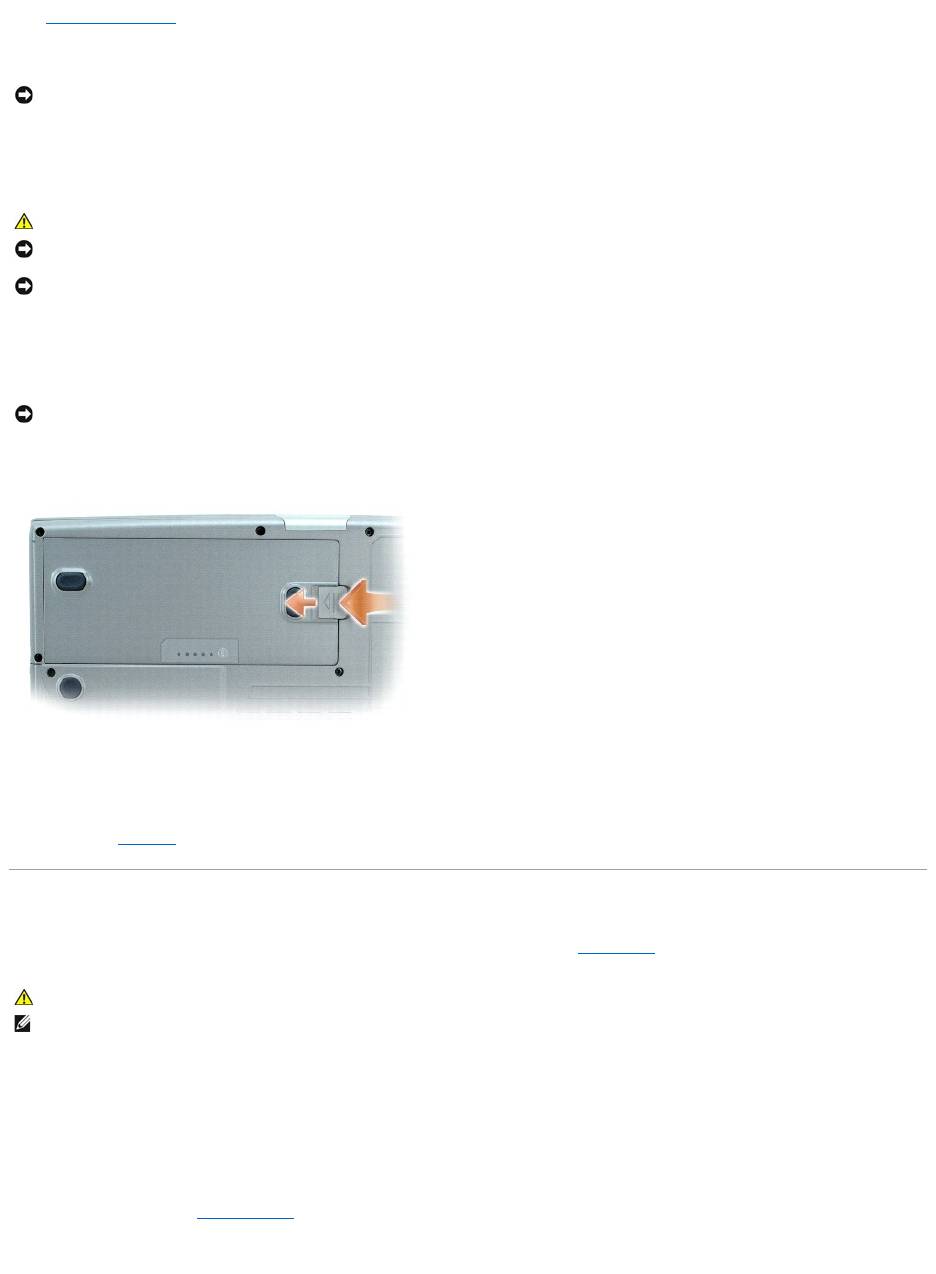
2. Turn off your computer.
3. If the computer is connected to a docking device (docked), undock it. See the documentation that came with your docking device for instructions.
4. Disconnect any telephone or telecommunication lines from the computer.
5. Disconnect your computer and all attached devices from their electrical outlets, and then press the power button to ground the system board.
6. Remove any installed PC Cards from the PC Card slot.
7. Close the display and turn the computer upside down on a flat work surface.
8. Slide and hold the battery-bay latch release on the bottom of the computer, and then remove the battery from the bay.
9. Remove any installed modules, including a second battery, if installed.
10. Remove the hard drive.
Memory
You can increase your computer memory by installing memory modules on the system board. See "Specifications" for information on the memory supported by
your computer. Install only memory modules that are intended for your computer.
The computer has two memory slots, DIMM A and DIMM B. DIMM A (located under the keyboard) holds the basic memory module as configured from the factory.
If you did not order additional memory, DIMM B (located on the bottom of the computer under the options door) will be empty. Generally, if you are adding
memory, you will install a memory module in DIMM B. If you are upgrading memory, you may need to install memory in DIMM A and B depending on the extent
of the upgrade.
Memory Module DIMM B
1. Follow the procedures in "Before You Begin."
2. Turn the computer over, loosen the captive screws from the options door, and then remove the door.
NOTICE: To disconnect a network cable, first unplug the cable from your computer and then unplug it from the network device.
CAUTION: To guard against electrical shock, always unplug your computer from the electrical outlet before opening the cover.
NOTICE: Before touching anything inside your computer, ground yourself by touching an unpainted metal surface, such as the metal at the back of the
computer. While you work, periodically touch an unpainted metal surface to dissipate any static electricity that could harm internal components.
NOTICE: To connect a network cable, first plug the cable into the network device and then plug it into the computer.
NOTICE: To avoid damaging the system board, you must remove the main battery before you service the computer.
CAUTION: Before you begin any of the procedures in this section, follow the safety instructions located in the Product Information Guide.
NOTE: Memory modules purchased from Dell are covered under your computer warranty.
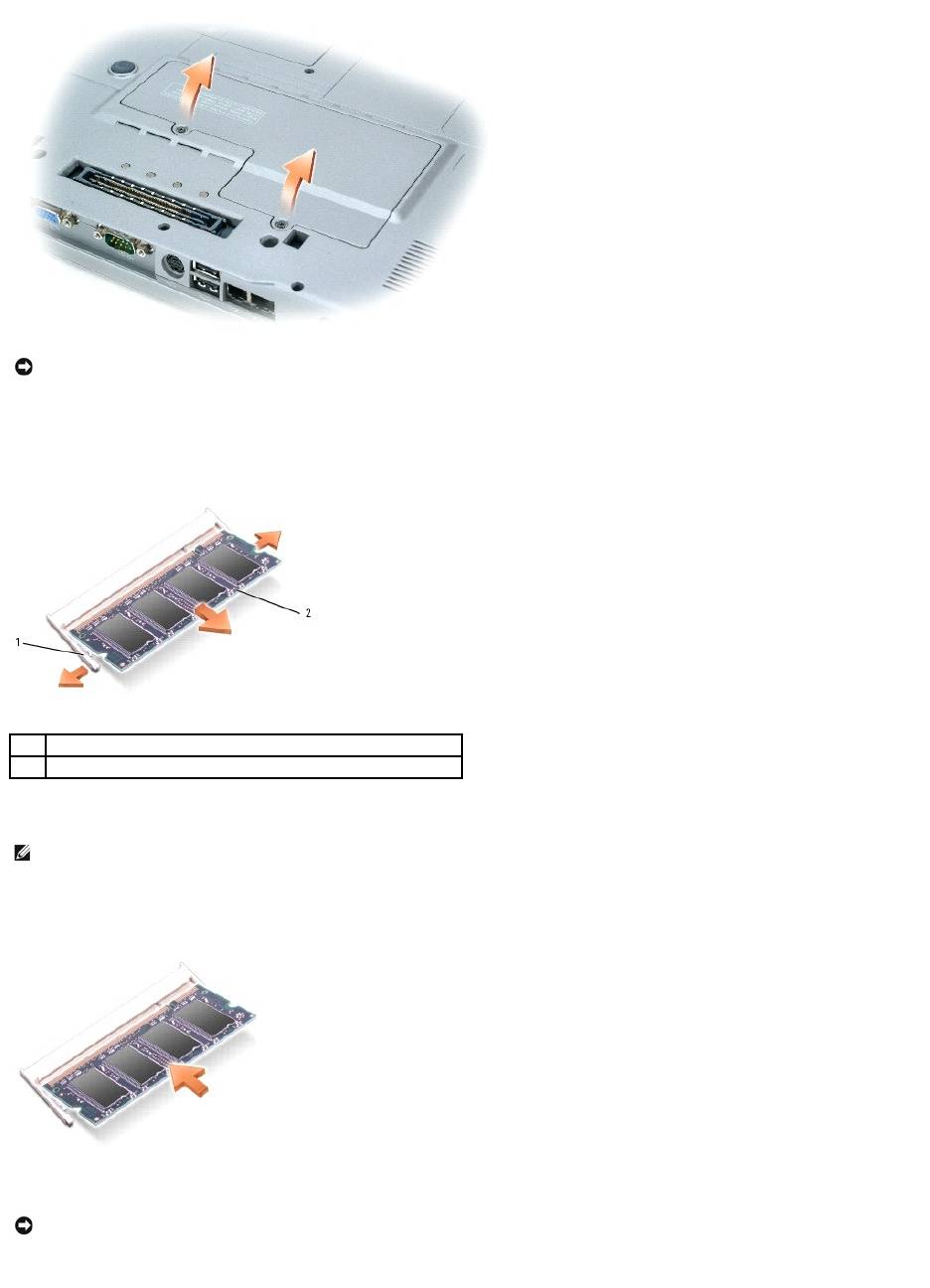
3. If you are replacing a memory module, remove the existing module:
a. Use your fingertips to carefully spread apart the securing clips on each end of the memory module connector until the module pops up.
b. Remove the module from the connector.
4. Ground yourself and install the new memory module:
a. Align the notch in the module edge connector with the tab in the connector slot.
b. Slide the module firmly into the slot at a 45-degree angle, and rotate the module down until it clicks into place. If you do not feel the click, remove
the module and reinstall it
5. Replace the options door.
6. Insert the battery into the battery bay, or connect the AC adapter to your computer and an electrical outlet.
NOTICE: To prevent damage to the memory module connector, do not use tools to spread the memory-module securing clips.
1
securing clips (2 per connector)
2
memory module
NOTE: If the memory module is not installed properly, the computer may not boot properly. No error message indicates this failure.
NOTICE: If the door is difficult to close, remove the module and reinstall it. Forcing the door to close may damage your computer.
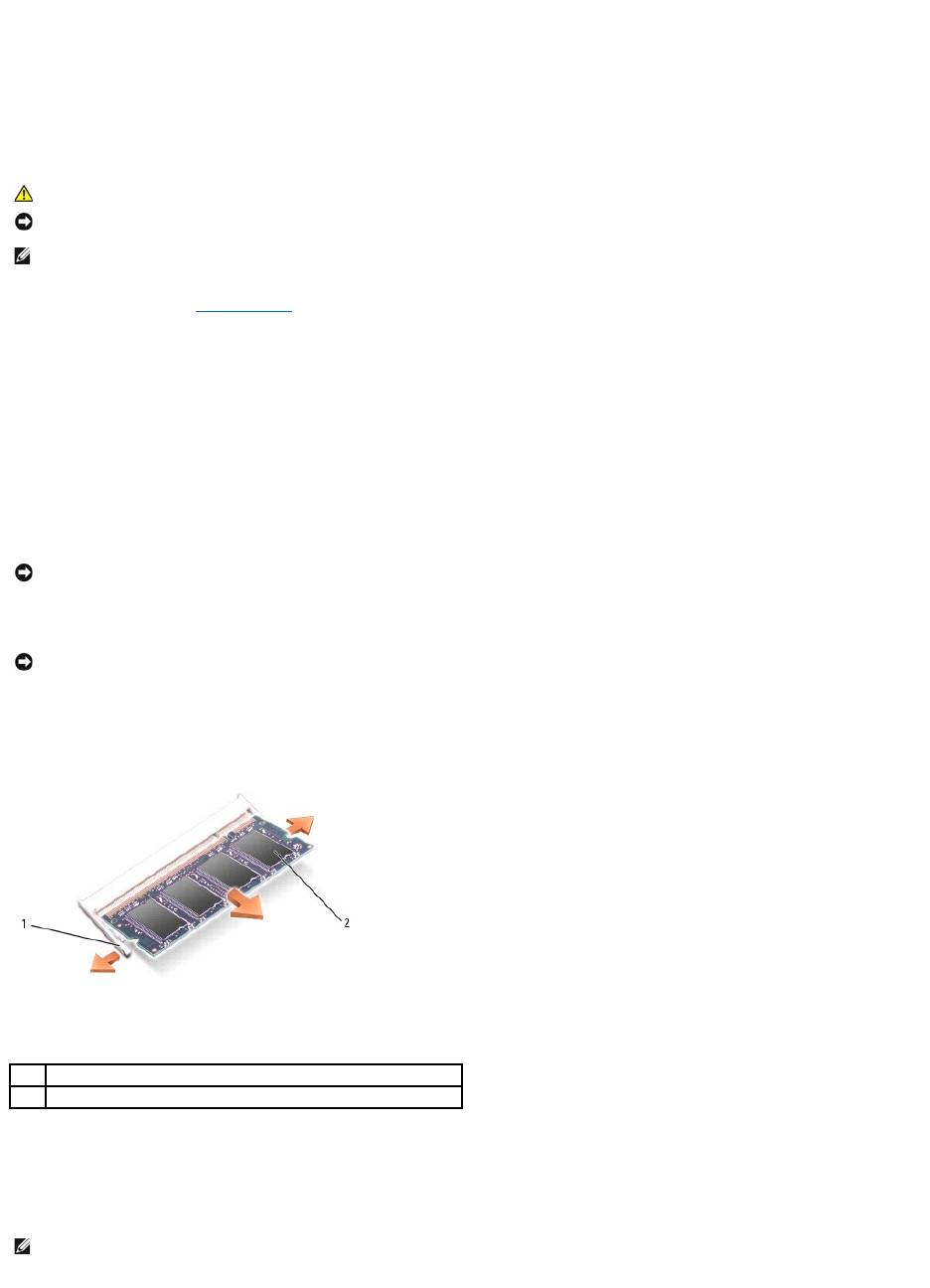
7. Turn on the computer.
As the computer boots, it detects the additional memory and automatically updates the system configuration information.
To confirm the amount of memory installed in the computer, click the Start button, click Help and Support, and then click Computer Information.
Memory Module DIMM A
1. Follow the procedures in "Before You Begin."
2. Remove the central control cover.
a. Open the display all the way (180 degrees) so that it lies flat against your work surface.
b. Starting at the right side of the computer, use a flat-blade screwdriver to pry up the central control cover.
c. Lift the central control cover away from the computer and lay it aside.
3. Remove the keyboard.
a. Remove the two screws across the top of the keyboard
b. Gently lift the keyboard up and out of its tabs to allow access to the keyboard connector.
c. Pull up on the keyboard connector tab to disconnect the keyboard from the system board.
4. If you are replacing a memory module, remove the existing module.
a. Use your fingertips to carefully spread apart the securing clips on each end of the memory module connector until the module pops up.
b. Remove the module from the connector.
5. Ground yourself and install the new memory module:
a. Align the notch in the module with the slot in the center of the connector.
b. Slide the edge of the module firmly into the connector, and rotate the module down until you feel a click. If you do not feel the click, remove the
module and reinstall it.
CAUTION: BeforeworkinginsideyourDell™computer,readthesafetyinstructionsinyourProductInformationGuide.
NOTICE: To prevent static damage to components inside your computer, discharge static electricity from your body before you touch any of your
computer's electronic components. You can do so by touching an unpainted metal surface.
NOTE: Memory modules purchased from Dell are covered under your computer warranty.
NOTICE: To prevent damage to the memory module connector, do not use tools to spread the metal securring clips that secure the memory module.
NOTICE: Handle memory modules by their edges, and do not touch the components on a module.
1
securing clips (2 per connector)
2
memory module
NOTE: If the memory module is not installed properly, the computer does not boot. The Num Lock and Scroll Lock lights blink about ten times.
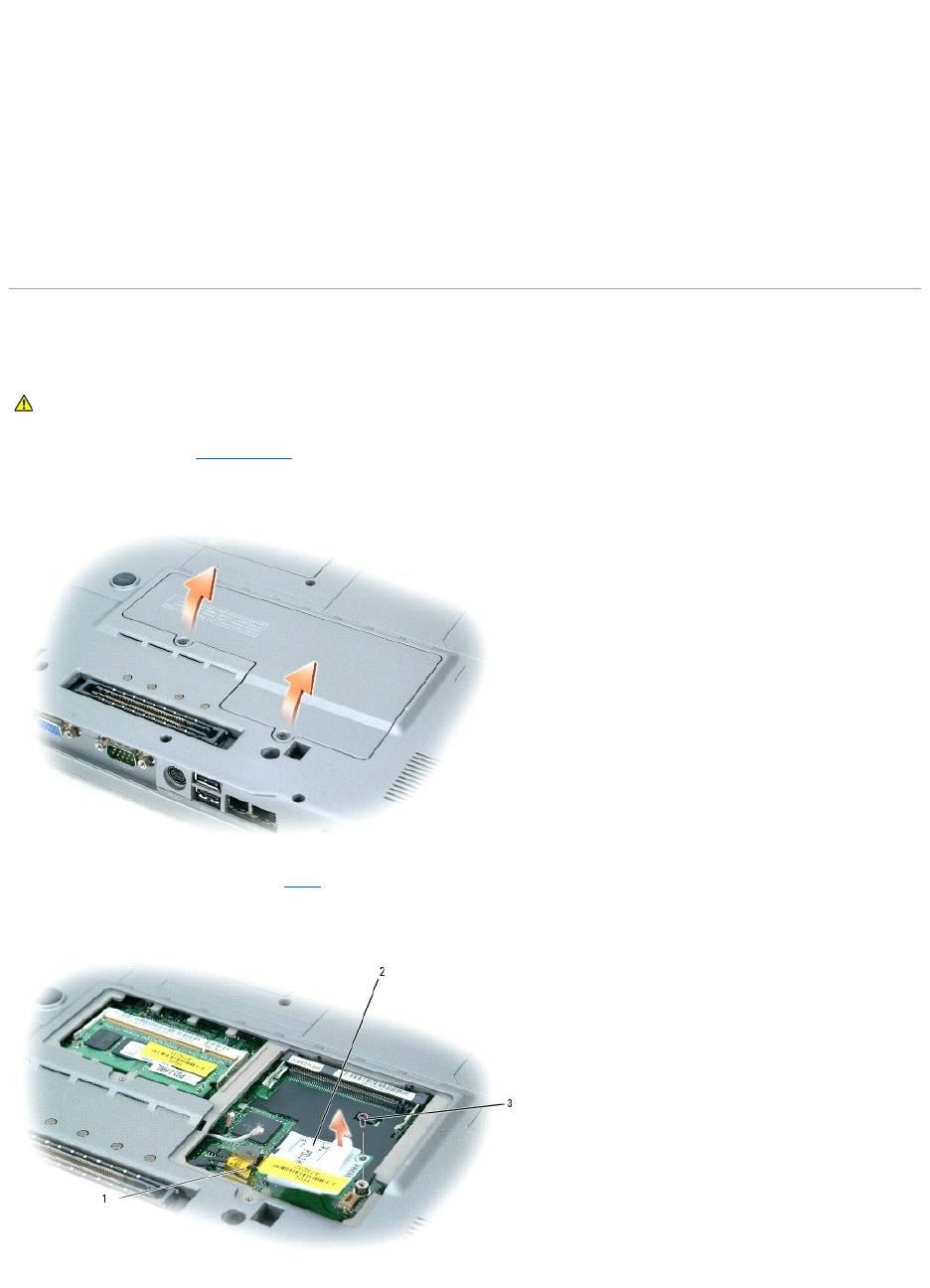
6. Replace the keyboard.
a. Reconnect the keyboard connector to the system board.
b. Slide the tabs at the bottom of the keyboard back into their slots.
c. Reinsert and tighten the two screws across the top of the keyboard.
7. Replace the central control cover. Starting at the left side of the computer, press down on the control cover until you feel it click into place.
8. Insert the battery into the battery bay, or connect the AC adapter to your computer and an electrical outlet.
9. Turn on the computer.
As the computer boots, it detects the additional memory and automatically updates the system configuration information.
To confirm the amount of memory installed in the computer, click the Start button, click Help and Support, and then click Computer Information.
Modem
If you ordered the optional modem at the same time that you ordered your computer, the modem is already installed.
1. Follow the procedures in "Before You Begin."
2. Turn the computer over, loosen the captive screws from the options door, and then remove the door.
3. If a modem is not already installed, go to step 4. If you are replacing a modem, remove the existing modem:
a. Remove the screws securing the modem to the system board, and set them aside.
b. Pull straight up on the attached pull-tab to lift the modem out of its connector on the system board, and disconnect the modem cable.
CAUTION: Before you begin any of the procedures in this section, follow the safety instructions located in the Product Information Guide.
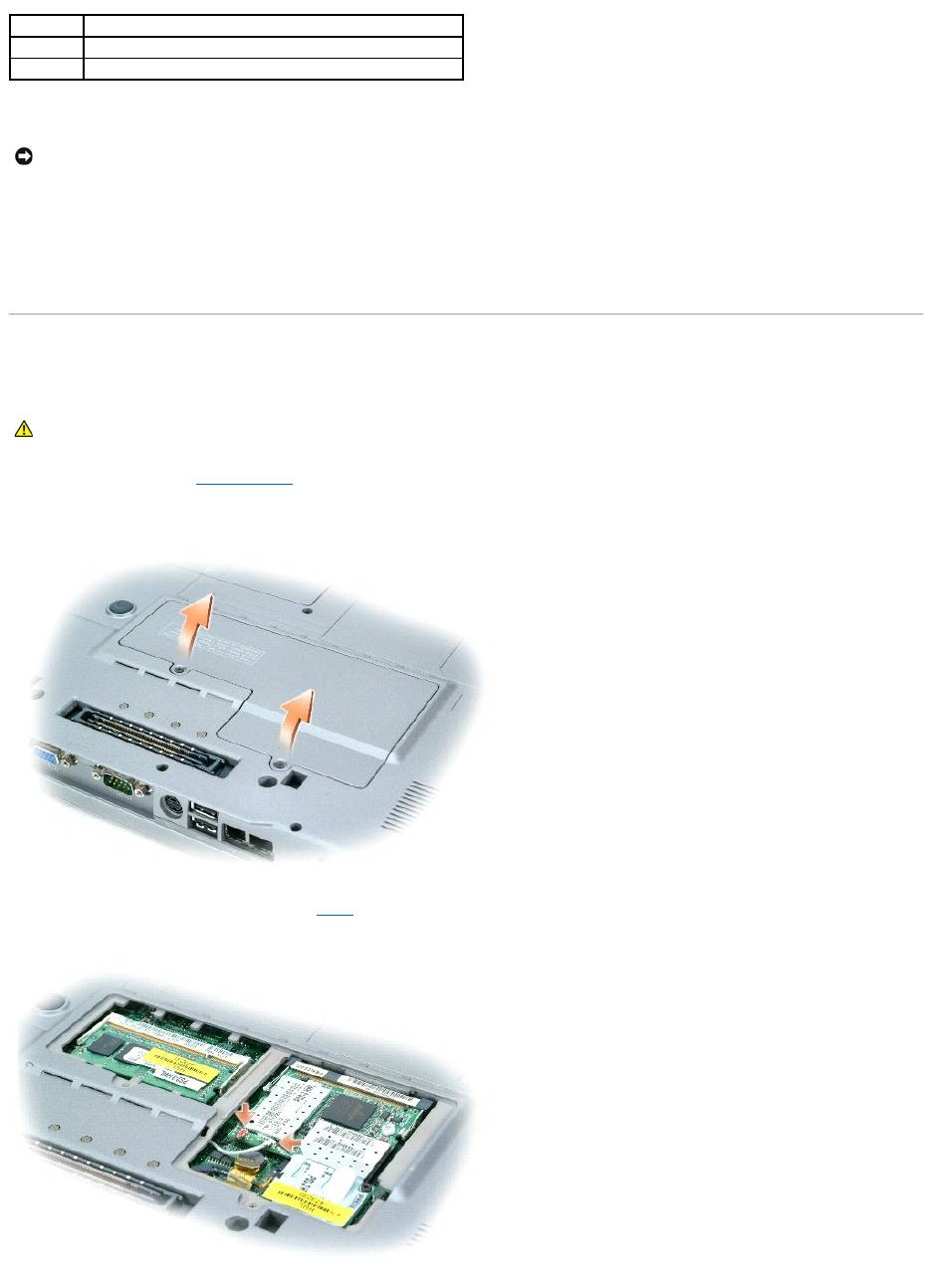
4. Connect the modem cable to the modem.
5. Align the modem with the screw hole and press the modem into the connector on the system board.
6. Install the screw to secure the modem to the system board.
7. Replace the options door.
Mini PCI Card
If you ordered a Mini PCI card with your computer, the card is already installed.
1. Follow the procedures in "Before You Begin."
2. Turn the computer over, loosen the captive screws from the options door, and then remove the door.
3. If a Mini PCI card is not already installed, go to step 4. If you are replacing a Mini PCI card, remove the existing card:
a. Disconnect the Mini PCI card from any attached cables.
1
modem cable
2
modem
3
screw
NOTICE: The connectors are keyed to ensure correct insertion. If you feel resistance, check the connectors and realign the card.
CAUTION: Before you begin any of the procedures in this section, follow the safety instructions located in the Product Information Guide.
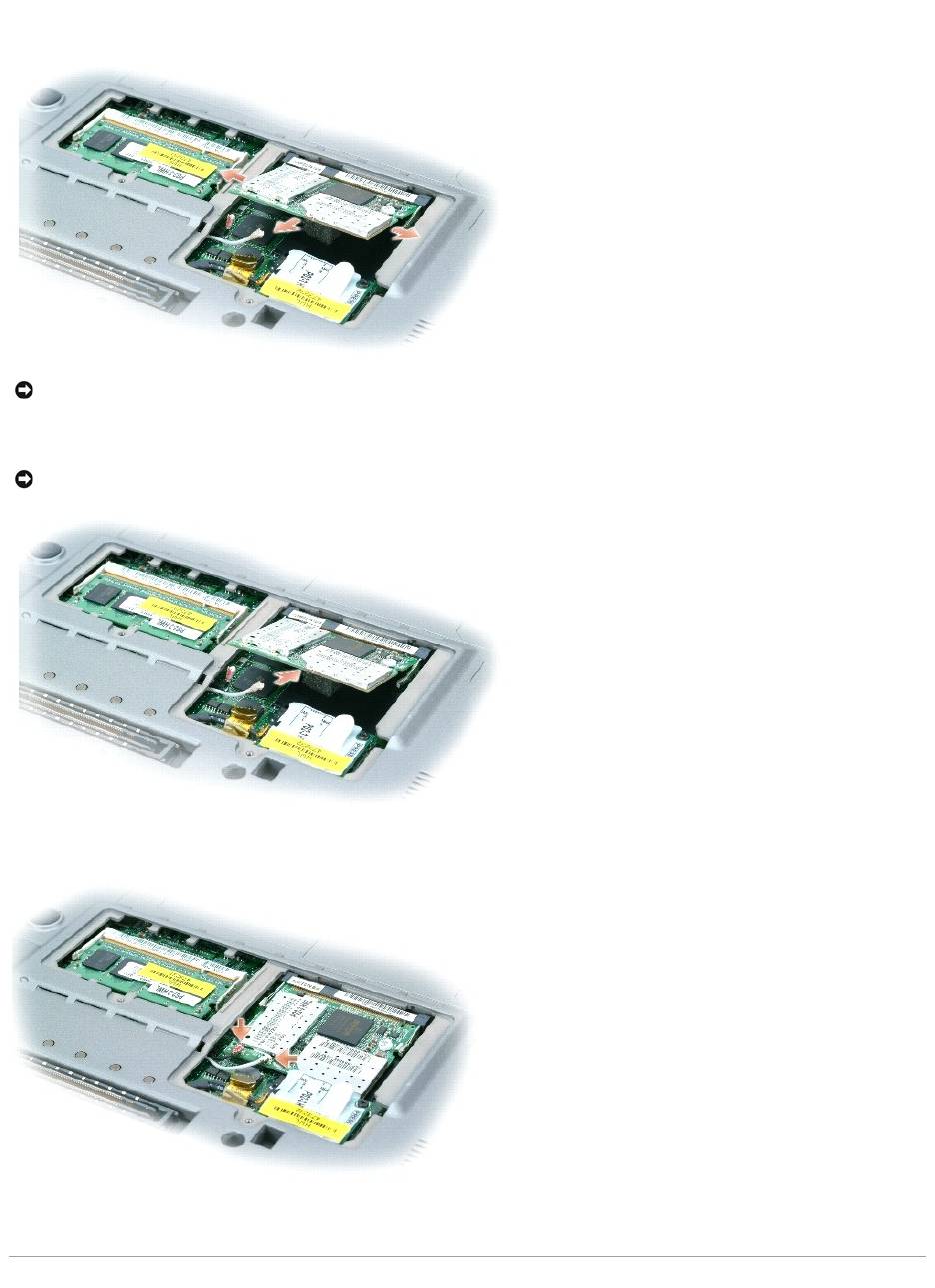
b. Release the Mini PCI card by spreading the metal securing tabs until the card pops up slightly.
c. Lift the Mini PCI card out of its connector.
4. Align the Mini PCI card with the connector at a 45-degree angle, and press the Mini PCI card into the connector until you hear a click.
5. Connect the antenna cables to the Mini PCI card.
6. Replace the door.
NOTICE: The connectors are keyed to ensure correct insertion. If you feel resistance, check the connectors and realign the card.
NOTICE: To avoid damaging the Mini PCI card, never place cables on top of or under the card.
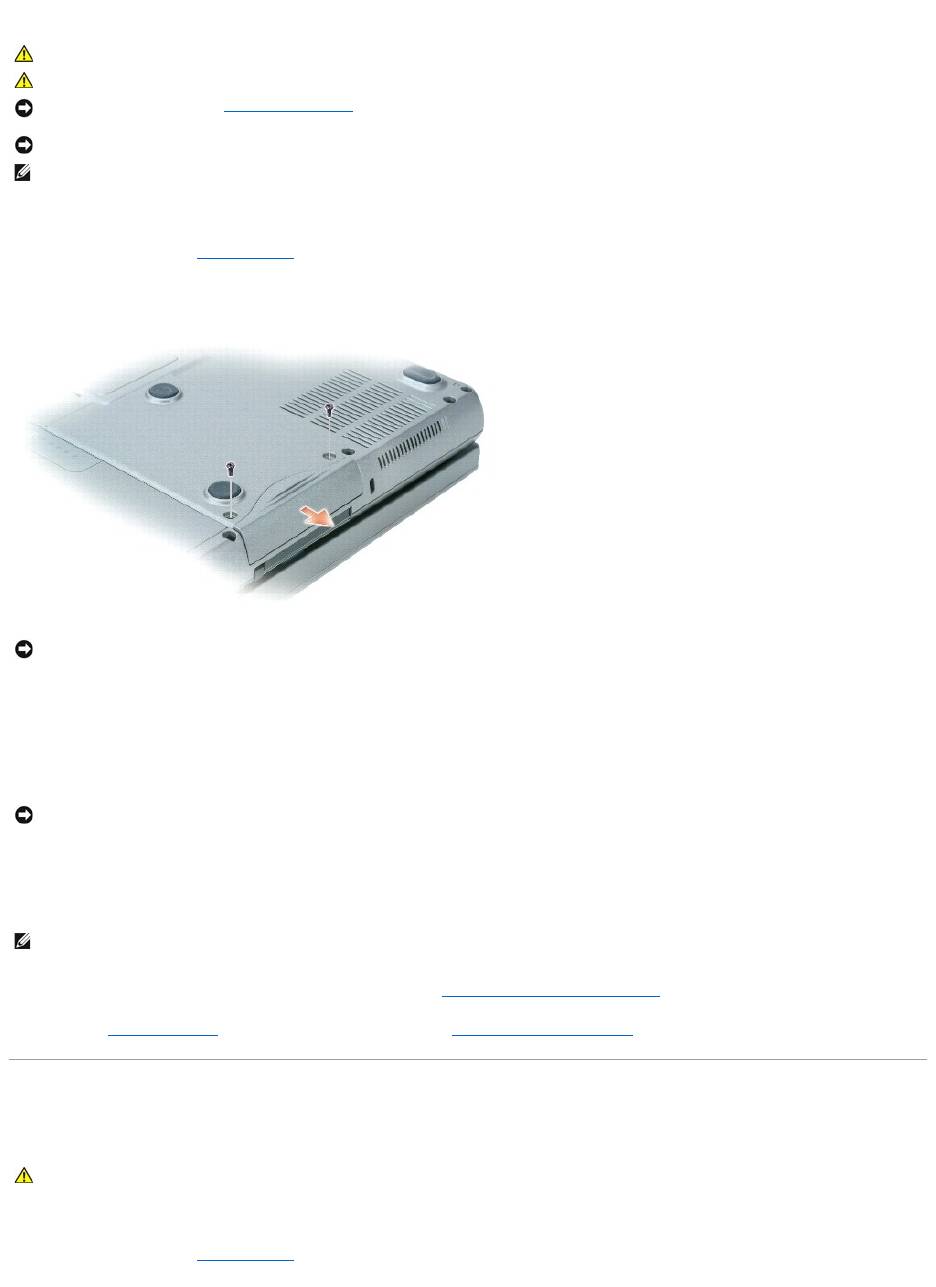
Hard Drive
To replace the hard drive in the hard drive bay:
1. Follow the procedures in "Before You Begin."
2. Turn the computer over, and remove the hard drive screws.
3. Slide the hard drive out of the computer.
4. Remove the new drive from its packaging.
Save the original packaging for storing or shipping the hard drive.
5. Slide the hard drive into the bay until it is fully seated.
6. Replace and tighten the screws.
7. Install the operating system for your computer. For instructions, see Reinstalling Microsoft® Windows® XP.
8. Install the drivers and utilities for your computer. For instructions, see Reinstalling Drivers and Utilities.
Internal Card With Bluetooth®Wireless Technology
If you ordered an internal card with Bluetooth Wireless Technology with your computer, the card is already installed.
To replace the internal wireless card:
1. Follow the procedures in "Before You Begin."
CAUTION: If you remove the hard drive from the computer when the drive is hot, do not touch the metal housing of the hard drive.
CAUTION: Before working inside your computer, follow the safety instructions located in the Product Information Guide.
NOTICE: To prevent data loss, turn off your computer before removing the hard drive. Do not remove the hard drive while the computer is on, in
standby mode, or in hibernate mode.
NOTICE: Hard drives are extremely fragile; even a slight bump can damage the drive.
NOTE: Dell does not guarantee compatibility or provide support for hard drives from sources other than Dell.
NOTICE: When the hard drive is not in the computer, store it in protective antistatic packaging. See "Protecting Against Electrostatic Discharge" in the
Product Information Guide.
NOTICE: Use firm and even pressure to slide the drive into place. If you use excessive force, you may damage the connector.
NOTE: The Operating System CD and the Drivers and Utilities CD are optional and may not ship with all computers.
CAUTION: Before working inside your computer, read the safety instructions in your System Information Guide.
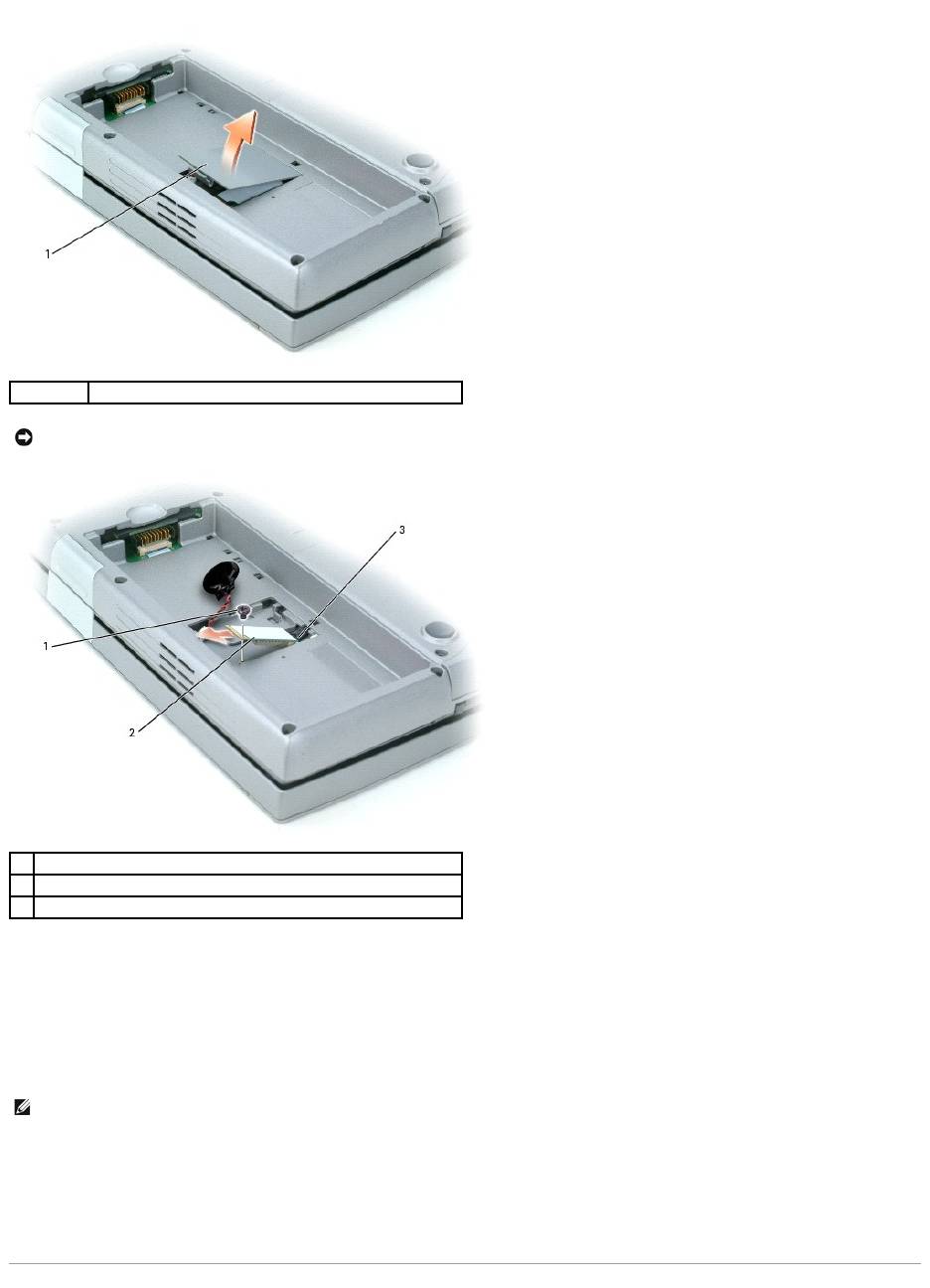
2. Remove the access door beneath the battery.
3. Remove the screw.
4. Pull the card out of the system board connector.
5. Remove the card from the computer and set it aside.
6. Attach the new card to the system board connector.
7. Replace and tighten the screw.
8. Reattach the access door and gently press down on the latch until you feel a click.
9. Reinsert the battery.
1
access door
NOTICE: Handle the card by its edges, and avoid touching pins and contacts. Ground yourself by touching a metal connector on the back of the
computer. Continue to ground yourself periodically during this procedure.
1
screw
2
internal card with Bluetooth wireless technology
3
system board connector
NOTE: The card and system board connector can only connect in one configuration. If you encounter resistance, check the configuration and try again.
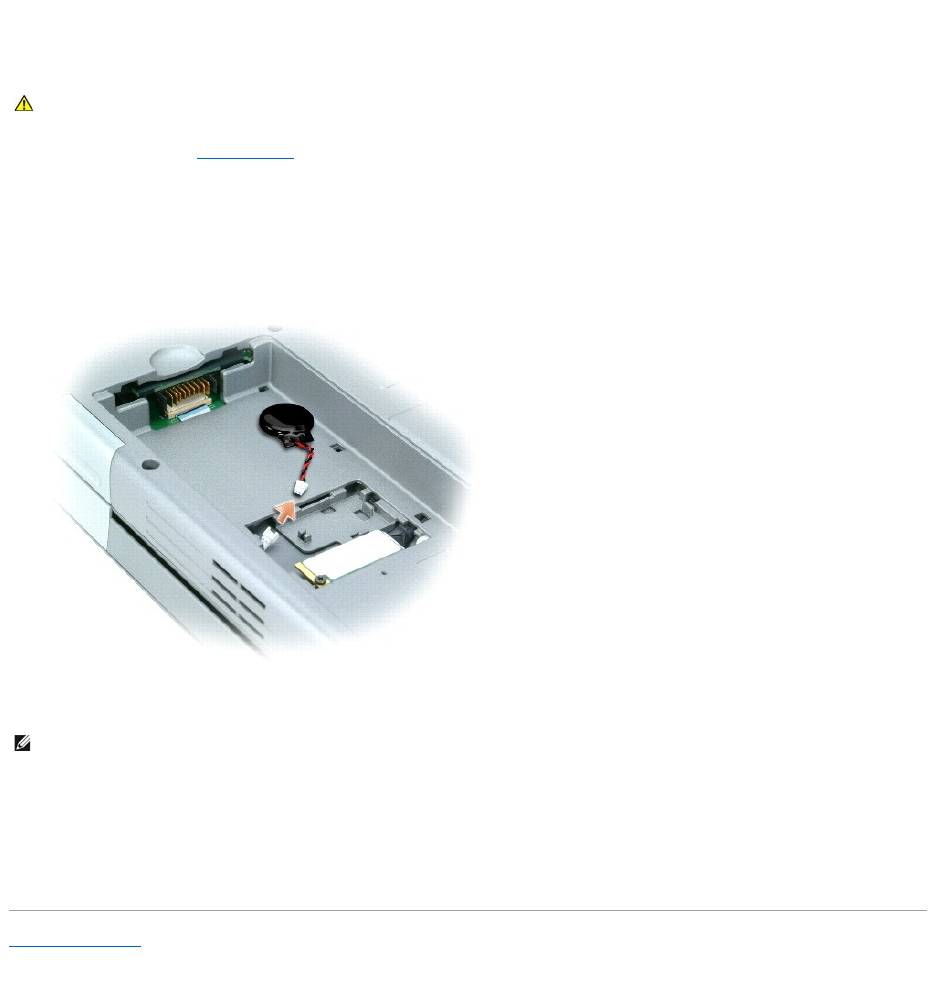
Coin-Cell Battery
Your computer uses a coin-cell battery to maintain the date and time even while the computer is off. However, after several years, this battery may lose its
charge.
1. Follow the procedures in "Before You Begin."
2. Remove the access door beneath the battery.
3. Slide the coin-cell battery out of the tabs that hold it in place.
4. Grasp the coin-cell battery connector cable and disconnect it from the coin-cell battery socket.
5. Connect the new coin-cell battery to the socket.
6. Slide the coin-cell battery under the tabs that hold it in place.
7. Reattach the access door and gently press down on the latch until you feel a click.
8. Reinsert the battery.
Back to Contents Page
CAUTION: Before working inside your computer, read the safety instructions in your System Information Guide.
NOTE: The coin-cell battery connector and socket can only connect in one configuration. If you encounter resistance, check the configuration and try
again.

Back to Contents Page
Using the System Setup Program
DellPrecision™MobileWorkstationM70User'sGuide
Overview
Viewing the System Setup Screens
System Setup Screen
Commonly Used Options
Overview
You can use system setup as follows:
l To set or change user-selectable features—for example, your computer password
l To verify information about the computer's current configuration, such as the amount of system memory
After you set up the computer, run system setup to familiarize yourself with your system configuration information and optional settings. You may want to
write down the information for future reference.
The system setup screens display the current setup information and settings for your computer, such as:
l System configuration
l Boot sequence
l Boot (start-up) configuration and docking-device configuration settings
l Basic device-configuration settings
l System security and hard-drive password settings
Viewing the System Setup Screens
1. Turn on (or restart) your computer.
2. WhentheDELL™logoappears,press<F2>immediately.IfyouwaittoolongandtheWindowslogoappears,continuetowaituntilyouseethe
Windows desktop. Then shut down your computer and try again.
3. Press the down-arrow key to position the cursor on the BIOS Setup option.
4. Press <Enter> to select Setup.
System Setup Screen
The System Setup screen consists of three panes. The left pane contains a menu of control categories. To show or hide subcategories, select a category (such
as System, Onboard Devices, or Video) and press the <Enter> key. The right pane displays information about the category or subcategory.
The bottom pane describes how to control system setup with key functions. Use the keys to select a category, modify settings, or exit system setup.
Commonly Used Options
Certain options require that you reboot the computer for new settings to take effect.
Changing the Boot Sequence
The boot sequence, or boot order, tells the computer where to look to find the software needed to start the operating system. You can control the boot
sequence and enable/disable devices using the Boot Sequence page of system setup.
NOTE: Your operating system may automatically configure most of the options available in system setup, thus overriding options that you set through
system setup. (An exception is the External Hot Key option, which you can disable or enable only through system setup.) For more information on
configuring features for your operating system, see the Windows Help and Support Center (Windows XP).
NOTICE: Unless you are an expert computer user or are directed to do so by Dell technical support, do not change the system setup settings. Certain
changes might make your computer work incorrectly.

The Boot Sequence page displays a general list of the bootable devices that may be installed in your computer, including but not limited to the following:
l Diskette Drive
l Internal HDD
l USB Storage Device
l CD/DVD/CD-RW drive
l Modular bay HDD
During the boot routine, the computer starts at the top of the list and scans each enabled device for the operating system start-up files. When the computer
finds the files, it stops searching and starts the operating system.
To control the boot devices, select (highlight) a device by pressing the down-arrow or up-arrow key, and then enable or disable the device or change its order
in the list.
l To enable or disable a device, highlight the item and press the space bar. Enabled items are preceded by a number; disabled items are not preceded by
a number.
l To reorder a device in the list, highlight the device and then press <u> to move the highlighted device up, or <d> (not case-sensitive) to move the
highlighted device down.
Boot sequence changes take effect as soon as you save the changes and exit system setup.
Performing a One-Time Boot
You can set a one-time-only boot sequence without entering system setup. (You can also use this procedure to boot the Dell Diagnostics on the diagnostics
utility partition on your hard drive.)
1. Shut down the computer through the Start menu.
2. If the computer is connected to a docking device (docked), undock it. See the documentation that came with your docking device for instructions.
3. Connect the computer to an electrical outlet.
4. Turn on the computer. When the DELL logo appears, press <F12> immediately. If you wait too long and the Windows logo appears, continue to wait
until you see the Windows desktop. Then shut down your computer and try again.
5. When the boot device list appears, highlight the device from which you want to boot and press <Enter>.
The computer boots to the selected device.
The next time you reboot the computer, the previous boot order is restored.
Changing COM Ports
Serial Port (a subcategory of Onboard Devices) allows you to map the serial port COM address or disable the serial port and its address, which frees
computer resources for another device to use.
Enabling the Infrared Sensor
1. Under the Onboard Devices category, press <Enter> to select the Fast IR setting, and press the right-arrow or left arrow key to change the setting to
a COM port.
2. Press <Enter> and then <Esc> to save the changes and exit the system setup program.
After you enable the infrared sensor, you can use it to establish a link to an infrared device. To set up and use an infrared device, see the infrared device
documentation and the Windows Help and Support Center.
Back to Contents Page
NOTE: To change the boot sequence on a one-time-only basis, see "Performing a One-Time Boot."
NOTE: Only devices that are preceded by a number are bootable.
NOTE: The default setting is Off.
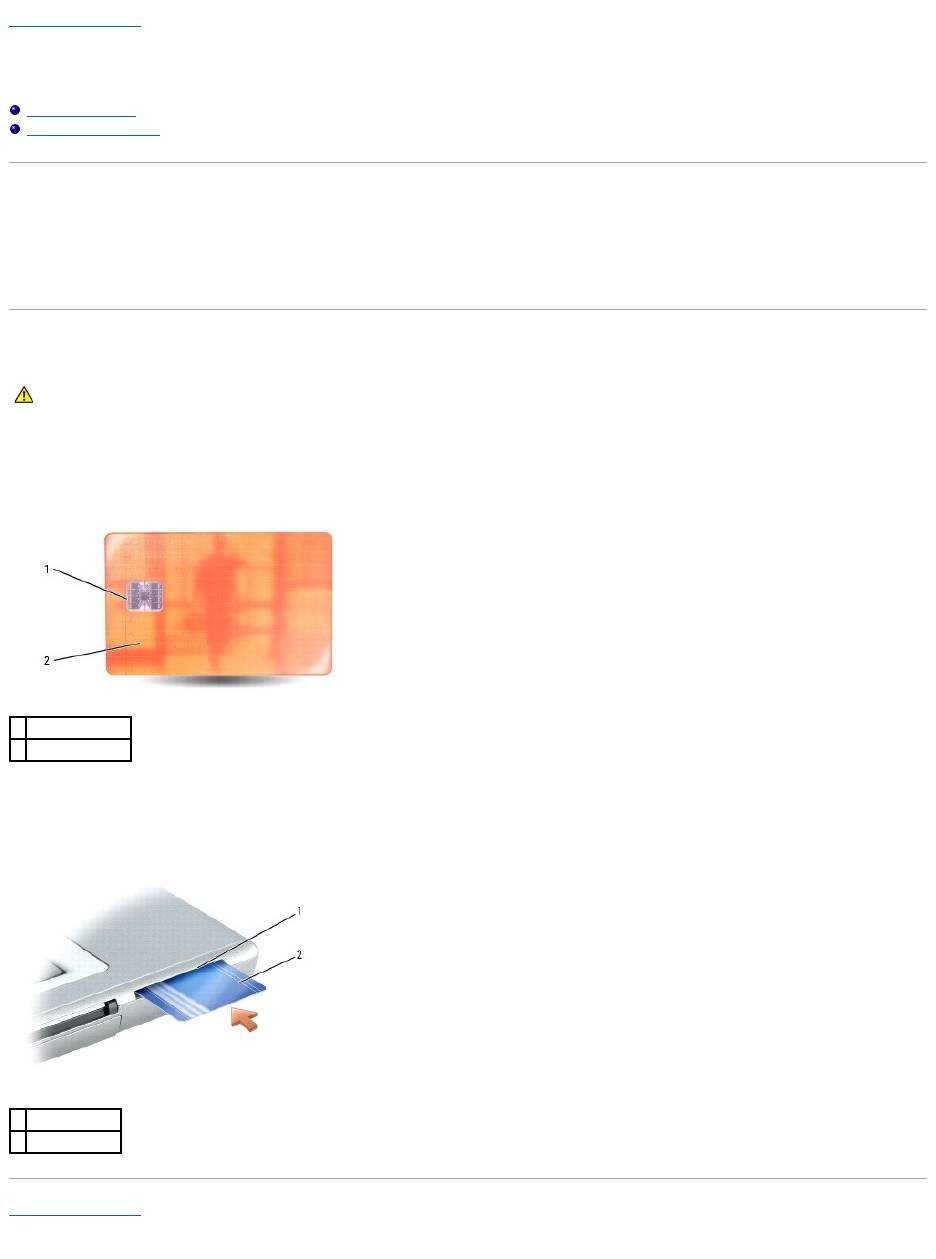
Back to Contents Page
Using Smart Cards
DellPrecision™MobileWorkstationM70User'sGuide
About Smart Cards
Installing a Smart Card
About Smart Cards
Smart cards are portable credit-card shaped devices with internal integrated circuits. The top surface of the smart card usually contains an embedded
processor located under the gold contact pad. The combination of the small size and integrated circuits make smart cards valuable tools for security, data
storage, and special programs. Using smart cards can improve system security by combining something a user has (the smart card) with something only the
user should know (a PIN) to provide more secure user-authentication than passwords alone.
Installing a Smart Card
You can install a smart card in the computer while the computer is running. The computer automatically detects the card.
To install a smart card:
1. Hold the card so that the gold contact pad is facing upward and pointing toward the smart card slot.
2. Slide the smart card into the smart card slot until the card is completely seated in its connector. The smart card will protrude approximately 1.27 cm (1/2
inch) from the slot. The smart card slot is located beside the PC Card slot.
If you encounter too much resistance, do not force the card. Check the card orientation and try again.
Back to Contents Page
CAUTION: Before you begin any of the procedures in this section, follow the safety instructions located in the Product Information Guide.
1
gold contact pad
2
smart card (top)
1
smart card slot
2
smart card
Back to Contents Page
Specifications
DellPrecision™MobileWorkstationM70User'sGuide
Processor
Processor type
Intel®Pentium®M
L1 cache
64 KB (internal)
L2 cache
2 MB (on die)
External bus frequency
533 MHz
SystemInformation
System chipset
Intel 915PM
Data bus width
64 bits
DRAM bus width
64 bits
Processor address bus width
36 bits
PCCard
CardBus controller
TI 6515 CardBus controller
PC Card connector
one (supports one Type I or Type II card)
Cards supported
3.3 V and 5 V
PC Card connector size
80 pins
Data width (maximum)
PCMCIA 16 bits
CardBus 32 bits
SmartCard
Read/write capabilities
reads and writes to all ISO 7816 1/2/3/4
microprocessor cards (T=0, T=1)
Cards supported
3V and 5V
Program technology supported
Java cards
Interface speed
9600–115,200 BPS
EMV level
level 1 certified
WHQL certification
PC/SC
Compatibility
compatible within a PKI environment
Insert/eject cycles
certified for up to 100,000 cycles
Memory
Memory module connector
two user-accessible SODIMM sockets
Memory module capacities
256, 512, and 1024 MB
Memory type
533 DDRII SDRAM
Minimum memory
256 MB
Maximum memory
2 GB
PortsandConnectors
Serial
9-pin connector; 16550C-compatible,
16-byte buffer connector
Video
15-hole connector
Audio
microphone miniconnector, stereo
headphones/speakers miniconnector
USB
four 4-pin USB 2.0-compliant connectors
Infrared sensor
sensor compatible with IrDA Standard 1.1 (Fast IR)
and IrDA Standard 1.0 (Slow IR)
S-video TV-out
7-pin mini-DIN connector for S-video composite video,

and S/PDIF (TV/digital audio-adapter cable supports
composite video and S/PDIF)
Mini PCI
Type IIIA Mini PCI card slot
Modem
RJ-11 support
Network adapter
RJ-45 port
Communications
Modem:
Type
v.92 56K MDC
Controller
softmodem
Interface
internal AC'97 bus
Network adapter
1 Gb Ethernet LAN on system board
Wireless
internal Mini PCI Wi-Fi and Bluetooth®wireless
technology support
Video
Video type
128-bit hardware accelerated
Data bus
PCI Express
Video controller
NVIDIA Quadro FX Go1400 256 MB
Video memory
256 MB
LCD interface
LVDS
TV support
NTSC or PAL in S-video and composite modes
Audio
Audio type
AC'97 (Soft Audio)
Audio controller
SigmaTel STAC9751
Stereo conversion
20-bit (stereo digital-to-analog),
18-bit (stereo analog-to-digital)
Interfaces:
Internal
PCI bus/AC'97
External
microphone miniconnector, stereo
headphones/speakers miniconnector
Speaker
two 4-ohm speakers
Internal speaker amplifier
2-W channel into 4 ohms
Volume controls
keyboard shortcuts or program menus
Display
Type (active-matrix TFT)
WXGA, WSXGA+, or WUXGA
Dimensions:
Height
222.5 mm max (8.7 inches)
Width
344.5 mm (13.56 inches)
Diagonal
391.16 mm (15.4 inches)
Resolutions:
WXGA
1280 x 800 max resolution
WSXGA+
1680 x 1050 max resolution
WUXGA
1920 x 1200 max resolution
Refresh rate
60 Hz
Operating angle
0º (closed)to180°
Viewing angles:
WXGA Horizontal
40/40°
WXGA Vertical
10/30°
WSXGA+ Horizontal
65/65°
WSXGA+ Vertical
50/50°
WUXGA Horizontal
65/65°
WUXGA Vertical
50/50°
Pixel pitch:
WXGA
0.2588 (15.4 inch)
WSXGA+
0.1971 (15.4 inch)
WUXGA
0.1725 (15.4 inch)
Power Consumption (panel with backlight) (typical):
WXGA
5.0 W (max.)
WSXGA+
5.5 W (max.)
WUXGA
6.0 W (max.)
Controls
brightness can be controlled through keyboard
shortcuts
Keyboard
Number of keys
87 (U.S. and Canada); 88 (Europe); 91 (Japan)
Key travel
2.7 mm ± 0.3 mm (0.11 inch ± 0.016 inch)
Key spacing
19.05 mm ± 0.3 mm (0.75 inch ± 0.012 inch)
Layout
QWERTY/AZERTY/Kanji
TouchPad
X/Ypositionresolution(graphicstablemode)
240 cpi
Size:
Width
64.88-mm (2.55-inch) sensor-active area
Height
48.88-mm (1.92-inch) rectangle
TrackStick
X/Ypositionresolution(graphicstablemode)
250 count/sec @ 100 gf
Size
protrudes 0.5 mm higher than surrounding keycaps
Battery
Type
80 WHr
Dimensions:
Depth
77.2 mm (3.08 inches)
Height
20.0 mm (0.80 inch)
Width
187.03 mm (7.48 inches)
Weight
0.485kg(1.07lb)typical
Voltage
14.8 VDC
Charge time (approximate):
approximately 1 hour to reach 80 percent charge
Operating time
varies depending on operating conditions and can be
significantly reduced under certain power-intensive
conditions.
See "Battery Performance" for more information.
Life span (approximate)
500 discharge/charge cycles
Temperature range:
Operating
0° to35°C(32°to95°F)
Storage
–40° to65°C(–40°to149°F)
ACAdapter
Input voltage
100–240 VAC
Input current (maximum)
1.5 A
Input frequency
50–60 Hz
Output current
4.62 A
Output power
90 W
Rated output voltage
19.5 VDC
Dimensions:
Back to Contents Page
Height
27.94 mm (1.1 inches)
Width
58.42 mm (2.3 inches)
Depth
133.85 mm (5.25 inches)
Weight (with cables)
0.4 kg (0.9 lb)
Temperature range:
Operating
0°to35°C(32°to95°F)
Storage
–40°to65°C(–40°to149°F)
Physical
Height
42.4 mm (1.67 inches)
Width
361.2 mm (14.2 inches)
Depth
260.4 mm (10.3 inches)
Weight:
With travel module and 80 WHr battery
3.035 kg (6.69 lb) typical
With CD drive and 80 WHr battery
3.230 kg (7.12 lb) typical
Environmental
Temperature range:
Operating
0° to35°C(32°to95°F)
Storage
–40° to65°C(–40°to149°F)
Relative humidity (maximum):
Operating
10% to 90% (noncondensing)
Storage
5% to 95% (noncondensing)
Maximum vibration (using a random-vibration
spectrum that simulates user environment):
Operating
0.66 GRMS
Storage
1.30 GRMS
Maximum shock (measured with hard drive in head-
parked position and a 2-ms half-sine pulse):
Operating
122 G
Storage
163 G
Altitude (maximum):
Operating
–15.2 to 3048 m (–50 to 10,000 ft)
Storage
–15.2 to 10,668 m (–50 to 35,000 ft)

Back to Contents Page
DellPrecision™
Mobile Workstation M70 User's Guide
Click the links to the left for information on the features and operation of your computer. For information on other documentation included with your computer,
see "Finding Information."
For a complete list of abbreviations and acronyms, see the "Glossary."
Information in this document is subject to change without notice.
©2005DellInc.Allrightsreserved.
Reproduction in any manner whatsoever without the written permission of Dell Inc. is strictly forbidden.
Trademarks used in this text: Dell, the DELL logo, DellNet, Dimension, Dell TravelLite, Inspiron, Latitude, OptiPlex, PowerApp, PowerEdge, PowerConnect, PowerVault, Dell Precision, and
Undock & Go are trademarks of Dell Inc.; Intel, Pentium, and SpeedStep are registered trademarks of Intel Corporation; Microsoft, Windows, and Outlook are registered trademarks of
Microsoft Corporation; Bluetooth is a registered trademark of Bluetooth SIG, Inc. and is used by Dell Inc. under license.; ENERGY STAR is a registered trademark of the U.S
Environmental Protection Agency. As an ENERGY STAR Partner, Dell Inc. has determined that this product meets the ENERGY STAR guidelines for energy efficiency.
Other trademarks and trade names may be used in this document to refer to either the entities claiming the marks and names or their products. Dell Inc. disclaims any
proprietary interest in trademarks and trade names other than its own.
Model PP15L
March2005P/ND5983Rev.A01
Back to Contents Page
NOTE: A NOTE indicates important information that helps you make better use of your computer.
NOTICE: A NOTICE indicates either potential damage to hardware or loss of data and tells you how to avoid the problem.
CAUTION: A CAUTION indicates a potential for property damage, personal injury, or death.
NOTE: Some features or services may not be available for your computer or in certain countries.

Back to Contents Page
Traveling With Your Computer
DellPrecision™MobileWorkstationM70User'sGuide
Identifying Your Computer
Packing the Computer
Travel Tips
Identifying Your Computer
l Attach a name tag or business card to the computer.
l Write down your Service Tag and store it in a safe place away from the computer or carrying case. Use the Service Tag if you need to report a loss or
theft to law enforcement officials and to Dell.
l Create a file on the Microsoft® Windows® desktop called if_found. Place information such as your name, address, and telephone number in this file.
l Contact your credit card company and ask if it offers coded identification tags.
Packing the Computer
l Remove any external devices attached to the computer and store them in a safe place. Remove any cables attached to installed PC Cards, and remove
any extended PC Cards.
l Tomakethecomputeraslightaspossible,replaceanydevicesinstalledinthemodulebaywiththeDellTravelLite™module.
l Fully charge the main battery and any spare batteries you plan to carry with you.
l Shut down the computer.
l Disconnect the AC adapter.
l Remove any extraneous items, such as paper clips, pens, and paper, from the keyboard and palm rest and close the display.
l UsetheoptionalDell™carryingcasetopackthecomputeranditsaccessoriestogethersafely.
l Avoid packing the computer with items such as shaving cream, colognes, perfumes, or food.
l Protect the computer, the batteries, and the hard drive from hazards such as extreme temperatures and overexposure to sunlight, dirt, dust, or liquids.
l Pack the computer so that it does not slide around in the trunk of your car or in an overhead storage compartment.
Travel Tips
l Consider disabling wireless activity on your computer to maximize battery operating time. To disable wireless activity, press <Fn> <F2>.
l Consider changing your power management options to maximize battery operating time.
l If you are traveling internationally, carry proof of ownership—or of your right to use the computer if it is company-owned—to speed your passage
through customs. Investigate the customs regulations of the countries you plan to visit, and consider acquiring an international carnet (also known as a
merchandise passport) from your government.
l Ensure that you know which electrical outlets are used in the countries you will visit, and have appropriate power adapters.
l Check with your credit card company for information about the kinds of emergency travel assistance it offers to users of portable computers.
Traveling by Air
l Ensure that you have a charged battery available in case you are asked to turn on the computer.
NOTICE: When the display is closed, extraneous items on the keyboard or palm rest could damage the display.
NOTICE: If the computer has been exposed to extreme temperatures, allow it to acclimate to room temperature for 1 hour before turning it on.
NOTICE: Do not check the computer as baggage.
NOTICE: If you choose to pack the computer after undocking it, ensure that the computer has been shut down or put into Standby Mode. Failure to do
so could cause the battery to wear down quickly or cause the computer to overheat.
NOTICE: Do not move the computer while using the optical drive. Doing so can result in loss of data.

l Before you use the computer on an airplane, verify that such usage is permitted. Some airlines forbid the use of electronic devices during the flight. All
airlines forbid the use of electronic devices during takeoff and landing.
If Your Computer Is Lost or Stolen
l Call a law enforcement agency to report the lost or stolen computer. Include the Service Tag in your description of the computer. Ask that a case
number be assigned and write down the number, along with the name, address, and telephone number of the law enforcement agency. If possible,
obtain the name of the investigating officer.
l If the computer belongs to a company, notify the security office of the company.
l Contact Dell customer service to report the missing computer. Provide the computer Service Tag, the case number, and the name, address, and
telephone number of the law enforcement agency to which you reported the missing computer. If possible, give the name of the investigating officer.
The Dell customer service representative will log your report under the computer Service Tag and flag the computer as missing or stolen. If someone calls Dell
for technical assistance and gives your Service Tag, the computer is identified automatically as missing or stolen. The representative will attempt to get the
phone number and address of the caller. Dell will then contact the law enforcement agency to which you made the report of the missing computer.
Back to Contents Page
NOTICE: Do not walk the computer through a metal detector. Send the computer through an X-ray machine or have it hand inspected.
NOTE: If you know where the computer was lost or stolen, call a law enforcement agency in that area. If you do not know, call a law enforcement
agency where you live.
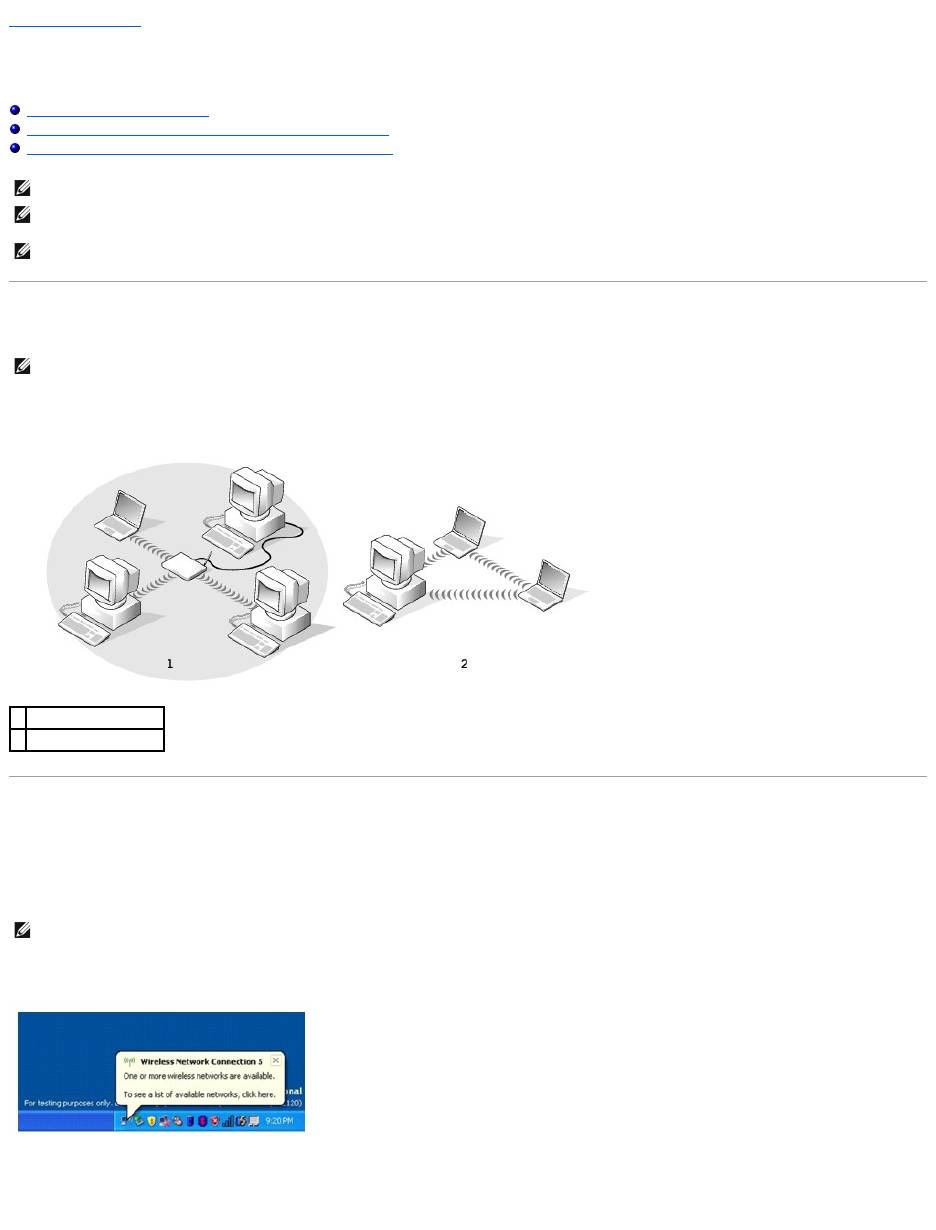
Back to Contents Page
Connecting to a Wireless Local Area Network
DellPrecision™MobileWorkstationM70User'sGuide
Determining Your Network Type
Connecting to a Wireless Network in Microsoft®Windows®XP
Finalizing Your Wireless Network Connection (Security Settings)
Determining Your Network Type
Wireless networks fall into two categories—infrastructure networks and ad-hoc networks. An infrastructure network uses routers or access points to connect
several computers. An ad-hoc network does not use routers or access points and consists of computers that broadcast to one another. For additional
assistance with setting up your wireless connection, go to support.dell.com and search for the keyword wireless setup.
Connecting to a Wireless Network in Microsoft®Windows®XP
Your wireless network card requires specific software and drivers in order to connect to a network. The software is already installed. If the software is
removed or corrupted, follow the instructions included in the user's guide for your wireless network card. The user's guide is located on your Drivers and
Utilities CD (that may have come with your computer) in the "User's Guides-Network User's Guides" category. The user's guide is also available on your
system's hard drive and on the Dell Support website at support.dell.com.
When you turn on your computer, a pop-up appears from the network icon in the notification area whenever a network is detected in the area for which your
computer is not configured.
1. Click either the pop-up or the network icon to configure your computer for one of the available wireless networks.
The Wireless Network Connections window lists the wireless networks available in your area.
NOTE: These networking instructions do not apply to Bluetooth®wireless technology or cellular products.
NOTE: To configure a wireless computer running the Windows 2000 operating system, see the user's guide that came with your wireless network
adapter.
NOTE: Your Dell QuickSet power management software can disable your wireless card. If your wireless card is not working, check your QuickSet help by
clicking on the QuickSet desktray icon, then clicking on Help.
NOTE: Most wireless networks are of the infrastructure type.
1
infrastructure network
2
ad-hoc network
NOTE: The Drivers and Utilities CD is optional and may not ship with all computers.
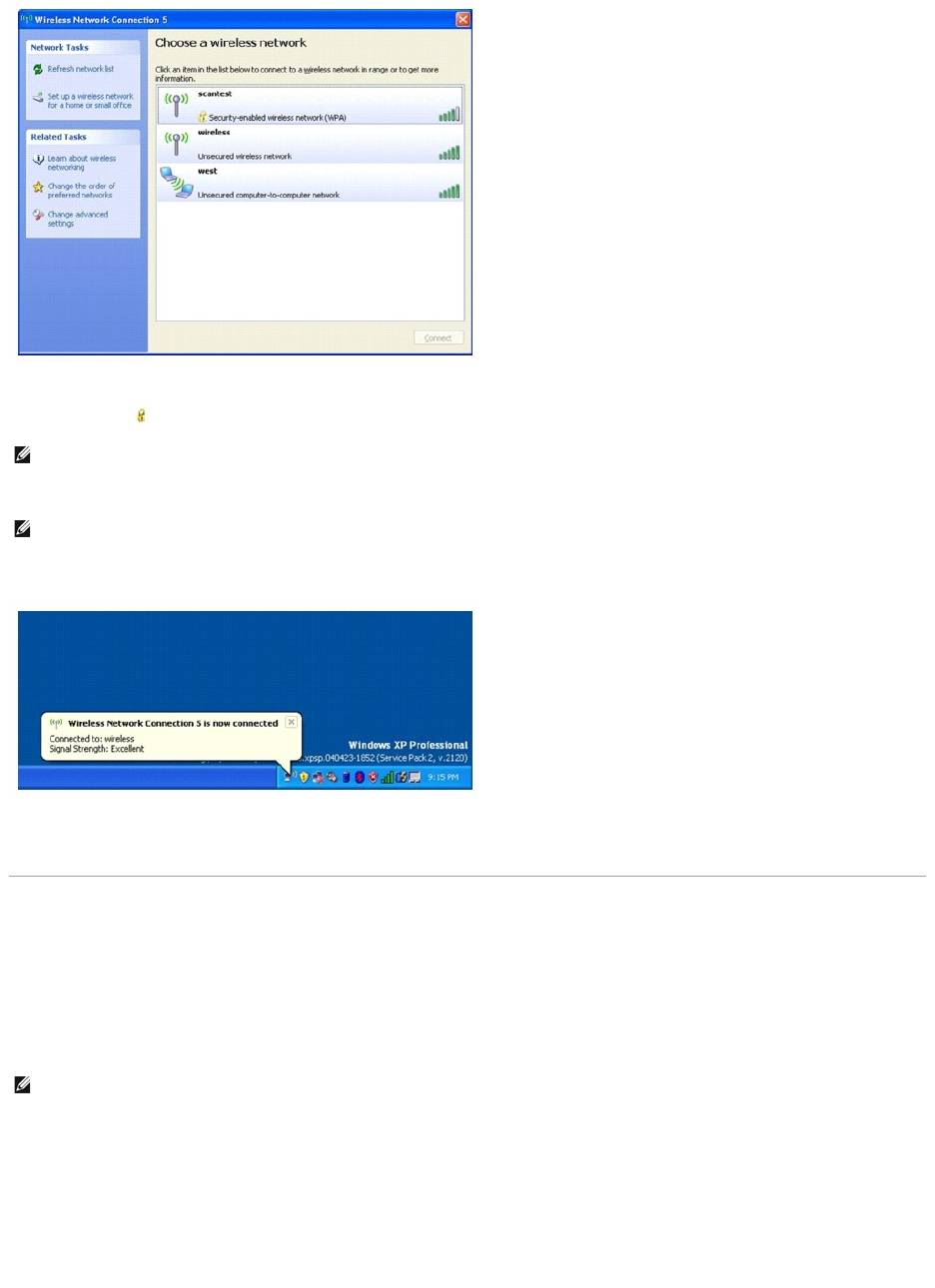
2. Click to select the network you want to configure, and then click Connect or double-click the network name in the list. If you select a secure network
(identified by a icon), you must enter a WEP or WPA key when prompted.
Your network is configured automatically.
After your computer is configured for the wireless network you selected, another pop-up notifies you that your computer is connected to the network
you selected.
Thereafter, whenever you log on to your computer in the area of the wireless network, the same pop-up notifies you of the wireless network
connection.
Finalizing Your Wireless Network Connection (Security Settings)
To finalize your network connection, you must change your wireless security settings to match the wireless network to which you are trying to connect.
Choose one of the following connection options based on the security settings for your network:
l Connecting to a Network without Security-Related Requirements (common for home and small business networks)
l Connecting to a Network with Wi-Fi Protected Access (WPA) Security Requirements
l Connecting to a Network with Wired Equivalent Protocol (WEP) Security Requirements
Connecting to a Network Without Security-Related Requirements
1. In the Preferred networks field, click the name of your wireless network.
2. Click Properties.
3. From the Network Authentication drop-down menu, select Open.
NOTE: Network security settings are unique to your network. Dell cannot provide this information.
NOTE: Your computer can take up to 1 minute to connect to the network.
NOTE: Network security settings are unique to your network. Dell cannot provide this information.

EarlierversionsoftheDell™wirelesssoftwaremaynotcontainthedrop-down menu. If you are using an earlier version, click to uncheck the Data
encryption (WEP enabled) check box and go to step 5.
4. From the Data encryption drop-down menu, select Disabled.
5. Click OK.
Your network setup is complete.
Connecting to a Network With Wi-Fi Protected Access (WPA) Security Requirements
The following instructions are basic steps for connecting to a WPA network. If your network requires a user name, password, or domain settings, consult the
setup instructions in the user's guide for your wireless network card.
1. In the Preferred networks field, click the name of your wireless network.
2. Click Properties.
3. From the Network Authentication drop-down menu, select your network authentication type.
If you do not see the drop-down menu, you must update your wireless network software before continuing. Download and install the latest version of
your wireless-network driver software from the Dell Support website at support.dell.com.
4. From the Data encryption drop-down menu, select your data encryption type.
5. If your wireless network requires a key, enter it in the Network key field.
6. Click OK.
Your network setup is complete.
Connecting to a Network With Wired Equivalent Protocol (WEP) Security Requirements
1. In the Preferred networks field, click the name of your wireless network.
2. Click Properties.
3. From the Network Authentication drop-down menu, select Open.
Earlier versions of Dell wireless network software may not contain the drop-down menu. If you are using an earlier version, click to check the Data
encryption (WEP enabled) check box and go to step 5.
4. From the Data encryption drop-down menu, select WEP.
5. If the wireless network does not require a network key, such as a password, go to step 8.
6. Click to uncheck the The key is provided for me automatically check box.
7. Enter the WEP network key in the Network key field.
8. Enter the WEP network key again in the Confirm network key field.
9. Click OK.
Your network setup is complete.
NOTE: Your computer can take up to 1 minute to connect to the network.
NOTE: WPA protocols require that you know the network authentication and data encryption settings for your wireless network. In addition, your WPA-
protected network may require special settings such as a network key, user name, password, and domain name.
NOTE: Your computer can take up to 1 minute to connect to the network.
NOTE: Your computer can take up to 1 minute to connect to the network.

Back to Contents Page

Back to Contents Page
Using Microsoft®Windows®XP
DellPrecision™MobileWorkstationM70User'sGuide
Help and Support Center
The Help and Support Center provides help with Windows XP and offers other support and educational tools. With the Help and Support Center, you can:
l Access user's guides for your computer hardware and software.
l Find detailed information about your computer, including configuration and error logs.
l Access support and educational tools installed on your computer.
l Search for topics based on words you provide.
To access the Windows Help and Support Center, click the Start button and click Help and Support.
Microsoft®Windows®Classic View
You can change the appearance of the Windows desktop, Start menu, and Control Panel so that they look more like previous versions of the Windows
operating system.
Desktop
1. Click the Start button and click Control Panel.
2. Under Pick a category, click Appearance and Themes.
3. Under Pick a task..., click Change the computer's theme.
4. In the Theme drop-down menu, click Windows Classic.
5. Click OK.
Start Menu
1. Right-click the Start button and click Properties.
2. Click the Start Menu tab.
3. Click Classic Start menu and click OK.
Control Panel
1. Click the Start button and click Control Panel.
2. In the left panel, click Switch to Classic View.
Help and Support Center
Microsoft®Windows®Classic View
Desktop Cleanup Wizard
Transferring Information to a New Computer
User Accounts and Fast User Switching
Setting Up a Home and Office Network
Internet Connection Firewall
Data Execution Prevention (DEP) Technology
NOTE: The Microsoft®Windows®XP Home Edition and Windows XP Professional operating systems have different features and appearances. Also,
options available in Windows XP Professional vary depending on whether your computer is connected to a domain.
NOTE: TheproceduresinthisdocumentwerewrittenfortheWindowsdefaultview,sotheymaynotworkifyousetyourDell™computertothe
Windows classic view.

Desktop Cleanup Wizard
Your computer is set up to use the Desktop Cleanup Wizard to move programs that are not frequently used to a designated folder 7 days after you first start
your computer and every 60 days after that. The appearance of the Start menu changes as programs are moved.
To turn off the Desktop Cleanup Wizard, perform the following steps.
1. Right-click an empty spot on the desktop and click Properties.
2. Click the Desktop tab and click Customize Desktop.
3. Click Run Desktop Cleanup Wizard every 60 days to remove the check mark.
4. Click OK.
To run the Desktop Cleanup Wizard at any time:
1. Right-click an empty spot on the desktop and click Properties.
2. Click the Desktop tab and click Customize Desktop.
3. Click Clean Desktop Now.
4. When the Desktop Cleanup Wizard appears, click Next.
5. In the list of shortcuts, deselect any shortcuts you want to leave on the desktop and click Next.
6. Click Finish to remove the shortcuts and close the wizard.
Transferring Information to a New Computer
The Microsoft®
Windows®XP operating system provides a Files and Settings Transfer wizard to move data from the source computer to the new computer.
You can move data such as:
l E-mails
l Toolbar settings
l Window sizes
l Internet bookmarks
You can transfer the data to the new computer over a network or serial connection, or you can store it on a removable medium, such as a writable CD or
floppy disk, for transfer to the new computer.
For transferring information to a new computer, you must run the Files and Settings Transfer wizard. You can use the Operating System CD for this process or
you can create a Wizard disk with the Transfer Wizard utility.
Running the Files and Settings Transfer Wizard With the Operating System CD
To prepare the new computer for the file transfer:
1. Click the Start button and click Files and Settings Transfer Wizard.
2. When the Files and Settings Transfer Wizard welcome screen appears, click Next.
3. On the Which computer is this? screen, click New Computer and click Next.
4. On the Do you have a Windows XP CD? screen, click I will use the wizard from the Windows XP CD and click Next.
NOTE: You can run the Desktop Cleanup Wizard any time by clicking Clean Desktop Now under Run Desktop Cleanup Wizard every 60 days.
NOTE: You can transfer information from the old computer to the new computer by directly connecting a serial cable to the input/output (I/O) ports of
the two computers. To transfer data over a serial connection, you must access the Network Connections utility from the Control Panel and perform
additional configuration steps, such as setting up an advanced connection and designating the host computer and the guest computer.
For instructions on setting up a direct cable connection between two computers, search the Microsoft Knowledge Base website for Knowledge Base
Article #305621 (How to Set Up a Direct Cable Connection Between Two Computers in Windows XP).
NOTE: This procedure requires the Operating System CD. This CD is optional and may not be included with all computers.

5. When the Now go to your old computer screen appears, go to your old or source computer. Do not click Next at this time.
To copy data from the old computer:
1. On the old computer, insert the Windows XP Operating System CD.
2. On the Welcome to Microsoft Windows XP screen, click Perform additional tasks.
3. Under What do you want to do?, click Transfer files and settings.
4. On the Files and Settings Transfer Wizard welcome screen, click Next.
5. On the Which computer is this? screen, click Old Computer and click Next.
6. On the Select a transfer method screen, click the transfer method you prefer.
7. On the What do you want to transfer? screen, select the items you want to transfer and click Next.
After the information has been copied, the Completing the Collection Phase screen appears.
8. Click Finish.
To transfer data to the new computer:
1. On the Now go to your old computer screen on the new computer, click Next.
2. On the Where are the files and settings? screen, select the method you chose for transferring your settings and files and click Next.
The wizard reads the collected files and settings and applies them to your new computer.
When all of the settings and files have been applied, the Finished screen appears.
3. Click Finished and restart the new computer.
Running the Files and Settings Transfer Wizard Without the Operating System CD
To run the Files and Settings Transfer Wizard without the Operating System CD, you must create a Wizard disk that will allow you to create a backup image file
to removable media.
To create a Wizard disk, use your new computer with Windows XP and perform the following steps:
1. Click the Start button.
2. Click Files and Settings Transfer Wizard.
3. When the Files and Settings Transfer Wizard welcome screen appears, click Next.
4. On the Which computer is this? screen, click New Computer and click Next.
5. On the Do you have a Windows XP CD? screen, click I want to create a Wizard Disk in the following drive: and click Next.
6. Insert the removable media, such as a floppy disk or CD, and click OK.
7. When the disk creation completes and the Now go to your old computer message appears, do not click Next.
8. Go to the old computer.
To copy data from the old computer:
1. On the old computer, insert the removable Wizard Disk.
2. Click the Start button and click Run.
3. In the Open field on the Run window, type in a:\fastwiz and click OK.
4. On the Files and Settings Transfer Wizard welcome screen, click Next.

5. On the Which computer is this? screen, click Old Computer and click Next.
6. On the Select a transfer method screen, click the transfer method you prefer.
7. On the What do you want to transfer? screen, select the items you want to transfer and click Next.
After the information has been copied, the Completing the Collection Phase screen appears.
8. Click Finish.
To transfer data to the new computer:
1. On the Now go to your old computer screen on the new computer, click Next.
2. On the Where are the files and settings? screen, select the method you chose for transferring your settings and files and click Next. Follow the
instructions on the screen.
The wizard reads the collected files and settings and applies them to your new computer.
When all of the settings and files have been applied, the Finished screen appears.
3. Click Finished and restart the new computer.
User Accounts and Fast User Switching
Adding User Accounts
After the Microsoft®Windows®XP operating system is installed, the administrator or a user with administrator rights can create additional user accounts.
1. Click the Start button and click Control Panel.
2. In the Control Panel window, click User Accounts.
3. Under Pick a task, click Create a new account.
4. Under Name the new account, type the name of the new user and click Next.
5. Under Pick an account type, click one of the following options:
l Computer administrator — You can change all computer settings.
l Limited — You can change only your own personal settings, such as your password. You cannot install programs or use the Internet.
6. Click Create Account.
Fast User Switching
Fast User Switching allows multiple users to access one computer without requiring the previous user to log off.
1. Click the Start button and click Log Off.
2. In the Log Off Windows window, click Switch User.
When you use Fast User Switching, programs that previous users were using remain running in the background, which might slow your computer's response
time. Also, multimedia programs, such as games and DVD software, might not work with Fast User Switching. For more information, see the Help and Support
Center.
NOTE: For more information about this procedure, search dell.support.com for document #PA1089586 (How Do I Transfer Files From My Old Computer to
My New Dell Computer Using the Microsoft®Windows®XP Operating System?).
NOTE: Additional options may be available, depending on whether you are using Windows XP Home Edition or Windows XP Professional. Also, options
available in Windows XP Professional vary depending on whether your computer is connected to a domain.
NOTE: Fast User Switching is unavailable if your computer is running Windows XP Professional and is a member of a computer domain, or if your
computer has less than 128 MB of memory.

Setting Up a Home and Office Network
Network Setup Wizard
The Microsoft®Windows®XP operating system provides a Network Setup Wizard to guide you through the process of sharing files, printers, or an Internet
connection between computers in a home or small office.
1. Click the Start button, point to All Programs® Accessories® Communications, and then click Network Setup Wizard.
2. On the Network Setup Wizard welcome screen, click Next.
3. Click Checklist for creating a network.
4. Complete the checklist and required preparations.
5. Return to the Network Setup Wizard and follow the instructions on the screen.
Internet Connection Firewall
The Internet Connection Firewall provides basic protection from unauthorized access to the computer while the computer is connected to the Internet. The
firewall is automatically enabled when you run the Network Setup Wizard. When the firewall is enabled for a network connection, the firewall icon appears
with a red background in the Network Connections section of the Control Panel.
Note that enabling the Internet Connection Firewall does not reduce the need for virus-checking software.
For more information, see the Windows Help and Support Center (Microsoft®Windows®XP).
Data Execution Prevention (DEP) Technology
Your computer may include data execution prevention (DEP) technology, which is supported by Microsoft®Windows®XP Service Pack 2 (SP2). This feature
prevents the execution of code in memory regions of the computer that are set aside for data storage. When an attempt is made to run code from an area
marked as data storage, DEP helps the computer to detect this action, intercept the code, and raise an exception to prevent the code from executing. If your
computer supports the DEP technology, it is enabled by default for essential Windows programs and services.
For more information about this memory protection technology, search the Microsoft Knowledge Base website for Knowledge Base Article #875352 for details
about the data execution prevention (DEP) feature.
If you receive a "Data Execution Prevention" error message in Microsoft Windows XP Service Pack 2, see Microsoft Knowledge Base Article #875351.
Back to Contents Page
NOTE: Selecting the connection method This computer connects directly to the Internet enables the integrated firewall provided with Windows XP
Service Pack 1 (SP1) or later.
