
Dell Precision M70 – страница 6
Инструкция к Ноутбуку Dell Precision M70
Оглавление

The Boot Sequence page displays a general list of the bootable devices that may be installed in your computer, including but not limited to the following:
l Diskette Drive
l Internal HDD
l USB Storage Device
l CD/DVD/CD-RW drive
l Modular bay HDD
During the boot routine, the computer starts at the top of the list and scans each enabled device for the operating system start-up files. When the computer
finds the files, it stops searching and starts the operating system.
To control the boot devices, select (highlight) a device by pressing the down-arrow or up-arrow key, and then enable or disable the device or change its order
in the list.
l To enable or disable a device, highlight the item and press the space bar. Enabled items are preceded by a number; disabled items are not preceded by
a number.
l To reorder a device in the list, highlight the device and then press <u> to move the highlighted device up, or <d> (not case-sensitive) to move the
highlighted device down.
Boot sequence changes take effect as soon as you save the changes and exit system setup.
Performing a One-Time Boot
You can set a one-time-only boot sequence without entering system setup. (You can also use this procedure to boot the Dell Diagnostics on the diagnostics
utility partition on your hard drive.)
1. Shut down the computer through the Start menu.
2. If the computer is connected to a docking device (docked), undock it. See the documentation that came with your docking device for instructions.
3. Connect the computer to an electrical outlet.
4. Turn on the computer. When the DELL logo appears, press <F12> immediately. If you wait too long and the Windows logo appears, continue to wait
until you see the Windows desktop. Then shut down your computer and try again.
5. When the boot device list appears, highlight the device from which you want to boot and press <Enter>.
The computer boots to the selected device.
The next time you reboot the computer, the previous boot order is restored.
Changing COM Ports
Serial Port (a subcategory of Onboard Devices) allows you to map the serial port COM address or disable the serial port and its address, which frees
computer resources for another device to use.
Enabling the Infrared Sensor
1. Under the Onboard Devices category, press <Enter> to select the Fast IR setting, and press the right-arrow or left arrow key to change the setting to
a COM port.
2. Press <Enter> and then <Esc> to save the changes and exit the system setup program.
After you enable the infrared sensor, you can use it to establish a link to an infrared device. To set up and use an infrared device, see the infrared device
documentation and the Windows Help and Support Center.
Back to Contents Page
NOTE: To change the boot sequence on a one-time-only basis, see "Performing a One-Time Boot."
NOTE: Only devices that are preceded by a number are bootable.
NOTE: The default setting is Off.
Back to Contents Page
Using Smart Cards
DellPrecision™MobileWorkstationM70User'sGuide
About Smart Cards
Installing a Smart Card
About Smart Cards
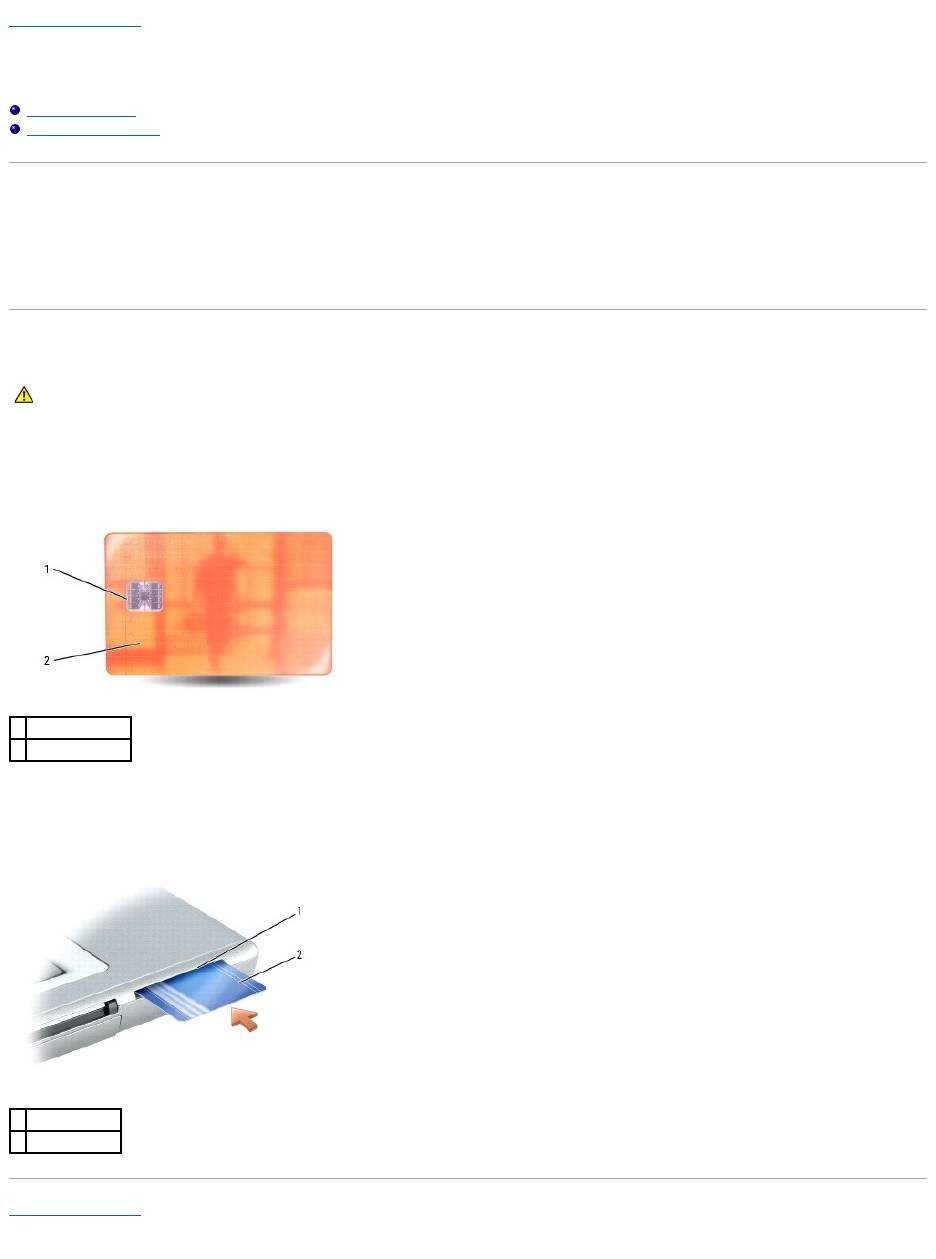
Smart cards are portable credit-card shaped devices with internal integrated circuits. The top surface of the smart card usually contains an embedded
processor located under the gold contact pad. The combination of the small size and integrated circuits make smart cards valuable tools for security, data
storage, and special programs. Using smart cards can improve system security by combining something a user has (the smart card) with something only the
user should know (a PIN) to provide more secure user-authentication than passwords alone.
Installing a Smart Card
You can install a smart card in the computer while the computer is running. The computer automatically detects the card.
To install a smart card:
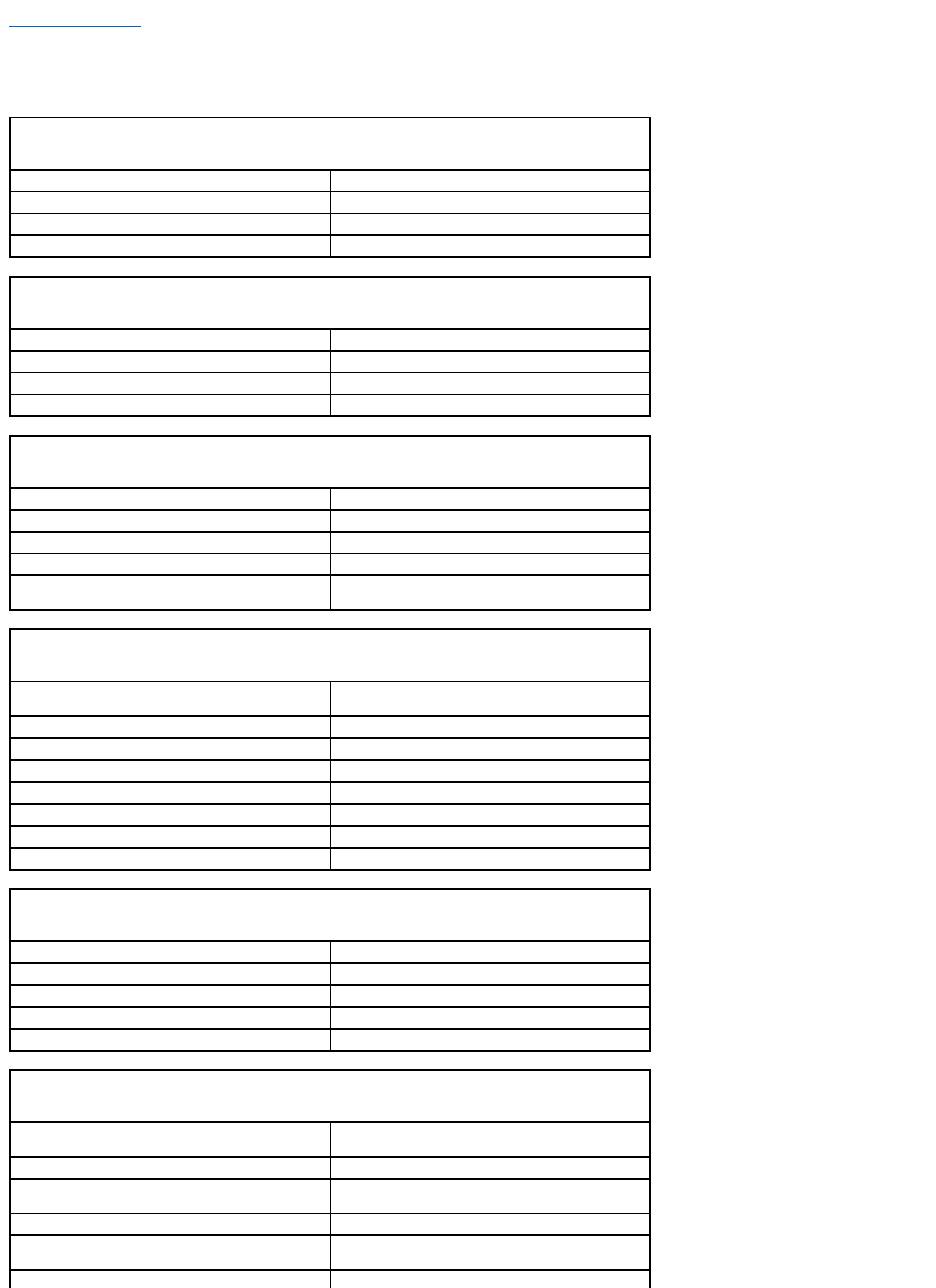
1. Hold the card so that the gold contact pad is facing upward and pointing toward the smart card slot.
2. Slide the smart card into the smart card slot until the card is completely seated in its connector. The smart card will protrude approximately 1.27 cm (1/2
inch) from the slot. The smart card slot is located beside the PC Card slot.
If you encounter too much resistance, do not force the card. Check the card orientation and try again.
Back to Contents Page
CAUTION: Before you begin any of the procedures in this section, follow the safety instructions located in the Product Information Guide.
1
gold contact pad
2
smart card (top)
1
smart card slot
2
smart card
Back to Contents Page
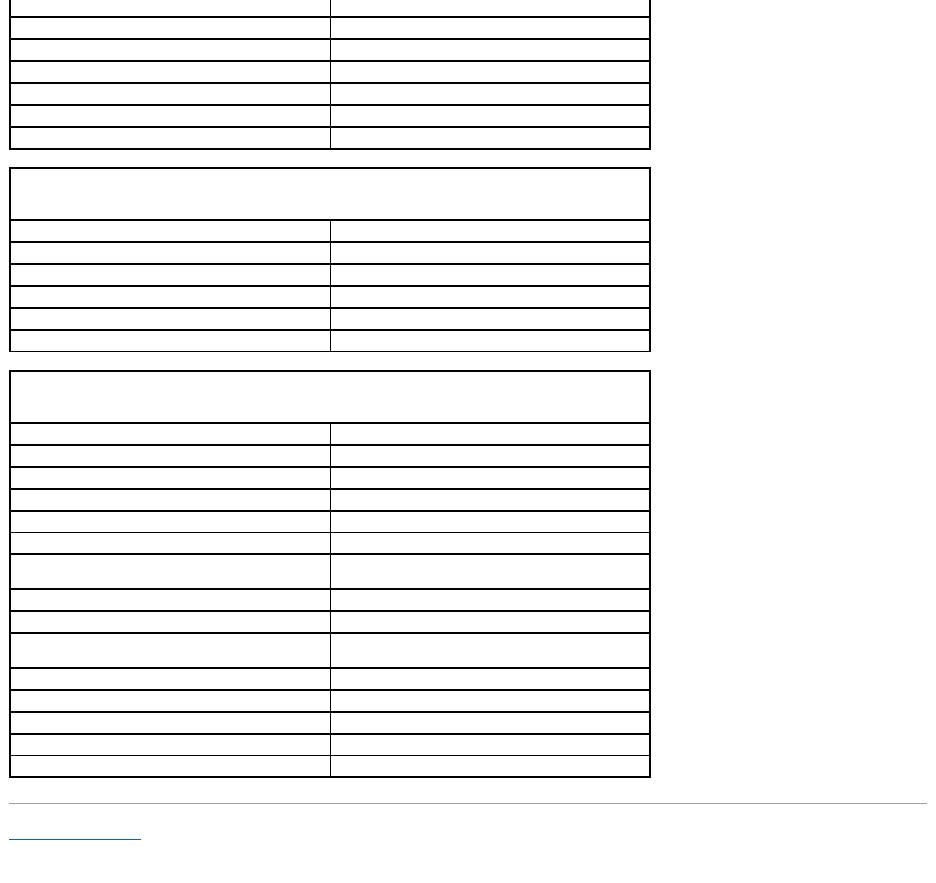
Specifications
DellPrecision™MobileWorkstationM70User'sGuide
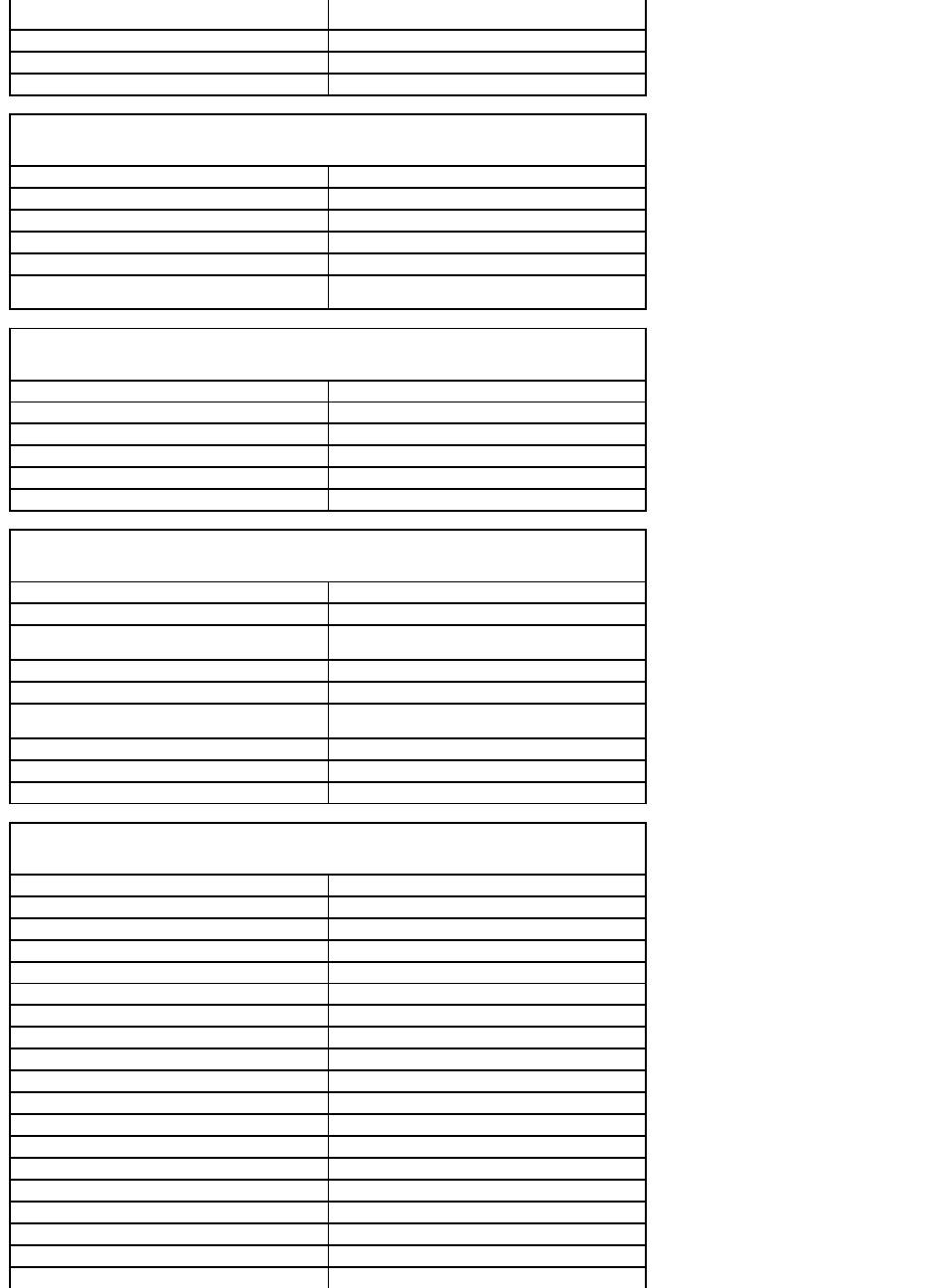
Processor
Processor type
Intel®Pentium®M
L1 cache
64 KB (internal)
L2 cache
2 MB (on die)
External bus frequency
533 MHz
SystemInformation
System chipset
Intel 915PM
Data bus width
64 bits
DRAM bus width
64 bits
Processor address bus width
36 bits
PCCard
CardBus controller
TI 6515 CardBus controller
PC Card connector
one (supports one Type I or Type II card)
Cards supported
3.3 V and 5 V
PC Card connector size
80 pins
Data width (maximum)
PCMCIA 16 bits
CardBus 32 bits
SmartCard
Read/write capabilities
reads and writes to all ISO 7816 1/2/3/4
microprocessor cards (T=0, T=1)
Cards supported
3V and 5V
Program technology supported
Java cards
Interface speed
9600–115,200 BPS
EMV level
level 1 certified
WHQL certification
PC/SC
Compatibility
compatible within a PKI environment
Insert/eject cycles
certified for up to 100,000 cycles
Memory
Memory module connector
two user-accessible SODIMM sockets
Memory module capacities
256, 512, and 1024 MB
Memory type
533 DDRII SDRAM
Minimum memory
256 MB
Maximum memory
2 GB
PortsandConnectors
Serial
9-pin connector; 16550C-compatible,
16-byte buffer connector
Video
15-hole connector
Audio
microphone miniconnector, stereo
headphones/speakers miniconnector
USB
four 4-pin USB 2.0-compliant connectors
Infrared sensor
sensor compatible with IrDA Standard 1.1 (Fast IR)
and IrDA Standard 1.0 (Slow IR)
S-video TV-out
7-pin mini-DIN connector for S-video composite video,
and S/PDIF (TV/digital audio-adapter cable supports
composite video and S/PDIF)
Mini PCI
Type IIIA Mini PCI card slot
Modem
RJ-11 support
Network adapter
RJ-45 port
Communications
Modem:
Type
v.92 56K MDC
Controller
softmodem
Interface
internal AC'97 bus
Network adapter
1 Gb Ethernet LAN on system board
Wireless
internal Mini PCI Wi-Fi and Bluetooth®wireless
technology support
Video
Video type
128-bit hardware accelerated
Data bus
PCI Express
Video controller
NVIDIA Quadro FX Go1400 256 MB
Video memory
256 MB
LCD interface
LVDS
TV support
NTSC or PAL in S-video and composite modes
Audio
Audio type
AC'97 (Soft Audio)
Audio controller
SigmaTel STAC9751
Stereo conversion
20-bit (stereo digital-to-analog),
18-bit (stereo analog-to-digital)
Interfaces:
Internal
PCI bus/AC'97
External
microphone miniconnector, stereo
headphones/speakers miniconnector
Speaker
two 4-ohm speakers
Internal speaker amplifier
2-W channel into 4 ohms
Volume controls
keyboard shortcuts or program menus
Display
Type (active-matrix TFT)
WXGA, WSXGA+, or WUXGA
Dimensions:
Height
222.5 mm max (8.7 inches)
Width
344.5 mm (13.56 inches)
Diagonal
391.16 mm (15.4 inches)
Resolutions:
WXGA
1280 x 800 max resolution
WSXGA+
1680 x 1050 max resolution
WUXGA
1920 x 1200 max resolution
Refresh rate
60 Hz
Operating angle
0º (closed)to180°
Viewing angles:
WXGA Horizontal
40/40°
WXGA Vertical
10/30°
WSXGA+ Horizontal
65/65°
WSXGA+ Vertical
50/50°
WUXGA Horizontal
65/65°
WUXGA Vertical
50/50°
Pixel pitch:
WXGA
0.2588 (15.4 inch)
WSXGA+
0.1971 (15.4 inch)
WUXGA
0.1725 (15.4 inch)
Power Consumption (panel with backlight) (typical):
WXGA
5.0 W (max.)
WSXGA+
5.5 W (max.)
WUXGA
6.0 W (max.)
Controls
brightness can be controlled through keyboard
shortcuts
Keyboard
Number of keys
87 (U.S. and Canada); 88 (Europe); 91 (Japan)
Key travel
2.7 mm ± 0.3 mm (0.11 inch ± 0.016 inch)
Key spacing
19.05 mm ± 0.3 mm (0.75 inch ± 0.012 inch)
Layout
QWERTY/AZERTY/Kanji
TouchPad
X/Ypositionresolution(graphicstablemode)
240 cpi
Size:
Width
64.88-mm (2.55-inch) sensor-active area
Height
48.88-mm (1.92-inch) rectangle
TrackStick
X/Ypositionresolution(graphicstablemode)
250 count/sec @ 100 gf
Size
protrudes 0.5 mm higher than surrounding keycaps
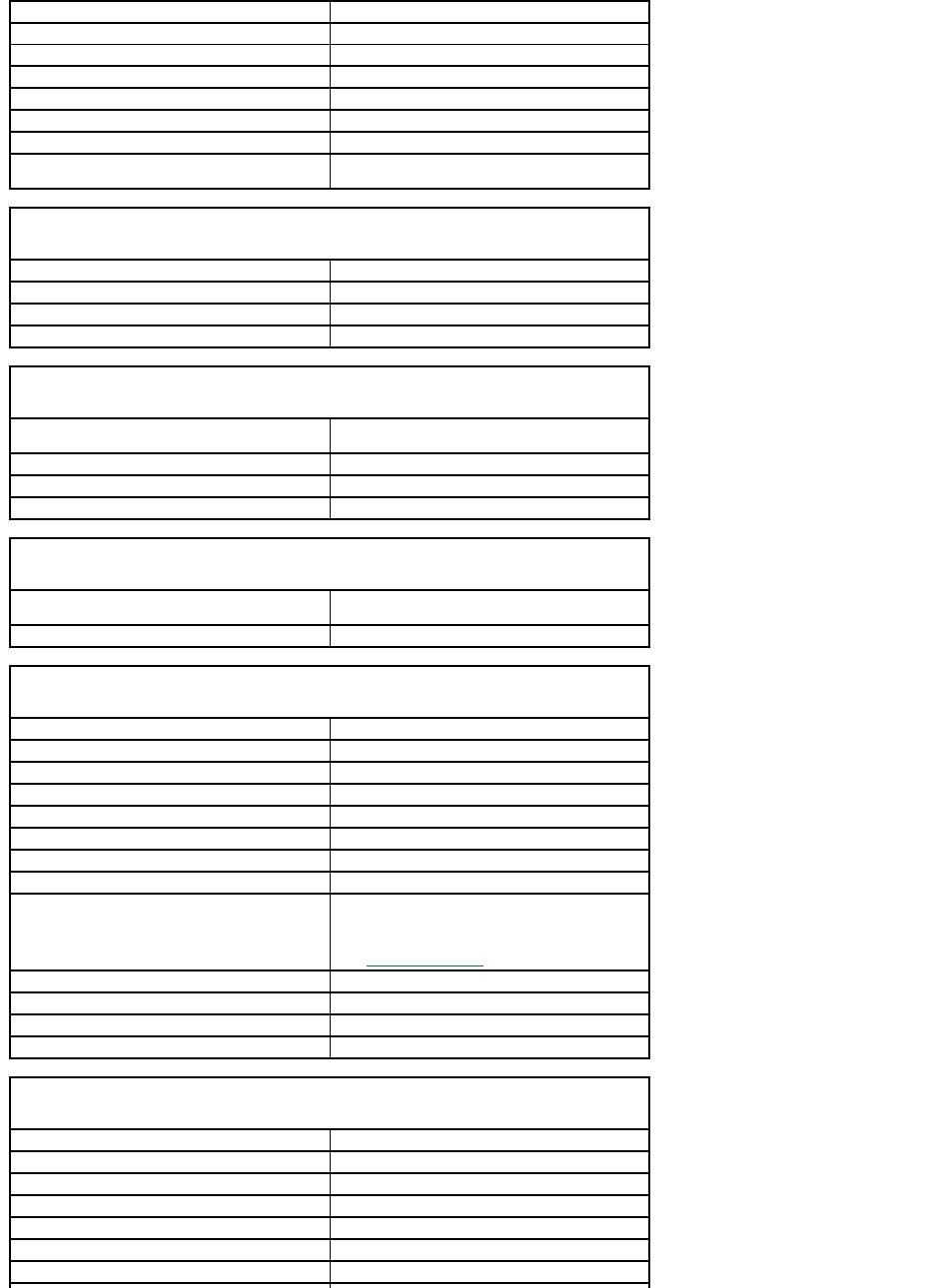
Battery
Type
80 WHr
Dimensions:
Depth
77.2 mm (3.08 inches)
Height
20.0 mm (0.80 inch)
Width
187.03 mm (7.48 inches)
Weight
0.485kg(1.07lb)typical
Voltage
14.8 VDC
Charge time (approximate):
approximately 1 hour to reach 80 percent charge
Operating time
varies depending on operating conditions and can be
significantly reduced under certain power-intensive
conditions.
See "Battery Performance" for more information.
Life span (approximate)
500 discharge/charge cycles
Temperature range:
Operating
0° to35°C(32°to95°F)
Storage
–40° to65°C(–40°to149°F)
ACAdapter
Input voltage
100–240 VAC
Input current (maximum)
1.5 A
Input frequency
50–60 Hz
Output current
4.62 A
Output power
90 W
Rated output voltage
19.5 VDC
Dimensions:
Back to Contents Page
Height
27.94 mm (1.1 inches)
Width
58.42 mm (2.3 inches)
Depth
133.85 mm (5.25 inches)
Weight (with cables)
0.4 kg (0.9 lb)
Temperature range:
Operating
0°to35°C(32°to95°F)
Storage
–40°to65°C(–40°to149°F)
Physical
Height
42.4 mm (1.67 inches)
Width
361.2 mm (14.2 inches)
Depth
260.4 mm (10.3 inches)
Weight:
With travel module and 80 WHr battery
3.035 kg (6.69 lb) typical
With CD drive and 80 WHr battery
3.230 kg (7.12 lb) typical
Environmental
Temperature range:
Operating
0° to35°C(32°to95°F)
Storage
–40° to65°C(–40°to149°F)
Relative humidity (maximum):
Operating
10% to 90% (noncondensing)
Storage
5% to 95% (noncondensing)
Maximum vibration (using a random-vibration
spectrum that simulates user environment):
Operating
0.66 GRMS
Storage
1.30 GRMS
Maximum shock (measured with hard drive in head-
parked position and a 2-ms half-sine pulse):
Operating
122 G
Storage
163 G
Altitude (maximum):
Operating
–15.2 to 3048 m (–50 to 10,000 ft)
Storage
–15.2 to 10,668 m (–50 to 35,000 ft)

Back to Contents Page
DellPrecision™
Mobile Workstation M70 User's Guide
Click the links to the left for information on the features and operation of your computer. For information on other documentation included with your computer,
see "Finding Information."
For a complete list of abbreviations and acronyms, see the "Glossary."
Information in this document is subject to change without notice.
©2005DellInc.Allrightsreserved.
Reproduction in any manner whatsoever without the written permission of Dell Inc. is strictly forbidden.
Trademarks used in this text: Dell, the DELL logo, DellNet, Dimension, Dell TravelLite, Inspiron, Latitude, OptiPlex, PowerApp, PowerEdge, PowerConnect, PowerVault, Dell Precision, and
Undock & Go are trademarks of Dell Inc.; Intel, Pentium, and SpeedStep are registered trademarks of Intel Corporation; Microsoft, Windows, and Outlook are registered trademarks of
Microsoft Corporation; Bluetooth is a registered trademark of Bluetooth SIG, Inc. and is used by Dell Inc. under license.; ENERGY STAR is a registered trademark of the U.S
Environmental Protection Agency. As an ENERGY STAR Partner, Dell Inc. has determined that this product meets the ENERGY STAR guidelines for energy efficiency.
Other trademarks and trade names may be used in this document to refer to either the entities claiming the marks and names or their products. Dell Inc. disclaims any
proprietary interest in trademarks and trade names other than its own.
Model PP15L
March2005P/ND5983Rev.A01
Back to Contents Page
NOTE: A NOTE indicates important information that helps you make better use of your computer.
NOTICE: A NOTICE indicates either potential damage to hardware or loss of data and tells you how to avoid the problem.
CAUTION: A CAUTION indicates a potential for property damage, personal injury, or death.
NOTE: Some features or services may not be available for your computer or in certain countries.

Back to Contents Page
Traveling With Your Computer
DellPrecision™MobileWorkstationM70User'sGuide
Identifying Your Computer
Packing the Computer
Travel Tips
Identifying Your Computer
l Attach a name tag or business card to the computer.
l Write down your Service Tag and store it in a safe place away from the computer or carrying case. Use the Service Tag if you need to report a loss or
theft to law enforcement officials and to Dell.
l Create a file on the Microsoft® Windows® desktop called if_found. Place information such as your name, address, and telephone number in this file.
l Contact your credit card company and ask if it offers coded identification tags.
Packing the Computer
l Remove any external devices attached to the computer and store them in a safe place. Remove any cables attached to installed PC Cards, and remove
any extended PC Cards.
l Tomakethecomputeraslightaspossible,replaceanydevicesinstalledinthemodulebaywiththeDellTravelLite™module.
l Fully charge the main battery and any spare batteries you plan to carry with you.
l Shut down the computer.
l Disconnect the AC adapter.
l Remove any extraneous items, such as paper clips, pens, and paper, from the keyboard and palm rest and close the display.
l UsetheoptionalDell™carryingcasetopackthecomputeranditsaccessoriestogethersafely.
l Avoid packing the computer with items such as shaving cream, colognes, perfumes, or food.
l Protect the computer, the batteries, and the hard drive from hazards such as extreme temperatures and overexposure to sunlight, dirt, dust, or liquids.
l Pack the computer so that it does not slide around in the trunk of your car or in an overhead storage compartment.
Travel Tips
l Consider disabling wireless activity on your computer to maximize battery operating time. To disable wireless activity, press <Fn> <F2>.
l Consider changing your power management options to maximize battery operating time.
l If you are traveling internationally, carry proof of ownership—or of your right to use the computer if it is company-owned—to speed your passage
through customs. Investigate the customs regulations of the countries you plan to visit, and consider acquiring an international carnet (also known as a
merchandise passport) from your government.
l Ensure that you know which electrical outlets are used in the countries you will visit, and have appropriate power adapters.
l Check with your credit card company for information about the kinds of emergency travel assistance it offers to users of portable computers.
Traveling by Air
l Ensure that you have a charged battery available in case you are asked to turn on the computer.
NOTICE: When the display is closed, extraneous items on the keyboard or palm rest could damage the display.
NOTICE: If the computer has been exposed to extreme temperatures, allow it to acclimate to room temperature for 1 hour before turning it on.
NOTICE: Do not check the computer as baggage.
NOTICE: If you choose to pack the computer after undocking it, ensure that the computer has been shut down or put into Standby Mode. Failure to do
so could cause the battery to wear down quickly or cause the computer to overheat.
NOTICE: Do not move the computer while using the optical drive. Doing so can result in loss of data.

l Before you use the computer on an airplane, verify that such usage is permitted. Some airlines forbid the use of electronic devices during the flight. All
airlines forbid the use of electronic devices during takeoff and landing.
If Your Computer Is Lost or Stolen
l Call a law enforcement agency to report the lost or stolen computer. Include the Service Tag in your description of the computer. Ask that a case
number be assigned and write down the number, along with the name, address, and telephone number of the law enforcement agency. If possible,
obtain the name of the investigating officer.
l If the computer belongs to a company, notify the security office of the company.
l Contact Dell customer service to report the missing computer. Provide the computer Service Tag, the case number, and the name, address, and
telephone number of the law enforcement agency to which you reported the missing computer. If possible, give the name of the investigating officer.
The Dell customer service representative will log your report under the computer Service Tag and flag the computer as missing or stolen. If someone calls Dell
for technical assistance and gives your Service Tag, the computer is identified automatically as missing or stolen. The representative will attempt to get the
phone number and address of the caller. Dell will then contact the law enforcement agency to which you made the report of the missing computer.
Back to Contents Page
NOTICE: Do not walk the computer through a metal detector. Send the computer through an X-ray machine or have it hand inspected.
NOTE: If you know where the computer was lost or stolen, call a law enforcement agency in that area. If you do not know, call a law enforcement
agency where you live.
Back to Contents Page
Connecting to a Wireless Local Area Network
DellPrecision™MobileWorkstationM70User'sGuide
Determining Your Network Type
Connecting to a Wireless Network in Microsoft®Windows®XP
Finalizing Your Wireless Network Connection (Security Settings)
Determining Your Network Type
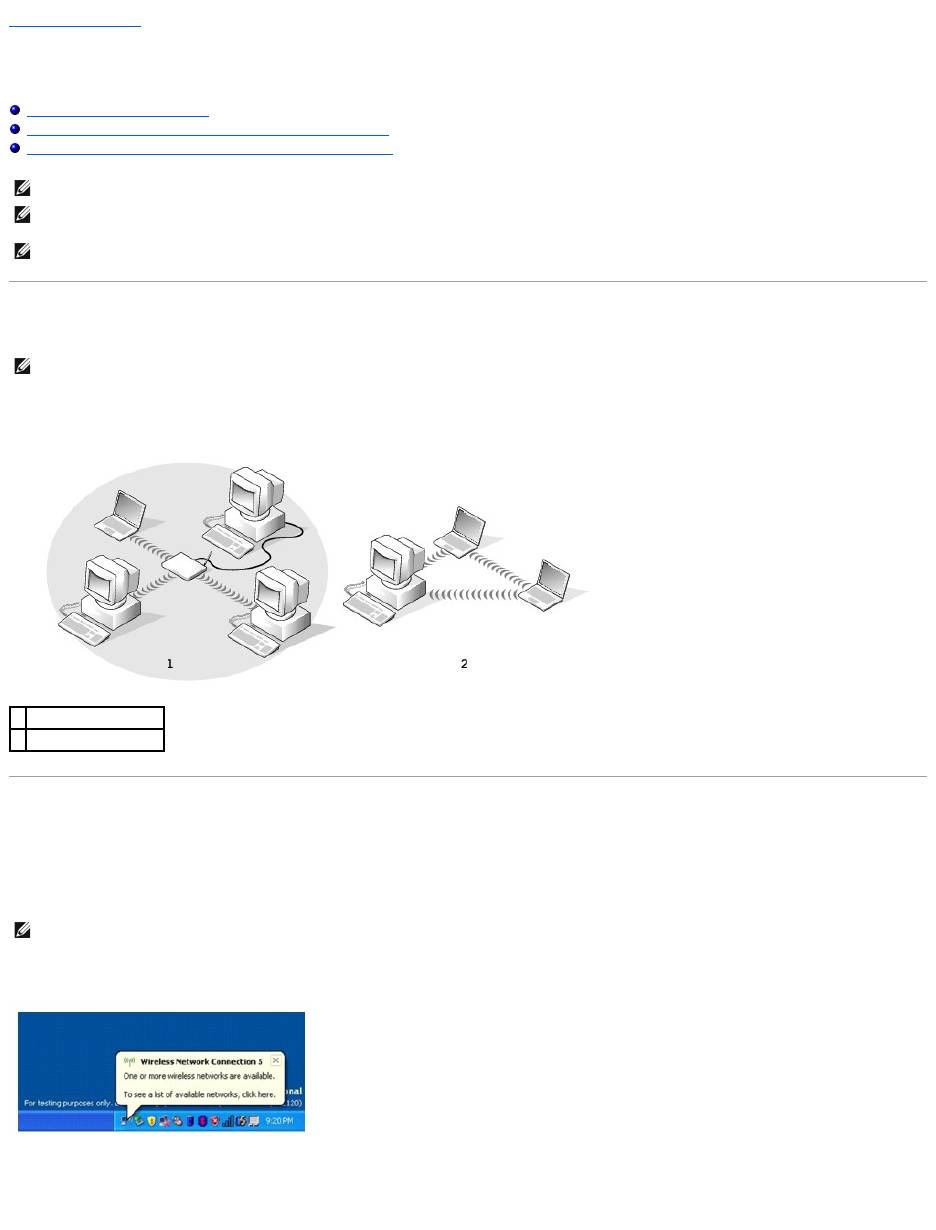
Wireless networks fall into two categories—infrastructure networks and ad-hoc networks. An infrastructure network uses routers or access points to connect
several computers. An ad-hoc network does not use routers or access points and consists of computers that broadcast to one another. For additional
assistance with setting up your wireless connection, go to support.dell.com and search for the keyword wireless setup.
Connecting to a Wireless Network in Microsoft®Windows®XP
Your wireless network card requires specific software and drivers in order to connect to a network. The software is already installed. If the software is
removed or corrupted, follow the instructions included in the user's guide for your wireless network card. The user's guide is located on your Drivers and
Utilities CD (that may have come with your computer) in the "User's Guides-Network User's Guides" category. The user's guide is also available on your
system's hard drive and on the Dell Support website at support.dell.com.
When you turn on your computer, a pop-up appears from the network icon in the notification area whenever a network is detected in the area for which your
computer is not configured.
1. Click either the pop-up or the network icon to configure your computer for one of the available wireless networks.
The Wireless Network Connections window lists the wireless networks available in your area.
NOTE: These networking instructions do not apply to Bluetooth®wireless technology or cellular products.
NOTE: To configure a wireless computer running the Windows 2000 operating system, see the user's guide that came with your wireless network
adapter.
NOTE: Your Dell QuickSet power management software can disable your wireless card. If your wireless card is not working, check your QuickSet help by
clicking on the QuickSet desktray icon, then clicking on Help.
NOTE: Most wireless networks are of the infrastructure type.
1
infrastructure network
2
ad-hoc network
NOTE: The Drivers and Utilities CD is optional and may not ship with all computers.
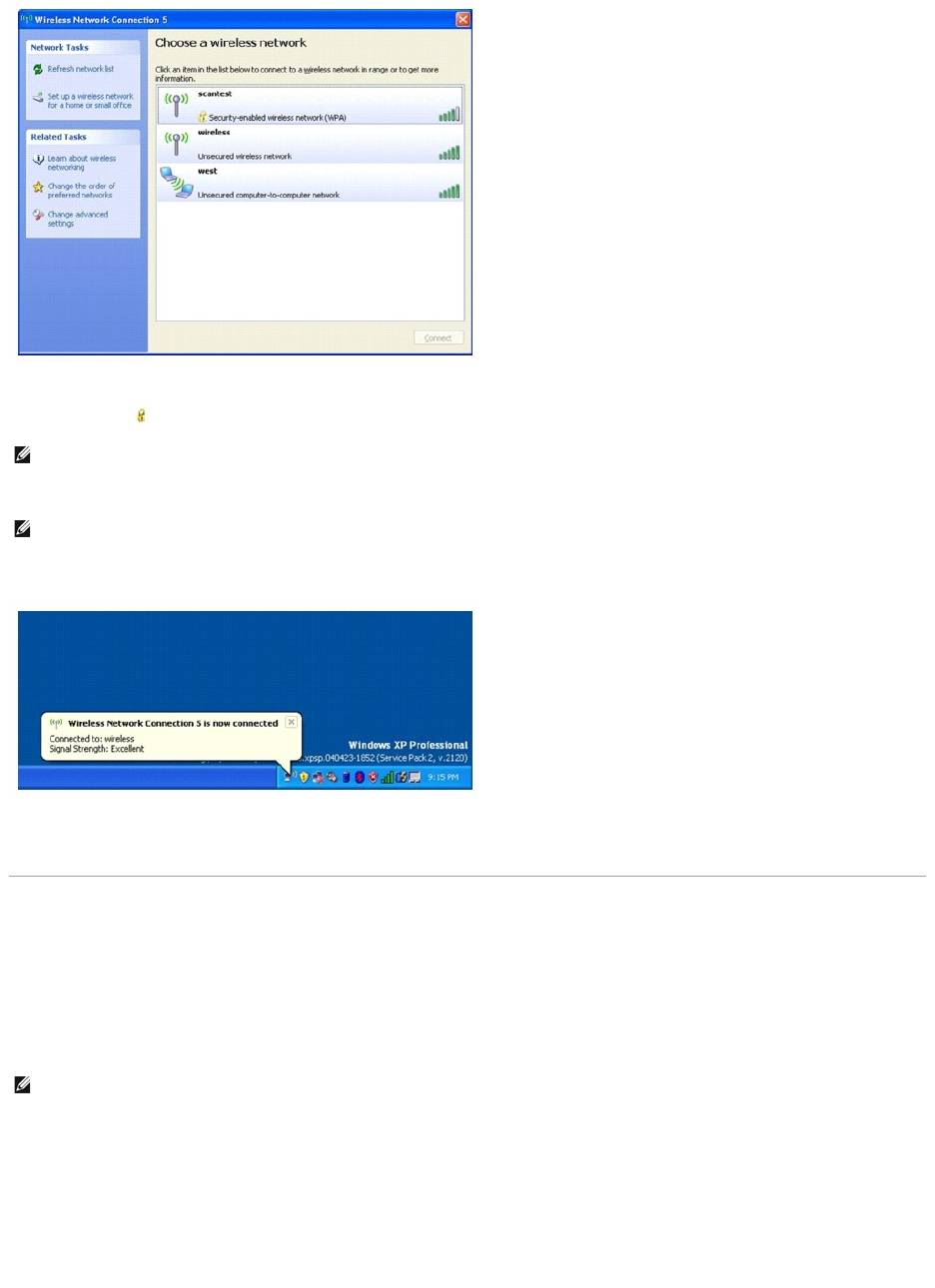
2. Click to select the network you want to configure, and then click Connect or double-click the network name in the list. If you select a secure network
(identified by a icon), you must enter a WEP or WPA key when prompted.
Your network is configured automatically.
After your computer is configured for the wireless network you selected, another pop-up notifies you that your computer is connected to the network
you selected.
Thereafter, whenever you log on to your computer in the area of the wireless network, the same pop-up notifies you of the wireless network
connection.
Finalizing Your Wireless Network Connection (Security Settings)
To finalize your network connection, you must change your wireless security settings to match the wireless network to which you are trying to connect.
Choose one of the following connection options based on the security settings for your network:
l Connecting to a Network without Security-Related Requirements (common for home and small business networks)
l Connecting to a Network with Wi-Fi Protected Access (WPA) Security Requirements
l Connecting to a Network with Wired Equivalent Protocol (WEP) Security Requirements
Connecting to a Network Without Security-Related Requirements
1. In the Preferred networks field, click the name of your wireless network.
2. Click Properties.
3. From the Network Authentication drop-down menu, select Open.
NOTE: Network security settings are unique to your network. Dell cannot provide this information.
NOTE: Your computer can take up to 1 minute to connect to the network.
NOTE: Network security settings are unique to your network. Dell cannot provide this information.

EarlierversionsoftheDell™wirelesssoftwaremaynotcontainthedrop-down menu. If you are using an earlier version, click to uncheck the Data
encryption (WEP enabled) check box and go to step 5.
4. From the Data encryption drop-down menu, select Disabled.
5. Click OK.
Your network setup is complete.
Connecting to a Network With Wi-Fi Protected Access (WPA) Security Requirements
The following instructions are basic steps for connecting to a WPA network. If your network requires a user name, password, or domain settings, consult the
setup instructions in the user's guide for your wireless network card.
1. In the Preferred networks field, click the name of your wireless network.
2. Click Properties.
3. From the Network Authentication drop-down menu, select your network authentication type.
If you do not see the drop-down menu, you must update your wireless network software before continuing. Download and install the latest version of
your wireless-network driver software from the Dell Support website at support.dell.com.
4. From the Data encryption drop-down menu, select your data encryption type.
5. If your wireless network requires a key, enter it in the Network key field.
6. Click OK.
Your network setup is complete.
Connecting to a Network With Wired Equivalent Protocol (WEP) Security Requirements
1. In the Preferred networks field, click the name of your wireless network.
2. Click Properties.
3. From the Network Authentication drop-down menu, select Open.
Earlier versions of Dell wireless network software may not contain the drop-down menu. If you are using an earlier version, click to check the Data
encryption (WEP enabled) check box and go to step 5.
4. From the Data encryption drop-down menu, select WEP.
5. If the wireless network does not require a network key, such as a password, go to step 8.
6. Click to uncheck the The key is provided for me automatically check box.
7. Enter the WEP network key in the Network key field.
8. Enter the WEP network key again in the Confirm network key field.
9. Click OK.
Your network setup is complete.
NOTE: Your computer can take up to 1 minute to connect to the network.
NOTE: WPA protocols require that you know the network authentication and data encryption settings for your wireless network. In addition, your WPA-
protected network may require special settings such as a network key, user name, password, and domain name.
NOTE: Your computer can take up to 1 minute to connect to the network.
NOTE: Your computer can take up to 1 minute to connect to the network.

Back to Contents Page
Back to Contents Page
Using Microsoft®Windows®XP
DellPrecision™MobileWorkstationM70User'sGuide
Help and Support Center
The Help and Support Center provides help with Windows XP and offers other support and educational tools. With the Help and Support Center, you can:
l Access user's guides for your computer hardware and software.
l Find detailed information about your computer, including configuration and error logs.
l Access support and educational tools installed on your computer.
l Search for topics based on words you provide.
To access the Windows Help and Support Center, click the Start button and click Help and Support.
Microsoft®Windows®Classic View
You can change the appearance of the Windows desktop, Start menu, and Control Panel so that they look more like previous versions of the Windows
operating system.
Desktop
1. Click the Start button and click Control Panel.
2. Under Pick a category, click Appearance and Themes.
3. Under Pick a task..., click Change the computer's theme.
4. In the Theme drop-down menu, click Windows Classic.
5. Click OK.
Start Menu
1. Right-click the Start button and click Properties.
2. Click the Start Menu tab.
3. Click Classic Start menu and click OK.
Control Panel
1. Click the Start button and click Control Panel.
2. In the left panel, click Switch to Classic View.
Help and Support Center
Microsoft®Windows®Classic View
Desktop Cleanup Wizard
Transferring Information to a New Computer
User Accounts and Fast User Switching
Setting Up a Home and Office Network
Internet Connection Firewall
Data Execution Prevention (DEP) Technology
NOTE: The Microsoft®Windows®XP Home Edition and Windows XP Professional operating systems have different features and appearances. Also,
options available in Windows XP Professional vary depending on whether your computer is connected to a domain.
NOTE: TheproceduresinthisdocumentwerewrittenfortheWindowsdefaultview,sotheymaynotworkifyousetyourDell™computertothe
Windows classic view.

Desktop Cleanup Wizard
Your computer is set up to use the Desktop Cleanup Wizard to move programs that are not frequently used to a designated folder 7 days after you first start
your computer and every 60 days after that. The appearance of the Start menu changes as programs are moved.
To turn off the Desktop Cleanup Wizard, perform the following steps.
1. Right-click an empty spot on the desktop and click Properties.
2. Click the Desktop tab and click Customize Desktop.
3. Click Run Desktop Cleanup Wizard every 60 days to remove the check mark.
4. Click OK.
To run the Desktop Cleanup Wizard at any time:
1. Right-click an empty spot on the desktop and click Properties.
2. Click the Desktop tab and click Customize Desktop.
3. Click Clean Desktop Now.
4. When the Desktop Cleanup Wizard appears, click Next.
5. In the list of shortcuts, deselect any shortcuts you want to leave on the desktop and click Next.
6. Click Finish to remove the shortcuts and close the wizard.
Transferring Information to a New Computer
The Microsoft®
Windows®XP operating system provides a Files and Settings Transfer wizard to move data from the source computer to the new computer.
You can move data such as:
l E-mails
l Toolbar settings
l Window sizes
l Internet bookmarks
You can transfer the data to the new computer over a network or serial connection, or you can store it on a removable medium, such as a writable CD or
floppy disk, for transfer to the new computer.
For transferring information to a new computer, you must run the Files and Settings Transfer wizard. You can use the Operating System CD for this process or
you can create a Wizard disk with the Transfer Wizard utility.
Running the Files and Settings Transfer Wizard With the Operating System CD
To prepare the new computer for the file transfer:
1. Click the Start button and click Files and Settings Transfer Wizard.
2. When the Files and Settings Transfer Wizard welcome screen appears, click Next.
3. On the Which computer is this? screen, click New Computer and click Next.
4. On the Do you have a Windows XP CD? screen, click I will use the wizard from the Windows XP CD and click Next.
NOTE: You can run the Desktop Cleanup Wizard any time by clicking Clean Desktop Now under Run Desktop Cleanup Wizard every 60 days.
NOTE: You can transfer information from the old computer to the new computer by directly connecting a serial cable to the input/output (I/O) ports of
the two computers. To transfer data over a serial connection, you must access the Network Connections utility from the Control Panel and perform
additional configuration steps, such as setting up an advanced connection and designating the host computer and the guest computer.
For instructions on setting up a direct cable connection between two computers, search the Microsoft Knowledge Base website for Knowledge Base
Article #305621 (How to Set Up a Direct Cable Connection Between Two Computers in Windows XP).
NOTE: This procedure requires the Operating System CD. This CD is optional and may not be included with all computers.

5. When the Now go to your old computer screen appears, go to your old or source computer. Do not click Next at this time.
To copy data from the old computer:
1. On the old computer, insert the Windows XP Operating System CD.
2. On the Welcome to Microsoft Windows XP screen, click Perform additional tasks.
3. Under What do you want to do?, click Transfer files and settings.
4. On the Files and Settings Transfer Wizard welcome screen, click Next.
5. On the Which computer is this? screen, click Old Computer and click Next.
6. On the Select a transfer method screen, click the transfer method you prefer.
7. On the What do you want to transfer? screen, select the items you want to transfer and click Next.
After the information has been copied, the Completing the Collection Phase screen appears.
8. Click Finish.
To transfer data to the new computer:
1. On the Now go to your old computer screen on the new computer, click Next.
2. On the Where are the files and settings? screen, select the method you chose for transferring your settings and files and click Next.
The wizard reads the collected files and settings and applies them to your new computer.
When all of the settings and files have been applied, the Finished screen appears.
3. Click Finished and restart the new computer.
Running the Files and Settings Transfer Wizard Without the Operating System CD
To run the Files and Settings Transfer Wizard without the Operating System CD, you must create a Wizard disk that will allow you to create a backup image file
to removable media.
To create a Wizard disk, use your new computer with Windows XP and perform the following steps:
1. Click the Start button.
2. Click Files and Settings Transfer Wizard.
3. When the Files and Settings Transfer Wizard welcome screen appears, click Next.
4. On the Which computer is this? screen, click New Computer and click Next.
5. On the Do you have a Windows XP CD? screen, click I want to create a Wizard Disk in the following drive: and click Next.
6. Insert the removable media, such as a floppy disk or CD, and click OK.
7. When the disk creation completes and the Now go to your old computer message appears, do not click Next.
8. Go to the old computer.
To copy data from the old computer:
1. On the old computer, insert the removable Wizard Disk.
2. Click the Start button and click Run.
3. In the Open field on the Run window, type in a:\fastwiz and click OK.
4. On the Files and Settings Transfer Wizard welcome screen, click Next.

5. On the Which computer is this? screen, click Old Computer and click Next.
6. On the Select a transfer method screen, click the transfer method you prefer.
7. On the What do you want to transfer? screen, select the items you want to transfer and click Next.
After the information has been copied, the Completing the Collection Phase screen appears.
8. Click Finish.
To transfer data to the new computer:
1. On the Now go to your old computer screen on the new computer, click Next.
2. On the Where are the files and settings? screen, select the method you chose for transferring your settings and files and click Next. Follow the
instructions on the screen.
The wizard reads the collected files and settings and applies them to your new computer.
When all of the settings and files have been applied, the Finished screen appears.
3. Click Finished and restart the new computer.
User Accounts and Fast User Switching
Adding User Accounts
After the Microsoft®Windows®XP operating system is installed, the administrator or a user with administrator rights can create additional user accounts.
1. Click the Start button and click Control Panel.
2. In the Control Panel window, click User Accounts.
3. Under Pick a task, click Create a new account.
4. Under Name the new account, type the name of the new user and click Next.
5. Under Pick an account type, click one of the following options:
l Computer administrator — You can change all computer settings.
l Limited — You can change only your own personal settings, such as your password. You cannot install programs or use the Internet.
6. Click Create Account.
Fast User Switching
Fast User Switching allows multiple users to access one computer without requiring the previous user to log off.
1. Click the Start button and click Log Off.
2. In the Log Off Windows window, click Switch User.
When you use Fast User Switching, programs that previous users were using remain running in the background, which might slow your computer's response
time. Also, multimedia programs, such as games and DVD software, might not work with Fast User Switching. For more information, see the Help and Support
Center.
NOTE: For more information about this procedure, search dell.support.com for document #PA1089586 (How Do I Transfer Files From My Old Computer to
My New Dell Computer Using the Microsoft®Windows®XP Operating System?).
NOTE: Additional options may be available, depending on whether you are using Windows XP Home Edition or Windows XP Professional. Also, options
available in Windows XP Professional vary depending on whether your computer is connected to a domain.
NOTE: Fast User Switching is unavailable if your computer is running Windows XP Professional and is a member of a computer domain, or if your
computer has less than 128 MB of memory.

Setting Up a Home and Office Network
Network Setup Wizard
The Microsoft®Windows®XP operating system provides a Network Setup Wizard to guide you through the process of sharing files, printers, or an Internet
connection between computers in a home or small office.
1. Click the Start button, point to All Programs® Accessories® Communications, and then click Network Setup Wizard.
2. On the Network Setup Wizard welcome screen, click Next.
3. Click Checklist for creating a network.
4. Complete the checklist and required preparations.
5. Return to the Network Setup Wizard and follow the instructions on the screen.
Internet Connection Firewall
The Internet Connection Firewall provides basic protection from unauthorized access to the computer while the computer is connected to the Internet. The
firewall is automatically enabled when you run the Network Setup Wizard. When the firewall is enabled for a network connection, the firewall icon appears
with a red background in the Network Connections section of the Control Panel.
Note that enabling the Internet Connection Firewall does not reduce the need for virus-checking software.
For more information, see the Windows Help and Support Center (Microsoft®Windows®XP).
Data Execution Prevention (DEP) Technology
Your computer may include data execution prevention (DEP) technology, which is supported by Microsoft®Windows®XP Service Pack 2 (SP2). This feature
prevents the execution of code in memory regions of the computer that are set aside for data storage. When an attempt is made to run code from an area
marked as data storage, DEP helps the computer to detect this action, intercept the code, and raise an exception to prevent the code from executing. If your
computer supports the DEP technology, it is enabled by default for essential Windows programs and services.
For more information about this memory protection technology, search the Microsoft Knowledge Base website for Knowledge Base Article #875352 for details
about the data execution prevention (DEP) feature.
If you receive a "Data Execution Prevention" error message in Microsoft Windows XP Service Pack 2, see Microsoft Knowledge Base Article #875351.
Back to Contents Page
NOTE: Selecting the connection method This computer connects directly to the Internet enables the integrated firewall provided with Windows XP
Service Pack 1 (SP1) or later.
