
Sony Bravia KDL-32D3010 – page 2
Manual for Sony Bravia KDL-32D3010
Table of contents
- Introduction Notice for Digital TV function Disposal of the TV set
- Start-up Guide 1: Checking the 2: Connecting an aerial/ accessories cable/VCR
- 3: Preventing the TV 5: Performing the initial from toppling over setup 4: Bundling the cables Selecting the language and country/ region
- To tune the TV for digital cable connection Auto-tuning the TV Detaching the Table- Top Stand from the TV
- Safety information
- Prohibited Usage Precautions Broken pieces: When not in use For children If the following problems occur...
- Overview of the remote
- Overview of the TV buttons and indicators
- Watching TV Additional operations
- To change the screen format manually to suit the broadcast Using the Tools menu
- Checking the Digital Electronic Programme Guide (EPG) * To Do this
- To Do this
- Using the Digital Favourite list *
- Connecting optional equipment
- Sockets Input symbol on Description screen
- Viewing pictures from the connected equipment
- Using HDMI control
- Navigating through menus
- Picture menu
- Colour Temperature
- Sound menu
- Dual Sound
- Screen menu
- Set-up menu
- AV Set-up
- HDMI Set-up
- All Reset
- PC Settings menu
- Analogue Set-up menu
- Manual Programme Preset
- Skip
- Digital Set-up menu
- Digital Set-up
- Specifications
- PC Input Signal Reference Chart
- Troubleshooting
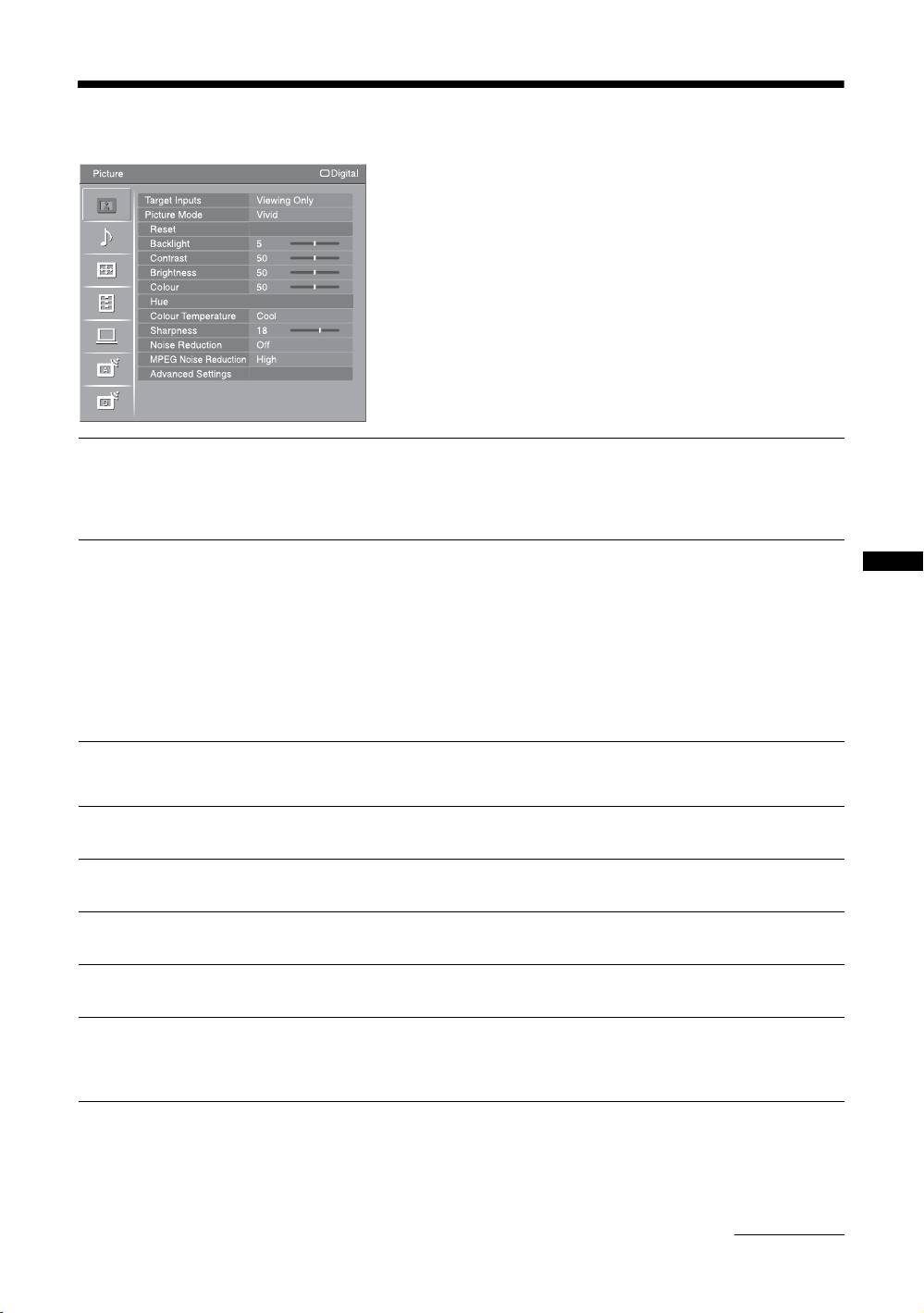
Picture menu
You can select the options listed below on the
“Picture” menu. To select options in “Settings”, refer
to “Navigating through menus” (page 20).
Target Inputs
Selects whether to apply settings made in the “Picture” menu to all inputs, or only to
the input currently being watched.
“All”: Applies settings to all inputs.
“Viewing Only”: Applies settings only to the current input.
Picture Mode
Selects the picture mode except for PC input source.
“Vivid”: For enhanced picture contrast and sharpness.
Using MENU Functions
“Standard”: For standard picture. Recommended for home entertainment.
“Cinema”: For viewing film-based content. Most suitable for viewing in a theatre-
like environment. This picture setting was developed in collaboration with Sony
Pictures Entertainment to faithfully reproduce movies as intended by their creators.
Display Mode
Selects the display mode for PC input source.
“Video”: For video images.
“Text”: For text, charts or tables.
Reset
Resets all the “Picture” settings except “Target Inputs”, “Picture Mode” and
“Display Mode” to the factory settings.
Backlight
Adjusts the brightness of the backlight.
Contrast
Increases or decreases picture contrast.
Brightness
Brightens or darkens the picture.
Colour
Increases or decreases colour intensity.
Hue
Increases or decreases the green tones and red tones.
~
“Hue” can only be adjusted for an NTSC colour signal (e.g. U.S.A. video tapes).
Continued
GB
21

Colour Temperature
Adjusts the whiteness of the picture.
“Cool”: Gives the white colours a blue tint.
“Neutral”: Gives the white colours a neutral tint.
“Warm 1”/“Warm 2”: Gives the white colours a red tint. “Warm 2” gives a redder
tint than “Warm 1”.
z
“Warm 1” and “Warm 2” are not available when “Picture Mode” is set to “Vivid”.
Sharpness
Sharpens or softens the picture.
Noise Reduction
Reduces the picture noise (snowy picture) in a weak broadcast signal.
“Auto”: Automatically reduces the picture noise (in analogue mode only).
“High”/“Medium”/“Low”: Modifies the effect of the noise reduction.
“Off”: Turns off the “Noise Reduction” feature.
MPEG Noise Reduction
Reduces the picture noise in MPEG-compressed video.
Advanced Settings
Customizes the Picture function in more detail. When you set “Picture Mode” to
“Cinema” or “Standard”, you can set/change these settings.
“Reset”: Resets all the advanced settings to the factory settings.
“Black Corrector”: Enhances black areas of the picture for stronger contrast.
“Adv. Contrast Enhancer”: Automatically adjusts “Backlight” and “Contrast” to
the most suitable settings judging from the brightness of the screen. This setting is
especially effective for dark images scenes. It will increase the contrast distinction
of the darker picture scenes.
“Gamma”: Adjusts the balance between bright and dark areas of the picture.
“Clear White”: Emphasizes white colours.
“Live Colour”: Makes colours more vivid.
“Colour Space”: Changes the colour reproduction gamut. “Wide” reproduces the
vivid colour and “Normal” reproduces the standard colour.
GB
22
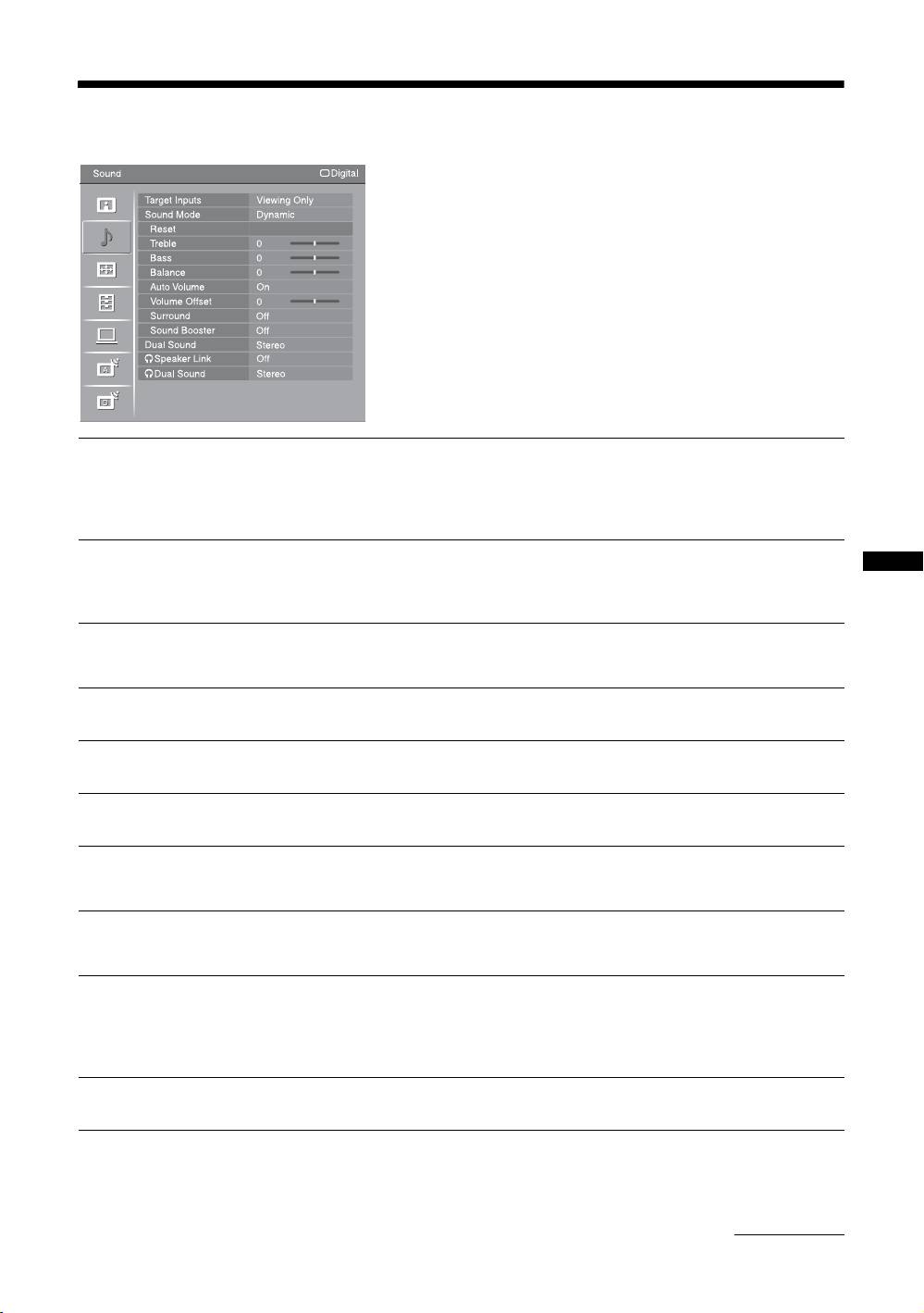
Sound menu
You can select the options listed below on the
“Sound” menu. To select options in “Settings”, refer
to “Navigating through menus” (page 20).
Target Inputs
Selects whether to apply settings made in the “Sound” menu to all inputs, or only to
the input currently being watched.
“All”: Applies settings to all inputs.
“Viewing Only”: Applies settings only to the current input.
Sound Mode
“Dynamic”: Enhances treble and bass.
“Standard”: For standard sound. Recommended for home entertainment.
Using MENU Functions
“Custom”: Flat response. Also allows you to store your preferred settings.
Reset
Resets all the “Sound” settings except “Target Inputs”, “Sound Mode”, “Dual
Sound”, “i Speaker Link” and “i Dual Sound” to the factory settings.
Treble
Adjusts higher-pitched sounds.
Bass
Adjusts lower-pitched sounds.
Balance
Emphasizes left or right speaker balance.
Auto Volume
Keeps a constant volume level even when volume level gaps occur (e.g. adverts tend
to be louder than programmes).
Volume Offset
Adjusts the volume level of the current input relative to other inputs, when “Target
Inputs” is set to “Viewing Only”.
Surround
“S-FORCE Front Surround”: Available for normal stereo broadcast and 5.1ch
digital broadcast surround audio, and the audio input from connected equipment.
“Off”: Converts and reproduces 5.1ch and other digital broadcast surround audio as
normal stereo audio (2ch). Reproduces the original audio of other broadcasts as is.
Sound Booster
Gives sound more impact by compensating for phase effects in speakers.
Continued
GB
23

Dual Sound
Selects the sound from the speaker for a stereo or bilingual broadcast.
“Stereo”/“Mono”: For a stereo broadcast.
“A”/“B”/“Mono”: For a bilingual broadcast, select “A” for sound channel 1, “B”
for sound channel 2, or “Mono” for a mono channel, if available.
~
If you select other equipment connected to the TV, set “Dual Sound” to “Stereo”, “A” or “B”.
However, when the external equipment connected to the HDMI socket is selected, this is fixed
to “Stereo”.
i Speaker Link
Switches the TV’s internal speakers on/off when headphones are connected.
“On”: Sound is output only from headphones.
“Off”: Sound is output from both the TV and headphones.
i Dual Sound
Selects the sound from the headphone for a stereo or bilingual broadcast, which
depends on the “Dual Sound” selection.
GB
24
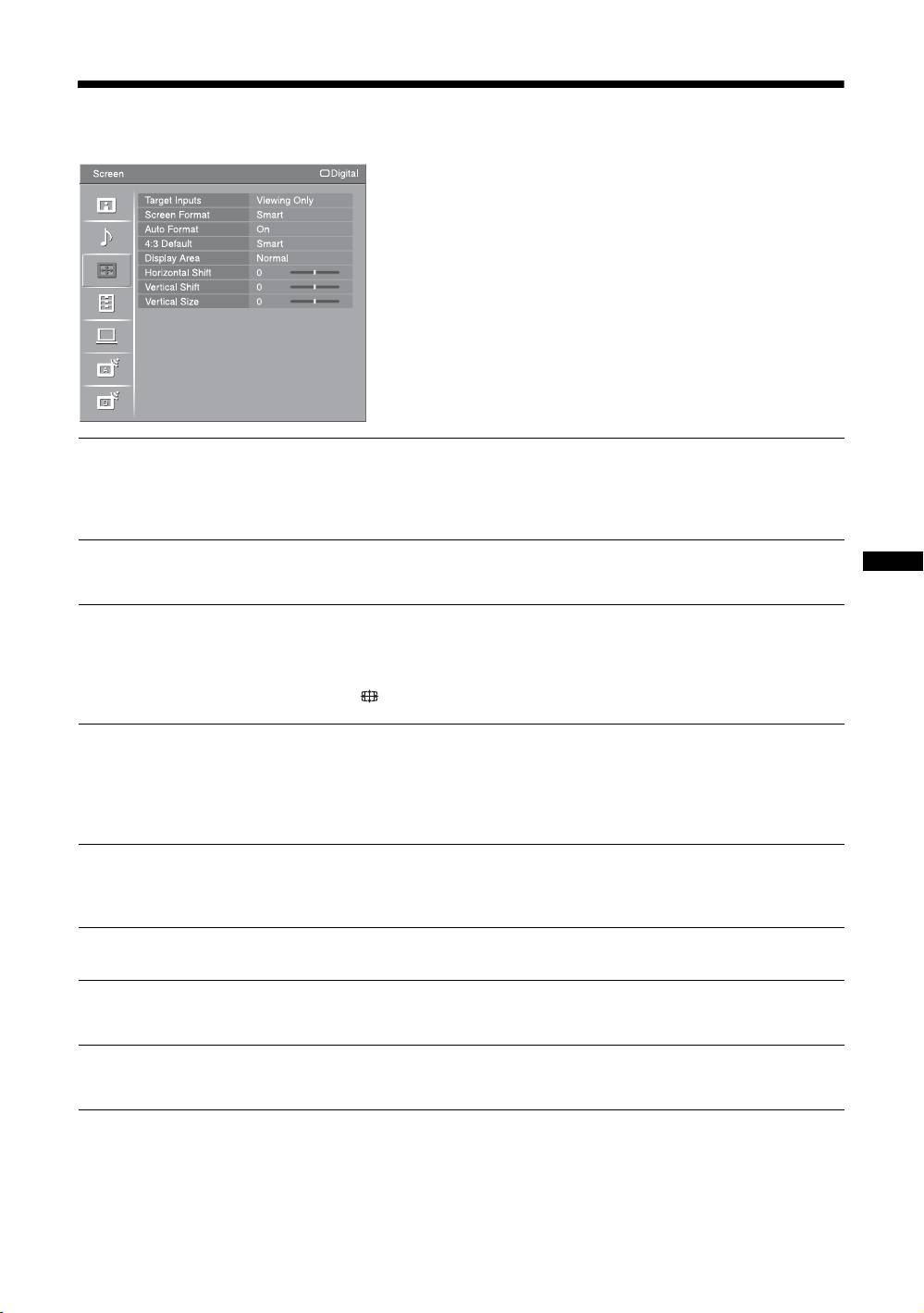
Screen menu
You can select the options listed below on the
“Screen” menu. To select options in “Settings”, refer
to “Navigating through menus” (page 20).
Target Inputs
Selects whether to apply settings made in the “Screen” menu to all inputs, or only to
the input currently being watched.
“All”: Applies settings to all inputs.
“Viewing Only”: Applies settings only to the current input.
Screen Format
For details about the screen format, see “To change the screen format manually to
suit the broadcast” on page 12.
Using MENU Functions
Auto Format
Automatically changes the screen format according to the broadcast signal. To keep
your setting, select “Off”.
z
Even if “Auto Format” is set to “On” or “Off”, you can always modify the format of the screen
by pressing repeatedly.
4:3 Default
Selects the default screen format for use with 4:3 broadcasts.
“Smart”: Displays conventional 4:3 broadcasts with an imitation wide screen effect.
“4:3”: Displays conventional 4:3 broadcasts in the correct proportions.
“Off”: Keeps the current “Screen Format” setting when the channel or input is
changed.
Display Area
Adjusts the screen area for displaying the picture.
“Normal”: Displays the picture in the original size.
“-1”/“-2”: Enlarges the picture to hide the edge of the picture.
Horizontal Shift
Adjusts the horizontal position of the picture.
Vertical Shift
Adjusts the vertical position of the picture when “Screen Format” is set to “Smart”
(50 Hz), “Zoom” or “14:9”.
Vertical Size
Adjusts the vertical size of the picture when “Screen Format” is set to “Smart”,
“Zoom” or “14:9”.
GB
25
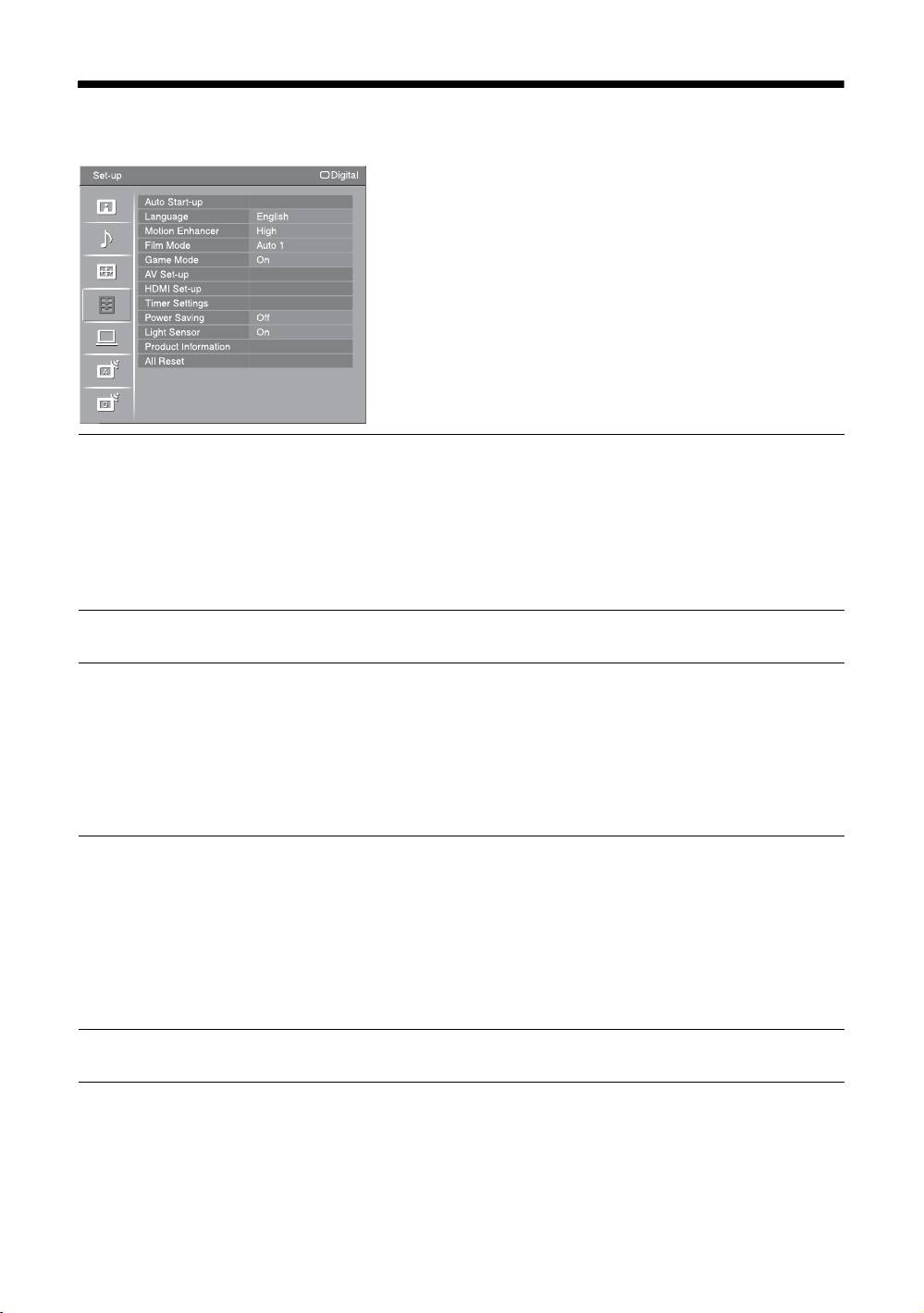
Set-up menu
You can select the options listed below on the “Set-
up” menu. To select options in “Settings”, refer to
“Navigating through menus” (page 20).
Auto Start-up
Starts the initial set-up to select the language and country/region, and tune in all
available digital and analogue channels.
Usually, you do not need to do this operation because the language and country/
region will have been selected and channels already tuned when the TV was first
installed (page 5).
However, this option allows you to repeat the process (e.g. to retune the TV after
moving house, or to search for new channels that have been launched by
broadcasters).
Language
Selects the language in which the menus are displayed.
Motion Enhancer
Provides smoother picture movement and reduces picture blur.
“High”: Provides smoother picture movement such as for film-based contents.
“Standard”: Provides smooth picture movement. Use this setting for standard use.
“Off”: Use this setting when the “High” and “Standard” settings result in noise.
~
• Depending on the video, you may not see the effect visually, even if you have changed the
setting.
• When you select Theatre Mode, “Motion Enhancer” is set to “Off” by default.
Film Mode
Provides smoother picture movement when playing DVD or VCR images taken on
film, reducing picture blur and graininess.
“Auto 1”: Provides smoother picture movement than the original film-based
content. Use this setting for standard use.
“Auto 2”: Provides the original film-based content as is.
“Off”: Turns off the “Film Mode” feature.
~
If the image contains irregular signals or too much noise, “Film Mode” will be automatically
turned off even if “Auto 1” or “Auto 2” is selected.
Game Mode
Depending on the game software, select “On” when reaction time is important.
GB
26
AV Set-up
AV Preset
Assigns a name to any equipment connected to the side and rear sockets. The name
will be displayed briefly on the screen when the equipment is selected. You can skip
input signals from connected equipment that you do not want displayed on the
screen.
1 Press F/f to select the desired input source, then press .
2 Press
F/f to select the desired option below, then press .
Equipment labels: Uses one of the preset labels to assign a name to connected
equipment.
“Edit:”: Creates your own label. Follow steps 2 to 4 of “Programme Labels”
(page 31).
“Skip”: Skips an unnecessary input source.
Auto S Video
Selects the input signal from S video sockets 6 when / 6 sockets are both
connected.
AV2 Output
Sets a signal to be output through the socket labelled / 2 on the rear of the TV.
If you connect a VCR or other recording equipment to the / 2 socket, you can
then record from the equipment connected to other sockets of the TV.
“TV”: Outputs a broadcast.
“AV1”: Outputs signals from equipment connected to the / 1 socket.
“AV6”: Outputs signals from equipment connected to the
/ 6 socket.
“Auto”: Outputs whatever is being viewed on the screen (except signals from the
/ 3, HDMI IN 4, HDMI IN 5, HDMI IN 7 and PC / sockets).
Using MENU Functions
Speaker
Turns on/off the TV’s internal speakers.
“TV Speaker”: The TV speakers are turned on in order to listen to the TV’s sound
through the TV speakers.
“Audio System”: The TV speakers are turned off in order to listen to the TV’s sound
only through your external audio equipment connected to the audio output sockets.
When connected with an HDMI control compatible equipment, you can turn the
connected equipment on interlocked with the TV. This setting must be made after
connecting the equipment.
Audio Out
“Variable”: The audio output from your audio system can be controlled by the TV’s
remote.
“Fixed”: The audio output of the TV is fixed. Use your audio receiver’s volume
control to adjust the volume (and other audio settings) through your audio system.
~
“Audio Out” is not available for audio system connected to the TV using the HDMI sockets.
Colour System
Selects the colour system (“Auto”, “PAL”, “SECAM”, “NTSC3.58”, “NTSC4.43”
or “PAL60”) according to the input signal from the input source.
Continued
GB
27

HDMI Set-up
This is used to set the HDMI control compatible equipment connected to the HDMI
sockets. Note that the interlock setting must also be made on the connected HDMI
control compatible equipment side.
HDMI Control
Sets whether to interlock the HDMI control compatible equipment and the TV.
When set to “On”, the following menu items can be performed.
Auto Devices Off
When this is set to “On”, the HDMI control compatible equipment turn off
interlocked with the TV.
Auto TV On
When this is set to “On”, the TV turns on interlocked with the HDMI control
compatible equipment.
Device List Update
Creates or updates the “HDMI Device List”. Up to 11 HDMI control compatible
equipment items can be connected, and up to 5 equipment items can be connected to
a single socket. Be sure to update the “HDMI Device List” when you change the
HDMI control compatible equipment connections or settings.
HDMI Device List
Displays the connected HDMI control compatible equipment.
~
You cannot use “HDMI Set-up” when an HDMI control compatible audio system is interlocked
with the TV.
Timer Settings
Sets the timer to turn on/off the TV.
Sleep Timer
Sets a period of time after which the TV automatically switches itself into standby
mode.
When “Sleep Timer” is activated, the (Timer) indicator on the TV front panel
lights up in orange.
z
• If you turn off the TV and turn it on again, “Sleep Timer” is reset to “Off”.
• A notification message appears on the screen one minute before the TV switches to standby
mode.
On Timer
Sets the timer to turn on the TV from standby mode.
“Day”: Selects the day on which you want to activate the “On Timer”.
“Time”: Sets the time to turn on the TV.
“Duration”: Selects the time period after which the TV automatically switches to
standby mode again.
“Volume Set-up”: Sets the volume for when the timer turns on the TV.
Clock Set
Allows you to adjust the clock manually. When the TV is receiving digital channels,
the clock cannot be adjusted manually since it is set to the time code of the
broadcasted signal.
Power Saving
Selects the power saving mode to reduce the power consumption of the TV.
When “Picture Off” is selected, the picture is switched off and the (Picture Off)
indicator on the TV front panel lights up in green. The sound remains unchanged.
GB
28

Light Sensor
“On”: Automatically optimizes the picture settings according to the ambient light in
the room.
“Off”: Turns off the “Light Sensor” feature.
~
Be sure not to put anything over the sensor, as its function may be affected. See page 10 for
further information on the sensor.
Product Information
Displays your TV’s product information.
All Reset
Resets all settings to the factory settings and then displays the “Auto Start-up”
screen.
~
• Be sure not to turn the TV off during this period (it takes about 30 seconds) or press any
buttons.
• All settings, including Digital Favourite list, country/region, language, auto tuned channels,
etc. will be reset.
Using MENU Functions
GB
29
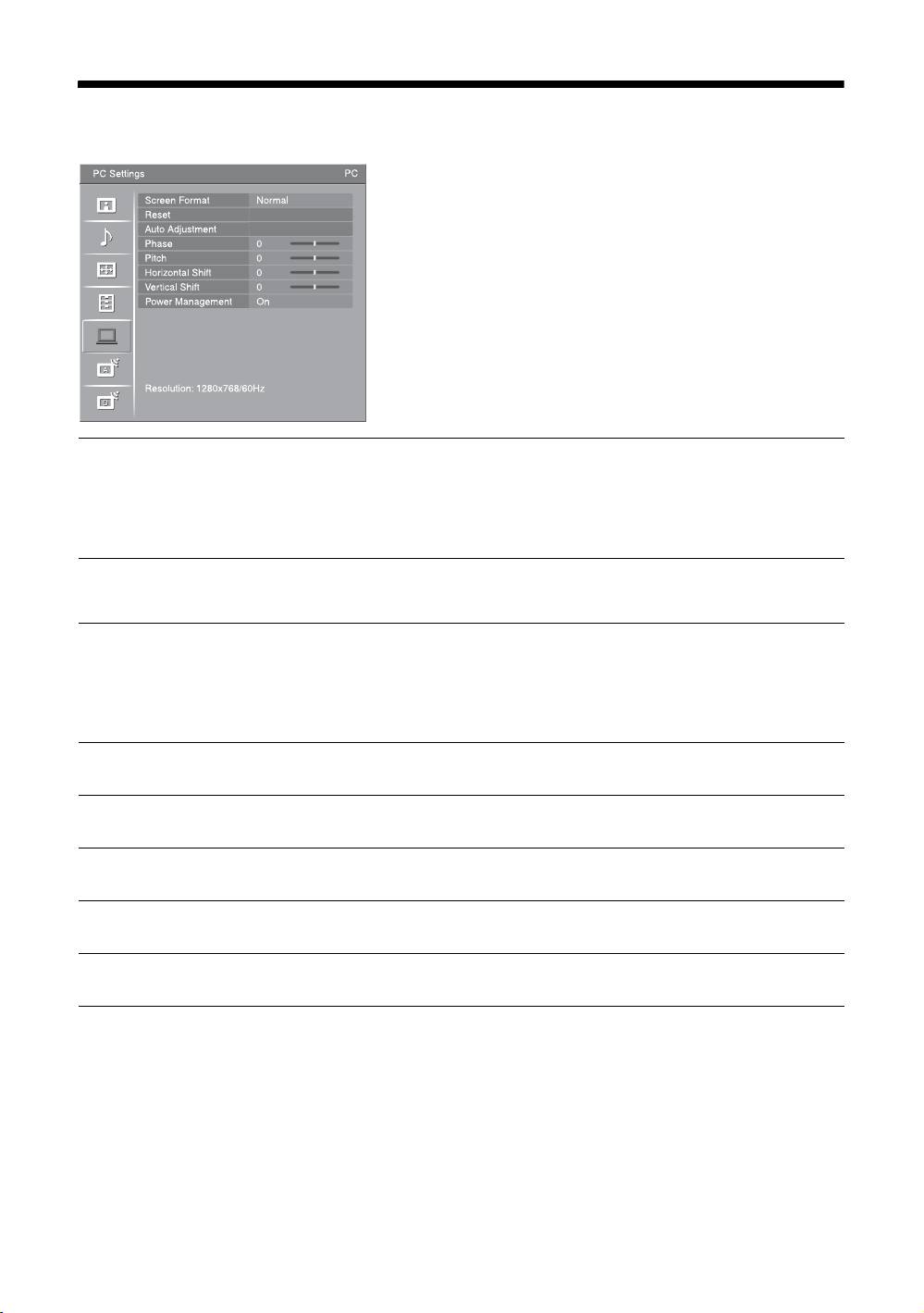
PC Settings menu
You can select the options listed below on the “PC
Settings” menu. To select options in “Settings”, refer
to “Navigating through menus” (page 20).
Screen Format
Selects a screen format for displaying input from your PC.
“Normal”: Displays the picture in its original size.
“Full 1”: Enlarges the picture to fill the display area, keeping its original horizontal-
to-vertical aspect ratio.
“Full 2”: Enlarges the picture to fill the display area.
Reset
Resets the PC settings except “Screen Format” and “Power Management” to the
factory settings.
Auto Adjustment
Automatically adjusts the display position and phase of the picture when the TV
receives an input signal from the connected PC.
z
“Auto Adjustment” may not work well with certain input signals. In such cases, manually
adjust “Phase”, “Horizontal Shift” and “Vertical Shift”.
Phase
Adjusts the phase when the screen flickers.
Pitch
Adjusts the pitch when the picture has unwanted vertical stripes.
Horizontal Shift
Adjusts the horizontal position of the picture.
Vertical Shift
Adjusts the vertical position of the picture.
Power Management
Switches the TV to standby mode if no signal is received for 30 seconds.
GB
30
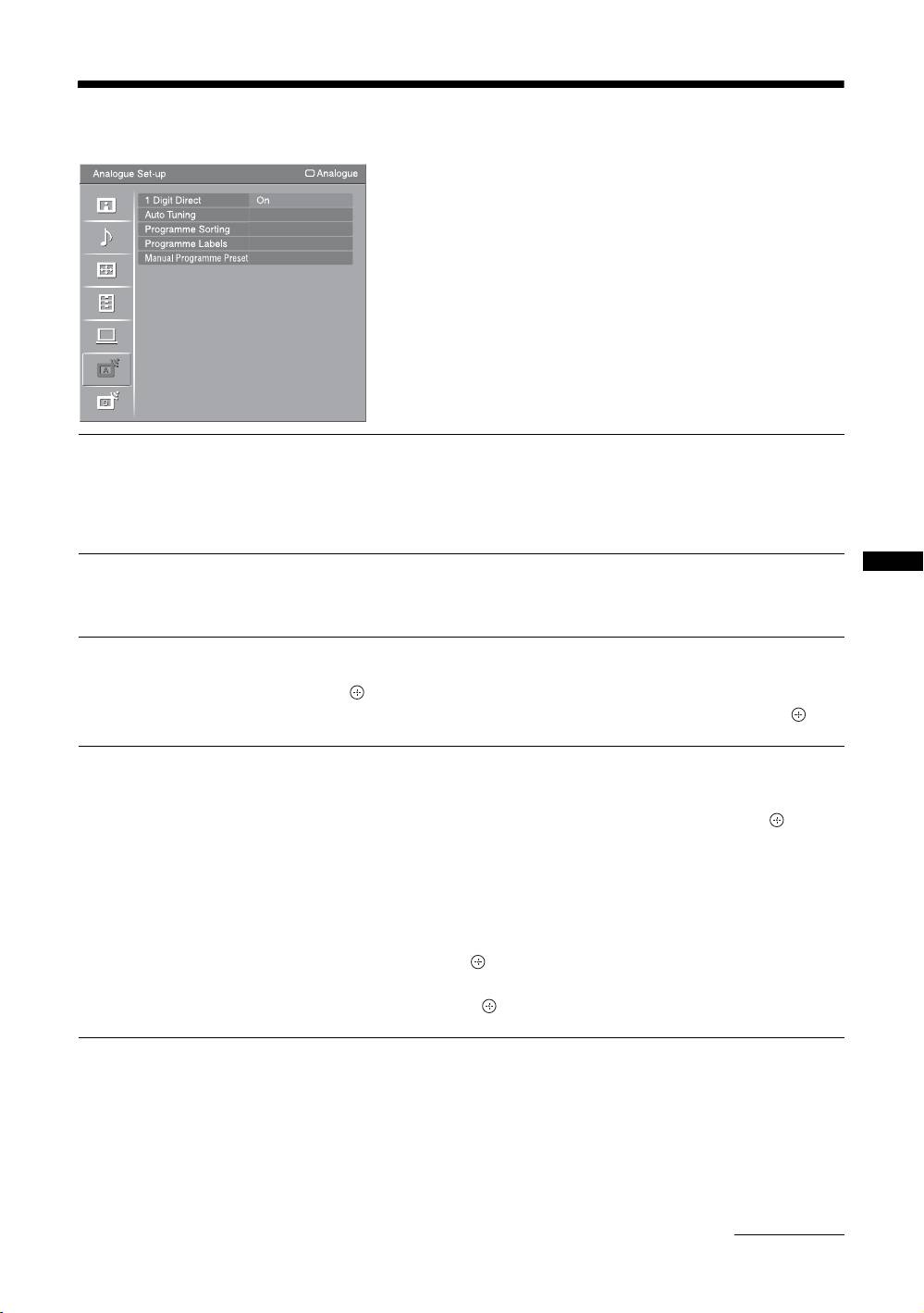
Analogue Set-up menu
You can select the options listed below on the
“Analogue Set-up” menu. To select options in
“Settings”, refer to “Navigating through menus”
(page 20).
1 Digit Direct
When “1 Digit Direct” is set to “On”, you can select an analogue channel using one
preset number button (0 - 9) on the remote.
~
When “1 Digit Direct” is set to “On”, you cannot select channel numbers 10 and above entering
two digits using the remote.
Auto Tuning
Tunes in all the available analogue channels.
This option allows you to retune the TV after moving house, or to search for new
Using MENU Functions
channels that have been launched by broadcasters.
Programme Sorting
Changes the order in which the analogue channels are stored on the TV.
1 Press
F/f to select the channel you want to move to a new position, then
press .
2 Press
F/f to select the new position for your channel, then press .
Programme Labels
Assigns a channel name of your choice up to five letters or numbers. The name will
be displayed briefly on the screen when the channel is selected. (Names for channels
are usually taken automatically from Text (if available).)
1 Press
F/f to select the channel you want to name, then press .
2 Press
F/f to select the desired letter or number (“_” for a blank space),
then press
g.
If you input a wrong character
Press G/g to select the wrong character. Then, press F/f to select the correct
character.
To delete all the characters
Select “Reset”, then press .
3 Repeat the procedure in step 2 until the name is completed.
4 Select “OK”, then press .
Continued
GB
31

Manual Programme
Before selecting “Label”/“AFT”/“Audio Filter”/“Skip”/“Decoder”, press PROG +/-
to select the programme number with the channel. You cannot select a programme
Preset
number that is set to “Skip” (page 33).
Programme/System/Channel
Presets programme channels manually.
1 Press
F/f to select “Programme”, then press .
2 Press
F/f to select the programme number you want to manually tune (if
tuning a VCR, select channel 00), then press RETURN.
3 Press F/f to select “System”, then press .
4 Press
F/f to select one of the following TV broadcast systems, then
press RETURN.
B/G: For western European countries/regions
I: For the United Kingdom
D/K: For eastern European countries/regions
L: For France
5 Press F/f to select “Channel”, then press .
6 Press
F/f to select “S” (for cable channels) or “C” (for terrestrial
channels), then press
g.
7 Tune the channels as follows:
If you do not know the channel number (frequency)
Press F/f to search for the next available channel. When a channel has been found,
the search will stop. To continue searching, press
F/f.
If you know the channel number (frequency)
Press the number buttons to enter the channel number of the broadcast you want or your
VCR channel number.
8 Press to jump to “Confirm”, then press .
9 Press
f to select “OK”, then press .
Repeat the procedure above to preset other channels manually.
Label
Assigns a name of your choice, up to five letters or numbers, to the selected channel.
This name will be displayed briefly on the screen when the channel is selected.
To input characters, follow steps 2 to 4 of “Programme Labels” (page 31).
AFT
Allows you to fine-tune the selected programme number manually if you feel that a
slight tuning adjustment will improve the picture quality.
You can adjust the fine tuning over a range of -15 to +15. When “On” is selected, the
fine tuning is performed automatically.
LNA
Improves the picture quality for individual channels in the case of very weak
broadcast signals (noisy picture).
If you cannot see any improvement in the picture quality even if you set to “On”, set
this option to “Off” (factory setting).
Audio Filter
Improves the sound for individual channels in the case of distortion in mono
broadcasts. Sometimes a non-standard broadcast signal can cause sound distortion or
intermittent sound muting when watching mono programmes.
If you do not experience any sound distortion, we recommend that you leave this
option set to the factory setting “Off”.
~
You cannot receive stereo or dual sound when “Low” or “High” is selected.
GB
32

Skip
Skips unused analogue channels when you press PROG +/- to select channels. (You
can still select a skipped channel using the number buttons.)
Decoder
Shows and records the scrambled channel selected when using a decoder connected
directly to scart connector / 1, or to scart connector / 2 via a VCR.
~
Depending on the country/region selected for “Country” (page 6), this option may not be
available.
Confirm
Saves changes made to the “Manual Programme Preset” settings.
Using MENU Functions
GB
33
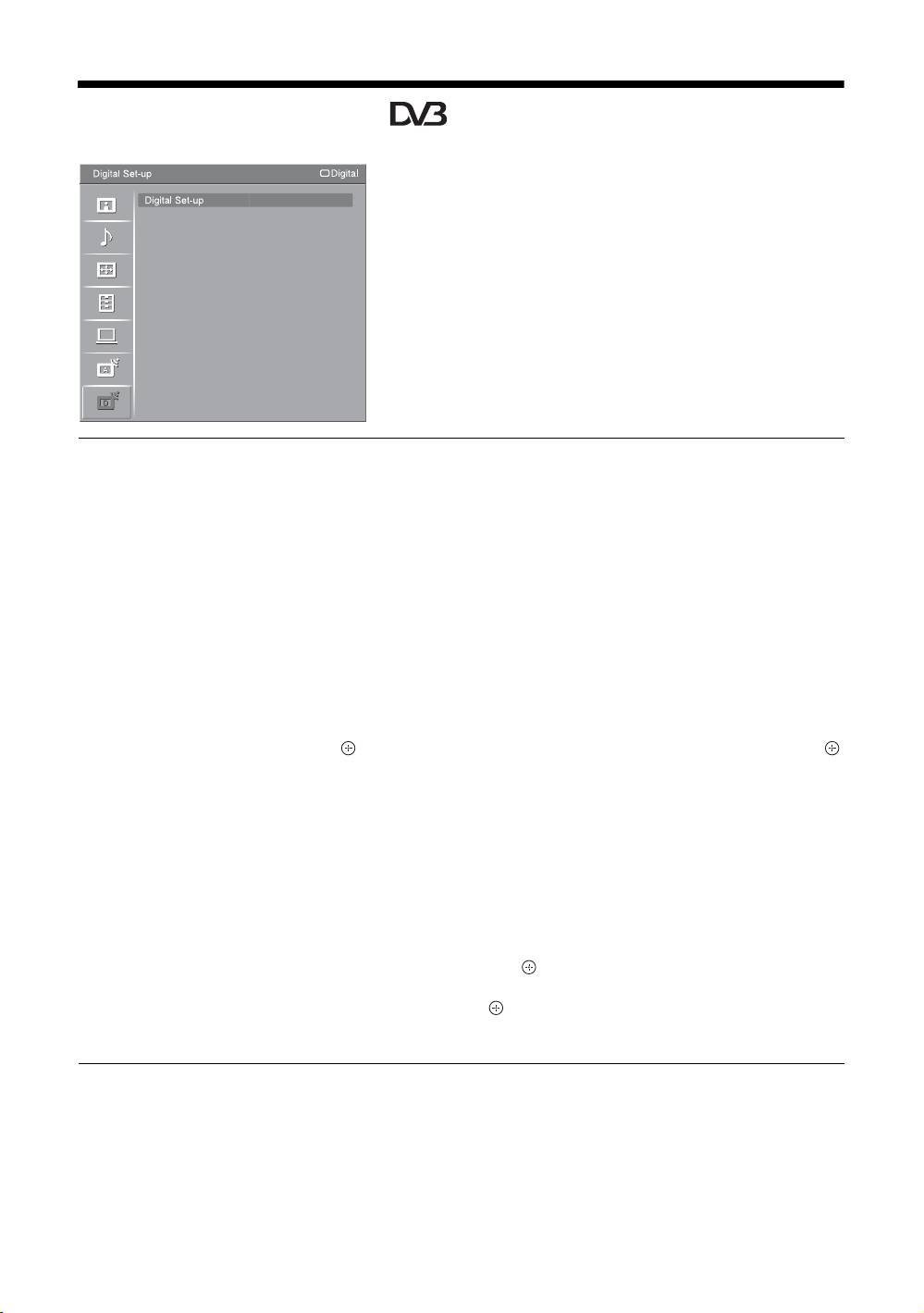
Digital Set-up menu
You can select the options listed below on the “Digital
Set-up” menu. To select options in “Settings”, refer to
“Navigating through menus” (page 20).
~
Some functions may not be available in some countries/
regions.
Digital Tuning
Digital Auto Tuning
Tunes in the available digital channels.
This option allows you to retune the TV after moving house, or to search for new
channels that have been launched by broadcasters. For details, see “Auto-tuning the
TV” on page 6.
Programme List Edit
Removes any unwanted digital channels stored on the TV, and changes the order of
the digital channels stored on the TV.
1 Press
F/f to select the channel you want to remove or move to a new
position.
Press the number buttons to enter the known three-digit programme number of the
broadcast you want.
2 Remove or change the order of the digital channels as follows:
To remove the digital channel
Press . After a confirmation message appears, press G to select “Yes”, then press .
To change the order of the digital channels
Press g, then press F/f to select the new position for the channel and press G.
3 Press RETURN.
Digital Manual Tuning
Tunes the digital channels manually. This feature is available when “Digital Auto
Tuning” is set to “Antenna”.
1 Press the number button to select the channel number you want to
manually tune, then press
F/f to tune the channel.
2 When the available channels are found, press
F/f to select the channel
you want to store, then press .
3 Press F/f to select the programme number where you want to store the
new channel, then press .
Repeat the above procedure to manually tune other channels.
GB
34

Digital Set-up
Subtitle Set-up
“Subtitle Setting”: When “For Hard Of Hearing” is selected, some visual aids may
also be displayed with the subtitles (if TV channels broadcast such information).
“Subtitle Language”: Selects which language subtitles are displayed in.
Audio Set-up
“Audio Type”: Switches to broadcast for the hearing impaired when “For Hard Of
Hearing” is selected.
“Audio Language”: Selects the language used for a programme. Some digital
channels may broadcast several audio languages for a programme.
“Audio Description”: Provides audio description (narration) of visual information,
if TV channels broadcast such information.
“Mixing Level”: Adjusts the TV main audio and Audio Description output levels.
Banner Mode
“Basic”: Displays programme information with a digital banner.
“Full”: Displays programme information with a digital banner, and displays detailed
programme information below that banner.
Radio Display
The screen wallpaper is displayed when listening to a radio broadcast. You can select
the screen wallpaper colour, or display a random colour. To cancel the screen
wallpaper display temporarily, press any button.
Parental Lock
Sets an age restriction for programmes. Any programme that exceeds the age
restriction can only be watched after a PIN Code is entered correctly.
Using MENU Functions
1 Press the number buttons to enter your existing PIN code.
If you have not previously set a PIN, a PIN code entry screen appears. Follow the
instructions of “PIN Code” below.
2 Press F/f to select the age restriction or “None” (for unrestricted
watching), then press .
3 Press RETURN.
PIN Code
To set your PIN for the first time
1 Press the number buttons to enter the new PIN code.
2 Press RETURN.
To change your PIN
1 Press the number buttons to enter your existing PIN code.
2 Press the number buttons to enter the new PIN code.
3 Press RETURN.
z
PIN code 9999 is always accepted.
Technical Set-up
“Auto Service Update”: Enables the TV to detect and store new digital services as
they become available.
“Software Download”: Enables the TV to automatically receive software updates
free through your existing aerial/cable (when issued). It is recommended that this
option be set to “On” at all times. If you do not want your software to be updated, set
this option to “Off”.
“System Information”: Displays the current software version and the signal level.
“Time Zone”: Allows you to manually select the time zone you are in, if it is not the
same as the default time zone setting for your country/region.
Continued
GB
35

“Auto DST”: Sets whether or not to automatically switch between summer time and
winter time.
• “Off”: The time is displayed according to the time difference set by “Time Zone”.
• “On”: Automatically switches between summer time and winter time according to the
calendar.
CA Module Set-up
Allows you to access a pay TV service once you obtain a Conditional Access Module
(CAM) and a view card. See page 16 for the location of the (PCMCIA) socket.
GB
36
Additional Information
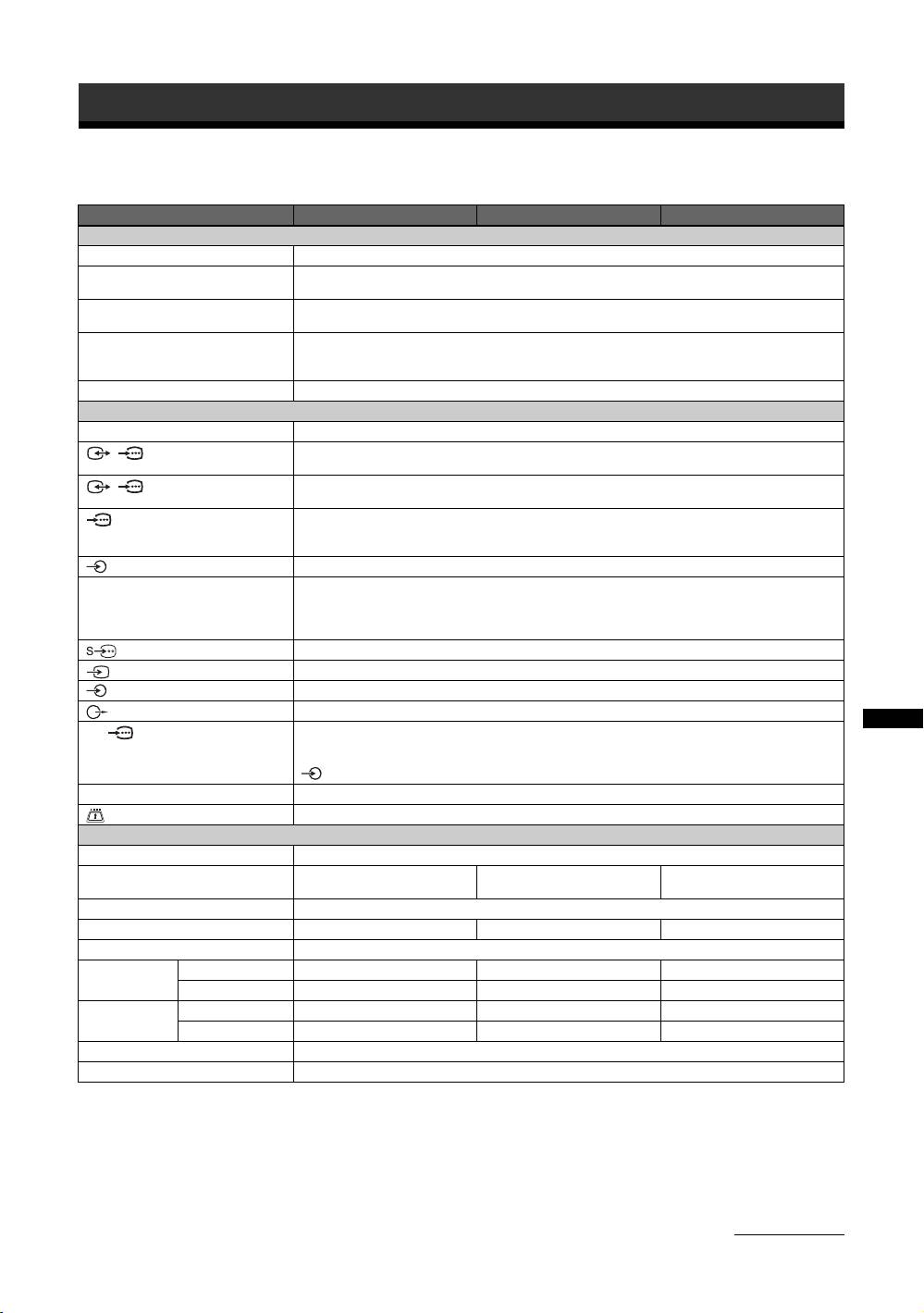
Specifications
Model name KDL-32D3000/32D3010 KDL-40D3000/40D3010 KDL-46D3000/46D3010
System
Panel System
LCD (Liquid Crystal Display) Panel
TV System
Analogue: Depending on your country/region selection: B/G/H, D/K, L, I
Digital: DVB-T/DVB-C
Colour/Video System
Analogue: PAL, SECAM, NTSC 3.58, 4.43 (only Video In)
Digital: MPEG-2 MP@ML
Channel Coverage
Analogue: VHF: E2–E12/UHF: E21–E69/CATV: S1–S20/HYPER: S21–S41
D/K: R1–R12, R21–R69/L: F2–F10, B–Q, F21–F69/I: UHF B21–B69
Digital: VHF/UHF
Sound Output
10 W + 10 W
Input/Output jacks
Aerial/Cable
75 ohm external terminal for VHF/UHF
/1
21-pin scart connector (CENELEC standard) including audio/video input, RGB input, and TV audio/
video output.
/2 (SmartLink)
21-pin scart connector (CENELEC standard) including audio/video input, RGB input, selectable audio/
video output, and SmartLink interface.
3
Supported formats: 1080p, 1080i, 720p, 576p, 576i, 480p, 480i
Y: 1 Vp-p, 75 ohms, 0.3V negative sync/P
B/CB: 0.7 Vp-p, 75 ohms/
P
R/CR: 0.7 Vp-p, 75 ohms
3
Audio input (phono jacks): 500 mVrms, Impedance: 47 kilohms
HDMI IN 4, 5, 7
Video: 1080/24p, 1080p, 1080i, 720p, 576p, 576i, 480p, 480i
Audio: Two channel linear PCM
32, 44.1 and 48 kHz, 16, 20 and 24 bits
Analogue audio input (phono jacks): 500 mVrms, Impedance: 47 kilohms (HDMI IN 5 only)
6
S video input (4-pin mini DIN)
6
Video input (phono jack)
6
Audio input (phono jacks)
DIGITAL OUT (OPTICAL) (digital optical jack)/Audio output (phono jacks)
PC
PC Input (D-sub 15-pin) (see page 38)
G: 0.7 Vp-p, 75 ohms, non Sync on Green/B: 0.7 Vp-p, 75 ohms/
Additional Information
R: 0.7 Vp-p, 75 ohms/HD: 1-5 Vp-p/VD: 1-5 Vp-p
PC audio input (minijack)
i
Headphones jack
CAM (Conditional Access Module) slot
Power and others
Power Requirements
220–240 V AC, 50 Hz
Screen Size
32 inches (Approx. 80.0 cm
40 inches (Approx. 101.5 cm
46 inches (Approx. 116.8 cm
measured diagonally)
measured diagonally)
measured diagonally)
Display Resolution
1,366 dots (horizontal) × 768 lines (vertical)
Power Consumption
149 W 169 W 199 W
Standby Power Consumption*
0.3 W
Dimensions
(with stand)
Approx. 790 × 577 × 214 mm Approx. 981 × 692 × 265 mm Approx. 1,114 × 778 × 306 mm
(w × h × d)
(without stand)
Approx. 790 × 530 × 100 mm Approx. 981 × 643 × 110 mm Approx. 1,114 × 730 × 115 mm
Mass (with stand)
Approx. 16.5 kg Approx. 24.5 kg Approx. 31.0 kg
(without stand)
Approx. 14.5 kg Approx. 21.0 kg Approx. 27.0 kg
Supplied Accessories
Refer to “1: Checking the accessories” on page 4.
Optional Accessories
Wall-Mount Bracket SU-WL500
* Specified standby power is reached after the TV finishes necessary internal processes.
Design and specifications are subject to change without notice.
Continued
GB
37

PC Input Signal Reference Chart
Horizontal
Vertical
Signals Horizontal (Pixel) Vertical (Line)
frequency
Standard
frequency (Hz)
(kHz)
VGA 640 480 31.5 60 VGA
640 480 37.5 75 VESA
720 400 31.5 70 VGA-T
SVGA 800 600 37.9 60 VESA Guidelines
800 600 46.9 75 VESA
XGA 1024 768 48.4 60 VESA Guidelines
1024 768 56.5 70 VESA
1024 768 60 75 VESA
WXGA 1280 768 47.4 60 VESA
1280 768 47.8 60 VESA
1360 768 47.7 60 VESA
• This TV’s PC input does not support Sync on Green or Composite Sync.
• This TV’s PC input does not support interlaced signals.
• For the best picture quality, it is recommended to use the signals (boldfaced) in the above chart with a 60 Hz vertical frequency
from a personal computer. In plug and play, signals with a 60 Hz vertical frequency will be selected automatically.
GB
38

• The picture of a display unit is composed of pixels. Tiny
black points and/or bright points (pixels) on the screen do
Troubleshooting
not indicate a malfunction.
The picture contours are disrupted
• Select “Standard” or “Off” in “Motion Enhancer”
Check whether the 1 (standby) indicator is
(page 26).
flashing in red.
No colour on programmes
• Select “Reset” (page 21).
When it is flashing
No colour or irregular colour when viewing a
The self-diagnosis function is activated.
signal from the 3 sockets
1 Count how many 1 (standby) indicator
• Check the connection of the 3 sockets and check if
flashes between each two second break.
each sockets are firmly seated in their respective sockets.
For example, the indicator flashes three times, then
there is a two second break, followed by another
Sound
three flashes, etc.
2 Press 1 on the top edge of the TV to turn it
No sound, but good picture
off, disconnect the mains lead, and inform
• Press 2 +/– or % (Mute).
your dealer or Sony service centre of how
• Check if the “Speaker” is set to “TV Speaker” (page 27).
the indicator flashes (number of flashes).
When it is not flashing
Channels
1 Check the items in the tables below.
The desired channel cannot be selected
2 If the problem still persists, have your TV
• Switch between digital and analogue mode and select the
serviced by qualified service personnel.
desired digital/analogue channel.
Some channels are blank
Picture
• Scrambled/Subscription only channel. Subscribe to the
pay TV service.
No picture (screen is dark) and no sound
• Channel is used only for data (no picture or sound).
• Check the aerial/cable connection.
• Contact the broadcaster for transmission details.
• Connect the TV to the mains, and press 1 on the top edge
of the TV.
Digital channels are not displayed
• If the 1 (standby) indicator lights up in red, press "/1.
• Contact a local installer to find out if digital transmissions
are provided in your area.
No picture or no menu information from equipment
• Upgrade to a higher gain aerial.
connected to the scart connector
• Press / to display the connected equipment list,
then select the desired input.
General
Additional Information
• Check the connection between the optional equipment and
the TV.
The TV turns off automatically (the TV enters
Double images or ghosting
standby mode)
• Check the aerial/cable connection.
• Check if the “Sleep Timer” is activated, or confirm the
• Check the aerial location and direction.
“Duration” setting of “On Timer” (page 28).
• If no signal is received and no operation is performed in
Only snow and noise appear on the screen
the TV mode for 10 minutes, the TV automatically
• Check if the aerial is broken or bent.
switches to standby mode.
• Check if the aerial has reached the end of its serviceable
The TV turns on automatically
life (three to five years in normal use, one to two years at
• Check if the “On Timer” is activated (page 28).
the seaside).
Some input sources cannot be selected
Distorted picture (dotted lines or stripes)
• Select “AV Preset” and cancel “Skip” of the input source
• Keep the TV away from electrical noise sources such as
(page 27).
cars, motorcycles, hair-dryers or optical equipment.
• When installing optional equipment, leave some space
The remote does not function
between the optional equipment and the TV.
• Replace the batteries.
• Make sure that the aerial/cable is connected using the
The “Store Display Mode: On” message appears
supplied coaxial cable.
on the screen
• Keep the aerial/cable TV cable away from other
• Select “All Reset” in the “Set-up” menu (page 29).
connecting cables.
HDMI equipment does not appear on “HDMI Device
Picture or sound noise when viewing a TV channel
List”
• Adjust “AFT” (Automatic Fine Tuning) to obtain better
• Check that your equipment is HDMI control compatible
picture reception (page 32).
equipment.
Some tiny black points and/or bright points appear
Not all channels are tuned
on the screen
• Check support web site for cable provide information.
http://support.sony-europe.com/TV/DVBC
GB
39
Введение
Предупреждение относительно
функции цифрового телевидения
Благодарим вас за то, что выбрали данный
продукт компании Sony.
• Функции, связанные с цифровым телевидением
Перед началом работы с телевизором
( ) доступны только в странах или регионах,
внимательно прочитайте настоящее
использующих цифровой формат наземного
руководство и сохраните его на случай, если
телевещания DVB-T (MPEG2) или при наличии
оно Вам понадобится.
доступа к услугам кабельной телевизионной сети,
совместимым с форматом DVB-C (MPEG2).
Пожалуйста, выясните у специалиста своей
дилерской компании, находитесь ли Вы в зоне
приема сигнала DVB-T или выясните у
специалиста своего оператора кабельного
Утилизация телевизора
телевидения, отвечает ли их кабельная услуга
DVB-C требованиям интегрированной работы с
Утилизация электрического
данным телевизором.
и электронного
• Оператор кабельного телевидения может взимать
оборудования (директива
дополнительную оплату за такие услуги, и Вам,
применяется в странах
возможно, потребуется согласовать условия
Евросоюза и других
работы.
• Несмотря на то, что данный телевизор
европейских странах, где
соответствует требованиям DVB-T и DVB-C,
действуют системы
совместимость с будущими стандартами
раздельного сбора отходов)
наземного телевещания DVB-T и кабельного
Данный знак на устройстве
телевещания DVB-C не гарантируется.
или его упаковке обозначает,
• Некоторые функции цифрового телевидения
что данное устройство нельзя
могут быть недоступны в некоторых странах/
утилизировать вместе с
регионах, и кабельное телевидение DVB-C может
прочими бытовыми отходами.
работать неправильно у некоторых операторов
Его следует сдать в соответствующий приемный
кабельного телевидения.
пункт переработки электрического и электронного
оборудования. Неправильная утилизация данного
Для получения списка совместимых операторов
изделия может привести к потенциально негативному
кабельного телевидения, обратитесь к следующему
влиянию на окружающую среду и здоровье людей,
веб-сайту:
поэтому для предотвращения подобных последствий
http://support.sony-europe.com/TV/DVBC
необходимо выполнять специальные требования по
утилизации этого изделия. Переработка данных
материалов поможет сохранить природные ресурсы.
Для получения более подробной информации о
переработке этого изделия обратитесь в местные
органы городского управления, службу сбора
Информация о товарных знаках
бытовых отходов или в магазин, где было
• is a registered trademark of the DVB Project
приобретено изделие.
• HDMI, логотип HDMI и High-Definition
Multimedia Interface являются товарными знаками
или зарегистрированными товарными знаками
компании HDMI Licensing LLC.
Рисунки, использованные в данном
руководстве, относятся к модели KDL-
40D3000, если не сделана оговорка.
RU
2
