Sony HVL-F36AM: instruction
Class: Video Audio Photo Equipment
Type:
Manual for Sony HVL-F36AM
Table of contents
2-687-522-23 (1)
Flash
Operating Instructions
Manual de instruções
Manual de instrucciones
Bruksanvisning
HVL-F36AM
© 2006 Sony Corporation Printed in Japan

English
Before operating the product, please read this manual thoroughly and
retain it for future reference.
WARNING
To reduce fire or shock hazard, do not expose the unit to rain or moisture.
Tape over lithium battery contacts to avoid short-circuit when disposing of
batteries, and follow local regulations for battery disposal.
Keep batteries or things that could be swallowed away from young
children. Contact a doctor immediately if an object is swallowed.
Immediately remove the batteries and discontinue use if...
• the product is dropped or subjected to an impact in which the interior is
exposed.
• the product emits a strange smell, heat, or smoke.
Do not disassemble. Electric shock may occur if a high voltage circuit
inside the product is touched.
IMPORTANT SAFETY
INSTRUCTIONS
When using your photographic equipment, basic safety
precautions should always be followed, including the
following:
Read and understand all instructions before using.
Close supervision is necessary when any appliance is used
by or near children. Do not leave appliance unattended
while in use.
Care must be taken as burns can occur from touching hot
parts.
2
Do not operate appliance with a damaged cord or if the
appliance has been dropped or damaged- until it has been
examined by a qualified serviceman.
Let appliance cool completely before putting away. Loop
cord loosely around appliance when storing.
To reduce the risk of electric shock, do not immerse this
appliance in water or other liquids.
To reduce the risk of electric shock, do not disassemble this
appliance, but take it to a qualified serviceman when
service or repair work is required. Incorrect reassembly can
cause electric shock when the appliance is used
subsequently.
The use of an accessory attachment not recommended by
the manufacturer may cause a risk of fire, electric shock, or
injury to persons.
Batteries may become hot or explode due to improper use.
Use only the batteries specified in this instruction manual.
Do not install the batteries with the polarity (+/-) reversed.
Do not subject batteries to fire or high temperatures.
Do not attempt to recharge (except for rechargeable
batteries), short or disassemble.
Do not mix, batteries of different types, brands or ages.
SAVE THESE
INSTRUCTIONS
CAUTION
Do not touch the flashtube during operation, it may become hot
when the flash fires.
3
For customers in Europe
Disposal of Old Electrical & Electronic Equipment
(Applicable in the European Union and other European
countries with separate collection systems)
This symbol on the product or on its packaging indicates that
this product shall not be treated as household waste. Instead
it shall be handed over to the applicable collection point for
the recycling of electrical and electronic equipment. By
ensuring this product is disposed of correctly, you will help
prevent potential negative consequences for the environment
and human health, which could otherwise be caused by
inappropriate waste handling of this product. The recycling
of materials will help to conserve natural resources. For more
detailed information about recycling of this product, please
contact your local Civic Office, your household waste
disposal service or the shop where you purchased the
product.
For the customers in the U.S.A.
CAUTION
You are cautioned that any changes or modifications not expressly
approved in this manual could void your authority to operate this
equipment.
NOTE:
This equipment has been tested and found to comply with the limits for a
Class B digital device, pursuant to Part 15 of the FCC Rules.
These limits are designed to provide reasonable protection against harmful
interference in a residential installation.
This equipment generates, uses, and can radiate radio frequency energy
and, if not installed and used in accordance with the instructions, may
cause harmful interference to radio communications.
However, there is no guarantee that interference will not occur a particular
installation. If this equipment does cause harmful interference to radio or
television reception, which can be determined by turning the equipment
off and on, the user is encouraged to try to correct the interference by one
or more of following measures:
– Reorient or relocate the receiving antenna.
– Increase the separation between the equipment and receiver.
– Connect the equipment into an outlet on a circuit different from that to
which the receiver is connected.
– Consult the dealer or an experienced radio/TV technician for help.
4

Table of contents
Features ................................................................................................. 6
Name of parts ....................................................................................... 7
Control panel ........................................................................................ 8
Preparations
Inserting batteries ................................................................................ 9
Attachment and removal of the flash ............................................. 11
Auto power ON/OFF ....................................................................... 12
Basics
Program auto flash (The basics) ...................................................... 13
Recording modes ............................................................................... 16
Apprications
Zoom flash coverage ......................................................................... 18
Bounce flash ....................................................................................... 22
AF illuminator .................................................................................... 25
High-speed sync (HSS) ..................................................................... 26
Wireless flash mode (WL)................................................................. 28
Time to auto power off...................................................................... 35
Additional Information
Flash range.......................................................................................... 37
Notes on use ....................................................................................... 39
Maintenance ....................................................................................... 40
Specifications ...................................................................................... 41
5

Before use
For details, refer to the operating instructions supplied with your camera.
This flash is not dust-proof, splash-proof or waterproof.
Do not place this flash in the following locations
Regardless of whether this unit is in use or in storage, do not place it in any
of the following locations. Doing so may lead to a malfunction.
• Placing this flash in locations subject to direct sunlight such as on
dashboards or near a heater may cause this unit to deform or
malfunction.
• Locations with excessive vibration
• Locations with strong electromagnetism
• Locations with excessive sand
In locations such as the seashore and other sandy areas or where dust
clouds occur, protect the unit from sand and dust.
This may lead to a malfunction.
Features
•A compact flash that provides a flash output with a maximum guide
number 36 (85 mm position, ISO 100 · m).
• Can be used with compatible lenses to enable ADI (Advanced Distance
Integration) flash metering, which is not affected by the reflection rate of
the background or subject.
• Enables High-speed Sync.
• Provides many functions such as bounce flash, etc.
6
Name of parts
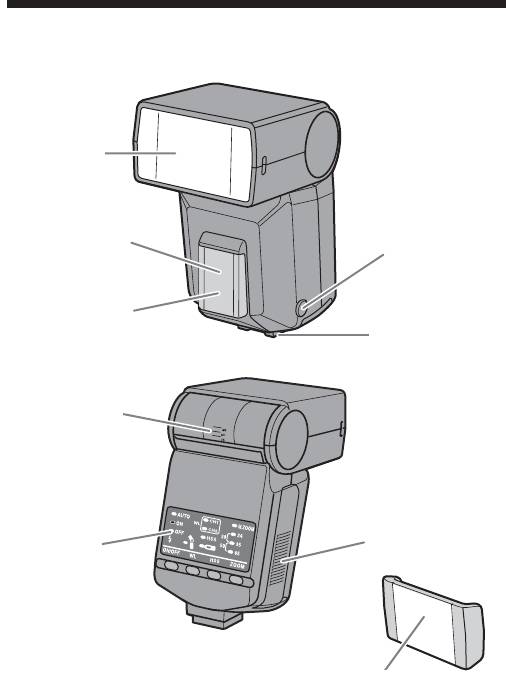
Flashtube
Wireless control-
signal receiver
Mounting-foot-
(28)
release button (11)
AF illuminator
(25)
Mounting foot
Bounce indicator
(22)
Battery-chamber
door (9)
Control panel
(8)
Wide panel (21)
Remove the protective sheet from the front
of the AF illuminator before use.
7
Control panel
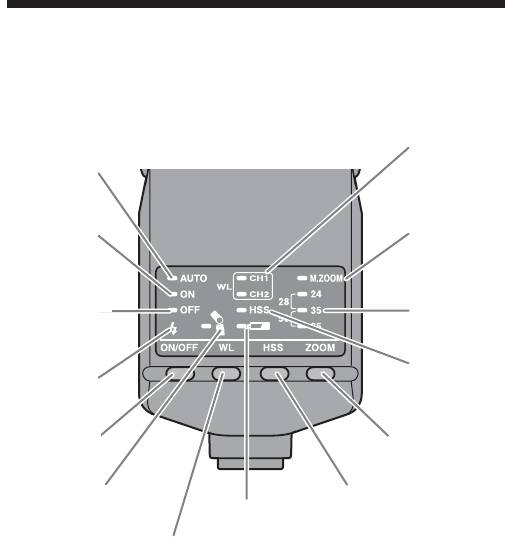
Wireless flash
lamps (28)
Auto lamp (13)
Manual-ZOOM
lamp (20)
Flash-ON lamp
(12)
ZOOM (flash
coverage)
Flash-OFF lamp
lamps (20)
(12)
High-speed-
Flash-ready
sync lamp
lamp (14)
(26)
ZOOM (flash
Flash ON/OFF
coverage)
button (12)
selection button
(20)
Bounce lamp (22)
High-speed-sync
Low-battery
button (26)
lamp (10)
Wireless flash
button (28)
8
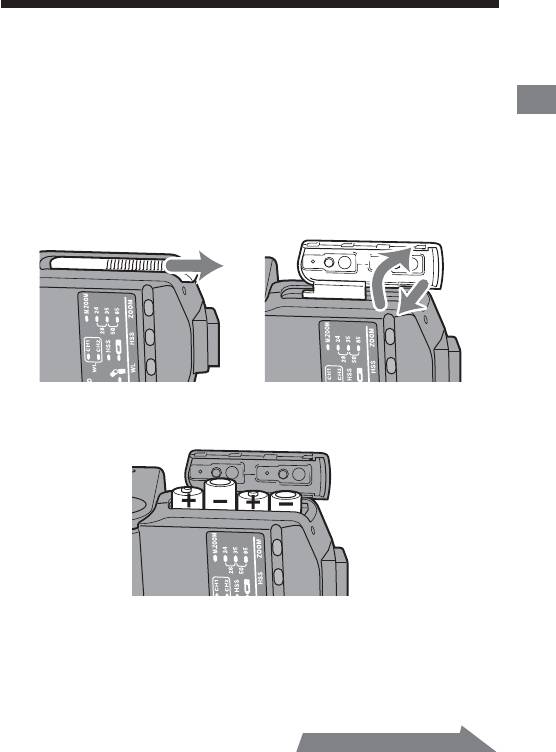
Inserting batteries
The HVL-F36AM may be powered by :
*Batteries are not supplied.
• Four AA-size alkaline batteries
Preparations
• Four AA-size lithium batteries
• Four AA-size rechargeable nickel-metal hydride (Ni-MH) batteries
Always ensure that rechargeable nickel-metal hydride batteries are
charged in the specified charger unit.
1 Open the battery-chamber door as shown.
1
3
2
2 Insert the batteries in the battery chamber as in the
diagram.
3 Close the battery-chamber door.
• Follow the reverse steps when opening the battery-chamber door.
• The lamp on the control panel comes on. If it does not come on,
press the flash ON/OFF button.
Continued on the next page
9
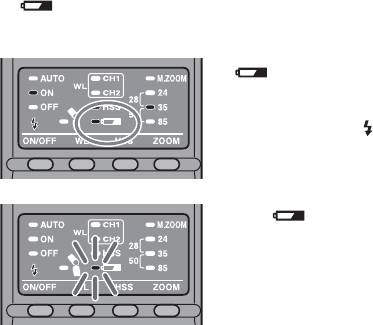
Checking Batteries
The lamp on the control panel comes on or blinks when the batteries
are low.
lamp on
Changing the batteries is
recommended. The flash can still be
used in this state if (Flash-ready
lamp) on the rear of the unit is lit.
Only lamp blinking
Flash cannot be used.
Insert new batteries.
• If nothing comes on when the flash ON/OFF button is pressed, check
the orientation of the batteries.
10
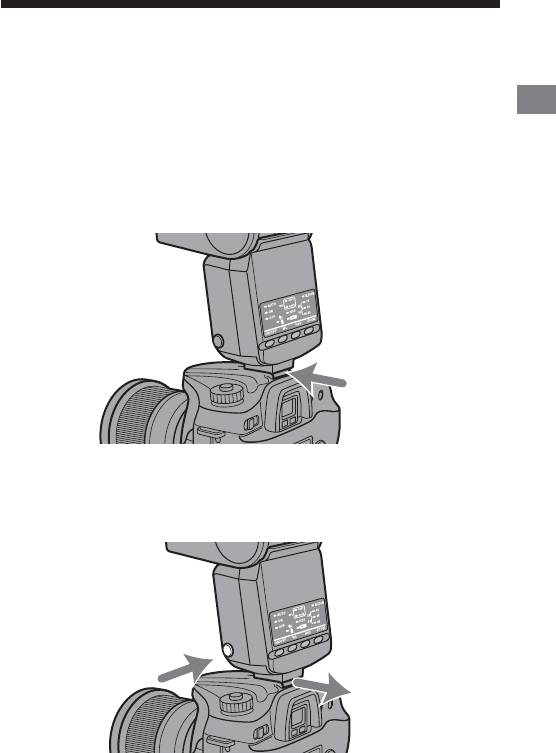
Attachment and removal of the
flash
Attaching the flash to the camera
Preparations
Push the mounting foot firmly onto the camera until it
stops.
• The flash is locked in place automatically.
• If the built-in flash in the camera is protruding, lower it before attaching
the flash unit.
Removing the flash from the camera
While pressing the mounting-foot release button 1,
remove the flash 2.
1
2
11
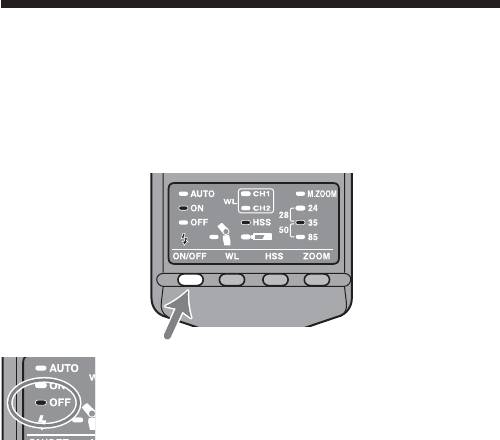
Auto power ON/OFF
Press the flash ON/OFF button on the back side of the
flash.
Power of the flash turns it on.
• When the power of the flash is turned on, the flash-ON lamp on the
control panel comes on.
If you press the flash ON/OFF button while the flash is
turned on, the flash switches off and the flash-OFF lamp
on the control panel comes on.
• The flash-OFF lamp goes out after 8 seconds.
Auto power off
When the camera or flash is not used for four minutes, power switches off
and control panel indicators disappear automatically to save the batteries.
• In wireless flash photography (p. 28), control panel indicators disappear
after 60 minutes.
• You can change the time until auto power off, or disable auto power off.
(p. 35)
12
Program auto flash (The basics)
1 Select the P mode on the camera.
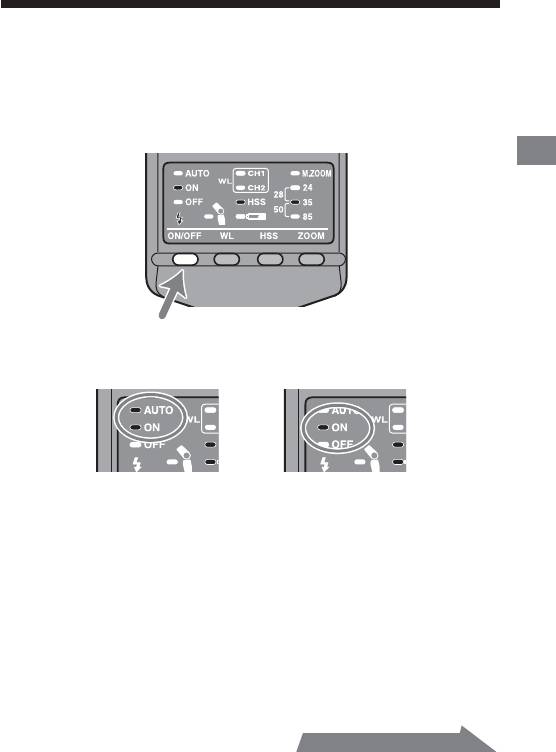
2 Press the flash ON/OFF button to turn on the “AUTO”
and “ON” lamps or the “ON” lamp on the control panel.
Basics
• The “AUTO” and “ON” lamps come on with Autoflash. Only the
“ON” lamp comes on with Fill-flash.
Continued on the next page
13
3 When the flash is charged, press the shutter button to
take a photo.
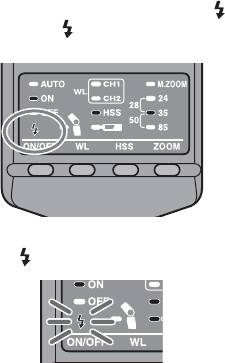
• The flash is charged when the flash-ready lamp on the control
panel of the unit and the indicator in the camera viewfinder are
both on.
When the correct exposure has been obtained for the photo just taken,
the flash-ready lamp on the control panel blinks.
• The photo will be under-exposed if taken before charging is complete.
• Press the shutter button after making sure that charging is complete
when using the flash with the self-timer.
• Either Autoflash or Fill-flash is selected, depending on your camera. For
details, refer to the operating instructions of your camera.
• If your camera has AUTO mode or Scene Selection mode, they are dealt
with here as program auto.
14
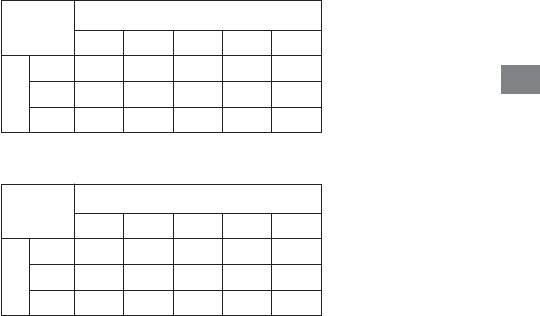
• The following tables show the distance reached by the light from the
flash (i.e. the flash range).
See page 37 for further details.
Focal length (mm)
ISO100
24 28 35 50 85
2.8 1-7 1-8 1-9 1-10 1-13
4 1-5 1-5.5 1-6 1-7 1-9
Basics
Aperture
5.6 1-3.5 1-4 1-4.5 1-5 1-6.5
(unit : m)
Focal length (mm)
ISO400
24 28 35 50 85
2.8 1-14 1-16 1-18 1-20 1.2-26
4 1-10 1-11 1-12.5 1-15 1-18
Aperture
5.6 1-7 1-8 1-9 1-10 1-13
(unit : m)
15
Recording modes
Aperture priority flash photography (A)
1 Select the A mode on the camera.
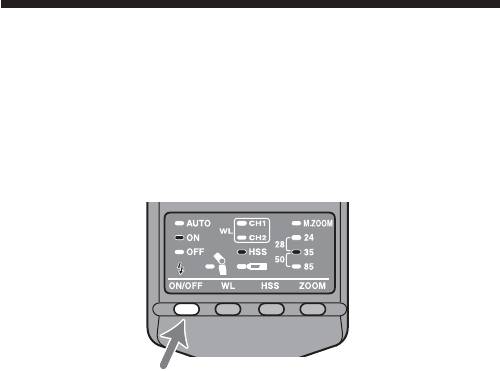
2 Press the flash ON/OFF button to turn on the flash-ON
lamp.
• Fill-flash is selected.
3 Set the aperture and focus the subject.
• Reduce the aperture (i.e. increase the f-stop) to reduce the flash
range, or open the aperture (i.e. reduce the f-stop) to increase the
flash range.
• The shutter speed is automatically set.
4 Press the shutter button when charging is complete.
16

Shutter speed priority flash
photography (S)
1 Select the S mode on the camera.
2 Press the flash ON/OFF button to turn on the flash-ON
lamp.
• Fill-flash is selected.
Basics
3 Set the shutter speed, and focus the subject.
4 Press the shutter button when charging is complete.
Manual exposure mode flash
photography (M)
1 Select the M mode on the camera.
2 Press the flash ON/OFF button to turn on the flash-ON
lamp.
• Fill-flash is selected.
3 Set the aperture and shutter speed, and focus the
subject.
• Reduce the aperture (i.e. increase the f-stop) to reduce the flash
range, or open the aperture (i.e. reduce the f-stop) to increase the
flash range.
4 Press the shutter button when charging is complete.
17
Zoom flash coverage
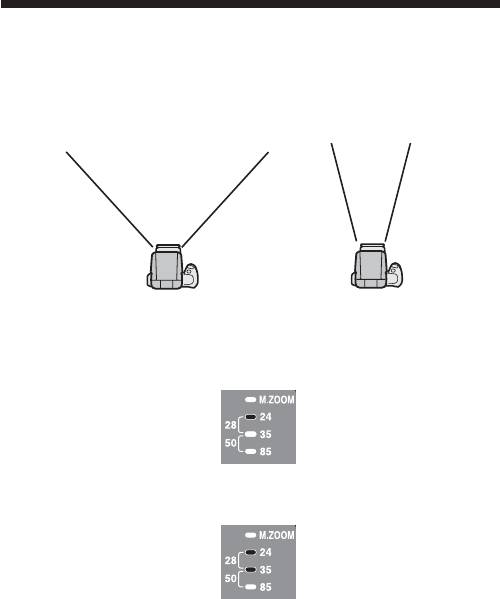
Auto zoom
This flash automatically switches zoom coverage to cover a range of focal
lengths from 24 mm to 85 mm when photographing (auto zoom).
Normally, you do not need to switch the zoom coverage manually.
24 mm focal length 85 mm focal length
• Press the shutter button partway down.
When the coverage is set to 24 mm, 35 mm or 85 mm, the corresponding
lamp comes on.
For example : 24 mm
When the coverage is set to 28 mm or 50 mm, two lamps come on.
For example : 28 mm
18
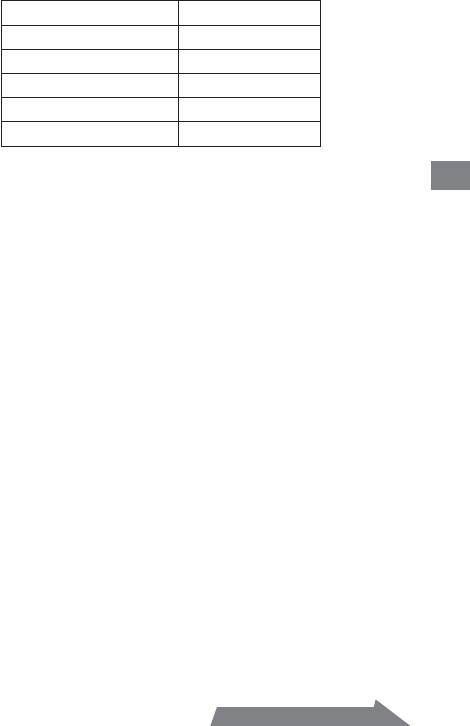
• Auto zoom coverage is set as follows:
Focal length in use Coverage
24 mm - 27 mm 24 mm
28 mm - 34 mm 28 mm
35 mm - 49 mm 35 mm
50 mm - 84 mm 50 mm
85 mm or more 85 mm
• When a lens having a focal length of less than 24 mm is used with auto
zoom, “24 mm” lamp blinks. Use of the wide panel (p. 21) is
Applications
recommended in this case to prevent darkening at the periphery of the
image.
Continued on the next page
19
Manual zoom
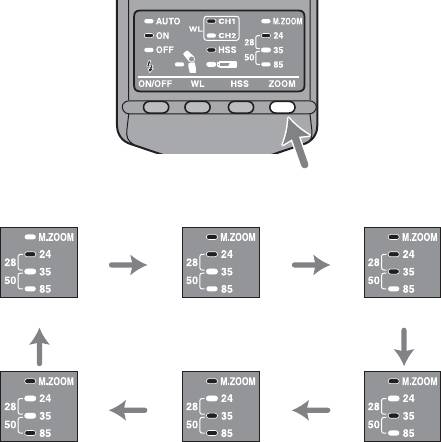
You can manually set the zoom coverage regardless of the focal length of
the lens in use.
Press the ZOOM button to display the desired zoom
coverage.
• Zoom coverage is changed in the following order.
The manual-ZOOM lamp “M.ZOOM” comes on.
Auto Zoom 24 mm 28 mm
85 mm 50 mm 35 mm
• If the zoom coverage is set to less than the focal length of the lens in use,
the periphery of the screen darkens.
20