Sony MZ-B100 – page 3
Manual for Sony MZ-B100
Table of contents
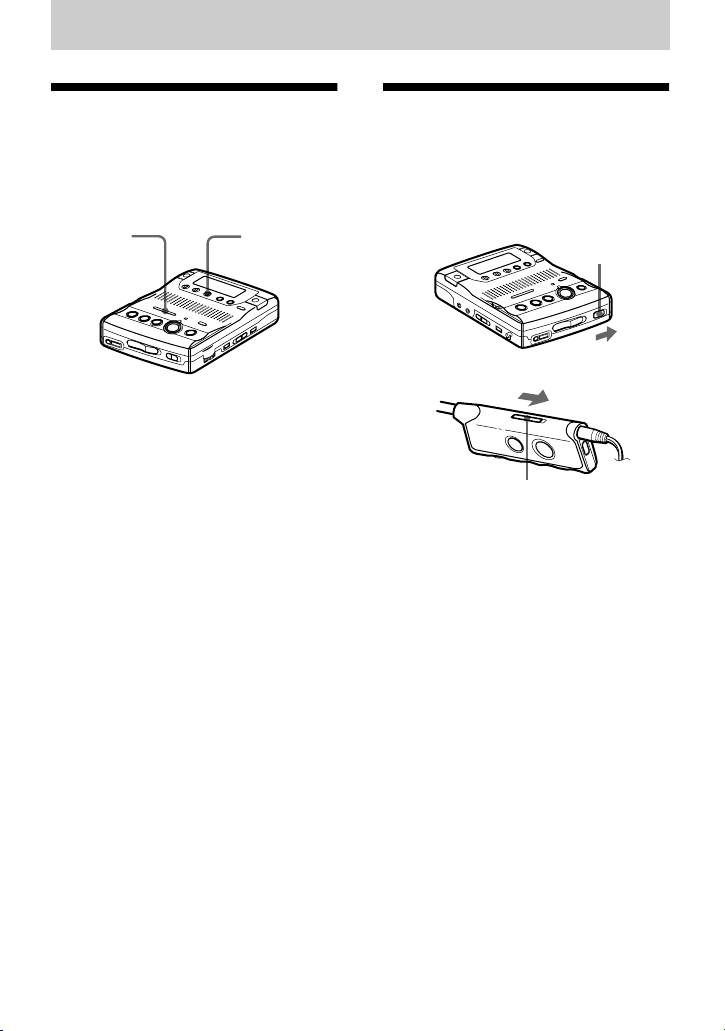
Other operations
Adjusting the contrast
Locking the controls
of the display window
(HOLD)
(Contrast adjustment)
To prevent the buttons from being
You can adjust the contrast of the display
accidentally operated when you carry the
window on the recorder.
recorder, use this function.
./>
EDIT/
ENTER
HOLD
1 While the recorder is stopped, press
EDIT/ENTER.
2 Press . or > repeatedly until
“CONTRAST” flashes in the display,
HOLD
and then press EDIT/ENTER.
3 Press . or > repeatedly to
adjust the contrast, and then press
1 Slide HOLD to the direction of the
EDIT/ENTER.
..
On the recorder, slide HOLD to lock
z
the controls of the recorder. On the
You can also use the SPEED CONTROL dial to
remote control, slide HOLD to lock
select and then enter the menu. Turn the dial
(instead of ./>) to show the menu items
the controls of the remote control.
one by one and press the dial (instead of EDIT/
Slide HOLD in the opposite direction
ENTER) to enter the selected menu.
of the arrow to unlock the controls.
41-GB
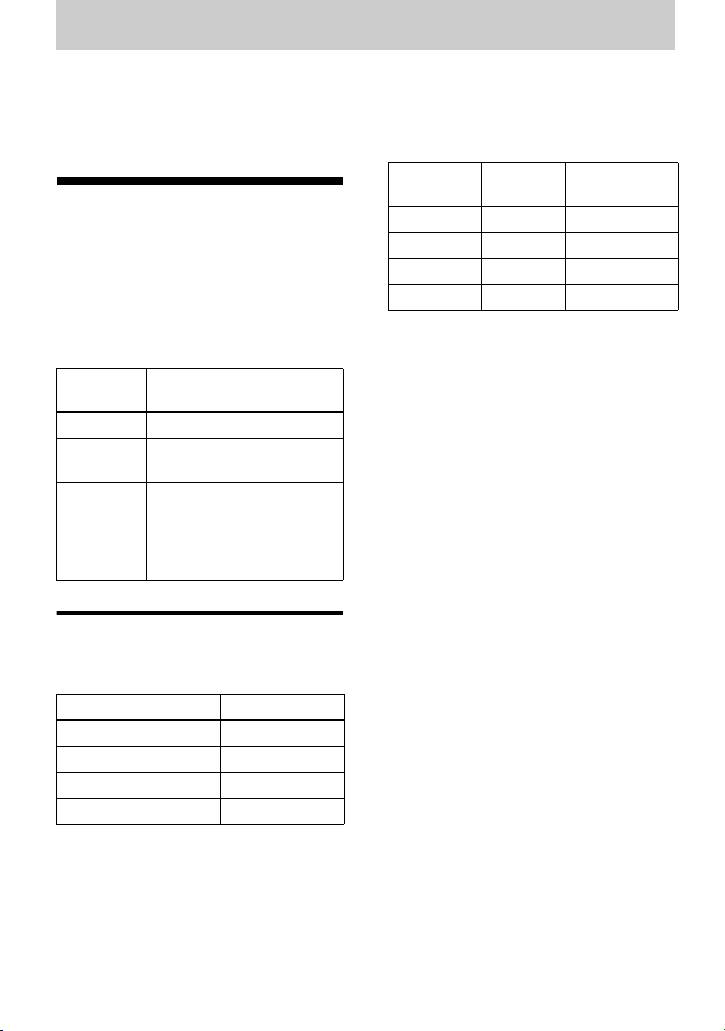
Power sources
4)
You can power the recorder not only with
Measured in accordance with the JEITA
(Japan Electronics and Information
alkaline dry battery (not supplied) but also
Technology Industries Association) standard.
with house current. You cannot, however,
1)
use manganese dry battery.
When playing
2)
(Unit: approx.hours)(JEITA
)
3)
4)
Recording
Speaker
Headphones
mode
When to replace the
Stereo 25.5 34.5
batteries
LP2 Stereo 27 39.5
You can check the battery condition with
LP4 Stereo 30 43
the battery indication which is displayed
while using the player. The battery
MONO 30 43
indicator changes as the table below due
1)
When using a Sony LR6 (SG) “STAMINA”
to the battery condition.
alkaline dry battery (produced in Japan).
The battery level indicator is approximate.
2)
Measured in accordance with the JEITA
(Japan Electronics and Information
Battery
Condition
Technology Industries Association) standard.
indicator
3)
When played using the built-in speaker.
4)
t Battery power decreasing.
When played using headphones.
r
Weak battery.
Notes
(flashing)
• Stop the recorder before replacing batteries.
• An optional AC power adaptor is
e
The battery has gone out.
recommended for long recording.
(flashing)
“LOW BATT” flashes in
the display on the remote
control, and the power
goes off.
1)
Battery life
2)3)
When recording
4)
(Unit: approx.hours)(JEITA
)
Recording mode Approx. hours
Stereo 9
LP2 Stereo 12.5
LP4 Stereo 15
MONO 12
1)
The battery life may be shorter due to
operating conditions and the temperature of
the location.
2)
When using a Sony LR6 (SG) “STAMINA”
alkaline dry battery (produced in Japan).
Recording time may differ according to the
alkaline batteries.
3)
When recorded with the built-in microphones.
42-GB
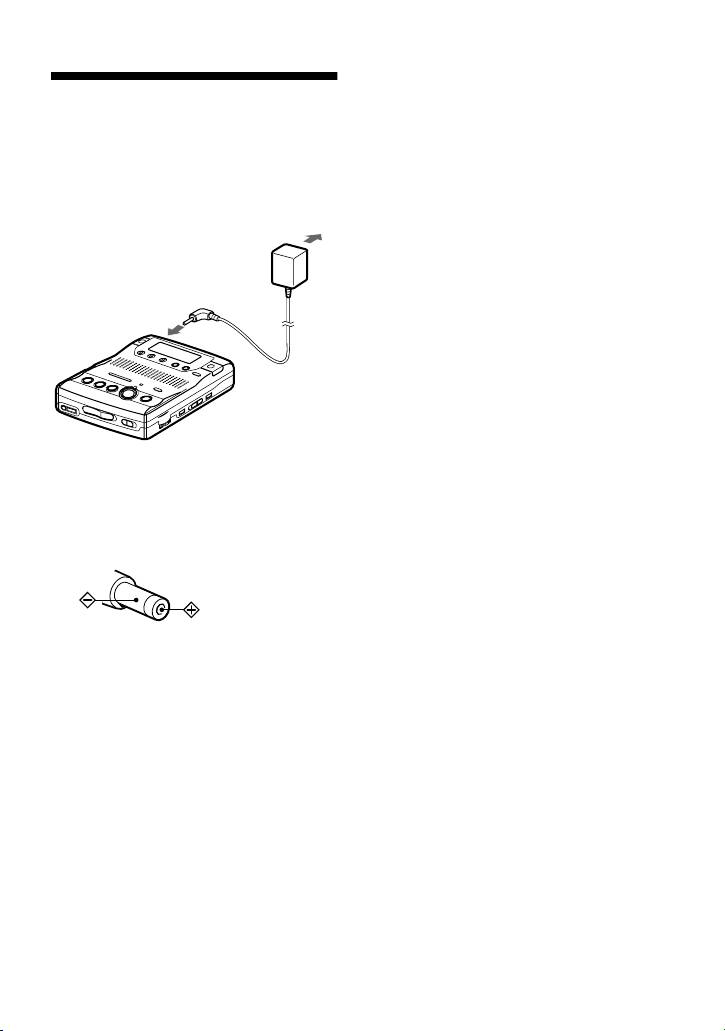
Using house current
1 Connect the AC power adaptor AC-
E30HG (not supplied) to DC IN 3V.
2 Connect the AC power adaptor (not
supplied) to the wall outlet.
to wall outlet
to DC IN 3V
AC power
adaptor (not
supplied)
Notes
• For use in your house: Use the AC power
adaptor AC-E30HG (not supplied). Do not use
any other AC power adaptor since it may
cause the recorder to malfunction.
Polarity of the
plug
• There are regional differences in AC-E30HG
specifications. For this reason, you should
verify that the power requirements and plug
configuration are appropriate for your area
before you purchase the recorder.
• Make sure to connect the AC power adaptor to
a wall outlet that is within easy reach, and
disconnect it quickly if an unusual condition
arises.
43-GB

Additional information
On the headphones
Precautions
Road safety
Do not use the headphones while driving,
On safety
cycling, or operating any motorized vehicle. It
Do not put any foreign objects in the DC IN 3V
may create a traffic hazard and is illegal in
jack.
many areas. It can also be potentially dangerous
to play your recorder at high volume while
On power sources
walking, especially at pedestrian crossings. You
should exercise extreme caution or discontinue
• Use LR6 (size AA) batteries, house current, or
use in potentially hazardous situations.
car battery.
• The recorder is not disconnected from the AC
Preventing hearing damage
power source (mains) as long as it is
Avoid using he headphones at high volume.
connected to the wall outlet, even if the
Hearing experts advise against continuous, loud
recorder itself has been turned off.
and extended play. If you experience a ringing
• If you are not going to use this recorder for a
in your ears, reduce the volume or discontinue
long time, be sure to disconnect the power
use.
supply (an optional AC power adaptor, dry
batteries, or car battery cord). To remove the
Caring for others
AC power adaptor (not supplied) from the
Keep the volume at a moderate level. This will
wall outlet, grasp the adaptor plug itself; never
allow you to hear outside sounds and to be
pull the cord.
considerate of the people around you.
On heat build-up
On the MiniDisc cartridge
Heat may build up in the recorder if it is used
• When carrying or storing the MiniDisc, keep
for an extended period of time. In this case,
it in its case.
leave the recorder turned off until it cools down.
• Do not break open the shutter.
• Do not place the cartridge where it will be
On installation
subject to light, extreme temperatures,
• Never use the recorder where it will be
moisture or dust.
subjected to extremes of light, temperature,
• Attach the supplied MD label only in the
moisture or vibration.
space designated for it on the disc. Do not
• Never wrap the recorder in anything when it is
stick it on any other disc surface.
being used with the AC power adaptor (not
supplied). Heat build-up in the recorder may
On cleaning
cause malfunction or damage.
• Clean the recorder casing with a soft cloth
• Never carry the recorder together with a hard
slightly moistened with water or a mild
object within the supplied carrying pouch.
detergent solution. Do not use any type of
Friction with the object may cause flacking or
abrasive pad, scouring powder or solvent such
scratching on the recorder’s painted surface.
as alcohol or benzene as it may mar the finish
of the casing.
• Wipe the disc cartridge with a dry cloth to
remove dirt.
• Dust on the lens may prevent the unit from
operating properly. Be sure to close the disc
compartment lid after inserting or ejecting an
MD.
44-GB
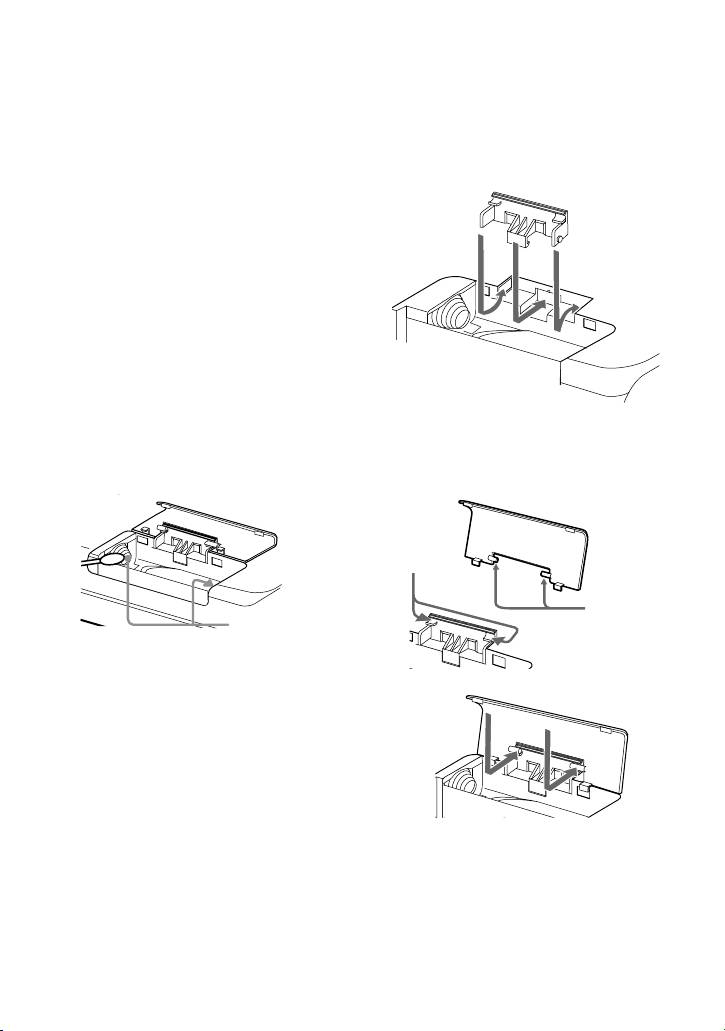
Notes on batteries
On the battery compartment
Incorrect battery usage may lead to leakage of
lid
battery fluid or bursting batteries. To prevent
The battery compartment lid is designed to
such accidents, observe the following
detach from the recorder when it is handled
precautions:
with great force. Do the following steps to
• Insert the + and – poles of the batteries
reattach the lid.
correctly.
• Do not try to recharge dry batteries.
• When the recorder is not to be used for a long
time, be sure to remove the batteries.
• If a battery leak should develop, carefully and
thoroughly wipe away battery fluid from the
battery compartment before inserting new
ones.
Note on mechanical noise
The recorder gives off mechanical noise while
operating, which is caused by the power-saving
system of the recorder and it is not a problem.
1 Insert the projections on the PUSH OPEN
Note on maintenance
tab firmly into the slots on the recorder one
Clean the terminals periodically with a cotton
at a time.
swab or a soft cloth as illustrated.
Terminals
If you have any questions or problems
concerning your recorder, please consult your
nearest Sony dealer. (If a trouble occurred when
the disc was in the recorder, we recommend that
the disc be left in the recorder when you consult
your Sony dealer so that the cause of trouble
may be better understood.)
2 Insert the projections on the lid firmly into
the slots on the PUSH OPEN tab one at a
time.
45-GB
1
2
1
2
Slots
Projections

Troubleshooting
Should any problem persist after you have made these checks, consult your nearest Sony
dealer.
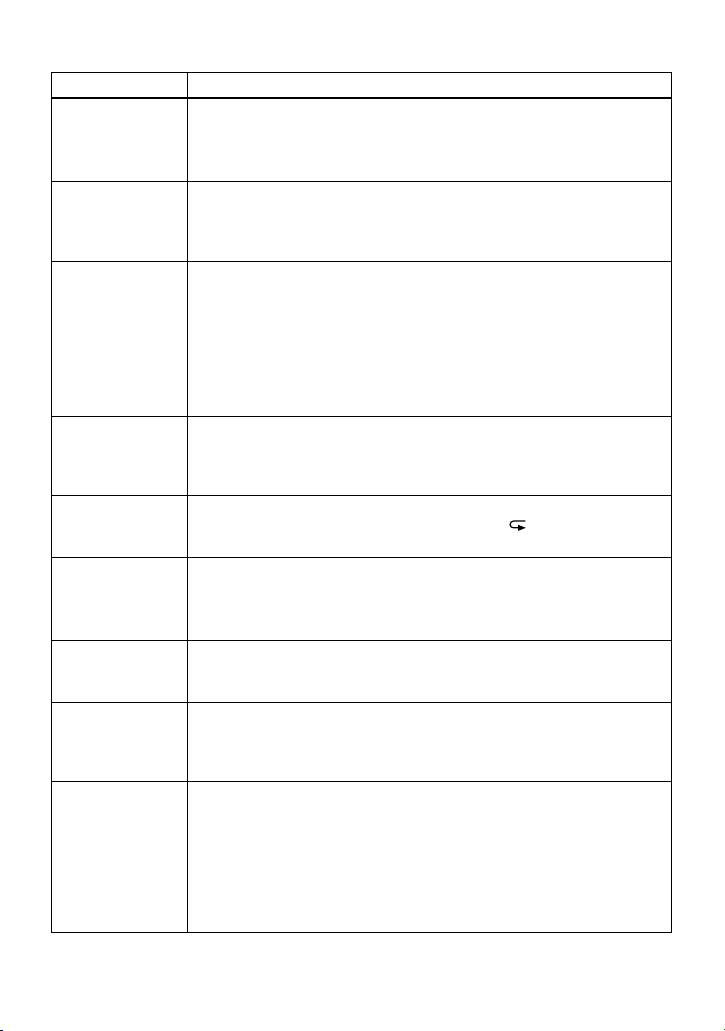
Symptom Cause/Solution
The recorder does
• Audio sources may not be securely connected.
not work or works
, Disconnect the audio sources once and connect them again
poorly.
(pages 20, 21).
• The HOLD function is turned on (“HOLD” appears in the display
when you press an operation button on the recorder).
, Disable HOLD by sliding the HOLD switch in the opposite
direction of the arrow (page 41).
• Moisture has condensed inside the recorder.
, Take the MD out and leave the recorder with the lid opened in a
warm place for several hours until the moisture evaporates.
• The dry battery is weak (r or “LOW BATT” flashes).
, Replace the dry battery (pages 9, 42).
• The dry battery have been inserted incorrectly.
, Insert the battery correctly (page 9).
• You pressed a button while the disc indication was rotating quickly.
, Wait until the indication becomes normal.
• When recording digitally from a portable CD player, you did not
use AC power or did not disable the anti-skip function such as ESP
(page 20).
, Use the portable CD player with AC power or disable the anti-
skip function such as ESP.
• The analog recording was made using a connecting cord with an
attenuator.
, Use a connecting cord without an attenuator (page 21).
• The AC power adaptor (not supplied) was unplugged during
recording or a power outage occurred.
• While operating, the recorder received a mechanical shock, too
much static, abnormal power voltage caused by lightning, etc.
, Restart the operation as follows.
1 Take out the batteries or disconnect all the power sources.
2 Leave the recorder for about 30 seconds.
3 Insert the batteries or connect the power source.
• The disc is damaged or does not contain proper recording or editing
data.
, Reinsert the disc. If this fails, rerecord.
• The lid is not firmly closed.
, Open the lid and close it again, pressing hard so that it closes
firmly.
• A disc with no track is inserted (“BLANKDISC” appears when
playing or editing).
, Replace to another disc.
• The record protect tab is opened.
, Slide the record protect tab closed.
46-GB
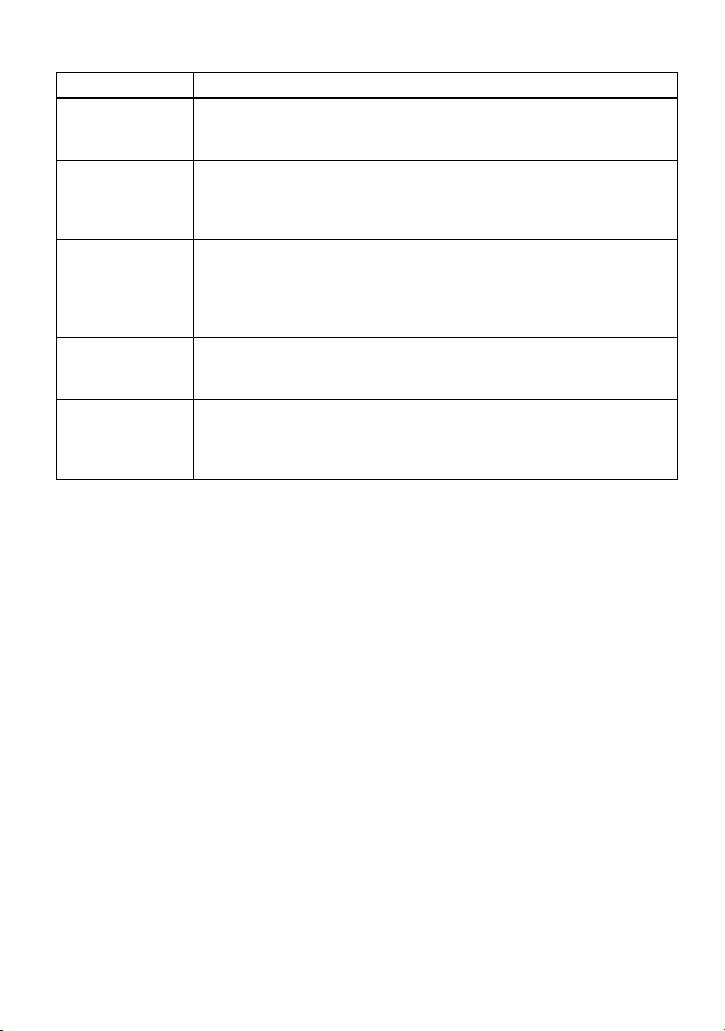
Symptom Cause/Solution
The recorder does
• The premastered MD is inserted.
not record or edit.
, Replace to the recordable MD.
• The power source was disrupted during recording or editing.
, Rerecord or reedit again.
The zREC
• The batteries have been exhausted or the power sources have been
button does not
disconnected during recording or editing.
come up. The lid
, Replace the exhausted batteries with new ones or connect the
does not open.
power source again.
No sound comes
• The headphones plug is not firmly connected.
through the
, Plug in the plug of the headphones firmly to the remote control.
headphones.
Plug in the plug of the remote control firmly to i.
• Volume is too low.
, Adjust the volume by turning VOL.
• Dirty plugs.
, Clean the plug on the end of the headphones cord and the plug
on the end of the remote control cord.
An MD is not
• Disc playing stopped before it came to the last track.
played from the
, Press .REVIEW/AMS repeatedly or open and close the lid
first track.
once to go back to the beginning of the disc, and restart playing
after checking the track number in the display.
The recorder does
• Repeat play is selected.
not play normally.
, Press PLAY MODE repeatedly until the indication
disappears from the display.
Playback sound
• The recorder is placed where it receives continuous vibration.
skips.
, Put the recorder on a stable place.
• A very short track may cause sound to skip.
, Try not to create tracks under one second long.
Sound has a lot of
• Strong magnetism from a television or such device is interfering
static.
with operation.
, Move the recorder away from the source of strong magnetism.
Cannot find the
• You pressed XPAUSE after pressing .REVIEW/AMS or
track marks.
> CUE/AMS.
, Press XPAUSE before pressing .REVIEW/AMS or
>CUE/AMS.
The clock loses
• The built-in battery for the clock is weak. Note that the clock may
time or the
gain or lose up to about 2 minutes per month under normal
display flashes.
condition.
The recording
, Insert new dry batteries and leave them for about more than two
hours to charge the built-in battery. After charging, set the clock
date was not
again (page 25).
stamped onto the
• The clock is not set.
disc.
, Set the clock (page 25).
47-GB
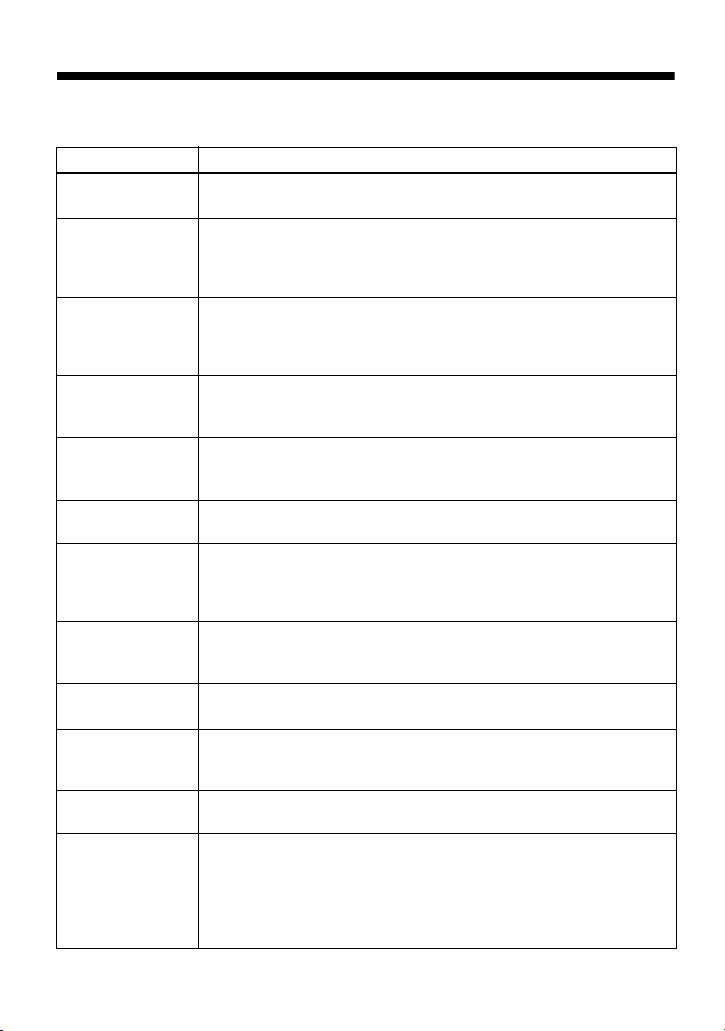
Symptom Cause/Solution
The disc cannot
• The component does not support LP2 stereo or LP4 stereo.
edit on other
, Edit on other component that support LP2 stereo or LP4 stereo.
component.
Momentary noise
• Due to the special digital audio compression technology used in
is heard.
LP4 stereo mode, momentary noise may occur on very rare
occasions with certain sound sources.
, Record in normal stereo or LP2 stereo mode.
The group
• While using a disc that has no group information, an attempt was
function (group
made to turn the group mode on (“No Group” appears).
mode/group skip
, Use a disc with a group information.
mode) does not
operate.
The display
• The recorder was disconnected from the power source.
window is not
, Let the recorder sit for a while, or disconnect the power source,
normal.
reconnect it, and then press any of the operating buttons.
The recorder
• The group skip mode is on.
skips tracks when
, The group skip mode automatically turns off if no operation is
you press ./
made for 5 seconds.
> .
48-GB

System limitations
The recording system in your MiniDisc recorder is radically different from those used in
cassette and DAT decks and is characterized by the limitations described below. Note,
however, that these limitations are due to the inherent nature of the MD recording system
itself and not to mechanical causes.
Symptom Cause
“TR FULL” appears
When 254 tracks have been recorded on the disc, “TR FULL”
even before the disc
appears regardless of the total recorded time. More than 254
has reached the
tracks cannot be recorded on the disc. To continue recording,
maximum recording
erase unnecessary tracks.
time (60, 74, or 80
minutes).
“TR FULL” appears
Repeated recording and erasing may cause fragmentation and
even before the disc
scattering of data. Although those scattered data can be read,
has reached the
each fragment is counted as a track. In this case, the number of
maximum track
tracks may reach 254 and further recording is not possible. To
number or recording
continue recording, erase unnecessary tracks.
time.
Track marks cannot be
When the data of a track is fragmented, the track mark of a
erased.
fragment under 12 seconds long (recorded in stereo), 24 seconds
The remaining
long (recorded in LP2 stereo mode or monaural mode), or 48
recording time does
seconds long (recorded in LP4 stereo mode) cannot be erased.
not increase even after
You cannot combine a track recorded in stereo and a track
erasing numerous short
recorded in monaural; nor can you combine a track recorded
tracks.
with digital connection and a track recorded with analog
connection.
Tracks of under 12 seconds, 24 seconds, 48 seconds in length
are not counted and so erasing them may not lead to an increase
in the recording time.
The total recorded time
Normally, recording is done in minimum units of approximately
and the remaining time
2 seconds (in stereo), 4 seconds (in LP2 stereo mode or
on the disc may not
monaural mode), or 8 seconds (in LP4 stereo mode). When
total the maximum
recording is stopped, the last unit of recording always uses this
recording time (60, 74,
unit of 2 seconds, 4 seconds, or 8 seconds even if the actual
or 80 minutes).
recording is shorter. Likewise, when recording is restarted after
the stop, the recorder will automatically insert a blank space
amounting to 2 seconds, 4 seconds, or 8 seconds before the next
recording. (This is to prevent accidental erasing of a previous
track whenever a new recording is started). Therefore, the actual
recording time will decrease whenever a recording is stopped; a
maximum of 6 seconds, 12 seconds, or 24 seconds compared to
the potential recording time for each stop.
The edited tracks may
The fragmentation of data may cause sound dropout while
exhibit sound dropout
searching because the tracks are played in higher speed than
during search
normal playback.
operations.
49-GB
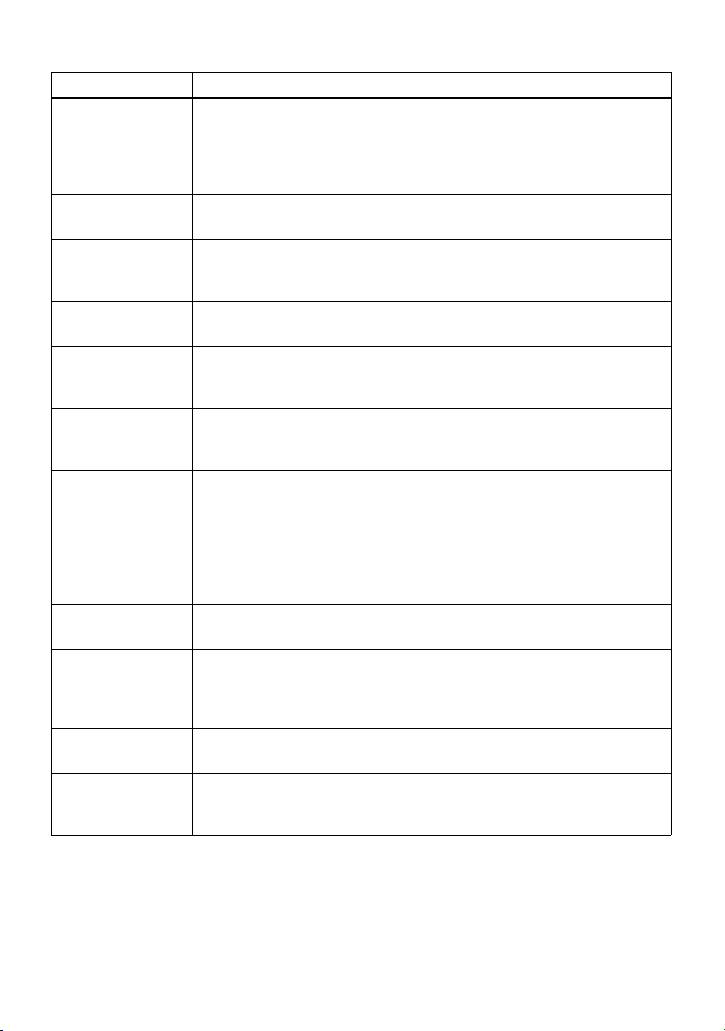
Messages
If the following messages flash in the display window, check the chart below.
Error message Meaning/Remedy
BLANKDISC • An MD with no recording on it is inserted.
, Insert a recorded MD.
BUSY • You tried to operate the recorder while it was accessing the
recorded data.
, Wait until the message goes out (in rare cases, it may take 2–3
minutes).
Data Save • The MD player is recording information (sounds) from the
memory to the disk.
, Wait until this process is completed. Do not expose the player
to any physical shock, nor disrupt power supply.
DISC ERR • The disc is damaged or does not contain proper recording or
editing data.
, Reinsert the disc. If this fails, rerecord.
DISC FULL • There is no more space to record on the disc (less than 12 seconds
available).
, Replace the disc.
EDITING • You pressed a key on the recorder while editing on the remote
control.
Hi DC in • Voltage of the power supply is too high (The recommended AC
power adaptor or the recommended car battery cord is not used).
, Use the recommended AC power adaptor (not supplied) or the
car battery cord (not supplied).
HOLD • The recorder is locked.
, Slide HOLD against the arrow to unlock the recorder
(page 41).
LOW BATT • Batteries are weak.
, Replace the dry batteries (pages 9, 42).
MEM OVER • You tried to record with the recorder placed where it receives
continuous vibration.
, Put the recorder on a stable place, and start recording again.
MENU • You pressed a key on the remote control while selecting a menu on
the recorder.
NAME FULL • You tried to enter more than 200 letters to label a single track or
disc.
• You tried to enter a total of more than 1700 letters for track or disc
names during playback or stop.
, Enter a shorter name for the track, group, or disc (page 34), or
delete “LP:” from the track name recorded in MDLP mode.
50-GB
Error message Meaning/Remedy
NO COPY • You tried to make a copy from a disc that is protected by the Serial
Copy Management System. You cannot make copies from a
digitally connected source which was itself recorded using digital
connection.
, Use analog connection instead (page 21).
NO DISC • You tried to play or record with no disc in the recorder.
, Insert an MD.
No Group • You tried to turn the group function on with a disc witch has no
group information.
, Use a disc witch the group information has been recorded.
NO SIGNAL • The recorder could not detect digital input signals.
, Make sure that the source is connected firmly (page 20).
P/B ONLY • You tried to record or edit on a premastered MD (P/B stands for
“playback”).
, Insert a recordable MD.
PROTECTED • You tried to record or edit on a MD with the tab in the record-
protect position (page 54).
, Slide the tab back.
SORRY • You tried to erase the track mark at the beginning of the first track.
• You tried to erase a track mark to combine tracks the recorder
cannot combine (a track recorded in stereo and in mono, for
example).
• You tried to press XPAUSE or TRACK MARK during synchro-
recording.
• You tried to release the group for “Group --”.
TEMP OVER • Heat has built up in the recorder.
, Let the recorder cool down.
TOC Edit • The MD player is recording information (track start and end
position) from the memory to the disk.
, Wait until this process is completed. Do not expose the player
to physical shock, nor disrupt power supply.
TR FULL • There is no more space for new data when you are editing the MD.
, Erase unnecessary tracks (page 39).
TrPROTECT • You tried to record or edit a write-protected track that was recorded
on other device.
, Record or edit on other tracks.
51-GB

Outputs
Specifications
i: stereo mini-jack (dedicated remote control
jack)
2)
Maximum output (DC)
System
Headphones: 5 mW + 5 mW (16 ohm)
Audio playing system
Speaker: 70 mW
MiniDisc digital audio system
Laser diode properties
General
Material: GaAlAs
Wavelength:
λ = 790 nm
Power requirements
Emission duration: continuous
DC 3V
Laser output: less than 44.6 µW
LR6 (size AA) alkaline dry battery (world
(This output is the value measured at a distance
model only)
of 200 mm from the lens surface on the optical
Battery operation time
pick-up block with 7 mm aperture.)
See “Battery life” (page 42)
Recording and playback time
Dimensions
When using MDW-80
Approx. 105.7 × 80.0 × 24.9 mm (w/h/d)
1
1
Maximum 160 min. in monaural.
(4
/4 × 3
/8 × 1 in.) not incl. projecting parts and
Maximum 320 min. in stereo
controls.
Revolutions
Mass
350 rpm to 2,800 rpm (CLV)
Approx. 160 g (5.7 oz) (main unit only)
Error correction
Supplied accessories
ACIRC (Advanced Cross Interleave Reed
Remote control (1)
Solomon Code)
Headphones (1)
Sampling frequency
Carrying pouch (1)
44.1 kHz
Hand strap (1)
Sampling rate converter
Sony LR6 (size AA) alkaline dry battery (world
Input: 32 kHz/44.1 kHz/48 kHz
model only) (1)
1)
Coding
The LINE IN (OPTICAL) jack is used to
connect either a digital (optical) cable or a line
ATRAC (Adaptive TRansform Acoustic
(analog) cable.
Coding)
2)
Measured in accordance with JEITA.
AT RAC 3 — LP2/LP4
Modulation system
Optional accessories
EFM (Eight to Fourteen Modulation)
AC power adaptor AC-E30HG
Speaker
1
Optical Cable POC-15B, POC-15AB
28 mm (1
/8 in.) dia.
Line Cable RK-G129HG, RK-G136HG
Frequency response (digital/analog
Stereo Microphones ECM-717
input)
Recordable MDs MDW-series
20 to 20,000 Hz ± 3 dB
Foot control unit FS-85B50
Wow and Flutter
Headphones* MDR-EX70LP, MDR-E838LP
Below measurable limit
* When using optional headphones, use only
Inputs
headphones with stereo mini plugs. You
Microphone: stereo mini-jack
cannot use headphones with micro plugs.
(minimum input level 0.25 mV)
1)
Line in
:
Your dealer may not handle some of the above
stereo mini-jack for analog input
listed accessories. Please ask the dealer for
(minimum input level 39 mV)
detailed information about the accessories in
optical (digital) mini-jack for optical
your country.
(digital) input
US and foreign patents licensed from Dolby
Laboratories.
Design and specifications are subject to change
without notice.
52-GB
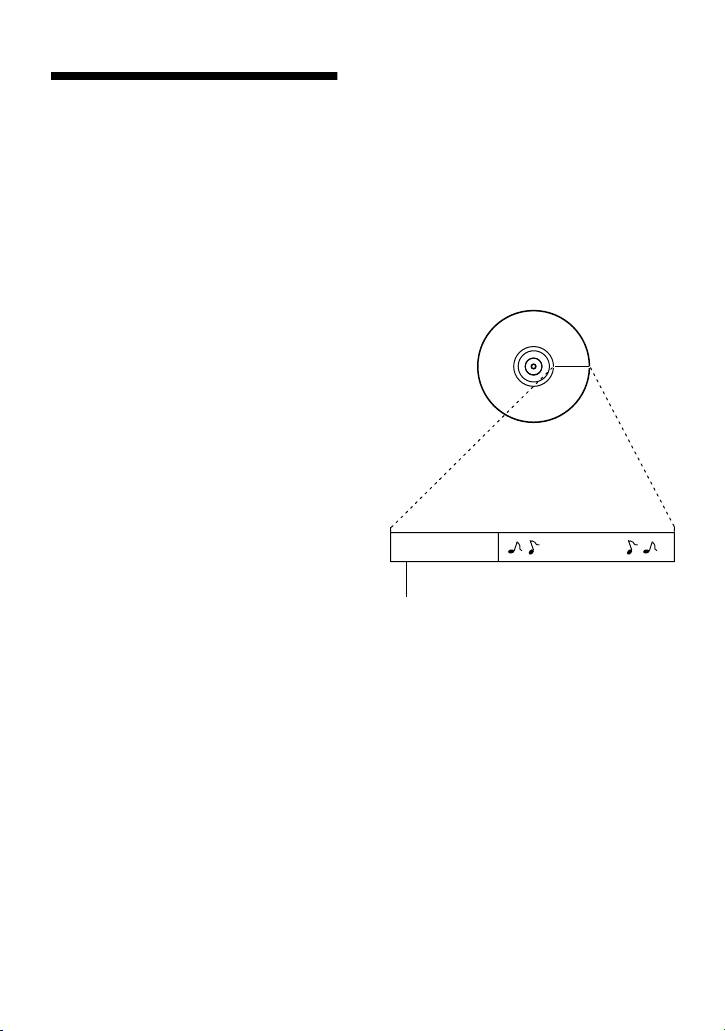
Recordable MDs are manufactured with a
Explanations
“User TOC Area” to contain the order of the
music. The TOC (Table of Contents) system
is similar to the “directory management
What is the newly developed
system” of floppy disks. In other words,
DSP TYPE-R for ATRAC?
starting and ending addresses for all music
“TYPE-R” is a high-level Sony specification
tracks recorded on the disc are stored in this
used in the Digital Signal Processor (DSP),
area. This lets you randomly access the
which is heart of the MiniDisc sound. This
beginning of any track as soon as you enter
technology gives the MiniDisc recorder
the track number (AMS), as well as label the
twice the signal processing capability as
location with a track name as you would a
previous MiniDisc Walkman models,
file on a diskette.
producing a sound quality close to that of
MiniDisc decks.
How the MiniDisc got so small
The 2.5-inch MiniDisc, encased in a plastic
cartridge that looks like a 3.5-inch diskette
(see illustration on the left column), uses a
new digital audio compression technology
called ATRAC (Adaptive TRansform
Acoustic Coding). To store more sound in
less space, ATRAC extracts and encodes
only those frequency components actually
audible to the human ear.
The meaning of “no sound”
User TOC Area
Music Data
“No sound” describes a recorder condition in
which the input level is about 4.8 mV during
analog input or less than –89 dB during
Contains the order and start/end
optical (digital) input (with 0 dB as full bit
points of the music.
(the maximum recordable level for a
MiniDisc)).
Shock-Resistant Memory
One major drawback of optical read systems
Quick Random Access
is that they can skip or mute when subjected
Like CDs, MDs offer instantaneous random
to vibration. The MD system resolves this
access to the beginning of any music track.
problem by using a buffer memory that
Premastered MDs are recorded with location
stores audio data.
addresses corresponding to each music
selection.
53-GB
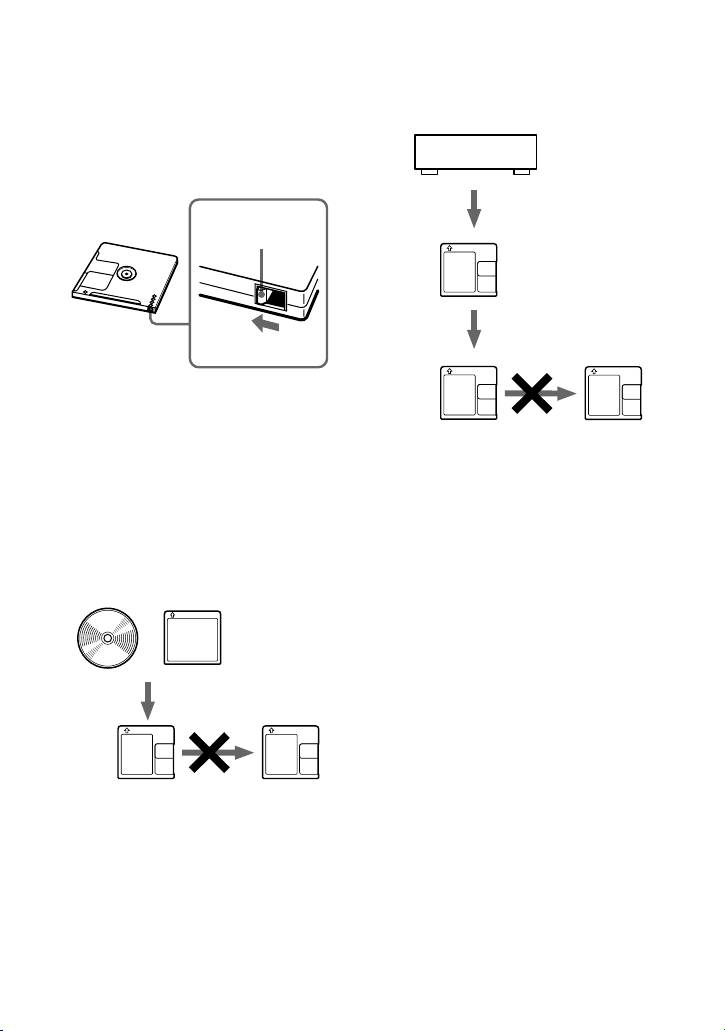
To protect a recorded MD
To record-protect an MD, slide open the tab at
Microphone, record player, tuner, etc (with
the side of the MD. In this position, the MD
analog output jacks).
cannot be recorded. To record again, slide the
tab back so the tab is visible.
When the disc is record-protected
Analog recording
Tab
Home-recorded MD
Digital recording
Back of the MD
Record-protect
Note on digital recording
Recordable
No
Recordable
This recorder uses the Serial Copy
MD
digital
MD
Management System, which allows only first-
recording
generation digital copies to be made from
premastered software. You can only make
If you have any questions or problems
copies from a home-recorded MD by using the
concerning your recorder, please consult your
analog (line out) connections.
nearest Sony dealer. (If a trouble occurred when
the disc was in the recorder, we recommend that
Premastered software such as CDs or
the disc be left in the recorder when you consult
MDs.
your Sony dealer so that the cause of trouble
may be better understood.)
Digital recording
Home-
No
Recordable
recorded
digital
MD
MD
recording
54-GB

55-GB

Grabador, Reproductor de
Minidisco portátil
POR FAVOR LEA
DETALLADAMENTE ESTE
MANUAL DE INSTRUCCIONES
ANTES DE CONECTAR Y OPERAR
ESTE EQUIPO.
RECUERDE QUE UN MAL USO DE
SU APARATO PODRÍA ANULAR
LA GARANTÍA.
Precaución
El uso de instrumentos ópticos con este
producto incrementa el riesgo de lesiones
oculares.
PRECAUCIÓN: RADIACIÓN LÁSER
INVISIBLE CUANDO LA UNIDAD
ESTÁ ABIERTA
EVITE LA EXPOSICIÓN AL HAZ
LÁSER
Información
EL VENDEDOR NO SERÁ
RESPONSABLE EN NINGÚN
CASO DE LOS DAÑOS DIRECTOS,
INCIDENTALES O
CONSECUENCIALES DE
CUALQUIER NATURALEZA, O DE
LAS PÉRDIDAS O GASTOS
RESULTANTES DE UN
PRODUCTO DEFECTUOSO O DEL
USO DE UN PRODUCTO.
En algunos países se regula la eliminación
de las pilas como las que sirven para
suministrar energía a este producto.
Obtendrá más información de las
autoridades locales.
2
-ES

ES
3
-ES

Contenidos
Controles ........................................................... 6
Preparación de la fuente de alimentación .......9
Grabación de un MD ....................................... 11
Reproducción de un MD .................................. 14
Opciones de grabación ................................... 16
Grabación de larga duración .................................................................16
VOR (Grabación accionada por la voz) ................................................17
Grabación con un micrófono ...................................................................18
Grabación con un equipo conectado externamente .................................19
Grabación con entrada digital (óptica) (requiere cable óptico) ........20
Grabación con entrada analógica (línea) (requiere cable
de línea) .............................................................................21
Grabación de pistas con la función de grupo (grabación en modo
de grupo) ............................................................................................22
Para activar el modo de grupo (grabación en modo de grupo) .........23
Grabación de una pista en un grupo nuevo .......................................23
Grabación de una pista en un grupo existente ..................................23
Cómo iniciar y detener la grabación sincronizada con el
reproductor fuente (grabación sincronizada) .....................................24
Ajuste del reloj para incluir la hora de grabación ...................................25
Comprobación del tiempo restante o de la posición de grabación ..........26
Opciones de reproducción ............................. 27
Cómo cambiar el ajuste de sonido ........................................................27
Cómo encontrar un punto concreto rápidamente (Easy Search) .............28
Cómo cambiar la velocidad de reproducción (control de velocidad) .....28
Reproducción de pistas de forma repetida ............................................29
Comprobación del tiempo restante o de la posición de reproducción ....29
Uso de la función de grupo (modo de grupo) .......................................30
Cómo escuchar pistas con el modo de grupo (reproducción
del modo de grupo) ...........................................................30
Selección y reproducción de grupos (función de salto de grupo) .....31
4
-ES

Edición de pistas grabadas ............................ 32
Adición de una marca de pista ............................................................. 32
Marcas de pista para dividir una grabación ..................................... 32
Marcas de pista en puntos importantes ............................................ 32
Borrado de una marca de pista ............................................................... 33
Etiquetado de grabaciones ...................................................................... 34
Registro de pistas o grupos como un grupo nuevo (ajuste de grupo) ..... 36
Para cambiar el ajuste de grupo .............................................................. 37
Cambio de orden de pistas grabadas ...................................................... 38
Cambio de una pista a un grupo distinto .............................................. 38
Cambio de orden de un grupo en un disco (cambio de grupo) ............ 39
Borrado de pistas .................................................................................. 39
Cómo borrar una pista ...................................................................... 39
Cómo borrar todo el disco ................................................................ 40
Cómo borrar un grupo ...................................................................... 40
Otras operaciones .......................................... 41
Ajuste del contraste del visor (ajuste del contraste) ............................. 41
Bloqueo de los controles (HOLD) .......................................................... 41
Fuentes de alimentación ................................ 42
Cuándo hay que sustituir las pilas ........................................................ 42
Duración de la pila ........................................................................... 42
Uso de corriente de la red .................................................................... 43
Información adicional ..................................... 44
Precauciones ......................................................................................... 44
Solución de problemas ........................................................................... 46
Limitaciones del sistema ........................................................................ 49
Mensajes ................................................................................................. 50
Especificaciones ..................................................................................... 52
Explicaciones .......................................................................................... 53
5
-ES
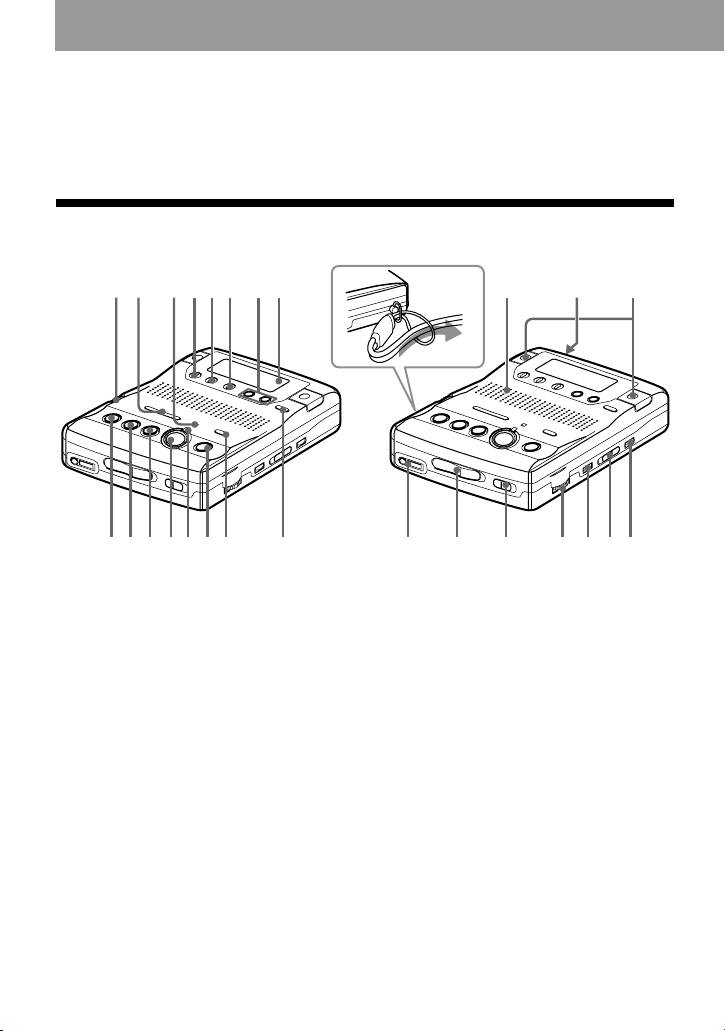
Controles
Consulte las páginas indicadas entre paréntesis para obtener más
detalles.
Parte frontal de la grabadora
Cómo fijar la correa de mano.
1
2
3456 78 qj qk ql
9q;qaqsqdqfqg qh w; wa ws wd wf wgwh
A Mando SPEED CONTROL (28)
M Indicador REC (12) (26)
B Botones .REVIEW/AMS/
N Botón TRACK MARK (32) (33)
>CUE/AMS (búsqueda /AMS)
O Interruptor REC MODE (12) (16)
(12) (15) (23) (25) (31) (33) (34) (41)
P Botón GROUP (23) (30) (37)
C Indicador VOR (17)
Q Altavoz (14)
D Botón DISPLAY (26) (29) (35)
R Toma DC IN 3V (43)
E Botón PLAY MODE (29) (35)
S Micrófonos (12) (17)
F Botón EDIT/ENTER (31) (34) (41)
T Toma i (auriculares) (12) (14)
G Botones EASY SEARCH +/– (28)
U Interruptor OPEN (11) (14)
(35)
V Interruptor HOLD (9) (41)
H Visor (24) (27) (33)
W Control VOL (14)
I Botón xSTOP (12) (14) (25) (35)
El control VOL tiene un punto
J Botón NPLAY (reproducir) (12)
tangible.
(14) (25) (34)
X Botón VOR (17)
El botón NPLAY tiene un punto
tangible.
Y Interruptor SYNCHRO REC ON/OFF
(24)
K Botón XPAUSE (13) (15) (33) (34)
Z Botón ERASE (39)
L Botón zREC (12) (16)
6
-ES