
Sony KDL-40V3000 – page 9
Manual for Sony KDL-40V3000
Table of contents
Digital inställning
Undertextinställningar
”Inställning av textning”: När ”Nedsatt hörsel” är valt kan det även hända att
visuella hjälpmedel visas tillsammans med textningen (om TV-kanalen sänder sådan
information).
”Textspråk”: Används för att välja textningsspråk.
Ljudinställningar
”Audiotyp”: Används för att gå över till läget för hörselskadade när ”Nedsatt
hörsel” är valt.
”Audiospråk”: Används för att välja ljudspråk för ett program. Somliga digitala
kanaler sänder program med ljud på flera olika språk.
”Röstmeny”: Används för att höra en beskrivning (berättarröst) av visuell
information, om TV-stationen sänder sådan information.
”Procentandel röstmeny”: Används för att ställa in volymbalansen mellan TV:ns
huvudljud och ljudbeskrivningen.
Banerläge
”Grundläggande”: Används för att se programinformation med ett digitalt baner.
”Fullständig”: Används för att se programinformation med ett digitalt baner och
detaljerad programinformation under baneret.
Radiovisning
En bakgrundsbild visas på skärmen när man lyssnar på radio. Det går att välja färg
på bakgrundsbilden, eller att visa en slumpmässigt vald färg. För att släcka
bakgrundsbilden tillfälligt trycker man på vilken knapp som helst.
Barnlås
Använda MENU-funktionerna
Används för att åldersbegränsa program. Program vars åldersbegränsning
överskrider den inställda gränsen går bara att se om man först matar in rätt PIN-kod.
1 Mata in din PIN-kod med sifferknapparna.
Om du inte redan har ställt in en PIN-kod tänds en PIN-kodsinmatningsskärm. Följ
anvisningarna under ”PIN-kod” nedan.
2 Tryck på F/f för att välja åldersbegränsning eller ”Ingen” (för obegränsat
tittande), och tryck sedan på .
3 Tr yck på RE TUR N.
PIN-kod
För att ställa in PIN-koden för första gången
1 Mata in den nya PIN-koden med sifferknapparna.
2 Tr yck på RE TUR N.
För att ändra PIN-koden
1 Mata in din PIN-kod med sifferknapparna.
2 Mata in den nya PIN-koden med sifferknapparna.
3 Tr yck på RE TUR N.
z
PIN-koden 9999 fungerar alltid.
Teknisk inställning
”Autom. uppdatering”: Gör det möjligt för TV:n att upptäcka och lagra nya
digitala tjänster när de blir tillgängliga.
”Hämta programvara”: Används för att automatiskt ladda ner gratis
mjukvaruuppdateringar till TV:n (när det finns) via den befintliga antennen/kabeln.
Vi rekommenderar att du alltid låter den här punkten vara inställd på ”På”. Om du
inte vill att mjukvaran ska uppdateras så ställ in den här punkten på ”Av”.
”Systeminformation”: Används för att se den nuvarande mjukvaruversionen och
signalnivån.
”Tidszon”: Används för att ställa in tidszonen för hand, även om det inte är samma
som standardinställningen för tidszonen för ditt land/område.
Forts.
SE
37

”Automatisk sommartid”: Används för att välja om TV:n automatiskt ska växla
mellan sommartid och vintertid.
• ”Av”: Klockan visas med den tidsskillnad som är inställd med punkten ”Tidszon”.
• ”På”: Klockan växlar automatiskt mellan sommartid och vintertid enligt kalendern.
CA-modulinställningar
Används för att komma åt betal-TV-tjänster när du har skaffat en CAM-modul
(Conditional Access-modul) och ett tittarkort. Se sidan 18 angående var
(PCMCIA)-uttaget sitter.
SE
38
Övrig information
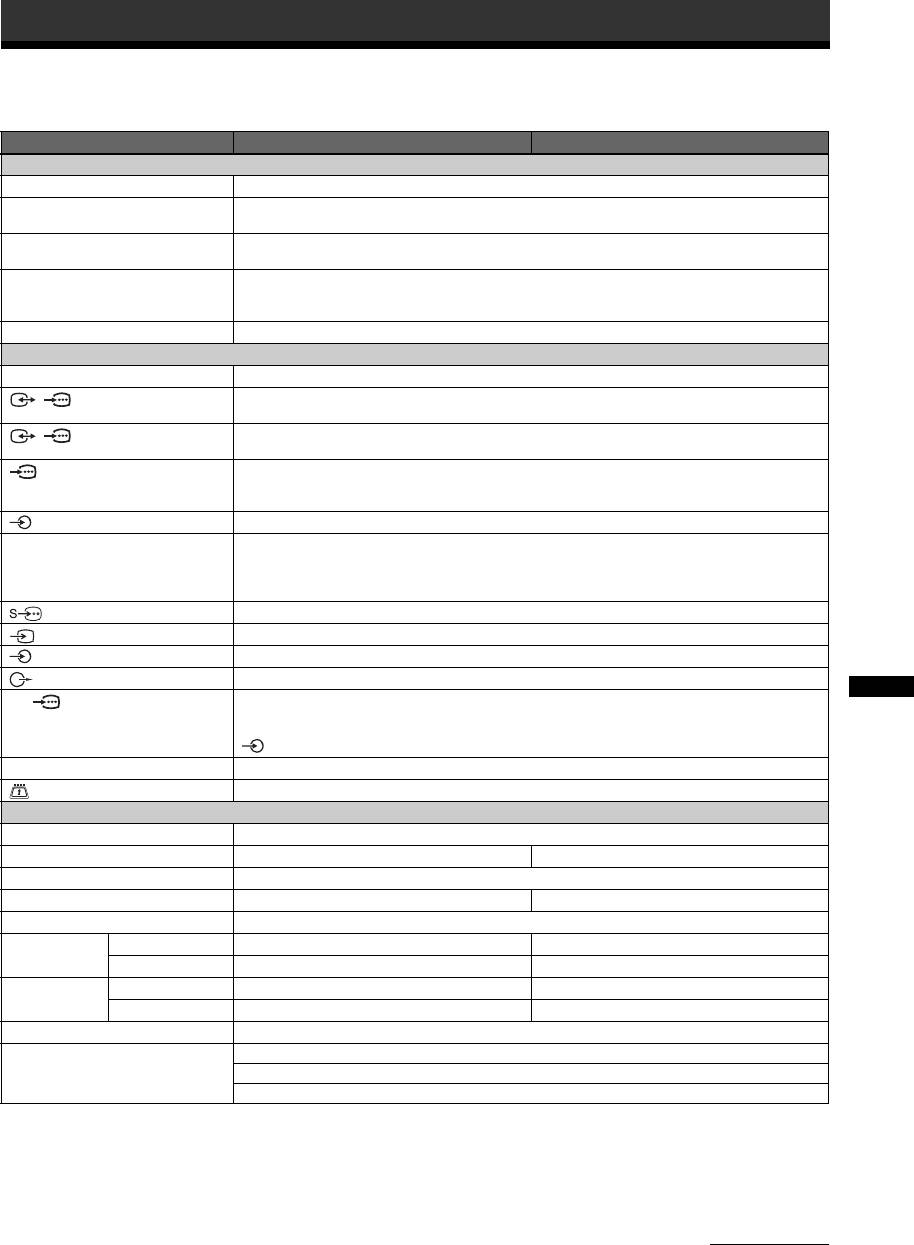
Tekniska data
Modellnamn KDL-40V3000 KDL-46V3000
System
Panelsystem
Flytande kristall-skärm (LCD)
TV-system
Analogt: Beror på valt land/vald region: B/G/H, D/K, L, I
Digitalt: DVB-T/DVB-C
Färg-/Videosystem
Analogt: PAL, SECAM NTSC 3.58, 4.43 (bara för videoinsignaler)
Digitalt: MPEG-2 MP@ML
Kanaltäckning
Analogt: VHF: E2–E12/UHF: E21–E69/CATV: S1–S20/HYPER: S21–S41
D/K: R1–R12, R21–R69/L: F2–F10, B–Q, F21–F69/I: UHF B21–B69
Digitalt: VHF/UHF
Uteffekt
10 W + 10 W
In/utgångar
Antenn/kabel
75 ohm extern anslutning för VHF/UHF
/1
21-stifts scartuttag (CENELEC-standard) inklusive insignaler för ljud/video, RGB-ingång och utsignaler
för TV-ljud/bild.
/2 (SmartLink)
21-stifts scartuttag (CENELEC-standard) inklusive insignaler för ljud/video, RGB-ingång, valbara
utsignaler för ljud/video och SmartLink-gränssnitt.
3
Stödda format:1080p, 1080i, 720p, 576p, 576i, 480p, 480i
Y: 1 Vtt, 75 ohm, 0,3 V negativ sync/P
B/CB: 0,7 Vtt, 75 ohm/
P
R/CR: 0,7 Vtt, 75 ohm
3
Ljudingångar (phono-uttag): 500 mVrms, Impedans: 47 kohm
HDMI IN 4, 5, 7
Video: 1080/24p, 1080p, 1080i, 720p, 576p, 576i, 480p, 480i
Ljud: Linjärt PCM-ljud med två kanaler
32, 44,1 och 48 kHz, 16, 20 och 24 bitar
Analoga ljudingångar (phono-uttag): 500 mVrms, Impedans: 47 kohm (gäller endast HDMI IN 5)
6
S-videoingång (4-stifts mini-DIN)
6
Videoingång (phono-uttag)
6
Ljudingångar (phono-uttag)
DIGITAL OUT (OPTICAL) (digitalt optiskt uttag)/Ljudutgångar (phono-uttag)
PC
PC-ingång (D-sub 15 stift) (se sidan 40)
G: 0,7 Vtt, 75 ohm, utan grönsynk/B: 0,7 Vtt, 75 ohm/
Övrig information
R: 0,7 Vtt, 75 ohm/HD: 1-5 Vtt/VD: 1-5 Vtt
Datorljudingång (minikontakt)
i
Utgång för hörlurar
CAM (Conditional Access Module)-fack
Strömförsörjning och övrigt
Strömkrav
220–240 V växelström, 50 Hz
Skärmstorlek
40 tum (Ca. 101,6 cm uppmätt diagonalt) 46 tum (Ca. 116,8 cm uppmätt diagonalt)
Upplösning
1 920 bildpunkter (horisontellt) × 1 080 linjer (vertikalt)
Energiförbrukning
193 W 238 W
Energiförbrukning i standbyläge*
0,3 W
Storlek
(med stativ)
Ca. 992 × 688 × 265 mm Ca. 1 135 × 779 × 306 mm
(b × h × d)
(utan stativ)
Ca. 992 × 643 × 122 mm Ca. 1 135 × 734 × 122 mm
Vikt (med stativ)
Ca. 24,0 kg Ca. 30,5 kg
(utan stativ)
Ca. 20,5 kg Ca. 26,5 kg
Medföljande tillbehör
Se ”1: Kontrollera tillbehören” på sidan 4.
Tillval
Väggfäste SU-WL500
Golvstativ SU-FL62
TV-stativ SU-FL300M
* Angiven effekt i standby-läge nås när TV:n är klar med vissa nödvändiga interna processer.
Rätt till ändringar förbehålles.
Forts.
SE
39
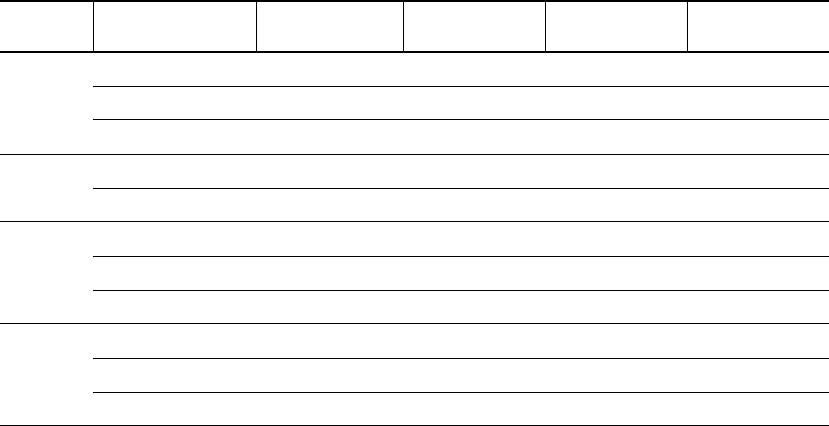
Referenstabell över datorinsignaler
Horisontellt
Horisontell
Vertikal
Signaltyp
Vertikalt (linjer)
Standard
(bildpunkter)
frekvens (kHz)
frekvens (Hz)
VGA 640 480 31,5 60 VGA
640 480 37,5 75 VESA
720 400 31,5 70 VGA-T
SVGA 800 600 37,9 60 VESA-riktlinjer
800 600 46,9 75 VESA
XGA 1024 768 48,4 60 VESA-riktlinjer
1024 768 56,5 70 VESA
1024 768 60 75 VESA
WXGA 1280 768 47,4 60 VESA
1280 768 47,8 60 VESA
1360 768 47,7 60 VESA
• Datoringången på den här TV:n saknar stöd för grönsynkronisering och kompositsynkronisering.
• Datoringången på den här TV:n saknar stöd för interlace-signaler.
• För bästa resultat rekommenderar vi att du använder signalerna (i fetstil) i ovanstående tabell med en vertikal frekvens på 60 Hz
från datorn. När datorn kopplas in väljs signaler med en vertikal frekvens på 60 Hz automatiskt.
SE
40
Det förekommer små svarta punkter och/eller ljusa
punkter på skärmen
Felsökning
• Bilden på den här bildskärmen är uppbyggd av
bildpunkter. Små svarta och/eller ljusa punkter (pixlar)
kan förekomma på skärmen, men är inte tecken på att
något är fel.
Kontrollera om 1 (standby)-indikatorn
blinkar rött.
Bildens konturer hänger inte ihop
• Välj ”Auto 1” eller ”Auto 2” för punkten ”Filmläge”
Om den blinkar
(sidan 28).
Självdiagnosfunktionen är aktiverad.
Ingen färg för program som sänds i färg
1 Räkna hur många gånger 1 (standby)-
• Välj ”Återställ” (sidan 23).
indikatorn blinkar mellan varje
Bilden för en signal som matas in via 3-uttagen
tvåsekunderspaus.
är inte i färg eller färgerna är konstiga
Exempel: indikatorn blinkar tre gånger, sedan är det
• Kontrollera anslutningarna till 3-uttagen och
uppehåll i två sekunder, sedan blinkar indikatorn tre
kontrollera att kontakterna är ordentligt isatta i respektive
gånger igen, osv.
uttag.
2 Tr yck på 1 på TV:ns ovankant för att stänga
av den, dra ut stickkontakten ur vägguttaget,
Ljud
och tala om för din handlare eller Sonys
servicecenter hur indikatorn blinkar (hur
Inget ljud men bra bild
många gånger den blinkar).
•Tryck på 2 +/- eller % (avstängning av ljudet).
• Kontrollera om punkten ”Högtalare” är inställd på ”TV-
Om den inte blinkar
högtalare” (sidan 29).
1 Kontrollera punkterna i tabellerna nedan.
• När Super Audio CD- eller DVD-Audio-signaler matas in
2 Om problemen kvarstår bör du lämna in TV:n
via HDMI-ingången kan det hända att det inte matas ut
några ljudsignaler via DIGITAL OUT (Optical)-
för service hos en behörig servicetekniker.
utgången.
Bild
Kanaler
Ingen bild (skärmen är mörk) och inget ljud
• Kontrollera antenn/kabelanslutningarna.
Önskad kanal går inte att välja
• Sätt i TV:ns stickkontakt i vägguttaget och tryck på 1 på
• Växla mellan det digitala och det analoga läget och välj
TV:ns ovankant.
önskad digital/analog kanal.
•Om 1 (standby)-indikatorn lyser rött så tryck på "/1.
Vissa kanaler är tomma
Ingen bild eller menyinformation från den
• Kodad kanal eller betal-TV-kanal. Prenumerera på den
utrustning som är ansluten till scartuttaget
Övrig information
betal-TV-tjänsten.
• Tryck på / för att se en lista över de anslutna
• Kanalen används enbart för data (utan bild eller ljud).
komponenterna, och välj sedan önskad ingång.
• Kontakta stationen för närmare detaljer om sändningarna.
• Kontrollera anslutningen mellan extrautrustningen och
TV:n.
Digitala kanaler visas inte
• Kontakta en lokal installatör och hör efter om det
Dubbla bilder eller spökbilder
förekommer digitala sändningar där du bor.
• Kontrollera antenn/kabelanslutningarna.
• Uppgradera till en antenn med bättre förstärkning.
• Kontrollera antennens placering och hur den är riktad.
Det är bara brus och flimmer på skärmen
• Se efter om antennen är skadad eller böjd.
Allmänt
• Antennen kan vara utsliten (tre till fem år är en ganska
normal ålder; ett till två år i kustnära miljöer).
TV:n stängs av automatiskt (TV:n går över till
standbyläge)
Bilden är förvrängd (prickiga linjer eller ränder)
• Kontrollera om ”Avstängn.timer” är aktiverad, eller
• Håll undan TV:n från källor till elektriska störningar som
kontrollera ”Varaktighet”-inställningen för ”På-timer”
bilar, motorcyklar, hårtorkar och optisk utrustning.
(sidan 30).
• När du ansluter extrautrustning bör du lämna ett visst
• Om ingen signal tas emot och inga åtgärder utförs i TV-
utrymme mellan utrustningen och TV:n.
läget under 10 minuter går TV:n automatiskt över till
• Kontrollera att antennen/kabeln är ansluten via den
standbyläge.
medföljande koaxialkabeln.
• Håll undan antennkabeln/kabel-TV-kabeln från övriga
TV:n slås på automatiskt
anslutningskablar.
• Kontrollera om ”På-timer” är aktiverad (sidan 30).
Det förekommer störningar i bilden eller ljudet när
Vissa ingångskällor går inte att välja
du tittar på en TV-kanal
• Välj ”AV namn” och ta bort ”Hoppa”-markeringen för
• Justera ”AFT”-funktionen (automatisk fininställning) så
den ingången (sidan 29).
att bilden blir bättre (sidan 34).
Forts.
SE
41
Fjärrkontrollen fungerar inte som den ska
• Byt batterier.
Meddelandet ”Butiksdemoläge: På” tänds på
skärmen
• Välj ”Återställ allt” på ”Inställningar”-menyn (sidan 31).
HDMI-apparater visas inte på ”HDMI-apparatlista”
• Kontrollera att apparaterna verkligen är kompatibla med
HDMI-styrning.
Inte alla kanaler ställs in
• Kontrollera webbsidan för vår kundtjänst för information
om kabelleverantörer.
http://support.sony-europe.com/TV/DVBC/
SE
42

Övrig information
SE
43
Introduction
Notice for Digital TV function
Thank you for choosing this Sony product.
• Any functions related to Digital TV ( ) will only work
Before operating the TV, please read this manual
in countries or areas where DVB-T (MPEG2) digital
terrestrial signals are broadcast or where you have access
thoroughly and retain it for future reference.
to a compatible DVB-C (MPEG2) cable service. Please
confirm with your local dealer if you can receive a DVB-
T signal where you live or ask your cable provider if their
DVB-C cable service is suitable for integrated operation
with this TV.
Disposal of the TV set
• The cable provider may charge an additional fee for such
services and you may be required to agree to their terms
Disposal of Old Electrical &
and conditions of business.
Electronic Equipment
• Although this TV set follows DVB-T and DVB-C
specifications, compatibility with future DVB-T digital
(Applicable in the European
terrestrial and DVB-C digital cable broadcasts cannot be
Union and other European
guaranteed.
countries with separate
• Some Digital TV functions may not be available in some
collection systems)
countries/regions and DVB-C cable may not operate
This symbol on the product or on
correctly with some providers.
its packaging indicates that this
product shall not be treated as
For a list of compatible cable providers, refer to the support
household waste. Instead it shall
web site:
be handed over to the applicable
http://support.sony-europe.com/TV/DVBC/
collection point for the recycling
of electrical and electronic
equipment. By ensuring this product is disposed of correctly,
you will help prevent potential negative consequences for the
environment and human health, which could otherwise be
caused by inappropriate waste handling of this product. The
Trademark information
recycling of materials will help to conserve natural
• is a registered trademark of the DVB Project
resources. For more detailed information about recycling of
• HDMI, the HDMI logo and High-Definition Multimedia
this product, please contact your local Civic Office, your
Interface are trademarks or registered trademarks of
household waste disposal service or the shop where you
HDMI Licensing LLC.
purchased the product.
The manufacturer of this product is Sony
Corporation, 1-7-1 Konan Minato-ku Tokyo, 108-
The illustrations used in this manual are of the KDL-
0075 Japan. The Authorized Representative for
40V3000 unless otherwise stated.
EMC and product safety is Sony Deutschland
GmbH, Hedelfinger Strasse 61, 70327 Stuttgart,
Germany. For any service or guarantee matters
please refer to the addresses given in separate
service or guarantee documents.
GB
2
Table of Contents
Start-up Guide 4
Safety information .....................................................................................................................8
Precautions .............................................................................................................................10
Overview of the remote ........................................................................................................11
Overview of the TV buttons and indicators........................................................................12
Watching TV
Watching TV............................................................................................................................13
Checking the Digital Electronic Programme Guide (EPG) ..............................................15
Using the Digital Favourite list ........................................................................................17
Using Optional Equipment
Connecting optional equipment...............................................................................................18
Viewing pictures from the connected equipment ....................................................................20
Using HDMI control .................................................................................................................21
Using MENU Functions
Navigating through menus ......................................................................................................22
Picture menu ...........................................................................................................................23
Sound menu............................................................................................................................25
Screen menu...........................................................................................................................27
Set-up menu............................................................................................................................28
PC Settings menu ...................................................................................................................32
Analogue Set-up menu ...........................................................................................................33
Digital Set-up menu ........................................................................................................36
GB
Additional Information
Specifications ..........................................................................................................................39
Troubleshooting ......................................................................................................................41
: for digital channels only
GB
3
Start-up Guide
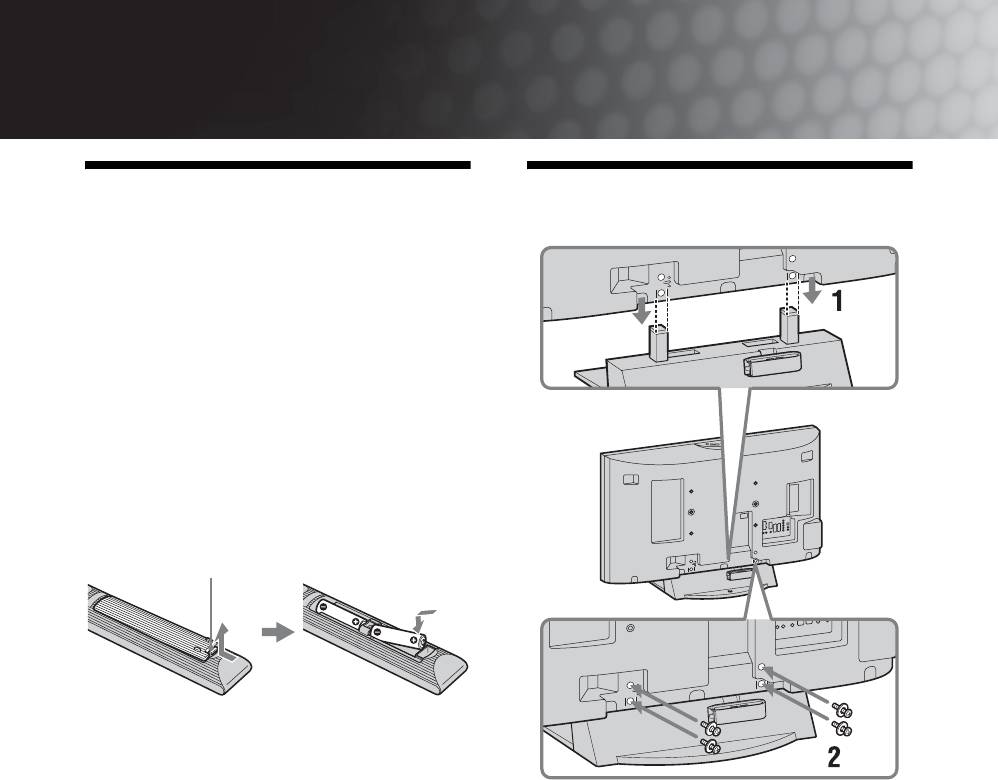
1: Checking the
2: Attaching the stand
accessories
Mains lead (Type C-6)* (1)
Coaxial cable (1)
Support belt (1) and screws (2)
Stand (1) and screws (4)
Remote RM-ED009 (1)
Size AA batteries (R6 type) (2)
* Do not remove the ferrite cores.
To insert batteries into the remote
Push and lift the cover to open.
~
• Observe the correct polarity when inserting batteries.
• Do not use different types of batteries together or mix old
and new batteries.
• Dispose of batteries in an environmentally friendly way.
1 Place the TV onto the stand by aligning the
Certain regions may regulate the disposal of batteries.
Please consult your local authority.
screw hole alignment lines over the stand
• Handle the remote with care. Do not drop or step on it, or
as shown.
spill liquid of any kind onto it.
• Do not place the remote in a location near a heat source, a
2 Fix the TV to the stand using the supplied
place subject to direct sunlight, or a damp room.
screws.
~
• This TV is very heavy, so two or more people should place
the TV on the stand.
• If using an electric screwdriver, set the tightening torque
at approximately 1.5 N·m (15 kgf·cm).
• When installing the TV onto the wall, follow step 1 to
prevent the TV panel from falling over.
GB
4
Start-up Guide
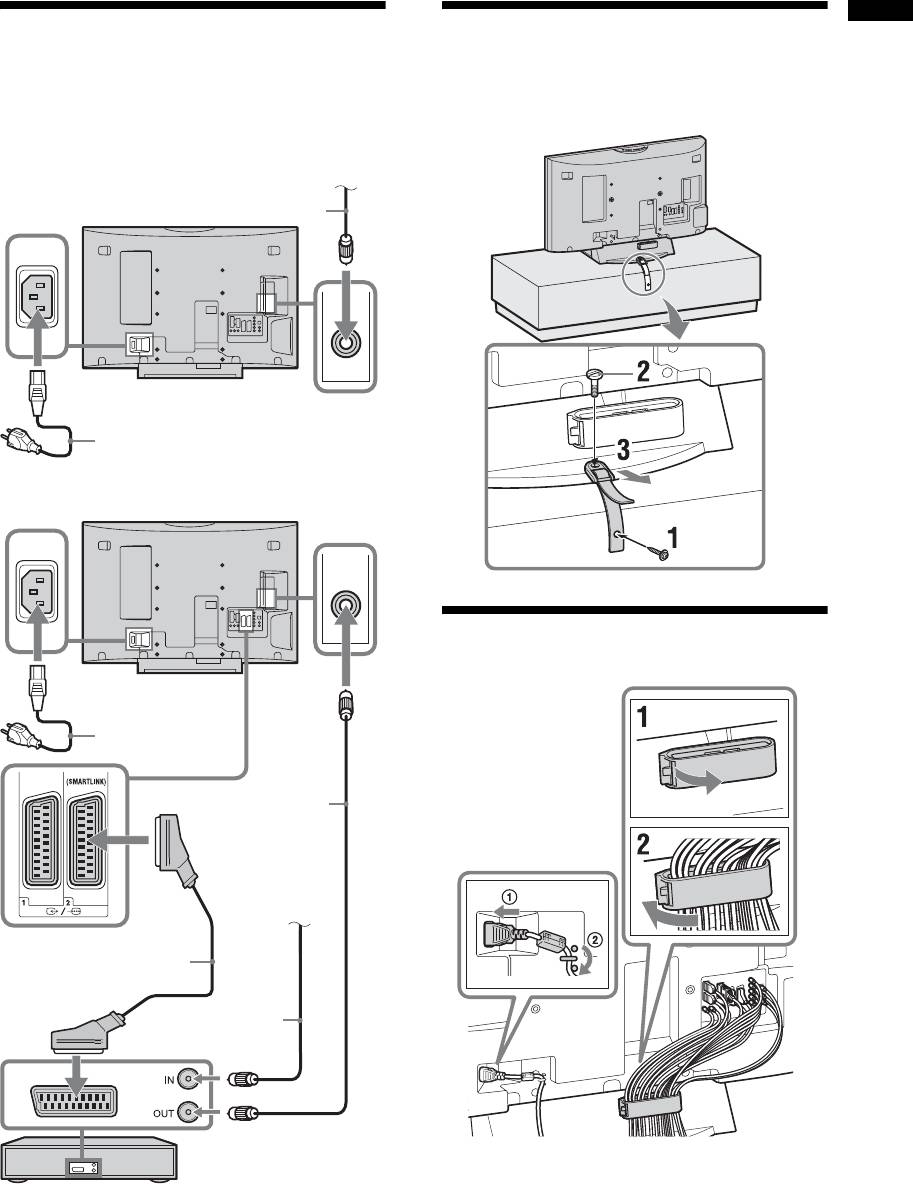
3: Connecting an aerial/
4: Preventing the TV
cable/VCR
from toppling over
Connecting an aerial/cable
Terrestrial signal or cable
Coaxial cable (supplied)
Mains lead (supplied)
Connecting an aerial/cable and VCR
5: Bundling the cables
Mains lead
(supplied)
Coaxial cable
(supplied)
Terrestrial signal
or cable
Scart lead (not supplied)
Coaxial cable
(not supplied)
VCR
~
The hook of the cable holder can be opened from either sides
depending on attaching position.
GB
5
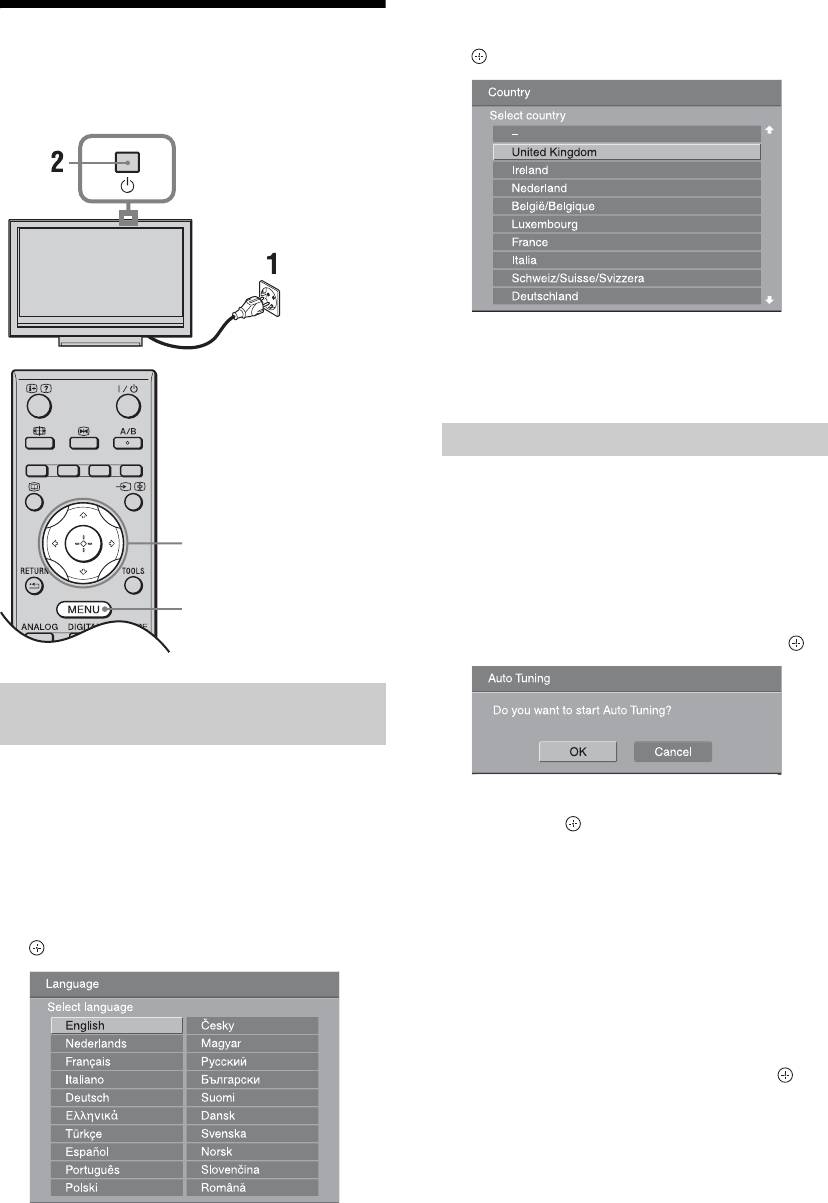
4 Press F/f to select the country/region in
which you will operate the TV, then press
6: Performing the initial
.
setup
If the country/region which you want to use on the
TV does not appear in the list, select “-” instead of
a country/region.
Auto tuning the TV
5 Before you start auto tuning the TV, insert
a pre-recorded tape into the VCR
connected to the TV (page 5) and start play
3,4,6,7
back.
The video channel will be located and stored on
the TV during auto tuning.
9
If no VCR is connected to the TV, skip this step.
6 Press G/g to select “OK”, then press .
Selecting the language and country/
region
1 Connect the TV to your mains socket
(220-240 V AC, 50 Hz).
7 Press F/f to select “Antenna” or “Cable”,
2 Press 1 on the top edge of the TV.
then press .
When you turn on the TV for the first time, the
If you select “Cable”, the screen for selecting the
Language menu appears on the screen.
scan type appears. See “To tune the TV for digital
cable connection” on page 7.
3 Press F/f/G/g to select the language
The TV starts searching for all available digital
displayed on the menu screens, then press
channels, followed by all available analogue
.
channels. This may take some time, so do not
press any buttons on the TV or remote while
proceeding.
If a message appears for you to confirm the aerial
connection
No digital or analogue channels were found.
Check all the aerial connections and press to
start auto tuning again.
8 When the Programme Sorting menu
appears on the screen, follow the steps of
“Programme Sorting” on page 33.
If you do not wish to change the order in which the
analogue channels are stored on the TV, go to next
step.
GB
6
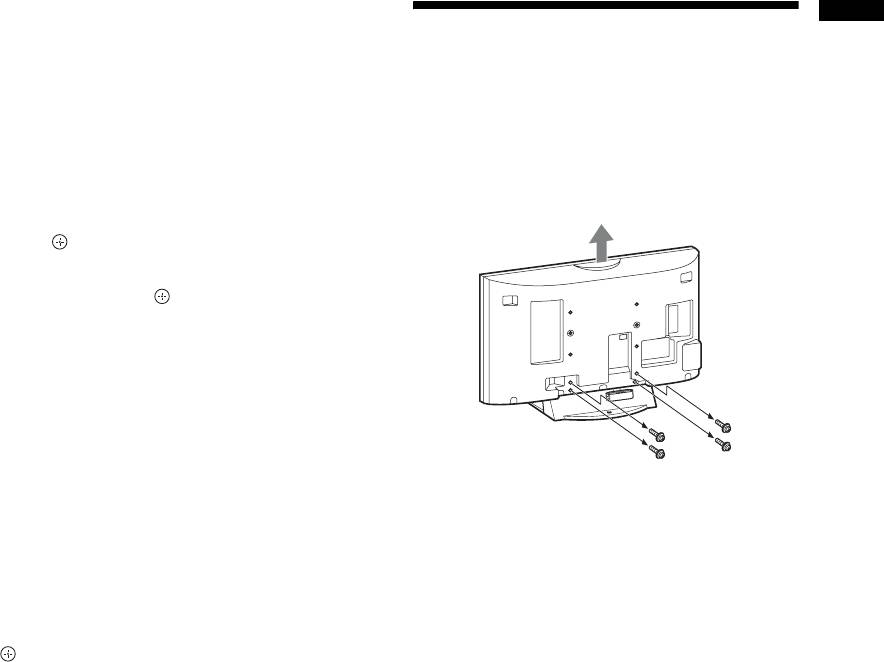
9 Press MENU to exit.
The TV has now tuned in all the available channels.
Start-up Guide
Detaching the stand
~
When a digital broadcast channel cannot be received, or
from the TV
when selecting a region in which there are no digital
broadcasts in step 4 (page 6), the time must be set after
performing step 9.
~
Do not remove the stand for any reason other than to wall-
mount the TV or to attach the optional TV stand.
To tune the TV for digital cable connection
1 Press F/f to select “Scan Type”, then
press .
2 Press F/f to select “Quick Scan” or “Full
Scan”, then press .
“Quick Scan”: Channels are tuned according to
the cable provider’s information within the
broadcast signal. The recommended setting for
“Frequency”, “Network ID” and “Symbol Rate” is
“Auto” unless your cable provider has supplied
actual values to use. “Quick Scan” is
recommended for fast tuning when this is
supported by your cable provider.
“Full Scan”: All available channels are tuned and
stored. This procedure may take some time. This
option is recommended when “Quick Scan” is not
supported by your cable provider.
For further information about supported cable
providers, refer to the support web site:
http://support.sony-europe.com/TV/DVBC/
3 Press G/g/f to select “Start”, then press
.
The TV starts searching for channels. Do not press
any buttons on the TV or remote.
~
Some cable providers do not support “Quick Scan”. If no
channels are detected using “Quick Scan”, perform “Full
Scan”.
GB
7
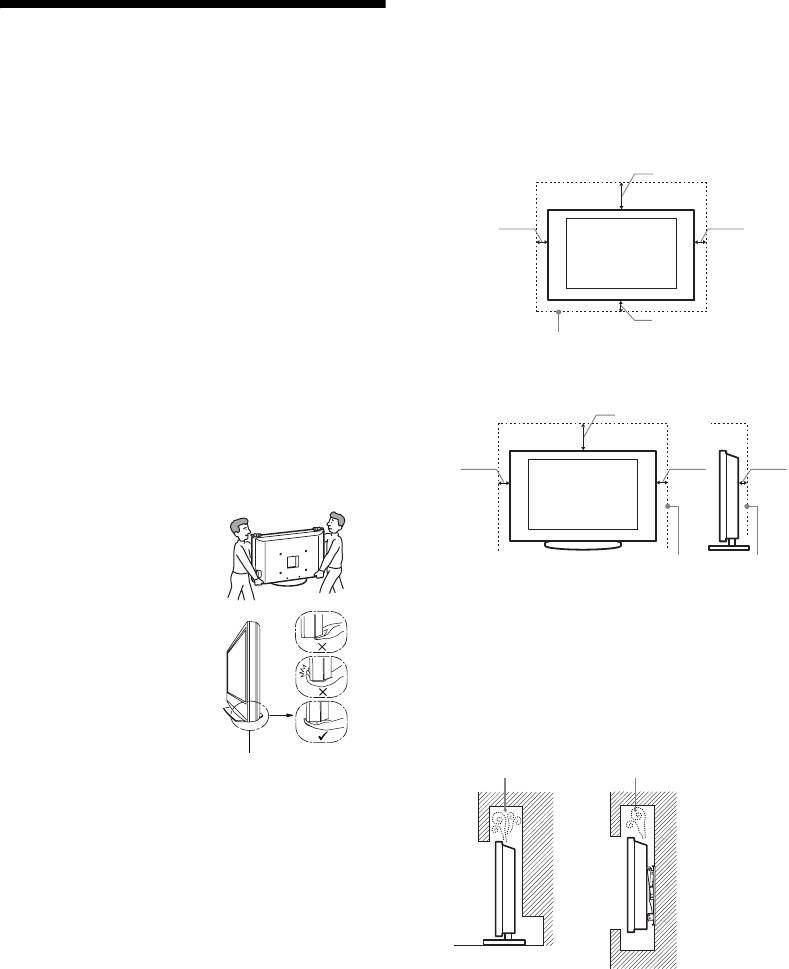
Ventilation
• Never cover the ventilation holes or insert anything in the
Safety information
cabinet.
• Leave space around the TV set as shown below.
• It is strongly recommended that you use a Sony wall-
mount bracket in order to provide adequate air-circulation.
Installation/Set-up
Installed on the wall
Install and use the TV set in accordance with the
instructions below in order to avoid any risk of fire,
30 cm
electrical shock or damage and/or injuries.
10 cm 10 cm
Installation
• The TV set should be installed near an easily accessible
mains socket.
• Place the TV set on a stable, level surface.
• Only qualified service personnel should carry out wall
installations.
10 cm
• For safety reasons, it is strongly recommended that you
Leave at least this space around the set.
use Sony accessories, including:
KDL-46V3000/40V3000:
– Wall-mount bracket SU-WL500
Installed with stand
KDL-46V3000/40V3000:
30 cm
– Floor stand SU-FL62
KDL-46V3000/40V3000:
– TV stand SU-FL300M
10 cm 10 cm 6 cm
Transporting
• Before transporting the
TV set, disconnect all
cables.
Leave at least this space around the set.
• Two or three people are
needed to transport a large
• To ensure proper ventilation and prevent the collection of
TV set.
dirt or dust:
• When transporting the TV
– Do not lay the TV set flat, install upside down,
set by hand, hold it as
backwards, or sideways.
shown on the right. Do not
– Do not place the TV set on a shelf, rug, bed or in a
put stress on the LCD
closet.
panel.
– Do not cover the TV set with a cloth, such as curtains,
• When lifting or moving
or items such as newspapers, etc.
the TV set, hold it firmly
– Do not install the TV set as shown below.
from the bottom.
Be sure to hold the
• When transporting the TV
Air circulation is blocked.
bottom of the panel, not
set, do not subject it to
jolts or excessive
the front part.
vibration.
• When transporting the TV
set for repairs or when
moving, pack it using the
Wall Wall
original carton and
packing material.
GB
8
Mains lead
When not in use
Handle the mains lead and socket as follows in order
• If you will not be using the TV set for several days, the TV
to avoid any risk of fire, electrical shock or damage
set should be disconnected from the mains for
environmental and safety reasons.
and/or injuries:
• As the TV set is not disconnected from the mains when the
– Connect the TV set using a three-wire grounding type
TV set is just turned off, pull the plug from the mains to
mains plug to a mains socket with a protective earthing
disconnect the TV set completely.
connection.
• However, some TV sets may have features that require the
– Use only Sony mains leads, not those of other brands.
TV set to be left in standby to work correctly.
– Insert the plug fully into the mains socket.
– Operate the TV set on a 220-240 V AC supply only.
– When wiring cables, be sure to unplug the mains lead
for your safety and take care not to catch your feet on
For children
the cables.
• Do not allow children to climb on the TV set.
– Disconnect the mains lead from the mains socket before
• Keep small accessories out of the reach of children, so that
working on or moving the TV set.
they are not mistakenly swallowed.
– Keep the mains lead away from heat sources.
– Unplug the mains plug and clean it regularly. If the plug
is covered with dust and it picks up moisture, its
insulation may deteriorate, which could result in a fire.
If the following problems occur...
Turn off the TV set and unplug the mains lead
Notes
immediately if any of the following problems occur.
• Do not use the supplied mains lead on any other
Ask your dealer or Sony service centre to have it
equipment.
checked by qualified service personnel.
• Do not pinch, bend, or twist the mains lead excessively.
The core conductors may be exposed or broken.
When:
• Do not modify the mains lead.
– Mains lead is damaged.
• Do not put anything heavy on the mains lead.
– Poor fitting of mains socket.
• Do not pull on the mains lead itself when disconnecting
– TV set is damaged by being dropped, hit or having
the mains lead.
something thrown at it.
• Do not connect too many appliances to the same mains
– Any liquid or solid object falls through openings in the
socket.
cabinet.
• Do not use a poor fitting mains socket.
Prohibited Usage
Do not install/use the TV set in locations,
environments or situations such as those listed below,
or the TV set may malfunction and cause a fire,
electrical shock, damage and/or injuries.
Location:
Outdoors (in direct sunlight), at the seashore, on a ship or
other vessel, inside a vehicle, in medical institutions,
unstable locations, near water, rain, moisture or smoke.
Environment:
Places that are hot, humid, or excessively dusty; where
insects may enter; where it might be exposed to mechanical
vibration, near flammable objects (candles, etc). The TV set
shall not be exposed to dripping or splashing and no objects
filled with liquids, such as vases, shall be placed on the TV.
Situation:
Do not use when your hands are wet, with the cabinet
removed, or with attachments not recommended by the
manufacturer. Disconnect the TV set from mains socket and
aerial during lightning storms.
Broken pieces:
• Do not throw anything at the TV set. The screen glass may
break by the impact and cause serious injury.
• If the surface of the TV set cracks, do not touch it until you
have unplugged the mains lead. Otherwise electric shock
may result.
GB
9

Precautions
Viewing the TV
• View the TV in moderate light, as viewing the TV in poor
light or during long period of time, strains your eyes.
• When using headphones, adjust the volume so as to avoid
excessive levels, as hearing damage may result.
LCD Screen
• Although the LCD screen is made with high-precision
technology and 99.99% or more of the pixels are effective,
black dots may appear or bright points of light (red, blue,
or green) may appear constantly on the LCD screen. This
is a structural property of the LCD screen and is not a
malfunction.
• Do not push or scratch the front filter, or place objects on
top of this TV set. The image may be uneven or the LCD
screen may be damaged.
• If this TV set is used in a cold place, a smear may occur in
the picture or the picture may become dark. This does not
indicate a failure. These phenomena disappear as the
temperature rises.
• Ghosting may occur when still pictures are displayed
continuously. It may disappear after a few moments.
• The screen and cabinet get warm when this TV set is in
use. This is not a malfunction.
• The LCD screen contains a small amount of liquid crystal
and mercury. The fluorescent tubes used in this TV set
also contain mercury. Follow your local ordinances and
regulations for disposal.
Handling and cleaning the screen surface/cabinet of
the TV set
Be sure to unplug the mains lead connected to the TV set
from mains socket before cleaning.
To avoid material degradation or screen coating degradation,
observe the following precautions.
• To remove dust from the screen surface/cabinet, wipe
gently with a soft cloth. If dust is persistent, wipe with a
soft cloth slightly moistened with a diluted mild detergent
solution.
• Never use any type of abrasive pad, alkaline/acid cleaner,
scouring powder, or volatile solvent, such as alcohol,
benzene, thinner or insecticide. Using such materials or
maintaining prolonged contact with rubber or vinyl
materials may result in damage to the screen surface and
cabinet material.
• When adjusting the angle of the TV set, move it slowly so
as to prevent the TV set from moving or slipping off from
its table stand.
Optional Equipment
Keep optional components or any equipment emitting
electromagnetic radiation away from the TV set. Otherwise
picture distortion and/or noisy sound may occur.
GB
10
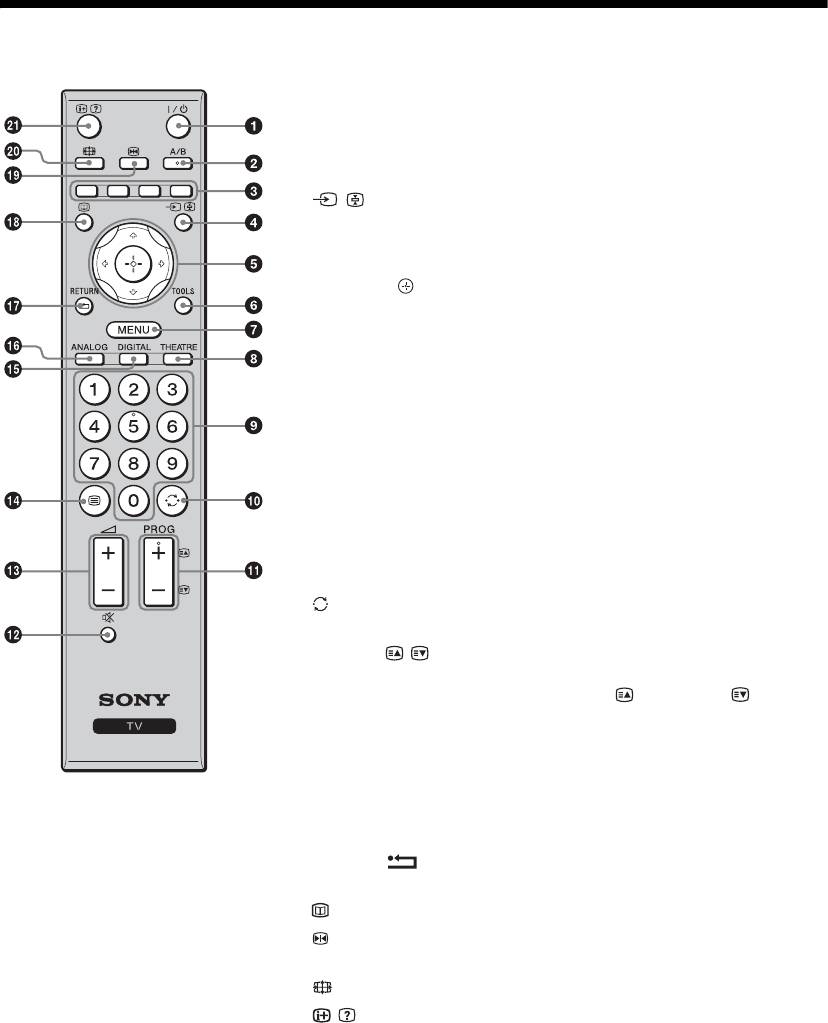
Overview of the remote
1 "/1 – TV standby
Turns the TV on and off from standby mode.
2 A/B – Dual Sound (page 26)
3 Coloured buttons (page 14, 15, 17)
4 / – Input select / Text hold
• In TV mode (page 20): Selects the input source from equipment connected
to the TV sockets.
• In Text mode (page 14): Holds the current page.
5 F/f/G/g/ (page 13, 22)
6 TOOLS (page 14, 20)
Enables you to access various viewing options and change/make adjustments
according to the source and screen format.
7 MENU (page 22)
8 THEATRE
You can set Theatre Mode on or off. When Theatre Mode is set to on, the
optimum audio output (if the TV is connected with an audio system using an
HDMI cable) and picture quality for film-based contents are automatically
set.
9 Number buttons
• In TV mode: Selects channels. For channel numbers 10 and above, enter
the second and third digit quickly.
• In Text mode: Enters the three digit page number to select the page.
0 – Previous channel
Returns to the previous channel watched (for more than five seconds).
qa PROG +/-/ /
• In TV mode (page 13): Selects the next (+) or previous (-) channel.
• In Text mode (page 14): Selects the next ( ) or previous ( ) page.
qs % – Mute (page 13, 20)
qd 2 +/- – Volume (page 20)
qf / – Text (page 14)
qg DIGITAL – Digital mode (page 13)
z
qh ANALOG – Analogue mode (page 13)
• The number 5, PROG + and A/B
qj RETURN /
buttons have tactile dots. Use the tactile
Returns to the previous screen of any displayed menu.
dots as references when operating the
TV.
qk – EPG (Digital Electronic Programme Guide) (page 15)
• If you turn the TV off, Theatre Mode is
ql – Picture freeze (page 13)
also turned off.
Freezes the TV picture.
w; – Screen mode (page 14)
wa / – Info / Text reveal
• In digital mode: Displays brief details of the programme currently being
watched.
• In analogue mode: Displays information such as current channel number
and screen format.
• In Text mode (page 14): Reveals hidden information (e.g. answers to a
quiz).
GB
11
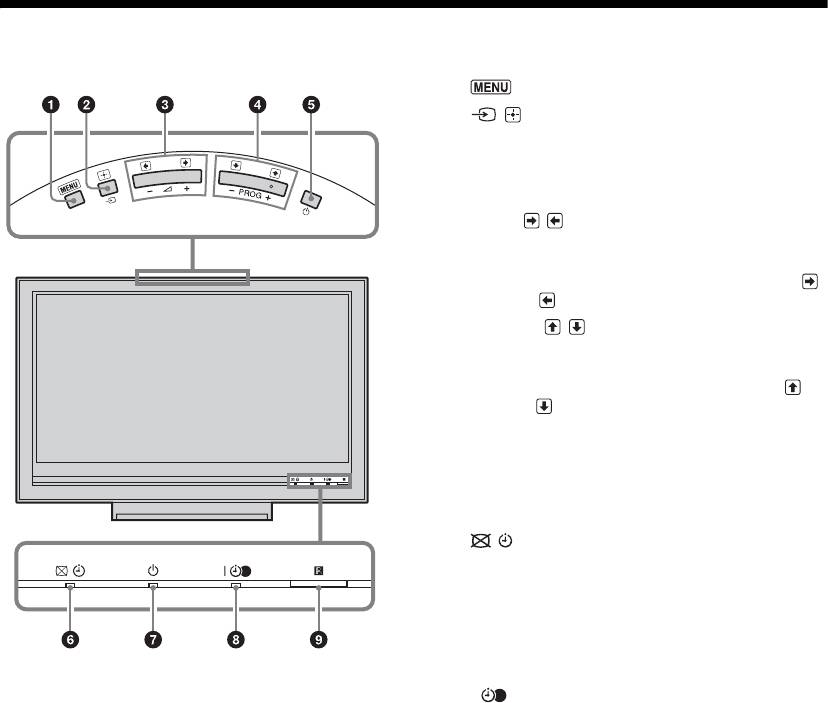
Overview of the TV buttons and indicators
1 (page 22)
2 / – Input select / OK
• In TV mode (page 20): Selects the input source
from equipment connected to the TV sockets.
• In TV menu: Selects the menu or option, and
confirms the setting.
3 2 +/-/ /
• In TV mode: Increases (+) or decreases (-) the
volume.
• In TV menu: Moves through the options right ( )
or left ( ).
4 PROG +/-/ /
• In TV mode: Selects the next (+) or previous (-)
channel.
• In TV menu: Moves through the options up ( ) or
down ( ).
5 1 – Power
Turns the TV on or off.
~
To disconnect the TV completely, pull the plug from the
mains.
6 – Picture Off / Timer indicator
• Lights up in green when the picture is switched off
(page 30).
• Lights up in orange when the timer is set
(page 30).
7 1 – Standby indicator
Lights up in red when the TV is in standby mode.
8 " – Power / Timer REC programme indicator
• Lights up in green when the TV is turned on.
• Lights up in orange when the timer recording is set
(page 15).
• Lights up in red during the timer recording.
9 Remote control sensor / Light sensor (page 31)
• Receives IR signals from the remote.
• Do not put anything over the sensor, as its function
may be affected.
~
Make sure that the TV is completely turned off before
unplugging the mains lead. Unplugging the mains lead while
the TV is turned on may cause the indicator to remain lit or
may cause the TV to malfunction.
GB
12
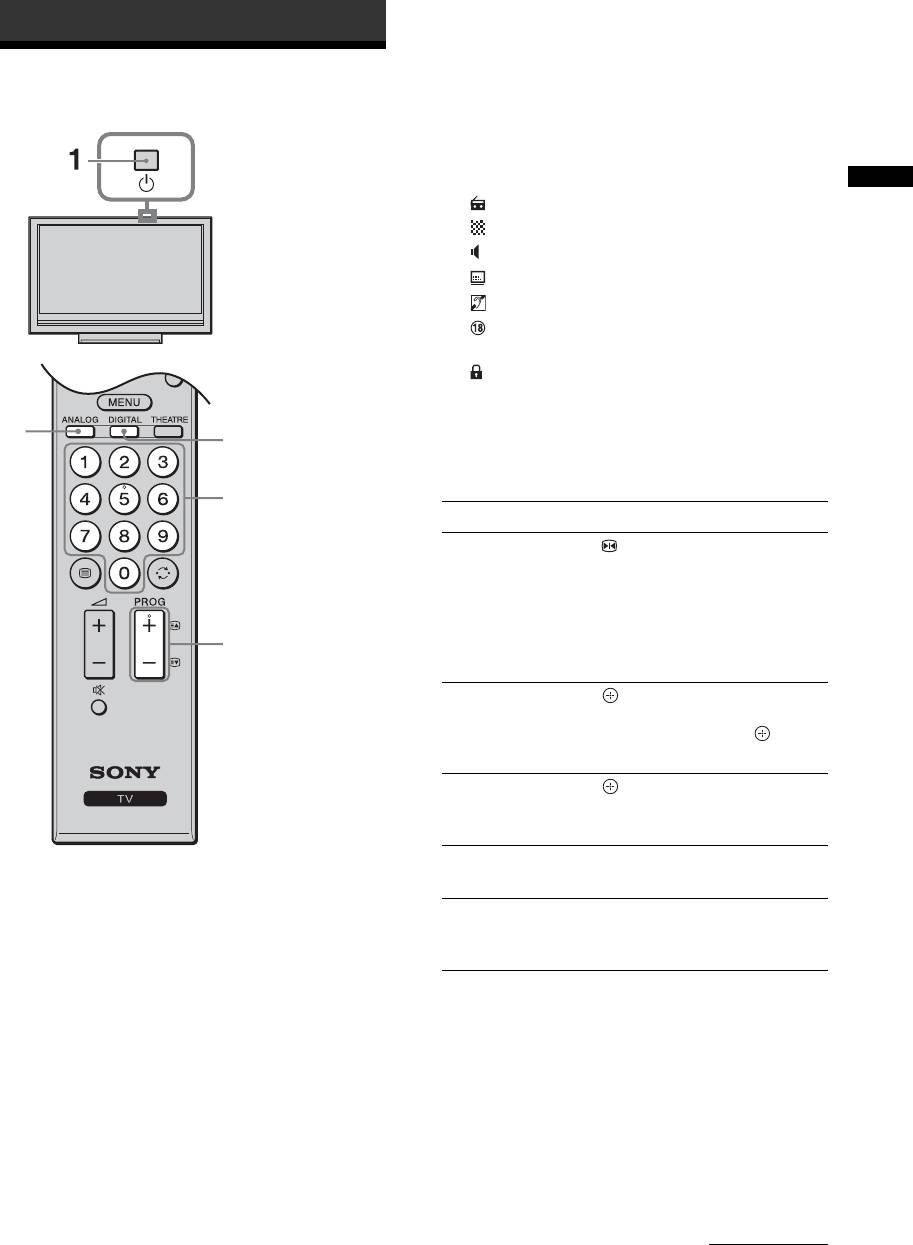
Watching TV
To select a digital channel using the Digital
Watching TV
Electronic Programme Guide (EPG), see page 15.
In digital mode
An information banner appears briefly. The
following icons may be indicated on the banner.
: Radio service
Watching TV
: Scrambled/Subscription service
: Multiple audio languages available
: Subtitles available
: Subtitles available for the hearing impaired
: Recommended minimum age for current
programme (from 4 to 18 years)
: Parental Lock
c (in red):
Current programme is being recorded
2
2
Additional operations
3
To Press
Freeze the picture
.
(Picture freeze)
Press once to remove the small
screen, then press again to return
to normal TV mode.
~
This function is not available for a
3
PC input source.
Access the
.
Programme index
To select an analogue channel,
table (in analogue
press
F/f, then press .
mode only)
Access the Digital
.
Favourites (in digital
For details, see page 17.
mode only)
Mute the sound %.
1 Press 1 on the top edge of the TV to turn
Press again to restore.
on the TV.
Turn on the TV
%.
When the TV is in standby mode (the 1 (standby)
without sound from
indicator on the TV front panel is red), press "/1
standby mode
on the remote to turn on the TV.
2 Press DIGITAL to switch to digital mode, or
press ANALOG to switch to analogue
mode.
The channels available vary depending on the
mode.
3 Press the number buttons or PROG +/- to
select a TV channel.
To select channel numbers 10 and above using the
number buttons, enter the second and third digits
quickly.
Continued
GB
13
To access Text
~
• You cannot select “4:3” or “14:9” for HD signal source
Press /. Each time you press /, the display changes
pictures.
cyclically as follows:
• You cannot use this function while the digital banner is
Text t Text over the TV picture (mix mode) t No
displayed.
Text (exit the Text service)
• Some characters and/or letters at the top and the bottom of
To select a page, press the number buttons or / .
the picture may not be visible in “Smart”. In such a case,
To hold a page, press / .
you can select “Vertical Size” using the “Screen” menu
To reveal hidden information, press / .
and adjust vertical size to make it visible.
z
• When “Auto Format” is set to “On”, the TV will
z
automatically select the best mode to suit the broadcast
When four coloured items appear at the bottom of the Text
(page 27).
page, Fastext is available. Fastext allows you to access pages
• You can adjust the position of the picture when selecting
quickly and easily. Press the corresponding coloured button
“Smart” (50Hz), “Zoom” or “14:9”. Press
F/f to move
to access the page.
up or down (e.g. to read subtitles) (except 720p and
1080i).
• Select “Smart” or “Zoom” to adjust for 720p or 1080i
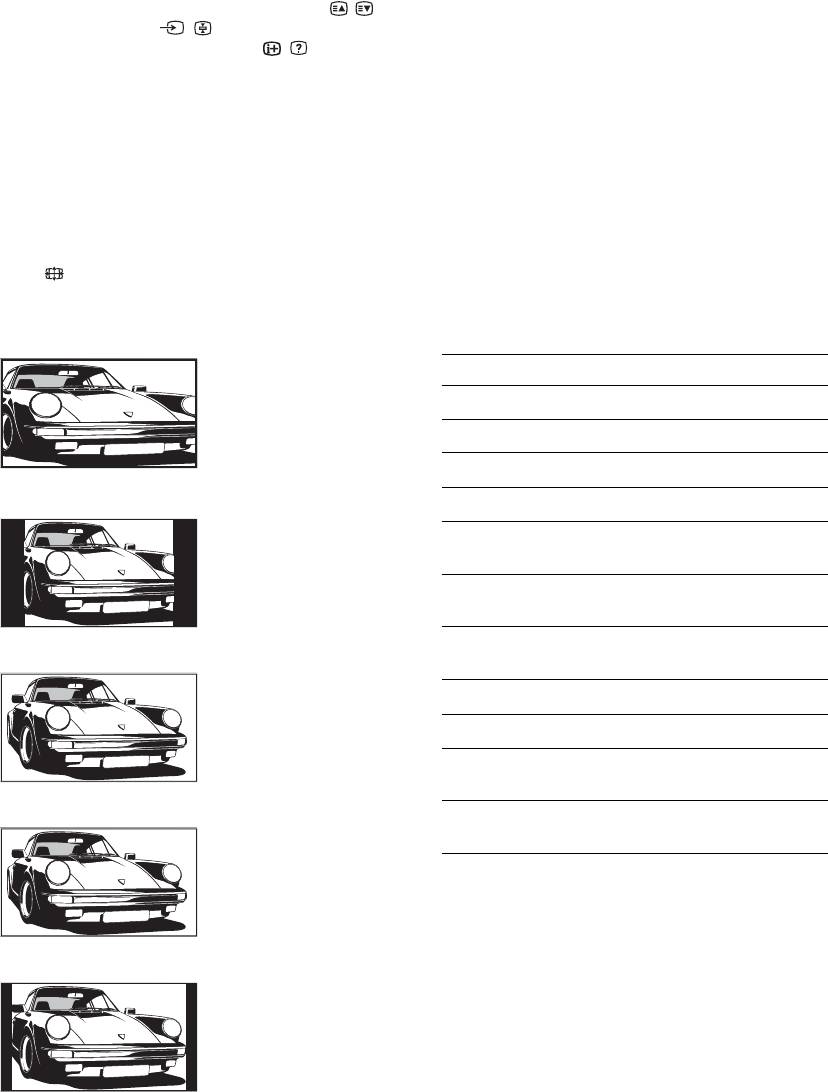
To change the screen format manually to
source pictures with edge portions cut off.
suit the broadcast
Press repeatedly to select the desired screen
format.
Using the Tools menu
Press TOOLS to display the following options when
viewing a TV programme.
Smart*
Displays conventional
Options Description
4:3 broadcasts with an
Close Closes the Tools menu.
imitation wide screen
effect. The 4:3 picture
Picture Mode See page 23.
is stretched to fill the
screen.
Sound Mode See page 25.
4:3
Speaker See page 29.
Displays conventional
Audio Language (in
See page 37.
4:3 broadcasts (e.g.
digital mode only)
non-wide screen TV) in
the correct proportions.
Subtitle Setting (in
See page 37.
digital mode only)
i Volume Adjusts the volume of the
Wide
headphones.
Displays wide screen
Sleep Timer See page 30.
(16:9) broadcasts in the
correct proportions.
Power Saving See page 30.
Auto Clock Set (in
Allows you to switch to digital
analogue mode only)
mode and obtain the time.
Zoom*
System Information (in
Displays the system
Displays cinemascopic
digital mode only)
information screen.
(letter box format)
broadcasts in the
correct proportions.
14:9*
Displays 14:9
broadcasts in the
correct proportions. As
a result, black border
areas are visible on the
screen.
* Parts of the top and bottom of the picture may be cut off.
GB
14
