
Sony KDL-46X4500 – page 2
Manual for Sony KDL-46X4500
Table of contents
Using Optional Equipment
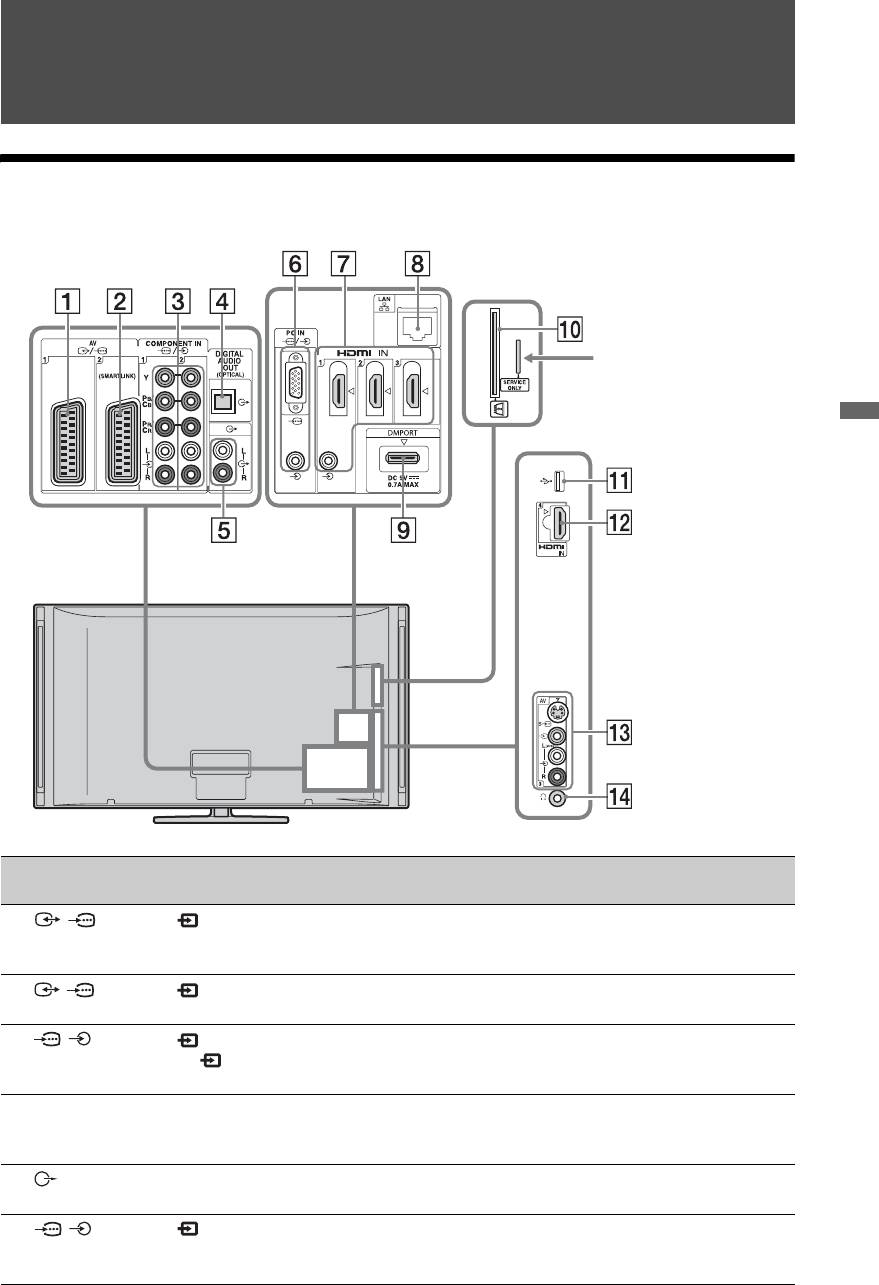
Connecting Optional Equipment
You can connect a wide range of optional equipment to your TV.
For service use only
Using Optional Equipment
Connect to Input symbol on
Description
screen
1 /AV1 AV1 When you connect a decoder, the TV tuner outputs scrambled
signals to the decoder, and the decoder unscrambles the
signals before outputting them.
2 /AV2
AV2 SmartLink provides a direct link between the TV and a
(SMARTLINK)
recorder (e.g. DVD recorder).
3 /
Component 1
The component video sockets support the following video
COMPONENT IN1
or Component
inputs only: 480i, 480p, 576i, 576p, 720p, 1080i and 1080p.
or 2
2
4 DIGITAL
Use an optical audio cable.
AUDIO OUT
(OPTICAL)
5 You can listen to TV sound on the connected Hi-Fi audio
equipment.
6 /PC IN PC It is recommended to use a PC cable with ferrites, such as the
“Connector, D-sub 15” (ref. 1-793-504-11, available in Sony
Service Centre), or an equivalent.
(Continued)
GB
21
Connect to Input symbol on
Description
screen
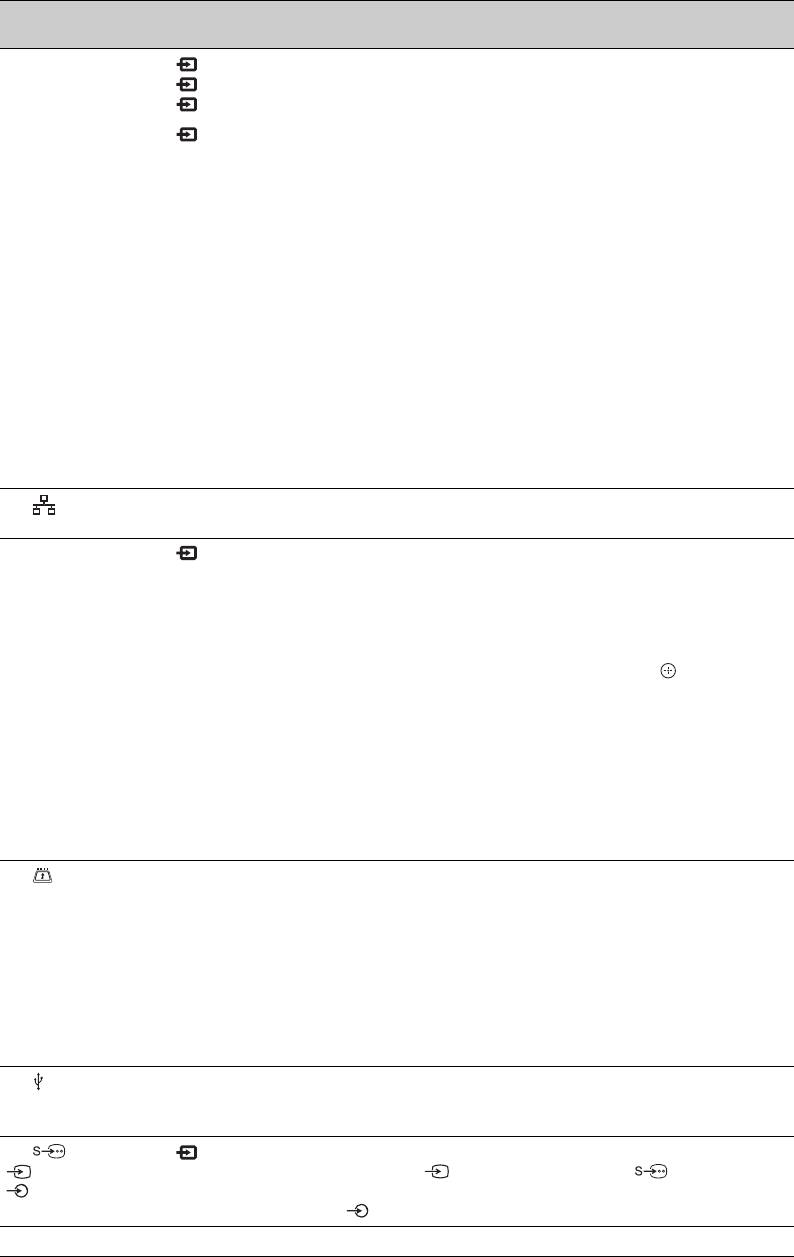
7 HDMI IN 1, 2, or
HDMI 1,
Digital video and audio signals are input from the connected
3
HDMI 2, or
equipment.
HDMI 3
In addition, when you connect the equipment that is
compatible with control for HDMI, communication with the
qs HDMI IN 4 HDMI 4
connected equipment is supported. Refer to page 43 to set up
this communication.
If the equipment has a DVI socket, connect the DVI socket to
the HDMI IN 1 socket through a DVI - HDMI adaptor
interface (not supplied), and connect the equipment’s audio
out sockets to the audio in sockets in the HDMI IN 1 sockets.
~
• The HDMI sockets support the following video inputs only:
480i, 480p, 576i, 576p, 720p, 1080i, 1080p and 1080/24p.
For PC video inputs, see page 52.
• Be sure to use only an authorized HDMI cable bearing the
HDMI logo. We recommend that you use a Sony HDMI
cable (high speed type).
• When connecting an audio system that is compatible with
control for HDMI, be sure to also connect it to the
DIGITAL AUDIO OUT (OPTICAL) socket.
8 LAN You can enjoy contents stored in DLNA-compatible devices
via a network (page 31).
9 DMPORT DMPORT You can play audio or video (optional cable required) of a
portable audio player that is connected to the TV using a
DIGITAL MEDIA PORT (DMPORT) adaptor.
Depending on the connected DIGITAL MEDIA PORT
adaptor, you can operate the connected equipment using the
TV as follows;
– Using the remote of the TV: F/f/G/g, , RETURN, N/
x/X/m/M/./>.
– Using the OPTIONS menu function: Press OPTIONS, and
select “Device Control (Menu)”.
~
• Do not connect or disconnect a DIGITAL MEDIA PORT
adaptor while the TV is turned on.
• The connected equipment is not powered when the TV is
turned off or in standby mode.
0 CAM
Provides access to pay TV services. For details, refer to the
(Conditional
instruction manual supplied with your CAM.
Access Module)
To use the CAM, remove the “dummy” card from the CAM
slot, then turn off the TV and insert your CAM card into the
slot. When you are not using the CAM, we recommend that
you keep the “dummy” card in the CAM slot.
~
• CAM is not supported in some countries/areas. Check with
your authorised dealer.
qa USB You can enjoy photo/music files stored in a Sony digital still
camera or camcorder through a USB cable or USB storage
device on your TV (page 24).
qd AV3,
AV3 To avoid picture noise, do not connect the camcorder to the
AV3, and
video jack AV3 and the S video jack AV3 at the same
AV3
time. When connecting a mono equipment, connect to the
AV3 L socket.
qf i Headphones You can listen to TV sound through headphones.
GB
22
~
Viewing Pictures from
• Depending on the “Skip AV Inputs” setting
(page 43), some input sources may not appear in
Connected Equipment
the list. If you have set an input source to “Skip”,
Turn on the connected equipment, and perform
that input source does not appear regardless of
one of the following operations.
whether the equipment is connected. If you have
set an input source to “Auto”, that input source
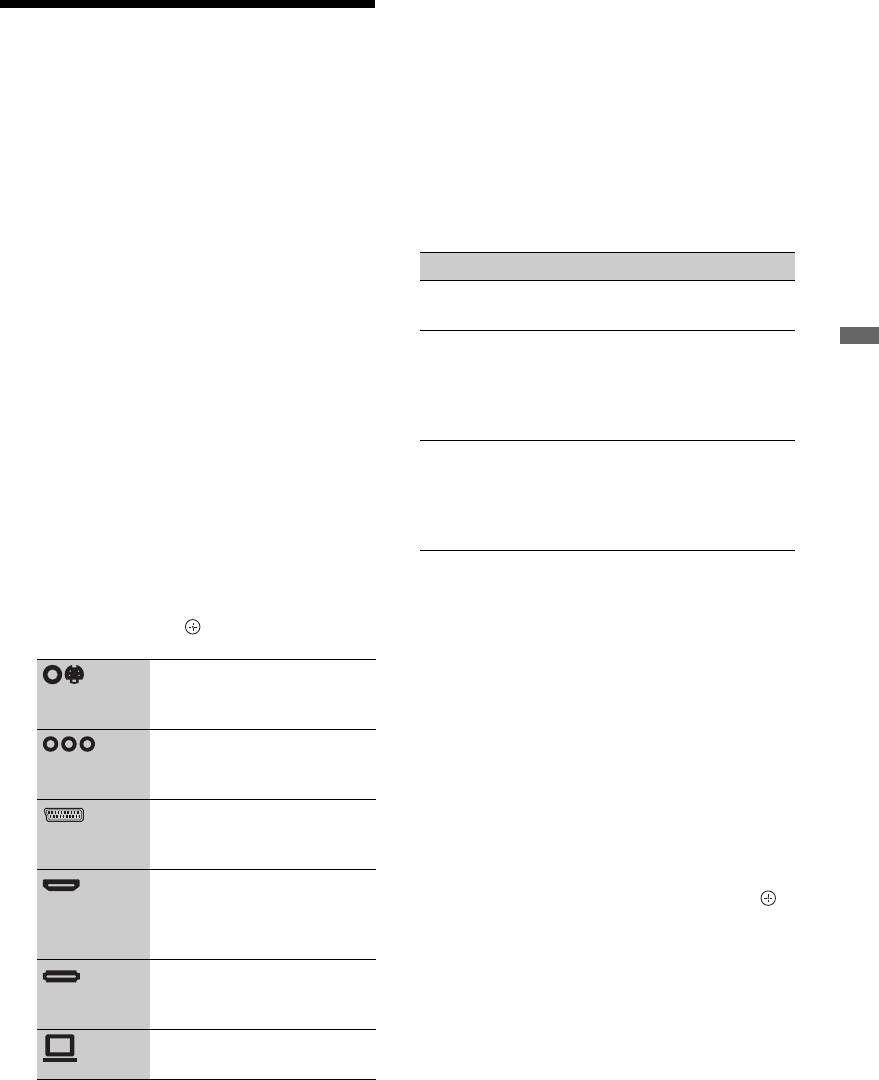
For equipment connected to the scart
does not appear when the equipment is not
sockets using a fully-wired 21-pin scart lead
connected to the TV.
Start playback on the connected equipment.
Additional operations
The picture from the connected equipment
appears on the screen.
To Do this
Return to normal TV
Press DIGITAL or
For an auto-tuned VCR
mode
ANALOG.
In analogue mode, press PROG +/– or the
Change the volume of
Press 2 +/–.
Using Optional Equipment
number buttons, to select the video channel.
the connected audio
system that is
compatible with
For a USB device
control for HDMI
See page 24.
Mute the sound of the
Press %.
For a network device, see page 31.
connected audio
Press again to restore
system that is
the sound.
For other connected equipment
compatible with
1 Press HOME.
control for HDMI
2 Press g to select “External Inputs”.
To view two pictures simultaneously
3 Press F/f to select the desired input
– PAP (Picture and Picture)
source, then press .
You can view two pictures (external input and
TV programme) on the screen simultaneously.
Switches to the video of
Connect an optional equipment (page 21), and
equipment connected to the
AV3 inputs.
make sure that images from the equipment
appear on the screen (page 23).
Switches to the video of
equipment connected to
~
Component 1 or 2 inputs.
• This function is not available for a PC input or
Switches to the video of
DIGITAL MEDIA PORT input.
equipment connected to
• You cannot change the size of the pictures.
AV1 or AV2 inputs.
1 Press OPTIONS.
Switches to the video of
2 Press F/f to select “PAP”, then press .
equipment connected to
HDMI 1, HDMI 2, HDMI
The picture from the connected equipment
3, or HDMI 4 input.
is displayed on the left, and the TV
Switches to the video of
programme is displayed on the right.
equipment connected to
3 Press the number buttons or PROG +/– to
DMPORT input.
select the TV channel.
Switches to the video of the
PC connected to PC input.
To return to single picture mode
Press RETURN.
z
• The highlighted picture is audible. You can switch
the audible picture by pressing G/g.
(Continued)
GB
23
To view two pictures simultaneously
– PIP (Picture in Picture)
Playing back Photo/Music
You can view two pictures (PC input and TV
via USB
programme) on the screen simultaneously.
You can enjoy photo/music files stored in a
~
Sony digital still camera or camcorder through
• This function is not available for a DIGITAL
a USB cable or USB storage device on your
MEDIA PORT input.
TV.
1 Press OPTIONS.
1 Connect a supported USB device to the
2 Press F/f to select “PIP”, then press .
TV.
The picture from the connected PC is
2 Press HOME.
displayed in full size, and the TV
3 Press G/g to select “Photo” or “Music”.
programme is displayed in the small
4 Press F/f to select a USB device, then
screen.
You can use F/f to change the position of
press .
the TV programme screen.
The file or folder list appears.
3 Press the number buttons or PROG +/– to
To display a thumbnail list, press the
select a TV channel.
yellow button while the list is displayed.
To return to single picture mode
5 Press F/f to select a file or folder, then
Press RETURN.
press .
z
When you select a folder, select a file,
• You can switch the audible picture by pressing G/
then press .
g.
Playback starts.
Photo Playback Auto Start
The TV automatically starts photo playback
when the TV is turned on and a digital still
camera or other device storing photo files is
connected to the USB port and then turned on
(page 42).
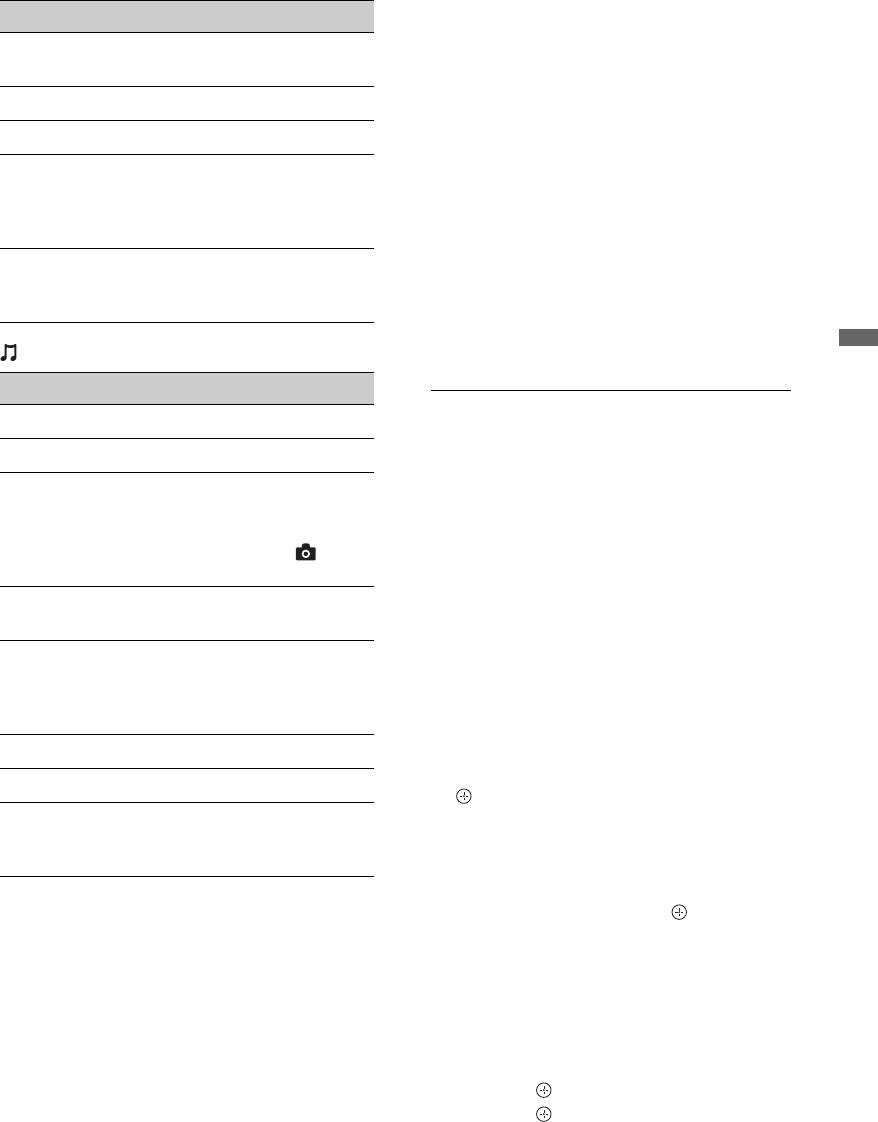
(Photo) Available OPTIONS
Option Description
Picture See page 36.
Sound See page 38.
Surround See page 39.
Video Settings See page 40.
Cropping Crops a photograph.
Display map Displays a map of the
location where a photo
was shot along with the
photo itself.
Show Options Allows you to set
repeat/shuffle for photo
playback.
Photo Set-up Sets how playback
should be performed
and what effects to use
during slideshows.
GB
24
• USB playback is supported for the following
Option Description
photo file formats:
Rotate and Save Rotates and saves
– JPEG (JPEG format files with the extension
unprotected files.
“.jpg” and conforming to DCF or Exif)
– RAW (ARW/ARW 2.0 format files with the
Speaker See page 42.
extension “.arw”. For preview only.)
i Volume See page 42.
• USB playback is supported for the following
music file formats:
Picture Frame
Allows you to select a
– MP3 (files with the extension “.mp3” that have
Image
photograph to be
not been copyrighted)
displayed as a picture
• When you connect a Sony digital still camera, set
frame.
the camera’s USB connection mode to Auto or
Information Displays information
“Mass Storage”. For more information about USB
about the device,
connection mode, refer to the instructions supplied
folders, and files.
with your digital camera.
• Check the website below for updated information
(Music) Available OPTIONS
about compatible USB devices.
Using Optional Equipment
http://support.sony-europe.com/TV/compatibility/
Option Description
Sound See page 38.
To display a photograph
— Picture Frame
Surround See page 39.
You can display a photograph on the screen for
Add to Slideshow Registers the
a selected period of time. After that period, the
background music to be
played during a
TV automatically switches itself into standby
slideshow using
mode.
(Photo).
1 Select a photograph.
Omit from
Cancels the registered
You can select a photograph from the
Slideshow
background music.
connected USB device or preset picture
Playback Options Allows music options to
folder. For details on selecting a
be set for repeat,
photograph, see page 24.
shuffle, or regular
playback.
2 Press OPTIONS while the selected
photograph is displayed, then press F/f to
Speaker See page 42.
select “Picture Frame Image” and press
i Volume See page 42.
.
Information Displays information
3 Press RETURN repeatedly to return to
about the device,
the Home Menu.
folders, and files.
4 Press G/g to select “Photo”, then select
~
“Picture Frame” and press .
• While the TV is accessing the data on the USB
device, observe the following:
The TV is switched to Picture Frame
– Do not turn off the TV or connected USB
mode, and the selected photograph is
device.
displayed on the screen.
– Do not disconnect the USB cable.
To set the duration of displaying a
– Do not remove the USB device.
photograph
The data on the USB device may be damaged.
Press OPTIONS, then select “Duration”
• Sony will not be held liable for any damage to, or
and press . Then, select the duration,
loss of, data on the recording media due to a
and press .
malfunction of any connected devices or the TV.
• Playback does not start automatically if the TV is
The counter appears on the screen.
turned on after connecting the digital still camera
To return to the XMB™
or other device to the USB port.
Press RETURN.
(Continued)
GB
25

6 Select the following items using F/f, then
~
• If the photograph is selected from a USB device, it
set them using G/g.
must remain connected to the TV.
–Time Zone
• If “Sleep Timer” is activated, the TV
–DST
automatically will switch into standby mode.
7 Select “OK”, then press .
To display a photograph with the
The GPS log files are loaded.
location on the map
8 Disconnect the GPS unit and connect the
When using a digital still camera with GPS
device on which the photograph is stored.
function, it is possible to display a photograph
9 Select a photograph (page 24).
with a map of the location where the
10 Press the green/red buttons to zoom in/out
photograph was taken using a function of GPS
for recording longitude and latitude. Because
on the map.
map information is downloaded from the
Internet online map service, the network
connection must be required and the TV has to
be connected to the network (page 31).
1 Select a photograph (page 24).
2 Press the green/red buttons to zoom in/out
on the map.
To change the display position of the map
on the TV screen, press the blue button
repeatedly.
~
• Because the Internet online map service is
provided by a third party, service may be changed
or terminated without prior notification to the user.
• The position indicated on the map may differ
depending on the digital still camera.
• Only a large-scale map that cannot be zoomed in
or out is displayed if the TV is not connected to
the Internet or the Internet online map service is
terminated.
z
• A map can be displayed in the case of
photograph’s Exif data includes a date
information, and the associated longitude and
latitude information (“Log files”) has been
recorded using a Sony GPS unit. Follow the
procedure described below.
1 Connect the GPS unit to the USB port.
2 Press HOME.
3 Press G/g to select “Photo”.
4 Press F/f to select the GPS unit, then
press
.
5 Select “Load GPS log files”, then press .
GB
26

To connect the equipment that is
Using BRAVIA Sync with
compatible with control for HDMI
Control for HDMI
Connect the compatible equipment and the TV
with an HDMI cable. When connecting an
The control for HDMI function enables the TV
audio system, be sure to also connect the
to communicate with the connected equipment
DIGITAL AUDIO OUT (OPTICAL) jack of
that is compatible with the function, using
the TV and the audio system using an optical
HDMI CEC (Consumer Electronics Control).
audio cable. For details, see page 21.
For example, by connecting Sony equipment
that is compatible with control for HDMI
To make the control for HDMI settings
(with HDMI cables), you can control them
The control for HDMI settings must be set on
together.
both the TV side and connected equipment
Be sure to connect the equipment correctly,
side. See “HDMI Set-up” on page 43 for the
and make the necessary settings.
TV side settings. For settings on the connected
equipment, refer to the operating instructions
Using Optional Equipment
Control for HDMI
for that equipment.
• Automatically turns the connected
equipment off when you switch the TV to
standby mode using the remote.
• Automatically turns the TV on and
switches the input to the connected
equipment when the equipment starts to
play.
• If you turn on a connected audio system
while the TV is on, the sound output
switches from the TV speaker to the audio
system.
• Adjusts the volume (2 +/–) and mutes the
sound (%) of a connected audio system.
• You can operate the connected Sony
equipment that has the BRAVIA Sync logo
by the TV remote by pressing:
– N/x/X/m/M to operate the connected
equipment directly.
– SYNC MENU to display the menu of the connected
HDMI equipment on the screen.
After displaying the menu, you can operate the
menu screen by using F/f/G/g, , colour buttons,
and RETURN.
– OPTIONS to display “Device Control”, then select
options from “Options” and “Content List” to
operate the equipment.
– Refer to the instruction manual of the equipment for
available control.
• If “Control for HDMI” of the TV is set to
“On”, “Control for HDMI” of the
connected equipment is also automatically
switched to “On”.
GB
27
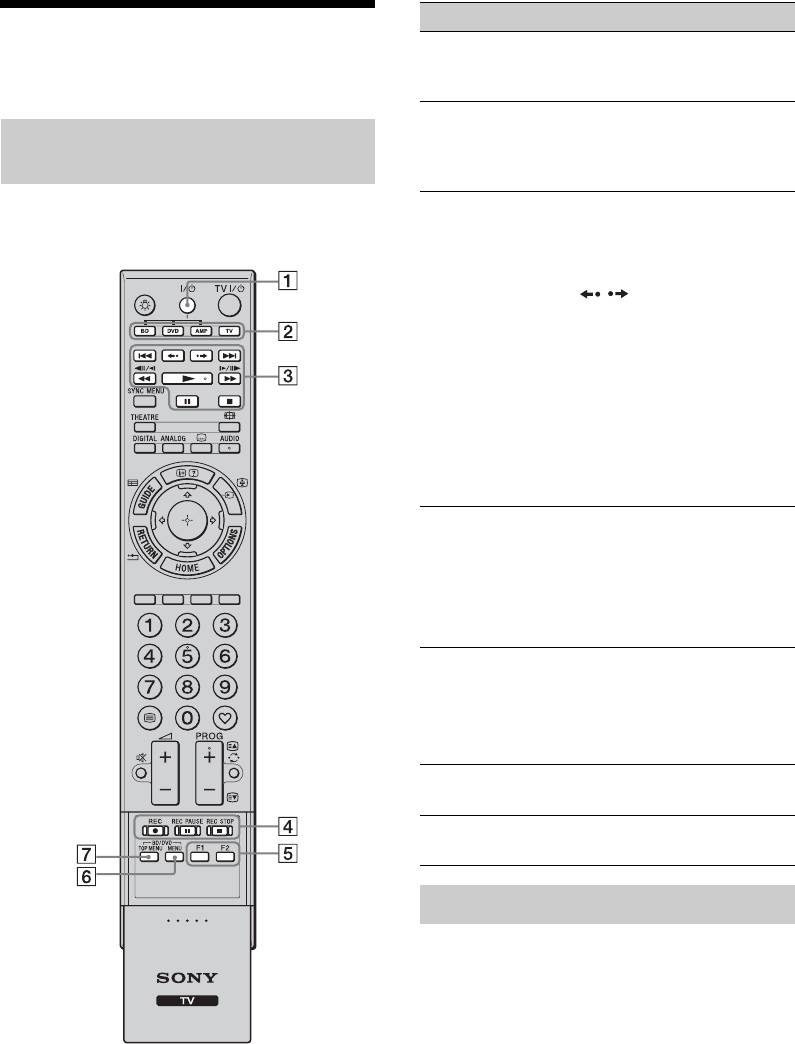
Item Description
Operating Optional
1 "/1 Turns on or off the optional
Equipment Using the TV
equipment you have selected
with the function buttons.
Remote
2 Function
Allows you to operate the
buttons
corresponding equipment. For
Buttons for using optional
details, see “Programming the
equipment
remote” on page 28.
3 BD/DVD
• ./>: Goes to the
For details, refer to the operating instructions
operating
beginning of the previous/
supplied with the connected equipment.
buttons
next title/chapter/scene/
track.
• / : Replays the scene/
briefly fast forwards the
scene.
• m/M: Fast reverses/fast
forwards the disc when
pressed during playback.
• N: Plays a disc at normal
speed.
• X: Pauses the playback.
• x: Stops the playback.
4 DVD record
• z REC: Starts the
buttons
recording.
• X REC PAUSE: Pauses the
recording.
• x REC STOP: Stops the
recording.
5 F1/F2 • Selects a disc when using a
disc changer.
• Selects a function when
using a combination unit
(e.g. a DVD/HDD).
6 BD/DVD
Displays the BD/DVD disc
MENU
menu.
7 BD/DVD
Displays the top menu of the
TOP MENU
BD/DVD disc.
Programming the remote
This remote is preset to operate Sony TVs, and
most Sony Blu-ray disc players, DVD players,
DVD/HDD recorders, and audio systems
(Home Theatre, etc.).
To control Blu-ray disc players, DVD players,
z
and DVD/HDD recorders of other
•The N button has a tactile dot. Use the tactile dot
manufacturers (and some other Sony models),
as a reference when operating other equipment.
programme the remote as follows.
~
• Before you start, look up the three-digit code of
your equipment from the “Manufacturer’s codes”
on page 29.
GB
28
If your equipment is not working, or
some of the functions do not work
Enter the correct code or try the next code
1
listed for the brand. Note that the list may
not include codes for all models of all
brands.
To return to normal TV operation
Press the TV function button.
Manufacturer’s codes
1
DVD players
Manufacturer Code
3
SONY 001, 029, 030, 036 – 044, 053 – 055
AIWA 021
AKAI 032
Using Optional Equipment
DENON 018, 027, 020, 002
2
GRUNDIG 009, 028, 023, 024, 016, 003
HITACHI 025, 026, 015, 004, 035
JVC 006, 017
KENWOOD 008
LG 015, 014, 034
LOEWE 009, 028, 023, 024, 016, 003
MATSUI 013, 016
ONKYO 022, 033
PANASONIC 018, 027, 020, 002, 045 – 047
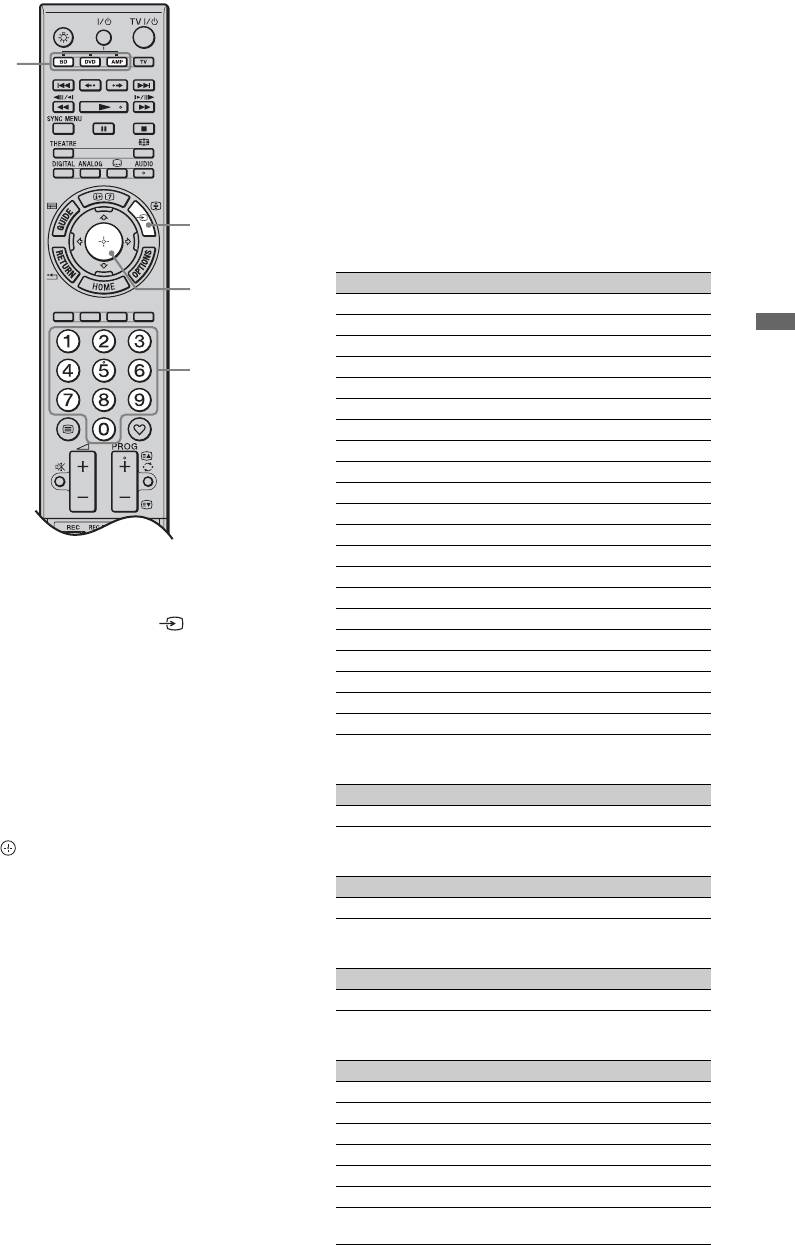
1 Press and hold the BD, DVD, or AMP
PHILIPS 009, 028, 023, 024, 016, 003, 031
function button you want to programme
PIONEER 004, 050, 051, 052
SAMSUNG 011, 014
on the remote, then press .
SANYO 007
The selected function button (BD, DVD,
SHARP 019, 027
or AMP) flashes.
THOMSON 012
TOSHIBA 003, 048, 049
2 Press the number buttons to enter the
YAMAHA 018, 027, 020, 002
three-digit manufacturer’s code number
when the function button flashes.
Blu-ray disc (BD) players
If you do not enter the code within
Manufacturer Code
10 seconds, you need to go back to step 1.
SONY 101 – 103
3 Press .
DVD/video cassette recorders
The selected function button flashes
Manufacturer Code
twice.
SONY 251
If the selected function button flashes five
times, repeat from step 1.
DVD/HDD recorders
Manufacturer Code
4 Turn on your equipment and check that
SONY 201 – 203
the following main functions work.
For Blu-ray disc players, DVD players
VCRs
and DVD/HDD recorders, check:
Manufacturer Code
N (playback), x (stop), m (rewind),
SONY 301 – 310, 362
M (fast forward), channel selection.
AIWA 325, 331, 351
For DVD players and DVD/HDD
AKAI 326, 329, 330
DAEWOO 342, 343
recorders, check:
GRUNDIG 358, 355, 360, 361, 320, 351, 366
TOP MENU/MENU and F/f/G/g.
HITACHI 327, 333, 334
JVC 314, 315, 322, 344, 352 – 354, 348,
349
(Continued)
GB
29
Manufacturer Code
LG 332, 338
LOEWE 358, 355, 360, 361, 320, 351
MATSUI 356, 357
ORION 328
PANASONIC 321, 323
PHILIPS 311 – 313, 316 – 318, 358, 359, 363,
364
SAMSUNG 339 – 341, 345
SANYO 335, 336
SHARP 324
THOMSON 319, 350, 365
TOSHIBA 337
DAV Home Theatre System
Manufacturer Code
SONY (DAV) 401 – 404
AV receivers
Manufacturer Code
SONY 451 – 454
Digital terrestrial receivers
Manufacturer Code
SONY 501 – 504
GB
30
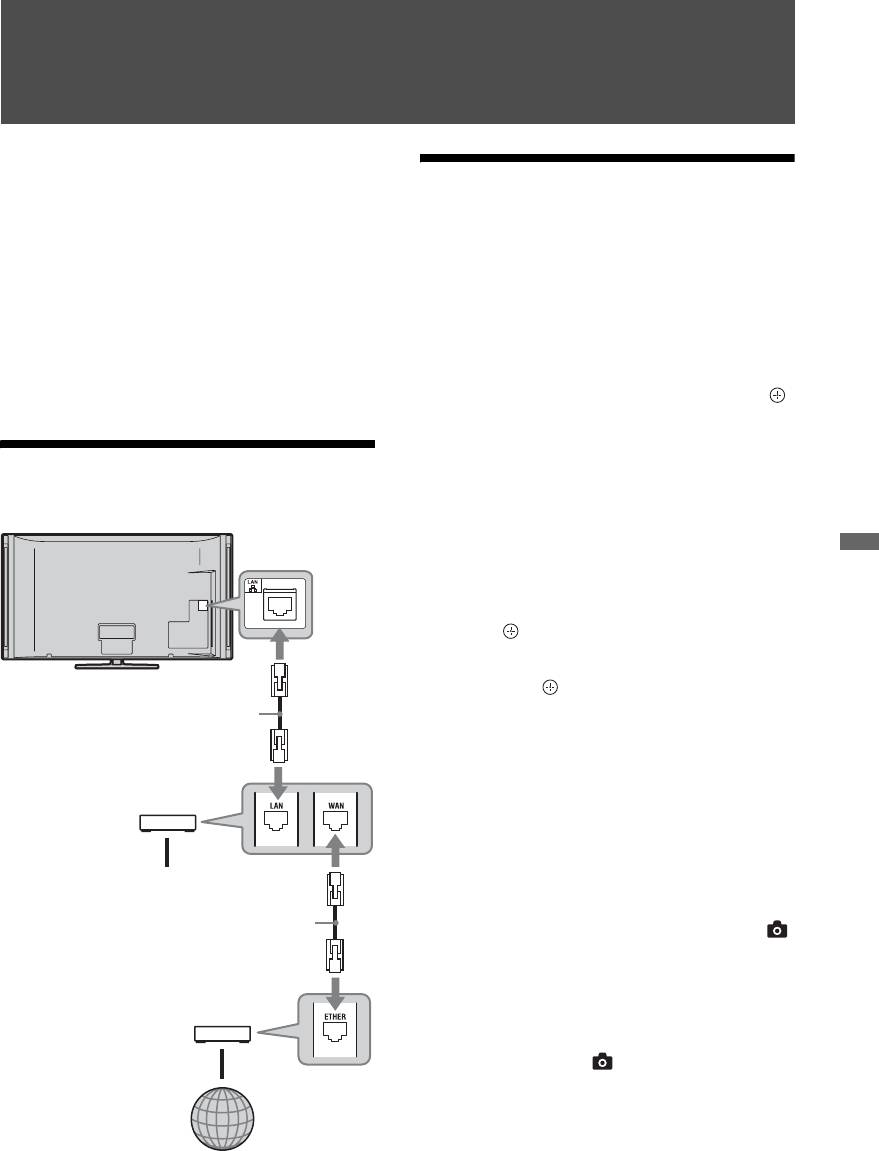
Using Home Network Features
With this TV, you can enjoy contents stored in
DLNA-compatible devices on the home
Enjoying Photo/Music Files
network.
via the Network
Devices that store and provide contents, such
as photo/music files, are called “server”. The
You can enjoy photo/music files on the server
TV receives the photo/music files from the
easily by selecting an icon on the Home Menu
server via the network, and you can enjoy
of the TV.
them on the TV even in other rooms.
1 Press HOME.
To enjoy the home network, a DLNA-
2 Press G/g to select “Photo” or “Music”.
compatible device (VAIO, Cyber-shot, etc.) is
3 Press F/f to select a server, then press .
necessary as a server.
The file or folder list appears.
To display the thumbnail list, press the
Connecting to the Network
yellow button while the list is displayed.
When the server cannot be found
TV
See “Checking the Network Connection”
(page 33) and “Adjusting the Server
Using Home Network Features
Display Settings” (page 33).
4 Press F/f to select a file or folder, then
press .
When you select a folder, select a file,
then press .
Network cable (not supplied)
Playback starts.
z
• A map can be displayed with a photograph in the
case of longitude and latitude information has
Broadband router
been recorded to photograph’s Exif data (page 26).
~
• Depending on the network device, it may be
To network devices
necessary to register the TV with the network
device.
Network cable (not supplied)
• Picture quality may appear coarse when using
(Photo) because images may be enlarged
depending on the file. Also, images may not fill
DSL modem/
the entire screen depending on the image size and
Cable modem
aspect ratio.
• Some photo files may take some time to be
displayed when using (Photo).
• To play files that are received from a network
device, they need to conform to one of the
following file formats.
– Still images: JPEG format
Internet
– Music: MP3 format or linear PCM format
Depending on the network device, the file format
may be converted before transfer. In such cases,
the file format resulting after conversion is used
for playback. For details, see the instruction
manual for the network device being used.
Even files conforming to one of the file formats
given above cannot be played in some cases.
(Continued)
GB
31
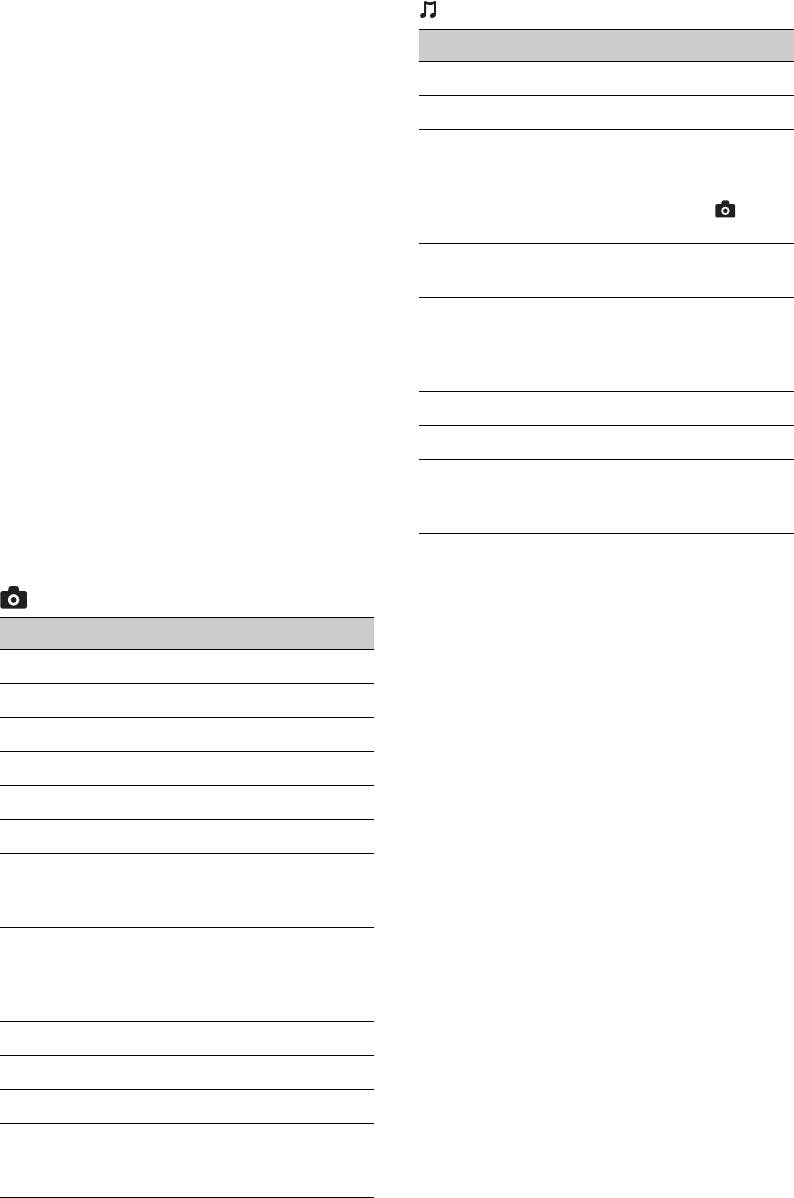
To enjoy photographs and music on the
(Music) Available OPTIONS
TV screen by operating devices
Option Description
– Renderer
Sound See page 38.
Renderer is a feature for playing photo files
and music files stored in network devices
Surround See page 39.
(digital still cameras, mobile phones, etc.) on
Add to Slideshow Registers the
the TV by operating the controller device in
background music to be
question. To use this feature, a renderer-
played during a
compatible device such as a digital still camera
slideshow using
(Photo).
or mobile phone is required as the controller.
Refer as well to the instruction manual
Omit from
Cancels the registered
supplied with the controller.
Slideshow
background music.
1 Set “Renderer Function”, “Renderer
Playback Options Allows music options to
Access Control” and “Renderer Set-up” in
be set for repeat,
shuffle, or regular
“Network Settings” if necessary
playback.
(page 48).
Speaker See page 42.
2 Play the file selected using the controller
on the TV.
i Volume See page 42.
The file is played on the TV over the
Information Displays information
about the device, folder,
connected network.
and files.
Use the controller or the TV’s remote to
perform operations during playback.
(Photo) Available OPTIONS
Option Description
Picture See page 36.
Sound See page 38.
Surround See page 39.
Video Settings See page 40.
Cropping Crops a photograph.
Display map See page 26.
Show Options Allows you to set
repeat/shuffle for photo
playback.
Photo Set-up Sets how playback
should be performed
and what effects to use
during slideshows.
Rotate Rotates files.
Speaker See page 42.
i Volume See page 42.
Information Displays information
about the device,
folders, and files.
GB
32
Checking the Network
Adjusting the Server
Connection
Display Settings
Enter the respective (alphanumeric) values for
You can select home network servers to be
your router. The items that need to be set may
displayed on the Home Menu.
differ, depending on the Internet service
Up to 10 servers can be displayed on the Home
provider or the router. For details, refer to the
Menu automatically.
instruction manuals that have been provided
1 Set the server to allow connections from
by your Internet service provider or supplied
the TV.
with the router.
For details on settings on the server, refer
1 Press HOME.
to the Operating Instructions supplied
2 Press G to select “Settings”.
with the server.
3 Press F/f to select “Network Settings”,
2 Press HOME.
then press .
3 Press G/g to select “Settings”.
4 Select “Network”, then press .
4 Press F/f to select “Network Settings”,
5 Select “IP Address Settings”, then press
then press .
.
5 Select “Server Display Settings”, then
6 Select an item, and press .
press .
Using Home Network Features
When you select “DHCP (DNS
6 Select the server you want to display on
automatic)”
the Home Menu, then press .
Go to step 7.
7 Select “Yes”, then press .
When you select “DHCP (DNS manual)”
Set “Primary DNS”/“Secondary DNS”
To set the server not to be displayed on
using F/f/g and the number buttons.
the Home Menu
When you select “Manual”
In step 7, press F/f to select “No”, then press
Set the following items using F/f/g and
.
the number buttons.
• IP Address
Available OPTIONS (on the connected
• Subnet Mask
server settings display)
• Default Gateway
• Primary DNS/Secondary DNS
Option Description
If your ISP has a specific proxy server
Delete All Deletes all connected
setting
servers.
Press OPTIONS, then press F/f to select
Update List Updates the server list
“Proxy Set-up” and press . Then enter
to the latest information.
the settings.
Information Displays information
7 Press .
about the connected
8 Press F/f to select “Test”, then press .
server currently
selected.
9 Press G/g to select “Yes”, then press .
Delete Deletes the connected
The network diagnostic starts.
server currently
When the message “Connection
selected.
successful.” appears, press RETURN
repeatedly to exit.
z
If “Connection successful.” does not appear, see
“Troubleshooting” on page 54 and check the
connections and settings.
(Continued)
GB
33
If you cannot connect to your home
network
The TV can check if the server is being
correctly recognised.
1 Press HOME.
2 Press G/g to select “Settings”.
3 Press F/f to select “Network Settings”,
then press .
4 Select “Server Diagnostics”, then press .
5 Select “Yes”, then press .
The server diagnostic starts.
When the server diagnostic is complete,
the diagnostic result list appears.
6 Select the server you want to confirm,
then press .
The diagnostic results of the selected
server appear.
If the diagnostic results indicate a failure,
look up the possible causes and what to
do, and check connections and settings.
For details, see “Troubleshooting” on
page
54.
GB
34
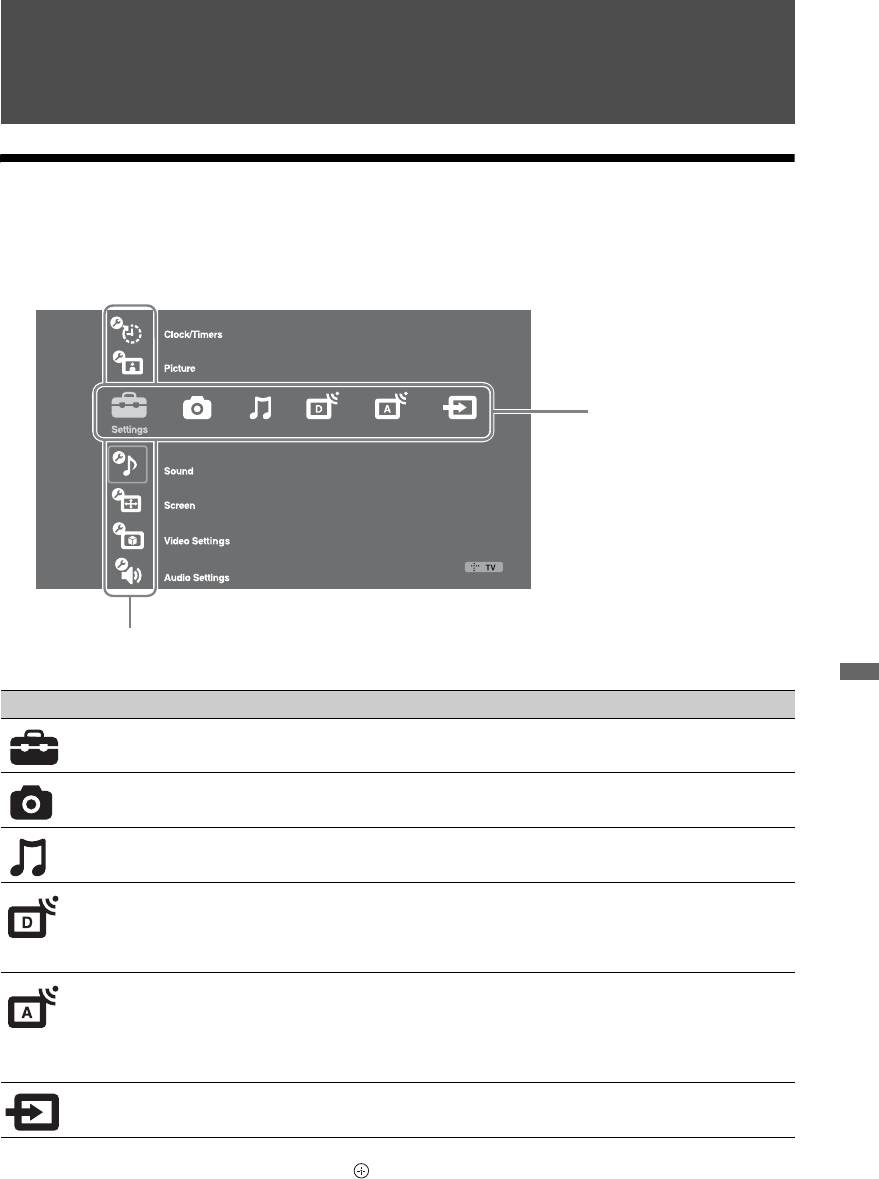
Using Menu Functions
Navigating through TV Home Menu on XMB™
The XMB™ (XrossMediaBar) is a menu of BRAVIA features and input sources displayed on the TV
screen. The XMB™ is an easy way to select programming and adjust settings on your BRAVIA TV.
1 Press HOME to display the XMB™.
Media Category Bar
Category Object Bar
2 Press G/g to select the category.
Using Menu Functions
Media category icon Description
Settings You can make advanced settings and adjustments. For details about
settings, see page 36.
Photo You can enjoy photo files via USB devices or the network (page 24,
31).
Music You can enjoy music files via USB devices or the network (page 24,
31).
Digital You can select a digital channel, Digital Favourite list (page 20), or
Digital Electronic Programme Guide (EPG) (page 19).
You can also select a channel using the number buttons or
PROG +/–.
Analogue You can select an analogue channel.
You can also select a channel using the number buttons or
PROG +/–.
To hide the list of analogue channels, set “Programme List Display”
to “Off” (page 44).
External Inputs You can select equipment connected to the TV.
To assign a label to an external input, see “AV Preset” (page 43).
3 Press F/f to select the item, then press .
4 Follow the instructions on the screen.
5 Press HOME to exit.
~
• The options you can adjust vary depending on the situation.
• Unavailable options are greyed out or not displayed.
GB
35
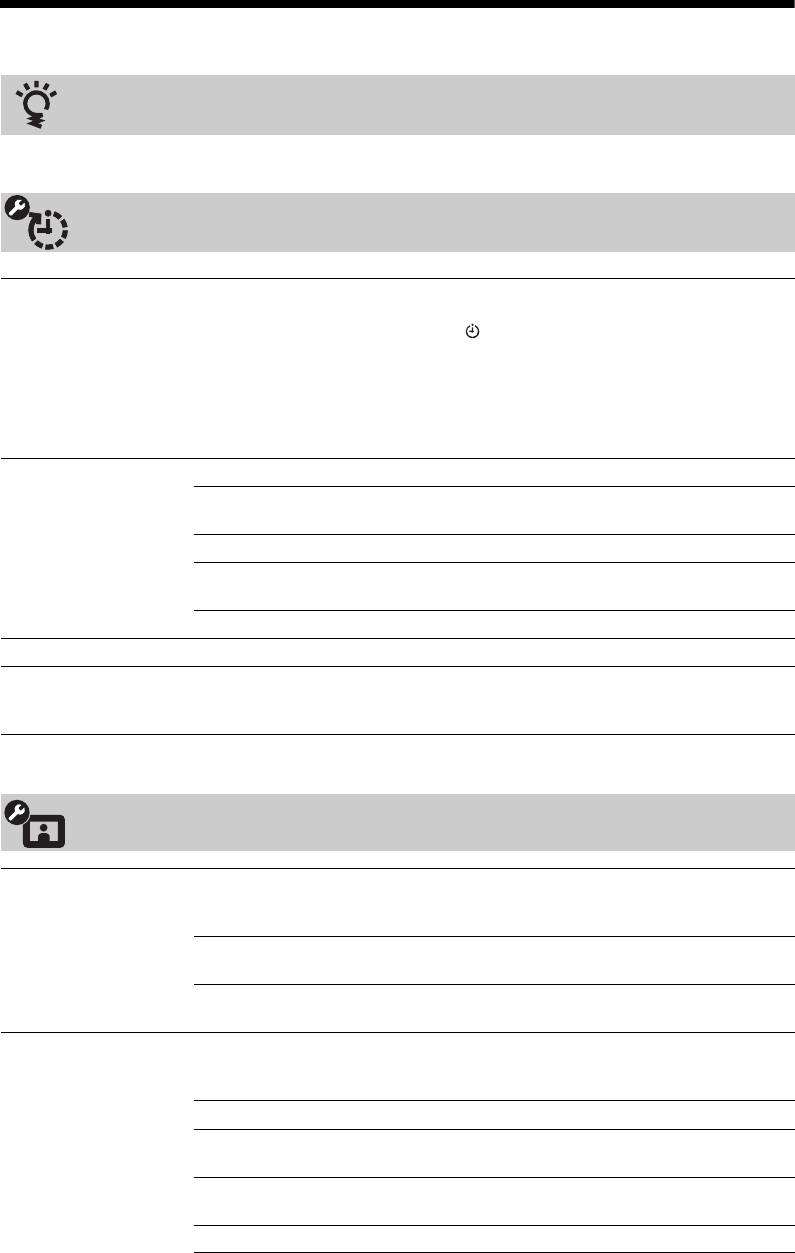
TV Settings Menu
BRAVIA Tips
Introduces how to enjoy the TV.
Clock/Timers
Sleep Timer Sets the TV to automatically switch to standby mode after a certain amount of
time.
When “Sleep Timer” is activated, the (Timer) indicator on the TV front panel
lights up in orange.
z
• When you turn off the TV and turn it on again, “Sleep Timer” is reset to “Off”.
• A notification message appears on the screen one minute before the TV switches
to standby mode.
On Timer On Timer Sets the TV to automatically turn on from standby mode.
Day Sets the desired day(s) of the week you want the timer to turn
on the TV.
Time Sets the time you want the timer to turn on the TV.
Duration Sets how long you want the TV to stay on before switching to
standby mode again.
Volume Set-up Sets the volume of the TV when the timer turns it on.
Auto Clock Update Switches to digital mode and obtains the time.
Clock Set Allows you to adjust the clock manually. When the TV is receiving digital
channels, you cannot adjust the clock manually, because the clock automatically
receives the time code from the broadcast signal.
Picture
Target Inputs Allows you to select whether to use the common settings or to make custom
settings for the input you are currently viewing. Set to “Common” if you want to
apply the same settings to each input.
Common Applies common settings to all inputs in which “Target
Inputs” is set to “Common”.
Name of current
Allows you to make custom settings for the input.
input (e.g. AV1)
Picture Mode Sets a picture mode. “Picture Mode” includes options best suited for video and
photographs, respectively. The options that can be selected differ depending on the
input source.
Vivid Enhances picture contrast and sharpness.
Standard For standard pictures. Recommended for home
entertainment.
Cinema For viewing film-based content. Most suitable when viewing
the TV in a theatre-like environment.
Custom Allows you to store your preferred settings.
GB
36
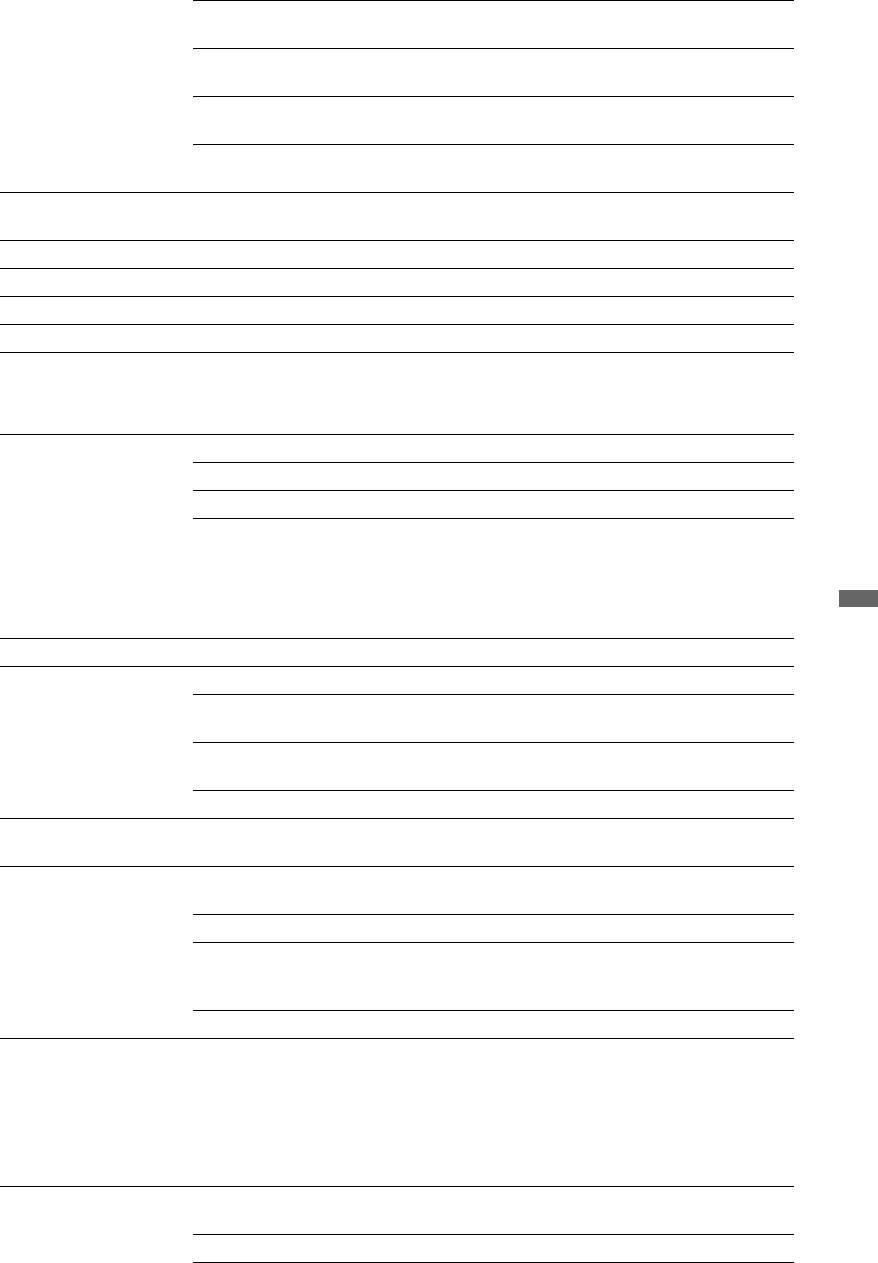
Photo-Vivid For viewing photographs. Enhances picture contrast and
sharpness.
Photo-Standard For viewing photographs. Provides the optimum picture
quality for viewing in the home.
Photo-Original For viewing photographs. Represents the picture quality used
when imaging developed photographs.
Photo-Custom For viewing photographs. Allows you to store your preferred
settings.
Reset Resets all the “Picture” settings to the factory settings excluding “Target Inputs”,
“Picture Mode” and “Advanced Settings”.
Backlight Adjusts the brightness of the backlight.
Contrast Increases or decreases picture contrast.
Brightness Brightens or darkens the picture.
Colour Increases or decreases colour intensity.
Hue Increases or decreases the green tones and red tones.
~
• “Hue” can be adjusted only for the NTSC colour signal (e.g. U.S.A. video tapes).
Colour Temperature Adjusts the whiteness of the picture.
Cool Gives white colours a blue tint.
Neutral Gives white colours a neutral tint.
Warm 1/Warm 2 Gives white colours a red tint. “Warm 2” gives a redder tint
than “Warm 1”.
z
• “Warm 1” and “Warm 2” are not available when “Picture Mode” is set to “Vivid”
Using Menu Functions
(or “Photo-Vivid”).
Sharpness Sharpens or softens the picture.
Noise Reduction Reduces the noise level of pictures (snowy pictures).
Auto Automatically reduces picture noise (in analogue TV mode,
or composite, S video or DMPORT input signals only).
High/Medium/
Modifies the effect of the noise reduction.
Low
Off Turns off the “Noise Reduction”.
MPEG Noise
Reduces picture noise in MPEG-compressed videos. This is effective when
Reduction
viewing a DVD or digital broadcast.
DRC Mode Produces a high-resolution picture for high-density sources (e.g., Blu-ray disc
player, DVD player, satellite receiver).
Mode 1 Recommended mode.
Mode 2 Only available for 1080i format. “Mode 2” is especially
effective when original standard-definition signals have been
up-converted to 1080i format.
Off Turns off the “DRC Mode”.
DRC Palette Customises the level of detail (“Reality”) and smoothness (“Clarity”) of pictures
from each input source. For example, you can create a custom setting for a cable
input source, and another for a DVD player.
Press F/f/G/g to adjust the position of the marker (z).
As you move the z higher along the “Reality” axis, the picture becomes more
detailed. As you move the z to the right along the “Clarity” axis, the picture
becomes smoother.
Advanced Settings Allows you to set “Picture” settings in more detail. These settings are not available
when “Picture Mode” is set to “Vivid” (or “Photo-Vivid”).
Reset Resets all the advanced settings to the factory settings.
(Continued)
GB
37
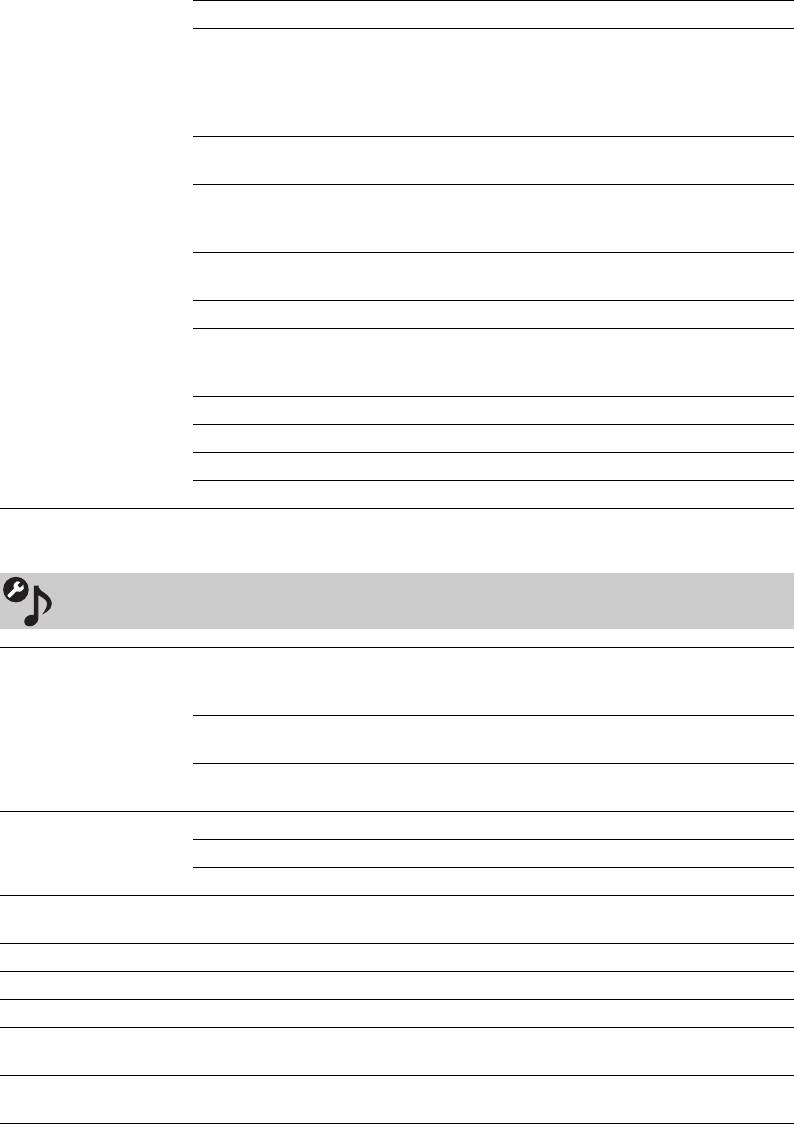
Black Corrector Enhances black areas of the picture for stronger contrast.
Adv. Contrast
Automatically adjusts “Backlight” and “Contrast” to the most
Enhancer
suitable settings judging from the brightness of the screen.
This setting is especially effective for dark images scenes,
and will increase the contrast distinction of the darker picture
scenes.
Gamma Adjusts the balance between bright and dark areas of the
picture.
LED Dynamic
Sharpens the contrast by making dark parts of the picture
Control (for KDL-
even darker.
55X4500/46X4500)
Auto Light
Reduces glare such as in scenes where the entire screen is
Limiter
white.
Clear White Emphasises white colours.
Colour Space Changes the colour reproduction gamut. “Wide” reproduces
the vivid colour and “Standard” reproduces the standard
colour.
Live Colour Makes colours more vivid.
White Balance Adjusts the temperature of each colour.
Detail Enhancer Enhances the details of the picture.
Edge Enhancer Enhances the outline of the picture.
Sound
Target Inputs Allows you to select whether to use the common settings or to make custom
settings for the input you are currently viewing. Set to “Common” if you want to
apply the same settings to each input.
Common Applies common settings to all inputs in which “Target
Inputs” is set to “Common”.
Name of current
Allows you to make custom settings for the input.
input (e.g. AV1)
Sound Mode Dynamic Enhances the treble and bass sounds.
Standard For standard sounds. Recommended for home entertainment.
Clear Voice Makes voice sound clearer.
Reset Resets all the “Sound” settings to the factory settings excluding “Target Inputs”,
“Sound Mode” and “Dual Sound”.
Treble Adjusts higher-pitched sounds.
Bass Adjusts lower-pitched sounds.
Balance Emphasises the left or right speaker.
Auto Volume Keeps volume level constant across all programmes and adverts (e.g. adverts tend
to be louder than programmes).
Volume Offset Adjusts the volume level of the current input relative to other inputs, when “Target
Inputs” is set to the current input name (e.g. AV1).
GB
38
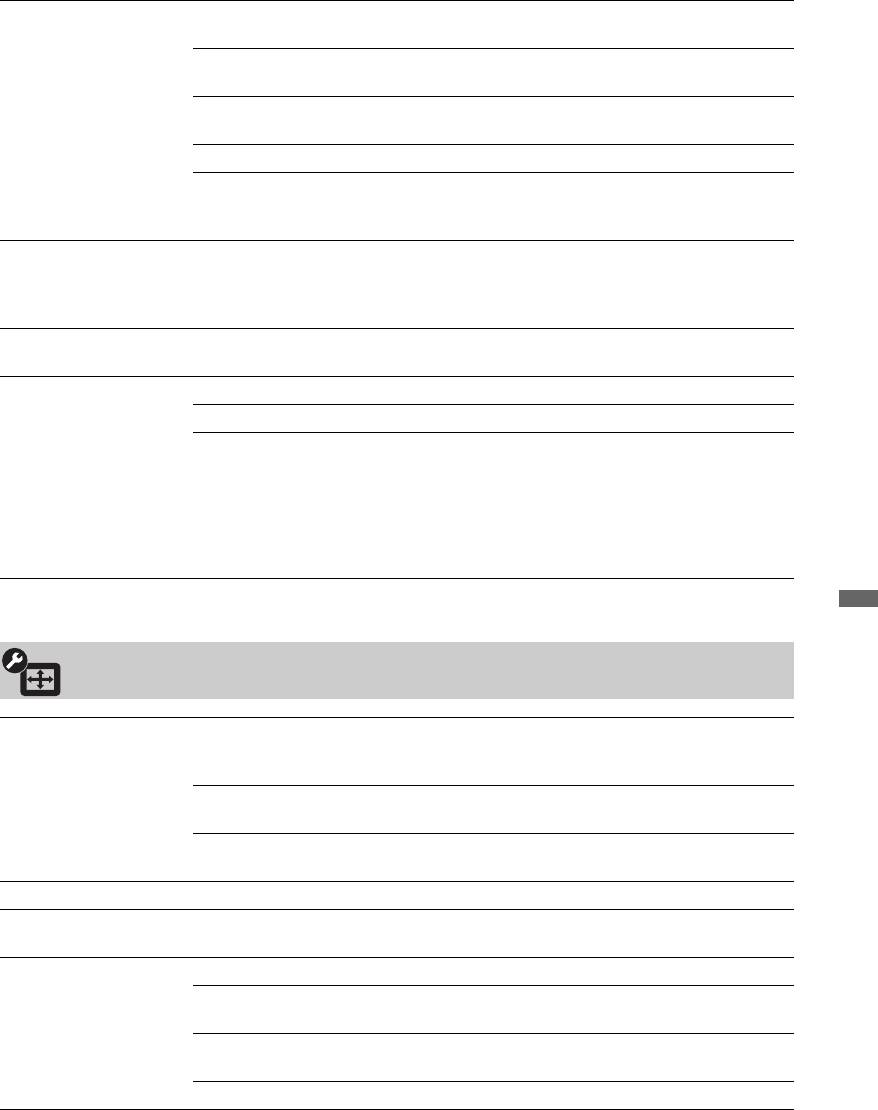
Surround Live Sports Delivers surround effects that make you feel like you are
watching a live sports contest.
Music Hall Delivers surround effects that make you feel like you are
surrounded by sound as in a music hall.
Cinema Delivers surround effects just like the high-grade audio
systems found in movie theatres.
Custom A “Voice Zoom” adjustment can be stored according to taste.
Off Converts and reproduces 5.1ch and other digital broadcast
surround audio to normal stereo audio (2ch). The original
audio of other broadcasts is reproduced.
Voice Zoom Adjusts the sound level of human voices. For example, if the voice of a news
announcer is indistinct, you can turn up this setting to make the voice louder.
Conversely, if you are watching a sports programme, you can turn down this
setting to soften the voice of the commentator.
Sound Booster Produces a fuller sound for more impact, by emphasizing the treble and bass
sounds.
Dual Sound Sets the sound from the speaker for a stereo or bilingual broadcast.
Stereo/Mono For stereo broadcasts.
A/B/Mono For bilingual broadcasts, select “A” for sound channel 1, “B”
for sound channel 2, or “Mono” for mono channel, if
available.
~
• For other equipment connected to the TV, set “Dual Sound” to “Stereo”, “A”, or
“B”.
Using Menu Functions
Screen (for inputs other than a PC)
Target Inputs Allows you to select whether to use the common settings or to make custom
settings for the input you are currently viewing. Set to “Common” if you want to
apply the same settings to each input.
Common Applies common settings to all inputs in which “Target
Inputs” is set to “Common”.
Name of current
Allows you to make custom settings for the input.
input (e.g. AV1)
Screen Format See “To change the screen format manually” on page 18.
Auto Format Automatically changes the screen format to match the broadcast signal. If you
want to use the setting that you specified in “Screen Format”, select “Off”.
4:3 Default Sets the default screen format for 4:3 broadcasts.
Smart Displays conventional 4:3 broadcasts with an imitation wide
screen effect.
4:3 Displays conventional 4:3 broadcasts in the correct
proportion.
Off Uses the setting that you specified in “Screen Format”.
(Continued)
GB
39
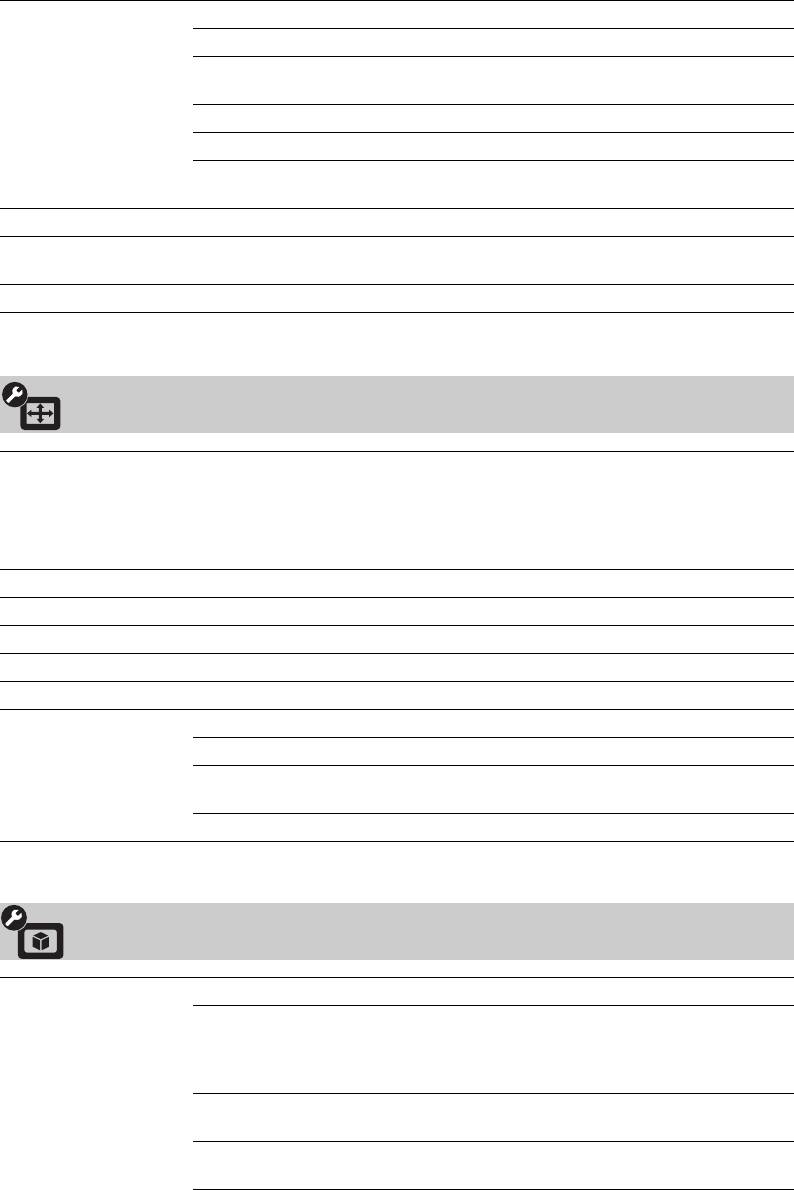
Display Area Adjusts the picture display area.
Auto Automatically switches to the most appropriate display area.
Full Pixel Displays pictures in their original size when parts of the
picture are cut off.
+1 Displays pictures in their original size.
Normal Displays pictures in their recommended size.
-1/-2 Enlarges the picture so that the edges are outside the visible
display area.
Horizontal Shift Adjusts the horizontal position of the picture.
Vertical Shift Adjusts the vertical position of the picture when “Screen Format” is set to “Smart”,
“Zoom” or “14:9”.
Vertical Size Adjusts the vertical size of the picture when “Screen Format” is set to “Smart”.
Screen (for PC input)
Auto Adjustment Automatically adjusts the display position, phase, and pitch of the picture when the
TV receives an input signal from the connected PC.
z
• “Auto Adjustment” may not work well with certain input signals. In such cases,
manually adjust “Phase”, “Pitch”, “Horizontal Shift”, and “Vertical Shift”.
Reset Resets all PC screen settings to factory settings.
Phase Adjusts the phase when the screen flickers.
Pitch Adjusts the pitch when the picture has unwanted vertical stripes.
Horizontal Shift Adjusts the horizontal position of the picture.
Vertical Shift Adjusts the vertical position of the picture.
Screen Format Sets a screen format for displaying pictures from your PC.
Normal Displays the picture in its original size.
Full 1 Enlarges the picture to fill the vertical display area, while
maintaining its original proportion.
Full 2 Enlarges the picture to fill the display area.
Video Settings
Motionflow Provides smoother picture movement and reduces picture blur.
High (for KDL-
Provides smoother picture movement such as for film-based
40X4500)/
contents.
Smooth (for KDL-
55X4500/46X4500)
Standard Provides smooth picture movement. Use this setting for
standard use.
Clear (for KDL-
Provides smooth and sharp picture movement. Suitable when
55X4500/46X4500)
viewing video containing fast motion.
GB
40
