
Festool LEX 3 77-2-5: Original operating manual1 Symbols 2 Machine features
Original operating manual1 Symbols 2 Machine features: Festool LEX 3 77-2-5
12
LEX 3
GB
Original operating manual 1 Symbols 2 Machine features
The specified illustrations appear at the beginning
of the Operating Instructions.
Accessories shown or described are sometimes not
included in the scope of delivery.
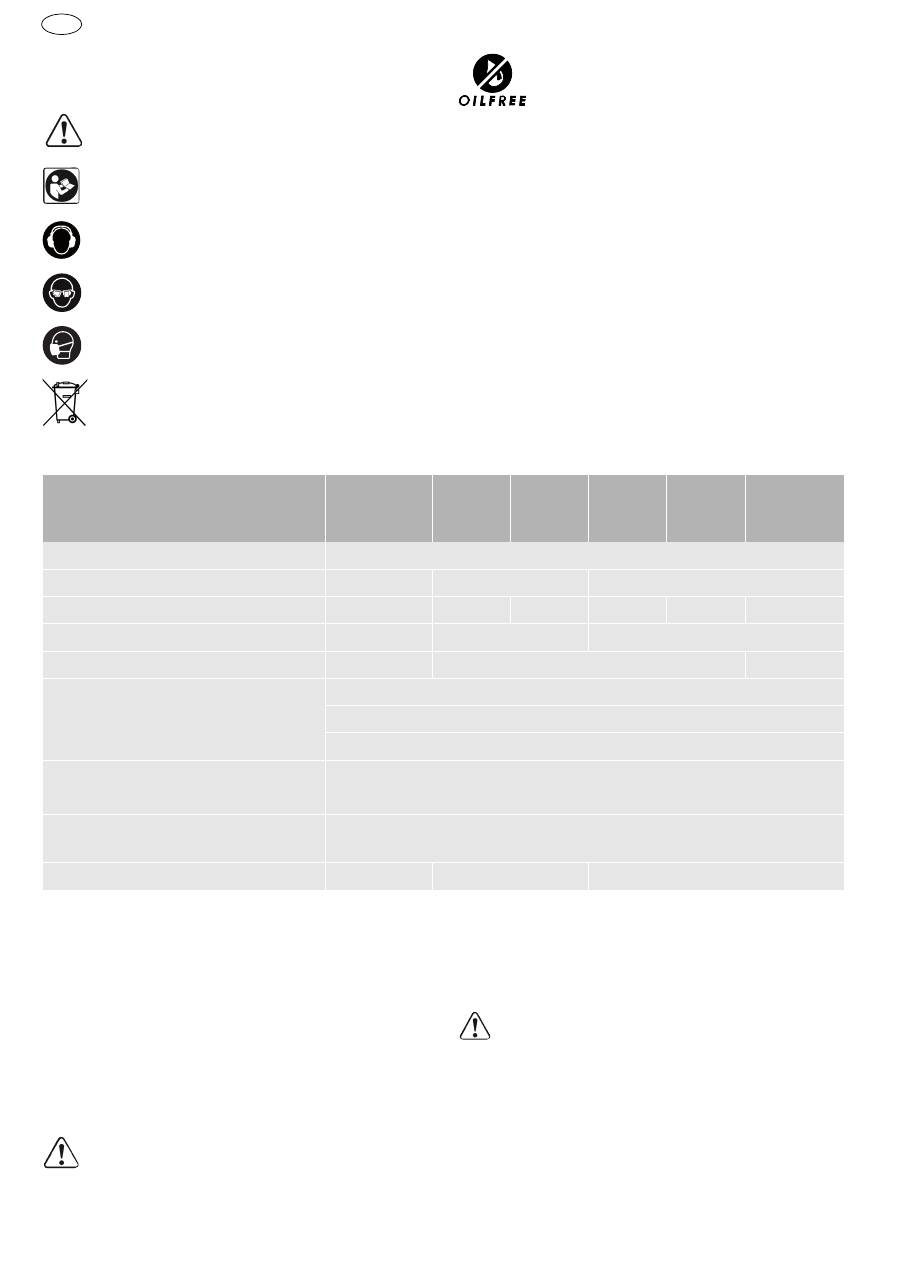
3 Technical data
* at 6 bar inlet pressure; n
0
, load 30N
4 Intended use
The compressed air eccentric sanders are suitable
for sanding wood, plastic, metal, stone, compos-
ites, acrylic-based mineral materials, paint/clear
coats, fillers and similar materials.
Materials containing asbestos must not be pro-
cessed.
Only
use with Festool hose system IAS 2 or IAS 3
and Festool sanding pads!
The user is liable for improper or non-in-
tended use.
5 Safety instructions
5.1
General safety instructions
General safety regulations
Warning! Before setting up, using, repairing
and servicing this compressed air tool or re-
placing accessory parts, you must have read and
understood all safety instructions and informa-
tion.
Ignoring warning notes and instructions may
result in serious injuries.
– Only trained and qualified persons are permitted
to set up, adjust and operate this compressed air
Warning of general danger
Manual, read the instructions
Wear ear protection.
Wear protective goggles.
Wear a dust mask.
Do not throw in the household waste.
Oil-free compressed air
[1-1]
On/Off switch
[1-2]
Button for loosening the IAS connection
[1-3]
IAS connection adapter
[1-4]
Speed control
[1-5]
Sanding pad
Compressed air eccentric sander
LEX 3
LEX 3
LEX 3
LEX 3
LEX 3
LEX 3
77/2,5
125/3
125/5
150/3
150/5
150/7
Drive
Compressed-air vane motor
Sanding pad Ø
77 mm
125 mm
150 mm
Sanding stroke
2,5 mm
3 mm
5 mm
3 mm
5 mm
7 mm
Idle engine speed n
0
10.500 rpm
9.500 rpm
10.000 rpm
Air consumption at rated load*
270 l/min
290 l/min
310 l/min
Air pressure
Max. inlet pressure
6,2 bar ( 90 psi)
Recommended minimum
5 bar ( 72.5 psi)
Compressed air quality i.a.w. DIN
ISO 8573-1
Lubricated operation: Class 5
Non-lubricated operation: Class 4
Recommended storage temperature
/ operating temperature
0° - 60° C / 10° - 40° C
Weight
0,7 kg
0,9 kg
1,0 kg

LEX 3
13
GB
tool. Persons without the relevant qualifications
and training are more likely to cause accidents.
– This compressed air tool may not be modified.
Modifications may reduce the effectiveness of
safety devices and pose a greater risk to operat-
ing personnel.
– Keep all of the attached documents and pass on
the documentation if the machine changes own-
ership.
– Never use a damaged compressed air tool.
– Regularly inspect compressed air tool. The com-
pressed air tool must be marked with clearly leg-
ible rated values and markings. Replacement
signs can be ordered from the manufacturer.
Danger from ejected parts
– In the event the workpiece, accessory or machine
parts break parts may be ejected at high speed.
– Wear impact-resistant protective goggles.
– Wear a helmet when doing overhead work. Also
assess the risks for other people.
– Secure the workpiece. Use clamping devices or a
vice to hold the workpiece firmly.
Risk of getting caught
– Wear suitable protective clothing! Do not wear
loose clothing or jewellery. They can be caught by
moving parts. Wear a hair net if you have long
hair.
Risks during operation
– Wear protective gloves.
– Operating and maintenance personnel must be
physically strong enough to handle the size,
weight and power of the machine.
– Hold the machine correctly. Prepare to counter-
act normal or sudden movements - hold the ma-
chine with both hands.
– Avoid abnormal posture. Ensure secure stance
and keep your balance at all times.
– Enable the command device for starting and
shutting down in case of an interruption to the
energy supply.
– The machine can only be operated with abrasives
which were developed for this purpose.
– Wear protective goggles, protective gloves and
protective clothing.
– Check sanding pad before each use. Do not use
the sanding pad if it is torn, broken or has fallen.
– Avoid direct contact with the sanding pad. Wear
suitable gloves as protection.
– Never use without an abrasive.
– Risk of an electrostatic discharge if the com-
pressed air tool is used on plastic and other non-
conductible materials.
– Potentially explosive atmosphere: If explosive or
self-igniting dust is produced during sanding of
certain materials, the processing instructions of
the material manufacturer must be observed un-
der all circumstances.
Risk through repeated movements
– The use of the compressed air tool may cause
unpleasant sensations in the hands and arms of
the operator, as well as in the neck and shoulder
area or other body parts.
– Adopt a comfortable posture. Change posture if
working continuously.
– If symptoms such as malaise, complaints, throb-
bing, pain, tingling, numbness, burning or stiff-
ness occur inform your employer and consult a
doctor.
Risk as a result of accessory parts
– Disconnect the compressed air hose from the
compressed air supply. In the event of non-use of
the compressed air tool, before maintenance and
when changing insertion tools.
– Avoid contact with the insertion tool during and
after use.
– Always use original accessories.
– Grinding wheels and cutting-off wheels are not
permitted.
– The permissible rotational speed of the accesso-
ry must be at least 1,000 rpm higher than the
maximum speed specified on the machine. Ac-
cessories that rotate faster than the permissible
level can rupture.
– Self-adhesive abrasives must be attached con-
centrically on the sanding pad.
Risk at work station
– Slipping and tripping hazard! Pay attention to
slippery surfaces and tripping hazards as a result
of air pressure hoses.
– Not intended for use in explosive atmospheres
and not insulated against contact with electrical
power sources.
– Proceed with caution in unfamiliar surroundings
that may contain electrical or other supply cables
that harbour hidden dangers. Ensure that there
are no electrical cables, gas pipelines or similar
that, if damaged, could pose a hazard when the
machine is used.
Hazard as a result of dust and vapours
– If hazardous dust is produced during sanding, the
machine should be connected to an appropriate

14
LEX 3
GB
extractor and the safety regulations that apply to
the working material should be observed.
– A risk assessment in relation to this hazard must
be carried out and corresponding control mech-
anisms implemented. Arising dust must be fac-
tored in.
– Connect the dust extractor. Make sure that avail-
able dust extraction equipment is connected and
used correctly. Observe the regional safety regu-
lations for hazardous dusts and vapours. Operate
and service the compressed air tool as described
in the recommendations included in these in-
structions and use accessories and attachments
from Festool to minimise the release of dust and
vapours into the atmosphere. In dusty environ-
ments, make sure that the dissipation of exhaust
air does not disturb the dust.
– If necessary arising dust or vapours must be con-
trolled at the place of their release.
– All components must be fitted correctly and meet
all requirements to ensure that the compressed
air tool operates correctly.
– Select, maintain and replace accessories and
consumables according to these operating in-
structions.
– Wear a dust mask. Observe instructions from the
employer or occupational and health regulations.
Noise hazard
– Higher noise level can lead to permanent hearing
damage, loss of hearing or other problems if in-
adequate hearing protection is not worn or avail-
able.
– A risk assessment in relation to this hazard must
be carried out and corresponding control mech-
anisms implemented, e.g. the use of insulating
materials.
– Wear ear protection. Observe instructions from
the employer or occupational and health regula-
tions.
– Operate and maintain compressed air tool ac-
cording to these operating instructions.
– Select, maintain and replace accessories and
consumables according to these operating in-
structions.
– Assure function of the silencer at the com-
pressed air tool.
Vibration hazard
– Vibrations can cause damage to nerves and prob-
lems with blood circulation in hands and arms.
– When working in cold environments wear warm
clothing and keep hands warm and dry.
– In the event of numbness, tingling or pains in fin-
gers or hands or white colouration of the fingers
or hands, cease work, inform employer and con-
sult a doctor.
– Operate and maintain compressed air tool ac-
cording to these operating instructions.
– Do not hold the compressed air tool too tight, but
with a secure grip while observing the necessary
hand reaction forces. The vibration risk is greater
with increasing gripping strength.
Additional safety information for pneumatic ma-
chines
– Compressed air can cause serious injuries.
– Disconnect the compressed air hose from
the compressed air supply. In the event of
non-use of the compressed air tool, before
maintenance and when changing inser-
tion tools.
– Never direct the air flow towards yourself
or other persons.
– Hoses flapping around can cause serious inju-
ries. Check whether hoses and their fixing devic-
es have not suffered damage or become loose.
– The operating pressure should not exceed 6.2
bar.
– Never carry the compressed air tool by the com-
pressed air hose.
Further safety information
–
Keep your work area tidy.
Untidiness in the work
area can cause accidents.
–
Take into consideration environmental influ-
ences.
Do not leave compressed air tools out in
the rain.
–
. Keep away from children!
Do not allow others
to touch the compressed air tool or the com-
pressed air hose. Keep others away from your
work area.
–
Store your compressed air tools safely.
Unused
compressed air tools should be stored in a dry,
inaccessible or locked location, out of the reach
of children.
–
Do not use the compressed air hose for purpos-
es for which it was not intended.
Protect the
compressed air hose from heat, oil and sharp
edges. Check the compressed air hose regularly
and if it becomes damaged, have it replaced by an
approved specialist. The compressed air hose
cannot be used for application devices such as
atomising and spraying equipment as the safety
Оглавление
- Click 1-1 1-2 1-3 1-4 1-5
- 3-13-23-33-13-23-33-13-2
- 5-2 5-1
- Originalbetriebsanleitung1 Symbole 2 Geräteelemente
- 6 Druckluftanschluss und Inbetrieb-nahme
- 8 Arbeiten mit der Maschine
- Original operating manual1 Symbols 2 Machine features
- 6 Compressed-air supply and com-missioning
- 7 Settings
- 9 Service and maintenance
- Notice d'utilisation d'origine1 Symboles 2 Composants de l’appareil
- 6 Raccordement pneumatique et mise en service
- 8 Travail avec la machine
- 12 Déclaration de conformité CE
- Manual de instrucciones original1 Símbolos 2 Componentes
- 6 Conexión de aire comprimido y puesta en servicio
- 8 Trabajo con la máquina
- 12 Declaración de conformidad CE
- Istruzioni per l'uso originali1 Simboli 2 Elementi dell'utensile
- 6 Collegamento dell'aria compressa e messa in funzione
- 8 Lavorazione con la macchina
- 10 Accessori
- Originele gebruiksaanwijzing1 Symbolen 2 Toestelelementen
- 6 Persluchtaansluiting en inge-bruikneming
- 8 Het werken met de machine
- Originalbruksanvisning1 Symboler 2 Maskindelar
- 6 Tryckluftsanslutning och använd-ning
- 7 Inställningar
- 10 Tillbehör
- Alkuperäiset käyttöohjeet1 Tunnukset 2 Laitteen osat
- 6 Paineilmaliitäntä ja käyttöönotto
- 7 Säädöt
- 10 Tarvikkeet
- Original brugsanvisning1 Symboler 2 Maskinelementer
- 6 Tryklufttilslutning og ibrugtag-ning
- 7 Indstillinger
- 10 Tilbehør
- Originalbruksanvisning1 Symboler 2 Apparatets deler
- 6 Trykklufttilkobling og igangset-ting
- 7 Innstillinger
- 10 Tilbehør
- Manual de instruções original1 Símbolos 2 Componentes da ferramenta
- 6 Ligação de ar comprimido e colo-cação em funcionamento
- 8 Trabalhos com a ferramenta
- Оригинальное руководство по эксплуатации 1 Символы 2 Составные части инструмента
- 5 Указания по технике безопасности
- 6 Подключение сжатого воздуха и начало работы
- 7 Настройки
- 10 Оснастка
- Originální návod k použití1 Symboly 2 Jednotlivé součásti
- 6 Připojení stlačeného vzduchu a uvedení do provozu
- 7 Nastavení
- 10 Příslušenství
- Oryginalna instrukcja eksploatacji1 Symbole 2 Elementy urządzenia
- 6 Podłączanie sprężonego powie-trza i uruchomienie
- 8 Praca za pomocą urządzenia
- 10 Wyposażenie
