
Dell UPS 10000R: Charge the batteries.
Charge the batteries.: Dell UPS 10000R
Table of contents
- Notes and Warnings
- System Features
- Finding Information What are You Looking For? Find It Here
- Installation and Startup
- Unpacking the Cabinet To unpack the system: Using a forklift or pallet jack, move the shipping carton and pallet near the rack where you will install the UPS. Detach and remove the outer carton.
- Remove the two accessory boxes tucked into the channels in the top Styrofoam section. Open the accessory boxes and set them on a flat, stable surface nearby. Remove the top Styrofoam section and set it on a flat, stable surface nearby.
- Remove both retaining brackets from the UPS: Ensure all battery connectors are disconnected.
- Remove the battery trays from the UPS:
- With one person on each side, carefully lift the cabinet out of the styrofoam using the handles on the cardboard. Place the cabinet on a flat, stable surface in a protected area near the rack where you will install it.
- Rackmount Setup To install the UPS in a rack:
- Installing the Rails Remove the rails from the rail kit accessory box. Select the proper holes in the rail for positioning the cabinet in the desired location in the rack. Locate the rails at the bottom of the 5U space allocated for the UPS. Position the left and right rails as illustrated. Attach the the left and right rails to the rack:
- Installing and Securing the Cabinet Slide the cabinet onto the rails and into the rack. Secure the front of the cabinet to the rack using the four thumbscrews on the mounting brackets. Tighten the thumbscrews clockwise by hand; do not use power tools. Installing the Battery Trays Locate the battery trays you placed near the rack.
- Install the battery trays: Tuck the loop tabs into the plastic sleeve on the front of each battery tray to move them out of the way. Connecting Internal Battery Connectors Connect the internal battery connectors:
- Replacing the Battery Retaining Brackets Replace the left (L)and right (R) battery retaining brackets: Installing the UPS Front Cover
- Install the UPS front cover:
- Connecting the Equipment To install the UPS:
- Hardwiring the UPS Input
- Removing the Terminal Block Cover
- Manufacturer Type Rating
- Installing the Input and Ground Wires
- Starting the UPS To start up the UPS: Verify that the internal batteries are connected.
- Charge the batteries.
- Identifying the UPS Rear Panels 10 kW 208V UPS (DELL10KWOLHVUS)
- 10 kW 230V UPS (DELL10KWOLHV)
- 10 kW 230V UPS (DELL10KWOLHVB)
6
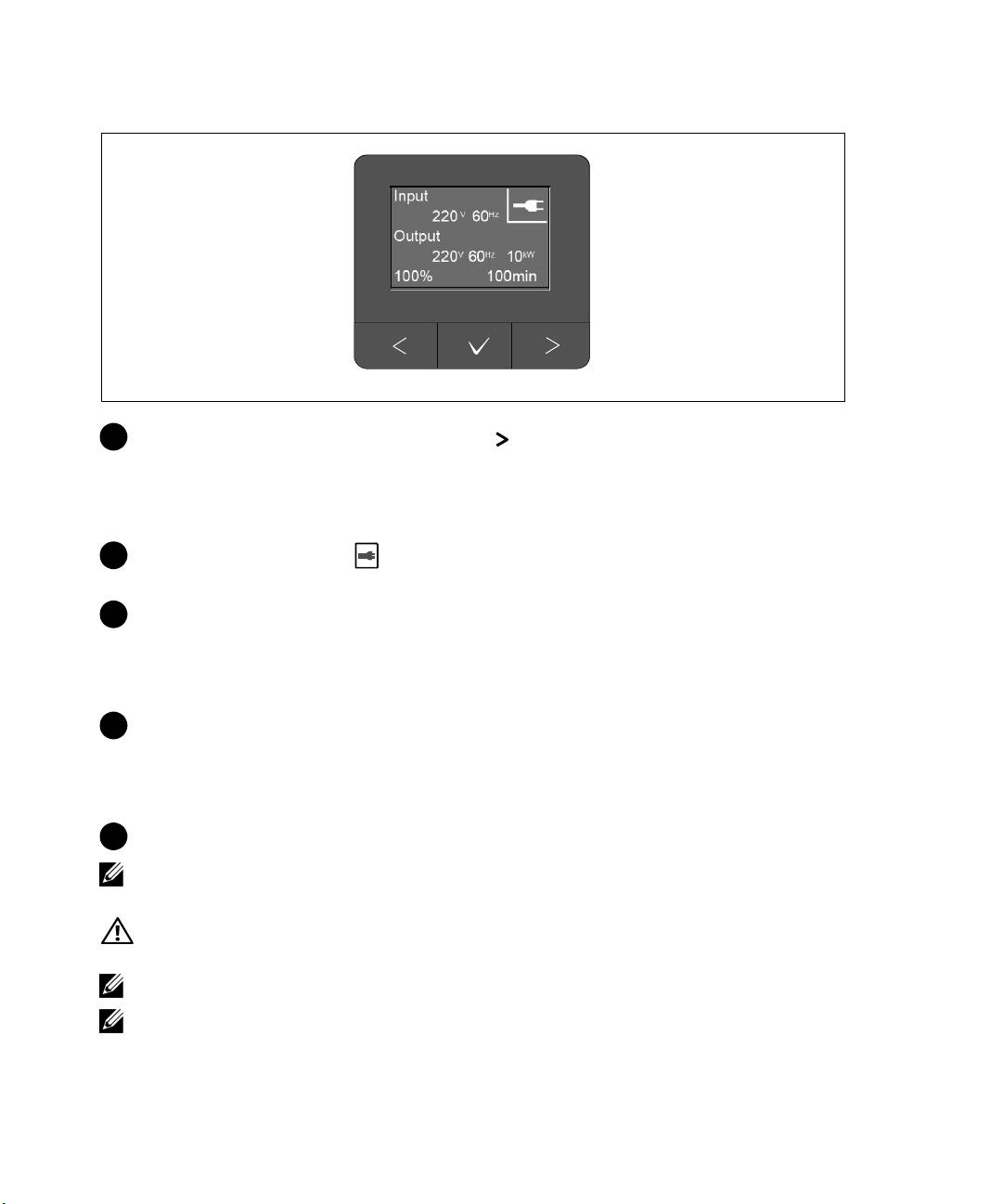
On the UPS status summary screen, press the button to check for active alarms or notices.
Resolve any active alarms before continuing. See “Troubleshooting” in the Dell Online Rack UPS
10 kW User's Guide.
If there are no active alarms, a “No Active Alarms” message appears.
7
Verify that the Normal icon appears on the UPS status summary screen, indicating that the
UPS is operating normally and a ny loads are powered.
8
Refer to the Dell Online Rack UPS 10 kW User's Guide for the following:
S
For configuration procedures if an optional extended battery module (EBM) is installed
S
To set the date and time and to change other factory-set defaults
9
If you installed an optional REPO, test the REPO function:
Activate the external REPO switch. Verify the status change on the UPS display.
Deactivate the external REPO switch and restart the UPS.
10
Charge the batteries.
NOTE:
The internal batteries charge to 90% capacity in less than three hours. However, you must charge the
batteries for 48 hours after installation or long-term storage.
CAUTION:
To prevent an UPS overload condition, connect one load at a time and make sure that each
protected device starts up completely before you connect the next load.
NOTE:
Dell recommends setting the date and time for troubleshooting or warranty purposes.
NOTE:
At initial startup, the UPS sets system frequency according to input line frequency (input frequency auto
sensing is enabled by default). After initial startup, auto sensing is disabled until you manually enable it by using
the output frequency setting.
Installation and Startup
|
23
