
Dell Precision T3400: instruction
Class: Household, kitchen appliances, electronics and equipment
Type: Computer
Manual for Dell Precision T3400
Table of contents
- Notes, Notices, and Cautions
- Contents
- Finding Information What Are You Looking For? Find It Here
- What Are You Looking For? Find It Here
- What Are You Looking For? Find It Here
- What Are You Looking For? Find It Here
- What Are You Looking For? Find It Here
- What Are You Looking For? Find It Here
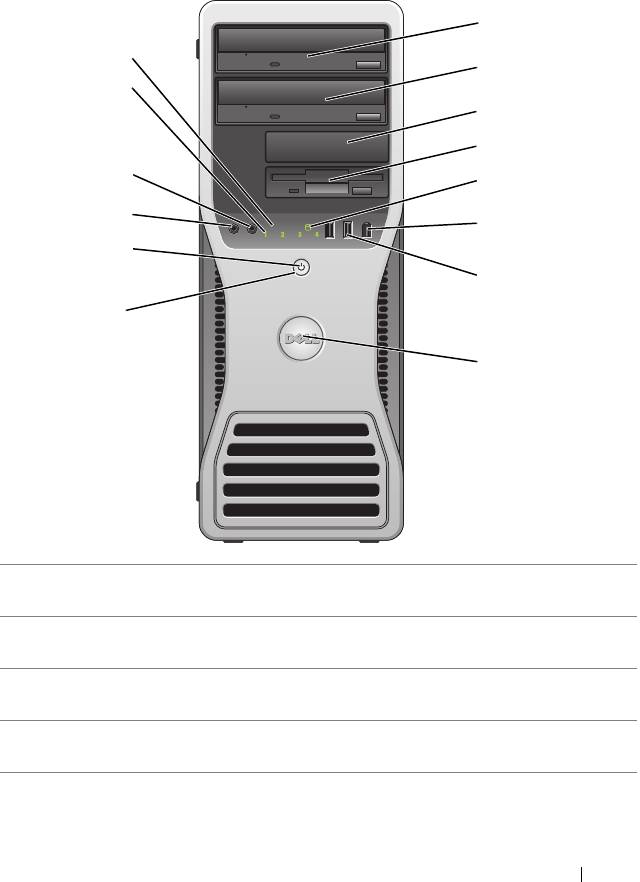
- About Your Computer Front View (Tower Orientation) 4 lower 3.5-inch drive bay
- 9 power button Press to turn on the computer.
- 14 network link light The network link light is on when a good connection
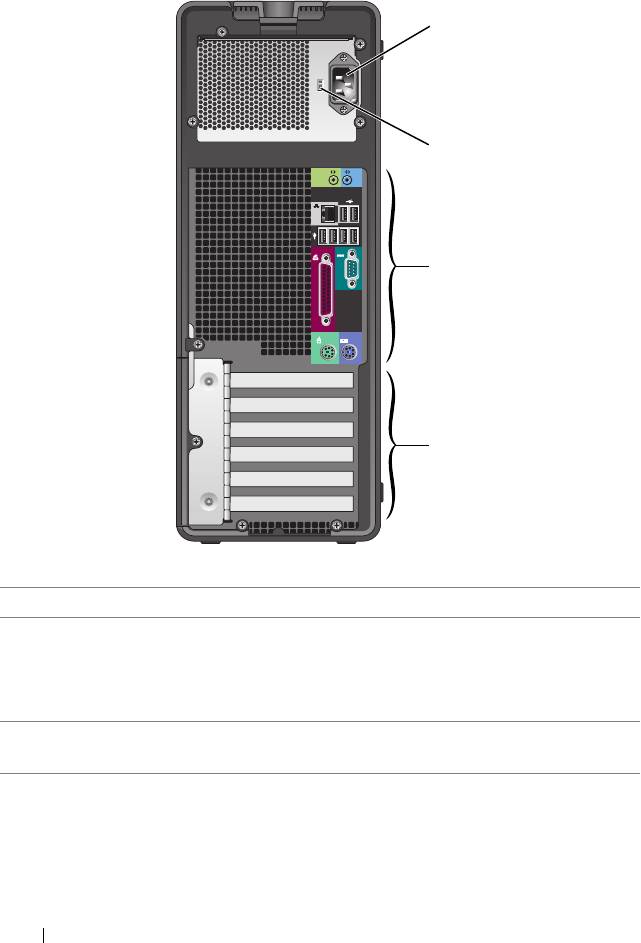
- Back View (Tower Orientation)
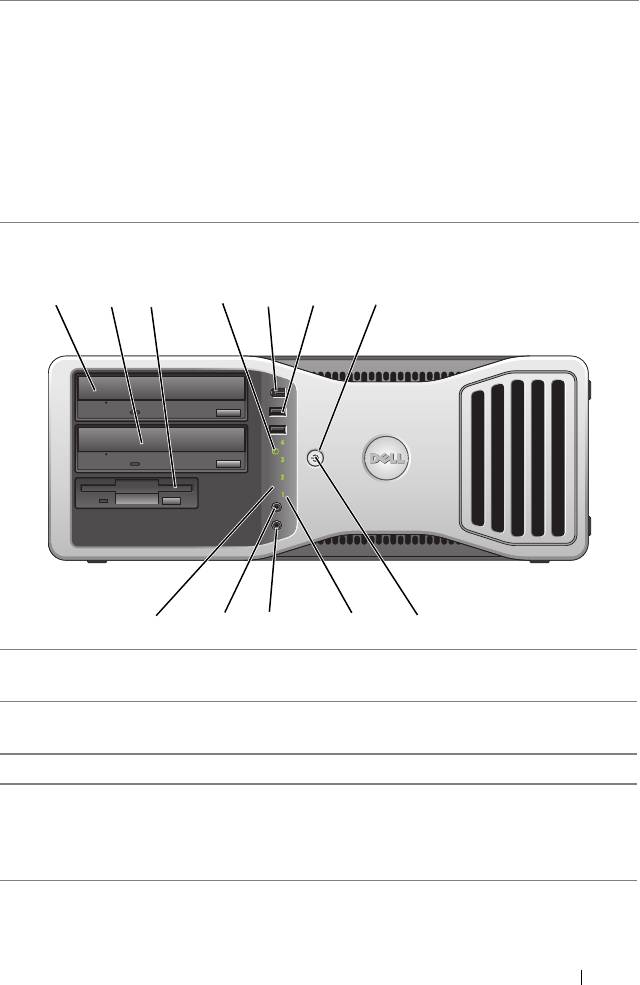
- 4 card slots Access connectors for any installed PCI or PCI Express Front View (Desktop Orientation) 4 hard drive activity light
- 7 power button Press to turn on the computer.
- 12 network link light The network link light is on when a good connection
- Back View (Desktop Orientation)
- Back Panel Connectors
- 8 Rear Dual USB 2.0 connectors (2)
- 11 keyboard connector Setting Up Your Computer Changing Between Tower and Desktop Orientations
- Switching From Tower to Desktop Orientation Switching From Desktop to Tower Orientation Installing Your Computer in an Enclosure
- • Leave 10.2 cm (4 in) minimum clearance on all vented sides of the computer to permit the airflow required for proper ventilation.
- • Do not install your computer in an enclosure that does not allow airflow.
- Transferring Information to a New Computer Microsoft Windows XP
- Files and Settings Transfer Wizard (With the Operating System Media) PREPARE THE DESTINATION COMPUTER FOR THE FILE TRANSFER: COPY DATA FROM THE SOURCE COMPUTER: TRANSFER DATA TO THE DESTINATION COMPUTER:
- Files and Settings Transfer Wizard (Without the Operating System Media) CREATE A WIZARD DISK: COPY DATA FROM THE SOURCE COMPUTER:
- TRANSFER DATA TO THE DESTINATION COMPUTER: Microsoft Windows Vista Power Protection Devices
- Surge Protectors Line Conditioners Uninterruptible Power Supplies (UPS)
- Cleaning Your Computer Computer, Keyboard, and Monitor Mouse (Non-Optical)
- Floppy Drive CDs and DVDs Troubleshooting Tools Power Lights
- • Eliminate interference. Some possible causes of interference are:
- Diagnostic Lights Diagnostic Light Codes During POST Light Pattern Problem Description Suggested Resolution
- Light Pattern Problem Description Suggested Resolution
- Light Pattern Problem Description Suggested Resolution
- Light Pattern Problem Description Suggested Resolution
- Light Pattern Problem Description Suggested Resolution
- Code Description Suggested Remedy
- Code Description Suggested Remedy System Messages
- 40 Quick Reference Guide
- Hardware Troubleshooter Windows XP: Windows Vista: Dell Diagnostics When to Use the Dell Diagnostics
- Starting the Dell Diagnostics From Your Hard Drive
- Starting the Dell Diagnostics From the Drivers and Utilities Disc
- Dell Diagnostics Main Menu Option Function
- Tab Function Troubleshooting
- Battery Problems Drive Problems
- Optical drive problems Problems writing to an optical drive Hard drive problems
- E-Mail, Modem, and Internet Problems USE A DIFFERENT TELEPHONE LINE — RUN THE MODEM DIAGNOSTIC TOOL — VERIFY THAT THE MODEM IS COMMUNICATING WITH WINDOWS —
- ENSURE THAT YOU ARE CONNECTED TO THE INTERNET — Ensure that you have Error Messages
- IEEE 1394 Device Problems
- Keyboard Problems Lockups and Software Problems The computer does not start up The computer stops responding
- A program stops responding A program crashes repeatedly A program is designed for an earlier Windows operating system A solid blue screen appears
- Other software problems BACK UP YOUR FILES IMMEDIATELY Memory Problems F YOU RECEIVE AN INSUFFICIENT MEMORY MESSAGE — IF YOU EXPERIENCE OTHER MEMORY PROBLEMS —
- Mouse Problems C HECK THE MOUSE CABLE — RESTART THE COMPUTER — C HECK THE MOUSE SETTINGS —
- Network Problems Power Problems
- Printer Problems
- Scanner Problems
- Sound and Speaker Problems
- Video and Monitor Problems The screen is blank
- The screen is difficult to read 3D image quality is poor Only part of the screen is readable
Dell Precision™ Workstation T3400
Quick Reference Guide
Model DCTA
www.dell.com | support.dell.com

Notes, Notices, and Cautions
NOTE: A NOTE indicates important information that helps you make better use of
your computer.
NOTICE: A NOTICE indicates either potential damage to hardware or loss of data
and tells you how to avoid the problem.
CAUTION: A CAUTION indicates a potential for property damage, personal injury,
or death.
____________________
Information in this document is subject to change without notice.
© 2007 Dell Inc. All rights reserved.
Reproduction in any manner whatsoever without the written permission of Dell Inc. is strictly
forbidden.
Trademarks used in this text: Dell, the DELL logo, and Dell Precision are trademarks of Dell Inc.;
Microsoft, Windows, and Windows Vista are either trademarks or registered trademarks of Microsoft
Corporation in the United States and/or other countries.
Other trademarks and trade names may be used in this document to refer to either the entities claiming
the marks and names or their products. Dell Inc. disclaims any proprietary interest in trademarks and
trade names other than its own.
Model DCTA
August 2007 P/N DU217 Rev. A00

Contents
Finding Information . . . . . . . . . . . . . . . . . . . . 5
About Your Computer
. . . . . . . . . . . . . . . . . . 11
Front View (Tower Orientation)
. . . . . . . . . . 11
Back View (Tower Orientation)
. . . . . . . . . . 14
Front View (Desktop Orientation)
. . . . . . . . . 15
Back View (Desktop Orientation)
. . . . . . . . . 18
Back Panel Connectors
. . . . . . . . . . . . . . 19
Setting Up Your Computer
. . . . . . . . . . . . . . . . 21
Changing Between Tower and
Desktop Orientations
. . . . . . . . . . . . . . . . 21
Installing Your Computer in an Enclosure
. . . . . 22
Transferring Information to a New Computer
. . . 25
Power Protection Devices
. . . . . . . . . . . . . 28
Cleaning Your Computer
. . . . . . . . . . . . . . . . 30
Computer, Keyboard, and Monitor
. . . . . . . . . 30
Mouse (Non-Optical)
. . . . . . . . . . . . . . . . 30
Floppy Drive
. . . . . . . . . . . . . . . . . . . . 31
CDs and DVDs
. . . . . . . . . . . . . . . . . . . 31
Troubleshooting Tools
. . . . . . . . . . . . . . . . . . 31
Power Lights
. . . . . . . . . . . . . . . . . . . . 31
Diagnostic Lights
. . . . . . . . . . . . . . . . . . 33
Beep Codes
. . . . . . . . . . . . . . . . . . . . 37
System Messages
. . . . . . . . . . . . . . . . . 39
Hardware Troubleshooter
. . . . . . . . . . . . . 41
Dell Diagnostics
. . . . . . . . . . . . . . . . . . 41
Contents 3

Troubleshooting . . . . . . . . . . . . . . . . . . . . . 45
Battery Problems
. . . . . . . . . . . . . . . . . . 46
Drive Problems
. . . . . . . . . . . . . . . . . . . 46
E-Mail, Modem, and Internet Problems
. . . . . . 48
Error Messages
. . . . . . . . . . . . . . . . . . 49
IEEE 1394 Device Problems
. . . . . . . . . . . . . 50
Keyboard Problems
. . . . . . . . . . . . . . . . . 51
Lockups and Software Problems
. . . . . . . . . . 51
Memory Problems
. . . . . . . . . . . . . . . . . 53
Mouse Problems
. . . . . . . . . . . . . . . . . . 54
Network Problems
. . . . . . . . . . . . . . . . . 55
Power Problems
. . . . . . . . . . . . . . . . . . 55
Printer Problems
. . . . . . . . . . . . . . . . . . 56
Scanner Problems
. . . . . . . . . . . . . . . . . 57
Sound and Speaker Problems
. . . . . . . . . . . 58
Video and Monitor Problems
. . . . . . . . . . . . 59
Index . . . . . . . . . . . . . . . . . . . . . . . . . . . . . . . 61
4 Contents
Finding Information
NOTE: Some features or media may be optional and may not ship with your
computer. Some features or media may not be available in certain countries.
NOTE: Additional information may ship with your computer.
What Are You Looking For? Find It Here
• A diagnostic program for my computer
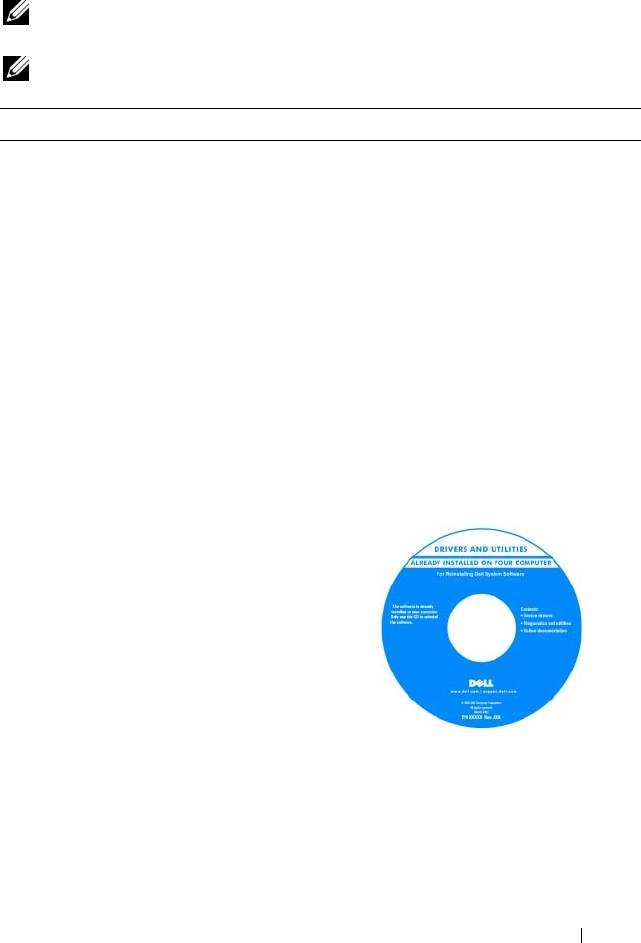
Drivers and Utilities Disc
• Drivers for my computer
NOTE: The Drivers and Utilities disc may
be optional and may not ship with your
• Desktop System Software (DSS)
computer.
Documentation and drivers are already
installed on your computer. You can use
the Drivers and Utilities disc to reinstall
drivers (see "Reinstalling Drivers and
Utilities" in your User’s Guide), or to run
the Dell Diagnostics (see "Dell Diagnostics"
on page 41).
Readme files may be included on your
disc to provide last-minute updates about
technical changes to your computer or
advanced technical-reference material for
technicians or experienced users.
Drivers and documentation updates can be
found at support.dell.com.
Quick Reference Guide 5
What Are You Looking For? Find It Here
• Warranty information
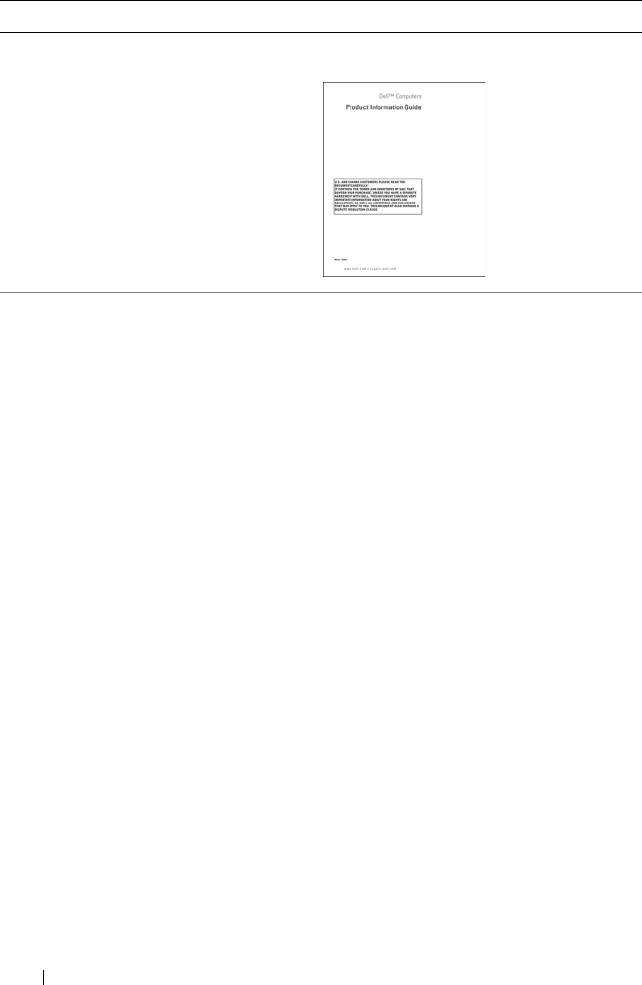
Dell™ Product Information Guide
• Terms and Conditions (U.S. only)
• Safety instructions
• Regulatory information
• Ergonomics information
• End User License Agreement
• How to remove and replace parts
Dell Precision™ User’s Guide
®
®
• Specifications
Microsoft
Windows
XP and Windows
™
Vista
Help and Support Center
• How to configure system settings
1
Click
Start
→
Help and Support
→
• How to troubleshoot and solve problems
Dell User and System Guides
→
System Guides
.
2
Click the
User’s Guide
for your
computer.
6 Quick Reference Guide
What Are You Looking For? Find It Here
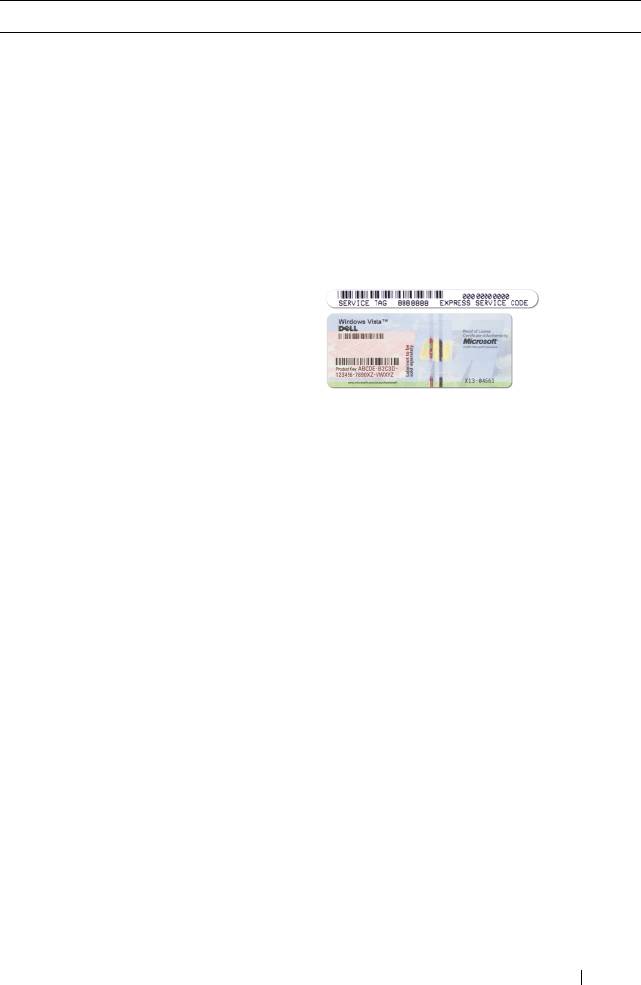
• Service Tag and Express Service Code
Service Tag and Microsoft Windows
Product Key
• Microsoft Windows Product Key
These labels are located on your
computer.
• Use the Service Tag to identify your
computer when you use
support.dell.com
or contact support.
• Enter the Express Service Code to
direct your call when contacting
support.
NOTE: As an increased security measure,
the newly designed Microsoft Windows
license label incorporates a missing
portion, or hole, to discourage removal of
the label.
Quick Reference Guide 7

What Are You Looking For? Find It Here
• Solutions — Troubleshooting hints and
Dell Support Website — support.dell.com
tips, articles from technicians, online
NOTE: Select your region or business
courses, and frequently asked questions
segment to view the appropriate support
• Community — Online discussion with
site.
other Dell customers
• Upgrades — Upgrade information for
components, such as the memory, hard
drive, and operating system
• Customer Care — Contact information,
service call and order status, and
warranty and repair information
• Service and support — Service call
status, support history, service contract,
and online discussions with support
• Dell Technical Update Service —
Proactive e-mail notification of software
and hardware updates for your computer
• Reference — Computer documentation,
details on my computer configuration,
product specifications, and white papers
• Downloads — Certified drivers, patches,
and software updates
8 Quick Reference Guide

What Are You Looking For? Find It Here
• Desktop System Software (DSS)— If
To download Desktop System Software:
you reinstall the operating system for
1
Go to
support.dell.com
, select your
your computer, you should also reinstall
country/region, and then click
Drivers
the DSS utility. DSS automatically
& Downloads
.
detects your computer and operating
2
Click
Select Model
or
Enter a Tag
,
system and installs the updates
make the appropriate selections or enter
appropriate for your configuration,
the appropriate information for your
providing critical updates for your
computer, and then click
Confirm
.
operating system and support for
3
Scroll down to
System and
processors, optical drives, USB devices,
Configuration Utilities
→
Desktop
etc. DSS is necessary for correct
System Software
, and then click
operation of your Dell computer.
Download Now.
NOTE: The support.dell.com user
interface may vary depending on your
selections.
• How to use Windows XP
Windows Help and Support Center
1
Click
Start
→
Help and Support
.
• How to use Windows Vista
2
Type a word or phrase that describes
• How to work with programs and files
your problem and click the arrow icon.
• How to personalize my desktop
3
Click the topic that describes your
problem.
4
Follow the instructions on the screen.
Quick Reference Guide 9
What Are You Looking For? Find It Here
• How to reinstall my operating system
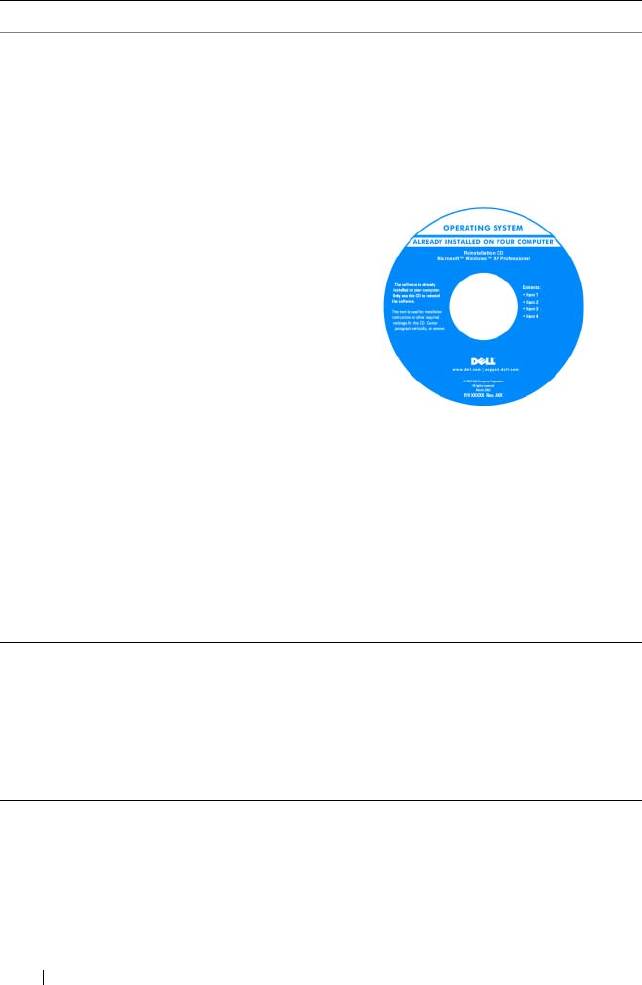
Operating System Media
The operating system is already installed
on your computer. To reinstall your
operating system, use the Operating
System reinstallation media that came
with your computer (see "Restoring Your
Operating System" in your User’s Guide).
After you reinstall your operating system,
use the optional Drivers and Utilities disc
to reinstall drivers for the devices that
came with your computer
Your operating system product key label is
located on your computer.
NOTE: The color of your operating system
installation media varies according to the
operating system you ordered.
• How to use Linux
Dell Supported Linux Sites
• E-mail discussions with users of Dell
• linux.dell.com
Precision products and the Linux
• lists.us.dell.com/mailman/listinfo/linux-
operating system
precision
• Additional information regarding Linux
and my Dell Precision computer
10 Quick Reference Guide
About Your Computer
Front View (Tower Orientation)
1
14
2
13
3
4
12
5
11
6
10
7
9
8
1 upper 5.25-inch drive
Supports an optical drive.
bay
2 lower 5.25-inch drive
Supports an optical drive or an additional hard drive
bay
(SATA only).
3 upper 3.5-inch drive
Supports a floppy drive, a Media Card Reader, or an
bay
additional hard drive (SATA or SAS).
4 lower 3.5-inch drive
Supports a floppy drive or a Media Card Reader.
bay
Quick Reference Guide 11
5 hard drive activity
The hard drive activity light is on when the computer
light
reads data from or writes data to the hard drive. The
light may also be on when a device such as an optical
drive is in operation.
6 IEEE 1394 connector
Use the optional IEEE 1394 connector for high-speed
(optional)
data devices such as digital video cameras and external
storage devices.
7 USB 2.0 connectors
Use the front USB connectors for devices that you
(2)
connect occasionally, such as flash memory keys or
cameras, or for bootable USB devices (see "System
Setup" in your User’s Guide for more information on
booting to a USB device).
NOTE: It is recommended that you use the back USB
connectors for devices that typically remain connected,
such as printers and keyboards.
8 Dell badge (rotatable) Use the plastic handle on the back of the Dell badge to
rotate the badge for tower-to-desktop or desktop-to-
tower conversion.
9 power button Press to turn on the computer.
NOTICE: To avoid losing data, do not use the
power button to turn off the computer. Instead,
perform an operating system shutdown.
NOTICE: If your operating system has ACPI
enabled, when you press the power button the
computer will perform an operating system
shutdown.
NOTE: The power button can also be used to wake the
system or to place it into a power-saving state (see
"Power Management" in your User’s Guide).
12 Quick Reference Guide

10 power light The power light illuminates and blinks or remains solid
to indicate different states:
• No light — The computer is turned off (S4, S5, or
mechanical OFF).
• Steady green — The computer is in a normal
operating state.
• Blinking green — The computer is in a power-
saving state (S1 or S3).
• Blinking or solid amber — See "Power Problems" in
your
User’s Guide
.
To exit from a power-saving state, press the power
button or use the keyboard or mouse if it is configured
as a wake device in the Windows Device Manager. For
more information about sleep states and exiting from
a power-saving state, see "Power Management" in your
User’s Guide
.
For a description of diagnostic light codes for
troubleshooting problems with your computer, see
"Diagnostic Lights" on page 33.
11 microphone
Use the microphone connector to attach a personal
connector
computer microphone for voice or musical input into
a sound or telephony program.
12 headphone connector Use the headphone connector to attach headphones.
13 diagnostic lights (4) Use the diagnostic lights to help you troubleshoot
a problem with your computer (see "Diagnostic Lights"
on page 33).
14 network link light The network link light is on when a good connection
exists between a 10-Mbps, 100-Mbps, or 1000-Mbps
(1-Gbps) network and the computer.
Quick Reference Guide 13
Back View (Tower Orientation)
1
2
3
4
1 power connector Insert the power cable.
2 voltage selection
See the safety instructions in the Product Information
switch
Guide for more information.
NOTE: The voltage selection switch is available on the 375-W
PSU only.
3 back panel
Plug serial, USB, and other devices into the appropriate
connectors
connector.
14 Quick Reference Guide
4 card slots Access connectors for any installed PCI or PCI Express
cards.
NOTE: The upper five connector slots support full-length
cards; the connector slot at the bottom supports a half-length
card.
NOTE: Check the documentation for cards to ensure that you
can accommodate them in your configuration. Some cards
that require more physical space and power (such as PCI
Express graphics cards) may restrict the use of other cards.
Front View (Desktop Orientation)
1 2 7
3
4
5 6
9101112
8
1 upper 5.25-inch drive
Supports an optical drive.
bay
2 lower 5.25-inch drive
Supports an optical drive or an additional hard drive
bay
(SATA only).
3 3.5-inch drive bay Supports a floppy drive or a Media Card Reader.
4 hard drive activity
The hard drive activity light is on when the computer
light
reads data from or writes data to the hard drive. The
light may also be on when a device such as an optical
drive is in operation.
Quick Reference Guide 15

5 IEEE 1394 connector
Use the optional IEEE 1394 connector for high-speed
(optional)
data devices such as digital video cameras and external
storage devices.
6 USB 2.0 connectors
Use the front USB connectors for devices that you
(2)
connect occasionally, such as flash memory keys or
cameras, or for bootable USB devices (see "System
Setup" in your User’s Guide for more information on
booting to a USB device).
NOTE: It is recommended that you use the back USB
connectors for devices that typically remain connected,
such as printers and keyboards.
7 power button Press to turn on the computer.
NOTICE: To avoid losing data, do not use the
power button to turn off the computer. Instead,
perform an operating system shutdown.
NOTICE: If your operating system has ACPI
enabled, when you press the power button the
computer will perform an operating system
shutdown.
NOTE: The power button can also be used to wake the
system or to place it into a power-saving state (see
"Power Management" in your User’s Guide).
16 Quick Reference Guide

8 power light The power light illuminates and blinks or remains solid
to indicate different states:
• No light — The computer is turned off (S4, S5, or
mechanical OFF).
• Steady green — The computer is in a normal
operating state.
• Blinking green — The computer is in a power-
saving state (S1 or S3).
• Blinking or solid amber — See "Power Problems"
in
your User’s Guide
.
To exit from a power-saving state, press the power
button or use the keyboard or mouse if it is configured
as a wake device in the Windows Device Manager. For
more information about sleep states and exiting from
a power-saving state, see "Power Management" in your
User’s Guide.
For a description of diagnostic light codes for
troubleshooting problems with your computer, see
"Diagnostic Lights" on page 33.
9 diagnostic lights (4) Use the diagnostic lights to help you troubleshoot
a problem with your computer (see "Diagnostic Lights"
on page 33).
10 microphone
Use the microphone connector to attach a personal
connector
computer microphone for voice or musical input into
a sound or telephony program.
11 headphone connector Use the headphone connector to attach headphones.
12 network link light The network link light is on when a good connection
exists between a 10-Mbps, 100-Mbps, or 1000-Mbps
(or 1-Gbps) network and the computer.
Quick Reference Guide 17
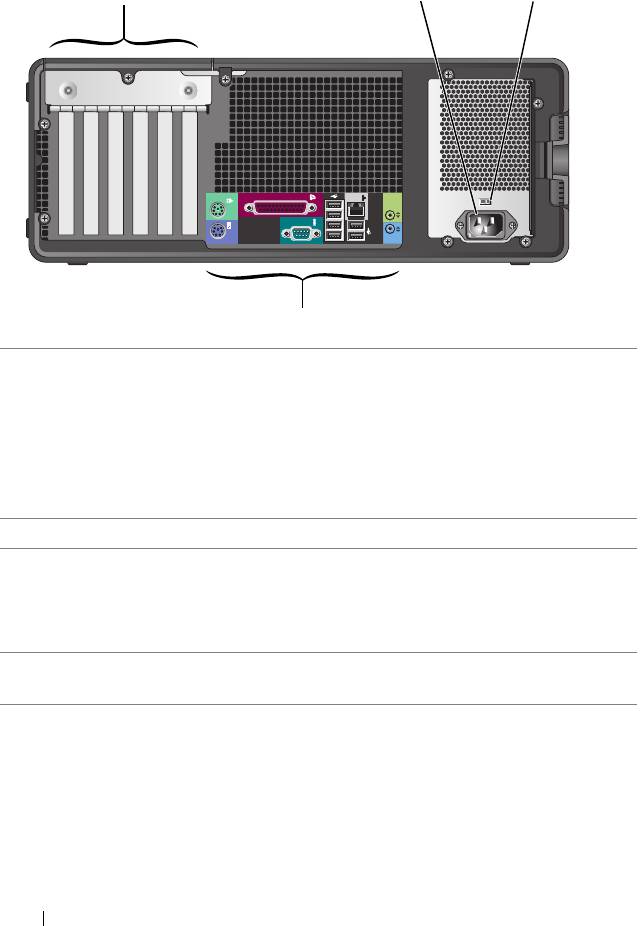
Back View (Desktop Orientation)
1
32
4
1 card slots Access connectors for any installed PCI or PCI Express
cards.
NOTE: Check the documentation for cards to ensure that
you can accommodate them in your configuration. Some
cards that require more physical space and power (such
as PCI Express graphics cards) may restrict the use of
other cards.
2 power connector Insert the power cable.
3 voltage selection
See the safety instructions in the Product Information
switch
Guide for more information.
NOTE: The voltage selection switch is available on the
375-W PSU only.
4 back panel connectors Plug serial, USB, and other devices into the
appropriate connector.
18 Quick Reference Guide
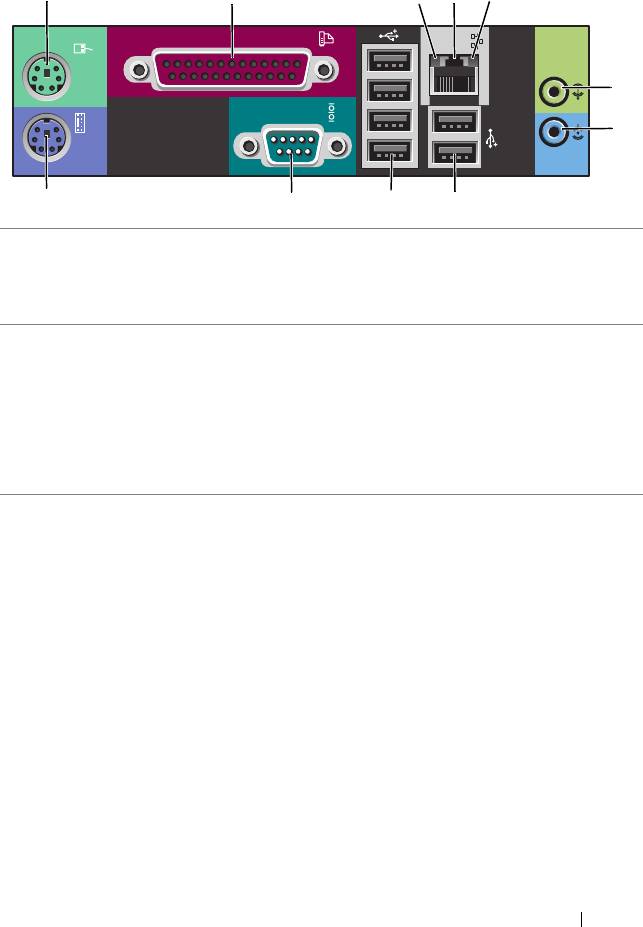
Back Panel Connectors
1
2 345
6
7
891011
1 mouse connector Plug a PS/2 mouse into the green mouse connector. Turn off
the computer and any attached devices before you connect
a mouse to the computer. If you have a USB mouse, plug it
into a USB connector.
2 parallel
Connect a parallel device, such as a printer, to the parallel
connector
connector. If you have a USB printer, plug it into a USB
connector.
NOTE: The integrated parallel connector is automatically
disabled if the computer detects an installed card containing
a parallel connector configured to the same address. For more
information, see "System Setup Options" in your User’s Guide.
3 link integrity
• Green — A good connection exists between a 10-Mbps
light
network and the computer.
• Orange — A good connection exists between a 100-Mbps
network and the computer.
• Yellow — A good connection exists between a 1000-Mbps
(1-Gbps) network and the computer.
• Off — The computer is not detecting a physical
connection to the network.
Quick Reference Guide 19

4 network adapter
To attach your computer to a network or broadband device,
connector
connect one end of a network cable to either a network jack
or your network or broadband device. Connect the other
end of the network cable to the network adapter connector
on your computer. A click indicates that the network cable
has been securely attached.
NOTICE: Do not plug a telephone cable into the network
connector.
On computers with an additional network connector card,
use the connectors on the card and on the back of the
computer when setting up multiple network connections
(such as a separate intra- and extranet).
It is recommended that you use Category 5 wiring and
connectors for your network. If you must use Category
3 wiring, force the network speed to 10 Mbps to ensure
reliable operation.
5 network activity
The network activity light is on (flashing) when the
light
computer is transmitting or receiving network data. A high
volume of network traffic may make this light appear to be
in a steady on state.
6 line-out
Use the green line-out connector to attach headphones and
connector
most speakers with integrated amplifiers.
On computers with a sound card, use the connector on the
card.
7 line-in connector Use the blue line-in connector to attach a record/playback
device such as a microphone, cassette player, CD player,
or VCR.
On computers with a sound card, use the connector on the
card.
8 Rear Dual USB
Use the back USB connectors for devices that typically
2.0 connectors
remain connected, such as printers and keyboards.
(2)
NOTE: It is recommended that you use the front USB
connectors for devices that you connect occasionally, such as
flash memory keys or cameras, or for bootable USB devices.
20 Quick Reference Guide
