
Dell PowerEdge T605: instruction
Class: Household, kitchen appliances, electronics and equipment
Type: Computer
Manual for Dell PowerEdge T605
Table of contents
- Getting Started With Your System
- Notes, Notices, and Cautions
- System Features
- The system board includes the following integrated features:
- Supported Operating Systems
- Other Information You May Need Obtaining Technical Assistance
- Installation and Configuration Unpack the System
- Connect the Keyboard, Mouse, and Monitor Connect the System to Power
- Installing the Power Cord Retention Bracket Turn on the System and Monitor
- Complete the 0perating System Setup Technical Specifications Processor Expansion Bus Memory
- Drives Connectors
- Video Power Physical
- Environmental

Dell™ PowerEdge™
T605 Systems
Getting Started With
Your System
Začínáme se systémem
Guide de mise en route
Erste Schritte mit dem System
Τα πρώτα βήµατα µε το σύστηµά σας
Rozpoczęcie pracy z systemem
Начало работы с системой
Procedimientos iniciales con el sistema
תכרעמה ע הדובעה תליחת


Dell™ PowerEdge™
T605 Systems
Getting Started With
Your System

Notes, Notices, and Cautions
NOTE: A NOTE indicates important information that helps you make better use
of your computer.
NOTICE: A NOTICE indicates either potential damage to hardware or loss of data
and tells you how to avoid the problem.
CAUTION: A CAUTION indicates a potential for property damage, personal injury,
or death.
____________________
Information in this document is subject to change without notice.
© 2007 Dell Inc. All rights reserved.
Reproduction in any manner whatsoever without the written permission of Dell Inc. is strictly
forbidden.
Trademarks used in this text: Dell and the DELL logo are trademarks of Dell Inc.; AMD and AMD Opteron
are registered trademarks of Advanced Micro Devices; Microsoft, Windows and Windows Server are
registered trademarks of Microsoft Corporation; Red Hat and Red Hat Enterprise Linux are registered
trademarks of Red Hat, Inc.; SUSE is a registered trademark of Novell Inc.
Other trademarks and trade names may be used in this document to refer to either the entities claiming
the marks and names or their products. Dell Inc. disclaims any proprietary interest in trademarks
and trade names other than its own.
Model SCM
November 2007 P/N JW993 Rev. A00
System Features
This section describes the major hardware and software features of your
system. It also provides information about other documents you may
need when setting up your system and how to obtain technical assistance.
• One or two dual-core or quad-core AMD™ Opteron™ processors.
NOTE: Use the System Setup program to view processor information.
See the Hardware Owner’s Manual.
• A minimum of 1 GB (single-processor systems) or 2 GB (two-processor
systems) of 533 or 667 MHz registered parity DDR-II memory modules.
Memory is upgradable to a maximum of 32 GB (two-processor systems)
by installing combinations of 512-MB, 1-GB, 2-GB, or 4-GB memory
modules in the eight memory module sockets on the system board.
• Support for up to four 3.5-inch, internal non-hot-pluggable or hot-
pluggable (when available) Serial Attached SCSI (SAS) or SATA hard
drives. A controller expansion card is required for SAS hard drives or
for more than two SATA hard drives.
• One 3.5-inch peripheral drive bay for the optional diskette drive, and
two 5.25-inch bays for the following supported drives: DVD-ROM,
combination CD-RW/DVD, DVD+RW, or tape backup device.
NOTE: DVD devices are data only.
• An intrusion switch that signals the appropriate systems management
software if the cover is opened.
• A 650-W non-redundant power supply, or an optional hot-pluggable
675-W power supply in a 1 + 1 redundant configuration.
Getting Started With Your System 3

The system board includes the following integrated features:
• SATA controller that supports up to two cabled SATA hard drives,
and up to two of the following supported devices: DVD-ROM,
CD-RW/DVD combination drive, DVD+RW, or SATA tape
backup device.
NOTE: DVD devices are data only.
• One 133-MHz PCI-X expansion slot, three PCI Express (PCIe) x4
expansion slots, and one PCIe x8 expansion slot.
• An integrated ATI RN50 2D graphics controller with a minimum of 32 MB
of graphics memory. Maximum resolution is 1280 x 1024 with 65,536
colors; graphics are supported in the following resolutions: 640 x 480,
800 x 600, 1024 x 768, and 1280 x 1024.
• An integrated Gigabit NIC, capable of supporting 1000-Mbps, 100-Mbps,
or 10-Mbps data rates, with support for PXE, Wake-on-LAN, TCP/IP
Offload Engine (TOE), and iSCSI offload and boot.
• An integrated Trusted Platform Module (TPM) version 1.2 used for
security applications, capable of generating and storing keys and storing
passwords and digital certificates. (Not available in China.)
• Eight USB 2.0-compliant connectors (two on the front, one internal
for a bootable memory key, and five on the back) capable of supporting
a diskette drive, a DVD-ROM drive, a keyboard, a mouse, or a USB flash
drive.
• Optional Remote Access Controller (RAC) for remote systems
management.
• Standard Baseboard Management Controller (BMC) with serial
and LAN access.
• Back-panel connectors include serial, video, five USB connectors,
and one NIC connector.
• Front-panel connectors include two USB connectors.
• Front-panel LCD for system ID and error messaging.
For more information about specific features, see “Technical Specifications”
on page 10.
4 Getting Started With Your System

Supported Operating Systems
Your system supports the following operating systems:
®
®
• Microsoft
Windows Server
2008 Standard and Enterprise (32-bit x86)
Editions
• Microsoft Windows Server 2008 Standard and Enterprise (x64) Editions
®
• Microsoft Windows
Small Business Server 2008 Standard and Premium
Editions
• Microsoft Windows Server 2003 Standard and Enterprise (32-bit x86)
Editions with SP2
• Microsoft Windows Server 2003 Standard and Enterprise (x64) Editions
with SP2
• Microsoft Windows Server 2003 R2 Standard and Enterprise (32-bit x86)
Editions with SP2
• Microsoft Windows Server 2003 R2 Standard and Enterprise (x64)
Editions with SP2
• Microsoft Windows Small Business Server 2003 R2 Standard
and Premium Editions with SP2
®
®
•Red Hat
Enterprise Linux
ES and AS (version 4.5) (x86_32)
• Red Hat Enterprise Linux ES and AS (version 4.5) (x86_64)
• Red Hat Enterprise Linux Server 5 (x86_32)
• Red Hat Enterprise Linux Server 5 (x86_64)
®
•SUSE
Linux Enterprise Server 9 (SP4) (x86_64)
• SUSE Linux Enterprise Server 10 (x86_64)
NOTE: For the latest information on supported operating systems,
see www.dell.com.
Getting Started With Your System 5
Other Information You May Need
CAUTION: The Product Information Guide provides important safety and
regulatory information. Warranty information may be included within this
document or as a separate document.
•The
Hardware Owner’s Manual
provides information about system
features and describes how to troubleshoot the system and install
or replace system components.
• CDs included with your system provide documentation and tools
for configuring and managing your system.
• Updates are sometimes included with the system to describe changes
to the system, software, and/or documentation.
NOTE: Always check for updates on support.dell.com and read the updates
first because they often supersede information in other documents.
• Release notes or readme files may be included to provide last-minute
updates to the system or documentation or advanced technical reference
material intended for experienced users or technicians.
• Operating system documentation describes how to install (if necessary),
configure, and use the operating system software.
• Documentation for any components you purchased separately provides
information to configure and install these options.
Obtaining Technical Assistance
If you do not understand a procedure in this guide or if the system
does not perform as expected, see your Hardware Owner’s Manual.
Dell Enterprise Training and Certification is available; see
www.dell.com/training for more information. This service may not be
offered in all locations.
6 Getting Started With Your System
Installation and Configuration
CAUTION: Before performing the following procedure, read and follow the safety
instructions and important regulatory information in your Product Information
Guide.
NOTICE: Make sure there are no physical obstructions within 30 cm (12 inches)
of the front of the system and 61 cm (24 inches) of the rear of the system.
This may cause a decrease in airflow, which could cause your system to overheat.
This section describes the steps to set up your system for the first time.
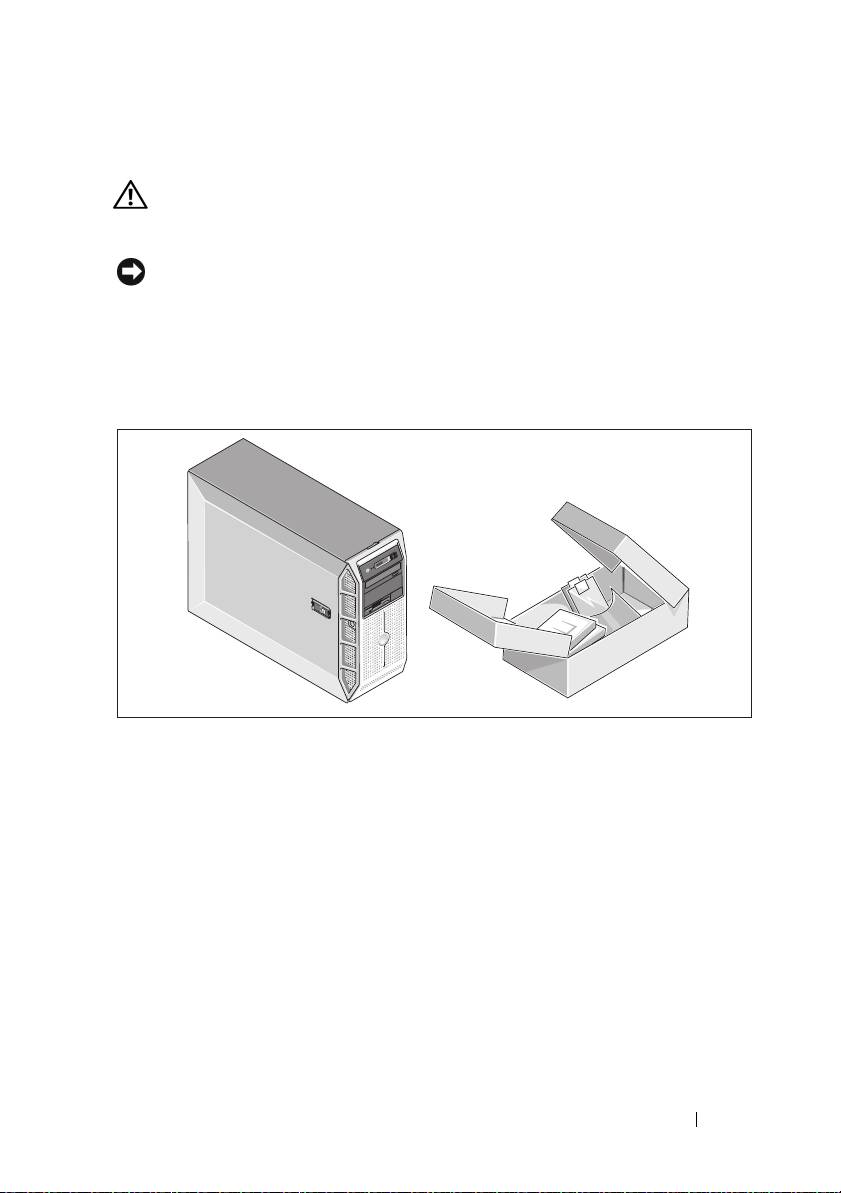
Unpack the System
Upack your system and identify each item. Keep all shipping materials in case
you need them later.
Getting Started With Your System 7
Connect the Keyboard, Mouse, and Monitor
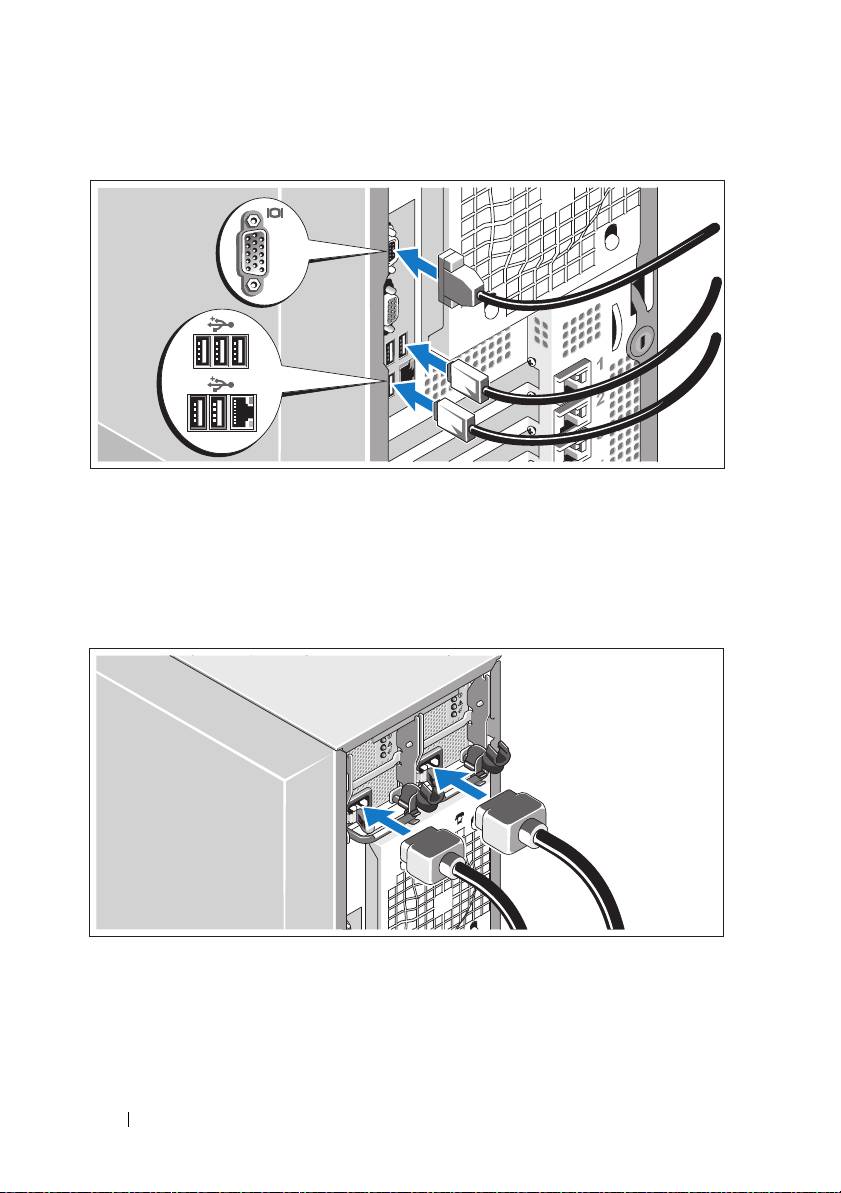
Connect the keyboard, mouse, and monitor (optional).
The connectors on the back of your system have icons indicating which
cable to plug into each connector. Be sure to tighten the screws (if any)
on the monitor's cable connector.
Connect the System to Power
Connect the monitor’s power cable to the monitor (optional), and connect
the system’s power cable(s) to the system.
8 Getting Started With Your System
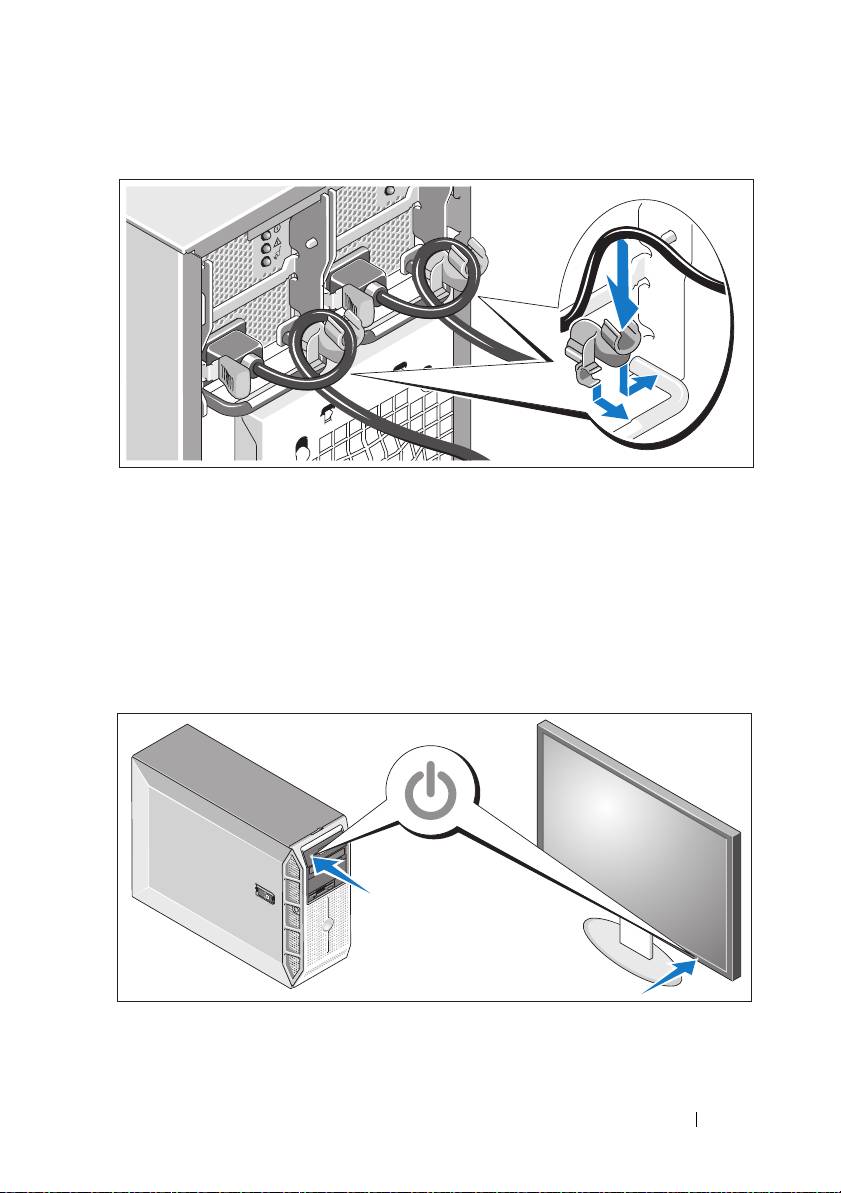
Installing the Power Cord Retention Bracket
Attach the power cord retention bracket on the right bend of the power
supply handle. Bend the system power cable into a loop as shown in the
illustration and attach to the bracket’s cable clasp. Repeat the procedure
for the second power supply.
Plug the other end of the power cable(s) into a grounded electrical outlet
or a separate power source such as an uninterrupted power supply (UPS)
or a power distribution unit (PDU).
Turn on the System and Monitor
Press the power button on the system and the monitor (optional). The power
indicators should light. Adjust the monitor's controls until the displayed
image is satisfactory.
Getting Started With Your System 9

Complete the 0perating System Setup
If you purchased a preinstalled operating system, see the operating system
documentation that ships with your system. To install an operating system
for the first time, see the Quick Installation Guide. Be sure the operating system
is installed before installing hardware or software not purchased with the
system.
Technical Specifications
Processor
Processor type One or two dual- or quad-core
AMD
™
Opteron
™
processors
Expansion Bus
Bus type PCIe and PCI-X
Expansion slots
PCIe
One x8 full-height, full-length 3.3-V
(slot 4)
Three x4 full-height, full-length 3.3-V
(slots 1 through 3)
PCI-X
One full-height, full-length 3.3-V (slot 5)
One internal USB key socket
Memory
Architecture
128-bit DDR II SDRAM DIMMs, rated
for
533-MHz or 667-MHz operation
Memory module sockets Eight 240-pin
Memory module capacities
512 MB, 1 GB, 2 GB, or 4 GB
Minimum RAM
1 GB (one processor) or 2 GB
(two processors)
Maximum RAM 16 GB (one processor) or 32 GB
(two processors)
10 Getting Started With Your System

Drives
Hard drives
Up to four 3.5-inch internal non-hot-plug
or hot-plug (when available) SAS or SATA
Diskette drive One optional internal 3.5-inch, 1.44-MB
Optical drives Up to two optional internal DVD-ROM
(SATA or PATA), DVD+RW (SATA or
PATA), or CD-RW/DVD combination
(SATA) drives
NOTE: DVD devices are data only.
External optional USB DVD
Tape drive One optional internal half-height,
5.25-inch SAS, SATA, or SCSI
External optional USB tape backup
device
Flash drive External optional USB
Internal optional USB
Connectors
Back
NIC
One RJ-45 (for Broadcom Gigabit LOM)
Serial
9-pin, DTE, 16550-compatible
USB
Five 4-pin, USB 2.0-compliant
Video
15-pin VGA
Front
USB
Two 4-pin, USB 2.0-compliant
Internal
USB
One 4-pin, USB 2.0-compliant
Getting Started With Your System 11

Video
Video type Integrated
Video memory 32 MB (minimum)
Power
AC power supply
Wa tt ag e
650 W (non-redundant power supply)
675 W (redundant power supply)
Voltage 100-240VAC, 6.0-3.0A, 50/60 Hz
Heat dissipation
624 BTU/Hour (non-redundant
power supply)
574 BTU/Hour (redundant power supply)
CMOS backup battery CR 2032 3.0-V lithium ion coin cell
Physical
Height 456 mm (17.95 inches)
Width 210 mm (8.27 inches)
Depth 635 mm (25 inches)
Weight (maximum configuration) 27 kg (59.52 lb)
12 Getting Started With Your System

Environmental
NOTE: For additional information about environmental measurements for specific
system configurations, see dell.com/environmental_datasheets.
Temperature
Operating
10° to 35°C (50° to 95°F)
Storage
–40° to 65°C (–40° to 149°F)
Relative humidity
Operating
20% to 80% (noncondensing)
with a maximum humidity gradient
of 10% per hour
Storage
5% to 95% (noncondensing)
Maximum vibration
Operating
0.26 Grms, 5 to 350 Hz at 0.0002 G2/Hz
Storage
1.54 Grms, 10 to 250 Hz
at 0.003 to 0.01 G2/Hz
Maximum shock
Operating
27 G +/– 10% with pulse duration
of 2.6 msec +/– 10%
Storage
71 G +/– 10% with pulse duration
of 2 msec +/– 10%, 32G +/– 5% with
velocity change of 235 ips +/– 5%
Altitude
Operating
–15.2 to 3,048 m (–50 to 10,000 ft)
Storage
–15.2 to 10,600 m (–50 to 35,000 ft)
Airborne contaminant level
Class
G2 or lower as defined
by ISA-S71.04-1985
Getting Started With Your System 13

14 Getting Started With Your System

Systémy Dell™
PowerEdge™ T605
Začínáme
se systémem

Poznámky, upozornění a výstrahy
POZNÁMKA: POZNÁMKA označuje důležitou informaci, která vám
pomůže při lepším využívání vašeho počítače.
UPOZORNĚNÍ: UPOZORNĚNÍ poukazuje na možnost poškození
hardwaru nebo ztráty dat a poskytuje návod, jak se danému problému
vyhnout.
POZOR: Výstraha („POZOR“) poukazuje na riziko poškození
majetku, poranění nebo smrtelného úrazu.
____________________
Informace obsažené v tomto dokumentu podléhají změnám bez předchozího upozornění.
© 2007 Dell Inc. Všechna práva vyhrazena.
Reprodukce jakýmkoli způsobem bez písemného povolení společnosti Dell Inc. je přísně zakázána.
Ochranné známky použité v tomto textu: Dell a logo DELL jsou ochranné známky společnosti Dell Inc.;
AMD a AMD Opteron jsou registrované ochranné známky společnosti Advanced Micro Devices;
Microsoft, Windows a Windows Server jsou registrované ochranné známky společnosti Microsoft
Corporation; Red Hat a Red Hat Enterprise Linux jsou registrované ochranné známky společnosti
Red Hat, Inc.; SUSE je registrovaná ochranná známka společnosti Novell Inc.
V tomto dokumentu mohou být použity další ochranné známky a obchodní názvy buď s odkazem
na právnické osoby a organizace, které uplatňují na dané ochranné známky a obchodní názvy nárok,
nebo s odkazem na jejich výrobky. Společnost Dell Inc. nemá vlastnické zájmy vůči ochranným
známkám a obchodním názvům jiným než svým vlastním.
Model SCM
Listopad 2007 Č. dílu JW993 Rev. A00

Systémové funkce
V této části jsou popsány hlavní hardwarové a softwarové funkce vašeho počítače.
Jsou v ní obsaženy i informace o dalších dokumentech, které můžete potřebovat
při instalaci počítače, a informace k odborné pomoci.
•
Jeden nebo dva dvoujádrové nebo čtyřjádrové procesory AMD
™
Opteron
™
.
POZNÁMKA: K zobrazení informací o procesoru použijte program
Nastavení systému. Další informace naleznete v Uživatelské příručce
hardwaru.
•
Paměťové moduly DDR-II alespoň 1 GB (jednoprocesorové systémy)
nebo 2 GB (dvouprocesorové systémy), 533 nebo 667 MHz, s registrovanou
paritou. Paměť lze upgradovat maximálně na 32 GB (u dvouprocesorových
systémů) instalací kombinace paměťových modulů 512 MB, 1 GB, 2 GB
nebo 4 GB do osmi paměťových patic na základní desce.
•
Podpora až čtyř 3,5", interních pevných disků SAS (Serial Attached SCSI)
nebo SATA, které nelze instalovat za provozu nebo lze instalovat za provozu
(jsou-li k dispozici). U pevných disků SAS a u více než dvou pevných disků
SATA je nutné použití rozšiřovací karty řadiče.
•
Jedna 3,5",periferní disková přihrádka pro volitelnou disketovou jednotku
a dvě 5,25" přihrádky pro následující podporované jednotky: DVD-ROM,
kombinace CD-RW/DVD, DVD+RW nebo pásková zálohovací jednotka.
POZNÁMKA: DVD zařízení jsou určena pouze pro data.
•
Spínač při vniknutí, který předává příslušnému softwaru systémové
správy signál vpřípadě, že dojde k otevření krytu.
•
650W, záložní napájecí zdroj nebo volitelný, připojitelný za provozu
675W napájecí zdroj v konfiguraci 1 + 1 záložní.
Začínáme se systémem 17

Systémová deska má následující funkce:
•
SATA řadič podporující až dva připojené pevné disky SATA a až dvě
z následujících podporovaných zařízení: DVD-ROM, kombinovaná
jednotka CD-RW/DVD, DVD+RW nebo pásková zálohovací jednotka
SATA.
POZNÁMKA: DVD zařízení jsou určena pouze pro data.
•
Jeden 133MHz PCI-X rozšiřovací slot, tři PCI Express (PCIe) x4 rozšiřovací
sloty a jeden rozšiřovací slot PCIe x8.
•
Integrovaný grafický řadič ATI RN50 2D s min. 32 MB paměti.
Max. rozlišení je 1280 x 1024 s 65 536 barvami; grafika je podporována
v následujících rozlišeních: 640 x 480, 800 x 600, 1024 x 768 a 1280 x 1024.
•
Integrovaná, Gb síťová karta podporující rychlosti přenosu dat 1000 Mb/s,
100 Mb/s nebo 10 Mb/s, s podporou funkcí PXE, Wake-on-LAN, TCP/IP
Offload Engine (TOE) a iSCSI offload and boot.
•
Integrovaný modul TPM (Trusted Platform Module) verze 1.2 používaný
pro aplikace zabezpečení s funkcí generování a ukládání klíčů a ukládání
hesel a digitálních certifikátů (není k dispozici v Číně).
•
Osm konektorů USB 2.0 (dva na přední straně, jeden interní pro bootovací
paměťový klíč a pět na zadní straně) podporujících disketovou jednotku,
jednotku CD-ROM, klávesnici, myš nebo USB flash disk.
•
Volitelný řadič RAC (Remote Access Controller) umožňující vzdálenou
správu systému.
•
Standardní řadič BMC (Baseboard Management Controller) se sériovým
portem a přístupem do sítě LAN.
•
Konektory na zadním panelu – sériový port, video, pět USB konektorů
a jeden síťový konektor.
•
Konektory na čelním panelu – dva USB konektory.
•
LCD displej na předním panelu pro zobrazení ID systému a chybových
hlášení.
Více informací o specifických funkcí na „Technické údaje“ na stránce 24.
18 Začínáme se systémem
