
Dell Precision 360 – page 2
Manual for Dell Precision 360
Table of contents
- Notes, Notices, and Cautions Abbreviations and Acronyms
- Contents
- Finding Information for Your Computer What are you looking for? Find It Here
- What are you looking for? Find It Here
- What are you looking for? Find It Here
- Setting Up Your Computer
- 6 Verify that the voltage selection switch is set correctly for your location. Press the power buttons to turn on the computer and monitors.
- Mini-Tower Setup — Without Expansion Cards
- Mini-Tower Setup — With Expansion Card
- Desktop Setup — Without Expansion Cards
- Desktop Setup — With Expansion Cards
- Monitor Connections For dual monitor capable cards with a single connector
- For dual-monitor capable cards with 1 DVI and 1 VGA connector For dual-monitor capable cards with 2 DVI connectors
- Completed Setup
- Opening the Computer Cover
- While you work, periodically touch any unpainted metal surface on the computer to dissipate any static electricity that could harm internal components.
- Inside Your Computer Mini-Tower Computer
- Desktop Computer
- Solving Problems Resolving Software and Hardware Incompatibilities Microsoft Windows XP
- Windows 2000
- Using System Restore in Windows XP Creating a Restore Point Restoring the Computer to an Earlier Operating State
- Using the Last Known Good Configuration in Windows 2000 Other Options to Help Resolve Additional Device or Software Conflicts When to Use the Dell Diagnostics
- Starting the Dell Diagnostics Starting the Dell Diagnostics From Your Hard Drive Starting the Dell Diagnostics From the Drivers and Utilities CD
- Dell Diagnostics Main Menu Option Function
- Tab Function Beep Codes
- Error Messages System Lights Power Light Hard-Drive Problem Description Suggested Resolution Light
- Power Light Hard-Drive Problem Description Suggested Resolution Light
- Diagnostic Lights Light Pattern Problem Description Suggested Resolution
- Light Pattern Problem Description Suggested Resolution
- Light Pattern Problem Description Suggested Resolution
- Frequently Asked Questions How Do I... Solution Where to Find Additional Information

Solving Problems
Resolving Software and Hardware Incompatibilities
®
®
Microsoft
Windows
XP
Windows XP IRQ conflicts occur if a device either is not detected during the operating
system setup or is detected but incorrectly configured.
To check for conflicts on a computer running Windows XP:
1 Click the Start button and click Control Panel.
2 Click Performance and Maintenance and click System.
3 Click the Hardware tab and click Device Manager.
4 In the Device Manager list, check for conflicts with the other devices.
Conflicts are indicated by a yellow exclamation point (
!) beside the conflicting device
or a red
X if the device has been disabled.
5 Double-click any conflict to display the Properties window.
If an IRQ conflict exists, the Device status area in the Properties window reports the
cards or devices that share the device's IRQ.
6 Resolve conflicts by reconfiguring the devices or removing the devices from the Device
Manager.
To use the Windows XP Hardware Troubleshooter:
1 Click the Start button and click Help and Support.
2 Ty p e hardware troubleshooter in the Search field, and click the arrow to start the
search.
3 Click Hardware Troubleshooter in the Search Results list.
4 In the Hardware Troubleshooter list, click I need to resolve a hardware conflict on my
computer, and then click Next.
Setup and Quick Reference Guide 21

Windows 2000
To check for conflicts on a computer running Windows 2000:
1 Click the Start button, point to Settings, and then click Control Panel.
2 In the Control Panel window, double-click System.
3 Click the Hardware tab.
4 Click Device Manager.
5 Click View and click Resources by connection.
6 Double-click Interrupt request (IRQ) to view the IRQ assignments.
Conflicts are indicated by a yellow exclamation point (
!) beside the conflicting device
www.dell.com | support.dell.com
or a red
X if the device has been disabled.
7 Double-click any conflict to display the Properties window.
If an IRQ conflict exists, the Device status area in the Properties window reports the
cards or devices that share the device's IRQ.
8 Resolve conflicts by reconfiguring the devices or removing the devices from the Device
Manager.
To use the Windows 2000 Hardware Troubleshooter:
1 Click the Start button and click Help.
2 Click Troubleshooting and Maintenance on the Contents tab, click Windows 2000
troubleshooters, and then click Hardware.
3 In the Hardware Troubleshooter list, click I need to resolve a hardware conflict on my
computer, and then click Next.
22 Setup and Quick Reference Guide

Using System Restore in Windows XP
The Windows XP operating system provides System Restore to allow you to return your
computer to an earlier operating state (without affecting data files) if changes to the
hardware, software, or other system settings have left the computer in an undesirable
operating state.
NOTICE: Back up your data files regularly. System Restore does not monitor your data files or
recover them.
Creating a Restore Point
1 Click the Start button and click Help and Support.
2 Click System Restore.
3 Follow the instructions on the screen.
Restoring the Computer to an Earlier Operating State
NOTICE: Before you restore the computer to an earlier operating state, save and close all open
files and close all open programs. Do not alter, open, or delete any files or programs until the
system restoration is complete.
1
Click the Start button, point to All Programs→Accessories→System Tools,
and then click System Restore.
2 Ensure that Restore my computer to an earlier time is selected, and then click Next.
3 Click a calendar date to which you want to restore your computer.
The Select a Restore Point screen provides a calendar that allows you to see and select
restore points. All calendar dates with available restore points appear in bold.
4 Select a restore point and click Next.
If a calendar date has only one restore point, then that restore point is automatically
selected. If two or more restore points are available, click the restore point that you
prefer.
5 Click Next.
The Restoration Complete screen appears after System Restore finishes collecting
data, and then the computer automatically restarts.
6 After the computer restarts, click OK.
To change the restore point, you can either repeat the steps using a different restore
point, or you can undo the restoration.
Setup and Quick Reference Guide 23

Using the Last Known Good Configuration in Windows 2000
1 Restart your computer and press <F8> when the message Please select the
operating system to start
appears.
2 Highlight Last Known Good Setting, press <Enter>, press <l>, and then select your
operating system when prompted.
Other Options to Help Resolve Additional Device or Software Conflicts
NOTICE: The following processes erase all of the information on your hard drive.
• If the previous procedures did not work, run a low-level format of your hard drive.
See your operating system installation guide for more information.
www.dell.com | support.dell.com
• Reinstall your operating system using the operating system installation guide and
operating system CD.
When to Use the Dell Diagnostics
If you experience a problem with your computer, perform the checks in “Solving Problems”
in your User’s Guide and run the Dell Diagnostics before you contact Dell for technical
assistance. Running the Dell Diagnostics may help you resolve the problem without
contacting Dell. If you do contact Dell, the test results can provide important information
for Dell's service and support personnel.
The Dell Diagnostics allows you to:
• Perform tests on one or all devices.
• Select tests based on a symptom of the problem you are having.
• Choose how many times a test is run.
• Suspend testing if an error is detected.
• Access help information that describes the tests and devices.
• Receive status messages that tell you whether tests completed successfully.
• Receive error messages if problems are detected.
24 Setup and Quick Reference Guide

Starting the Dell Diagnostics
It is recommended that you print these procedures before you begin.
NOTICE: Use the Dell Diagnostics to test your Dell™ computer only. Using this program with
other computers can result in error messages.
Enter system setup, review your computer’s configuration information, and ensure that the
device you want to test displays in system setup and is active.
Start the Dell Diagnostics from either your hard drive or from the Drivers and Utilities CD
(also known as the ResourceCD).
Starting the Dell Diagnostics From Your Hard Drive
1 Shut down and restart the computer.
2 When the DELL™ logo appears, press <F12> immediately.
NOTE: If you see a message stating that no diagnostics utility partition has been found, follow
the instruction to run the Dell Diagnostics from your Drivers and Utilities CD.
®
®
If you wait too long and the Microsoft
Windows
logo appears, continue to wait
until you see the Windows desktop. Then shut down your computer through the
Start menu and try again.
3 When the boot device list appears, highlight Boot to Utility Partition and press
<Enter>.
4 When the Dell Diagnostics Main Menu appears, select the test you want to run.
Starting the Dell Diagnostics From the Drivers and Utilities CD
1 Insert the Drivers and Utilities CD.
2 Shut down and restart the computer.
When the DELL logo appears, press <F12> immediately.
If you wait too long and the Windows logo appears, continue to wait until you see the
Windows desktop. Then shut down your computer through the Start menu and try
again.
NOTE: This feature changes the boot sequence for one time only. On the next start-up,
the computer boots according to the devices specified in system setup.
3
When the boot device list appears, highlight IDE CD-ROM Device
and press <Enter>.
4 Select the IDE CD-ROM Device option from the CD boot menu.
Setup and Quick Reference Guide 25

5 Select the Boot from CD-ROM option from the menu that appears.
6 Ty p e 1 to start the ResourceCD menu.
7 Ty p e 2 to start the Dell Diagnostics.
8 Select Run the 32 Bit Dell Diagnostics from the numbered list. If multiple versions
are listed, select the version appropriate for your computer.
9 When the Dell Diagnostics Main Menu appears, select the test you want to run.
Dell Diagnostics Main Menu
1 After the Dell Diagnostics loads and the Main Menu screen appears, click the button
for the option you want.
www.dell.com | support.dell.com
Option Function
Express Test Performs a quick test of devices. This test typically
takes 10 to 20 minutes and requires no interaction on
your part. Run Express Test first to increase the
possibility of tracing the problem quickly.
Extended Test Performs a thorough check of devices. This test
typically takes an hour or more and requires you to
answer questions periodically.
Custom Test Tests a specific device. You can customize the tests you
want to run.
Symptom Tree Lists the most common symptoms encountered and
allows you to select a test based on the symptom of the
problem you are having.
2 If a problem is encountered during a test, a message appears with an error code and a
description of the problem. Write down the error code and problem description and
follow the instructions on the screen.
If you cannot resolve the error condition, contact Dell.
NOTE: The Service Tag for your computer is located at the top of each test screen. If you
contact Dell, technical support personnel will ask for your Service Tag number.
26 Setup and Quick Reference Guide

3 If you run a test from the Custom Test or Symptom Tree option, click the applicable
tab described in the following table for more information.
Tab Function
Results Displays the results of the test and any error conditions
encountered.
Errors Displays error conditions encountered, error codes,
and the problem description.
Help Describes the test and may indicate requirements for
running the test.
Configuration Displays your hardware configuration for the selected
device.
The Dell Diagnostics obtains configuration
information for all devices from system setup, memory,
and various internal tests, and it displays the
information in the device list in the left pane of the
screen. The device list may not display the names of all
the components installed on your computer or all
devices attached to your computer.
Parameters Allows you to customize the test by changing the test
settings.
4 When the tests are completed, if you are running the Dell Diagnostics from the
Drivers and Utilities CD, remove the CD.
5 Close the test screen to return to the Main Menu screen. To exit the Dell Diagnostics
and restart the computer, close the Main Menu screen.
Beep Codes
Your computer might emit a series of beeps that identify a problem. One possible series
(code 1-3-1) consists of one beep, a burst of three beeps, and then one beep. This series tell
you that the computer encountered a memory problem.
If a beep code is emitted, write it down and look it up under “Beep Codes” in the User’s
Guide.
Setup and Quick Reference Guide 27

Error Messages
NOTE: If the message is not listed, see the documentation for either the operating system or the
program that was running when the message appeared.
If an error occurs during start-up, a message may be displayed on the monitor identifying
the problem. See “Error Messages” in the User’s Guide for suggestions on resolving any
problems.
System Lights
Your computer has a number of lights that can help you analyze and solve problems.
www.dell.com | support.dell.com
Power Light Hard-Drive
Problem Description Suggested Resolution
Light
Solid green N/A Power is on, and the computer is
No corrective action is required.
operating normally.
Blinking green Blank The computer is in the suspended
Press the power button, move the
®
®
state (Microsoft
Windows
2000
mouse, or press a key on the
and Windows XP).
keyboard to wake the computer. See
“Power Button” in your User’s
Guide.
Blinks green
N/A A configuration error exists. Check the diagnostic lights to see if
several times and
the specific problem is identified.
then turns off
Solid yellow N/A The Dell Diagnostics is running a
If the Dell Diagnostics is running,
test, or a device on the system board
allow the testing to complete.
may be faulty or incorrectly
Check the diagnostic lights to see if
installed.
the specific problem is identified.
See “System Board Problems” in
your User’s Guide.
If the computer does not boot,
contact Dell for technical
assistance.
Blinking yellow Blank A power supply or system board
Check the diagnostic lights to see if
failure has occurred.
the specific problem is identified.
See “Power Problems” and “System
Board Problems” in your User’s
Guide.
28 Setup and Quick Reference Guide

Power Light Hard-Drive
Problem Description Suggested Resolution
Light
Blinking yellow Solid green A system board or VRM failure has
Check the diagnostic lights to see
occurred.
if the specific problem is identified.
See “System Board Problems” in
your User’s Guide.
Solid green and a
N/A A problem was detected while the
See “Beep Codes” in your User’s
beep code during
BIOS was executing.
Guide. Also, check the diagnostic
POST
lights to see if the specific problem
is identified.
Solid green power
N/A The monitor or the graphics card
Check the diagnostic lights to see
light and no beep
may be faulty or incorrectly
if the specific problem is identified.
code and no video
installed.
See “Video and Monitor Problems”
during POST
in your User’s Guide.
Solid green power
N/A An integrated system board device
Check the diagnostic lights to see
light and no beep
may be faulty.
if the specific problem is identified.
code, but the
If the problem is not identified,
computer locks
contact Dell for technical
up during POST
assistance.
Setup and Quick Reference Guide 29
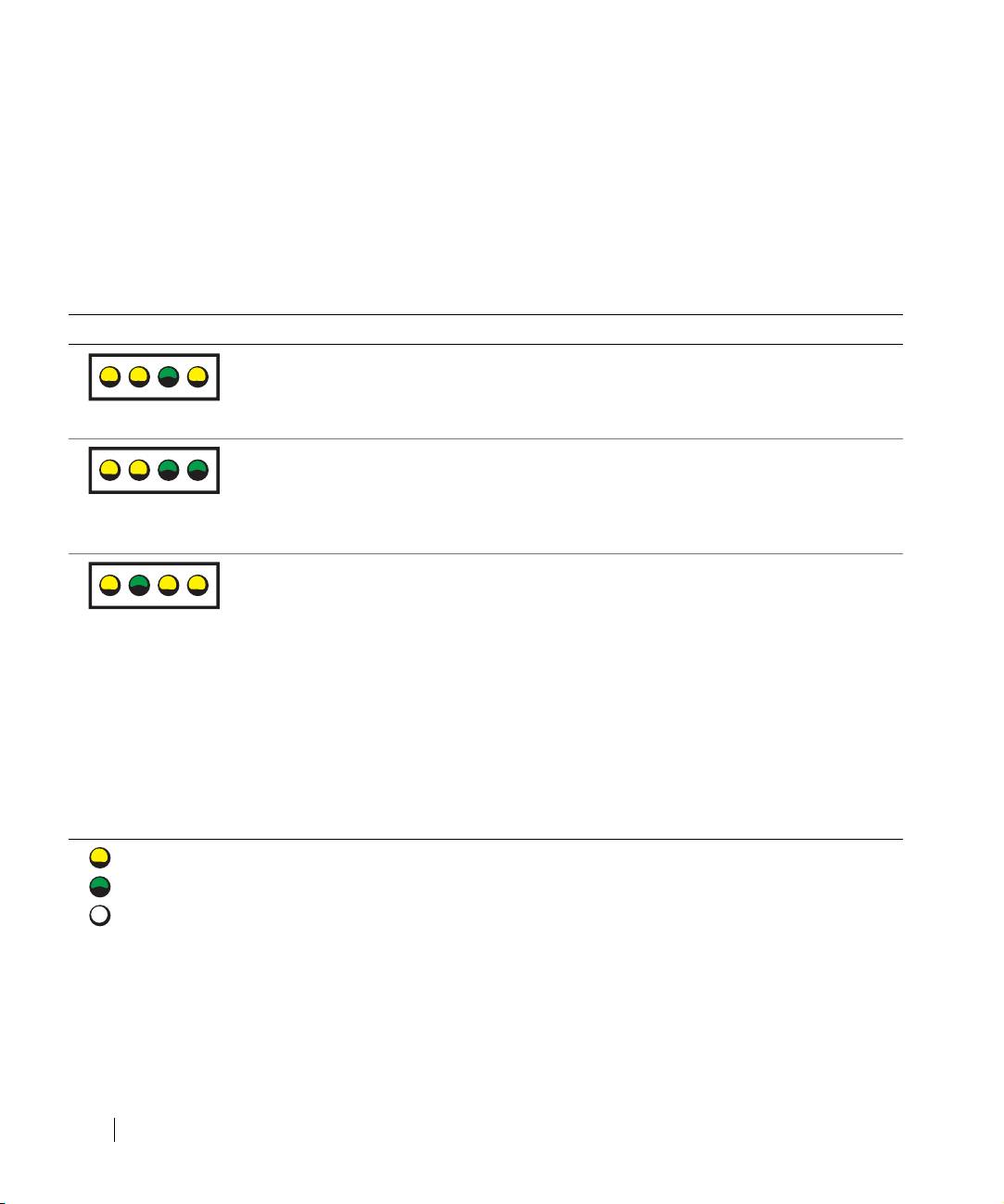
Diagnostic Lights
To help you troubleshoot a problem, your computer is equipped with four lights labeled “A,”
“B,” “C,” and “D.” Diagnostic lights are located on the back of the mini-tower computer
and on the front of the desktop computer. When the computer starts normally, the lights
flash. After the computer starts, all four lights will display solid green. If the computer
malfunctions, the color and sequence of the lights identify the problem.
Light Pattern Problem Description Suggested Resolution
A possible microprocessor failure has
Reinstall the microprocessor and restart the
occurred.
computer. See your User’s Guide for
information on how to reinstall the
www.dell.com | support.dell.com
A B C D
microprocessor for your computer.
Memory modules are detected, but a memory
1 Remove and reinstall all memory modules.
failure has occurred.
Ensure that all the connector tabs are
locked. For optimal performance, install
A B C D
the DIMMs in pairs (1 and 2 and 3 and 4).
2 Restart the computer.
A possible expansion card failure has
1 Determine if a conflict exists by removing
occurred.
a card (not the video card) and then
restarting the computer.
A B C D
2 If the problem persists, reinstall the card
that you removed, remove a different card,
and then restart the computer.
3 Repeat this process for each card. If the
computer starts normally, troubleshoot the
last card removed from the computer for
resource conflicts (see “Resolving Software
and Hardware Incompatibilities” in your
User’s Guide).
4 If the problem persists, contact Dell.
= yellow
= green
= off
30 Setup and Quick Reference Guide
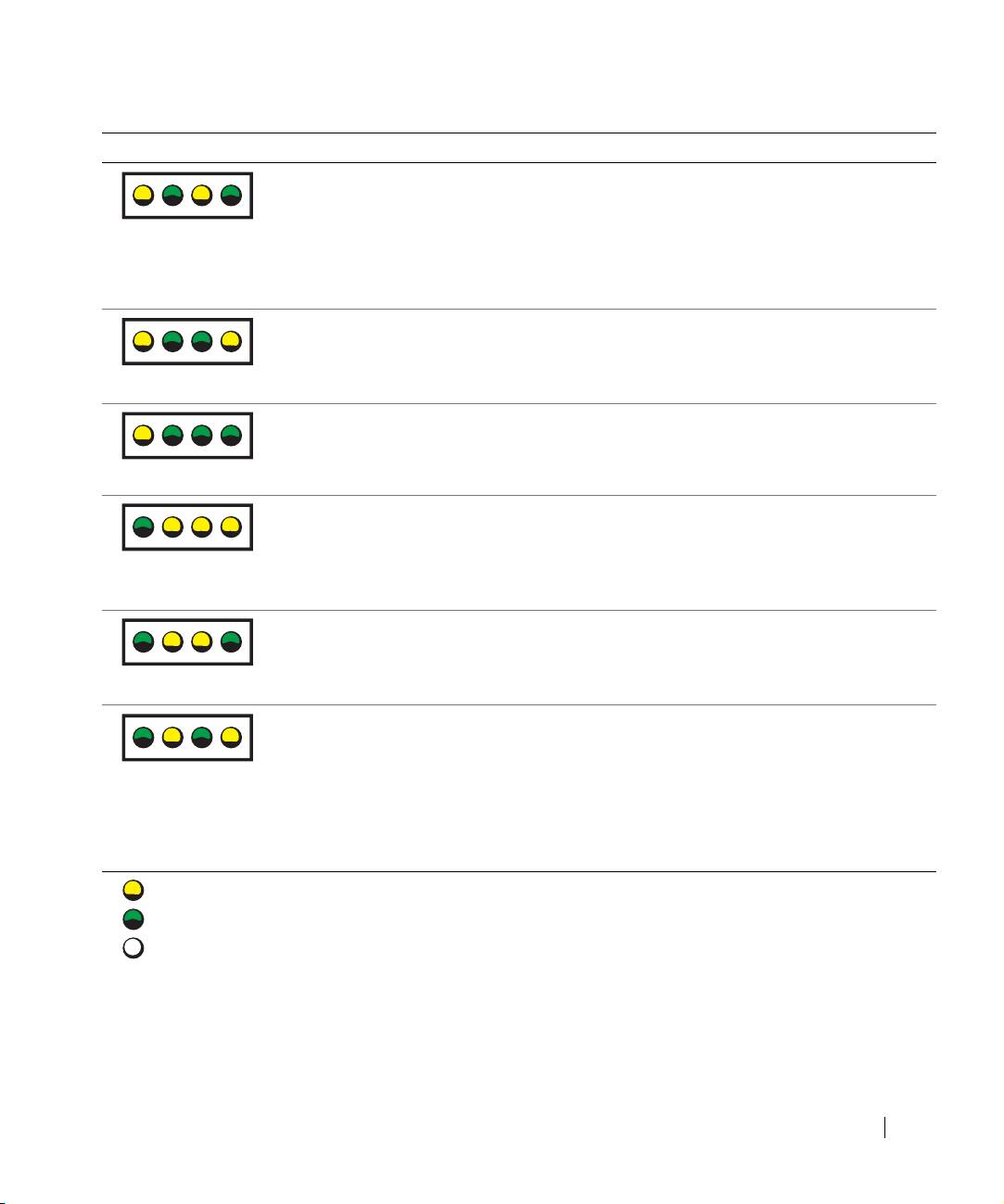
Light Pattern Problem Description Suggested Resolution
A possible graphics card failure has occurred. Reinstall the graphics card and restart the
computer.
If the problem still exists, install a graphics
A B C D
card that you know works and restart the
computer.
If the problem persists, contact Dell.
A possible floppy or hard drive failure has
Check all power and data cable connections,
occurred.
and then restart the computer.
A B C D
A possible USB failure has occurred. Reinstall all USB devices, check cable
connections, and then restart the computer.
A B C D
No memory modules are detected.
1 Remove and reinstall all memory modules.
Ensure that all the connector tabs are
locked. For optimal performance, install
A B C D
the DIMMs in pairs (1 and 2 and 3 and 4).
2 Restart the computer.
System board failure has occurred. Perform the procedures in “System Board
Problems” in your User’s Guide.
If the problem persists, contact Dell.
A B C D
Memory modules are detected, but a memory
Ensure that there are no special memory
configuration or compatibility error exists.
module/memory connector placement
requirements. See “Memory” in your User’s
A B C D
Guide.
Reinstall the memory modules, and then
restart the computer.
If the problem persists, contact Dell.
= yellow
= green
= off
Setup and Quick Reference Guide 31
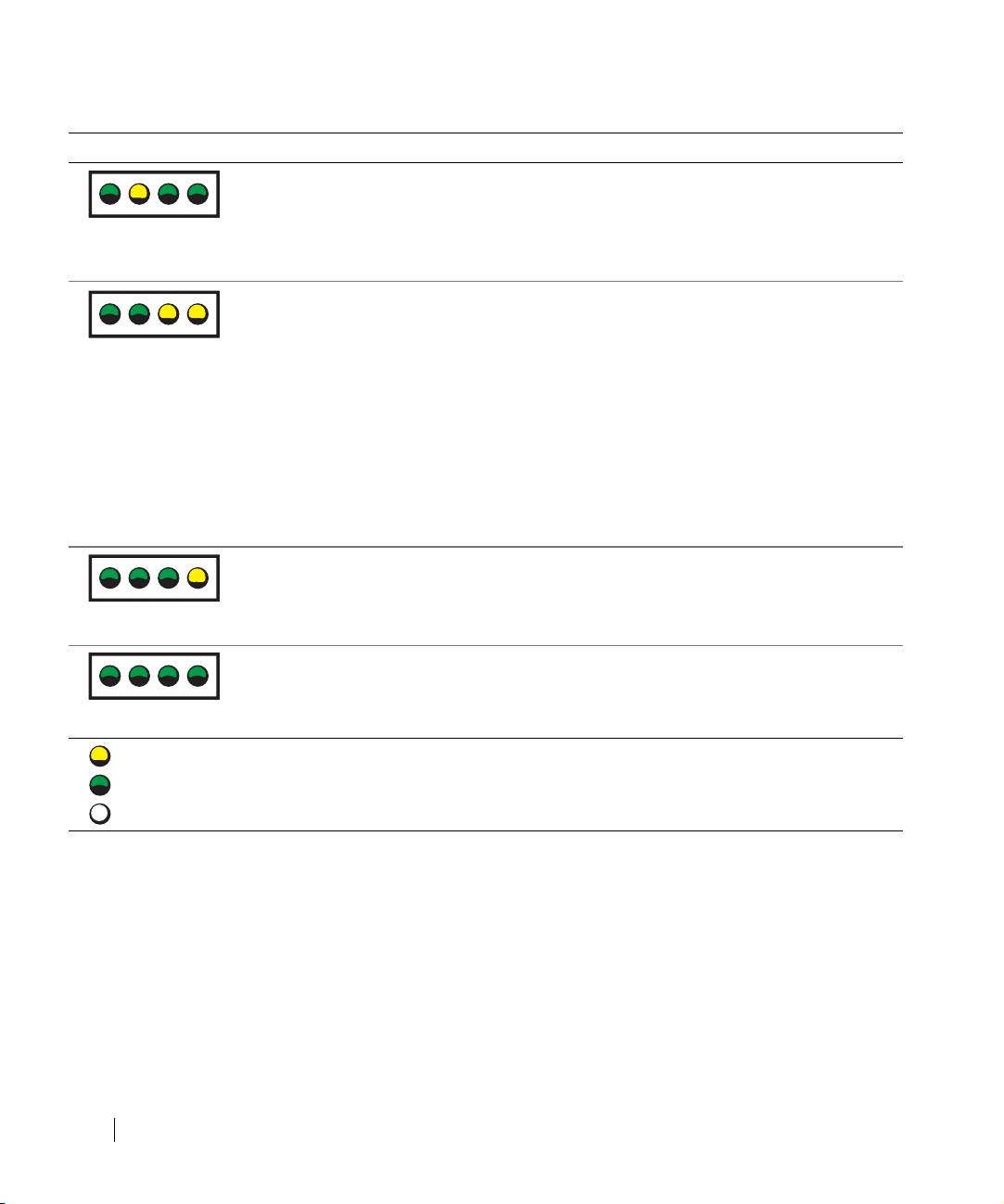
Light Pattern Problem Description Suggested Resolution
A possible system board resource and/or
Perform the procedure in “System Board
hardware failure has occurred.
Problems” and see “Resolving Software and
Hardware Incompatibilities” in your User’s
A B C D
Guide.
If the problem persists, contact Dell.
A possible expansion card failure has
1 Determine if a conflict exists by removing
occurred.
a card and then restarting the computer.
2 If the problem persists, reinstall the card
A B C D
that you removed, remove a different card,
and then restart the computer.
3 Repeat this process for each card. If the
www.dell.com | support.dell.com
computer starts normally, troubleshoot the
last card removed from the computer for
resource conflicts (see “Resolving Software
and Hardware Incompatibilities” in your
User’s Guide).
4 If the problem persists, contact Dell.
Other failure has occurred. Ensure that the cables are properly connected
from the hard drive, CD drive, and DVD drive
to the system board.
A B C D
If the problem persists, contact Dell.
The computer is in a normal operating
None.
condition after POST.
A B C D
= yellow
= green
= off
32 Setup and Quick Reference Guide

Frequently Asked Questions
How Do I... Solution Where to Find Additional
Information
Set up my computer to use
See “Monitor Connections”
two monitors?
on page 14 for instructions on
connecting two display monitors to
the provided graphics card.
Connect my monitor when the
If your graphics card has a DVI
Contact Dell Technical Support for more
monitor cable connector doesn’t
connector but your monitor has a
information.
seem to fit the connector on the
VGA connector, you need to use an
back of my computer?
adapter. An adapter should be
included in the box.
Connect my speakers? If you have a sound card installed,
See the documentation that came with
connect the speakers to the
your speakers for more information.
connectors on the card.
Find the right connectors for
Your Dell Precision 360 computer
See the front and back view graphics of
my USB devices?
has eight USB connectors (two on
your computer in your User’s Guide. To
the front and six on the back).
locate your User’s Guide, see “Finding
Information for Your Computer”
on page 5.
Locate information about the
Yo u r User’s Guide has a
Go to the Dell Support website and use
hardware and other technical
specifications table that provides
one of the following support tools: read
specifications for my computer?
more detailed information about
white papers on the latest technology or
your computer and the hardware.
communicate with other Dell users at the
To locate your User’s Guide, see
Dell forum chat room.
“Finding Information for Your
Computer” on page 5.
Find documentation for
The following documentation is
If you lose your documentation, it is
my computer?
available for your computer:
available on the Dell Support website
• User’s Guide
at support.dell.com.
• Setup and Quick Reference
Guide
• System Information Guide
• System Information Label
• Service Manual
To locate these documents,
see “Finding Information for Your
Computer” on page 5.
Setup and Quick Reference Guide 33

www.dell.com | support.dell.com
34 Setup and Quick Reference Guide

G0428bk0.book Page 35 Wednesday, March 5, 2003 5:27 PM
Dell Precision™ Workstation 360
Informator o systemie
i konfiguracji
Modele: DHM i WHM
www.dell.com | support.dell.com

G0428bk0.book Page 36 Wednesday, March 5, 2003 5:27 PM
Uwagi, przypomnienia i ostrzeżenia
WSKAZÓWKA: UWAGA oznacza ważną informację, pozwalającą lepiej wykorzystać
posiadany komputer.
UWAGA: PRZYPOMNIENIE informuje o sytuacjach, w których występuje ryzyko
uszkodzenia sprzętu lub utraty danych i przedstawia sposoby uniknięcia problemu.
OSTROŻNIE: Sekcja OSTROŻNIE informuje o sytuacjach, w których
występuje ryzyko uszkodzenia sprzętu, uszkodzenia ciała lub śmierci.
Skróty i skrótowce
Pełną listę skrótów i skrótowców można znaleźć w sekcji “Słowniczek”
w Przewodniku Użytkownika.
____________________
Informacje zawarte w tym dokumencie mogą ulec zmianie bez uprzedzenia.
© 2003 Dell Computer Corporation. Wszystkie prawa zastrzeżone.
Powielanie w jakikolwiek sposób bez pisemnego zezwolenia od firmy Dell Computer Corporation jest surowo
zabronione.
Znaki towarowe użyte w tekście: Dell, logo DELL oraz Dell Precision to znaki towarowe Dell Computer Corporation;
Microsoft, Windows, oraz Windows NT to zastrzeżone znaki towarowe Microsoft Corporation.
Tekst może zawierać także inne znaki towarowe i nazwy towarowe, odnoszące się do podmiotów posiadających prawa
do tych znaków i nazw lub do ich produktów. Firma Dell Computer Corporation nie rości sobie praw do jakichkolwiek
znaków towarowych i nazw towarowych, których nie jest prawnym właścicielem.
Modele: DHM i WHM
Luty 2003 P/N G0428 Rev. A00

G0428bk0.book Page 37 Wednesday, March 5, 2003 5:27 PM
Spis treści
Wyszukiwanie informacji na temat komputera . . . . . . . . 39
Instalacja komputera
. . . . . . . . . . . . . . . . . . . . . . . 43
Podłączanie monitora
. . . . . . . . . . . . . . . . . . . . . . 49
Ukończona instalacja
. . . . . . . . . . . . . . . . . . . . . . 51
Otwieranie pokrywy komputera
. . . . . . . . . . . . . . . . . 52
Wewnątrz komputera
. . . . . . . . . . . . . . . . . . . . . . 54
Rozwiązywanie problemów
. . . . . . . . . . . . . . . . . . . 56
Rozwiązywanie problemów dotyczących niezgodności
oprogramowania i sprzętu
. . . . . . . . . . . . . . . . . . 56
Korzystanie z funkcji przywracania systemu w Windows XP
58
Wykorzystanie ostatniej znanej dobrej konfiguracji
w Windows 2000
. . . . . . . . . . . . . . . . . . . . . . . 59
Kiedy używać programu Dell Diagnostics
. . . . . . . . . . 59
Uruchamianie programu Dell Diagnostics
. . . . . . . . . . 60
Kody dźwiękowe
. . . . . . . . . . . . . . . . . . . . . . . 63
Komunikaty o błędach
. . . . . . . . . . . . . . . . . . . . 64
Lampki systemowe
. . . . . . . . . . . . . . . . . . . . . . 64
Lampki diagnostyczne
. . . . . . . . . . . . . . . . . . . . 66
Często zadawane pytania
. . . . . . . . . . . . . . . . . . . . 70
Spis treści 37

G0428bk0.book Page 38 Wednesday, March 5, 2003 5:27 PM
38 Spis treści
G0428bk0.book Page 39 Wednesday, March 5, 2003 5:27 PM
Wyszukiwanie informacji na temat komputera
Firma Dell dostarcza następujące narzędzia źródłowe i wsparcia technicznego.
Dodatkowe źródła informacji mogą zostać dostarczone wraz z komputerem.
Wyszukiwane informacje Znajdziesz je tutaj
• Program diagnostyczny dla komputera
Dysk CD Drivers and Utilities
• Sterowniki dla komputera
(nazywany także dyskiem ResourceCD)
•Mój Przewodnik użytkownika
Dokumentacja i sterowniki są
• Dokumentacja urządzeń
zainstalowane przed dostawą komputera.
Tego dysku CD można użyć w celu
ponownego zainstalowania sterowników,
uruchamiania narzędzi diagnostycznych i
przeczytania dokumentacji.
Pliki readme mogą zostać umieszczone na
płycie CD, aby opisać najnowsze
aktualizacje techniczne wprowadzone do
komputera lub dostarczyć zaawansowany
materiał informacyjny dla doświadczonych
użytkowników oraz techników.
• Złącza płyty systemowej
Etykieta z informacjami o systemie
• Lokalizacja składników płyty systemowej
lub
Znajduje się na wewnętrznej stronie obudowy komputera.
Informator o systemie i konfiguracji 39
G0428bk0.book Page 40 Wednesday, March 5, 2003 5:27 PM
Wyszukiwane informacje Znajdziesz je tutaj
• Informacje dotyczące gwarancji
Podręcznik z informacjami o systemie
• Informacje na temat bezpieczeństwa
• Jak wyjmować i wymieniać podzespoły
Ikona przewodnika użytkownika
www.dell.com | support.dell.com
®
®
• Parametry techniczne
(Microsoft
Windows
2000)
• Jak konfigurować ustawienia systemowe
Kliknij dwukrotnie ikonę Przewodnik użytkownika
• Jak rozwiązywać problemy
na pulpicie.
Centrum pomocy i obsługi technicznej systemu Windows XP
1
Kliknij przycisk Start i kliknij polecenie Pomoc i obsługa
techniczna.
2 Kliknij Przewodnik użytkownika i systemu oraz kliknij
Przewodnik użytkownika.
• Kod ekspresowej obsługi i znacznik usługi
Kod ekspresowej obsługi i etykieta klucza produktu
• Etykieta licencji Windows
Te etykiety znajdują się na komputerze.
40 Informator o systemie i konfiguracji
