
Beurer BM 85: Notes on batteries Instructions for repairs and disposal Instructions for storage and maintenance
Notes on batteries Instructions for repairs and disposal Instructions for storage and maintenance: Beurer BM 85
Table of contents
- 1. Getting to know your instrument 2. Important notes Signs and symbols
- Notes on use
- Notes on batteries Instructions for repairs and disposal Instructions for storage and maintenance
- 3. Unit description
- Information on the display: USB interface System requirements for the Beurer “HealthManager” PC software.
- 4. Preparing for the measurement Press and hold the START/STOP button
- 5. Measuring blood pressure Attaching the cuff
- Performing the blood pressure measurement Adopting the correct posture
- 6. Evaluating results Cardiac arrhythmia: WHO classification:
- Resting indicator measurement (using HSD diagnostics) GREEN: haemodynamically stable RED: lack of haemodynamic stability
- 7. Displaying and deleting measurements
- Average values Individual measured values Deleting measured values
- 8. Transferring measurements Transfers using the USB interface
- 9. Cleaning and storing the unit 0. Error messages/trouble-shooting 11. Battery
- 12. Technical specifications
- Technical information is subject to change without notification 3. Mains part to allow for updates.
•
Avoid any mechanical restriction, compression or bending of
– Do not use the device in the vicinity of strong electromag-
the cuff line.
netic fields and keep it away from radio systems or mobile
•
Do not allow sustained pressure in the cuff or frequent meas-
telephones.
urements. The resulting restriction of the blood flow may
– Only use the cuff included with the delivery or original
cause injury.
replacement parts. Otherwise incorrect measurements will
•
Make sure that the cuff is not placed on an arm in which the
be recorded.
arteries or veins are undergoing medical treatment, e.g. in-
•
Do not press the buttons before the cuff is placed on the arm.
travascular access or intravascular or therapy, or an arterio-
Notes on batteries
venous (AV) shunt.
•
Do not use the cuff on people who have undergone a mas-
•
Swallowing batteries can be extremely dangerous. Keep the
tectomy.
batteries and products out of the reach of small children. If a
•
Do not place the cuff over wounds as this may cause further
battery has been swallowed, seek medical attention immedi-
injury.
ately.
•
Please note that data transfer and data storage is only pos-
•
Batteries must not be taken apart, thrown into an open fire or
sible when your blood pressure monitor is supplied with
short circuited.
power. As soon as the battery is empty, the blood pressure
monitor loses the date and time setting.
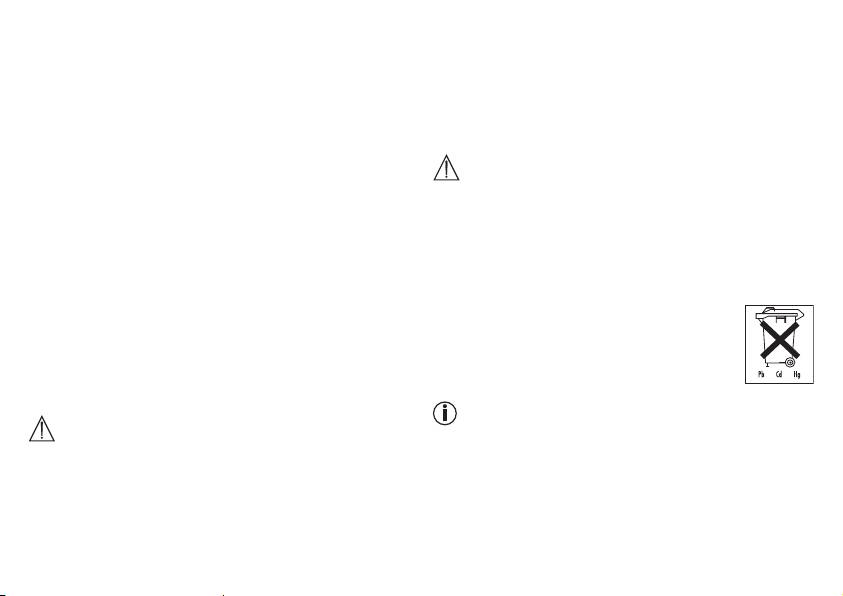
The codes below are printed on batteries
•
To conserve the battery, the blood pressure monitor switches
containing harmful substances:
off automatically if you do not press any buttons for 3 minutes.
Pb: battery contains lead,
•
The device is only intended for the purpose described in
Cd: battery contains cadmium,
these instructions for use. The manufacturer is not liable for
Hg: battery contains mercury.
damage resulting from improper or careless use.
Instructions for repairs and disposal
Instructions for storage and maintenance
•
Do not repair or adjust the device yourself. Proper operation
•
The blood pressure monitor is made from precision and elec-
can no longer be guaranteed in this case.
tronic components. The accuracy of the measurements and
•
Repairs must only be carried out by Customer Services or
service life of the device depend on its careful handling:
authorised suppliers.
– Protect the device from impacts, humidity, dirt, marked
•
Do not open the device, except during disposal. In this case,
temperature fluctuations and direct sunlight.
remove the installed battery. Failure to comply will invalidate
– Do not drop the device.
the warranty.
21
