Beurer BM 85: Information on the display: USB interface System requirements for the Beurer “HealthManager” PC software.
Information on the display: USB interface System requirements for the Beurer “HealthManager” PC software.: Beurer BM 85
Table of contents
- 1. Getting to know your instrument 2. Important notes Signs and symbols
- Notes on use
- Notes on batteries Instructions for repairs and disposal Instructions for storage and maintenance
- 3. Unit description
- Information on the display: USB interface System requirements for the Beurer “HealthManager” PC software.
- 4. Preparing for the measurement Press and hold the START/STOP button
- 5. Measuring blood pressure Attaching the cuff
- Performing the blood pressure measurement Adopting the correct posture
- 6. Evaluating results Cardiac arrhythmia: WHO classification:
- Resting indicator measurement (using HSD diagnostics) GREEN: haemodynamically stable RED: lack of haemodynamic stability
- 7. Displaying and deleting measurements
- Average values Individual measured values Deleting measured values
- 8. Transferring measurements Transfers using the USB interface
- 9. Cleaning and storing the unit 0. Error messages/trouble-shooting 11. Battery
- 12. Technical specifications
- Technical information is subject to change without notification 3. Mains part to allow for updates.
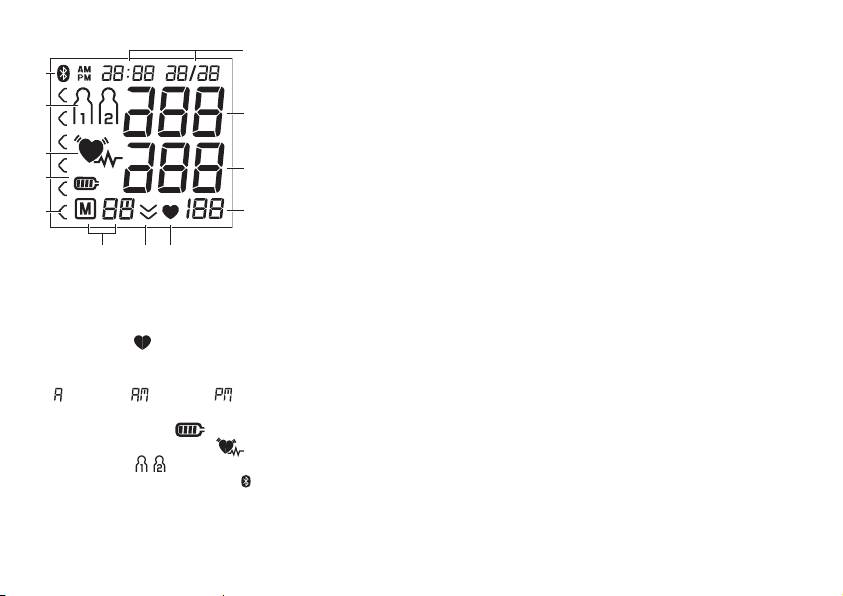
Information on the display:
USB interface
1
The blood pressure monitor also allows you to transfer your
12
measured values to the PC.
To do this you require a commercially available USB cable
11
(included in delivery) and the Beurer “HealthManager” PC
2
software.
The software can be downloaded free of charge from the
10
download area under Service at www.beurer.com.
3
9
System requirements for the Beurer “HealthManager” PC
software.
8
4
1. Supported operating systems:
• Windows XP SP3
567
• Windows Vista SP1 or later
1. Time/date
• Windows 7
2. Systolic pressure
• Windows 7 SP1
3. Diastolic pressure
• Windows 8
4. Calculated pulse value
2. Supported architectures:
5. Pulse symbol
• x86 (32 bit)
6. Release air (arrow)
• x64 (64 bit)
7. Number of memory space/memory display average value
3. Hardware requirements:
( ), morning ( ), evening ( )
• Recommended: at least Pentium 1 GHz or faster with at
8. WHO classification
least 1 GB RAM
9. Battery level symbol
• Free memory on the primary partition of at least:
10. Cardiac arrhythmia symbol
– x86 – 600 MB
11. User memory
– x64 – 1.5 GB
12. Symbol for Bluetooth® transfer
• Graphic resolution from: 1024 x 768 pixels
• USB port 1.0 or later
23