
Beurer BC 60: 3. Unit description Repair and disposal
3. Unit description Repair and disposal: Beurer BC 60
Table of contents
- 2. Important information Advice on use 1. Getting to know your instrument
- Storage and Care Advice on batteries
- 3. Unit description Repair and disposal
- 4. Getting started 5. Measuring blood pressure
- 5.2 Measuring blood pressure
- 5.3 Evaluating results WHO classification:
- 5.4 Resting indicator measurement (using HSD : lack of haemodynamic stability diagnostics) : haemodynamic stability
- 6. Calling up stored values 7. Cleaning and care 8. Rectifying faults
- 9. Specifications
length of time. This prevents any damage as a result of
3. Unit description
leakage. Always replace all the batteries at the same time.
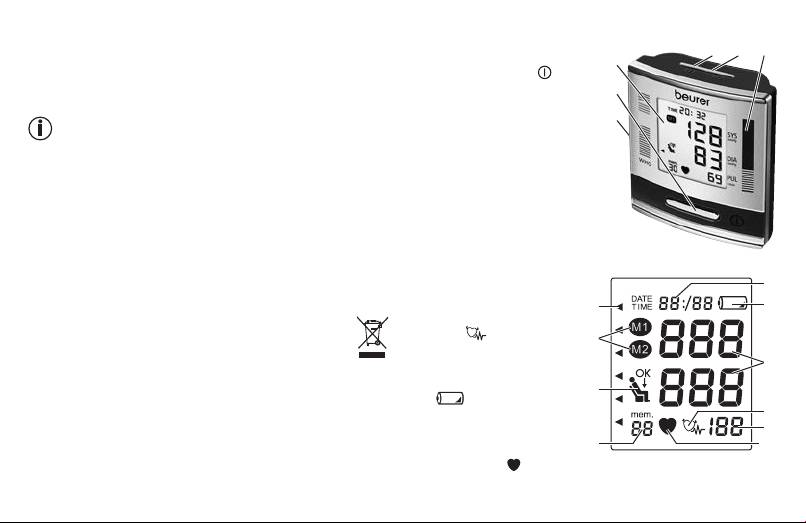
A Display
C D F
A
•
Never use different types of battery, battery brands or
B Start/stop button
batteries with different capacities. You should preferably
C Memory button M1
B
use alkaline batteries.
D Memory button M2
E Battery compartment
E
Repair and disposal
F Positioning display
•
Batteries do not belong in domestic refuse. Used batteries
(heart level)
should be disposed of at the collection points provided.
•
Never open the instrument. If these instructions are not
heeded, the warranty will be null and void.
•
Never attempt to repair the instrument or adjust it yourself.
We can no longer guarantee perfect functioning if you do.
•
Repairs may only be performed by Customer Service or
Icons in the display:
authorized dealers. However, always check the batteries
and replace them if necessary prior to making any
1 Memory (M1, M2)
5
complaint.
2 WHO classification
2
6
•
The appliance should be disposed of according to
3 Cardiac arrhythmia
Regulation 2002/96/EC-WEEE (Waste Electrical
icon
1
and Electronic Equipment). In case of queries,
4 Resting indicator
please contact the municipal authorities responsible for
5 Date and time
8
waste disposal in your area.
6 Low battery indicator
4
3
7 Pulse
7
8 Systole/diastole
9
10
9 Storage space
10 Pulse Mark
15
