
Dell Precision T3400 (Late 2007): Tab Function Troubleshooting
Tab Function Troubleshooting: Dell Precision T3400 (Late 2007)
Table of contents
- Notes, Notices, and Cautions
- Contents
- 4 Contents
- Finding Information What Are You Looking For? Find It Here
- What Are You Looking For? Find It Here
- What Are You Looking For? Find It Here
- What Are You Looking For? Find It Here
- What Are You Looking For? Find It Here
- What Are You Looking For? Find It Here
- About Your Computer Front View (Tower Orientation) 4 lower 3.5-inch drive bay
- 9 power button Press to turn on the computer.
- 14 network link light The network link light is on when a good connection
- Back View (Tower Orientation)
- Front View (Desktop Orientation) 4 hard drive activity light
- 7 power button Press to turn on the computer.
- 12 network link light The network link light is on when a good connection
- Back View (Desktop Orientation)
- Back Panel Connectors 1 mouse connector Plug a PS/2 mouse into the green mouse connector. Turn off
- 8 Rear Dual USB 2.0 connectors (2)
- 11 keyboard connector Setting Up Your Computer Changing Between Tower and Desktop Orientations
- Switching From Tower to Desktop Orientation Switching From Desktop to Tower Orientation Installing Your Computer in an Enclosure
- • Leave 10.2 cm (4 in) minimum clearance on all vented sides of the computer to permit the airflow required for proper ventilation.
- • Do not install your computer in an enclosure that does not allow airflow.
- Transferring Information to a New Computer Microsoft Windows XP
- Files and Settings Transfer Wizard (With the Operating System Media)
- Files and Settings Transfer Wizard (Without the Operating System Media)
- TRANSFER DATA TO THE DESTINATION COMPUTER: Power Protection Devices
- Surge Protectors Line Conditioners Uninterruptible Power Supplies (UPS)
- Cleaning Your Computer Computer, Keyboard, and Monitor Mouse (Non-Optical)
- Floppy Drive CDs and DVDs Troubleshooting Tools Power Lights
- • Eliminate interference. Some possible causes of interference are:
- Diagnostic Lights Diagnostic Light Codes During POST Light Pattern Problem Description Suggested Resolution
- Light Pattern Problem Description Suggested Resolution
- Light Pattern Problem Description Suggested Resolution
- Light Pattern Problem Description Suggested Resolution
- Light Pattern Problem Description Suggested Resolution Beep Codes Code Cause
- Code Description Suggested Remedy
- Code Description Suggested Remedy System Messages
- NOT A BOOT DISKETTE —Insert a bootable floppy disk and restart your computer.
- Hardware Troubleshooter Dell Diagnostics When to Use the Dell Diagnostics
- Starting the Dell Diagnostics From Your Hard Drive
- Starting the Dell Diagnostics From the Drivers and Utilities Disc
- Dell Diagnostics Main Menu Option Function
- Tab Function Troubleshooting
- Battery Problems Drive Problems
- Optical drive problems Problems writing to an optical drive Hard drive problems
- E-Mail, Modem, and Internet Problems RUN THE MODEM DIAGNOSTIC TOOL — VERIFY THAT THE MODEM IS COMMUNICATING WITH WINDOWS —
- Error Messages
- IEEE 1394 Device Problems
- Keyboard Problems Lockups and Software Problems The computer does not start up The computer stops responding
- A program stops responding A program crashes repeatedly A program is designed for an earlier Windows operating system A solid blue screen appears
- Other software problems Memory Problems F YOU RECEIVE AN INSUFFICIENT MEMORY MESSAGE — IF YOU EXPERIENCE OTHER MEMORY PROBLEMS —
- Mouse Problems RESTART THE COMPUTER — TEST THE MOUSE — Connect a properly working mouse to the computer, then try C HECK THE MOUSE SETTINGS — REINSTALL THE MOUSE DRIVER — See "Drivers" in your User’s Guide. R UN THE HARDWARE TROUBLESHOOTER — See "Hardware Troubleshooter" on
- Network Problems Power Problems
- Printer Problems
- Scanner Problems
- Sound and Speaker Problems
- Video and Monitor Problems The screen is blank
- The screen is difficult to read 3D image quality is poor Only part of the screen is readable
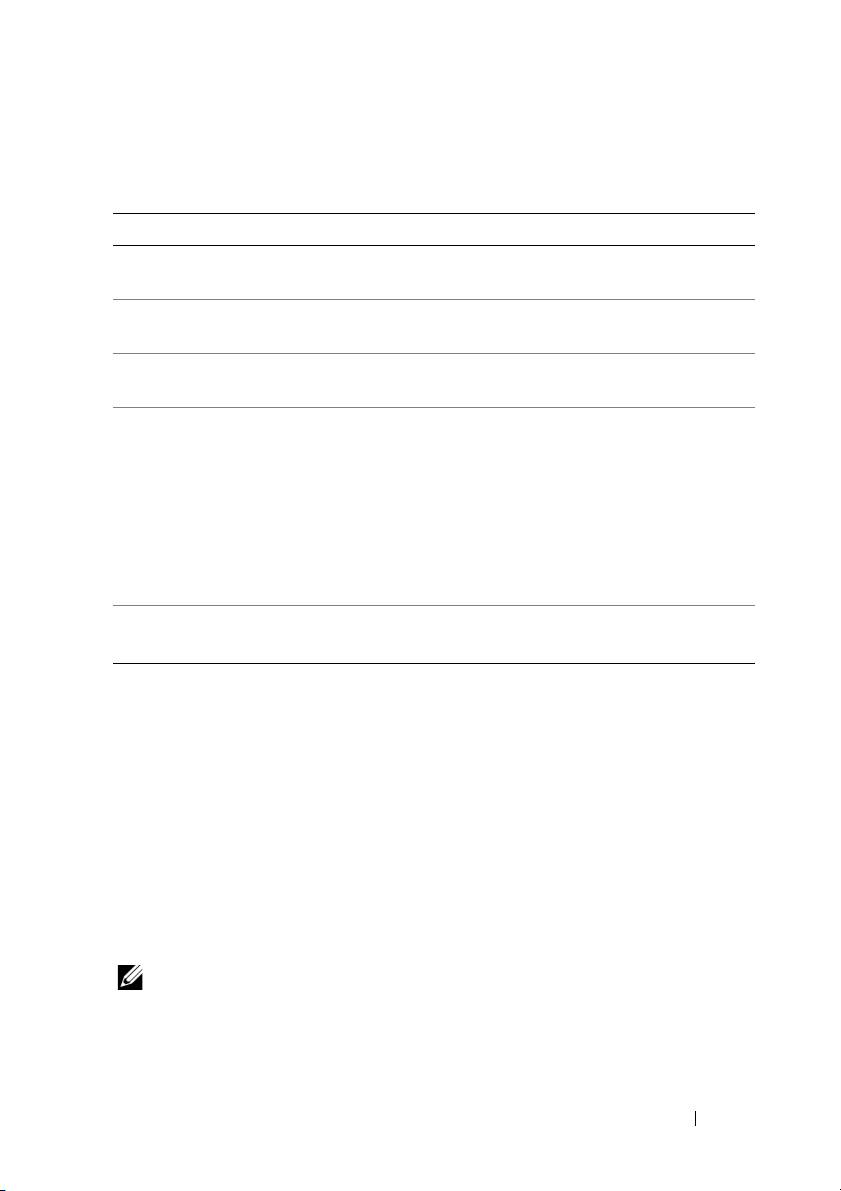
The following tabs provide additional information for tests run from the
Custom Test or Symptom Tree option:
Tab Function
Results Displays the results of the test and any error conditions
encountered.
Errors Displays error conditions encountered, error codes, and the
problem description.
Help Describes the test and any requirements for running the
test.
Configuration
Displays the hardware configuration for the selected device.
(Custom Test only)
The Dell Diagnostics obtains configuration information for
all devices from System Setup, memory, and various
internal tests, and it displays the information in the device
list in the left pane of the screen.
NOTE: The device list may not display the names of all the
components installed on your computer or all devices
attached to your computer.
Parameters
Allows you to customize the test, if applicable, by changing
the test settings.
(Custom Test only)
Troubleshooting
Follow these tips when you troubleshoot your computer:
• If you added or removed a part before the problem started, review the
installation procedures and ensure that the part is correctly installed.
• If a peripheral device does not work, ensure that the device is properly
connected.
• If an error message appears on the screen, write down the exact message.
This message may help support personnel diagnose and fix the problem(s).
• If an error message occurs in a program, see the program’s documentation.
NOTE: The procedures in this document were written for the Windows default
view, and may not apply if you set your Dell computer to the Windows Classic view.
Quick Reference Guide 45
