
Dell Precision 470: Beep Codes Code Cause Code Cause
Beep Codes Code Cause Code Cause: Dell Precision 470
Table of contents
- Notes, Notices, and Cautions Abbreviations and Acronyms
- Contents
- Finding Information What Are You Looking For? Find It Here
- What Are You Looking For? Find It Here
- What Are You Looking For? Find It Here
- What Are You Looking For? Find It Here
- Setting Up Your Dell Precision 670 Computer Connect the keyboard and the mouse. Connect the modem or the network cable.
- Connect the monitor.
- For single- and dual-monitor capable cards with a single connector
- For dual-monitor capable cards with one DVI and one VGA connector For dual-monitor capable cards with two DVI connectors
- Connect the speakers. Connect the power cables and turn on the computer and monitor.
- Install additional software or devices. To access the User’s Guide from your hard drive: To access your User’s Guide from the Dell Support website:
- Setting Up Your Dell Precision 470 Computer Connect the keyboard and the mouse. Connect the modem or the network cable.
- Connect the monitor.
- Connect the speakers. Connect the power cables and turn on the computer and monitor.
- To access the User’s Guide from your hard drive: To access your User’s Guide from the Dell Support website: Opening the Computer Cover
- Dell Precision 670 Computer
- Inside the Dell Precision 670 Computer
- Dell Precision 470 Computer Inside the Dell Precision 470 Computer
- Caring for Your Computer Solving Problems Resolving Software and Hardware Incompatibilities Microsoft Windows
- Windows 2000 Using System Restore in Windows XP
- Creating a Restore Point Restoring the Computer to an Earlier Operating State Using Last Known Good Configuration
- Other Options to Help Resolve Additional Device or Software Conflicts When to Use the Dell Diagnostics Before You Start Testing
- Running the Dell Diagnostics
- System Lights Power Light Hard-Drive Light Cause Corrective Action
- Beep Codes Code Cause Code Cause
- Error Messages Diagnostic Lights
- Diagnostic Light Codes Before POST Light Pattern Problem Description Suggested Resolution
- Light Pattern Problem Description Suggested Resolution Diagnostic Light Codes During POST Light Pattern Problem Description Suggested Resolution
- Light Pattern Problem Description Suggested Resolution
- Light Pattern Problem Description Suggested Resolution
- Light Pattern Problem Description Suggested Resolution
- Light Pattern Problem Description Suggested Resolution
- Light Pattern Problem Description Suggested Resolution Memory Overview
- Frequently Asked Questions How Do I... Solution Where to Find Additional Information
- How Do I... Solution Where to Find Additional Information
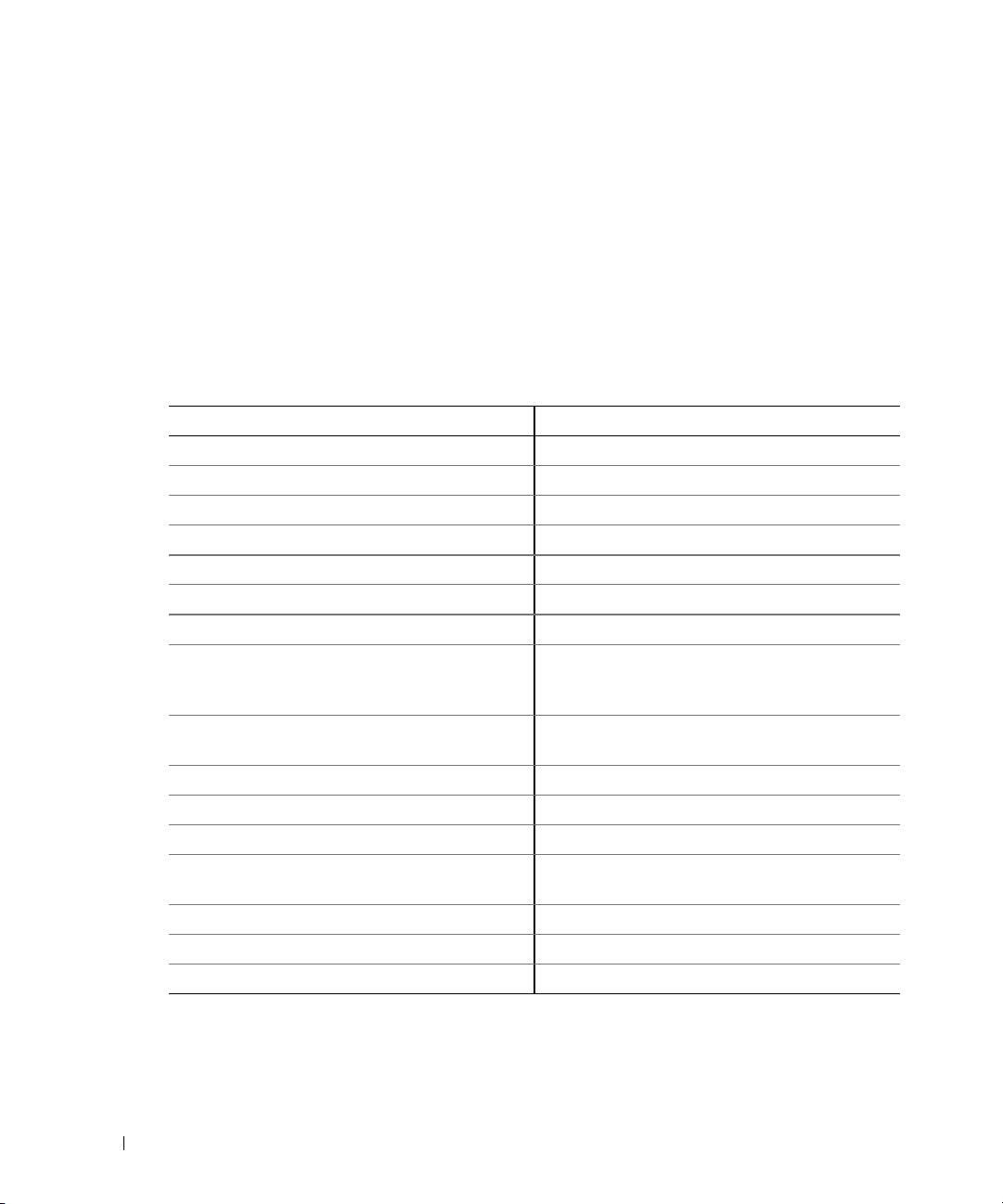
Beep Codes
Your computer might emit a series of beeps during start-up if the monitor cannot display errors or
problems. This series of beeps, called a beep code, identifies a problem. One possible beep code
(code 1-3-1) consists of one beep, a burst of three beeps, and then one beep. This beep code tells
you that the computer encountered a memory problem.
If your computer beeps during start-up:
1
Write down the beep code on the Diagnostic Checklist (see your
User’s Guide
).
2
Run the Dell Diagnostics to identify a more serious cause.
3
Contact Dell for technical assistance.
www.dell.com | support.dell.com
Code Cause Code Cause
1-1-2 Microprocessor register failure 3-3-4 Video Memory Test failure
1-1-3 NVRAM read/write failure 3-4-1 Screen initialization failure
1-1-4 ROM BIOS checksum failure 3-4-2 Screen retrace failure
1-2-1 Programmable interval timer failure 3-4-3 Search for video ROM failure
1-2-2 DMA initialization failure 4-2-1 No timer tick
1-2-3 DMA page register read/write failure 4-2-2 Shutdown failure
1-3 Video Memory Test failure 4-2-3 Gate A20 failure
1-3-1
Memory not being properly identified
4-2-4 Unexpected interrupt in protected
through
or used
mode
2-4-4
3-1-1 Slave DMA register failure 4-3-1 Memory failure above address
0FFFFh
3-1-2 Master DMA register failure 4-3-3 Timer-chip counter 2 failure
3-1-3 Master interrupt mask register failure 4-3-4 Time-of-day clock stopped
3-1-4 Slave interrupt mask register failure 4-4-1 Serial or parallel port test failure
3-2-2 Interrupt vector loading failure 4-4-2 Failure to decompress code to
shadowed memory
3-2-4 Keyboard Controller Test failure 4-4-3 Math-coprocessor test failure
3-3-1 NVRAM power loss 4-4-4 Cache test failure
3-3-2 Invalid NVRAM configuration 4-3-4 Time-of-day clock stopped
28 Quick Reference Guide
