
Beurer GS 42: 10 Evaluation of results Body mass index (BMI) 11 Replacing batteries 12 Storage and maintenance
10 Evaluation of results Body mass index (BMI) 11 Replacing batteries 12 Storage and maintenance: Beurer GS 42
Table of contents
- 1 Getting to know your instrument Function of the unit 2 Signs and symbols 3 Safety notes Safety notes
- Notes on handling batteries General notes 4 Unit description Overview
- 5 Initial use Inserting the batteries (3 x 1,5 V AAA Micro) Changing the weight unit Setting up the scale 6 Information The measuring principle General tips 7 Switch on the scale 8 Settings Set time and date
- Setting user data 9 Operation Weighing yourself and calculating BMI
- Accessing saved measurements
- 10 Evaluation of results Body mass index (BMI) 11 Replacing batteries 12 Storage and maintenance
- 13 Disposal 14 What if there are problems?
- No measurement possible Incorrect weight measurement
10 Evaluation of results
Body mass index (BMI)
The body mass index (BMI) is a number that is often called upon to evaluate body weight. The
number is calculated from body weight and height, the formula is – body mass index = body
weight : height². The measurement unit for BMI is [kg/m²]. According to the BMI, weight is
classied for adults (20 years and over) using the following values (source: WHO):
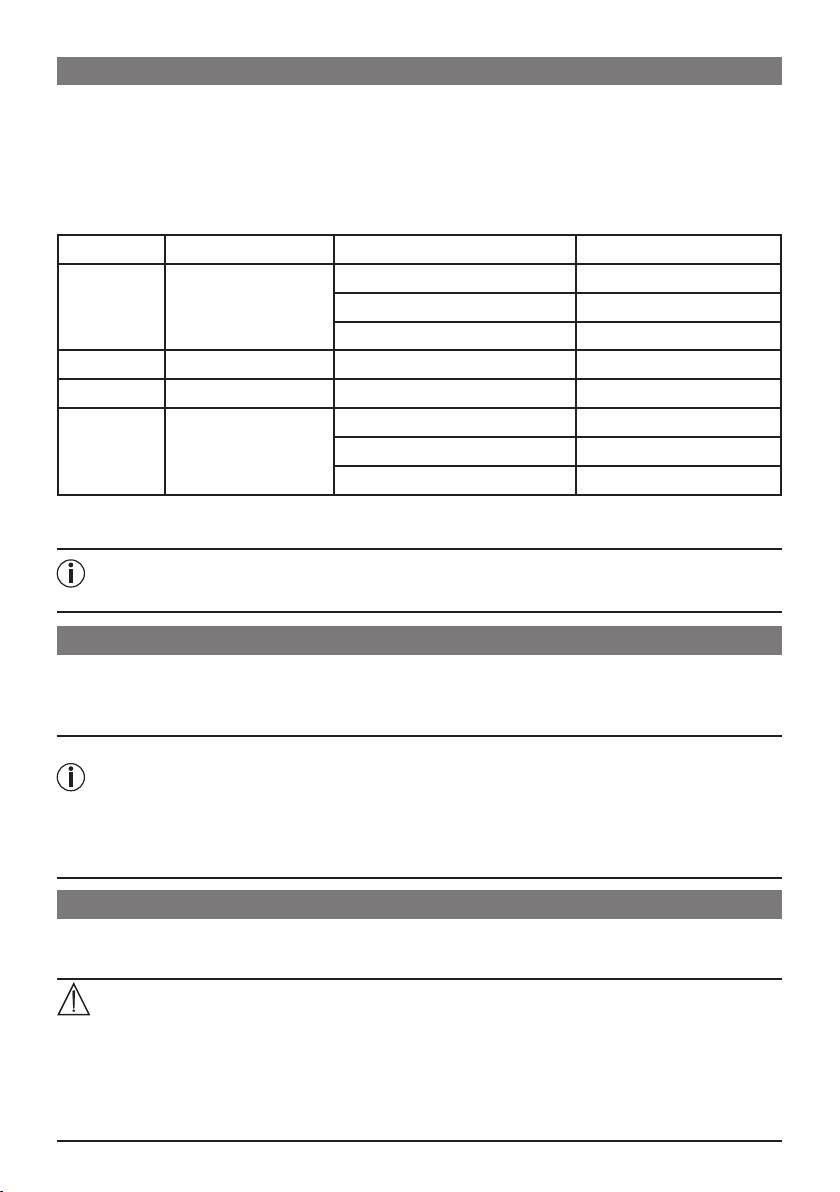
Display Category BMI
Pink Underweight Severely underweight < 16
Moderately underweight 16-16,9
Slightly underweight 17-18,4
Green Normal weight 18,5-25
Yellow Overweight Pre-obese 25,1-29,9
Red Obese (overweight) Class I obese 30-34,9
Class II obese 35-39,9
Class III obese ≥ 40
Results in relation to time
Remember that only long-term trends are important. Short-term fluctuations in
weight over a few days are usually the result of a loss of fluid.
11 Replacing batteries
The batteries in the scale must be replaced if the message “Lo” appears in the display. If the
batteries are too at, then the scale will switch o automatically.
Note:
• When changing batteries, always use batteries of the same type, brand and capacity.
Always replace all batteries simultaneously.
• Do not use rechargeable batteries.
• Use batteries that are free of heavy metals.
12 Storage and maintenance
The precision of the measurements and service life of the device depends on its careful handling:
Important:
• The unit should be cleaned occasionally. Use a slightly damp cloth to clean the device. You
may also use a small quantity of cleaning agent if desired. Do not use abrasive detergents
and never immerse the unit in water.
• Protect the scale from knocks, damp, dust, chemicals, drastic changes in temperature,
electromagnetic elds and nearby sources of heat (ovens, heaters). Do not press the
buttons violently or with pointed objects.
16
