Beurer BM70: Advice on use
Advice on use: Beurer BM70
Table of contents
- 2. Important information Signs and symbols 1. Getting to know your instrument
- Advice on use
- Storage and Care Repair and disposal Advice on batteries
- 3. Unit description Icons in the display: 4. Prepare measurement Inserting battery
- PC interface System requirements for the Beurer “Health Manager” Setting date and time computer software Mains operation
- . Measuring blood pressure 5.2 Correct posture 5.1 Positioning cuff 5.3 Select memory 5.4 Measuring blood pressure
- WHO classification: 5.5 Evaluating results Cardiac arrhythmia:
- Table for classification of blood pressure values (unit of measurement mmHg) for adults: : Haemodynamic stability 5.6 Resting indicator measurement (using HSD diagnostics) : Lack of haemodynamic stability
- 7. Cleaning and storing the instrument 8. Rectifying faults 6. Saving, retrieving and deleting results
- 9. Specifications
- 10. Adapter
•
Do not use the blood pressure monitor on newborns, preg-
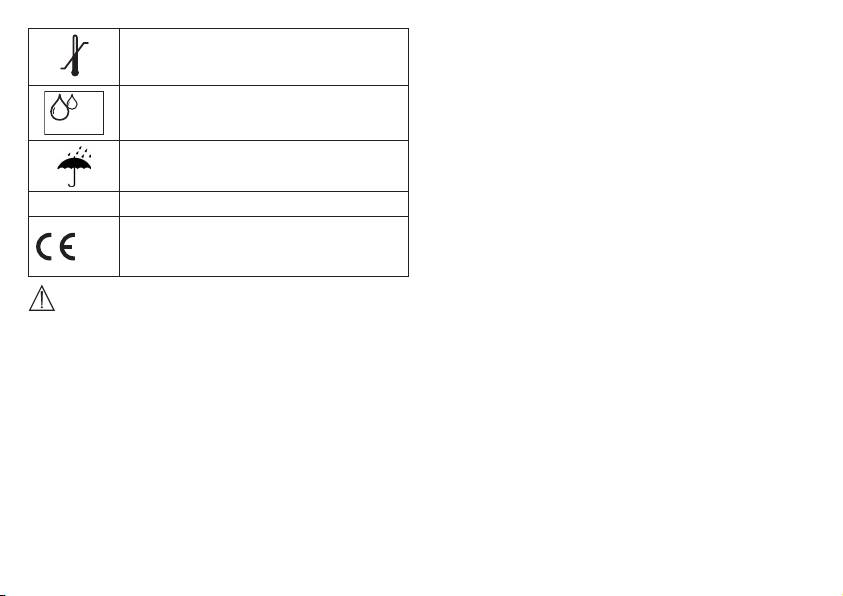
60°C
Temperature limitation
nant women or patients with preeclampsia.
-10°C
•
Cardiovascular diseases may lead to incorrect measure-
ments or have a detrimental effect on measurement accu-
Permissible storage humidity
racy. The same also applies to very low blood pressure, dia-
betes, circulatory disorders and arrhythmias as well as chills
RH 10-90%
or shaking.
Keep dry
•
The blood pressure monitor must not be used in connection
with a high-frequency surgical unit.
•
Only use the device on people who have the specified upper
SN Serial number
arm measurement for the device.
•
Please note that when inflating, the functions of the limb in
The CE labelling certifies that the product
question may be impaired.
complies with the essential requirements of
0483
•
During the blood pressure measurement, blood circulation
Directive 93/42/EEC on medical products.
must not be stopped for an unnecessarily long time. If the
device malfunctions, remove the cuff from the arm.
Advice on use
•
Avoid any mechanical restriction, compression or bending of
•
In order to ensure comparable values, always measure your
the cuff line.
blood pressure at the same time of day.
•
Do not allow sustained pressure in the cuff or frequent meas-
•
Before every measurement, relax for about five minutes.
urements. The resulting restriction of the blood flow may
•
If you want to perform several measurements on the same
cause injury.
person, wait five minutes between each measurement.
•
Ensure that the cuff is not placed on an arm in which the
•
Do not take a measurement within 30 minutes after eating,
arteries or veins are undergoing medical treatment, e.g. intra-
drinking, smoking or exercising.
vascular access or therapy, or an arteriovenous (AV) shunt.
•
Repeat the measurement if you are unsure of the measured
•
Do not use the cuff on people who have undergone a mas-
value.
tectomy.
•
The measurements taken by you are for your information
•
Do not place the cuff over wounds as this may cause further
only – they are not a substitute for a medical examination!
injury.
Discuss the measurements with your doctor, and never base
•
You can either use the blood pressure monitor with batteries
any medical decisions on them (e.g. medicines and their
or with a mains part. Please note that data transfer and data
administration)!
storage is only possible when your blood pressure monitor is
15