Beurer BM 90: Performing the blood pressure measurement 7. Evaluating results Cardiac arrhythmia:
Performing the blood pressure measurement 7. Evaluating results Cardiac arrhythmia:: Beurer BM 90
Table of contents
- 1. Getting to know your instrument 2. Included in delivery
- 3. Important notes Signs and symbols Instructions for application
- Instructions for storage and maintenance Notes on batteries Instructions for repairs and disposal
- 4. Unit description
- Information on the display 5. Preparing the measurement
- Replacing the batteries Setting the date and time
- Operating the blood pressure monitor with a mains part 6. Measuring blood pressure Attach the cuff Adopt the correct posture
- Performing the blood pressure measurement 7. Evaluating results Cardiac arrhythmia:
- Table for the classification of blood pressure values (measurement unit, mmHg) for adults: 8. Saving, displaying and deleting measurements on the device Saving measurements Displaying measurements Deleting measured values from the device 9. Error message/troubleshooting
- 10. Cleaning and storing the unit 11. Technical specifications
- Mains part for wireless box Mains part for blood pressure monitor
•
To carry out a blood pressure measurement, make sure you are sitting comfortably, with your arms and back
leaning on something. Do not cross your legs. Place your feet flat on the ground.
•
To avoid falsifying the measurement, it is important to remain still during the measurement and not to speak!
Performing the blood pressure measurement
•
As described before, attach the cuff and adopt the posture in which you want to perform the measurement.
•
Start the blood pressure monitor with the START/STOP button. • After the self test, during which all display el-
ements are displayed, measurement begins. The cuff pumps itself up automatically. The measurement is taken
during the pump operation.
Measuring can be cancelled at any time by pressing the START/STOP button.
•
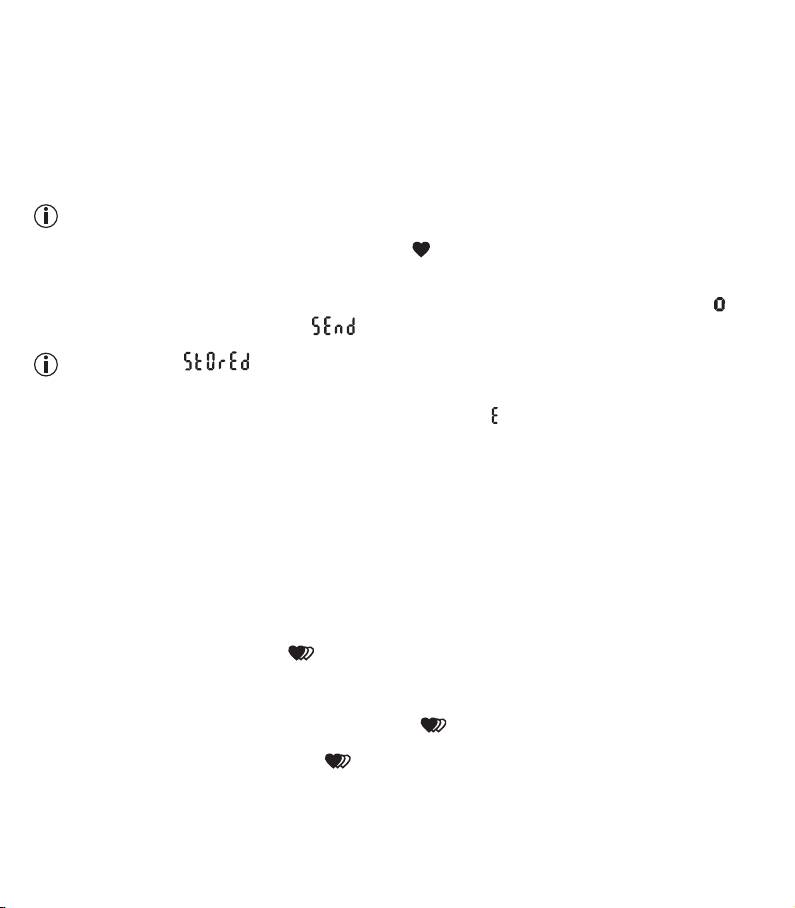
As soon as a pulse is detected, the pulse symbol flashes .
•
When the measurement has been taken, the pressure dissipates very quickly. The pulse, the systolic blood
pressure and diastolic blood pressure are shown on the display.
•
The measurements are automatically transferred to your profile. This is shown on the display by a rolling .
•
The successful transfer is signalled when is shown on the display.
If the transfer fails, is shown on the display. In this event, the measurements are stored on the
blood pressure monitor and will be transferred once the server connection is re-established.
• If the blood pressure measurement has not been performed properly, appears on the display. Observe the
chapter on error messages/troubleshooting in these instructions for use and repeat the measurement.
• In addition to the transfer of the measurements to your Beurer Connect profile, the device has 60 memory
spaces available. The measurement is automatically stored.
• To switch off the device, press the START/STOP button. If you forget to turn off the device, it will switch off
automatically after approx. 1 minute.
Wait at least 5 minutes before taking another measurement!
7. Evaluating results
Cardiac arrhythmia:
This unit can identify potential disruption of the heart rhythm when measuring and if necessary, indicates this
after the measurement with the symbol . This can be an indicator for arrhythmia. Arrhythmia is an illness in
which the heart rhythm is abnormal because of flaws in the bioelectrical system that regulates the heartbeat. The
symptoms (skipped or premature heart beats, pulse being slow or too fast) can be caused by factors such as
heart disease, age, physical make-up, excess stimulants, stress or lack of sleep. Arrhythmia can only be deter-
mined through an examination by your doctor. If the symbol is shown on the display after the measurement
has been taken, it should be repeated. Please ensure that you rest for 5 minutes beforehand and do not speak or
move during the measurement. If the symbol appears frequently, please consult your doctor. Self-diagnosis
and treatment based on the measurements can be dangerous. Always follow your GP‘s instructions.
21