Beurer BM 44: ENGLISH
ENGLISH: Beurer BM 44
ENGLISH
Dear Customer,
2. Important information
Thank you for choosing one of our products. Our name
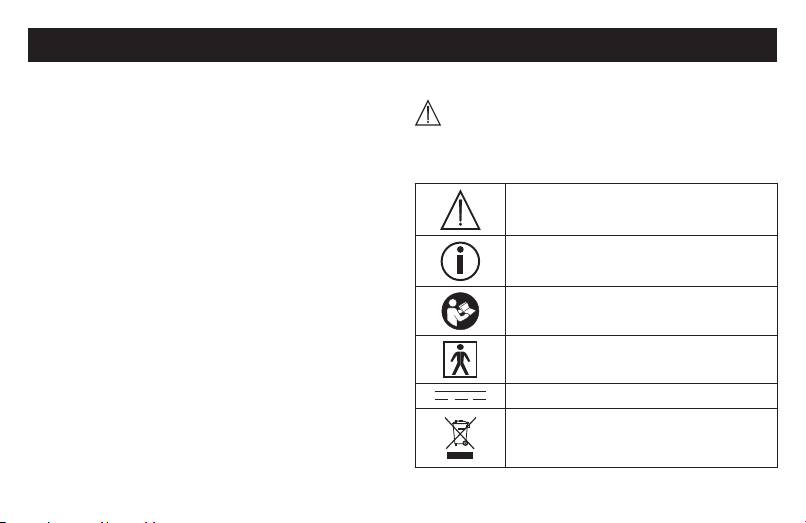
Signs and symbols
stands for high-quality, thoroughly tested products for the
applications in the areas of heat, weight, blood pressure,
The following symbols are used in these instructions for
body temperature, pulse, gentle therapy, massage and air.
use, on the packaging and on the type plate for the device
Please read these instructions for use carefully and keep
and accessories:
them for later use, be sure to make them accessible to other
Caution
users and observe the information they contain.
Best regards,
Your Beurer Team
Note
Note on important information
1. Getting to know your instrument
The upper arm blood pressure monitor is used for non-
Follow instructions for use
invasive measurement and monitoring of adults‘ arterial
blood pressure.
This allows you to quickly and easily measure your blood
Type BF applied part
pressure and to display the last recorded measurement.
A warning is issued for anyone suffering from cardiac ar-
rhythmia.
Direct current
The values determined are classified and graphically evalu-
Disposal in accordance with EC Directive
ated according to WHO guidelines.
2002/96/EC – WEEE (Waste Electrical and
Electronic Equipment).
14
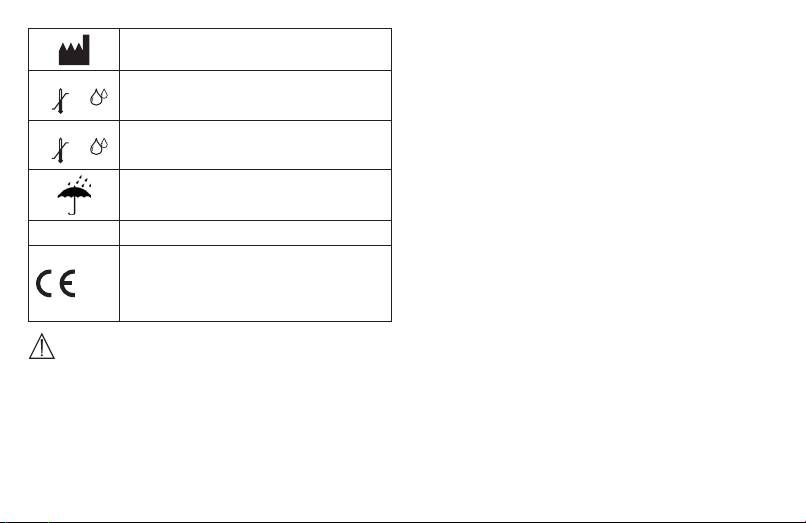
Manufacturer
15
Storage
Permissible storage temperature and hu-
55°C
midity
-20°C
RH ≤90%
Operating
•
Repeat the measurement if you are unsure of the meas-
ured value.
•
The measurements taken by you are for your information
only – they are not a substitute for a medical examination!
Discuss the measurements with your doctor, and never
base any medical decisions on them (e.g. medicines and
Permissible operating temperature and
40°C
their administration)!
humidity
10°C
•
Do not use the blood pressure monitor on newborns,
RH ≤90%
pregnant women or patients with preeclampsia.
Keep dry
•
Cardiovascular diseases may lead to incorrect measure-
ments or have a detrimental effect on measurement ac-
curacy. The same also applies to very low blood pressure,
SN Serial number
diabetes, circulatory disorders and arrhythmias as well as
The CE labelling certifies that the product
chills or shaking.
complies with the essential requirements
•
The blood pressure monitor must not be used in connec-
0483
of Directive 93/42/EEC on medical prod-
tion with a high-frequency surgical unit.
ucts.
•
Only use the device on people who have the specified up-
per arm measurement for the device.
•
Please note that when inflating, the functions of the limb
Advice on use
in question may be impaired.
•
In order to ensure comparable values, always measure
•
During the blood pressure measurement, blood circulation
your blood pressure at the same time of day.
must not be stopped for an unnecessarily long time. If the
•
Before every measurement, relax for about five minutes.
device malfunctions, remove the cuff from the arm.
•
If you want to perform several measurements on the same
•
Avoid any mechanical restriction, compression or bending
person, wait five minutes between each measurement.
of the cuff line.
•
Do not take a measurement within 30 minutes after eating,
drinking, smoking or exercising.

•
Do not allow sustained pressure in the cuff or frequent
Storage and Care
measurements. The resulting restriction of the blood flow
may cause injury.
•
The blood pressure monitor is made up of precision elec-
•
Ensure that the cuff is not placed on an arm in which the
tronic components. Accuracy of readings and the instru-
arteries or veins are undergoing medical treatment, e.g.
ment’s service life depend on careful handling.
intravascular access or therapy, or an arteriovenous (AV)
– You should protect the device from impact, moisture,
shunt.
dirt, major temperature fluctuations and direct exposure
•
Do not use the cuff on people who have undergone a
to the sun’s rays.
mastectomy.
– Never drop the device.
•
Do not place the cuff over wounds as this may cause fur-
– Do not use near strong electromagnetic fields, i.e. keep
ther injury.
it away from any radio systems and mobile phones.
•
You can either use the blood pressure monitor with batter-
•
Do not press the start/stop button before the cuff is
ies or with a mains part. Please note that data transfer and
placed on.
data storage is only possible when your blood pressure
•
We advise you to remove the batteries if the device is not
monitor is supplied with power. As soon as the batter-
going to be used for a longer period of time.
ies are empty or the mains part is disconnected from the
Advice on batteries
power supply, the blood pressure monitor loses the date
and time.
•
Batteries can be fatal if swallowed. You should therefore
•
To conserve the batteries, the monitor switches off auto-
store the batteries and products where they are inaccessi-
matically if no buttons are pressed for one minute.
ble to small children. If a battery has been swallowed, call
•
The device is only intended for the purpose described in
a doctor immediately.
these instructions for use. The manufacturer is not liable
•
Batteries should not be charged or reactivated with any
for damage resulting from improper or careless use.
other means, nor should they be taken apart, thrown in
the fire or short-circuited.
•
Remove the batteries from the instrument if they are worn
out or if you are not going to use the instrument for any
16
length of time. This prevents any damage as a result of
3. Unit description / Icons in the display
leakage. Always replace all the batteries at the same time.
1
•
Never use different types of battery, battery brands or bat-
3
teries with different capacities. You should preferably use
2
alkaline batteries.
Repair and disposal
•
Batteries do not belong in domestic refuse. Used batteries
should be disposed of at the collection points provided.
•
Never open the instrument. If these instructions are not
heeded, the warranty will be null and void.
•
Never attempt to repair the instrument or adjust it your-
self. We can no longer guarantee perfect functioning if you
do.
•
Repairs may only be performed by Customer Service or
authorized dealers. However, always check the batteries
and replace them if necessary prior to making any com-
plaint.
•
The appliance should be disposed of according to
Regulation 2002/96/EC-WEEE (Waste Electrical
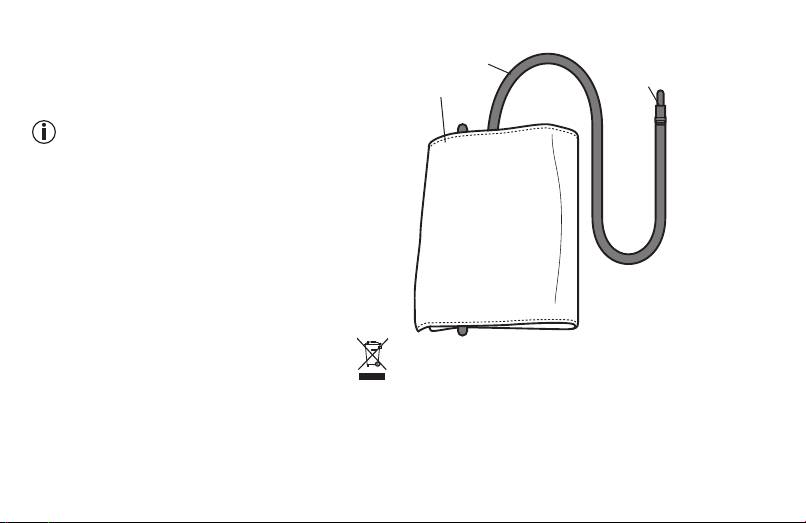
1. Cuff tube
and Electronic Equipment). In case of queries,
2. Cuff
please contact the municipal authorities responsible for
3. Cuff connector
waste disposal in your area.
17
4. Prepare measurement
WHO
Inserting battery
12
1
•
Remove the battery cover
SYS
11
mmHg
from the back of the moni-
tor.
10
2
•
Insert four AA 1.5 V alkaline
DIA
9
mmHg
batteries. making absolutely
PUL
sure that you insert them
/min
3
with the correct polarity
8
as marked. Never use re-
4
chargeable batteries.
7
•
Replace the battery cover carefully.
5
6
If the battery change
is continuously illuminated, meas-
urement is no longer possible and you must replace all the
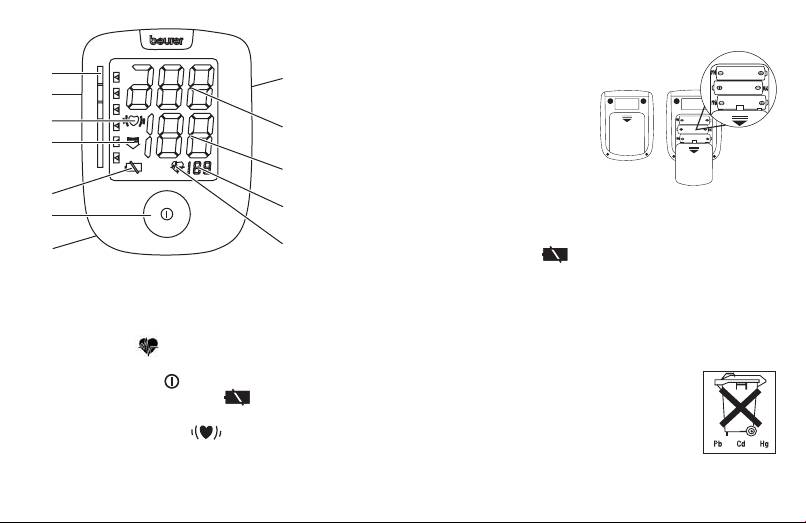
1. Mains part port
batteries.
2. Systolic pressure
Used batteries do not belong in the household waste. You
3. Diastolic pressure
are legally obliged to dispose of the batteries. Dispose of
4. Pulse
them via your specialist electrical supplier or local collec ting
5. Pulse symbol
point for recyclable waste.
6. Battery compartment
Note: Batteries containing pollutant
7. Start-/stop-button
substances are marked as follows:
8. Battery replacement symbol
Pb = Battery contains lead, Cd = Battery
9. Deflate arrow
contains cadmium, Hg = Battery contains
10. Arrhythmia recognition
mercury.
11. Cuff connector port
12. WHO classification indication
18
Operation with the mains part
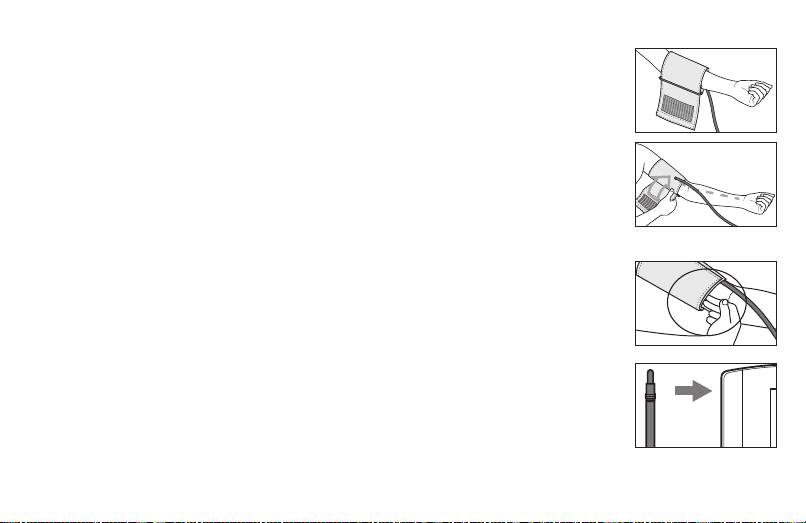
Positioning cuff
You can also operate this device with a mains part.
Fit the cuff round your bare left
When doing so, there must not be any batteries in the bat-
upper arm. Blood circulation in the
tery compartment. The mains part can be obtained from
arm should not be restricted by
specialist retailers or from the service address using order
tight clothing or other objects.
number 071.19.
•
To prevent possible damage to the device, the blood
The cuff should be placed on the
pressure monitor must only be used with the mains part
upper arm so that the lower edge is
described here.
2 to 3 cm above the bend of the
•
Insert the mains part into the connection provided for this
elbow and above the artery. The
purpose on the right-hand side of the blood pressure mo-
tube should be in line with the
nitor. The mains part must only be connected to the mains
centre of the palm.
voltage that is specified on the type plate.
•
Then insert the mains plug of the mains part into the
Now place the free end of the
mains socket.
cuff snugly, but not too tightly,
•
After using the blood pressure monitor, unplug the mains
around the arm, and fix it with the
part from the mains socket first and then disconnect it
Velcro fastener. The cuff should be
from the blood pressure monitor. As soon as you unplug
fitted tight enough to allow just two
the mains part, the blood pressure monitor loses the date
fingers to fit beneath the cuff.
and time setting but the saved measurements are retai-
Insert the cuff tubing into the
ned.
socket for the cuff attachment.
5. Measuring blood pressure
Please ensure the device is at room temperature before
measuring.
19
Important: The instrument should only be operated with the
Measuring blood pressure
original cuff. The cuff is suitable for an arm circumference of
•
Switch on the blood pressure monitor with the start/stop
22 to 30 cm.
button
.
A larger cuff for upper arm circumferences from 30 to 42 cm
•
Before the measurement, the last saved test result is brief-
is available from retailers or the service address under order
ly displayed. If there is no measurement in the memory,
no. 162.795.
the instrument always displays the value
.
•
The cuff automatically inflates. Cuff air pressure is re-
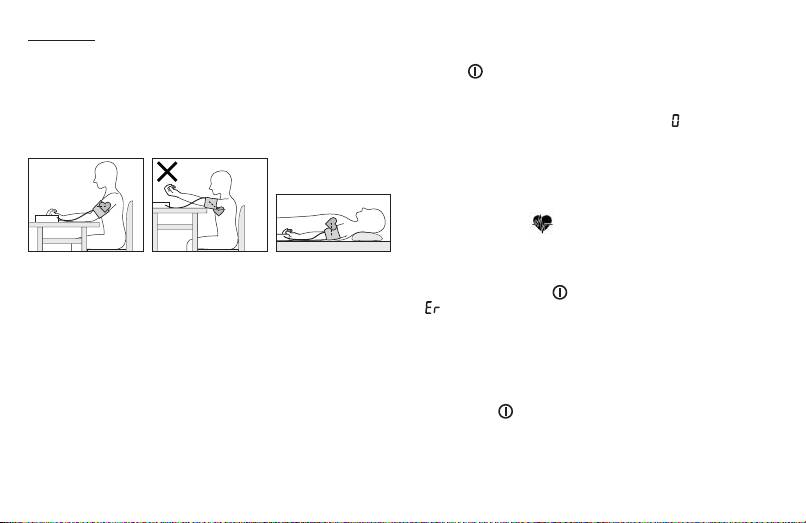
Correct posture
leased slowly.
If a tendency towards high blood pressure is already
detectable, the cuff is pumped up again and cuff pressure
increased further. As soon as a heart rate is detected, the
heart rate symbol
is displayed.
•
Heart rate, systolic and diastolic blood pressure are dis-
played.
•
Rest for approx. 5 minutes before each measurement.
•
You can interrupt measurement at any time by pressing
Otherwise there may be divergences.
the start/stop button
.
•
You can perform the measurement either sitting or lying
•
_ appears if it has not been possible to perform the
down. Always make sure that the cuff is on a level with
measurement properly. Observe the section in these in-
your heart.
structions on error messages/troubleshooting and repeat
•
To carry out a blood pressure measurement, make sure
the measurement.
you are sitting comfortably with your arms and back lean-
•
The test result is saved automatically.
ing on something. Do not cross your legs. Place your feet
•
To switch off and release the pressure, press the start/
flat on the ground.
stop button
again. If you forget to switch off the device,
•
In order not to distort the result, it is important to keep still
it switches off automatically after approx. 1 minute.
during the measurement and not talk.
Wait at least 5 minutes before taking another measurement!
20
Evaluating results
However, these standard values serve only as a general
Cardiac arrhythmia:
guideline, as the individual blood pressure varies in different
people and different age groups etc.
This instrument can identify possible cardiac arrhythmia dis-
It is important to consult your doctor regularly for advice.
orders during measurement and if necessary indicates the
Your doctor will tell you your individual values for normal
measurement with the flashing icon
.
blood pressure as well as the value above which your blood
This may be an indicator for arrhythmia. Arrhythmia is a
pressure is classified as dangerous.
condition where the heart rhythm is abnormal as a result
of defects in the bioelectrical system controlling the heart
Range of blood
Systolic
Diastolic
Measure
beat. The symptoms (omitted or premature heart beats,
pressure values
(in mmHg)
(in mmHg)
slow or excessively fast heart rate) may be caused, among
Grade 3:
>= 180 >= 110 Seek medical
other things, by heart disease, age, physical predisposi-
Severe hyper-
advice
tion, excessive use of stimulants, stress or lack of sleep.
tension
Arrhythmia can only be ascertained through examination by
Grade 2:
160 – 179 100 – 109 Seek medical
your doctor.
Moderate
advice
Repeat the measurement if the flashing icon
is dis-
hyper tension
played after the measurement. Please note that you should
rest for 5 minutes between measurements and not talk or
Grade 1: Mild
140 – 159 90 – 99
Have it checked
move during the measurement. If the icon
appears
hypertension
regularly by doctor
often, please contact your doctor. Any self-diagnosis and
High normal 130 – 139 85 – 89
Have it checked
treatment based on the test results may be dangerous. It is
regularly by doctor
vital to follow your doctor’s instructions.
Normal 120 – 129 80 – 84 Check it yourself
WHO-classification:
Optimal < 120 < 80 Check it yourself
In accordance with the guidelines/definitions of the World
Source: WHO, 1999
Heath Organization and the latest findings, the measure-
ments can be classified and assessed according to the fol-
The bar graph in the display and the scale on the unit indicate
lowing table.
the range of the blood pressure which has been recorded.
21
If the values for systolic and diastolic pressure are in two
Technical alarm – description
different WHO ranges (e.g. systolic in the high-normal range
Should the recorded blood pressure (systolic or diastolic)
and diastolic pressure in the normal range) the graphic WHO
lie outside the limits specified in the section “Technical
classification on the unit indicates the higher range (high-
specifications”, the technical alarm will appear on the dis-
normal in the example described).
play indicating either “Hi” or “Lo”. In such cases, you should
seek medical assistance and check the accuracy of your
6. Error messages / trouble-shooting
procedure.
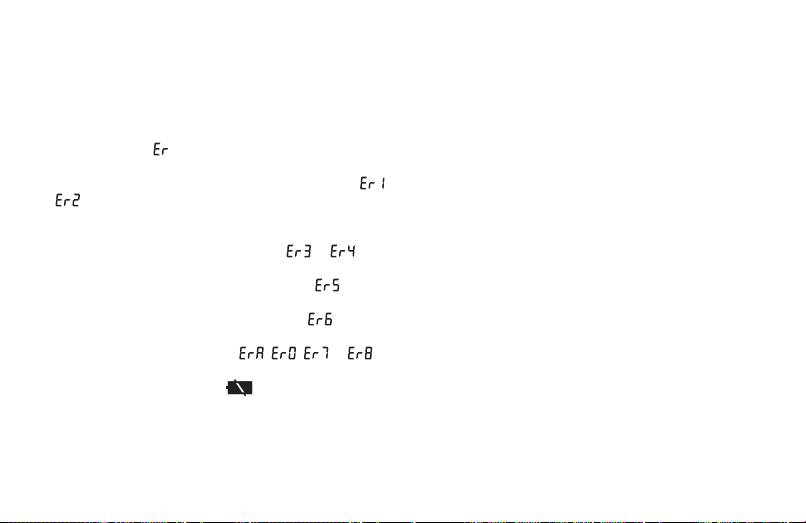
In case of faults, the _ message appears in the display.
The limit values for the technical alarm are factory set and
Error messages may appear if:
cannot be adjusted or deactivated. These alarm limit val-
•
systolic or diastolic pressure could not be measured (
ues are accorded second priority under the standard IEC
or
appears on the display)
60601-1-8.
•
systolic or diastolic pressure was outside the measure-
The technical alarm is a non-locking alarm and must not be
ment range (“Hi” or “Lo” appears on the display)
reset. The signal shown on the display will disappear auto-
•
the cuff is fastened too tightly or loosely ( or ap-
matically after about 8 seconds.
pears on the display)
•
the pump pressure is higher than 300 mmHg ( ap-
7. Cleaning and care
pears on the display)
•
Clean your device and cuff carefully only with a slightly
•
pumping up takes longer than 160 seconds ( appears
moistened cloth.
on the display)
•
Do not use any detergents or solvents.
•
there is a system or device error ( , , or
•
Never hold the instrument under water as otherwise liquid
appears on the display)
can penetrate and damage the instrument.
•
the batteries are almost empty .
•
Never place any heavy objects on the instrument.
In such cases, repeat the measurement. Ensure you do not
move or speak.
If necessary, re-insert or replace the batteries.
22

8. Technical details
Battery life For approx. 600 measurements, depend-
Model no. BM 44
ing on the blood pressure level and/or
pump pressure
Measurement
Oscillometric, non-invasive blood pres-
method
sure measurement on the upper arm
Accessories Instruction for use, 4 x 1.5 V AA batteries,
storage pouch
Measurement
Cuff pressure 0 – 300 mmHg,
range
systolic 60 – 260 mmHg,
Classification Internal supply, IPX0, no AP or APG,
diastolic 40 –199 mmHg,
continuous operation, type BF applied
Pulse 40 –180 beats/minute
part
Display accuracy Systolic ± 3 mmHg,
Technical information is subject to change without notifica-
diastolic ± 3 mmHg,
tion to allow for updates.
pulse ± 5 % of the value shown
Measurement
Max. permissible standard deviation
•
This unit is in line with European Standard EN 60601-1-2
inaccuracy
according to clinical testing:
and is subject to particular precautions with regard to
systolic 8 mmHg /diastolic 8 mmHg
electromagnetic compatibility (EMC). Please note that
portable and mobile HF communication systems may in-
Dimensions L 94 mm x W 122 mm x H 53 mm
terfere with this unit. More details can be requested from
Weight Approx. 230 g (without batteries)
the stated Customer Service address or found at the end
Cuff size 22 to 30 cm
of the instructions for use.
Permissible oper-
+ 10 °C to + 40 °C, ≤90 % relative air
•
This device is in line with the EU Medical Devices Directive
ating conditions
humidity (non-condensing)
93/42/EC, the “Medizinproduktegesetz” (German Medical
Devices Act) and the standards EN1060-1 (non-invasive
Permissible stor-
- 20 °C to + 55 °C, ≤90 % relative air
sphygmomanometers, Part 1: General requirements),
age conditions
humidity, 800 –1050 hPa ambient pressure
EN1060-3 (non-invasive sphygmomanometers, Part 3:
Power supply
4 x 1,5 V
AA batteries
Supplementary requirements for electro-mechanical blood
pressure measuring systems) and IEC 80601-2-30 (Medi-
cal electrical equipment – Part 2 – 30: Particular require-
23

ments for the safety and essential performance of auto-
Enclosures
Equipment enclosed to protect against
mated non-invasive blood pressure monitors).
and Protective
contact with live parts, and with parts which
•
The accuracy of this blood pressure monitor has been
Covers
can become live (finger, pin, hook test).
carefully checked and developed with regard to a long
The operator shall not contact the patient
useful life. If using the device for commercial medical pur-
and the output plug of AC mains part simul-
poses, it must be regularly tested for accuracy by appro-
taneously.
priate means. Precise instructions for checking accuracy
may be requested from the service address.
9. Mains part
Model no. FW 7575M/EU/6/06
Input 100 – 240 V, 50 – 60 Hz
Output 6 V DC, 600 mA, in connection with Beurer
blood pressure monitor
Supplier Friwo Gerätebau GmbH
Protection This device is double insulated and pro-
tected against short circuit and overload by
a primary thermal fuse. Make sure to take
the batteries out of the compartment before
using the mains part.
double insulated / equipment class 2
Polarity of the the DC voltage connection
24