
Beurer EM 41.1: 3.3 Pulse width 3.4 Pulse intensity 3. Current parameters 3.1 Pulse shape 3.5 Cycle-controlled pulse parameter variation 3.2 Pulse frequency
3.3 Pulse width 3.4 Pulse intensity 3. Current parameters 3.1 Pulse shape 3.5 Cycle-controlled pulse parameter variation 3.2 Pulse frequency: Beurer EM 41.1
Table of contents
- ENGLISH
- 1. Getting to know your machine 1.1 What is Digital TENS/EMS and what can it do?
- 2. Important Information 1.2 Scope of supply
- IMPORTANT! PRECAUTIONARY MEASURES:
- 3.3 Pulse width 3.4 Pulse intensity 3. Current parameters 3.1 Pulse shape 3.5 Cycle-controlled pulse parameter variation 3.2 Pulse frequency
- 4. Unit description 4.1 Description of components 5. Start-up 4.2 Key functions
- 6. Programme overview 6.1 Basic information
- 6.2 TENS programmes
- 6.3 EMS programmes
- 6.4 MASSAGE programmes 6.5 Information on placing the electrodes
- 7.3 Procedure for TENS/EMS programmes 11 to 20 7. Application 7.1 Advice on application 7.2 Procedure for TENS, EMS and MASSAGE programmes 01–10
- 7.4 Changes to the settings 8. Cleaning and storage 7.5 Doctor’s Function 9. Disposal
- 10. Problems and solutions 11. Technical details
- 29
20
•
Do not, under any circumstances, attempt to open or repair the machine
yourself! Only have repairs carried out by the customer service department
or an authorized dealer. If these instructions are not heeded, the warranty
becomes null and void.
•
The manufacturer assumes no liability for damage caused through im-
proper or wrong use.
Information on ESD (Electrostatic Discharge)
Please note that jacks marked with the ESD warning label must not
be touched.
ESD protective measures:
– Do not touch plugs/jacks marked with the ESD warning label with fingers!
– Do not touch plugs/jacks marked with the ESD warning label with hand-
held tools!
Further explanations on the ESD warning label, as well as possible training
courses and their contents, are available on request from the customer
service department.
3. Current parameters
Electrical stimulation machines operate with the following current settings,
which will alter the stimulation effect depending on the setting.
3.1 Pulse shape
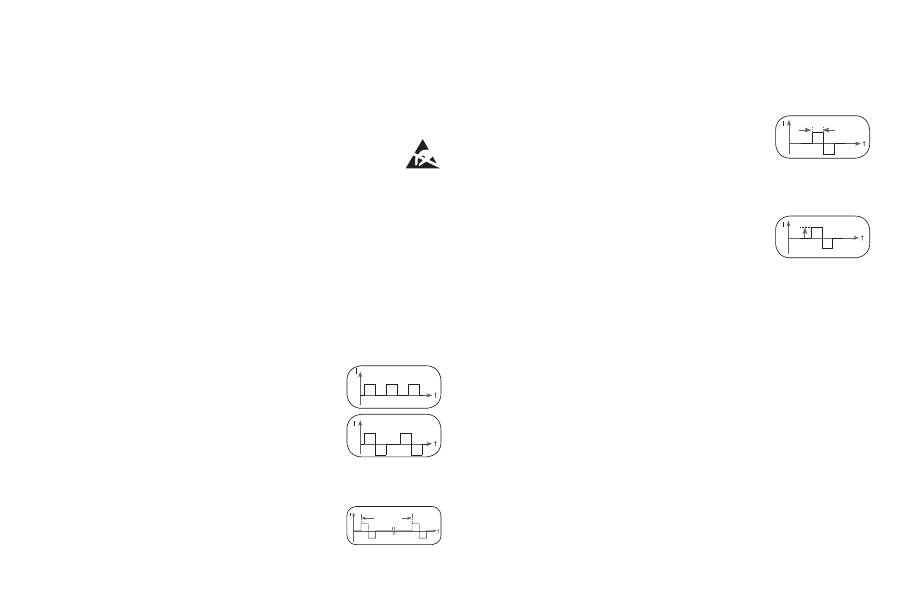
This describes the time function of the excitation current.
whereby monophase pulse trains are differentiated from
biphase. In monophase pulse trains the current flows in
one direction, in biphase pulse trains the excitation current
changes direction.
In the Digital TENS/EMS unit, there are only biphase pulse
trains, as they reduce the strain on the muscle, leading to
less muscle fatigue as well as safer application.
3.2 Pulse frequency
Frequency indicates the number of individual pulses per
second, and is indicated in Hz (Hertz). It can be calculated
by working out the inverse value of the periodic time. The
respective frequency determines which types of muscle fibre preferably react.
Slow-response fibres tend to react to lower pulse frequencies up to 15 Hz,
while fast-response fibres only respond to frequencies over approx. 35 Hz.
With pulses of approx. 45–70 Hz, there is permanent tension in the muscle
combined with premature muscle fatigue. Higher pulse frequencies can
therefore preferably be used for elasticity and maximum strength training.
3.3 Pulse width
Pulse width is used to indicate the duration of an indi-
vidual pulse in microseconds. Pulse width also determines
the pene tration depth of the current whereby in general,
the following applies: a greater muscle mass requires a
greater pulse width.
3.4 Pulse intensity
Setting the degree of intensity is individually dependent
on the subjective feeling of each individual user and is
determined by a number of parameters such as application
site, skin circulation, skin thickness as well as quality of elec-
trode contact. The actual setting should be effective but should never produce
any unpleasant sensations such as pain at the site of application. While a slight
tingling sensation indicates sufficient stimulation energy, any setting which leads
to pain must be avoided.
With prolonged application, readjustment may be necessary due to time
adjustment processes at the site of application.
3.5 Cycle-controlled pulse parameter variation
In many cases it is necessary to cover the entirety of tissue structures at the
site of application by using several pulse parameters. With the Digital TENS/
EMS unit, this is done by the existing programmes automatically making a
cyclical pulse parameter change. This also prevents individual muscle groups
at the site of application from getting tired.
With the Digital TENS/EMS unit there are useful presettings for current
para meters. During the application, however, you do have the possibility of
changing pulse intensity at any time and, with individual programmes, you
can also alter pulse frequency beforehand in order implement the application
which is the most comfortable or promises the most success for you.
pulse int
ensity
monophase pulses
time
biphase pulses
periodic
time
Pulse width
