
Beurer BG40: Repairs 4. Unit description 5. Initial use 6. Information The measuring principle General tips
Repairs 4. Unit description 5. Initial use 6. Information The measuring principle General tips: Beurer BG40
Table of contents
- 1. Getting to know your instrument Function of the unit 2. Signs and symbols 3. Safety notes WARNING Notes on handling batteries
- General notes Storage and maintenance Batteries
- Repairs 4. Unit description 5. Initial use 6. Information The measuring principle General tips
- Limitations 7. Settings Setting user data Degrees of activity
- 8. Taking measurements Weighing, carrying out diagnostics The following appears: 9. Evaluation of results Body fat percentage Man Woman
- Body water percentage Man Woman Muscle percentage Man Woman Bone mass BMR
- AMR Results in relation to time 0. Replacing batteries 11. Cleaning and care of the unit 12. Disposal
- 13. What if there are problems?
Repairs
IMPORTANT
•
Never open or attempt to repair the unit yourself, as otherwise proper function is no longer guar-
anteed. Failure to observe this regulation shall void the warranty.
•
If you need to have the unit repaired, contact customer service or an authorised dealer.
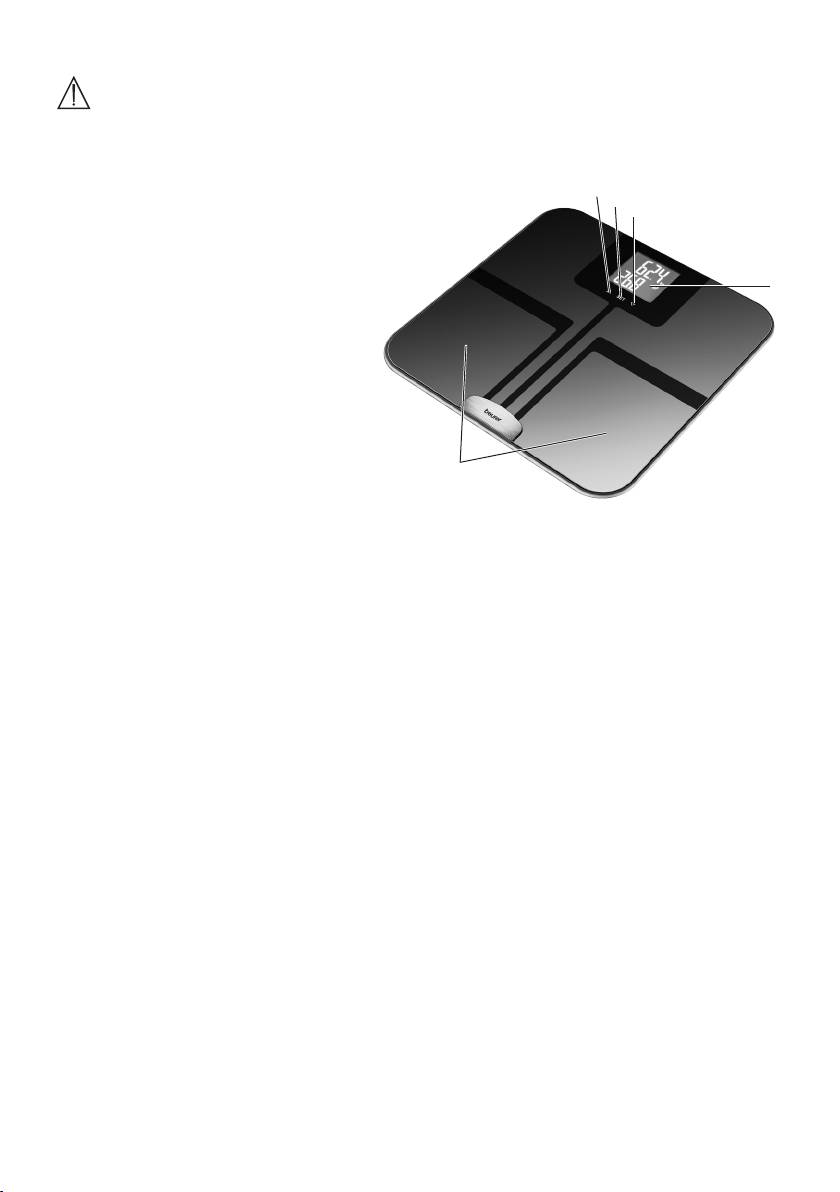
4. Unit description
3
4
Overview
5
1. Electrodes = conductive ITO coating
2. Display
3. “Up” key
4. “SET” key
2
5. “Down” key
1
5. Initial use
Inserting batteries
If provided, pull out the battery insulating strip at the battery compartment or remove the protective film
from the battery and insert the battery with the correct polarity. If the scale fails to operate, remove the
battery completely and reinsert it.
Changing the weight unit
On delivery, the scale is set to “cm” and “kg”. At the back of the scales is a switch with which you can
switch between “inches”, “pounds” and “stones” (lb, st).
Setting up the scale
Place the scale on a firm level floor (no carpet); a firm floor covering is required for correct measurement.
Switch on the scale
Audibly, briefly and firmly tap the scale with your foot to activate the vibration sensor.
6. Information
The measuring principle
This scale operates according to the B.I.A. principle (bioelectric impedance analysis). This enables the
measurement of physical relationships within seconds by means of an undetectable, completely harmless
electric current. The body fat percentage and other physical relationships in the body can be determined
by measuring the electrical resistance (impedance) and calculating constants and individual parameters
such as age, height, gender and degree of activity.
Muscle tissue and water have good electrical conductivity, and therefore lower resistance. Bones and fatty
tissue, on the other hand, have low conductivity as fat cells and bones conduct hardly any current as a
result of their very high resistance.
Please be aware that values obtained from the diagnostic scale represent only an approximation of actual
analytical medical data. Only a specialist physician can accurately determine body fat, body water, muscle
percentage and bone structure using medical procedures (e.g. computed tomography).
General tips
•
If possible, always weigh yourself at the same time of day (preferably in the morning), after using the toi-
let, on an empty stomach and unclothed, in order to achieve comparable results.
•
Important for the measurement: only measure body fat when barefoot and with the soles of the feet
slightly moist.
13
