
Vitek VT-1686: Dishes for microwave ovens Checking dishes before using them in the microwave Materials and dishes that are safe to use in your microwave oven
Dishes for microwave ovens Checking dishes before using them in the microwave Materials and dishes that are safe to use in your microwave oven: Vitek VT-1686
Table of contents
- PRECAUTIONS, WHICH MUST BE FOLLOWED IN ORDER TO MINIMIZE THE RISK OF MICROWAVE ENERGY EXPOSURE IMPORTANT SAFETY INSTRUCTIONS Important information SAFETY MEASURES
- Rules that should always be remembered: CAUTION
- Dishes for microwave ovens Checking dishes before using them in the microwave Materials and dishes that are safe to use in your microwave oven
- Materials and dishes that are NOT safe for microwave use DESCRIPTION CONTROL PANEL DISPLAY Assembling the microwave oven Protective covering
- Installing the Glass Tray Installation INSTRUCTIONS FOR USING THE MICROWAVE OVEN 1. Setting the Current Time 2. Cooking in the Microwave Oven Power Selection Table
- 3. Defrosting Food by Weight 4. Defrosting Food by Time 5. Express Cooking Mode 6. Cooking Food in Two Stages
- 7. Setting the Cook Start Time 8. Child Lock Function 9. Viewing the Set functions 10.Information on the Display 11. Audible Signals 12. CARE AND CLEANING
- Eliminating malfunctions TECHNICAL CHARACTERISTICS
ENGLISH
Dishes for microwave ovens
CAUTION!
• Tightly sealed containers heated in a microwave can be explosive.
• Sealed containers should be opened and plastic bags should be poked a few times with a fork in order to allow
steam to escape before being placed in the microwave oven.
• If you are unsure about using a certain dish in the microwave oven, then conduct a test.
Checking dishes before using them in the microwave
• Place the dish in the cooking chamber of the oven (a plate, for example) and place a glass cup of water in the
center of the dish.
• Set the microwave to maximum power and heat for no more than one minute.
• Carefully touch the dish you are testing: if it heated up and the water in the cup is cold, than the dish should not
be used in the microwave.
• Avoid testing dishes for more than one minute.
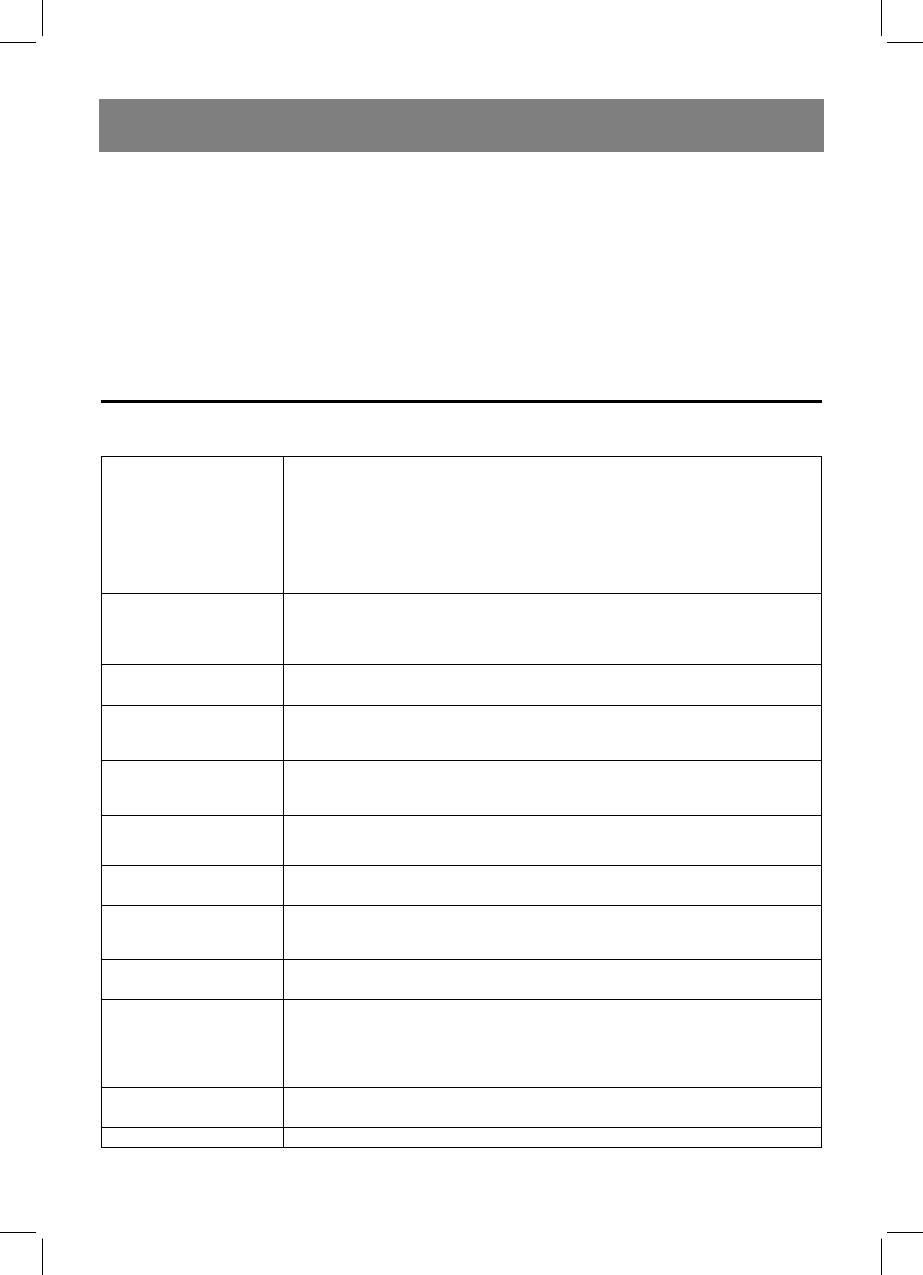
Materials and dishes that are safe to use in your microwave oven
Foil can only be used in grill mode. The distance between the foil and the walls of
the microwave oven should be no less than 2.5 cm.
Small pieces of foil can be used to cover thin pieces of meat or poultry to prevent
overcooking.
Aluminum Foil
In microwave mode, if the foil is placed too close to the cooking chamber
walls, arcing, burning out of the screening grill on the door and oven
malfunction can occur. In this case, you void your free warranty service
and repair.
Follow the manufacturer’s instructions.
Dishes for frying
The bottom of the dish for frying should be 5 mm thicker than the rotating glass
tray. Improper use of dishes for frying can lead to cracks in the dishes themselves
and in the glass tray.
Dinner plates Only those designed for use in microwave ovens. Follow the manufacturer’s
instructions. Do not use cracked or chipped plates.
Only containers made from heat-resistant glass and designed for use in
Glass containers
microwave ovens. Make sure there are no metal rims. Do not use cracked or
chipped containers.
Only containers made from heat-resistant glass and designed for use in
Glassware
microwave ovens. Make sure there are no metal rims. Do not use cracked or
chipped containers.
The cooking process in
Follow the manufacturer’s instructions. Do not close the bags, use metal ties or
microwave ovens using
fasteners. Several holes should be made in the bag to allow the release of steam.
special bags
Use only for quick cooking/reheating. Do not leave the microwave oven
Paper plates and cups
unattended during cooking/reheating in this type of container.
Food products may be covered with paper towels to keep warmth in and to
Paper towels
prevent fat from spraying out. Use only when supervised and only for quick
cooking/reheating.
Parchment
Use to prevent fat from spraying out or as a wrapper. Use only when supervised
Paper
and only for quick cooking/reheating.
Only those plastic products that are labeled “Microwave Safe.” Follow the
manufacturer’s instructions.
Plastic
Some plastic containers can soften as a result of the heating of their contents.
Hermetically sealed plastic bags must be poked with a fork or cut as directed on
the bags themselves.
Only those plastic products that are labeled “Microwave Safe.” Food may be
Plastic wrapper
covered to keep moisture in.
Wax paper
Use to prevent fat from spraying out and also to keep moisture in.
5
5
Vt-1686.indd 5Vt-1686.indd 5 13.08.2009 14:36:4213.08.2009 14:36:42


