Indesit DFP 2727: Installation
Installation: Indesit DFP 2727
EN
16
Installation
Keep this instruction manual in a safe place for
future reference. If the appliance is sold, given away or
moved, please ensure the manual is kept with the
machine, so that the new owner may benefit from the
advice contained within it.
Please read this instruction manual carefully: it
contains important information regarding the safe
installation, use and maintenance of the appliance.
If the appliance must be moved at any time, keep it
in an upright position; if absolutely necessary, it may
be tilted onto its back.
This appliance is intended to be used in household and
similar applications such as:
- staff kitchen areas in shops, offices and other working
environments;
- farm houses;
- by clients in hotels, motels and other residential type
environments;
- bed and breakfast type environments.
Positioning and levelling
1. Remove the appliance from all packaging and
check that it has not been damaged during
transportation.
If it has been damaged, contact the retailer and do not
proceed any further with the installation process.
2. Check the dishwasher by placing it so that its sides
or back panel are in contact with the adjacent
cabinets or even with the wall. This appliance can
also be recessed under a single worktop
*
(
see the
Assembly instruction sheet).
3. Position the dishwasher on a level and sturdy floor. If
the floor is uneven, the front feet of the appliance may
be adjusted until it reaches a horizontal position. If the
appliance is levelled correctly, it will be more stable
and much less likely to move or cause vibrations and
noise while it is operating.
4. Adjust the height of the rear foot from the front of the
appliance
*
on the central lower part of the dishwasher,
turning a hexagonal spanner (red color) with an opening of
8 mm in a clockwise direction to increase the height or in an
anticlockwise direction to decrease the height.
Connecting the water and electricity
supplies
Connection to the water and electricity supplies
should only be performed by a qualified technician.
The dishwasher should not stand on top of the
water hoses or the electricity supply cable.
The appliance must be connected to the water
supply network using new hoses.
Do not use old hoses.
The water inlet and outlet hoses and the electricity
supply cable may be positioned towards the right or the
left in order to achieve the best possible installation.
Connecting the water inlet hose
• To a suitable cold water connection point: before
attaching the hose, run the water until it is perfectly
clear so that any impurities that may be present in the
water do not clog the appliance; after performing this
operation, screw the inlet hose tightly onto a tap with
a ¾ gas threaded connection.
• To a suitable hot water connection point: your
dishwasher may be supplied with hot water from the
mains supply (if you have a central heating system
with radiators) provided that it does not exceed a
temperature of 60°C.
Screw the hose to the tap as described for connection
to a cold water supply.
If the inlet hose is not long enough, contact a
specialist store or an authorised technician (
see
Assistance).
The water pressure must be within the values
indicated in the Technical data table (
see adjacent
information).
The hose should not be bent or compressed.
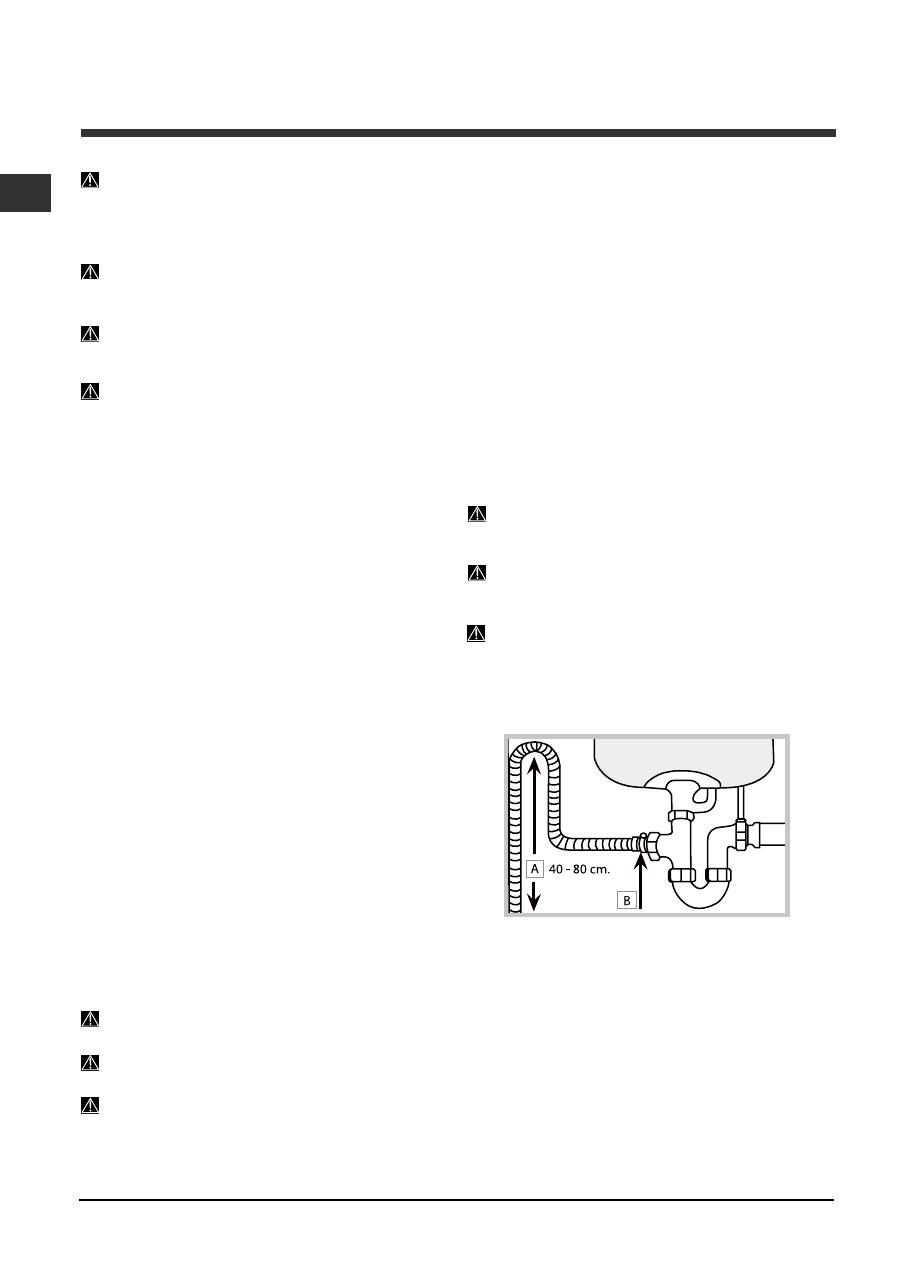
Connecting the water outlet hose
Connect the outlet hose (without bending it) to a drain
duct with a minimum diameter of 4 cm.
The outlet hose must be at a height ranging from 40 to
80 cm from the floor / surface where the dishwasher
rests (A).
Before connecting the water outlet hose to the sink
drain, remove the plastic plug (B).
*
Only available in selected models.
EN
17
Anti-flooding protection
To ensure floods do not occur, the dishwasher:
- is provided with a special system which blocks the
water supply in the event of anomalies or leaks from
inside the appliance.
Some models are also equipped with the supplementary
safety device
New Acqua Stop
*
, which guarantees anti-
flooding protection even in the event of a supply hose
rupture.
WARNING: HAZARDOUS VOLTAGE!
Under no circumstance should the water inlet hose be
cut as it contains live electrical parts.
Electrical connection
Before inserting the plug into the electrical socket, make
sure that:
• The socket is earthed and complies with current
regulations.
• The socket can withstand the maximum load of the
appliance, which is indicated on the data plate
located on the inside of the door (
see chapter entitled
Description of the appliance).
• The power supply voltage falls within the values
indicated on the data plate on the inside of the door.
• The socket is compatible with the plug of the
appliance. If this is not the case, ask an authorised
technician to replace the plug (
see Assistance); do
not use extension cables or multiple sockets.
Once the appliance has been installed, the power
supply cable and the electrical socket should be easily
accessible.
The cable should not be bent or compressed.
If the power supply cable is damaged, it must be re-
placed by the manufacturer or its Technical Assistance
Service in order to prevent all potential hazards. (See As-
sistance)
The Company shall not be held responsible for any
incidents that occur if these regulations are not
observed.
Anti-condensation strip
*
After installing the dishwasher, open the door and stick
the adhesive transparent strip under the wooden shelf in
order to protect it from any condensation which may
form.
Advice regarding the first wash cycle
After the appliance has been installed, immediately
before running the first wash cycle, completely fill the
salt dispenser with water and add only then
approximately 1 kg of salt (
see chapter entitled Rinse aid
and refined salt). The water may overflow: this is normal
and is not a cause for concern. Select the water
hardness value (
see chapter entitled Rinse aid and
refined salt). - After the salt has been poured into the
machine, the LOW SALT indicator light
*
switches off.
If the salt container is not filled, the water softener
and the heating element may be damaged as a result.
ECODESIGN REGULATION
ECO wash cycle is the standard cycle to which the energy label data refers; this cycle can be used to wash crockery with a normal
soil level and is the most efficient in terms of energy and water consumption for this type of crockery. To reduce consumption even
further, only run the dishwasher when it is full.
Standby consumption: Left-on mode consumption: 3 W – Off mode consumption: 1,3 W
Consumption data table for the main cycles
*
Cycle data refers to the values recorded in a laboratory, in accordance with European standard EN 50242.
**
Data is obtained by recording values when the appliance is operational and loaded with user crockery.
Standard conditions
*
User
conditions
**
Energy consumption
(kWh/cycle)
Water consumption
(l/cycle)
Duration
(min/cycle)
Energy consumption
(kWh/cycle)
Water consumption
(l/cycle)
Duration
(min/cycle)
INTENSIVE
1,60 16 150
1,40 15 135
NORMAL
1,30 16 120
1,10 15 110
Technical data
Dimensions
width 60 cm
height 85 cm
depth 60 cm
Capacity
12 standard place-settings
Water supply
pressure
0,05 ÷ 1MPa (0.5 ÷ 10 bar)
7,25 – 145 psi
Power supply voltage
See appliance data plate
Total absorbed power
See appliance data plate
Fuse
See appliance data plate
This dishwasher conforms to the
following European Community
Directives:
-2006/95/EC (Low Voltage)
-2004/108/EC (Electromagnetic
Compatibility)
-2005/32/EC (Comm. Reg.
1275/2008) (Ecodesign)
-97/17/EC (Labelling)
-2002/96/EC
(
Waste Electrical
and Electronic Equipment)
(WEEE)
Table of contents
- Монтаж
- Описание изделия
- Загрузка корзин
- Включение и эксплуатация
- Программы
- Ополаскиватель и регенерирующая соль
- Техническоеобслуживание и уход
- Неисправности и методы их устранения
- Operating instructions
- Installation
- Description of theappliance
- Loading the racks
- Start-up and use
- Wash cycles
- Rinse aid and refined salt
- Care and maintenance
- Precautions and advice
- Troubleshooting
- Assistance
- Manual deInstrucciones
- Instalación
- Descripción del aparato
- Cargar los cestos
- Puesta enfuncionamiento y uso
- Programas
- Abrillantador y salregeneradora
- Mantenimiento ycuidados
- Precauciones y consejos
- Anomalías y soluciones
- Ýþletim Talimatlarý
- Kurulum
- Cihazýn tanýmý
- Raflarýn yüklenmesi
- Baþlangýç ve kullaným
- Yýkama devirleri
- Parlatýcý ve iþlenmiþ tuz
- Bakým ve onarým
- Önlemler ve öneri
- Sorun giderme