
Nikon 24mm-f-35D-PC-E-Nikkor: The shift function
The shift function: Nikon 24mm-f-35D-PC-E-Nikkor
Table of contents
- Notes on Safety Operations
- Observe the following precautions when handling the camera and lens
- 1. Nomenclature
- 2. Major features
- Note on the shift and tilt lock-release knobs 3. Usable cameras and available functions
- Cameras
- Aperture stop-down button (one-touch preset aperture operation)
- Important 4. Mounting lens
- 5. Using bayonet hood HB-41
- 6. Determining exposure When using the Nikon D4, D3-Series, Df, When using other Nikon cameras
- Determining exposure (with an external exposure meter) 7. The shift/tilt function Important
- The shift function
- The tilt function Revolving
- 8. Focusing
- 9. Depth of field
- 10. Taking flash pictures using cameras with a built-in flash
- 11. Recommended focusing screens
- 12. Lens care 13. Standard accessories
- 14. Optional accessories 15. Specifications
- Weight: Approx. 730 g (25.7 oz) 16. Customer service
• When the lens is mounted to a camera other than the D4
or D3-Series, shift and/or tilt the lens with care. Failure to
do so, may result in your fingers being nipped between
the lens and the camera body, or the lens scratching the
En
camera body.
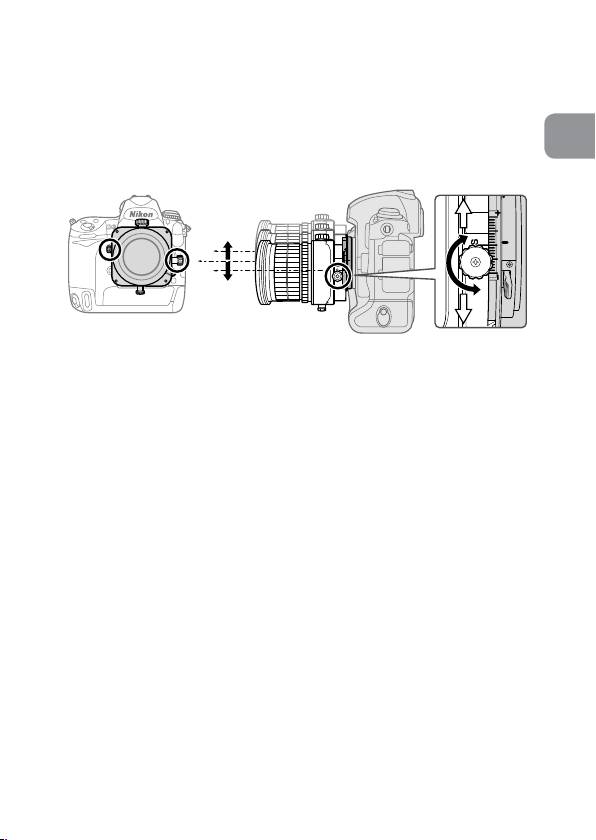
The shift function
Fig. 7
When the shift knob is rotated, the lens is shifted horizontally (or
vertically, when the lens is revolved) parallel to the camera body
(±11.5 mm).
By shifting, you can recompose the frame of the shot
without moving the camera.
This lets you correct the perspective distortion of the
subject or exclude unwanted objects from appearing in
front of the main subject (p. 207).
• After shifting, tighten the shift lock release knob to fix
the lens’ shift position.
Note: When shifting the lens, be careful not to pinch your
fingers between the lens and the grip of the camera
body.
29
