
Nikon 24mm-f-35D-PC-E-Nikkor: Important 4. Mounting lens
Important 4. Mounting lens: Nikon 24mm-f-35D-PC-E-Nikkor
Table of contents
- Notes on Safety Operations
- Observe the following precautions when handling the camera and lens
- 1. Nomenclature
- 2. Major features
- Note on the shift and tilt lock-release knobs 3. Usable cameras and available functions
- Cameras
- Aperture stop-down button (one-touch preset aperture operation)
- Important 4. Mounting lens
- 5. Using bayonet hood HB-41
- 6. Determining exposure When using the Nikon D4, D3-Series, Df, When using other Nikon cameras
- Determining exposure (with an external exposure meter) 7. The shift/tilt function Important
- The shift function
- The tilt function Revolving
- 8. Focusing
- 9. Depth of field
- 10. Taking flash pictures using cameras with a built-in flash
- 11. Recommended focusing screens
- 12. Lens care 13. Standard accessories
- 14. Optional accessories 15. Specifications
- Weight: Approx. 730 g (25.7 oz) 16. Customer service
Important
• When the lens is mounted to a camera other than the D4
or D3-Series, shift, tilt and/or revolve the lens with care.
Failure to do so, may result in the lens scratching the
En
camera body.
• This lens is a manual focus lens, and autofocus is not
possible even when the camera's focus mode is set to
AF mode.
•
Use of tilt/shift function can cause some vignetting or slight
color change. (Vignetting is the darkening of the corners
around the image.)
• When mounted on Nikon DX format digital SLR cameras,
such as the D300-Series and D7000, the lens’ picture
angle becomes 61° and its 35 mm equivalent focal length
is approx. 36 mm.
• Be careful not to soil or damage the CPU contacts.
• If the lens mount rubber gasket is damaged, be sure to
visit your nearest Nikon authorized dealer or service
center for repair.
• In low temperatures, new or fully charged batteries
should be used in the camera.
4. Mounting lens
a
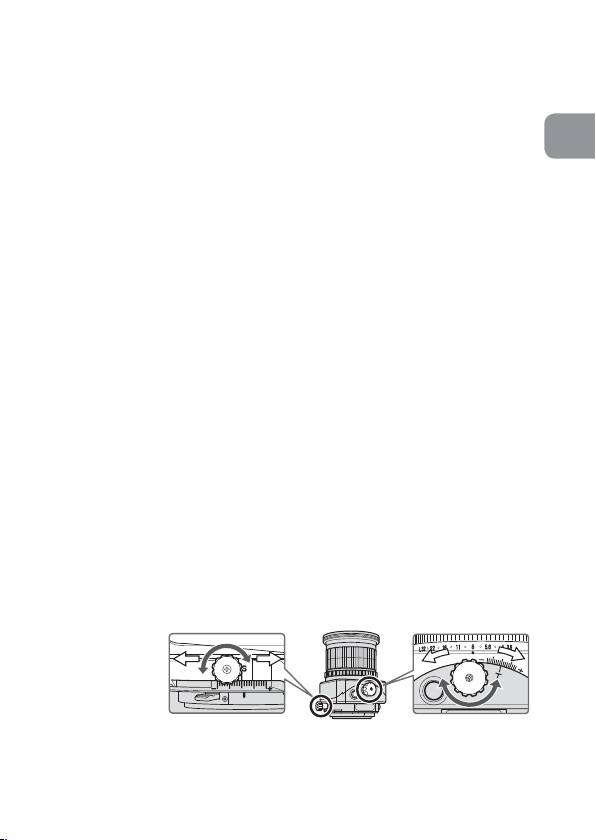
Set the shift amount and tilt amount to 0 by rotating the
shift and tilt knobs (Fig. 2).
Note: Avoid attaching/detaching the lens to/from the
camera while using tilt, shift and/or revolving, and
without locking each knob. Failure to do so can
lead to you pinching your fingers between the lens
and the camera body, or the lens scratching the
camera body.
Fig. 2
25
