
Siemens LD97AA670: Important safety information General information
Important safety information General information: Siemens LD97AA670
Table of contents
- Important safety information General information
- Appliance measurements (fig. 1) Preparing the kitchen units (fig. 2) Fitting the appliance
en
Ú
Installation instructions
:
Important safety information
Read these instructions carefully. Only then will you be able to
operate your appliance safely and correctly. Retain the
instruction manual and installation instructions for future use or
for subsequent owners.
The appliance can only be used safely if it is correctly installed
according to the safety instructions. The installer is responsible
for ensuring that the appliance works perfectly at its installation
location.
The width of the extractor hood must correspond at least with
the width of the hob.
For the installation, observe the currently valid building
regulations and the regulations of the local electricity and gas
suppliers.
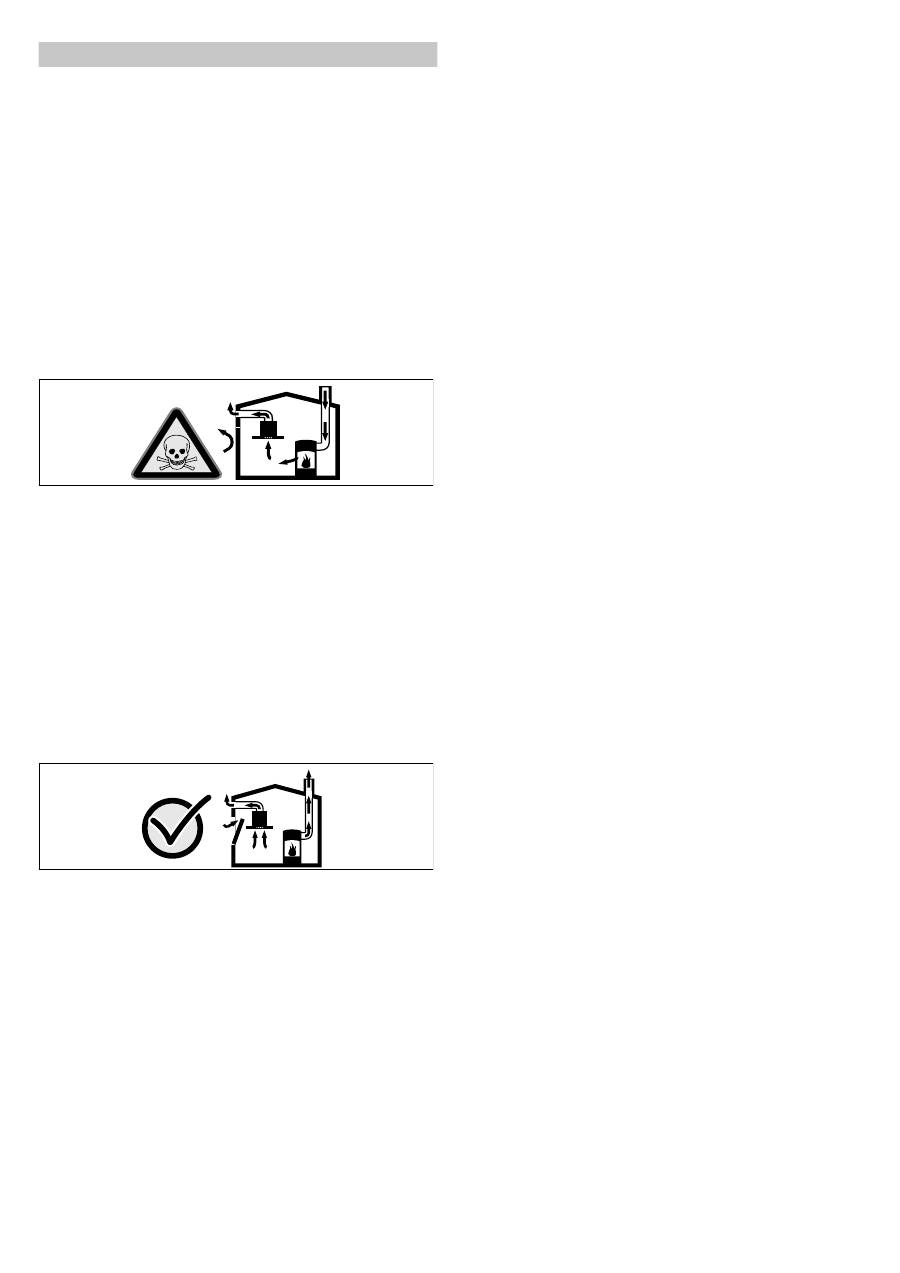
Danger of death!
Risk of poisoning from flue gases that are drawn back in.
Always ensure adequate fresh air in the room if the appliance is
being operated in exhaust air mode at the same time as room
air-dependent heat-producing appliance is being operated.
Room air-dependent heat-producing appliances (e.g. gas, oil,
wood or coal-operated heaters, continuous flow heaters or water
heaters) obtain combustion air from the room in which they are
installed and discharge the exhaust gases into the open air
through an exhaust gas system (e.g. a chimney).
In combination with an activated vapour extractor hood, room air
is extracted from the kitchen and neighbouring rooms - a partial
vacuum is produced if not enough fresh air is supplied. Toxic
gases from the chimney or the extraction shaft are sucked back
into the living space.
■
Adequate incoming air must therefore always be ensured.
■
An incoming/exhaust air wall box alone will not ensure
compliance with the limit.
Safe operation is possible only when the partial vacuum in the
place where the heat-producing appliance is installed does not
exceed 4 Pa (0.04 mbar). This can be achieved when the air
needed for combustion is able to enter through openings that
cannot be sealed, for example in doors, windows, incoming/
exhaust air wall boxes or by other technical means.
In any case, consult your responsible Master Chimney Sweep.
He is able to assess the house's entire ventilation setup and will
suggest the suitable ventilation measures to you.
Unrestricted operation is possible if the vapour extractor hood is
operated exclusively in the circulating-air mode.
Danger of death!
Risk of poisoning from flue gases that are drawn back in. If
installing a ventilation system in a room with a heat-producing
appliance connected to a chimney/flue, the electricity supply to
the hood must be equipped with a suitable safety switch.
Risk of fire!
■
Operating several gas burners at the same time gives rise to a
great deal of heat. The ventilation appliance may become
damaged or catch fire. The ventilation appliance must only be
combined with gas burners that do not exceed the maximum
total output of 12.4 kW.
Risk of fire!
■
Grease deposits in the grease filter may catch fire. The
specified safety distances must be observed in order to
prevent an accumulation of heat. Observe the specifications
for your cooking appliance. If gas and electric hobs are
operated together, the largest specified distance applies.
Only one side of the appliance may be installed directly next
to a high-sided unit or a wall. The distance between the
appliance and wall or high-sided unit must be at least 50 mm.
Risk of injury!
■
Components inside the appliance may have sharp edges.
Wear protective gloves.
Risk of injury!
■
The appliance is heavy. To move the appliance, 2 people are
required. Use only suitable tools and equipment.
Risk of electric shock!
Components inside the appliance may have sharp edges. These
may damage the connecting cable. Do not kink or pinch the
connecting cable during installation.
Danger of suffocation!
Packaging material is dangerous to children. Never allow
children to play with packaging material.
Risk of tipping!
The appliance is very narrow and can tip over easily. Do not set
the appliance on an uneven surface. Set the appliance flat on
the surface.
General information
Exhaust air mode
Note:
The exhaust air must not be conveyed into a functioning
smoke or exhaust gas flue or into a shaft which is used to
ventilate installation rooms which contain heat-producing
appliances.
■
Before conveying the exhaust air into a non-functioning smoke
or exhaust gas flue, obtain the consent of the heating
engineer responsible.
■
If the exhaust air is conveyed through the outer wall, a
telescopic wall box should be used.
Exhaust duct
Note:
The appliance manufacturer does not assume any
warranty for complaints attributable to the pipe section.
■
The appliance achieves its optimum performance by means of
a short, straight exhaust air pipe and as large a pipe diameter
as possible.
■
Because of long rough exhaust air pipes, many of which are
pipe bends or have diameters smaller than 150 mm, the
optimum extraction performance is not achieved and fan
noise is increased.
■
The pipes or hoses for laying the exhaust duct must consist of
non-combustible material.
Round pipes
An inner diameter of 150 mm, but at least 120 mm, is
recommended.
Flat ducts
The inner cross-section must correspond to the diameter of the
round pipes.
Ø 150 mm approx. 177 cm
2
Ø 120 mm approx. 113 cm
2
■
Flat ducts should have no sharp deflections.
■
Use sealing strip for deviating pipe diameters.
Gas hob
The appliance can be used in conjunction with a gas hob.
Caution!
The gas hob must not exceed the following values:
■
Total maximum output: 12.4 kW
■
Maximum output for a single burner: 5 kW
■
Maximum of 5 single burners
Electrical connection
:
Risk of electric shock!
Components inside the appliance may have sharp edges. These
may damage the connecting cable. Do not kink or pinch the
connecting cable during installation.
Check the indoor installation before connecting the appliance.
Ensure that the indoor installation is sufficiently fused. The
voltage and frequency of the appliance must correspond to that
of the electrical installation (see rating plate).
The appliance corresponds to protection class I and must only
be operated with a protective earth connection.
An all-pole isolating switch with at least a 3 mm contact gap
must be fitted in the installation. The plug must still be
accessible after installation.
Only a qualified electrician who takes the appropriate
regulations into account may install or replace the connecting
cable.
