Nikon PD-10: Notices
Notices: Nikon PD-10
Table of contents
- For Your Safety
- Notices
- Notice for customers in Canada CAUTION IMPORTANT NOTE: ATTENTION
- Caring for the Adapter
- Introduction
- Before You Begin
- Parts of the Adapter
- Inserting the Batteries
- Connecting the PD-10 to a Printer
- Setting Profile Information on the Camera
- Number of Devices That Can Be Set Profile names Turning the PD-10 Off
- Wireless Printing
- LED Lamp Display
- Troubleshooting
- Specifications
Notices
• No part of the manuals included with this product may be reproduced,
• Nikon will not be held liable for any damages resulting from the use of
En
transmitted, transcribed, stored in a retrieval system, or translated into
this product.
any language in any form, by any means, without Nikon’s prior written
• While every effort has been made to ensure that the information in
permission.
these manuals is accurate and complete, we would appreciate it were
• Nikon reserves the right to change the specifications of the hardware
you to bring any errors or omissions to the attention of the Nikon rep-
and software described in these manuals at any time and without prior
resentative in your area (address provided separately).
notice.
Notice for customers in the U.S.A.
Federal Communications Commission (FCC)
Declaration of Conformity
This device complies with Part 15 of the FCC rules. Operation of the de-
vice is subject to the following two conditions: (1) this device may not
cause harmful interference, and (2) this device must accept any interfer-
ence received, including interference that may cause undesired operation.
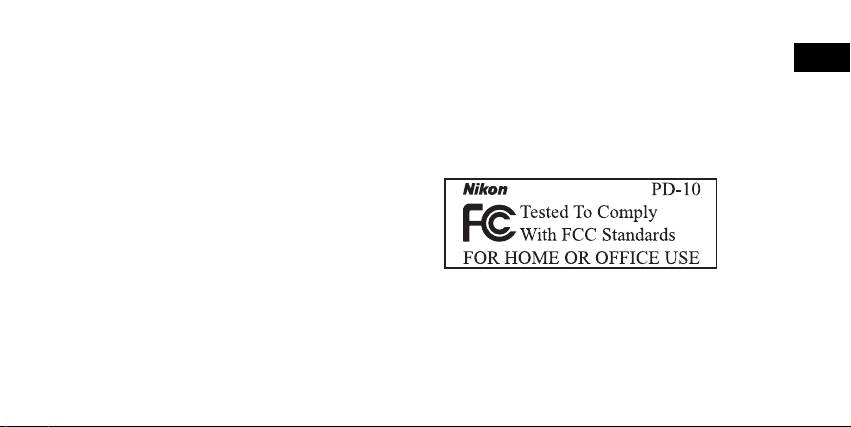
Products that contain a radio transmitter are labeled with FCC ID and may
also carry the FCC logo.
Federal Communication Commission Interference Statement
This equipment has been tested and found to comply with the limits for
turning the equipment off and on, the user is encouraged to try to correct
a Class B digital device, pursuant to Part 15 of the FCC Rules. These limits
the interference by one of the following measures:
are designed to provide reasonable protection against harmful interfer-
• Reorient or relocate the receiving antenna.
ence in a residential installation. This equipment generates, uses and can
• Increase the separation between the equipment and receiver.
radiate radio frequency energy and, if not installed and used in accor-
• Connect the equipment into an outlet on a circuit different from that to
dance with the instructions, may cause harmful interference to radio com-
which the receiver is connected.
munications. However, there is no guarantee that interference will not
• Consult the dealer or an experienced radio/TV technician for help.
occur in a particular installation. If this equipment does cause harmful in-
terference to radio or television reception, which can be determined by
i