
Nikon AF-S NIKKOR 200-400mm f/4G ED VR II 2187: ■ Recommended focusing screens
■ Recommended focusing screens: Nikon AF-S NIKKOR 200-400mm f/4G ED VR II 2187
Table of contents
- Notes on Safety Operations
- Observe the following precautions when handling the camera and lens
- ■ Nomenclature
- En
- ■ Major features ■ Usable cameras and available functions
- ■ Focusing
- ■ Focus operation selection switch and focus operation button (See p. 20 for compatible cameras.)
- ■ Vibration reduction mode (VR
- Setting the vibration reduction ON/OFF switch Setting the vibration reduction mode switch Notes on using vibration reduction
- ■ Setting the aperture ■ Focusing, zooming, and depth of field ■ Using a built-in rotating tripod collar ■ Using the lens hood
- ■ Lens protective glass ■ The built-in flash and vignetting ■ Slip-in filter holder
- ■ Recommended focusing screens
- ■ Lens care ■ Standard accessories ■ Optional accessories
- ■ Specifications
Slip-in Circular Polarizing Filter C-PL1L (optional)
• Blocks reflections from nonmetallic surfaces such as glass and water.
• When a Slip-in Circular Polarizing Filter C-PL1L is attached, the focus distance
Jp
is different from when a 52mm screw-on filter is attached. The distance scale
is shifted from the correct position. The closest focused distance is extended
En
slightly.
• The memory set position may change slightly when using focus preset.
• Attach the C-PL1L filter before using the memory set function.
De
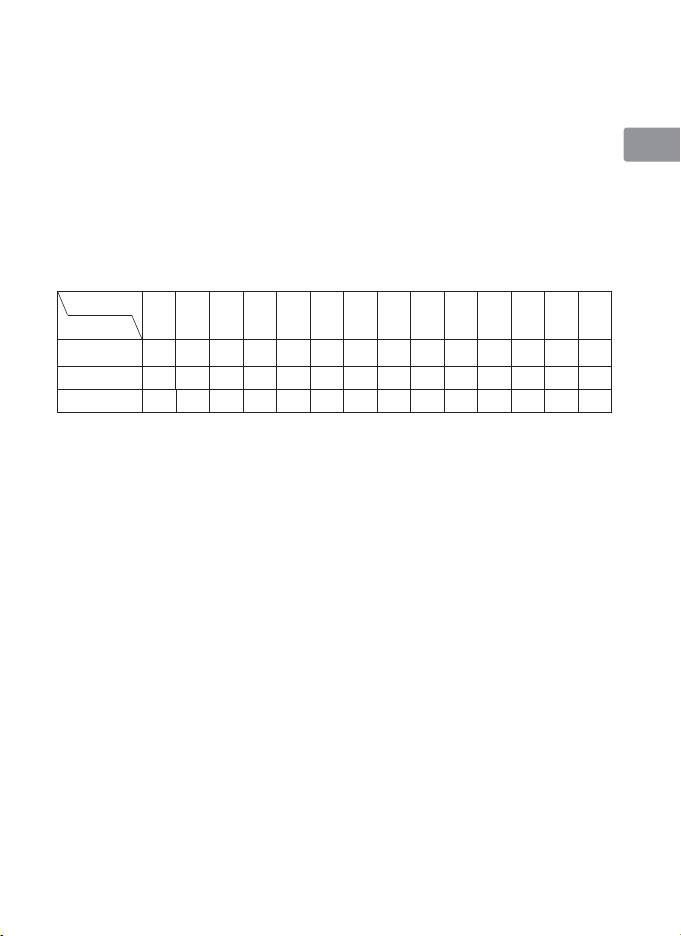
■ Recommended focusing screens
Various interchangeable focusing screens are available for certain Nikon SLR
Fr
cameras to suit any picture-taking situation. The ones recommended for use
with this lens are:
Es
Screen
G1
EC-B
ABCE
F
G2
G4 J K L M P U
EC-E
Se
Camera
G3
◎
◎
F6
◎◎◎
◎
(–0.5)
(–0.5)
Ru
F5+DP-30
◎◎
○
◎◎
○
◎◎ ◎
F5+DA-30
◎◎
○
◎◎
○
◎◎ ◎
Nl
◎
: Excellent focusing
○
: Acceptable focusing
It
Slight vignetting or moiré patterns appear in the viewfinder, but not on the film.
—
: Not available
Ck
( ) : Indicates degree of exposure compensation needed (center-weighted
metering only). For F6 cameras, compensate by selecting “Other screen“ in
Ch
Custom Setting “b6: Screen comp.“ and setting the EV level to -2.0 to +2.0
in 0.5 EV steps. When using screens other than type B or E, “Other screen“
must be selected even when the required compensation value is “0“ (no
Kr
compensation required). For F5 cameras, compensate using Custom Setting
#18 on the camera body. See user’s manual of the camera body for more
details.
Blank box means not applicable. Since type M screen can be used for
both macro photography at a magnification ratio of 1:1 or above and for
photomicrography, it has different applications than other screens.
Important
• For F5 cameras, only EC-B, EC-E, B, E, J, A, L focusing screens are usable in
Matrix Metering.
27
