Nikon 70-200mm-f-28G-ED-AF-S-VR-II-Zoom-Nikko: Setting the vibration reduction ON/OFF switch Setting the vibration reduction mode switch Notes on using vibration reduction
Setting the vibration reduction ON/OFF switch Setting the vibration reduction mode switch Notes on using vibration reduction: Nikon 70-200mm-f-28G-ED-AF-S-VR-II-Zoom-Nikko
Table of contents
- Notes on Safety Operations
- Nomenclature
- Major features
- Usable cameras and available functions Focusing
- Vibration reduction mode
- Setting the vibration reduction ON/OFF switch Setting the vibration reduction mode switch Notes on using vibration reduction
- Focusing, zooming, and depth of field Setting the aperture Using a tripod
- The built-in flash and vignetting Using the lens hood
- Recommended focusing screens
- Lens care Standard accessories Optional accessory
- Specifications
Jp
En
De
Fr
Es
Se
Ru
Nl
It
Ck
Ch
Kr
19
When taking pictures
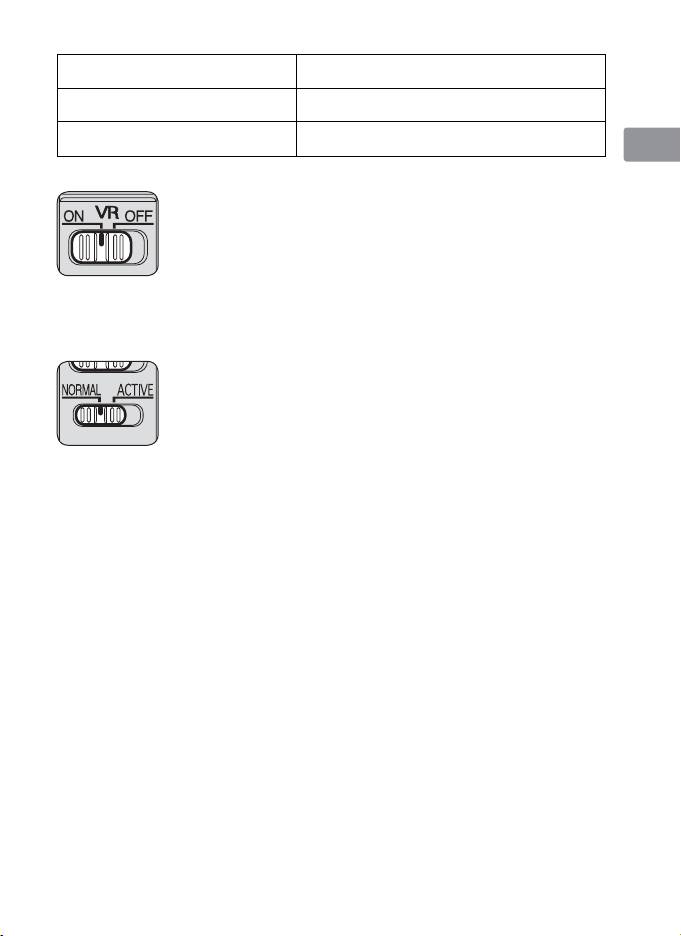
Set the vibration reduction mode switch to
either NORMAL or ACTIVE.
When taking panning shots
Set the vibration reduction mode switch
to NORMAL.
When taking pictures from
Set the vibration reduction mode switch
a moving vehicle
to ACTIVE.
Setting the vibration reduction ON/OFF switch
ON: Vibration is reduced while the shutter-release button
is pressed halfway and also at the instant the shutter
is released. Because vibration is reduced in the
viewfinder, auto/manual focusing and exact framing
of the subject are easier.
OFF: Vibration is not reduced.
Setting the vibration reduction mode switch
First, set the vibration reduction ON/OFF switch ON, then select the following
mode:
NORMAL: The vibration reduction mechanism primarily
reduces camera shake, making smooth panning
shots possible.
ACTIVE: The vibration reduction mechanism reduces
more noticeable camera shake, such as that
which occurs when taking pictures from a
moving vehicle. In this mode, the lens does not
automatically distinguish panning from camera
shake.
Notes on using vibration reduction
• After pressing the shutter-release button halfway, wait until the image in the
viewfinder stabilizes before pressing the shutter-release button the rest of the
way down.
• Due to the characteristics of the vibration reduction mechanism, the image
in the viewfinder may be blurred after the shutter is released. This is not a
malfunction.
• When taking panning shots, be sure to set the vibration reduction mode
switch to NORMAL. If the camera is panned in a wide arc, compensation for
camera shake in the panning direction is not performed. For example, when
panning the camera in a horizontal direction, vertical camera shake is reduced.
This stabilizes the image whilst allowing the desired panning effect to be realized.
• Do not turn the camera off or remove the lens from the camera while vibration
reduction is operating. Failure to observe this note could result in the lens
sounding and feeling as if an internal component is loose or broken when it is
shaken. This is not a malfunction. Turn the camera on again to correct this.
• With cameras featuring a built-in flash, vibration reduction does not function
while the built-in flash is charging.
• With autofocus cameras featuring an AF-ON button, vibration reduction does
not function when the AF-ON button is pressed.