
ASRock Fatal1ty Z77 Professional – страница 2
Инструкция к Материнской Плате ASRock Fatal1ty Z77 Professional

2.6 Expansion Slots (PCI and PCI Express Slots)
There are 2 PCI slots and 5 PCI Express slots on this motherboard.
PCI slots: PCI slots are used to install expansion cards that have the 32-bit PCI
interface.
PCIE slots: PCIE1 (PCIE 2.0 x1 slot) is used for a PCI Express x1 lane width card,
such as a Gigabit LAN card, SATA2 card or ASRock Game Blaster, etc.
PCIE3 (PCIE 2.0 x1 slot) is used for a PCI Express x1 lane width card,
such as a Gigabit LAN card, SATA2 card, etc.
PCIE2 (PCIE 3.0 x16 slot) is used for PCI Express x16 lane width
graphics cards, or to install PCI Express graphics cards to support
TM
TM
CrossFireX
or SLI
function.
PCIE4 (PCIE 3.0 x16 slot) is used for PCI Express x8 lane width graph-
ics cards, or to install PCI Express graphics cards to support CrossFi-
TM
TM
reX
or SLI
function.
PCIE5 (PCIE 2.0 x16 slot) is used for PCI Express x4 lane width graph-
ics cards, or to install PCI Express graphics cards to support 3-Way
TM
CrossFireX
.
1. In single VGA card mode, it is recommended to install a PCI Express
x16 graphics card on PCIE2 slot.
TM
TM
2. In CrossFireX
mode or SLI
mode, please install the PCI Express
x16 graphics cards on PCIE2 and PCIE4 slots. Therefore, both these
two slots will work at x8 bandwidth.
TM
3. In 3-Way CrossFireX
mode, please install PCI Express x16
graphics cards on PCIE2, PCIE4 and PCIE5 slots. Therefore, PCIE2
and PCIE4 slots will work at x8 bandwidth while PCIE5 slot will work
at x4 bandwidth.
4. Please connect a chassis fan to the motherboard’s chassis fan
connector (CHA_FAN1, CHA_FAN2 or CHA_FAN3) when using
multiple graphics cards for better thermal environment.
5. Only PCIE2 and PCIE4 slots support Gen 3 speed. To run the PCI
Express in Gen 3 speed, please install an Ivy Bridge CPU. If you
install a Sandy Bridge CPU, the PCI Express will run only at PCI
Express Gen 2 speed.
English
21
Fatal1ty Z77 Professional Series Motherboard

Installing an expansion card
Step 1. Before installing an expansion card, please make sure that the power
supply is switched off or the power cord is unplugged. Please read the
documentation of the expansion card and make necessary hardware
settings for the card before you start the installation.
Step 2. Remove the system unit cover (if your motherboard is already installed
in a chassis).
Step 3. Remove the bracket facing the slot that you intend to use. Keep the
screws for later use.
Step 4. Align the card connector with the slot and press rmly until the card is
completely seated on the slot.
Step 5. Fasten the card to the chassis with screws.
Step 6. Replace the system cover.
English
22
Fatal1ty Z77 Professional Series Motherboard
TM
TM
2.7 SLI
and Quad SLI
Operation Guide
®
TM
TM
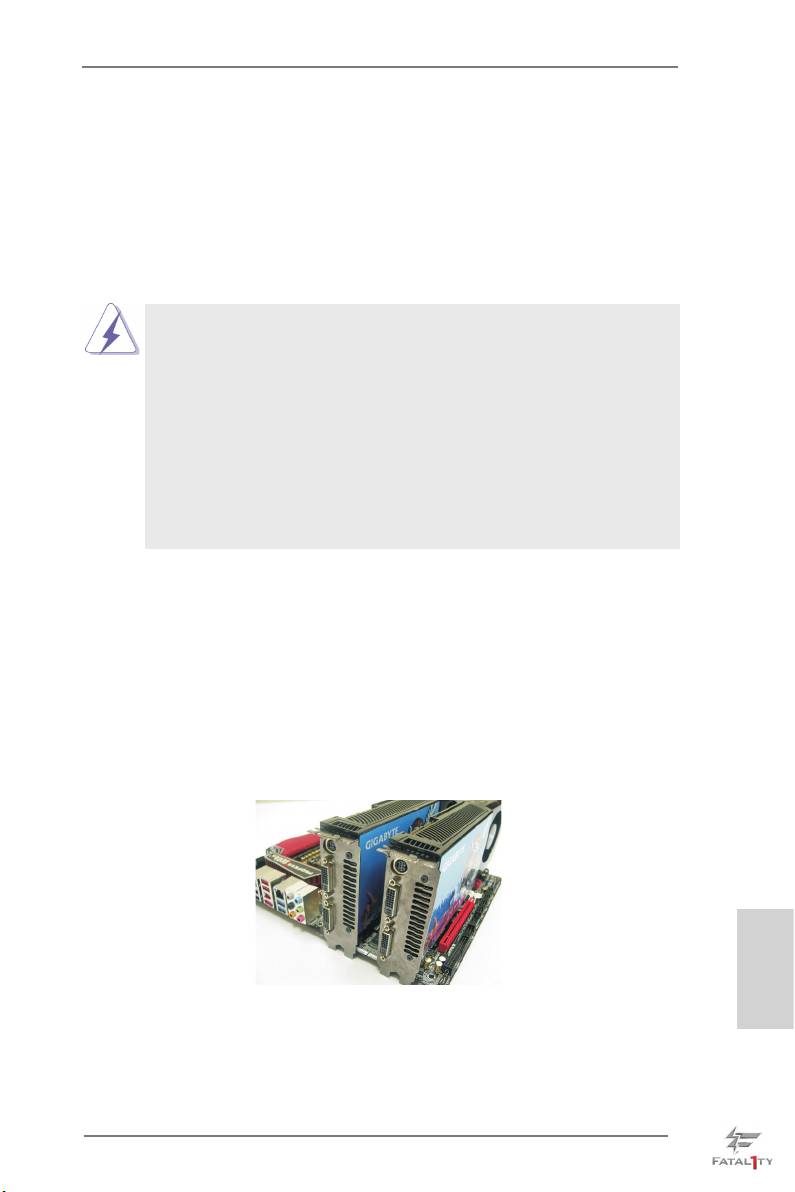
This motherboard supports NVIDIA
SLI
and Quad SLI
(Scalable Link Interface)
technology that allows you to install up to two identical PCI Express x16 graphics
®
TM
®
cards. Currently, NVIDIA
SLI
technology supports Windows
XP / XP 64-bit /
TM
TM
®
TM
Vista
/ Vista
64-bit / 7 / 7 64-bit OS. NVIDIA
Quad SLI
technology support
®
TM
TM
Windows
Vista
/ Vista
64-bit / 7 / 7 64-bit OS only. Please follow the installation
procedures in this section.
Requirements
1. For SLITM technology, you should have two identical SLITM-ready graphics
®
cards that are NVIDIA
certied. For Quad SLITM technology, you should
have two identical Quad SLITM-ready graphics cards (dual-GPU on each
®
graphics card) that are NVIDIA
certied.
®
TM
2. Make sure that your graphics card driver supports NVIDIA
SLI
®
technology. Download the driver from NVIDIA
website
(www.nvidia.com).
3. Make sure that your power supply unit (PSU) can provide at least the
minimum power required by your system. It is recommended to use
®
®
NVIDIA
certied PSU. Please refer to NVIDIA
website for details.
2.7.1 Graphics Card Setup
TM
2.7.1.1 Installing Two SLI
-Ready Graphics Cards
TM
®
Step 1. Install the identical SLI
-ready graphics cards that are NVIDIA
certied
because different types of graphics cards will not work together properly.
(Even the GPU chips version shall be the same.) Insert one graphics card
into PCIE2 slot and the other graphics card to PCIE4 slot. Make sure that
the cards are properly seated on the slots.
English
Step2. If required, connect the auxiliary power source to the PCI Express
graphics cards.
23
Fatal1ty Z77 Professional Series Motherboard
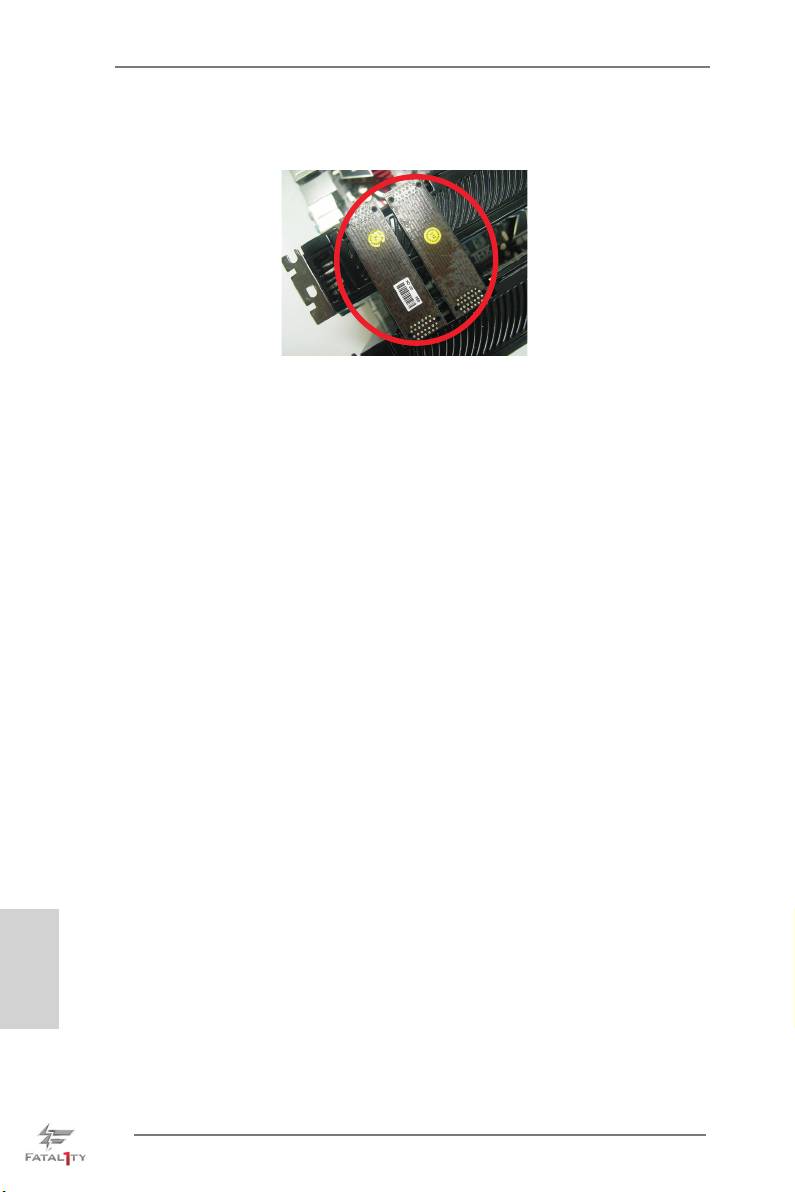
Step3. Align and insert SLI_Bridge_2S Card to the goldngers on each graphics
card. Make sure SLI_Bridge_2S Card is rmly in place.
Step4. Connect a VGA cable or a DVI cable to the monitor connector or the DVI
connector of the graphics card that is inserted to PCIE2 slot.
English
24
Fatal1ty Z77 Professional Series Motherboard
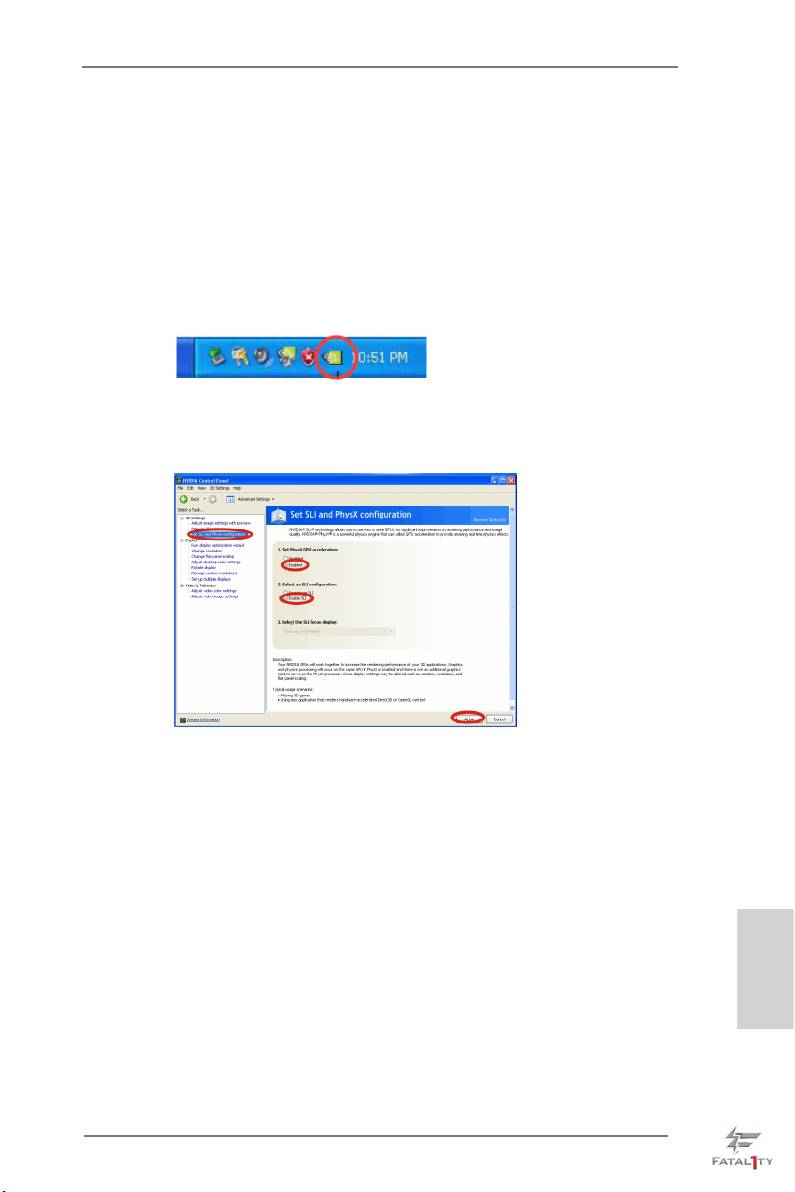
2.7.2 Driver Installation and Setup
Install the graphics card drivers to your system. After that, you can enable the Multi-
®
Graphics Processing Unit (GPU) feature in the NVIDIA
nView system tray utility.
Please follow the below procedures to enable the multi-GPU feature.
®
For Windows
XP / XP 64-bit OS:
TM
(For SLI
mode only)
®
A. Double-click NVIDIA Settings icon on your Windows
taskbar.
B. From the pop-up menu, select Set SLI and PhysX conguration. In
Set PhysX GPU acceleration item, please select Enabled. In Select
an SLI conguration item, please select Enable SLI. And click Apply.
C. Reboot your system.
TM
D. You can freely enjoy the benet of SLI
feature.
English
25
Fatal1ty Z77 Professional Series Motherboard
®
TM
TM
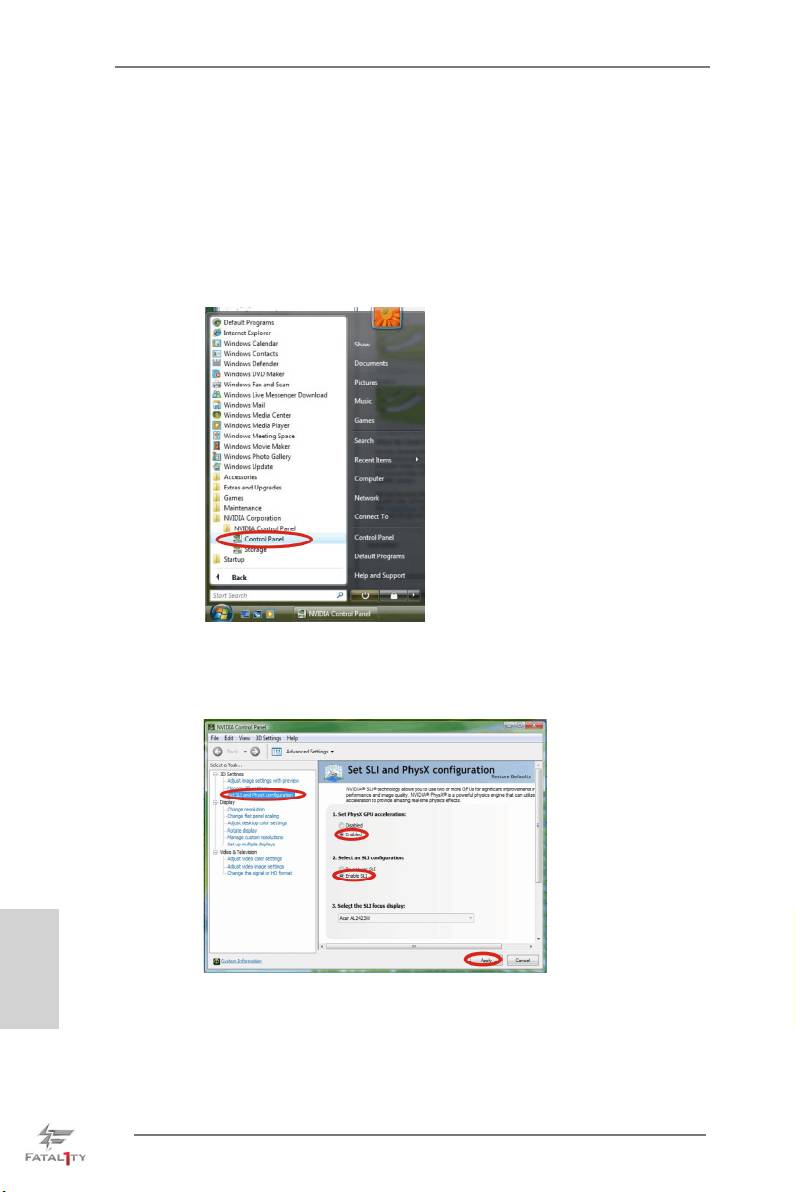
For Windows
Vista
/ Vista
64-bit / 7 / 7 64-bit OS:
TM
TM
(For SLI
and Quad SLI
mode)
A. Click the Start icon on your Windows taskbar.
B. From the pop-up menu, select All Programs, and then click NVIDIA
Corporation.
C. Select NVIDIA Control Panel tab.
D. Select Control Panel tab.
E. From the pop-up menu, select Set SLI and PhysX conguration. In
Set PhysX GPU acceleration item, please select Enabled. In Select
an SLI conguration item, please select Enable SLI. And click Apply.
English
F. Reboot your system.
TM
TM
G. You can freely enjoy the benet of SLI
or Quad SLI
feature.
TM
®
* SLI
appearing here is a registered trademark of NVIDIA
Technologies Inc., and is used
only for identication or explanation and to the owners’ benet, without intent to infringe.
26
Fatal1ty Z77 Professional Series Motherboard
TM
TM
2.8 CrossFireX
, 3-Way CrossFireX
and Quad
TM
CrossFireX
Operation Guide
TM
TM
This motherboard supports CrossFireX
, 3-way CrossFireX
and Quad
TM
TM
CrossFireX
feature. CrossFireX
technology offers the most advantageous
means available of combining multiple high performance Graphics Processing
Units (GPU) in a single PC. Combining a range of different operating modes with
TM
intelligent software design and an innovative interconnect mechanism, CrossFireX
enables the highest possible level of performance and image quality in any 3D
TM
®
application. Currently CrossFireX
feature is supported with Windows
XP with
TM
TM
TM
Service Pack 2 / Vista
/ 7 OS. 3-way CrossFireX
and Quad CrossFireX
feature
®
TM
are supported with Windows
Vista
/ 7 OS only. Please check AMD website for
TM
TM
ATI
CrossFireX
driver updates.
1. If a customer incorrectly congures their system they will not see the
TM
TM
performance benets of CrossFireX
. All three CrossFireX
components, a
TM
TM
CrossFireX
Ready graphics card, a CrossFireX
Ready motherboard and a
TM
CrossFireX
Edition co-processor graphics card, must be installed correctly to
TM
benet from the CrossFireX
multi-GPU platform.
TM
2. If you pair a 12-pipe CrossFireX
Edition card with a 16-pipe card, both cards
TM
will operate as 12-pipe cards while in CrossFireX
mode.
2.8.1 Graphics Card Setup
TM
2.8.1.1 Installing Two CrossFireX
-Ready Graphics Cards
TM
TM
Different CrossFireX
cards may require different methods to enable CrossFireX
TM
feature. For other CrossFireX
cards that AMD has released or will release in the
future, please refer to AMD graphics card manuals for detailed installation guide.
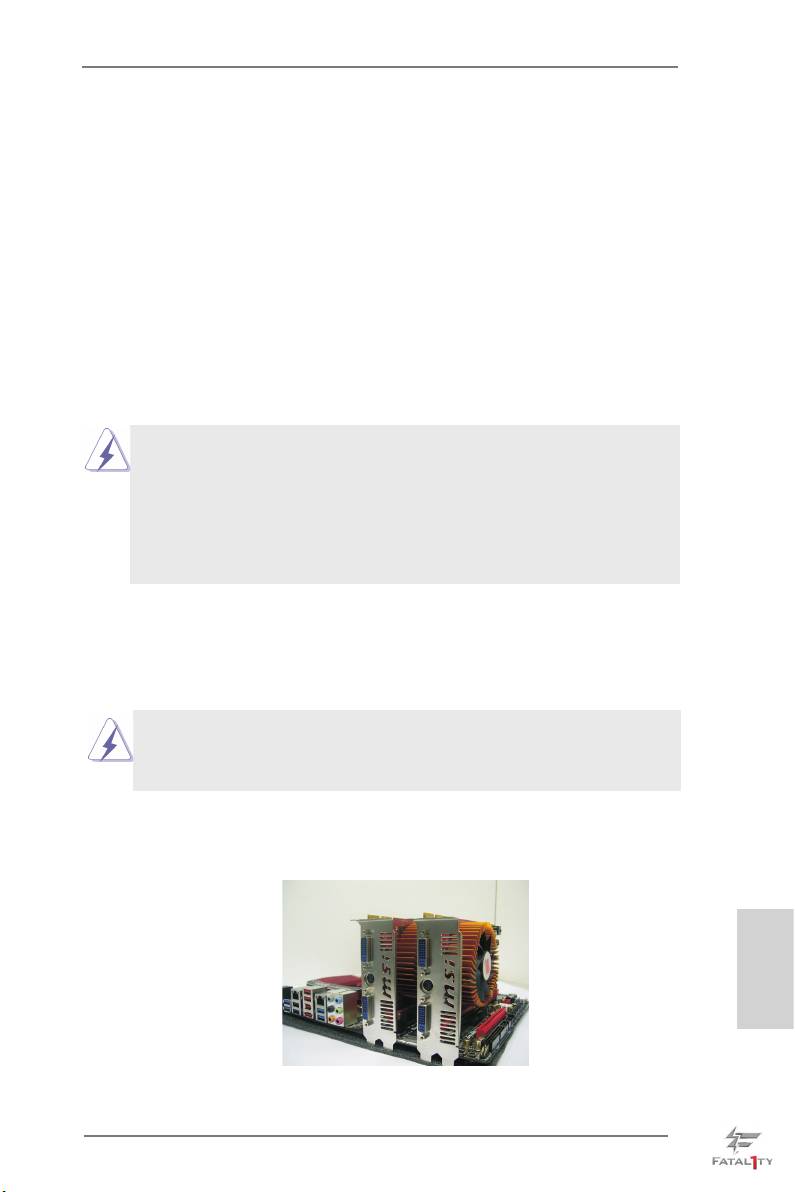
Step 1. Insert one Radeon graphics card into PCIE2 slot and the other Radeon
graphics card to PCIE4 slot. Make sure that the cards are properly seated
on the slots.
English
27
Fatal1ty Z77 Professional Series Motherboard
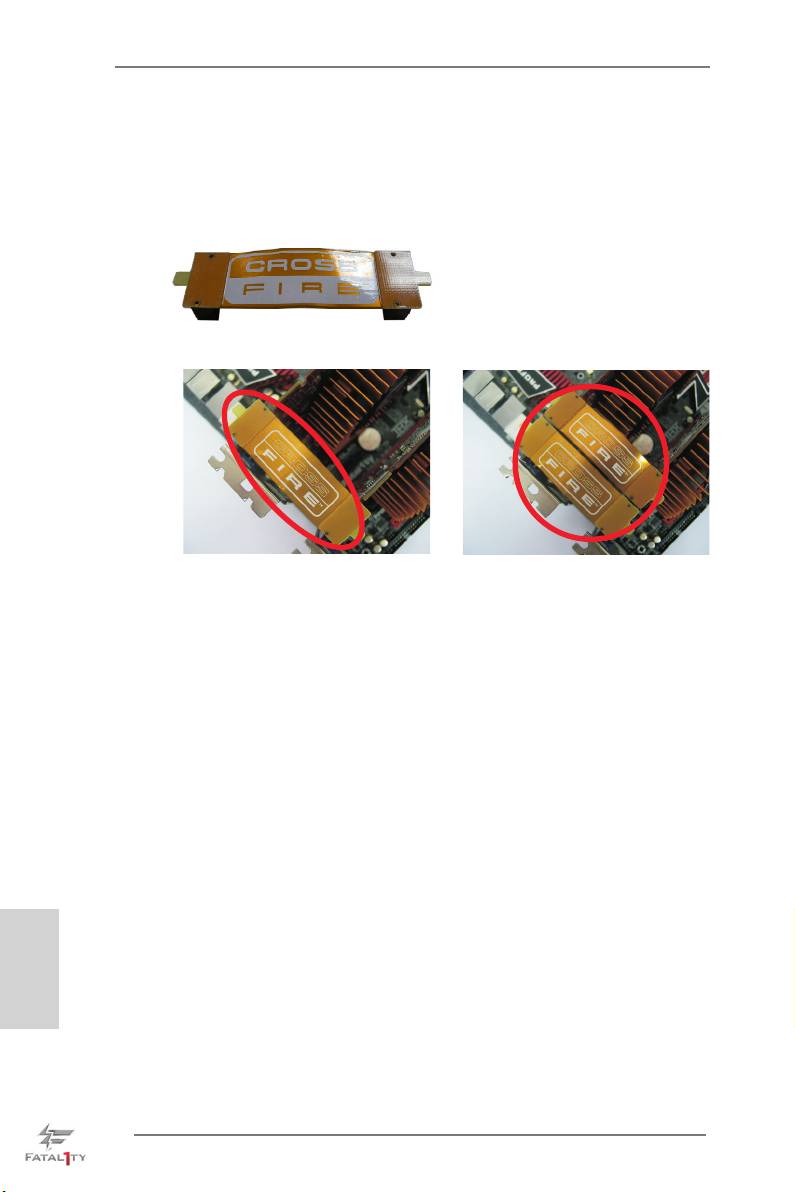
Step 2. Connect two Radeon graphics cards by installing CrossFire Bridge on
CrossFire Bridge Interconnects on the top of Radeon graphics cards.
(CrossFire Bridge is provided with the graphics card you purchase, not
bundled with this motherboard. Please refer to your graphics card vendor
for details.)
CrossFire Bridge
or
Step 3. Connect the DVI monitor cable to the DVI connector on the Radeon
graphics card on PCIE2 slot. (You may use the DVI to D-Sub adapter to
convert the DVI connector to D-Sub interface, and then connect the D-Sub
monitor cable to the DVI to D-Sub adapter.)
English
28
Fatal1ty Z77 Professional Series Motherboard
TM
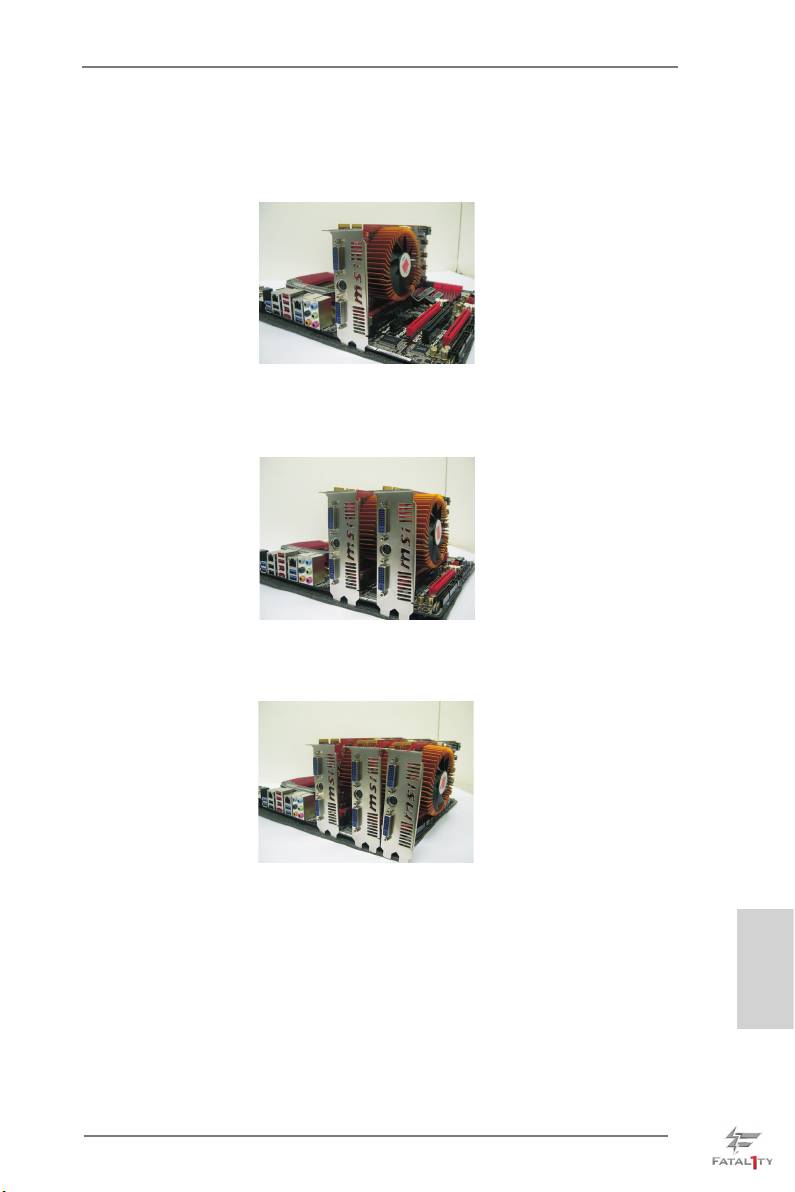
2.8.1.2 Installing Three CrossFireX
-Ready Graphics Cards
Step 1. Install one Radeon graphics card to PCIE2 slot. For the proper installation
procedures, please refer to section “Expansion Slots”.
Step 2. Install one Radeon graphics card to PCIE4 slot. For the proper installation
procedures, please refer to section “Expansion Slots”.
Step 3. Install one Radeon graphics card to PCIE5 slot. For the proper installation
procedures, please refer to section “Expansion Slots”.
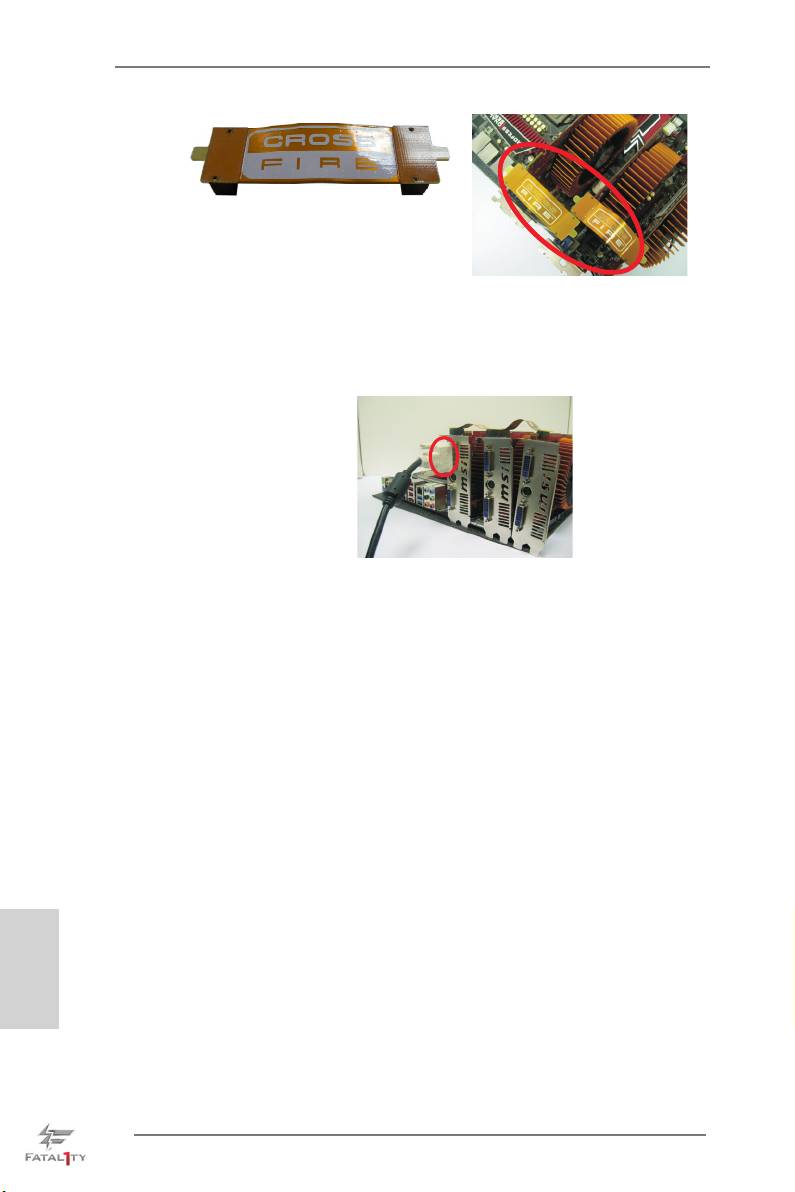
TM
Step 4. Use one CrossFire
Bridge to connect Radeon graphics cards on PCIE2
TM
and PCIE4 slots, and use the other CrossFire
Bridge to connect Radeon
TM
graphics cards on PCIE4 and PCIE5 slots. (CrossFire
Bridge is provided
with the graphics card you purchase, not bundled with this motherboard.
Please refer to your graphics card vendor for details.)
English
29
Fatal1ty Z77 Professional Series Motherboard
TM
CrossFire
Bridge
Step 5. Connect the DVI monitor cable to the DVI connector on the Radeon graph-
ics card on PCIE2 slot. (You may use the DVI to D-Sub adapter to convert
the DVI connector to D-Sub interface, and then connect the D-Sub monitor
cable to the DVI to D-Sub adapter.)
English
30
Fatal1ty Z77 Professional Series Motherboard
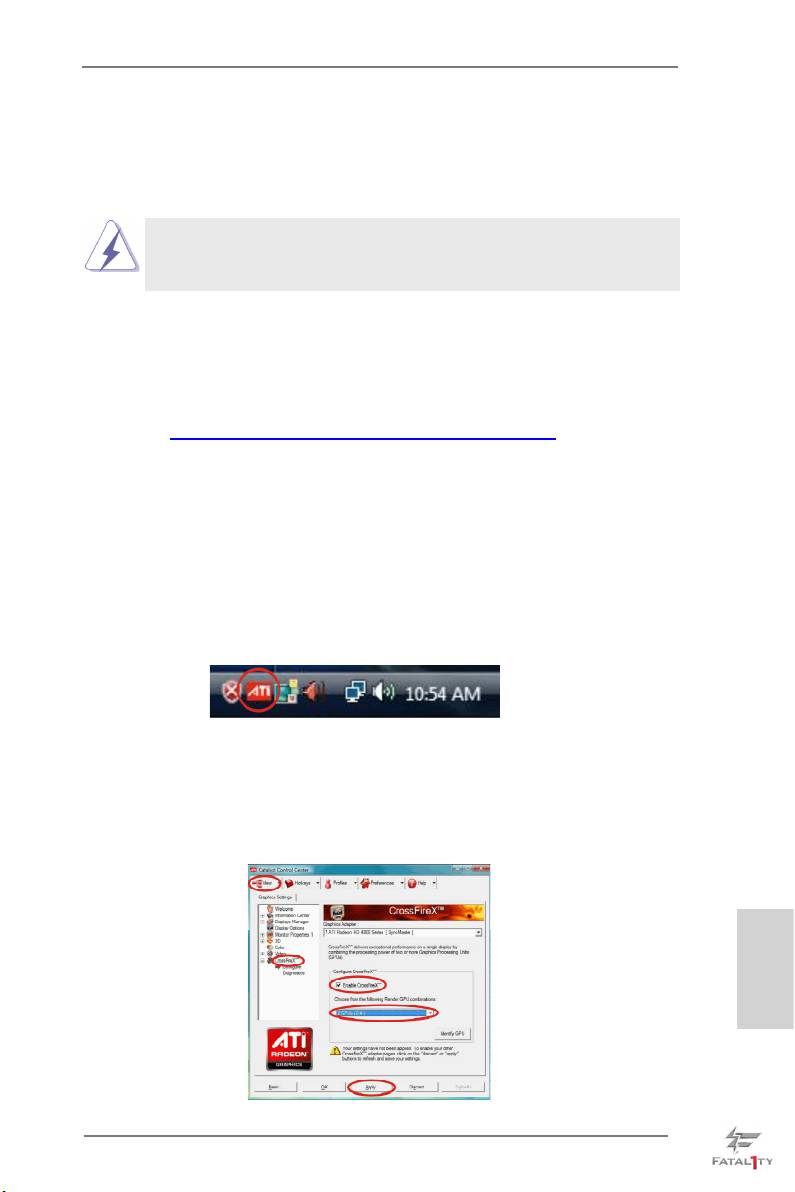
2.8.2 Driver Installation and Setup
Step 1. Power on your computer and boot into OS.
TM
Step 2. Remove the ATI
driver if you have any VGA driver installed in your
system.
The Catalyst Uninstaller is an optional download. We recommend using this
utility to uninstall any previously installed Catalyst drivers prior to installation.
TM
Please check AMD website for ATI
driver updates.
Step 3. Install the required drivers to your system.
®
For Windows
XP OS:
TM
®
A. ATI
recommends Windows
XP Service Pack 2 or higher to be
®
installed (If you have Windows
XP Service Pack 2 or higher installed
in your system, there is no need to download it again):
http://www.microsoft.com/windowsxp/sp2/default.mspx
B. You must have Microsoft .NET Framework installed prior to
downloading and installing the CATALYST Control Center. Please
check Microsoft website for details.
®
TM
For Windows
7 / Vista
OS:
Install the CATALYST Control Center. Please check AMD website for de-
tails.
Step 4. Restart your computer.
Step 5. Install the VGA card drivers to your system, and restart your computer.
®
Then you will nd “ATI Catalyst Control Center” on your Windows
taskbar.
ATI Catalyst Control Center
Step 6. Double-click “ATI Catalyst Control Center”. Click “View”, select “CrossFi-
TM
TM
reX
”, and then check the item “Enable CrossFireX
”. Select “2 GPUs”
and click “Apply” (if you install two Radeon graphics cards). Select “3
GPUs” and click “OK” (if you install three Radeon graphics cards).
English
31
Fatal1ty Z77 Professional Series Motherboard

TM
TM
Although you have selected the option “Enable CrossFire
”, the CrossFireX
function may not work actually. Your computer will automatically reboot. After
restarting your computer, please conrm whether the option “Enable
TM
CrossFire
” in “ATI Catalyst Control Center” is selected or not; if not, please
TM
select it again, and then you are able to enjoy the benet of CrossFireX
feature.
TM
TM
Step 7. You can freely enjoy the benet of CrossFireX
, 3-Way CrossFireX
or
TM
Quad CrossFireX
feature.
TM
TM
* CrossFireX
appearing here is a registered trademark of ATI
Technologies Inc., and is
used only for identication or explanation and to the owners’ benet, without intent to infringe.
TM
TM
* For further information of ATI
CrossFireX
technology, please check AMD website for
updates and details.
English
32
Fatal1ty Z77 Professional Series Motherboard
2.9 Dual Monitor and Surround Display Features
Dual Monitor Feature
This motherboard supports dual monitor feature. With the internal VGA output sup-
port (HDMI and DisplayPort), you can easily enjoy the benets of dual monitor fea-
ture without installing any add-on VGA card to this motherboard. This motherboard
also provides independent display controllers for HDMI and DisplayPort to support
dual VGA output so that HDMI and DisplayPort can drive same or different display
contents.
To enable dual monitor feature, please follow the below steps:
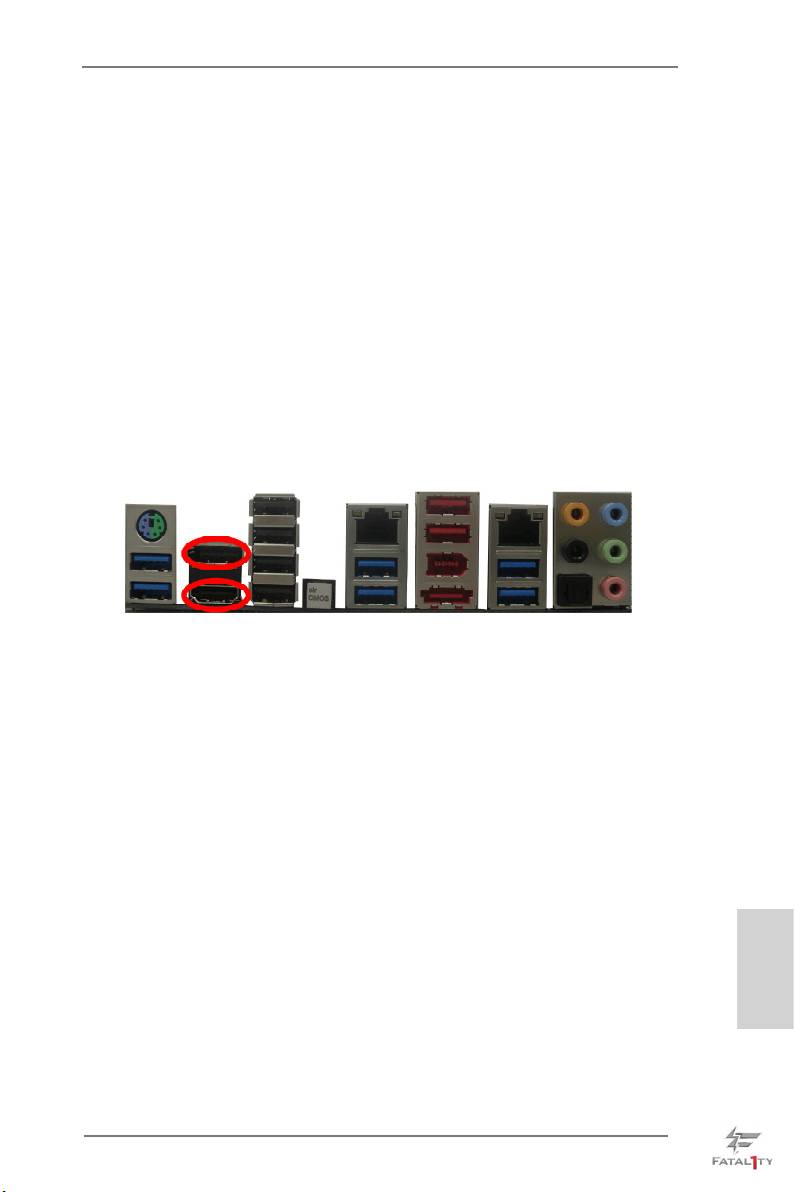
1. Connect HDMI monitor cable to HDMI port on the I/O panel, and connect
DisplayPort monitor cable to DisplayPort on the I/O panel.
DisplayPort
HDMI port
2. If you have installed onboard VGA driver from our support CD to your system
already, you can freely enjoy the benets of dual monitor function after your
system boots. If you haven’t installed onboard VGA driver yet, please install
onboard VGA driver from our support CD to your system and restart your
computer.
English
33
Fatal1ty Z77 Professional Series Motherboard

Surround Display Feature
This motherboard supports surround display upgrade. With the internal VGA output
support (HDMI and DisplayPort) and external add-on PCI Express VGA cards, you
can easily enjoy the benets of surround display feature.
Please refer to the following steps to set up a surround display environment:
1. Install the PCI Express VGA cards on PCIE2, PCIE4 and PCIE5 slots. Please
refer to page 21 for proper expansion card installation procedures.
2. Connect HDMI monitor cable to HDMI port on the I/O panel, and connect
DisplayPort monitor cable to DisplayPort on the I/O panel. Then connect other
monitor cables to the corresponding connectors of the add-on PCI Express VGA
cards on PCIE2, PCIE4 and PCIE5 slots.
3. Boot your system. Press <F2> or <Del> to enter UEFI setup. Enter “Share
Memory” option to adjust the memory capability to [32MB], [64MB], [128MB],
[256MB] or [512MB] to enable the function of D-sub. Please make sure that the
value you select is less than the total capability of the system memory. If you do
not adjust the UEFI setup, the default value of “Share Memory”, [Auto], will
disable D-Sub function when an add-on VGA card is inserted to this motherboard.
4. Install the onboard VGA driver and the add-on PCI Express VGA card driver to
your system. If you have installed the drivers already, there is no need to install
them again.
5. Set up a multi-monitor display.
®
For Windows
XP / XP 64-bit OS:
Right click on desktop, choose “Properties”, and select the “Settings” tab
so that you can adjust the parameters of the multi-monitors according to
the steps below.
A. Click the “Identify” button to display a large number on each monitor.
B. Right-click the display icon in the Display Properties dialog that you
wish to be your primary monitor, and then select “Primary”. When
you use multiple monitors with your card, one monitor will always be
Primary, and all additional monitors will be designated as Secondary.
C. Select the display icon identied by the number 2.
D. Click “Extend my Windows desktop onto this monitor”.
English
E. Right-click the display icon and select “Attached”, if necessary.
F. Set the appropriate “Screen Resolution” and “Color Quality” for the
second monitor. Click “Apply” or “OK” to apply these new values.
G. Repeat steps C through E for the display icon identied by the
numbers three to eight.
34
Fatal1ty Z77 Professional Series Motherboard

®
TM
TM
For Windows
7 / 7 64-bit / Vista
/ Vista
64-bit OS:
Right click the desktop, choose “Personalize”, and select the “Display
Settings” tab so that you can adjust the parameters of the multi-monitors
according to the steps below.
A. Click the number ”2” icon.
B. Click the items “This is my main monitor” and “Extend the desktop onto
this monitor”.
C. Click “OK” to save your change.
D. Repeat steps A through C for the display icons identied by the number
three to eight.
6. Use Surround Display. Click and drag the display icons to positions representing
the physical setup of your monitors that you would like to use. The placement of
display icons determines how you move items from one monitor to another.
HDCP Function
HDCP function is supported on this motherboard. To use HDCP
function with this motherboard, you need to adopt a monitor
that supports HDCP function as well. Therefore, you can enjoy
the superior display quality with high-denition HDCP
encryption contents. Please refer to the instructions below for
more details about HDCP function.
What is HDCP?
HDCP stands for High-Bandwidth Digital Content Protection, a
®
specication developed by Intel
for protecting digital
entertainment content that uses the DVI interface. HDCP is a
copy protection scheme to eliminate the possibility of
intercepting digital data midstream between the video source,
or transmitter - such as a computer, DVD player or set-top box -
and the digital display, or receiver - such as a monitor, television
or projector. In other words, HDCP specication is designed to
protect the integrity of content as it is being transmitted.
Products compatible with the HDCP scheme such as DVD
players, satellite and cable HDTV set-top-boxes, as well as few
English
entertainment PCs requires a secure connection to a compliant
display. Due to the increase in manufacturers employing HDCP
in their equipment, it is highly recommended that the HDTV or
LCD monitor you purchase is compatible.
35
Fatal1ty Z77 Professional Series Motherboard
2.10 Jumpers Setup
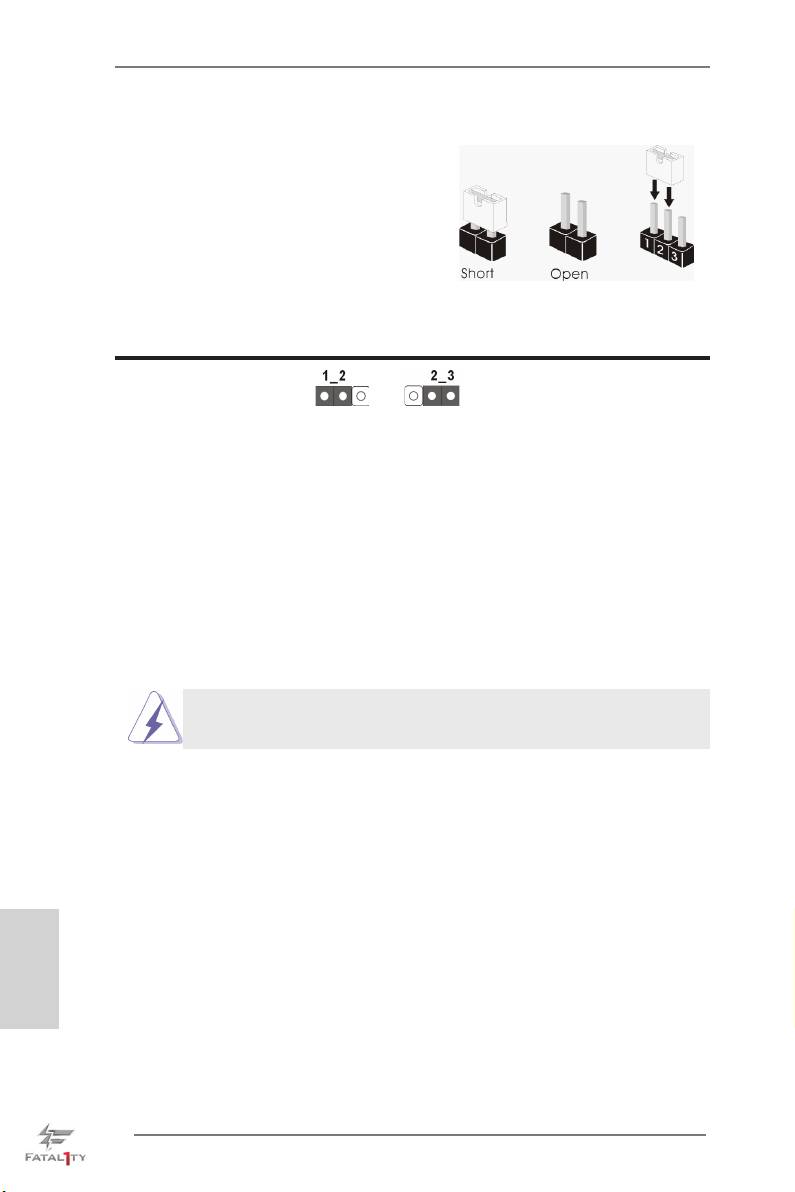
The illustration shows how jumpers are
setup. When the jumper cap is placed on
pins, the jumper is “Short”. If no jumper cap
is placed on pins, the jumper is “Open”. The
illustration shows a 3-pin jumper whose
pin1 and pin2 are “Short” when jumper cap
is placed on these 2 pins.
Jumper Setting Description
Clear CMOS Jumper
(CLRCMOS1)
(see p.4, No. 27)
Clear CMOSDefault
Note: CLRCMOS1 allows you to clear the data in CMOS. To clear and reset the
system parameters to default setup, please turn off the computer and unplug
the power cord from the power supply. After waiting for 15 seconds, use a
jumper cap to short pin2 and pin3 on CLRCMOS1 for 5 seconds. However,
please do not clear the CMOS right after you update the BIOS. If you need
to clear the CMOS when you just nish updating the BIOS, you must boot
up the system rst, and then shut it down before you do the clear-CMOS ac-
tion. Please be noted that the password, date, time, user default prole, 1394
GUID and MAC address will be cleared only if the CMOS battery is removed.
The Clear CMOS Switch has the same function as the Clear CMOS
jumper.
English
36
Fatal1ty Z77 Professional Series Motherboard
2.11 Onboard Headers and Connectors
Onboard headers and connectors are NOT jumpers. Do NOT place
jumper caps over these headers and connectors. Placing jumper caps
over the headers and connectors will cause permanent damage of the
motherboard!
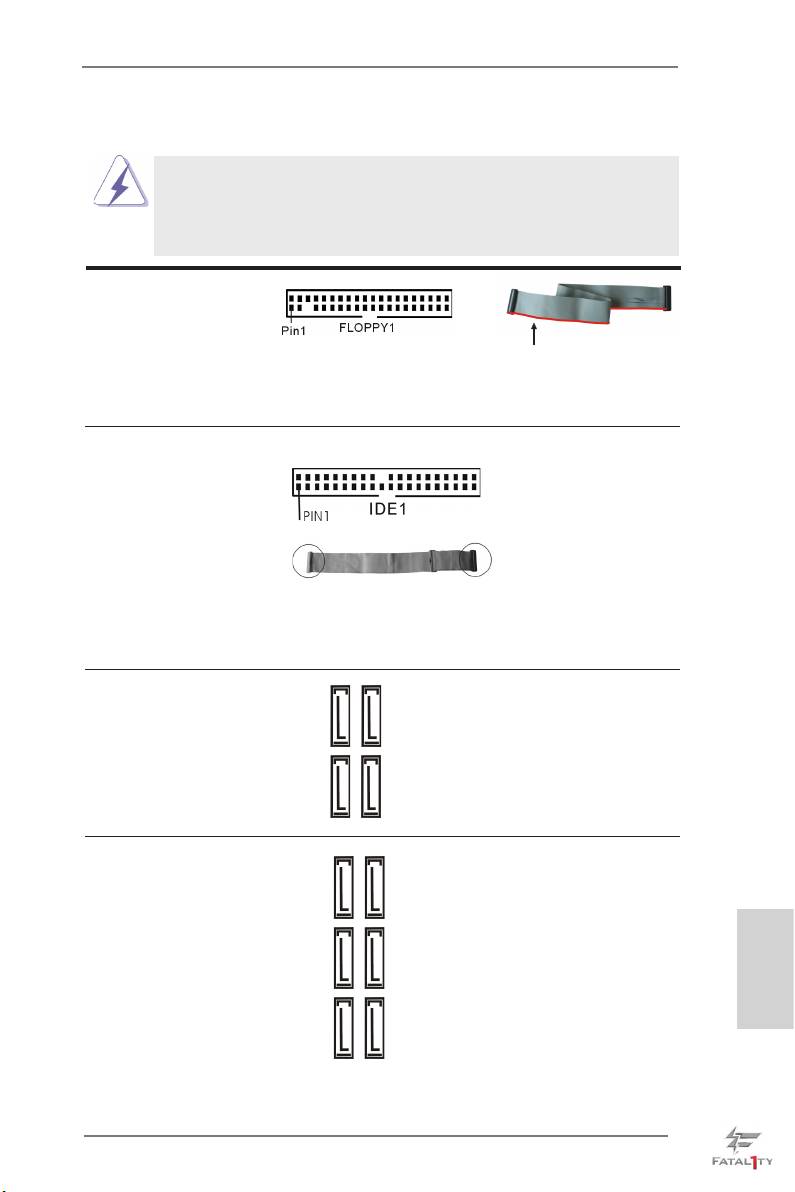
FDD connector
(33-pin FLOPPY1)
(see p.4 No. 30)
the red-striped side to Pin1
Note: Make sure the red-striped side of the cable is plugged into Pin1 side of the
connector.
Primary IDE connector (Black)
(39-pin IDE1, see p.4 No. 8)
connect the blue end
connect the black end
to the motherboard
to the IDE devices
80-conductor ATA 66/100/133 cable
Note: Please refer to the instruction of your IDE device vendor for the details.
Serial ATA2 Connectors These four Serial ATA2 (SATA2)
(SATA2_2_3: see p.4, No. 14)
connectors support SATA data
SATA2_2 SATA2_3
(SATA2_4_5: see p.4, No. 15)
cables for internal storage
devices. The current SATA2
interface allows up to 3.0 Gb/s
SATA2_4 SATA2_5
data transfer rate.
Serial ATA3 Connectors These six Serial ATA3 (SATA3)
(SATA3_0_1: see p.4, No. 13)
connectors support SATA data
SATA3_A3 SATA3_A4
(SATA3_A1_A2: see p.4, No. 12)
cables for internal storage
(SATA3_A3_A4: see p.4, No. 11)
devices. The current SATA3
interface allows up to 6.0 Gb/s
SATA3_A1 SATA3_A2
data transfer rate. If the eSATA3
port on the rear I/O has been
English
connected, the internal
SATA3_0 SATA3_1
SATA3_A4 will not function.
37
Fatal1ty Z77 Professional Series Motherboard
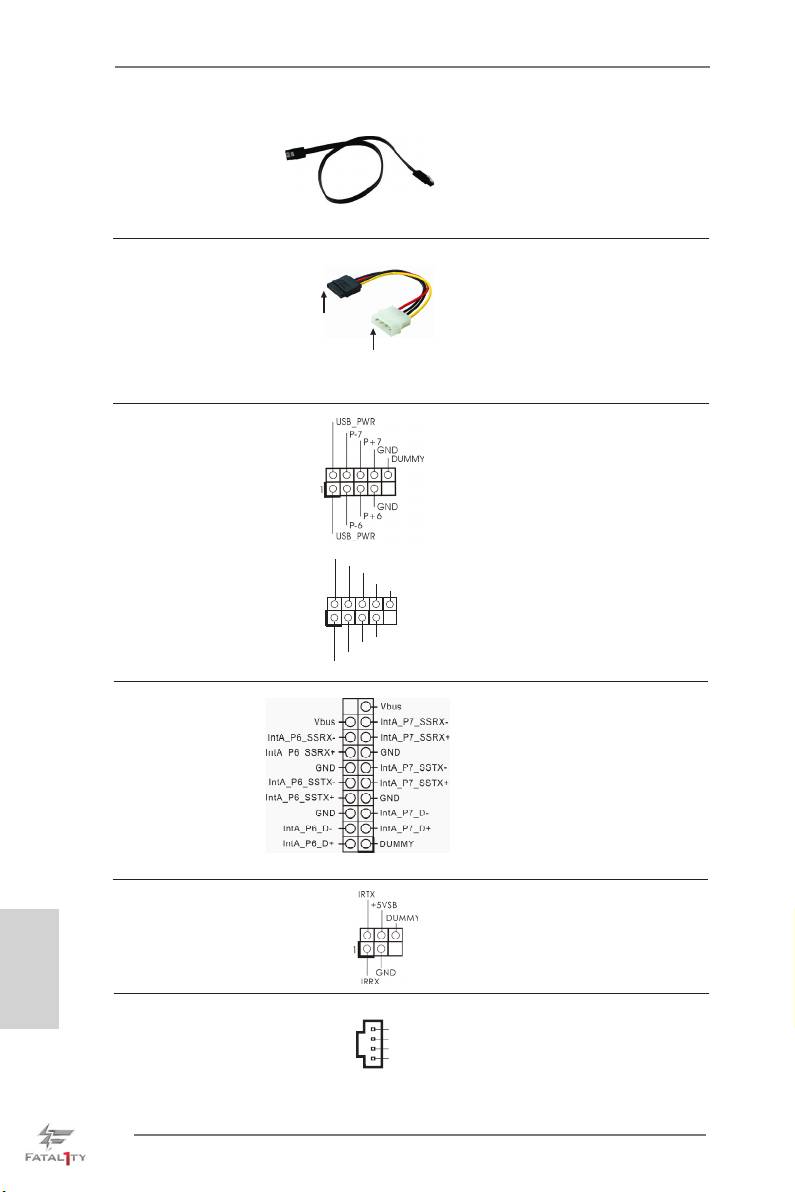
Serial ATA (SATA) Either end of the SATA data
Data Cable cable can be connected to the
(Optional)
SATA / SATA2 / SATA3 hard
disk or the SATA2 / SATA3
connector on this motherboard.
Serial ATA (SATA) Please connect the black end
Power Cable of SATA power cable to the
(Optional)
power connector on each drive.
Then connect the white end of
SATA power cable to the power
connect to the
power supply
connector of the power supply.
USB 2.0 Headers Besides six default USB 2.0
(9-pin USB_6_7)
ports on the I/O panel, there are
(see p.4, No. 24)
two USB 2.0 headers on this
motherboard. Each USB 2.0
header can support two USB 2.0
ports.
U SB_PWR
(9-pin USB_8_9)
P-9
P +9
GND
(see p.4, No. 25)
DUMMY
1
GND
P +8
P-8
U SB_PWR
USB 3.0 Header Besides six default USB 3.0
(19-pin USB3_6_7)
ports on the I/O panel, there is
(see p.4, No. 9)
one USB 3.0 header on this
motherboard. This USB 3.0
header can support two USB 3.0
ports.
Infrared Module Header This header supports an
(5-pin IR1)
optional wireless transmitting
English
(see p.4, No. 29)
and receiving infrared module.
Internal Audio Connectors This connector allows you
(4-pin CD1)
to receive stereo audio input
(CD1: see p.4 No. 42)
from sound sources such as
a CD-ROM, DVD-ROM, TV
CD1
tuner card, or MPEG card.
38
Fatal1ty Z77 Professional Series Motherboard
C D -L
GND
GND
C D -R
connect to the SATA
HDD power connector
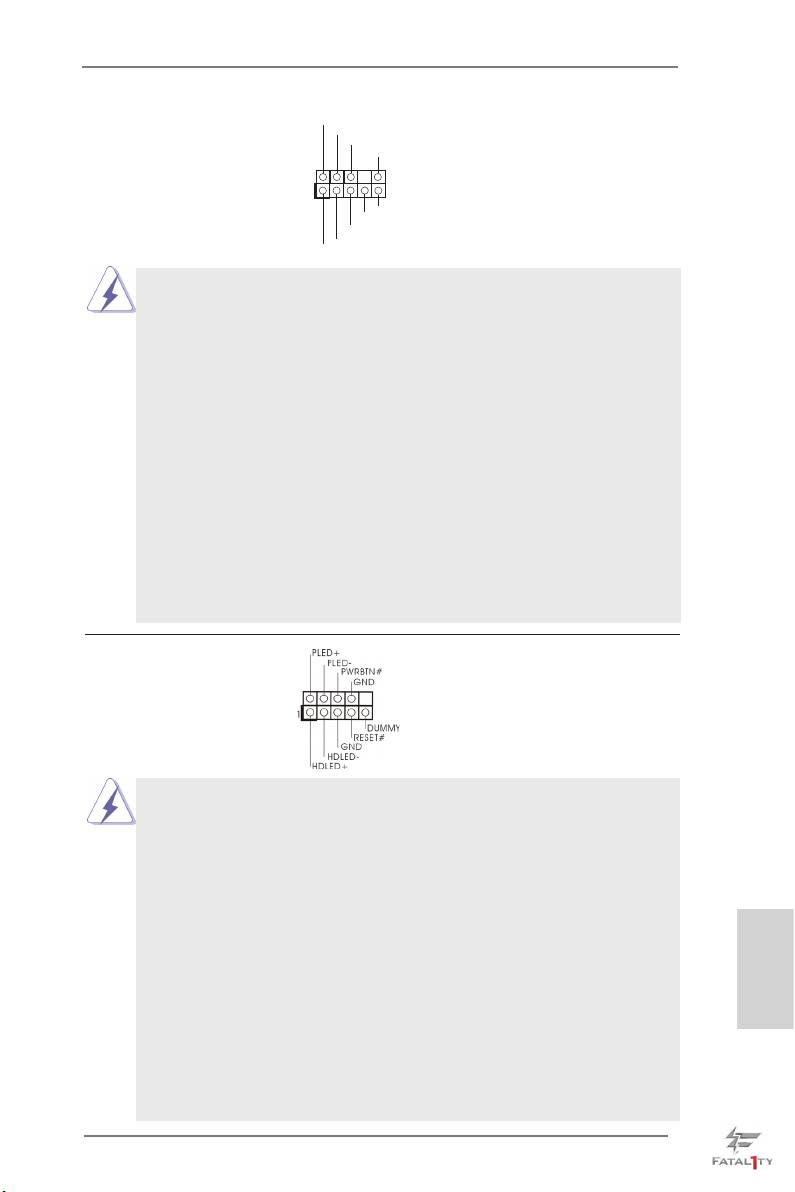
Front Panel Audio Header This is an interface for front
GND
P RESENCE#
M IC_RET
(9-pin HD_AUDIO1)
panel audio cable that allows
OUT_RET
(see p.4, No. 32)
convenient connection and
1
control of audio devices.
O UT2_L
J _SENSE
O UT2_R
M IC2_R
M IC2_L
1. High Denition Audio supports Jack Sensing, but the panel wire on the
chassis must support HDA to function correctly. Please follow the
instruction in our manual and chassis manual to install your system.
2. If you use AC’97 audio panel, please install it to the front panel audio
header as below:
A. Connect Mic_IN (MIC) to MIC2_L.
B. Connect Audio_R (RIN) to OUT2_R and Audio_L (LIN) to OUT2_L.
C. Connect Ground (GND) to Ground (GND).
D. MIC_RET and OUT_RET are for HD audio panel only. You don’t need
to connect them for AC’97 audio panel.
E. To activate the front mic.
®
For Windows
XP / XP 64-bit OS:
Select “Mixer”. Select “Recorder”. Then click “FrontMic”.
®
TM
TM
For Windows
7 / 7 64-bit / Vista
/ Vista
64-bit OS:
Go to the “FrontMic” Tab in the Realtek Control panel. Adjust
“Recording Volume”.
System Panel Header This header accommodates
(9-pin PANEL1)
several system front panel
(see p.4, No. 21)
functions.
Connect the power switch, reset switch and system status indicator on the
chassis to this header according to the pin assignments below. Note the
positive and negative pins before connecting the cables.
PWRBTN (Power Switch):
Connect to the power switch on the chassis front panel. You may congure
the way to turn off your system using the power switch.
RESET (Reset Switch):
Connect to the reset switch on the chassis front panel. Press the reset
switch to restart the computer if the computer freezes and fails to perform a
normal restart.
English
PLED (System Power LED):
Connect to the power status indicator on the chassis front panel. The LED
is on when the system is operating. The LED keeps blinking when the sys-
tem is in S1/S3 sleep state. The LED is off when the system is in S4 sleep
state or powered off (S5).
39
Fatal1ty Z77 Professional Series Motherboard
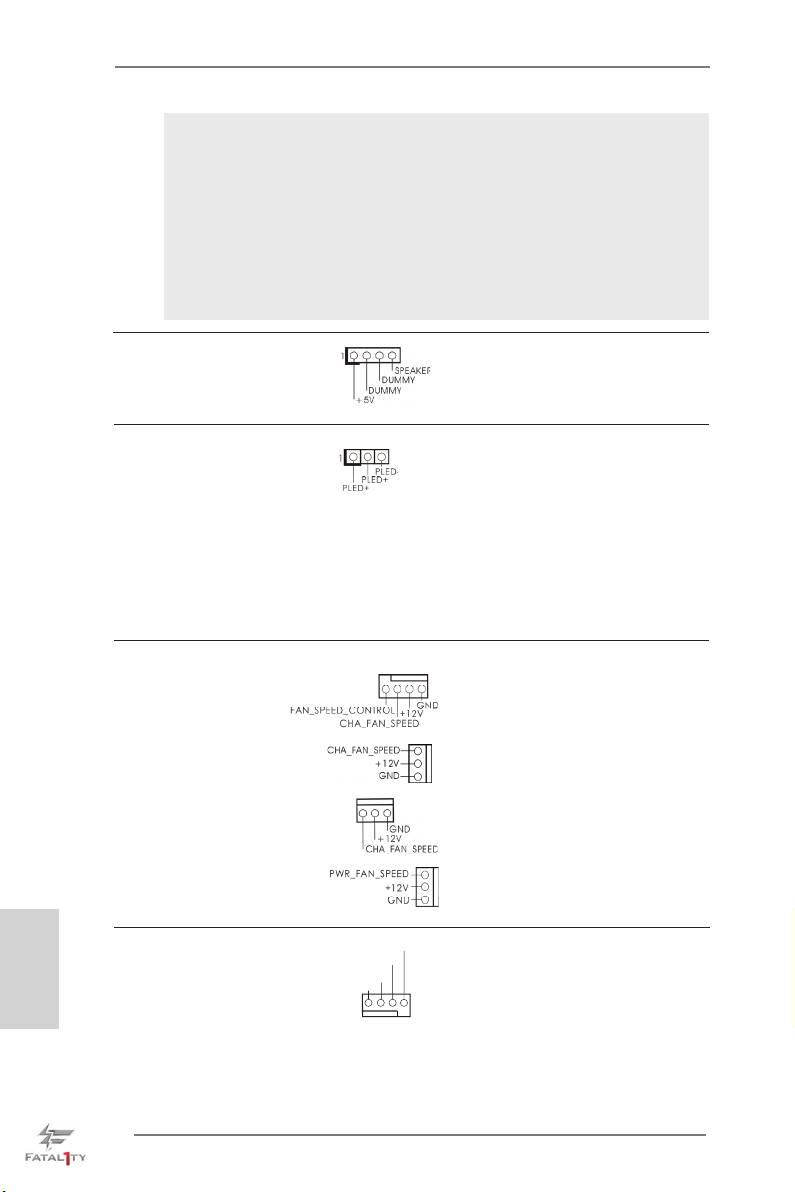
HDLED (Hard Drive Activity LED):
Connect to the hard drive activity LED on the chassis front panel. The LED
is on when the hard drive is reading or writing data.
The front panel design may differ by chassis. A front panel module mainly
consists of power switch, reset switch, power LED, hard drive activity LED,
speaker and etc. When connecting your chassis front panel module to this
header, make sure the wire assignments and the pin assign-ments are
matched correctly.
Chassis Speaker Header Please connect the chassis
(4-pin SPEAKER 1)
speaker to this header.
(see p.4, No. 20)
Power LED Header Please connect the chassis
(3-pin PLED1)
power LED to this header to
(see p.4, No. 19)
indicate system power status.
The LED is on when the system
is operating. The LED keeps
blinking in S1/S3 state. The
LED is off in S4 state or S5
state (power off).
Chassis and Power Fan Connectors Please connect the fan cables
(4-pin CHA_FAN1)
to the fan connectors and match
(see p.4, No. 26)
the black wire to the ground pin.
CHA_FAN1, CHA_FAN2 and
(3-pin CHA_FAN2)
CHA_FAN3 support Fan
(see p.4, No. 43)
Control.
(3-pin CHA_FAN3)
(see p.4, No. 22)
(3-pin PWR_FAN1)
(see p.4, No. 41)
English
CPU Fan Connectors Please connect the CPU fan
FAN_SPEED_CONTROL
CPU_FAN_SPEED
(4-pin CPU_FAN1)
cable to the connector and
+ 12V
GND
(see p.4, No. 3)
match the black wire to the
ground pin.
1 2 3 4
40
Fatal1ty Z77 Professional Series Motherboard
