
Dimplex DAB15W: UK
UK: Dimplex DAB15W
Installation and Operating Instructions
IMPORTANT: THESE INSTRUCTIONS SHOULD BE READ CAREFULLY AND RETAINED FOR FUTURE REFERENCE
UK
IMPORTANT SAFETY ADVICE
DO NOT COVER OR OBSTRUCT the air inlet or outlet grille.
ENSURE THE APPLIANCE IS EARTHED.
Do not use this heater in areas where excessive dust exists.
This heater must not be located immediately above or below a fixed
socket outlet or connection box.
Always disconnect supply before working on the product.
A suitable termination to the fixed wiring of the premises must be
provided adjacent to the final position of the appliance.
This product should be mounted safely to solid wall or ceiling
surfaces only.
This product must not be subjected to water spray or immersion.
Ensure the supply cables are of adequate current carrying capacity
and are protected by a suitable fuse.
If the appliance is mounted in a toilet or washroom, the appliance
should be mounted such that no part of it can be touched by a
person using a fixed bath or shower.
If the appliance is mounted in a toilet or washroom an isolating
switch must be provided outside the washroom adjacent to the
entrance door.
This appliance is not intended for use by persons (including chil-
dren) with reduced physical, sensory or mental capabilities, or lack
of experience and knowledge, unless they have been given supervi-
sion or instruction concerning use of appliance by a person re-
sponsible for their safety.
This heater is not equipped with a device to control the room tem-
perature. Do not use this heater in small rooms when they are
occupied by persons not capable of leaving the room, unless con-
stant supervision is provided.
WARNING: Isolate electrical supply to ALL modular linked units
when carrying out maintenance.
Models
Electrical
The installation of this appliance should be carried out by a competent electrician
and be in accordance with the current IEE wiring regulations.
Dimplex Compact Air Barriers Models : CAB10E, CAB15E, CAB10W, CAB15W, CAB10A, & CAB15A DAB10E, DAB15E, DAB10W, DAB15W, DAB10A, & DAB15A
(1)
Fixing Positions
This appliance may be either wall-mounted or fixed to a ceiling - see Fig. 3 for
various fixing positions and ‘Mounting’ sections below, for fixing details. A mini-
mum distance of 100mm is required from top of the appliance to ceiling (see ‘a’ in
Fig. 1) and also the distance between the bottom of the appliance and the top of the
door should be kept to a minimum (see ‘b’ in Fig. 1).
Wall Mounting
Using the wall mounting bracket as a guide (see Fig. 2) mark off hole positions on
the wall (a minimum height of 2.0 metres is required from the floor level to the
bottom of the bracket). Position the bracket such that the air outlet of the installed
air barriers will be as close to the top of the doorway as possible but will remain
unobstructed when installation is complete.
Solid brick or concrete block walls must be drilled and plugged (using a spirit level as
a guide - see ‘x’ in Fig. 2 - to ensure the bracket is level) with rawlplug No. 8 size fibre
inserts. The plug must be located in the solid part of the wall and not just in the
plaster layer.
When fixing to ‘panel’ walls, the wall bracket should be attached to the stud-work
using No. 8 wood screws or by an alternative, equally secure method of fixing.
Once the wall bracket has been fitted, the air barrier can be clipped in place as
shown in Fig. 3a.
Ceiling Mounting
By using threaded inserts in the top panel of the air barrier, attachment to a ceiling
over the product can be achieved using suitable M8 threaded steel rod or similar
supports of sufficient strength - see Fig. 3b.
Electrical connection
All products are fitted with a microprocessor control. Electrical power and control
connections are made as shown in Fig. 6. A suitable local isolating switch must be
provided in the electrical supply circuit with at least 3mm clearance on each pole.
In order to access the electrical connections, remove the outlet grilles (‘x’, and ‘y’
in Fig. 4) by releasing the quick release fasteners and hinging the mouldings as
shown. Remove the bottom panel (‘z’ in Fig. 4) and also remove the pressure plate
(‘w’ in Fig. 4).
All Electric Models
- Having removed a ‘knock out’ in the top panel, feed an
appropriate supply cable (see ‘a’ in Fig. 6A) through a suitable cable gland (not
supplied) fitted in the top panel and attach to the terminal block (see ‘b’ in Fig. 6A).
All Water heated and Ambient Models
- Having removed a 'knock out'
in the top panel, feed an appropriate supply cable (see 'a' in Fig. 6B) through a
suitable cable gland (not supplied) fitted in the top panel and attach to the PCB (see
'b' in Fig. 6B).
All Models
- A suitable cable (CAT5 or equivalent) for a switch panel (kit ref. -
CABC5 for electrically heated models or CABC6 for water heated/ambient models)
can be similarly introduced through the top panel and plugged into the circuit board
as shown in Fig. 6A & 6B. If the unit is to be operated in conjunction with a door
switch, a normally open switch should be wired as per Fig. 7 & 8 as appropriate.
Note: If using a door switch, an additional 2 core (low Voltage) cable is required
between the door switch and the air barriers.
If the unit is to be connected to a Building Energy Management System, connections
are made as per Fig. 7 & 8 as appropriate. Ensure that the air curtain is securely
fastened in position and that the supply cables are firmly clamped before operating
the appliance.
Water connection
Models designed for use in conjunction with a low pressure hot water supply should
be individually connected (in a parallel circuit) to the flow and return pipe-work.
Connections (see ‘a’ in Fig. 5) are: ½ “BSPT (CAB series) and ¾” BSPT (DAB series)
and isolation valves (see ‘b’ in Fig. 5) should be fitted as close to the air barrier
connection points as possible. For commissioning, air bleed valves (see ‘c’ in Fig.
5) are fitted to the coil, which can be accessed by removal of the lower panel and
intake grille - see Fig. 4. The drain (see ‘d’ in Fig. 5) can also be accessed when the
grille and lower panel is removed.
Maximum water supply conditions are 125ºC and 8 bar.
To aid installation, the water coil connections may be moved to either side of the
appliance. By removing the water coil and appropriate knockouts the water coil can
then be re-inserted into the required orientation. This procedure should be carried out
before mounting the appliance.
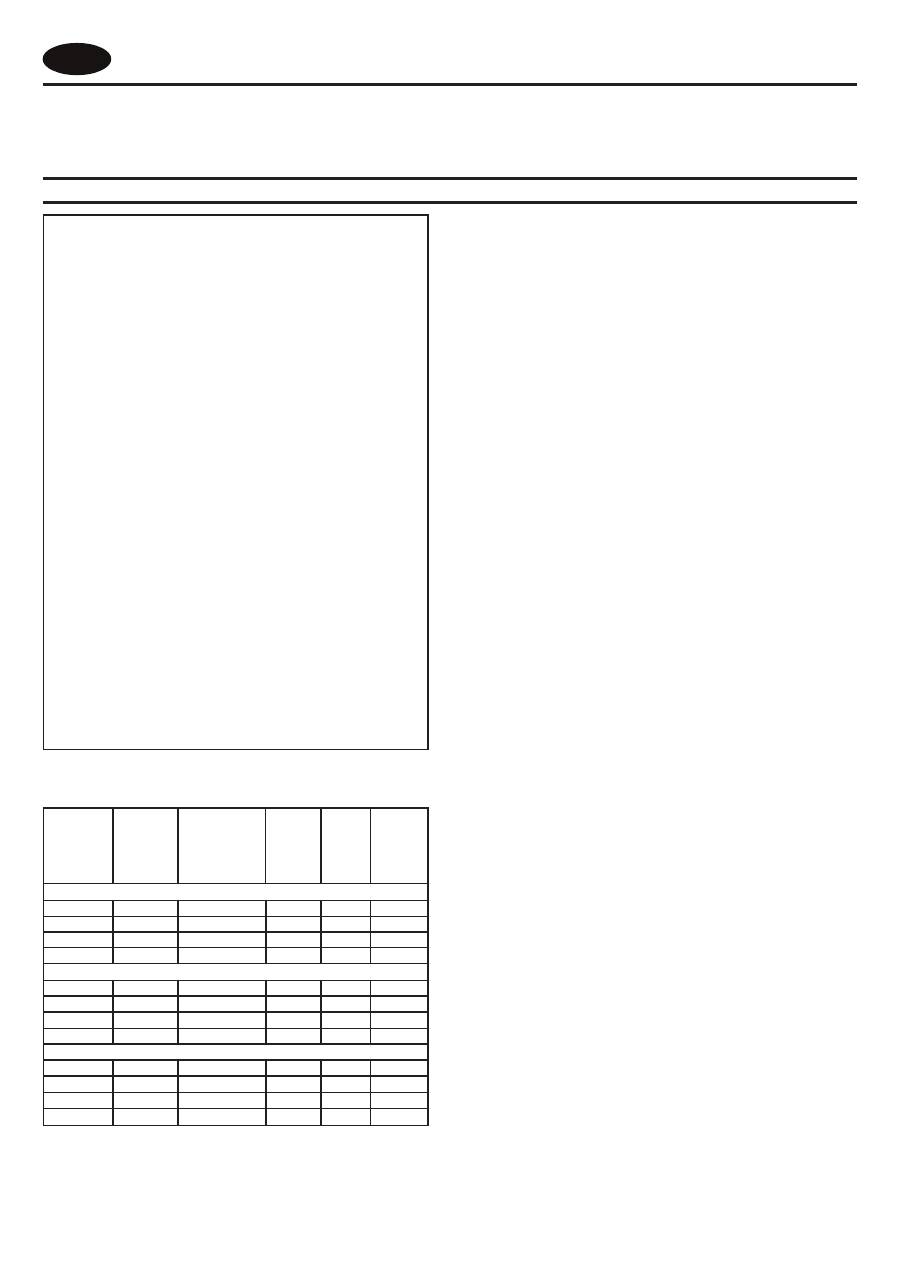
AMBIENT / COLD STORE
CAB10A
n/a
220-240V ~1PN
0.3
15.5
2.7
CAB15A
n/a
220-240V ~1PN
0.5
21.5
2.7
DAB10A
n/a
220-240V ~1PN
1.5
21.5
4.0
DAB15A
n/a
220-240V ~1PN
2.3
27.5
4.0
ELECTRICALLY HEATED
CAB10E
4.5 / 9.0
380-415V ~3PN
14
20.5
2.7
CAB15E
6.75 / 13.5
380-415V ~3PN
20
29
2.7
DAB10E
6.0 / 12.0
380-415V ~3PN
18
26.5
4.0
DAB15E
9.0 / 18.0
380-415V ~3PN
27
35
4.0
WATER HEATED (at 82/71 °C - LPHW)**
CAB10W
9.0
220-240V ~1PN
0.3
17.7
2.7
CAB15W
13.5
220-240V ~1PN
0.5
24.6
2.7
DAB10W
12.0
220-240V ~1PN
1.5
24.7
4.0
DAB15W
18.0
220-240V ~1PN
2.3
31.9
4.0
Model
Heat
output
kW
Electrical
Supply
Electrical
load
A
Weight
Kg
Max
Installed
height
m
Switch Panel Installation
The backing box (standard double gang) should be rebated into a suitable wall. The
box should be fitted so that the switch panel will be flush with the wall. Suitable
conduit should be used where applicable to carry the cable between the heater and
the switch. A CAT5 LAN cable with straight through connections should be used to
connect the switch panel to the appliance PCB.
Warning: Ensure cable is secure and the cable path does not come into contact
with heater element or other moving parts. Test all switch settings once installation
is complete.
Electrically heated variants
Operation using switch box - CABC5
Switch on electrical supply to the air curtain. Rotate the switch to the desired heat
setting. Settings available are;
OFF - Low Fan - Low Fan with Low Heat &
High Fan - High Fan with Low Heat - High Fan with Full Heat
The rocker (auto / manual) switch allows for manual over-ride of a door switch if
fitted. Manual allows the appliance to run at the desire setting, while Auto provides
an energy saving feature by shutting down the appliance while the door is closed.
The unit should always be switched OFF using the switch box control, and
not by mains power supply interruption.
When the unit is switched off (via the switch box) the fan will run on for 1 minute
without heat to discharge any residual energy from the heating elements.
When first turned on the control will run through a system check. The selected
settings will be reached and maintained after a 30 second period.
Thermostatic control (optional)
By including a single pole bi-metallic or electronic thermostat to the connections as
per 'C' in Fig. 7 the following functionality is introduced dependant on heat switch
setting.
- Fan only
- No effect
- Half Heat
- Heater will reduce to Fan only
- Full Heat
- Heater will reduce to Half Heat
Thermal Safety cut outs
The power supply to the heating elements will be interrupted if one or a combination
of the following abnormal events occur:
1.
Air inlet or outlet grilles are obstructed.
2.
Internal ventilation is impaired due to build up of dust and fluff.
3.
Blower unit stalls.
To reset the thermal safety cut-outs, access reset buttons as shown in Fig. 9.
Before re-setting the reason for activation must be determined and corrective
action taken.
Door switch control (Electric models)
By including a door switch in the circuit as per ‘D’ in Fig. 7, the air barrier will respond
to door openings as follows:
(1)
Door opening will energise the air barrier at the set conditions (switch box
settings).
(2)
On door closure operation will continue at the set conditions for a
further 1 minute.
(3)
Between 1 minute and 2 minutes from door closure, set back
operation, ½ heat (if heat selected) and ½ fan will activate.
(4)
Between 2 minutes and 3 minutes, the fan only (½ speed) shut down
cycle will be engaged.
(5)
After 3 minutes, the air curtain will return to a dormant state until the door
is re opened.
If the door re-opens during this 3 minute run on cycle, the process
will restart at (1).
Low pressure hot water heated / Ambient (fan only) variants
Operation using switch box - CABC6
Switch on electrical supply to the air curtain. Rotate the switch to the desired heat
setting. Settings available are;
OFF - Low Fan - High Fan
The rocker (auto / manual) switch allows for manual over-ride of a door switch if
fitted. Manual allows the appliance to run at the desire setting, while Auto provides
an energy saving feature by shutting down the appliance while the door is closed.
The unit should always be switched OFF using the switch box control, and not by
mains power supply interruption.
When first turned on the control will run through a system check. The selected
settings will be reached and maintained after a 30 second period.
Thermostatic control (optional)
1) A thermostatic regulation valve with a remote sensing bulb (not supplied) can be
positioned in the supply water pipe-work to regulate the heat output.
2) An electrical 3-Port Solenoid Valve can also be connected into the system. Please
contact your service agent using the contact details for more details.
Door switch control (Water / Ambient models)
By including a door switch in the circuit as shown in Fig. 8 as appropriate, the air
barrier will respond to door openings as follows:
(1)
Door opening will energise the air barrier at the set conditions
(switch box settings).
(2)
On door closure operation will continue at the set conditions for a
further 1 minute.
(3)
Between 1 minute and 2 minutes from door closure ½ fan set back
operation will activate.
(4)
After 2 minutes, the air barrier will return to a dormant state until the
door is re-opened.
If the door re-opens during this 2 minute run on cycle, the process will
re start at (1).
Wiring Diagrams
CAB & DAB ‘E’ - Electric models - see Fig. 7
CAB & DAB ‘W’ & ‘A’ - Water & Ambient models - see Fig. 8
C -
Thermostat
D -
Door Switch (Optional)
E -
Thermal Safety Cut-out Circuit
F -
Elements
G -
BMS Switches (Optional) (S, S1, S2)
M -
Motor
Remote (BMS / BEMS) Operation
Connection to Building Energy Management Control Systems (BEMS) is possible so
that remote control of the air-barrier can be carried out in conjunction with other
equipment.
Modular Connection
Refer to instructions provided with the modular linking kit.
Recessed Installation
Refer to instructions provided with the recess installation kit.
Recycling
For electrical products sold within the European Community.
At the end of the electrical products useful life it should not be
disposed of with household waste. Please recycle where facilities
exist. Check with your Local Authority or retailer for recycling advice
in your country.
Cleaning
WARNING: DISCONNECT SUPPLY before carrying out maintenance.
External appearance can be maintained by wiping occasionally with a damp cloth ;
for stain removal, a weak soap solution can be applied with a cloth and the surface
wiped dry. Care must be taken to avoid any moisture ingress into the product.
After Sales Service
Should you require after sales service or should you need to purchase any spares,
please contact the retailer from whom the appliance was purchased or contact the
service number relevant to your country on the warranty card.
Please do not return a faulty product to us in the first instance as this may result in
loss or damage and delay in providing you with a satisfactory service.
Please retain your receipt as proof of purchase.
Оглавление
- 3a 1 3b 2 4 5
- 9
- UK ...................................................... 1 DE ...................................................... 3 FR ...................................................... 5 ES ...................................................... 7 NL ...................................................... 9 IT ...................................................... 11 RU ...................................................... 13 PL ...................................................... 15 NO ...................................................... 17 SE ...................................................... 19 DK ...................................................... 21 FI ...................................................... 23 SI ...................................................... 25
- UK
- DE
- FR
- ES
- NL
- IT
- RU
- PL
- NO
- SE
- DK
- FI
- SI
