
Toshiba JournE Air1000: Following information is only valid for EU-member states:
Following information is only valid for EU-member states:: Toshiba JournE Air1000
Table of contents
- Table of Contents
- Regulatory information . . . . . . . . . . . . . . . . . . . . . . . . . . . . . 20
- Introduction Safety instructions
- Step 1: Check the package contents
- Step 2: Identify the parts Rear view Left view
- Remote control
- Step 3: Use the foot stand
- Step 4: Connect the AC power Step 5: Insert or remove a memory card
- Step 6: Operate the unit
- Step 7: Use the OSD menus Controls on the Photo menu
- Zooming the photo Controls on the Calendar menu
- Controls on the Music menu Controls on the Video menu
- Controls on the WiFi menu Using WiFi-enabled services
- To use the on-screen keypad: RSS
- Flickr / Picasa
- Radio
- Frequently asked questions
- TOSHIBA support Regulatory information
- Indication of restrictions of use Working environment
- Following information is only valid for EU-member states:
Air1000-QSG-EEMEA-V1-1208.book Page 23 Tuesday, November 18, 2008 11:54 PM
Following information is only valid for
EU-member states:
Disposal of products
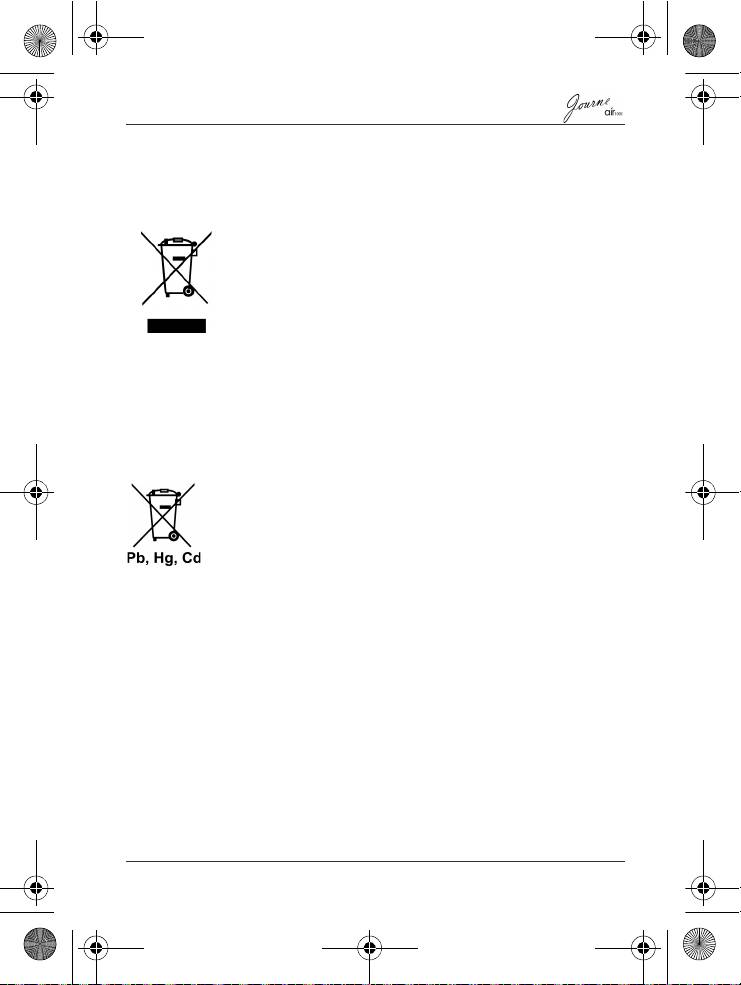
The crossed out wheeled dust bin symbol indicates that products
must be collected and disposed of separately from household
waste. Integrated batteries and accumulators can be disposed of
with the product. They will be separated at the recycling centres.
The black bar indicates that the product was placed on the market
after August 13, 2005.
By participating in separate collection of products and batteries,
you will help to assure the proper disposal of products and
batteries and thus help to prevent potential negative
consequences for the environment and human health.
For more detailed information about the collection and recycling
programmes available in your country, please visit our website
(
http://eu.computers.toshiba-europe.com
) or contact your local city
office or the shop where you purchased the product.
Disposal of batteries and/or accumulators
The crossed out wheeled dust bin symbol indicates that batteries
and/or accumulators must be collected and disposed of separately
from household waste.
If the battery or accumulator contains more than the specified
values of lead (Pb), mercury (Hg), and/or cadmium (Cd) defined in
the Battery Directive (2006/66/EC), then the chemical symbols for
lead (Pb), mercury (Hg) and/or cadmium (Cd) will appear below
the crossed out wheeled dust bin symbol.
By participating in separate collection of batteries, you will help to
assure the proper disposal of products and batteries and thus help
to prevent potential negative consequences for the environment
and human health.
For more detailed information about the collection and recycling
programmes available in your country, please visit our website
(
http://eu.computers.toshiba-europe.com
) or contact your local city
office or the shop where you purchased the product.
© 2008 TOSHIBA Europe GmbH. All rights reserved.
TOSHIBA reserves the right to make technical changes.
TOSHIBA assumes no liability for damages incurred directly or
indirectly from errors, omissions or discrepancies between this
product and the documentation
Quick Start Guide
EN-23
