
Partner B305 CBS Rev.7: OPERATING INSTRUCTIONS FOR USE WITH BLADE
OPERATING INSTRUCTIONS FOR USE WITH BLADE: Partner B305 CBS Rev.7
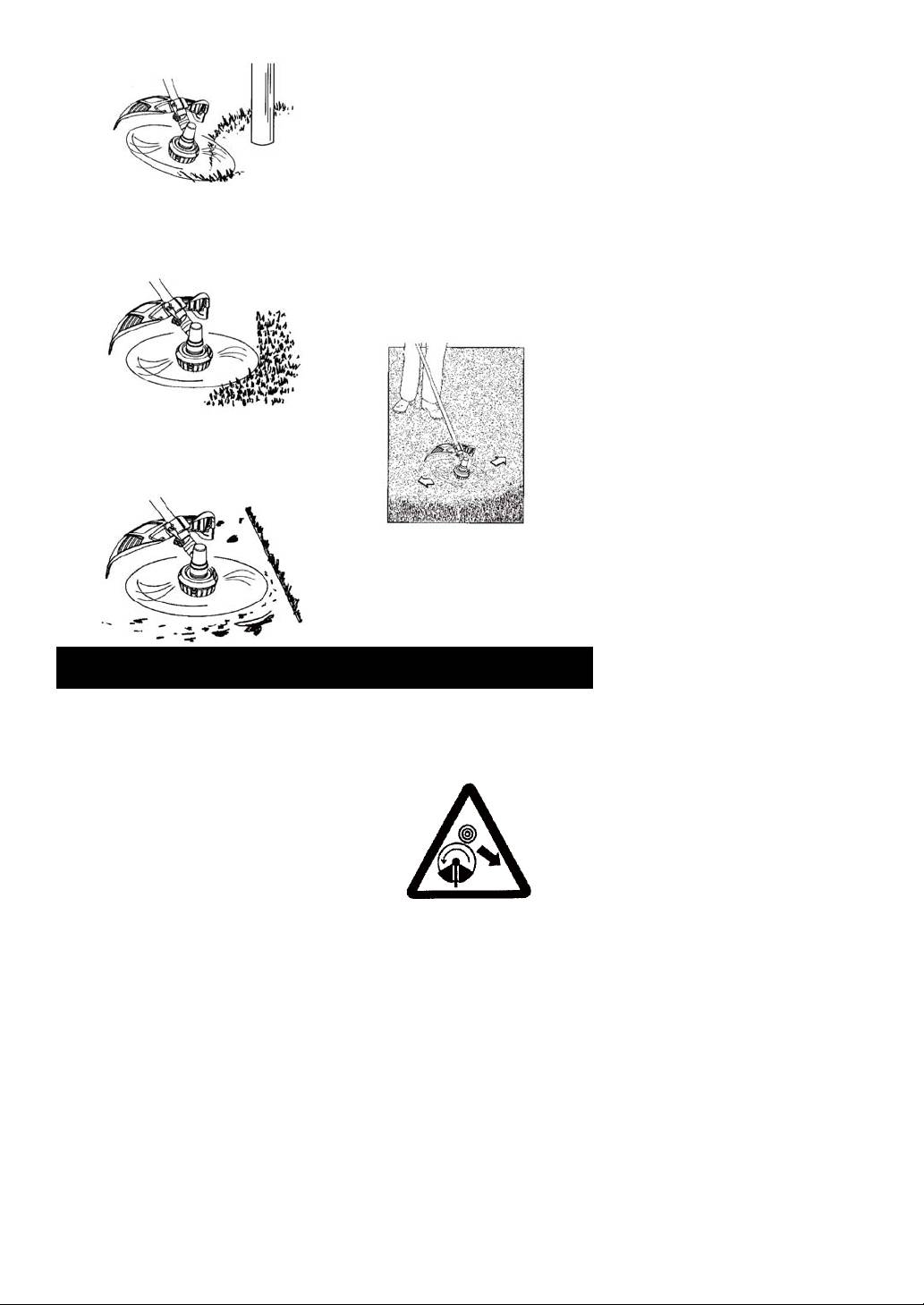
Scalping
TRIMMING PROCEDURES
When properly equipped with a cutting
attachment guard and cutting head, your unit
will trim unsightly weeds and tall grass in
those hard-to-reach areas - along fences,
walls, foundations and around trees. It can
also be used for scalping to remove
vegetation down to the ground for easier
preparation of a garden or to clean out a
MOWING - Your trimmer is ideal for mowing
particular area.
in places conventional lawn mowers cannot
NOTE: Even with care, trimming around
reach. In the mowing position, keep the line
foundations, brick or stone walls, curves,
parallel to the ground. Avoid pressing the
etc., will result in above normal string wear.
head into the ground as this can scalp the
TRIMMING / MOWING
ground and damage the tool.
Swing trimmer with a sickle-like motion from
Mowing
side to side. Do not tilt the cutting head during
the procedure. Test area to be trimmed for
proper cutting height. Keep cutting head at
same level for even depth of cut (Fig. 12A).
SWEEPING - The fanning action of the
rotating line can be used to blow away loose
debris from an area. Keep the line parallel to
and above the area surface and swing the
tool from side to side.
Sweeping
Fig. 12A
OPERATING INSTRUCTIONS FOR USE WITH BLADE
• Blade Thrust is a reaction that only occurs
the blade snags, stalls, or binds. This is
when using a bladed unit. This reaction
more likely to occur in areas where it is
can cause serious injury such as
difficult to see the material being cut. By
amputation. Carefully study this section. It
using the unit properly, the occurrence of
is important that you understand what
blade thrust will be reduced and the
causes blade thrust, how you can reduce
operator will be less likely to lose control.
the chance of its occurring, and how you
can remain in control of unit if blade thrust
occurs.
• WHAT CAUSES BLADE THRUST -
Blade Thrust can occur when the spinning
blade contacts an object that it does not
cut. This contact causes the blade to stop
for an instant and then suddenly move or
“thrust” away from the object that was hit.
The “thrusting” reaction can be violent
• Cut only grass, weeds, and woody brush
enough to cause the operator to be
up to 1 cm in diameter with the weed
propelled in any direction and lose control
blade. Do not let the blade contact
of the unit. The uncontrolled unit can cause
material it cannot cut such as stumps,
serious injury if the blade contacts the
rocks, fences, metal, etc., or clusters of
operator or others.
hard, woody brush having a diameter
• WHEN BLADE THRUST OCCURS -
greater than 1 cm.
Blade Thrust can occur without warning if
-- 10 --
Оглавление
- IDENTIFICATION (WHAT IS WHAT?)
- SAFETY RULES
- ASSEMBLY
- FUEL AND LUBRICATION
- TRIMMER INSTRUCTIONS
- OPERATING INSTRUCTIONS FOR USE WITH BLADE
- MAINTENANCE INSTRUCTIONS
- DECLARATION OF CONFORMITY
- TECHNICAL DATA SHEET
- ОПИСАНИЕ ДЕТАЛЕЙ ИНСТРУМЕНТА
- ПРАВИЛА ТЕХНИКИ БЕЗОПАСНОСТИ
- СБОРКА
- ТЕХНИЧЕСКИЕ ХАРАКТЕРИСТИКИ
- IDENTIFIERING (VAD ÄR VAD?)
- SÄKERHETSREGLER
- MONTERING
- DRIFTSINSTRUKTIONER
- TEKNISKT DATABLAD
- IDENTIFIKASJON (HVA ER HVA?)
- SIKKERHETSREGLER
- ASSEMBLY
- INSTRUKSJONER FOR BRUK
- TEKNISKE DATA
- IDENTIFICERING (HVAD ER HVAD?)
- SIKKERHEDSREGLER
- SAMLING
- DRIFTSANVISNINGER
- TEKNISK DATAARK
- TUNNISTUS (MIKÄ ON OLEELLISTA?)
- TURVAOHJEET
- KOKOAMINEN
- KÄYTTÖOHJEET
- TEKNISET TIEDOT
- IDENTYFIKACJA (CO TO JEST?)
- ZASADY BEZPIECZEŃSTWA
- СБОРКА
- ARKUSZ DANYCH TECHNICZNYCH
- IDENTIFIKACE (CO JE CO?)
- BEZPEČNOSTNÍ PRAVIDLA
- MONTÁŽ
- TECHNICKÉ ÚDAJE
- ІДЕНТИФІКАЦІЯ (ЩО ЦЕ ТАКЕ?)
- ПРАВИЛА ТЕХНІКИ БЕЗПЕКИ
- ЗБИРАННЯ
- ТЕХНІЧНИЙ ПАСПОРТ
