
Hotpoint-Ariston AVTXF 149: Installation
Installation: Hotpoint-Ariston AVTXF 149
14
GB
Installation
Keep this instruction manual in a safe place for
future reference. Should the appliance be sold,
transferred or moved, make sure the instruction
manual accompanies the washing machine to inform
the new owner as to its operation and features.
Read these instructions carefully: they contain vital
information on installation, use and safety.
Unpacking and levelling
Unpacking
1. Unpack the washing
machine.
2. Check whether the
washing machine has
been damaged during
transport. If this is the
case, do not install it
and contact your
retailer.
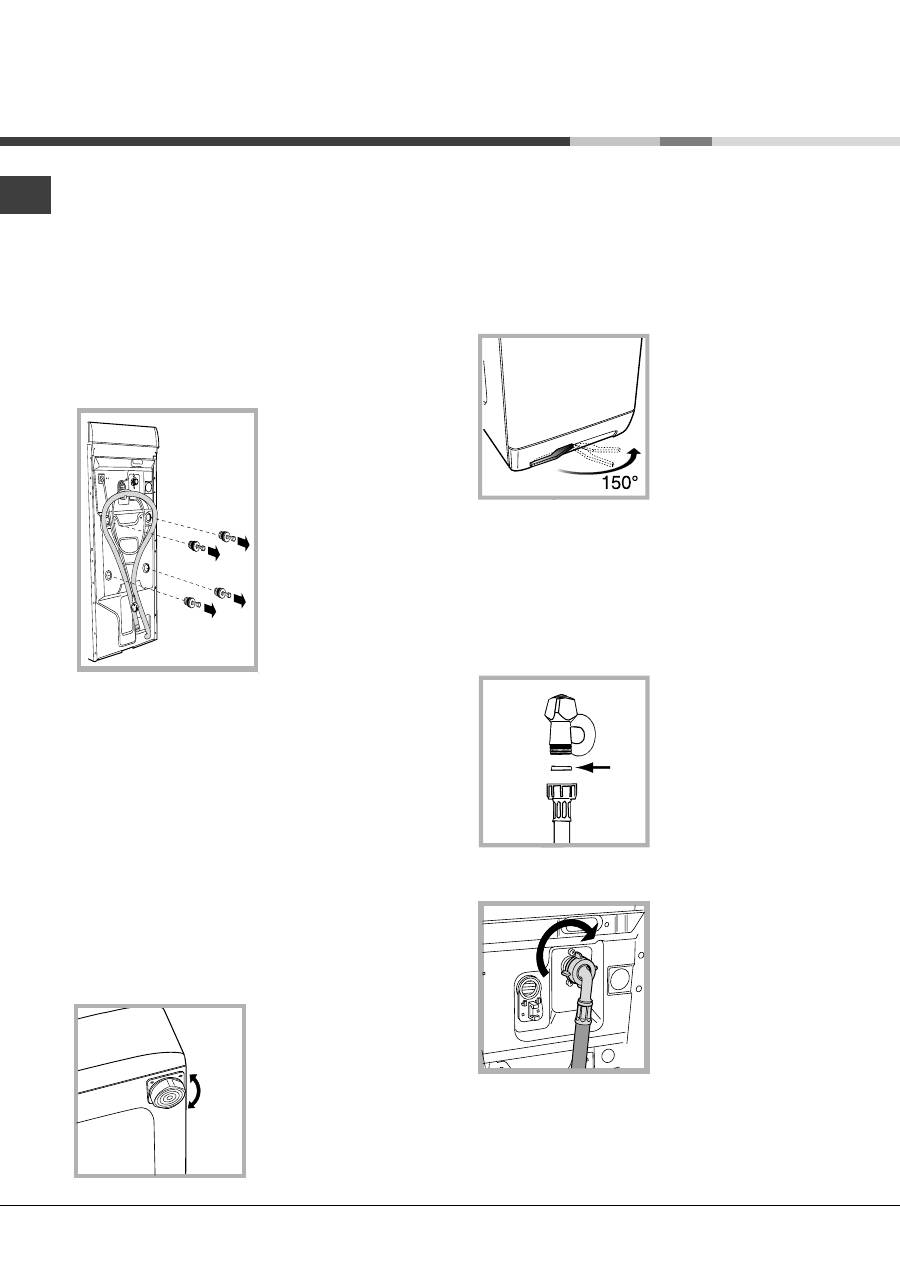
3. Remove the four
protective screws and
the rubber washer with
the respective spacer,
situated on the rear of
the appliance
(see
figure)
.
4. Seal the gaps using the plastic plugs provided.
5. Keep all the parts: you will need them again if the
washing machine needs to be moved to another
location.
Warning
:
should the screws be re-used, make sure
you fasten the shorter ones at the top.
Packaging materials are not children's toys.
Levelling
1. Install the washing machine on a flat sturdy floor,
without resting it up against walls, furniture cabinets
or other.
2. If the floor is not
perfectly level, compen-
sate for any unevenness
by tightening or
loosening the adjustable
front feet
(see figure)
; the
angle of inclination,
measured according to
the worktop, must not
exceed 2°.
Levelling your appliance correctly will provide it with
stability and avoid any vibrations, noise and shifting
during operation. If it is placed on a fitted or loose
carpet, adjust the feet in such a way as to allow
enough room for ventilation beneath the washing
machine.
Putting your appliance in place and moving it.
If your washing machine
is equipped with a
special set of retractable
wheels you can easy
move it. To lower the
wheels and thus move
the appliance effortlessly,
just pull the lever,
situated on the left-hand
side beneath the base.
Once the appliance is in
the required position, put the lever back in place.
The washing machine is now firmly in place
(see
figure)
.
Electric and water connections
Connecting the water inlet hose
1. Insert seal A into the
end of the inlet hose and
screw the latter onto a
cold water tap with a 3/
4 gas threaded mouth
(see figure)
.
Before making the
connection, allow the
water to run freely until it
is perfectly clear.
2. Connect the other end
of the water inlet hose to
the washing machine,
screwing it onto the
appliance's cold water
inlet, situated on the top
right-hand side on the
rear of the appliance
(see figure)
.
3. Make sure there are
no kinks or bends in the
hose.
The water pressure at the tap must be within the
values indicated in the Technical details table
(on the next page)
.
If the water inlet hose is not long enough, contact
a specialist store or an authorised serviceman.
A
15
GB
Connecting the drain hose
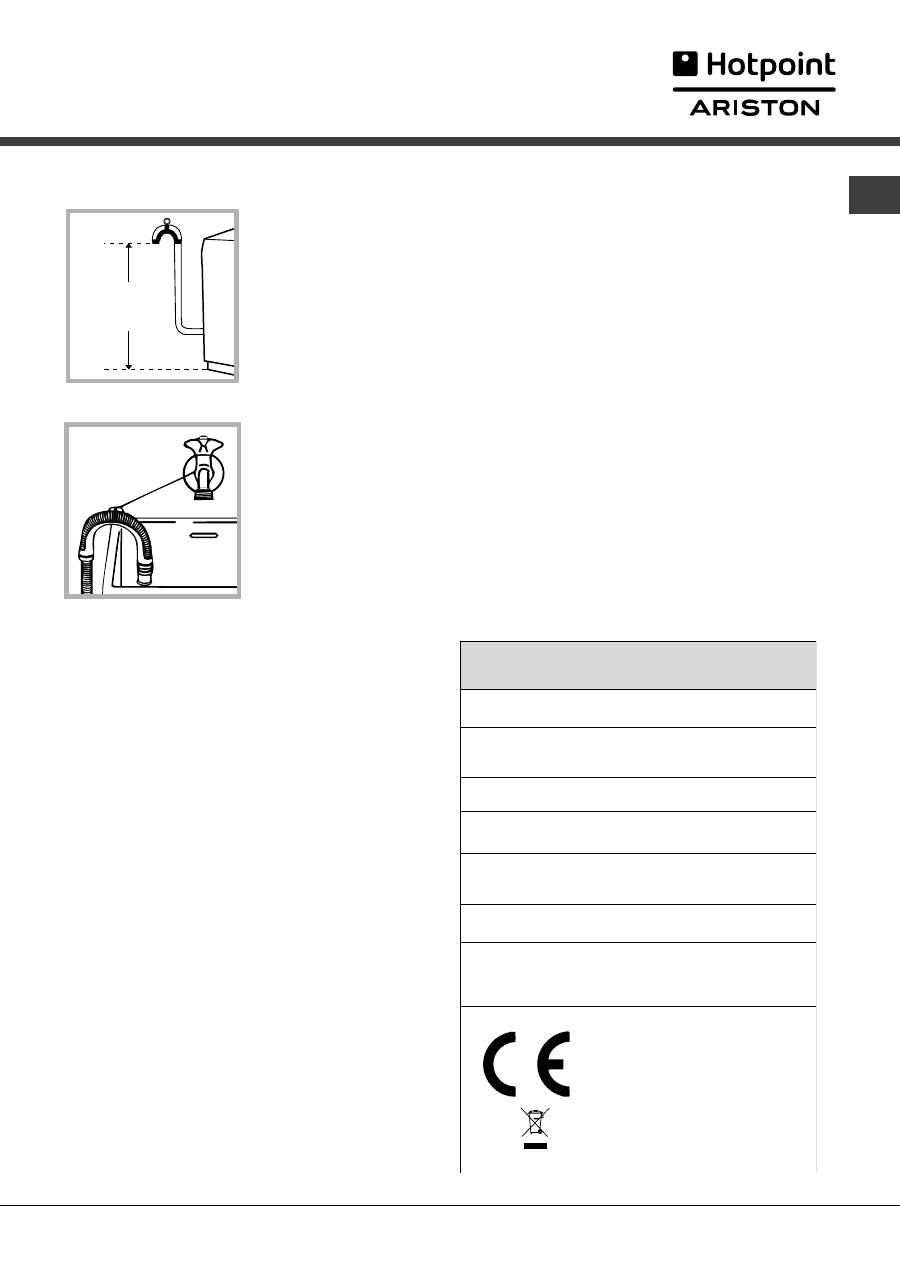
Connect the drain hose,
without bending it, to a
draining duct or a wall
drain situated between
65 and 100 cm from the
floor;
alternatively, place it over
the edge of a basin, sink
or tub, fastening the
duct supplied to the tap
(see figure)
. The free end
of the hose should not
be underwater.
We advise against the use of hose extensions; in
case of absolute need, the extension must have the
same diameter as the original hose and must not
exceed 150 cm in length.
Electric connection
Before plugging the appliance into the mains socket,
make sure that:
the socket is earthed and in compliance with the
applicable law;
the socket is able to sustain the appliance's
maximum power load indicated in the Technical
details table
(on the right)
;
the supply voltage is included within the values i
ndicated on the Technical details table
(on the right)
;
the socket is compatible with the washing
machine's plug. If this is not the case, replace the
socket or the plug.
The washing machine should not be installed in an
outdoor environment, not even when the area is
sheltered, because it may be very dangerous to leave
it exposed to rain and thunderstorms.
When the washing machine is installed, the main
socket must be within easy reach.
Do not use extensions or multiple sockets.
The power supply cable must never be bent or
dangerously compressed.
The power supply cable must only be replaced by
an authorised serviceman.
Warning! The company denies all liability if and when
these norms are not respected.
The first wash cycle
Once the appliance has been installed, and before
you use it for the first time, run a wash cycle with
detergent and no laundry, setting the 90°C programme
without a pre-wash cycle.
Technical details
Model
AVTXF 149
Dimensions
40 cm wide
85 cm high
60 cm deep
Capacity
from 1 to 6 kg
Electric
connections
Please refer to the technical data plate
fixed to the machine.
Water
connections
maximum pressure 1 MPa (10 bar)
minimum pressure 0.05 MPa (0.5 bar)
drum capacity 42 litres
Spin speed
up to 1400 rpm
Control
programmes
according to IEC
60456 directive
programme 3; temperature 60°C;
run with a load of 6 kg.
This appliance is compliant with the
following European Community
Directives:
- 73/23/CEE of 19/02/73 (Low
Voltage) and subsequent amendments
- 89/336/CEE of 03/05/89
(Electromagnetic Compatibility) and
subsequent amendments
- 2002/96/CE
65 - 100 cm
Table of contents
- Installation
- Description du lave-linge
- Mise en marche et Programmes
- Personnalisations
- Produits lessiviels et linge
- Précautions et conseils
- Entretien et soin
- Anomalies et remèdes
- Assistance
- Instructions for use
- Installation
- Washing machine description
- Starting and Programmes
- Personalisations
- Detergents and laundry
- Precautions and advice
- Care and maintenance
- Troubleshooting
- Service
- Ðóêîâîäñòâî ïî ýêïóàòàöèè
- Óñòàíîâêà
- Îïèñàíèå ñòèðàëüíîé ìàøèíû
- Çàïóñê ìàøèíû. Ïðîãðàììû
- Ïåðñîíàëèçàöèÿ ñòèðêè
- Ìîþùèå ñðåäñòâà è áåëüå
- Ïðåäóïðåæäåíèÿ èðåêîìåíäàöèè
- Îáñëóæèâàíèå è óõîä
- Íåèñïðàâíîñòèè ìåòîäû èõ óñòðàíåíèÿ
- Ñåðâèñíîåîáñëóæèâàíèå
- Használati utasítás
- Üzembehelyezés
- A mosógép leírása
- Indítás és Programok
- Program módosítások
- Mosószerek és mosandók
- Óvintézkedésekés tanácsok
- Karbantartás és törõdés
- Rendellenességekés elhárírásuk
- Szerviz
- Instrukcja obs³ugi
- Instalacja
- Opis pralki
- Uruchomienie i Programy
- Potrzeby indywidualne
- rodki pior¹ce i bielizna
- Zalecenia i rodkiostro¿noci
- Konserwacja
- Anomalie i rodkizaradcze
- Serwis Techniczny
- Návod k pouití
- Instalace
- Popis praèky
- Uvedení do chodu a programy
- Nastavení èinnostidle potøeb uivatele
- Prací prostøedky a prádlo
- Opatøení a rady
- Údrba a péèe
- Poruchy azpùsob jejich odstranìní
- Servisní sluba



